
Logic Truth Tables Propositions Implications Statements Logic is
Logic Truth Tables, Propositions, Implications
Statements • Logic is the tool for reasoning about the truth or falsity of statements. – Propositional logic is the study of Boolean functions – Predicate logic is the study of quantified Boolean functions (first order predicate logic)

Arithmetic vs. Logic Arithmetic 0 1 Boolean variable form of function value of function equality of function Logic false true statement variable statement form truth value of statement equivalence of statements
![Notation Word and or implies equivalent not parentheses Symbol v w 6 ] ~](http://slidetodoc.com/presentation_image_h/958dcc9771e09ba2650f108a54b77fad/image-4.jpg "Notation Word and or implies equivalent not parentheses Symbol v w 6 ] ~")
Notation Word and or implies equivalent not parentheses Symbol v w 6 ] ~ 5 ( ) used for grouping terms
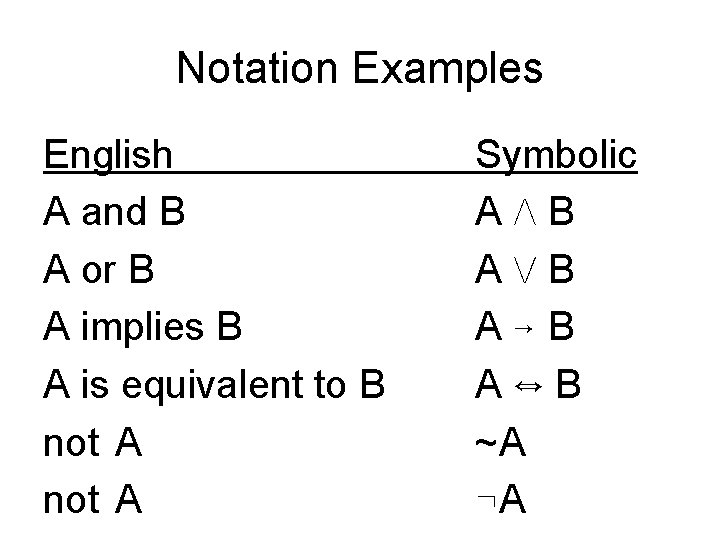
Notation Examples English A and B A or B A implies B A is equivalent to B not A Symbolic Av. B Aw. B A 6 B A]B ~A 5 A
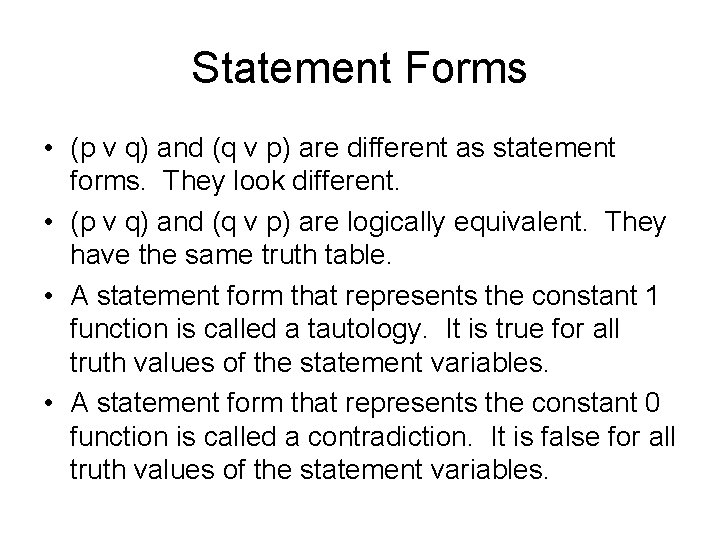
Statement Forms • (p v q) and (q v p) are different as statement forms. They look different. • (p v q) and (q v p) are logically equivalent. They have the same truth table. • A statement form that represents the constant 1 function is called a tautology. It is true for all truth values of the statement variables. • A statement form that represents the constant 0 function is called a contradiction. It is false for all truth values of the statement variables.
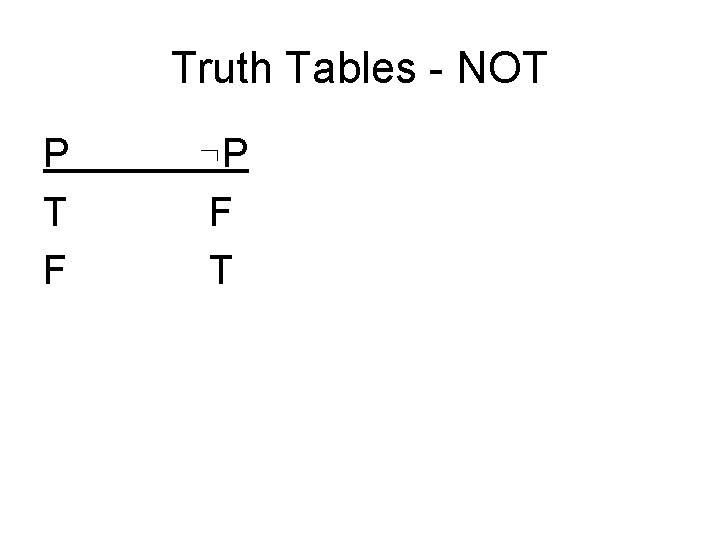
Truth Tables - NOT P T F 5 P F T
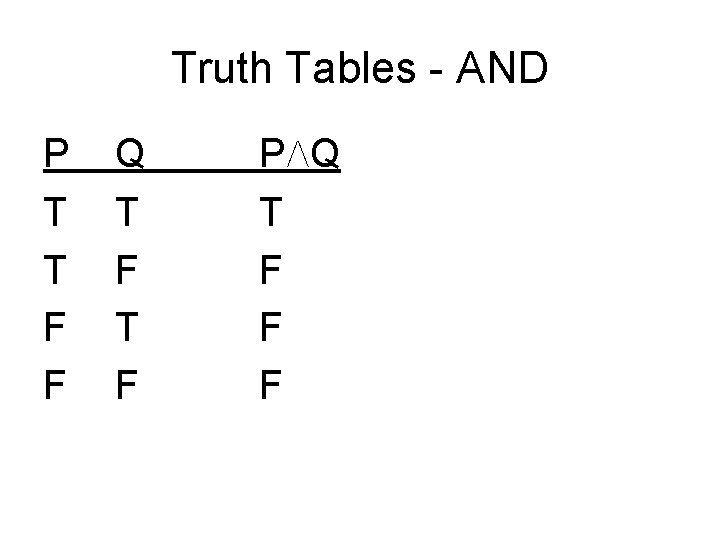
Truth Tables - AND P T T F F Q T F Pv. Q T F F F
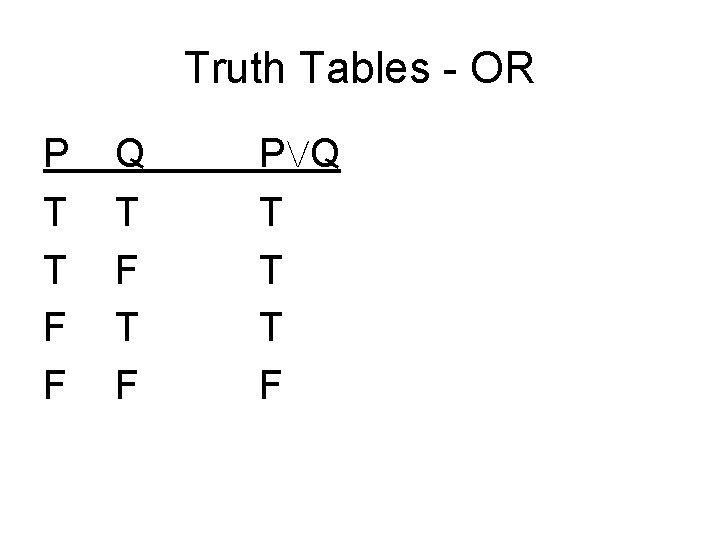
Truth Tables - OR P T T F F Q T F Pw. Q T T T F
![Truth Tables - EQUIVALENT P T T F F Q T F P]Q T](http://slidetodoc.com/presentation_image_h/958dcc9771e09ba2650f108a54b77fad/image-10.jpg "Truth Tables - EQUIVALENT P T T F F Q T F P]Q T")
Truth Tables - EQUIVALENT P T T F F Q T F P]Q T F F T
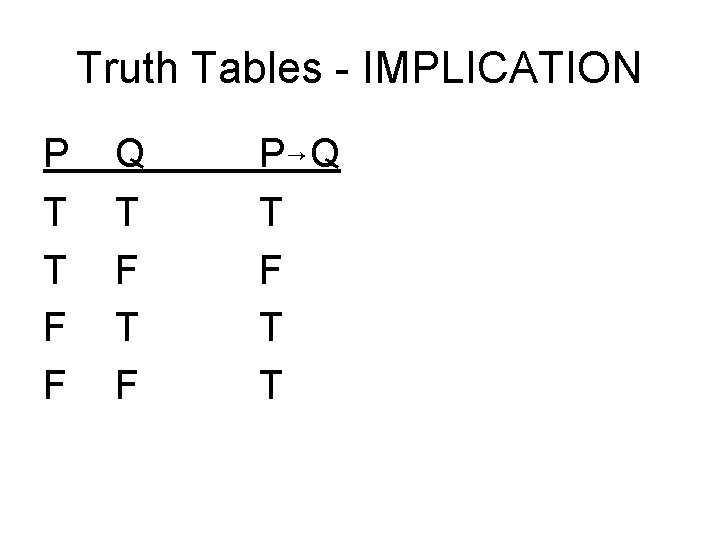
Truth Tables - IMPLICATION P T T F F Q T F P 6 Q T F T T
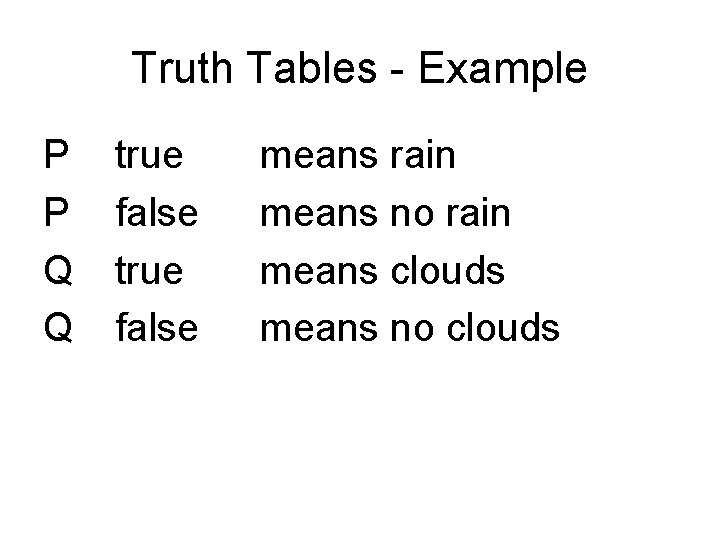
Truth Tables - Example P P Q Q true false means rain means no rain means clouds means no clouds
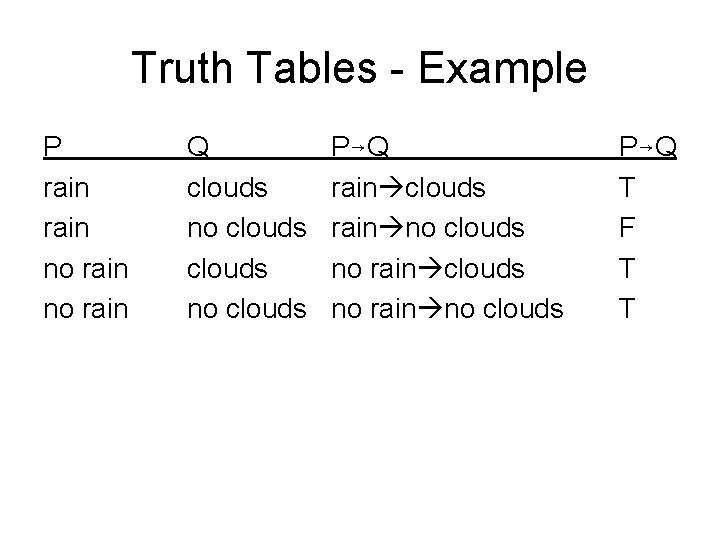
Truth Tables - Example P rain no rain Q clouds no clouds P 6 Q rain clouds rain no clouds no rain no clouds P 6 Q T F T T
![Algebraic rules for statement forms • Associative rules: (p v q) v r ]](http://slidetodoc.com/presentation_image_h/958dcc9771e09ba2650f108a54b77fad/image-14.jpg "Algebraic rules for statement forms • Associative rules: (p v q) v r ]")
Algebraic rules for statement forms • Associative rules: (p v q) v r ] p v (q v r) (p w q) w r ] p w (q w r) • Distributive rules: p v (q w r) ] (p v q) w (p v r) p w (q v r) ] (p w q) v (p w r) • Idempotent rules: pvp]p pwp]p
![Rules (continued) • Double Negation: 55 p ] p • De. Morgan’s Rules: 5(p](http://slidetodoc.com/presentation_image_h/958dcc9771e09ba2650f108a54b77fad/image-15.jpg "Rules (continued) • Double Negation: 55 p ] p • De. Morgan’s Rules: 5(p")
Rules (continued) • Double Negation: 55 p ] p • De. Morgan’s Rules: 5(p v q) ] 5 p w 5 q 5(p w q) ] 5 p v 5 q • Commutative Rules: pvq]qvp pwq]qwp
![Rules (continued) • Absorption Rules: p w (p v q) ] p p v](http://slidetodoc.com/presentation_image_h/958dcc9771e09ba2650f108a54b77fad/image-16.jpg "Rules (continued) • Absorption Rules: p w (p v q) ] p p v")
Rules (continued) • Absorption Rules: p w (p v q) ] p p v (p w q) ] p • Bound Rules: pv 0]0 pv 1]p pw 0]p pw 1]1 • Negation Rules: p v 5 p ] 0 p w 5 p ] 1
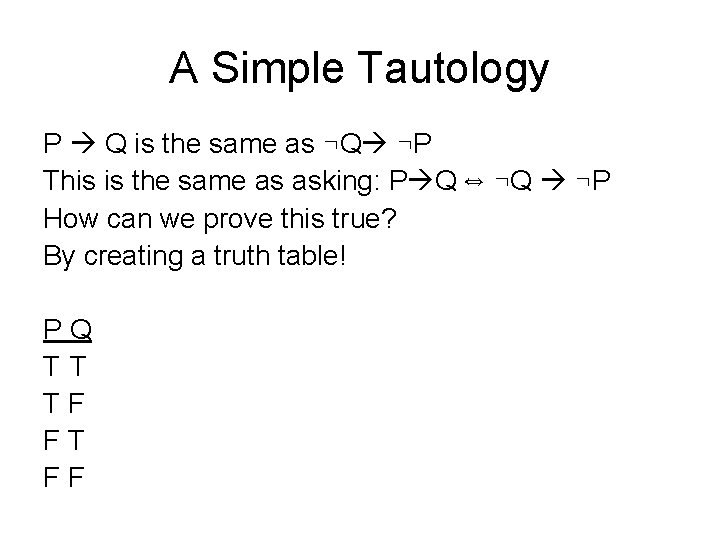
A Simple Tautology P Q is the same as 5 Q 5 P This is the same as asking: P Q ] 5 Q 5 P How can we prove this true? By creating a truth table! PQ TT TF FT FF
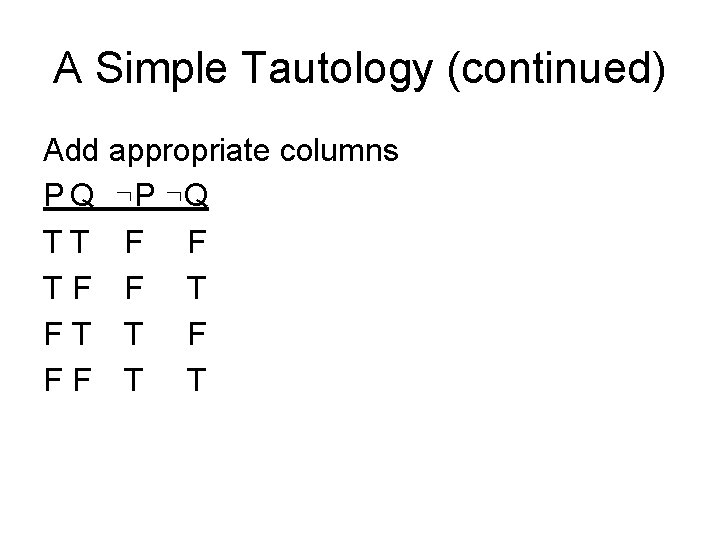
A Simple Tautology (continued) Add appropriate columns P Q 5 P 5 Q TT F F T FT T F FF T T
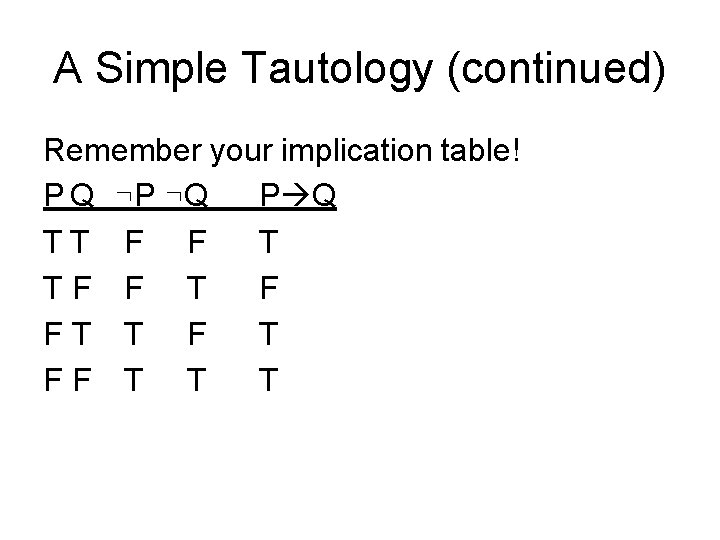
A Simple Tautology (continued) Remember your implication table! P Q 5 P 5 Q P Q TT F F T TF F T F FT T FF T T T
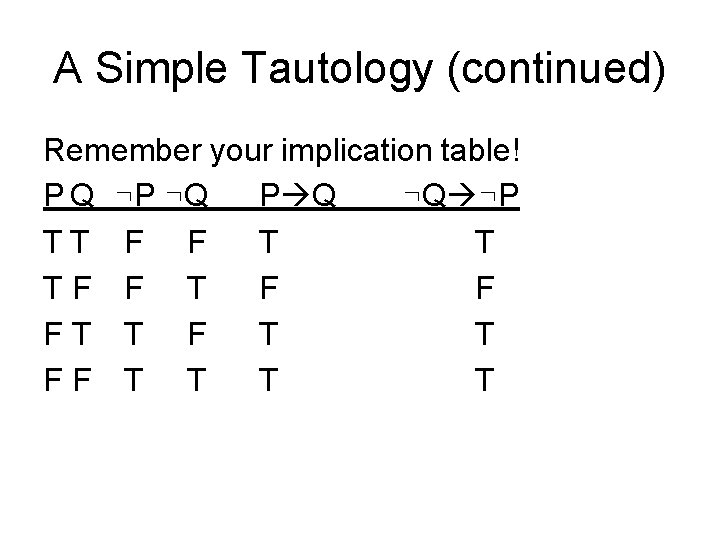
A Simple Tautology (continued) Remember your implication table! P Q 5 P 5 Q P Q 5 Q 5 P TT F F T T TF F T F F FT T FF T T
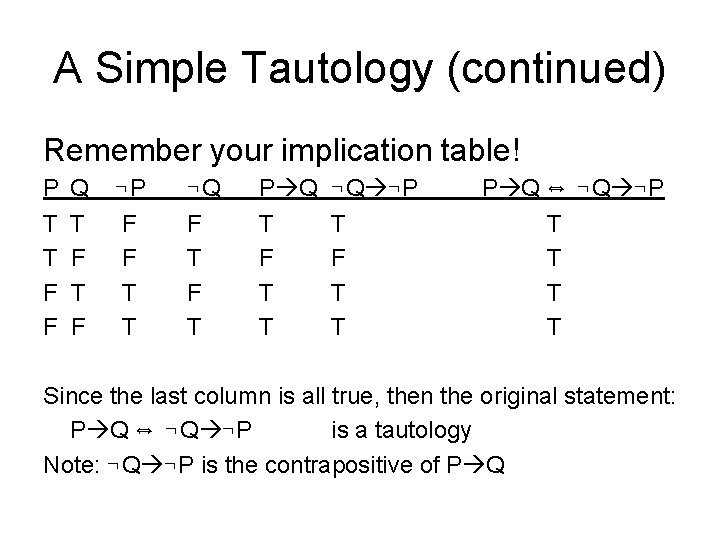
A Simple Tautology (continued) Remember your implication table! P T T F F Q T F 5 P F F T T 5 Q F T P Q T F T T 5 Q 5 P T F T T P Q ] 5 Q 5 P T T Since the last column is all true, then the original statement: P Q ] 5 Q 5 P is a tautology Note: 5 Q 5 P is the contrapositive of P Q
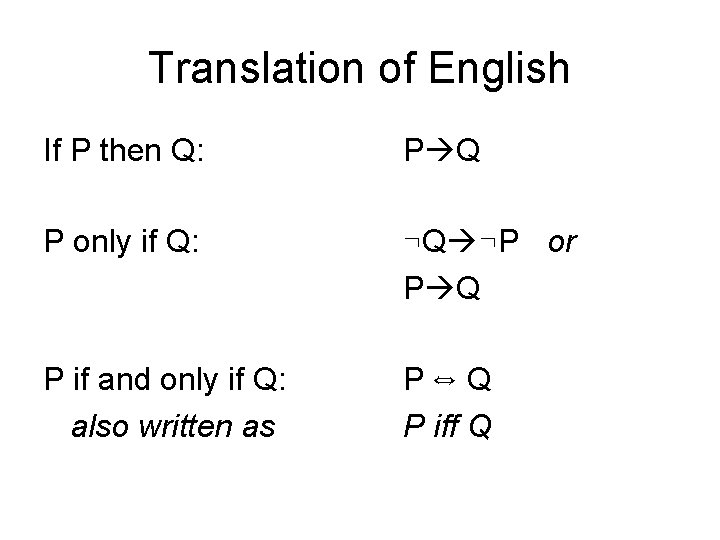
Translation of English If P then Q: P Q P only if Q: 5 Q 5 P or P Q P if and only if Q: also written as P]Q P iff Q
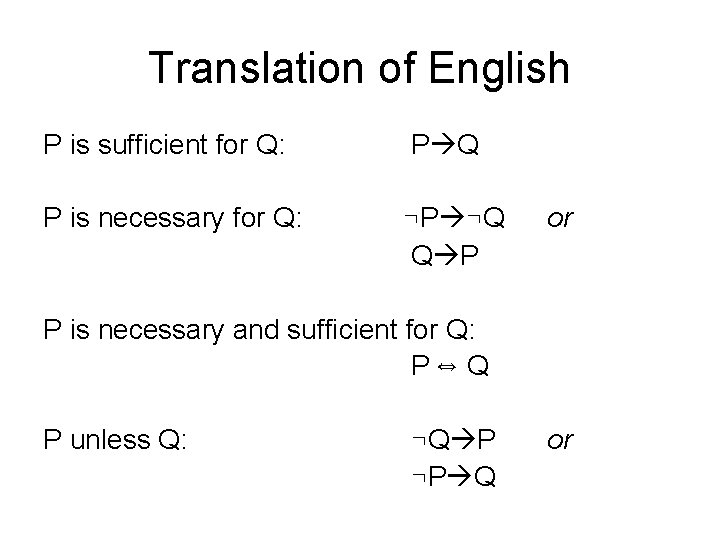
Translation of English P is sufficient for Q: P Q P is necessary for Q: 5 P 5 Q Q P or P is necessary and sufficient for Q: P]Q P unless Q: 5 Q P 5 P Q or
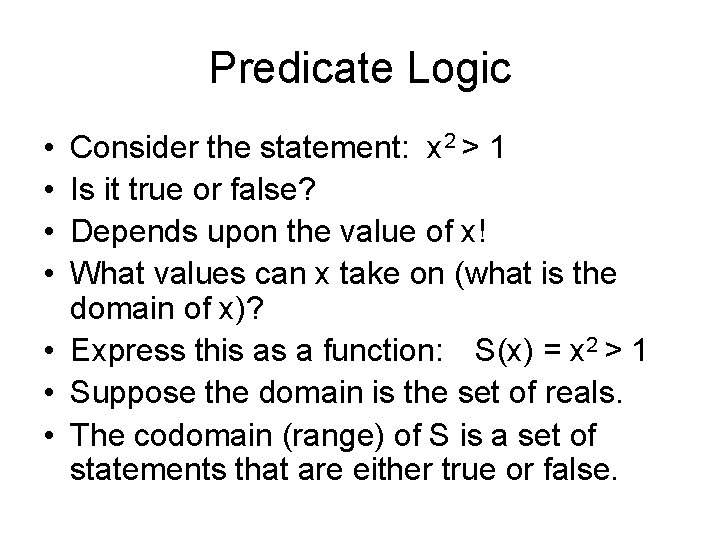
Predicate Logic • • Consider the statement: x 2 > 1 Is it true or false? Depends upon the value of x! What values can x take on (what is the domain of x)? • Express this as a function: S(x) = x 2 > 1 • Suppose the domain is the set of reals. • The codomain (range) of S is a set of statements that are either true or false.
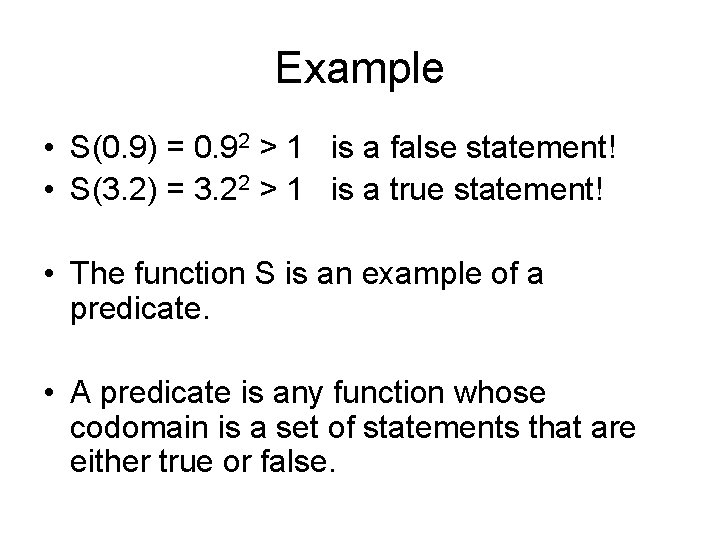
Example • S(0. 9) = 0. 92 > 1 is a false statement! • S(3. 2) = 3. 22 > 1 is a true statement! • The function S is an example of a predicate. • A predicate is any function whose codomain is a set of statements that are either true or false.
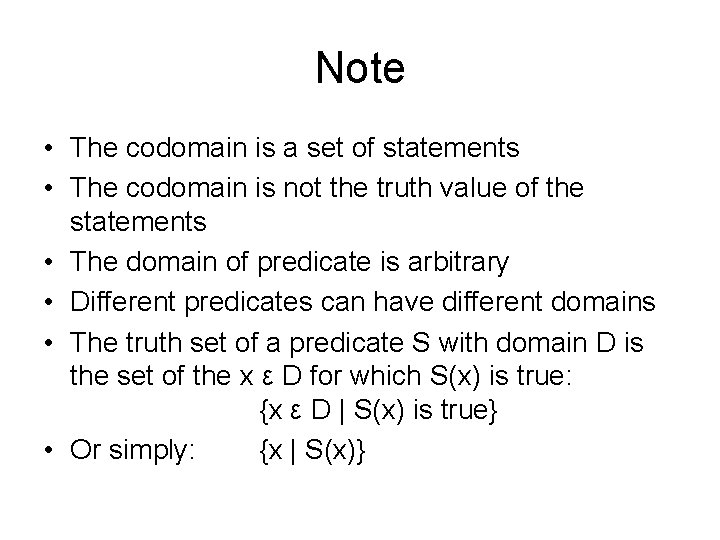
Note • The codomain is a set of statements • The codomain is not the truth value of the statements • The domain of predicate is arbitrary • Different predicates can have different domains • The truth set of a predicate S with domain D is the set of the x ε D for which S(x) is true: {x ε D | S(x) is true} • Or simply: {x | S(x)}
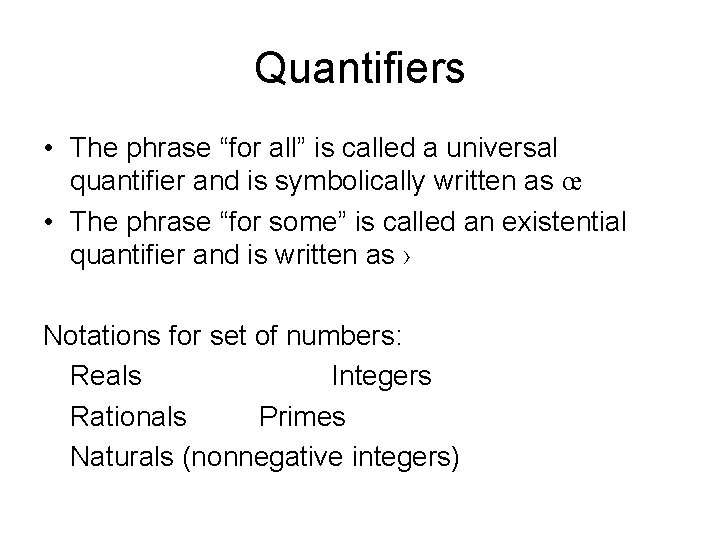
Quantifiers • The phrase “for all” is called a universal quantifier and is symbolically written as œ • The phrase “for some” is called an existential quantifier and is written as › Notations for set of numbers: Reals Integers Rationals Primes Naturals (nonnegative integers)
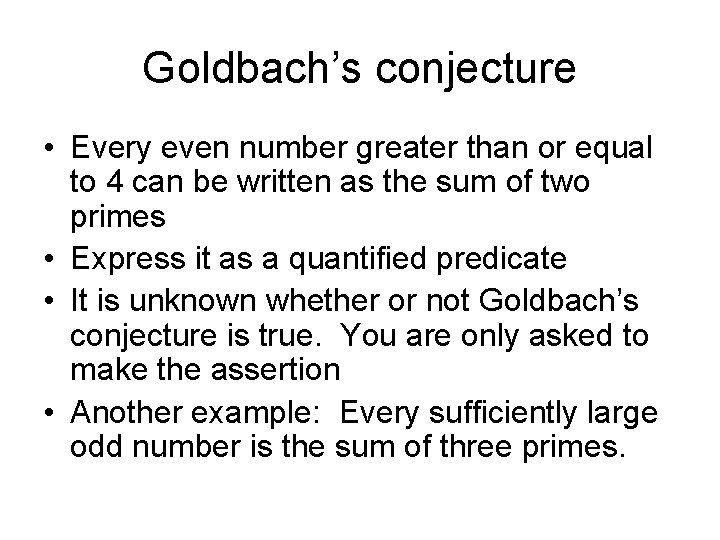
Goldbach’s conjecture • Every even number greater than or equal to 4 can be written as the sum of two primes • Express it as a quantified predicate • It is unknown whether or not Goldbach’s conjecture is true. You are only asked to make the assertion • Another example: Every sufficiently large odd number is the sum of three primes.
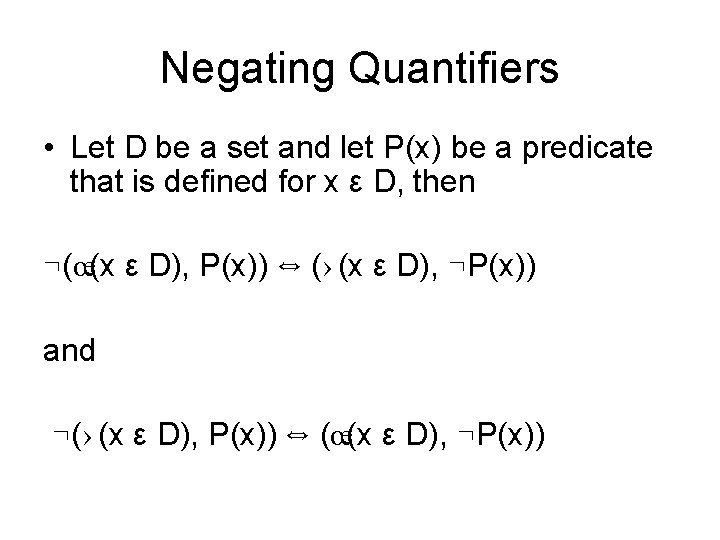
Negating Quantifiers • Let D be a set and let P(x) be a predicate that is defined for x ε D, then 5(œ(x ε D), P(x)) ] (› (x ε D), 5 P(x)) and 5(› (x ε D), P(x)) ] (œ(x ε D), 5 P(x))
- Slides: 29