
Logic Synthesis Technology Mapping Courtesy RK Brayton UCB
Logic Synthesis Technology Mapping Courtesy RK Brayton (UCB) and A Kuehlmann (Cadence) 1

Technology Mapping F Example: t 1 = a + bc; t 2 = d + e; t 3 = ab + d; t 4 = t 1 t 2 + fg; t 5 = t 4 h + t 2 t 3; F = t 5’; t 5 ’ t 4 h + t 2 t 3 t 1 t 2 + fg a+bc d+e ab+d This shows an unoptimized set of logic equations consisting of 16 literals 2

Optimized Equations Using technology independent optimization, these equations are optimized using only 14 literals: t 1 = d + e; t 2 = b + h; t 3 = at 2 + c; t 4 = t 1 t 3 + fgh; F = t 4’; F t 4 ’ F t 5 ’ t 1 t 2 + fg a+bc t 1 t 3 + fgh at 2 +c t 4 h + t 2 t 3 d+e ab+d d+e b+h 3

Optimized Equations Implement this network using a set of gates which form a library. Each gate has a cost (i. e. its area, delay, etc. ) 4
![Technology Mapping Two approaches: • Rule-Based [LSS] • Algoritmic [DAGON, MISII] • Represent each](http://slidetodoc.com/presentation_image_h/b88d26b2e7f73da71c3f0591ca69ed8a/image-5.jpg "Technology Mapping Two approaches: • Rule-Based [LSS] • Algoritmic [DAGON, MISII] • Represent each")
Technology Mapping Two approaches: • Rule-Based [LSS] • Algoritmic [DAGON, MISII] • Represent each function of a network using a set of base functions. This representation is called the subject graph. • Typically the base is 2 -input NANDs and inverters [MISII]. • The set should be functionally complete. – Each gate of the library is likewise represented using the base set. This generates pattern graphs • Represent each gate in all possible ways 5

Subject graph F F Subject graph of 2 -input NANDs and invertors t 4 ’ f t 1 t 3 + fgh at 2 +c c d’ e’ g h a d+e b+h b’ h’ 6
Algorithmic Approach A cover is a collection of pattern graphs such that • every node of the subject graph is contained in one (or more) pattern graphs • each input required by a pattern graph is actually an output of some other graph (i. e. the inputs of one gate must exists as outputs of other gates. ) For minimum area, the cost of the cover is the sum of the areas of the gates in the cover. Technology mapping problem: Find a minimum cost covering of the subject graph by choosing from the collection of pattern graphs for all the gates in the library. 7
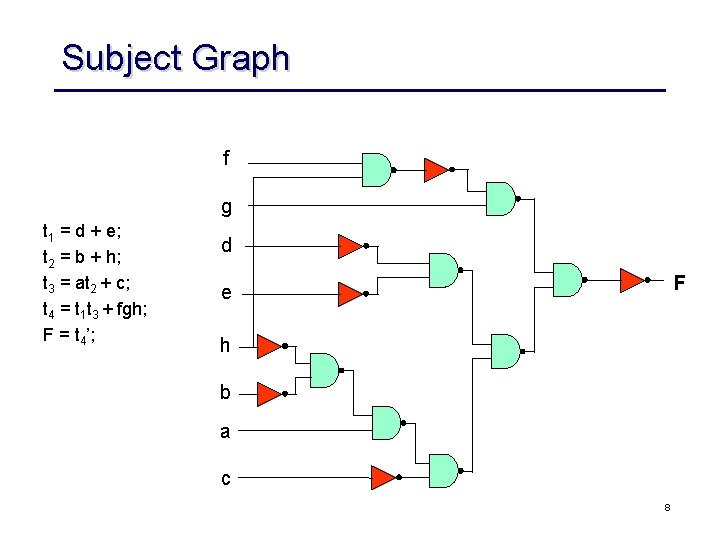
Subject Graph f g t 1 = d + e; t 2 = b + h; t 3 = at 2 + c; t 4 = t 1 t 3 + fgh; F = t 4’; d F e h b a c 8
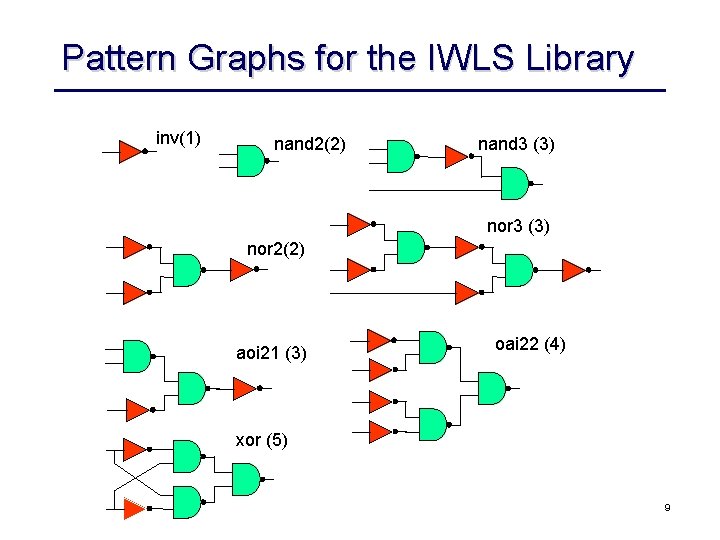
Pattern Graphs for the IWLS Library inv(1) nand 2(2) nand 3 (3) nor 2(2) aoi 21 (3) oai 22 (4) xor (5) 9

Subject graph covering f g t 1 = d + e; t 2 = b + h; t 3 = at 2 + c; t 4 = t 1 t 3 + fgh; F = t 4’; d F e h b a Total cost = 23 c 10
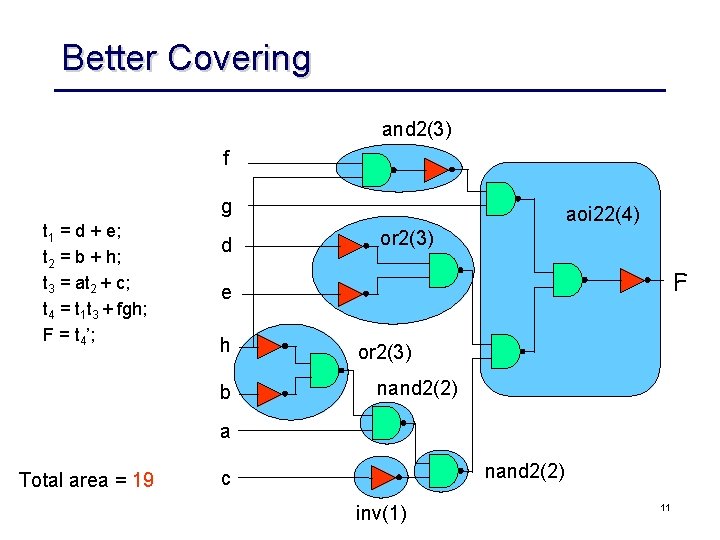
Better Covering and 2(3) f g t 1 = d + e; t 2 = b + h; t 3 = at 2 + c; t 4 = t 1 t 3 + fgh; F = t 4’; d aoi 22(4) or 2(3) F e h b or 2(3) nand 2(2) a Total area = 19 nand 2(2) c inv(1) 11
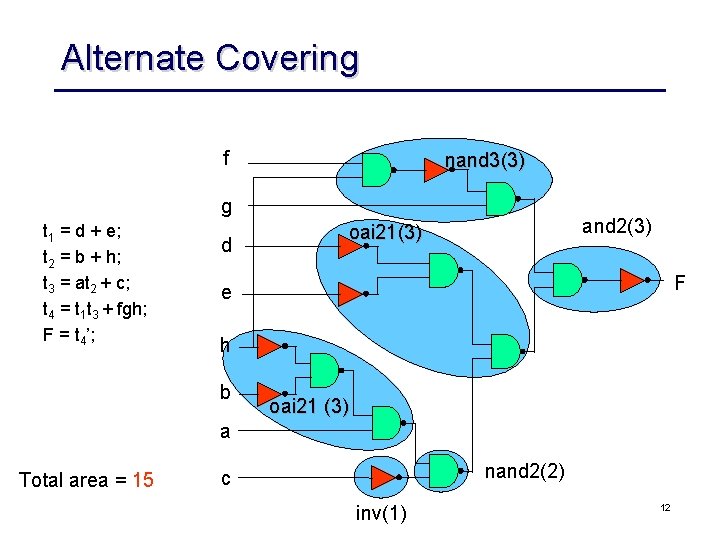
Alternate Covering f nand 3(3) g t 1 = d + e; t 2 = b + h; t 3 = at 2 + c; t 4 = t 1 t 3 + fgh; F = t 4’; d and 2(3) oai 21(3) F e h b oai 21 (3) a Total area = 15 nand 2(2) c inv(1) 12
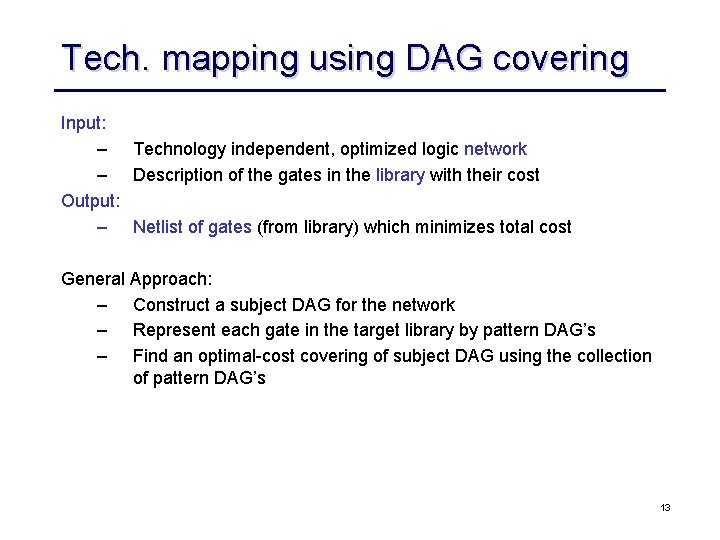
Tech. mapping using DAG covering Input: – Technology independent, optimized logic network – Description of the gates in the library with their cost Output: – Netlist of gates (from library) which minimizes total cost General Approach: – Construct a subject DAG for the network – Represent each gate in the target library by pattern DAG’s – Find an optimal-cost covering of subject DAG using the collection of pattern DAG’s 13
Tech. mapping using DAG covering Complexity of DAG covering: – NP-hard – Remains NP-hard even when the nodes have out degree 2 – If subject DAG and pattern DAG’s are trees, an efficient algorithm exists 14

DAG covering as binate covering problem • Compute all possible matches {mk } (ellipses in fig. ) for each node • Using a variable mi for each match of a pattern graph in the subject graph, (mi =1 if match is chosen) • Write a clause for each node of the subject graph indicating which matches cover this node. Each node has to be covered. – e. g. , if a subject node is covered by matches {m 2, m 5, m 10 }, then the clause would be (m 2 + m 5 + m 10). m 1 m 2. . . mk • Repeat for each subject node and take the product over all subject nodes. (CNF) n 1 n 2 nodes. . . nl 15
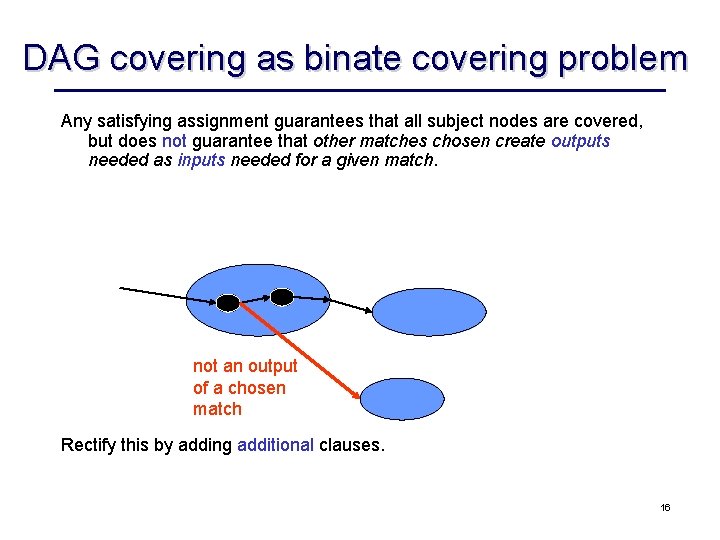
DAG covering as binate covering problem Any satisfying assignment guarantees that all subject nodes are covered, but does not guarantee that other matches chosen create outputs needed as inputs needed for a given match. not an output of a chosen match Rectify this by adding additional clauses. 16
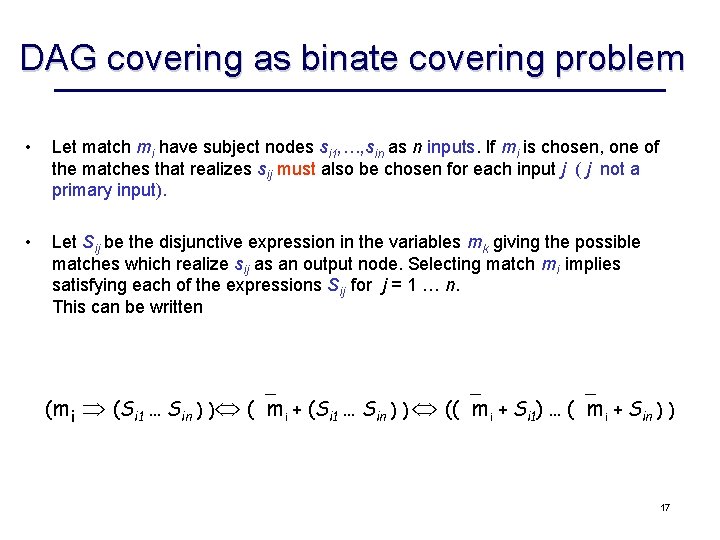
DAG covering as binate covering problem • Let match mi have subject nodes si 1, …, sin as n inputs. If mi is chosen, one of the matches that realizes sij must also be chosen for each input j ( j not a primary input). • Let Sij be the disjunctive expression in the variables mk giving the possible matches which realize sij as an output node. Selecting match mi implies satisfying each of the expressions Sij for j = 1 … n. This can be written (m i (Si 1 … Sin ) ) ( mi + (Si 1 … Sin ) ) (( mi + Si 1) … ( mi + Sin ) ) 17
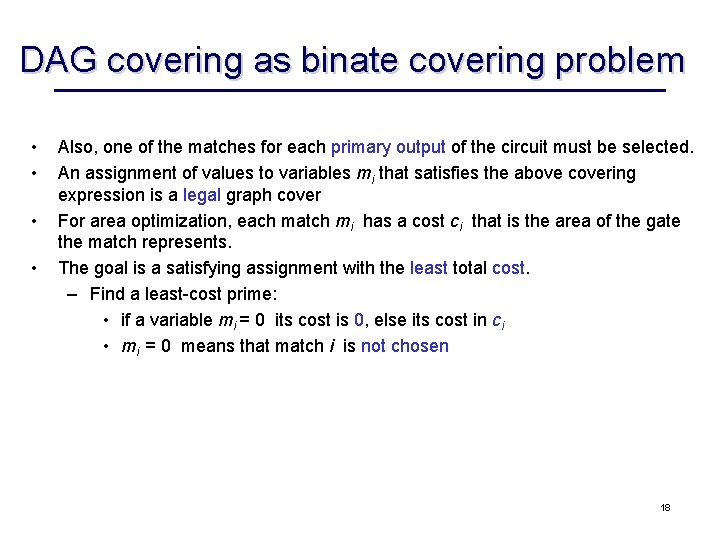
DAG covering as binate covering problem • • Also, one of the matches for each primary output of the circuit must be selected. An assignment of values to variables mi that satisfies the above covering expression is a legal graph cover For area optimization, each match mi has a cost ci that is the area of the gate the match represents. The goal is a satisfying assignment with the least total cost. – Find a least-cost prime: • if a variable mi = 0 its cost is 0, else its cost in ci • mi = 0 means that match i is not chosen 18
Binate Covering This problem is more general than unate-covering for two-level minimization because – variables are present in the covering expression in both their true and complemented forms. The covering expression is a binate logic function, and the problem is referred to as the binate-covering problem. 19
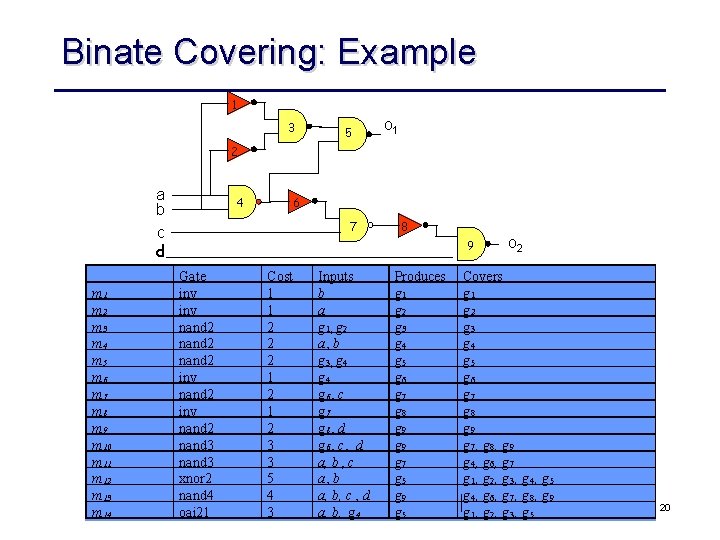
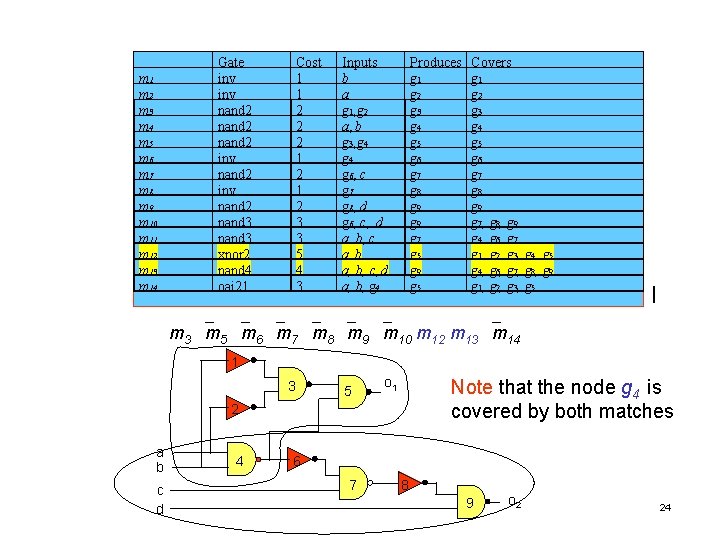
Binate Covering: Example 1 3 5 o 1 2 a b c d m 1 m 2 m 3 m 4 m 5 m 6 m 7 m 8 m 9 m 10 m 11 m 12 m 13 m 14 4 6 7 8 9 Gate inv nand 2 inv nand 2 nand 3 xnor 2 nand 4 oai 21 Cost 1 1 2 2 2 1 2 3 3 5 4 3 Inputs b a g 1, g 2 a, b g 3, g 4 g 6, c g 7 g 8, d g 6, c, d a, b , c a, b, c , d a, b, g 4 Produces g 1 g 2 g 3 g 4 g 5 g 6 g 7 g 8 g 9 g 7 g 5 g 9 g 5 o 2 Covers g 1 g 2 g 3 g 4 g 5 g 6 g 7 g 8 g 9 g 7, g 8 , g 9 g 4, g 6 , g 7 g 1, g 2 , g 3 , g 4, g 5 g 4, g 6 , g 7 , g 8, g 9 g 1, g 2 , g 3 , g 5 20
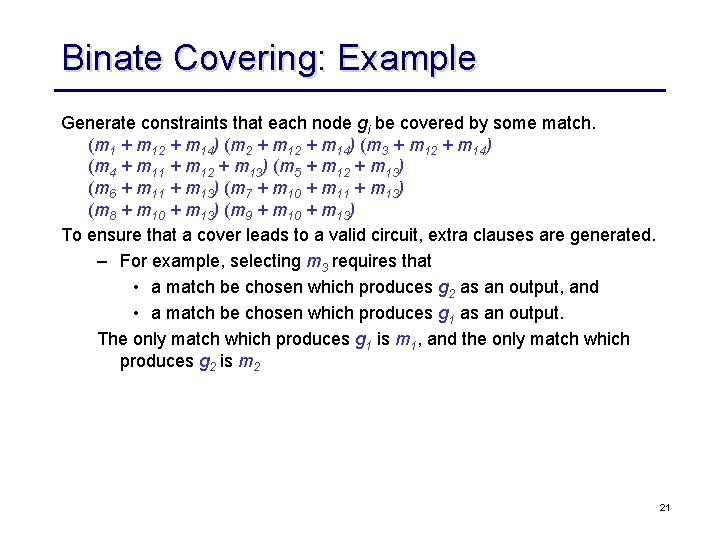
Binate Covering: Example Generate constraints that each node gi be covered by some match. (m 1 + m 12 + m 14) (m 3 + m 12 + m 14) (m 4 + m 11 + m 12 + m 13) (m 5 + m 12 + m 13) (m 6 + m 11 + m 13) (m 7 + m 10 + m 11 + m 13) (m 8 + m 10 + m 13) (m 9 + m 10 + m 13) To ensure that a cover leads to a valid circuit, extra clauses are generated. – For example, selecting m 3 requires that • a match be chosen which produces g 2 as an output, and • a match be chosen which produces g 1 as an output. The only match which produces g 1 is m 1, and the only match which produces g 2 is m 2 21
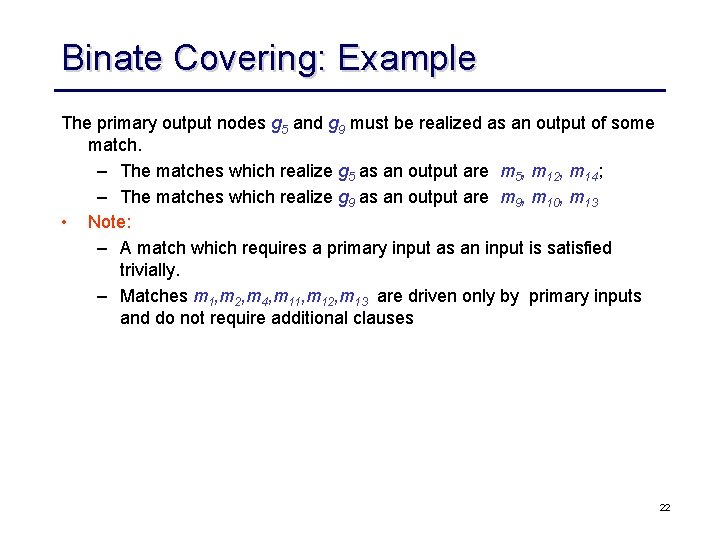
Binate Covering: Example The primary output nodes g 5 and g 9 must be realized as an output of some match. – The matches which realize g 5 as an output are m 5, m 12, m 14; – The matches which realize g 9 as an output are m 9, m 10, m 13 • Note: – A match which requires a primary input as an input is satisfied trivially. – Matches m 1, m 2, m 4, m 11, m 12, m 13 are driven only by primary inputs and do not require additional clauses 22
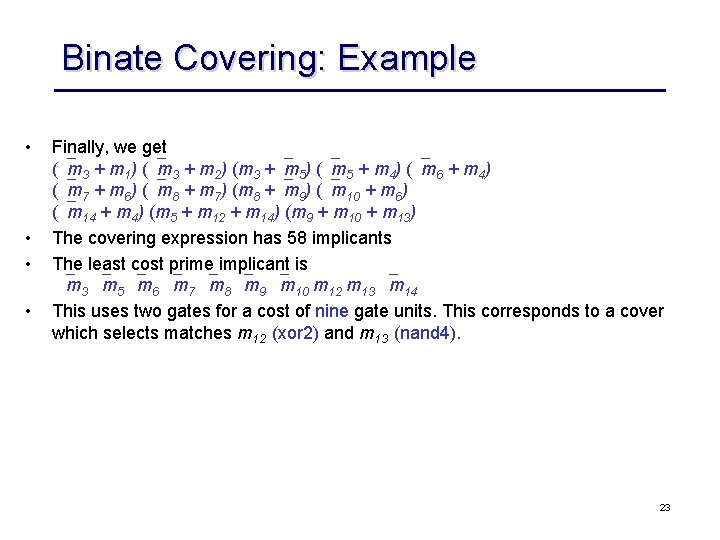
Binate Covering: Example • • Finally, we get ( m 3 + m 1) ( m 3 + m 2) (m 3 + m 5) ( m 5 + m 4) ( m 6 + m 4) ( m 7 + m 6) ( m 8 + m 7) (m 8 + m 9) ( m 10 + m 6) ( m 14 + m 4) (m 5 + m 12 + m 14) (m 9 + m 10 + m 13) The covering expression has 58 implicants The least cost prime implicant is m 3 m 5 m 6 m 7 m 8 m 9 m 10 m 12 m 13 m 14 This uses two gates for a cost of nine gate units. This corresponds to a cover which selects matches m 12 (xor 2) and m 13 (nand 4). 23
m 1 m 2 m 3 m 4 m 5 m 6 m 7 m 8 m 9 m 10 m 11 m 12 m 13 m 14 Gate inv nand 2 inv nand 2 nand 3 xnor 2 nand 4 oai 21 Cost 1 1 2 2 2 1 2 3 3 5 4 3 Inputs b a g 1, g 2 a, b g 3, g 4 g 6, c g 7 g 8, d g 6, c, d a, b, c, d a, b, g 4 Produces g 1 g 2 g 3 g 4 g 5 g 6 g 7 g 8 g 9 g 7 g 5 g 9 g 5 Covers g 1 g 2 g 3 g 4 g 5 g 6 g 7 g 8 g 9 g 7, g 8, g 9 g 4, g 6, g 7 g 1, g 2, g 3, g 4, g 5 g 4, g 6, g 7, g 8, g 9 g 1, g 2, g 3, g 5 m 3 m 5 m 6 m 7 m 8 m 9 m 10 m 12 m 13 m 14 1 3 5 o 1 Note that the node g 4 is covered by both matches 2 a b c d 4 6 7 8 9 o 2 24
Complexity of DAG covering More general than unate covering – Finding least cost prime of a binate function. • Even finding a feasible solution is NP-complete (SAT). • For unate covering, finding a feasible solution is easy. – DAG-covering: covering + implication constraints Given a subject graph, the binate covering provides the exact solution to the technology-mapping problem. – However, better results may be obtained with a different initial decomposition into 2 -input NANDS and inverters Methods to solve the binate covering formulation: – Branch and bound [Thelen] – BDD-based [Lin and Somenzi] Even for moderate-size networks, these are expensive. 25
Optimal Tree Covering by Trees • • • If the subject DAG and primitive DAG’s are trees, then an efficient algorithm to find the best cover exists Based on dynamic programming First proposed for optimal code generation in a compiler 26
Optimal Tree Covering by Trees Partition subject graph into forest of trees Cover each tree optimally using dynamic programming Given: – Subject trees (networks to be mapped) – Forest of patterns (gate library) • Consider a node N of a subject tree • Recursive Assumption: for all children of N, a best cost match (which implements the node) is known • Cost of a leaf of the tree is 0. • Compute cost of each pattern tree which matches at N, Cost = SUM of best costs of implementing each input of pattern plus the cost of the pattern • Choose least cost matching pattern for implementing N 27
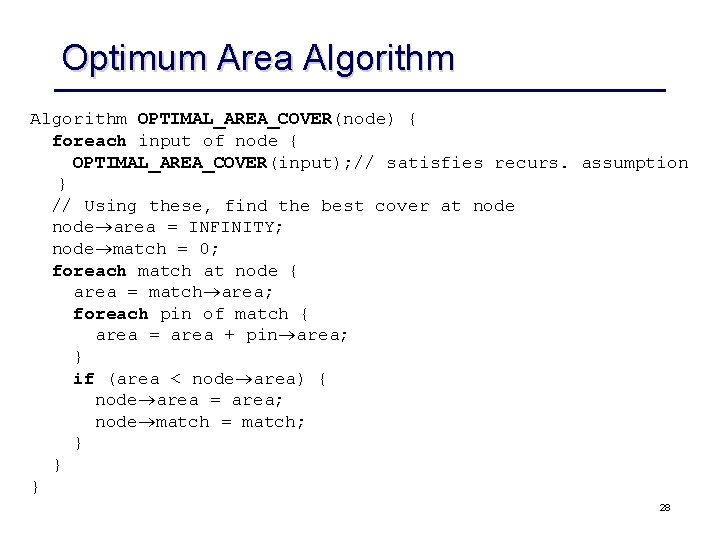
Optimum Area Algorithm OPTIMAL_AREA_COVER(node) { foreach input of node { OPTIMAL_AREA_COVER(input); // satisfies recurs. assumption } // Using these, find the best cover at node area = INFINITY; node match = 0; foreach match at node { area = match area; foreach pin of match { area = area + pin area; } if (area < node area) { node area = area; node match = match; } } } 28
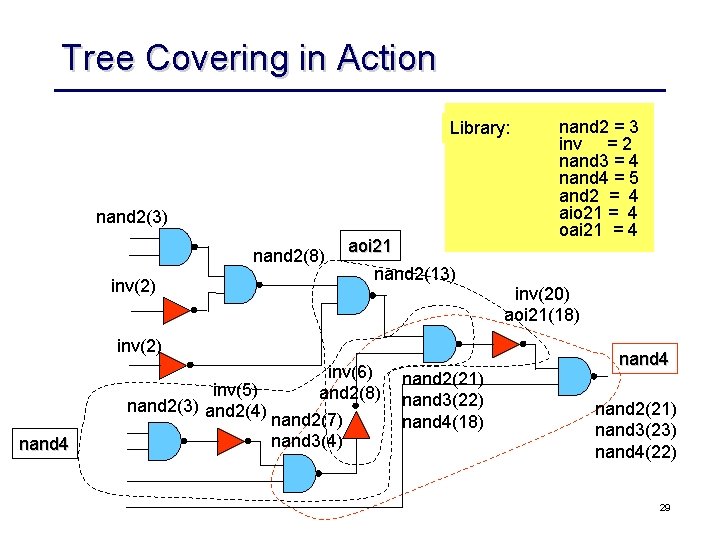
Tree Covering in Action Library: nand 2(3) nand 2(8) inv(2) aoi 21 nand 2(13) inv(2) nand 4 inv(6) inv(5) and 2(8) nand 2(3) and 2(4) nand 2(7) nand 3(4) nand 2(21) nand 3(22) nand 4(18) nand 2 = 3 inv = 2 nand 3 = 4 nand 4 = 5 and 2 = 4 aio 21 = 4 oai 21 = 4 inv(20) aoi 21(18) nand 4 nand 2(21) nand 3(23) nand 4(22) 29
Complexity of Tree Covering • • Complexity is controlled by finding all sub-trees of the subject graph which are isomorphic to a pattern tree. Linear complexity in both size of subject tree and size of collection of pattern trees 30
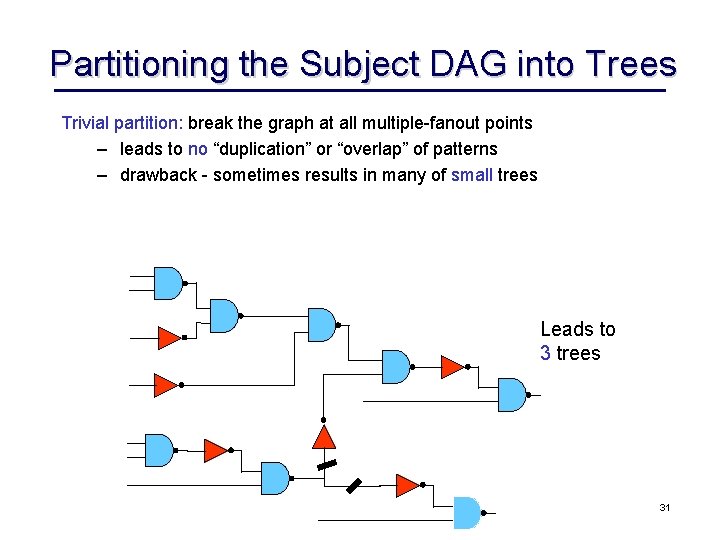
Partitioning the Subject DAG into Trees Trivial partition: break the graph at all multiple-fanout points – leads to no “duplication” or “overlap” of patterns – drawback - sometimes results in many of small trees Leads to 3 trees 31
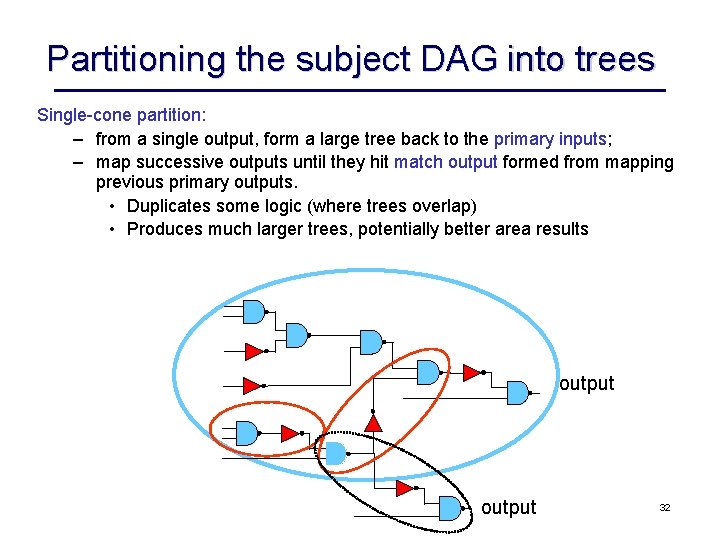
Partitioning the subject DAG into trees Single-cone partition: – from a single output, form a large tree back to the primary inputs; – map successive outputs until they hit match output formed from mapping previous primary outputs. • Duplicates some logic (where trees overlap) • Produces much larger trees, potentially better area results output 32
Min-Delay Covering • For trees: – identical to min-area covering – use optimal delay values within the dynamic programming paradigm • For DAGs: – if delay does not depend on number of fanouts: use dynamic programming as presented for trees – leads to optimal solution in polynomial time • “we don’t care if we have to replicate logic” • Combined objective – e. g. apply delay as first criteria, then area as second – combine with static timing analysis to focus on critical paths 33
Combined Decomposition and Technology Mapping Common Approach: • Phase 1: Technology independent optimization – commit to a particular Boolean network – algebraic decomposition used • Phase 2: AND 2/INV decomposition – commit to a particular decomposition of a general Boolean network using 2 -input ANDs and inverters • Phase 3: Technology mapping (tree-mapping) 34
Combined Decomposition and Technology Mapping Drawbacks: Procedures in each phase are disconnected: – Phase 1 and Phase 2 make critical decisions without knowing much about constraints and library – Phase 3 knows about constraints and library, but solution space is restricted by decisions made earlier 35
Combined Decomposition and Technology Mapping Incorporate technology independent procedures (Phase 1 and Phase 2) into technology mapping • Lehman – Watanabe – Algorithm: • Key Idea: – Efficiently encode a set of AND 2/INV decompositions into a single structure called a mapping graph – Apply a modified tree-based technology mapper while dynamically performing algebraic logic decomposition on the mapping graph 36
Outline • Mapping Graph – • • Tree-mapping on a mapping graph: graph-mapping: – – • without dynamic logic decomposition solution space: Phase 3 + Phase 2 -mapping: – – • Encodes a set of AND 2/INV decompositions with dynamic logic decomposition solution space: Phase 3 + Phase 2 + Algebraic decomposition (Phase 1) Experimental results 37
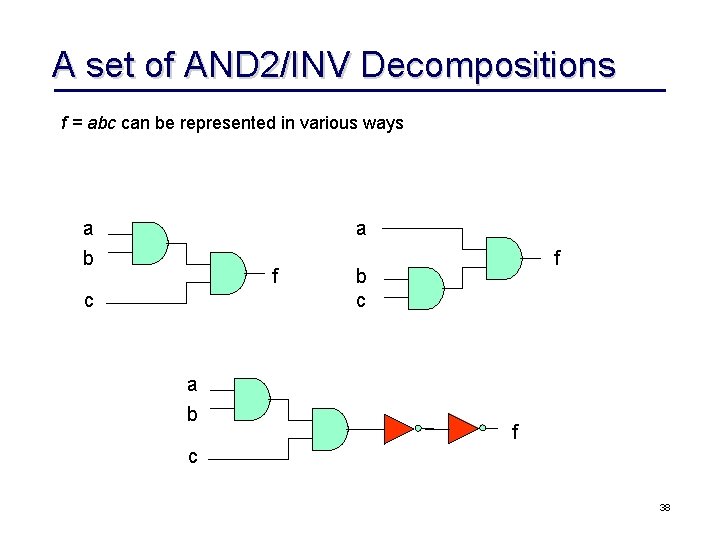
A set of AND 2/INV Decompositions f = abc can be represented in various ways a b a f c a b f b c f c 38
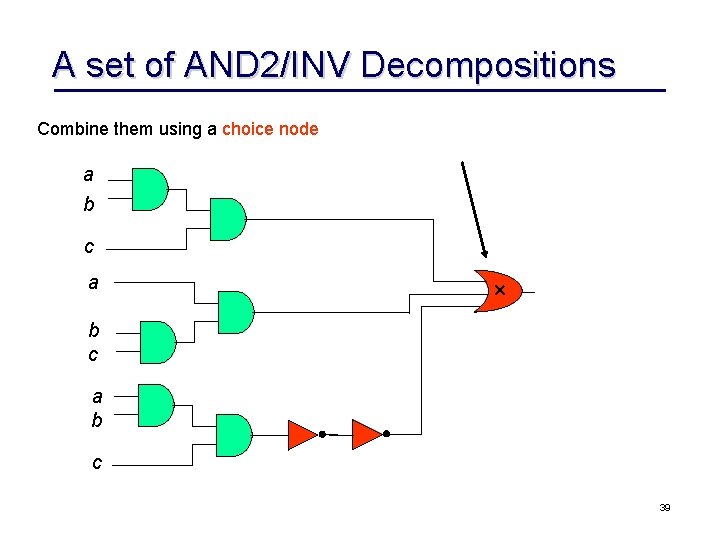
A set of AND 2/INV Decompositions Combine them using a choice node a b c 39
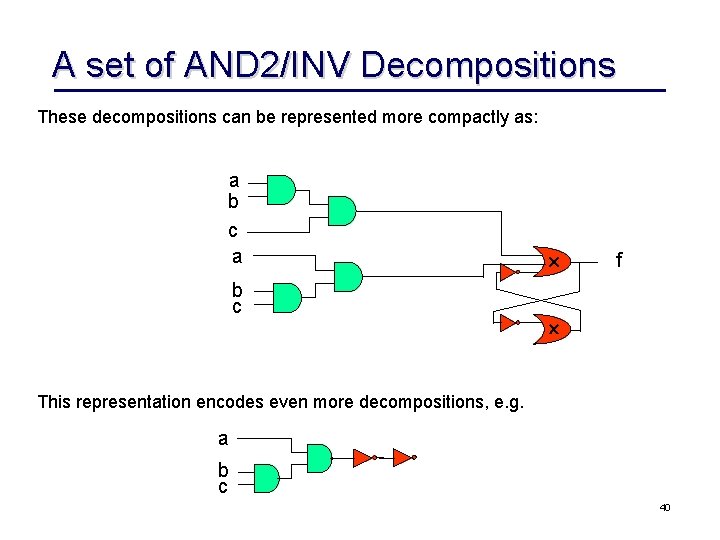
A set of AND 2/INV Decompositions These decompositions can be represented more compactly as: a b c f This representation encodes even more decompositions, e. g. a b c 40
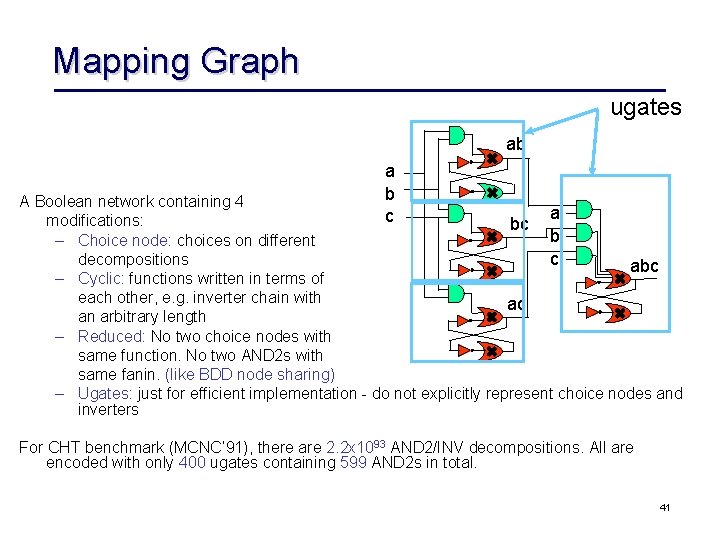
Mapping Graph ugates ab a b c A Boolean network containing 4 a modifications: bc b – Choice node: choices on different c decompositions abc – Cyclic: functions written in terms of each other, e. g. inverter chain with ac an arbitrary length – Reduced: No two choice nodes with same function. No two AND 2 s with same fanin. (like BDD node sharing) – Ugates: just for efficient implementation - do not explicitly represent choice nodes and inverters For CHT benchmark (MCNC’ 91), there are 2. 2 x 1093 AND 2/INV decompositions. All are encoded with only 400 ugates containing 599 AND 2 s in total. 41
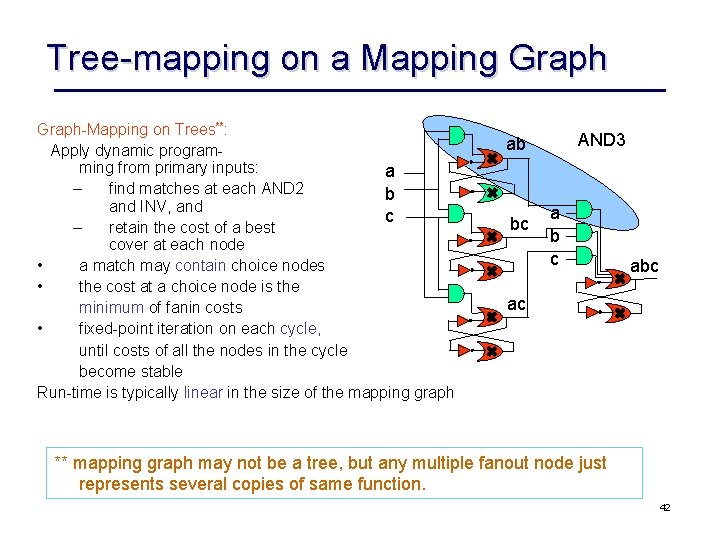
Tree-mapping on a Mapping Graph-Mapping on Trees**: Apply dynamic programming from primary inputs: a – find matches at each AND 2 b and INV, and c – retain the cost of a best cover at each node • a match may contain choice nodes • the cost at a choice node is the minimum of fanin costs • fixed-point iteration on each cycle, until costs of all the nodes in the cycle become stable Run-time is typically linear in the size of the mapping graph AND 3 ab bc a b c abc ac ** mapping graph may not be a tree, but any multiple fanout node just represents several copies of same function. 42
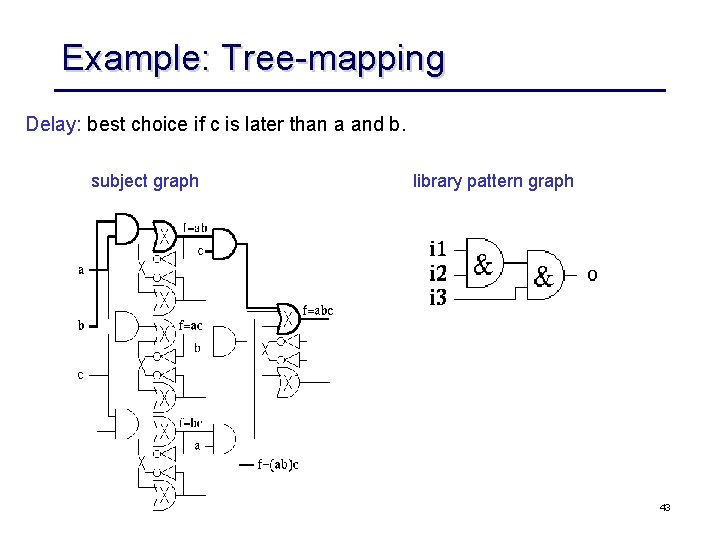
Example: Tree-mapping Delay: best choice if c is later than a and b. subject graph library pattern graph 43
Graph-Mapping: Theory Graph-mapping( ) = min (tree-mapping( )) : mapping graph : AND 2/INV decomposition encoded in • • Graph-mapping finds an optimal tree implementation for each primary output over all AND 2/INV decompositions encoded in Graph-mapping is as powerful as applying tree-mapping exhaustively, but is typically exponentially faster 44
-Mapping Given a Boolean network , • Generate a mapping graph : • For each node of , • encode all AND 2 decompositions for each product term Example: abc 3 AND 2 decompositions: a(bc), c(ab), b(ca) • encode all AND 2/INV decompositions for the sum term Example: p+q+r 3 AND 2/INV decompositions: p+(q+r), r+(p+q), q+(r+p). • Apply graph-mapping on In practice, is pre-processed so • each node has at most 10 product terms and • each term has at most 10 literals 45
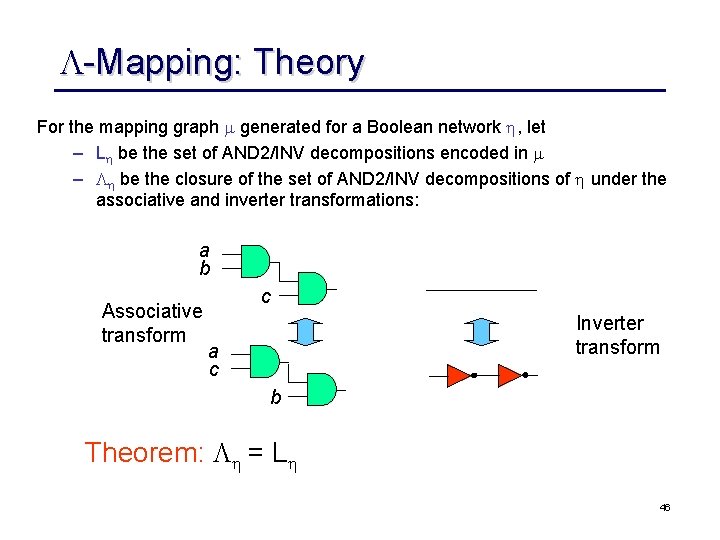
-Mapping: Theory For the mapping graph generated for a Boolean network , let – L be the set of AND 2/INV decompositions encoded in – be the closure of the set of AND 2/INV decompositions of under the associative and inverter transformations: a b Associative transform c Inverter transform a c b Theorem: = L 46
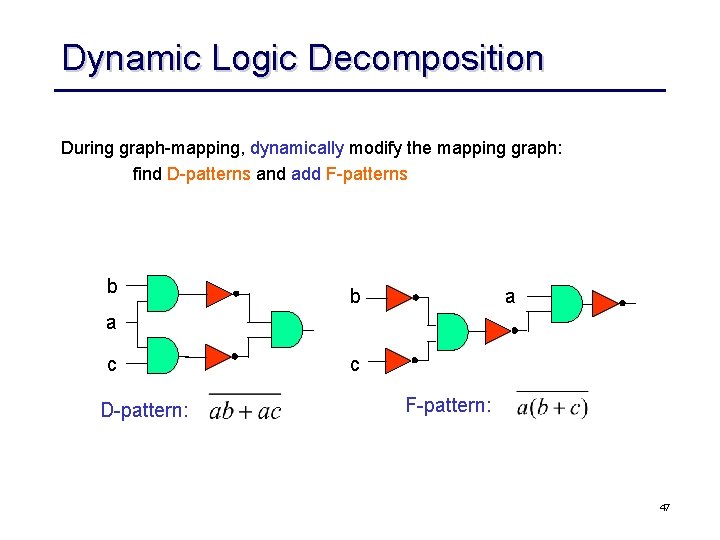
Dynamic Logic Decomposition During graph-mapping, dynamically modify the mapping graph: find D-patterns and add F-patterns b b a a c D-pattern: c F-pattern: 47
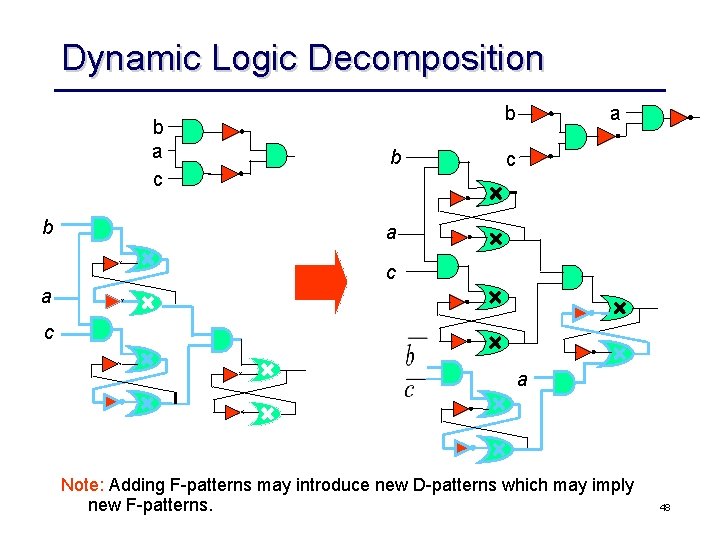
Dynamic Logic Decomposition b a c b b b a c a c a Note: Adding F-patterns may introduce new D-patterns which may imply new F-patterns. 48
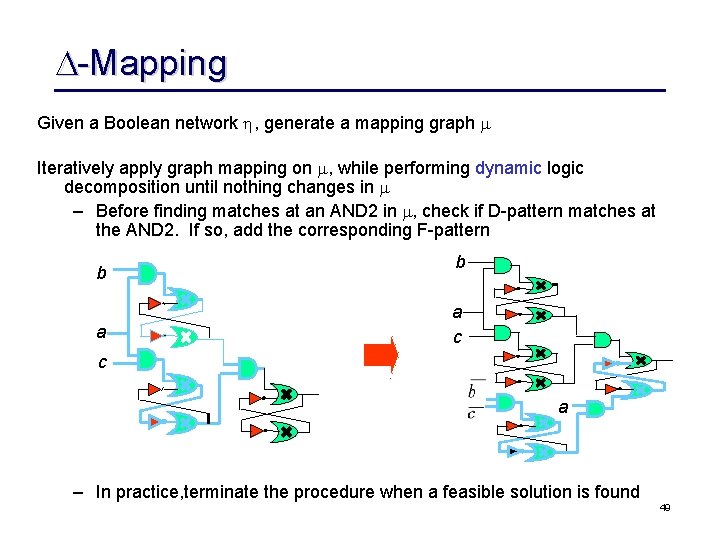
-Mapping Given a Boolean network , generate a mapping graph Iteratively apply graph mapping on , while performing dynamic logic decomposition until nothing changes in – Before finding matches at an AND 2 in , check if D-pattern matches at the AND 2. If so, add the corresponding F-pattern b a c c a – In practice, terminate the procedure when a feasible solution is found 49
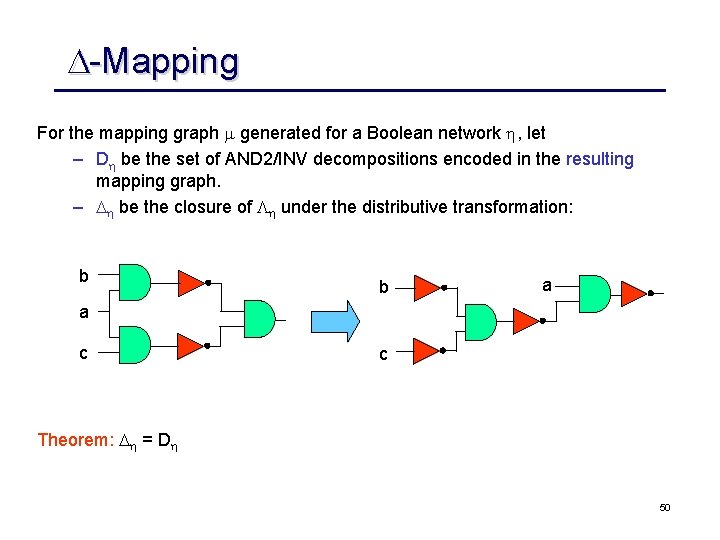
-Mapping For the mapping graph generated for a Boolean network , let – D be the set of AND 2/INV decompositions encoded in the resulting mapping graph. – be the closure of under the distributive transformation: b b a a c c Theorem: = D 50
-Mapping Theorem: If • ’ is an arbitrary Boolean network obtained from by algebraic decomposition. • is an arbitrary AND 2/INV decomposition of ’ then D The resulting mapping graph encodes all the AND 2/INV decompositions of all algebraic decompositions of . 51
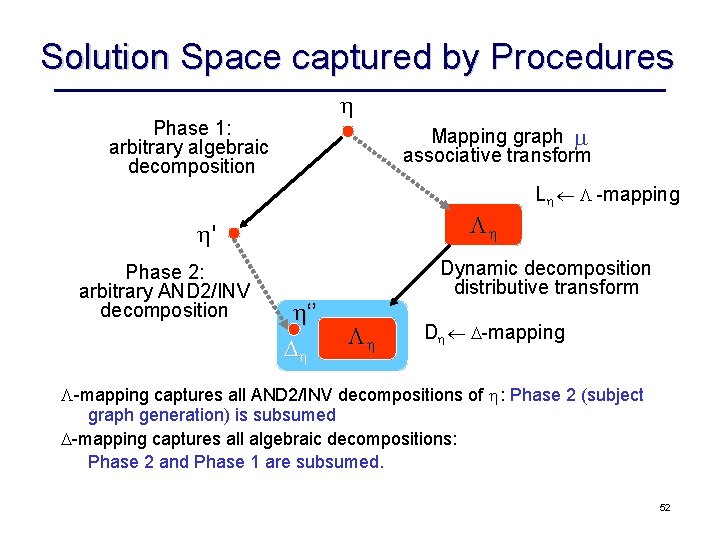
Solution Space captured by Procedures Phase 1: arbitrary algebraic decomposition Mapping graph associative transform L -mapping ' Phase 2: arbitrary AND 2/INV decomposition ‘’ Dynamic decomposition distributive transform D -mapping captures all AND 2/INV decompositions of : Phase 2 (subject graph generation) is subsumed -mapping captures all algebraic decompositions: Phase 2 and Phase 1 are subsumed. 52
Summary • • Logic decomposition during technology mapping – Efficiently encode a set on AND 2/INV decompositions – Dynamically perform logic decomposition Two mapping procedures – -mapping: optimal over all AND 2/INV decompositions (associative rule) – -mapping: optimal over all algebraic decompositions (distributive rule) Was implemented and used for commercial design projects (in DEC/Compac alpha) Extended for sequential circuits: – considers all retiming possibilities (implicitly) and algebraic factors across latches 53
- Slides: 53