
Logic Synthesis for Programmable Devices Onur Bay Debatosh
Logic Synthesis for Programmable Devices Onur Bay & Debatosh Debnath obay@oakland. edu , debnath@oakland. edu
Problem Statement • For large functions, two-level networks are difficult to generate and manipulate. • In order to efficiently implement logic functions in many programmable devices two-level networks should be converted into networks with three or more levels. • Among three-level networks OR-AND-OR and AND-OREXOR networks are proven to be powerful architectures. • Large two-level networks first need to be partitioned into small sub-networks and then converted into three-level networks. • To address these problems a computer-aided design (CAD) tool is under development to optimally partition large networks into manageable sub-networks and then synthesize optimized OR-AND-OR and AND-OR-EXOR networks.
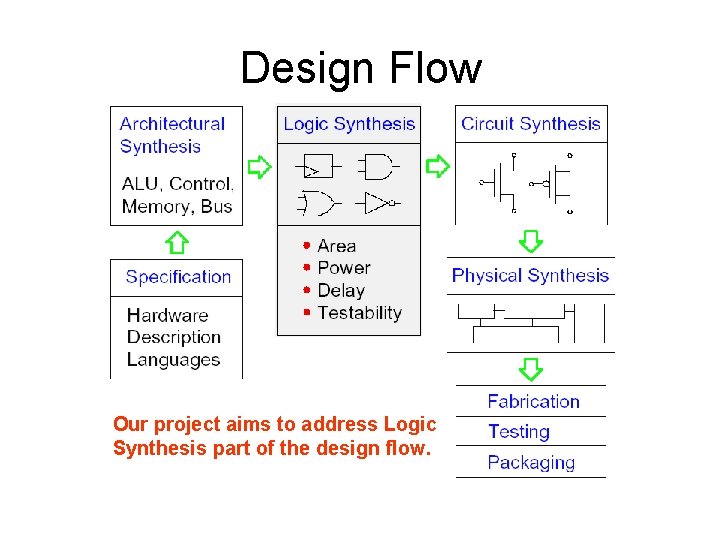
Design Flow Our project aims to address Logic Synthesis part of the design flow.
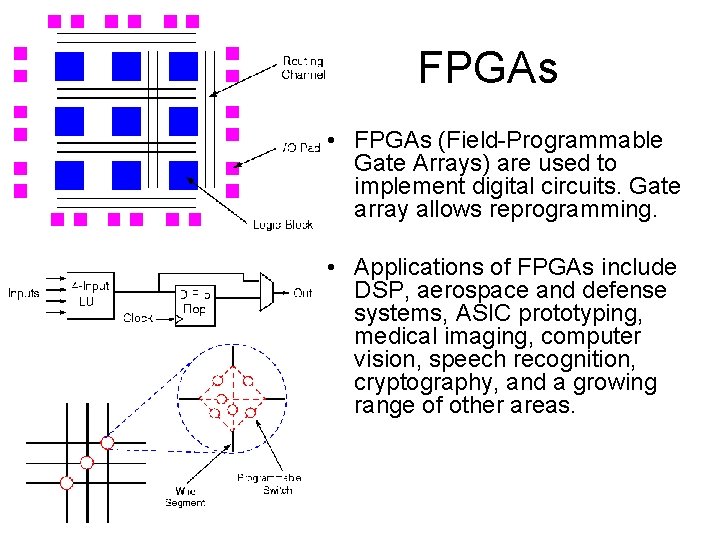
FPGAs • FPGAs (Field-Programmable Gate Arrays) are used to implement digital circuits. Gate array allows reprogramming. • Applications of FPGAs include DSP, aerospace and defense systems, ASIC prototyping, medical imaging, computer vision, speech recognition, cryptography, and a growing range of other areas.
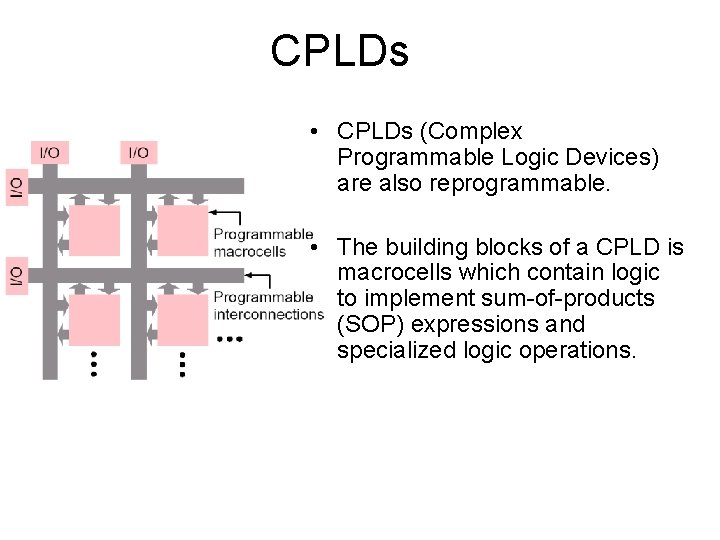
CPLDs • CPLDs (Complex Programmable Logic Devices) are also reprogrammable. • The building blocks of a CPLD is macrocells which contain logic to implement sum-of-products (SOP) expressions and specialized logic operations.

CPLD Macrocells • Able to implement OR-AND-OR or AND-OR-EXOR three level networks
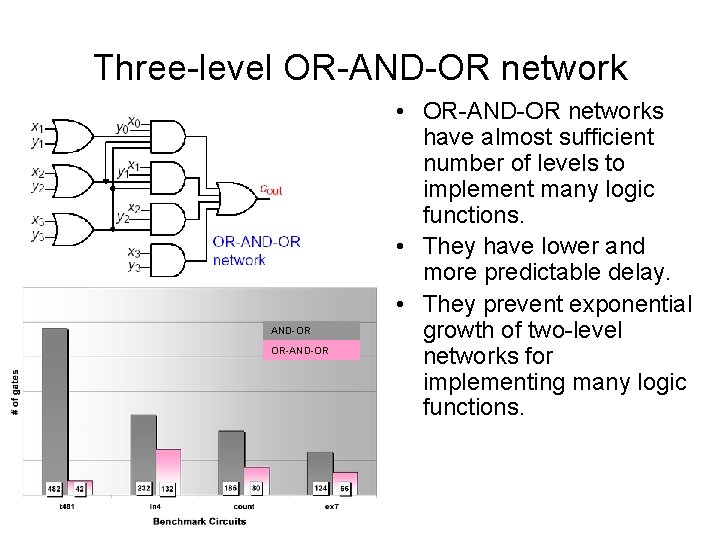
Three-level OR-AND-OR network AND-OR OR-AND-OR • OR-AND-OR networks have almost sufficient number of levels to implement many logic functions. • They have lower and more predictable delay. • They prevent exponential growth of two-level networks for implementing many logic functions.
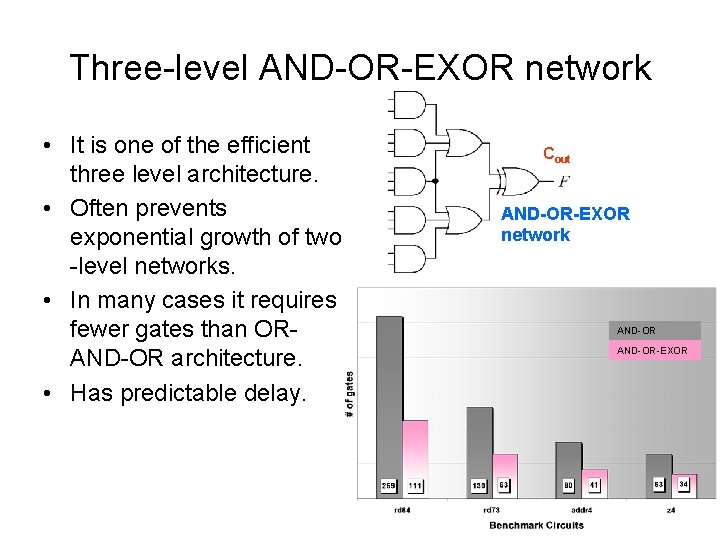
Three-level AND-OR-EXOR network • It is one of the efficient three level architecture. • Often prevents exponential growth of two -level networks. • In many cases it requires fewer gates than ORAND-OR architecture. • Has predictable delay. Cout AND-OR-EXOR network AND-OR-EXOR
Partitioning Multi-Level Networks • • Partitioning is a technique to divide a network into a collection of smaller sub-networks. Synthesis tools often cannot cope with the complexity of the entire system under development. The present state of design technology often requires a partitioning of the system. As the target architecture is fixed in most applications, their types and their geometric arrangement are given, the partitioning task is to find a mapping of the system’s objects to the FPGAs while satisfying constraints. Partitioning divides a network into sub-networks while minimizing the number or weight of the edges cut by the operation.
Our Approach • Design methods for three-level networks require twolevel networks. • Large multi-level networks are difficult to convert into two -level forms. • We partition a given multi-level network into smaller multi -level sub-networks. • The sub-networks are then converted into two-level networks which are then represented as optimized ORAND-OR and AND-OR-EXOR networks. • These three-level networks are then implemented into CPLDs.
References 1. 2. 3. 4. 5. Altera Corporation, MAX 7000 A Programmable Logic Device Family Data Sheet, Oct. 2001 S. Brown and J. Rose, FPGA and CPLD architectures: A tutorial, IEEE Design & Test of Computers, Vol. 13, No. 2, pp. 42 --57, Summer 1996 D. Debnath and Z. G. Vranesic, A fast algorithm for OR-AND-OR synthesis, IEEE Trans. Computer-Aided Design of Integrated Circuits and Systems, Vol. 22, No. 9, pp. 1166 --1176, Sept. 2003. A. Jabir and J. Saul, Minimization algorithm for three-level mixed AND-OR-EXOR/AND-OR-EXNOR representation of Boolean functions, IEEE Proceedings---Computers and Digital Techniques, Vol. 149, No. 3, pp. 82 --96, May 2002. C. Alpert and A. Kahng, Recent directions in netlist partitioning: A survey, Integration: the VLSI Journal, Vol. 19, pp. 1 --81, 1995.
- Slides: 11