
Logic Seminar 1 Introduction 24 10 2005 Slobodan
Logic Seminar 1 Introduction 24. 10. 2005. Slobodan Petrović
Introduction • It has long been man’s ambition to find a general decision procedure to prove theorems. • This desire dates back to Leibniz (1646 -1716). • It was revived by Peano in the beginning of the 20 th century and by Hilbert's school in the 1920 s. • A very important theorem was proved by Herbrand in 1930: he proposed a mechanical method to prove theorems. • Unfortunately, his method was very difficult to apply since it was extremely time consuming to carry out by hand.

Introduction • With the invention of digital computers, logicians regained interest in mechanical theorem proving. • In 1960, Herbrand’s procedure was implemented by Gilmore on a digital computer. • A more efficient procedure was proposed by Davis and Putnam.
Introduction • A major breakthrough in mechanical theorem proving was made by J. A. Robinson in 1965. • He developed a single inference rule, the resolution principle, which was shown to be highly efficient and very easily implemented on computers. • Since then, many improvements of the resolution principle have been made.
Introduction • Mechanical theorem proving has been applied to many areas, such as program analysis, program synthesis, deductive question-answering systems, problemsolving systems, and robot technology. • In the field of computer security, it has been applied in protocol analysis.
Introduction • There are many points of view from which we can study symbolic logic. • Traditionally, it has been studied from philosophical and mathematical orientations. • We are interested in the applications of symbolic logic to solving intellectually difficult problems. • We want to use symbolic logic to represent problems and to obtain their solutions.

Introduction • A simple example. • Assume that we have the following facts: – F : If it is hot and humid, then it will rain. 1 – F : If it is humid, then it is hot. 2 – F : It is humid now. 3 • The question is: Will it rain? • Let P, Q, and R represent “It is hot, ” “It is humid, ” and “It will rain, ” respectively.
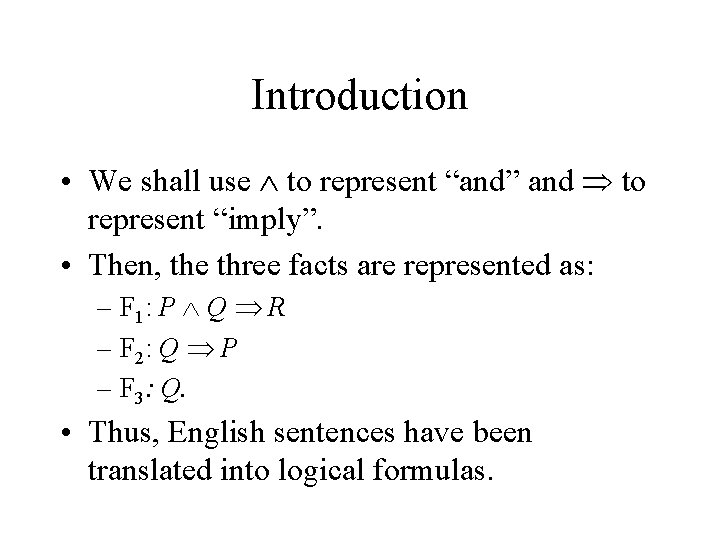
Introduction • We shall use to represent “and” and to represent “imply”. • Then, the three facts are represented as: – F 1: P Q R – F 2: Q P – F 3: Q. • Thus, English sentences have been translated into logical formulas.
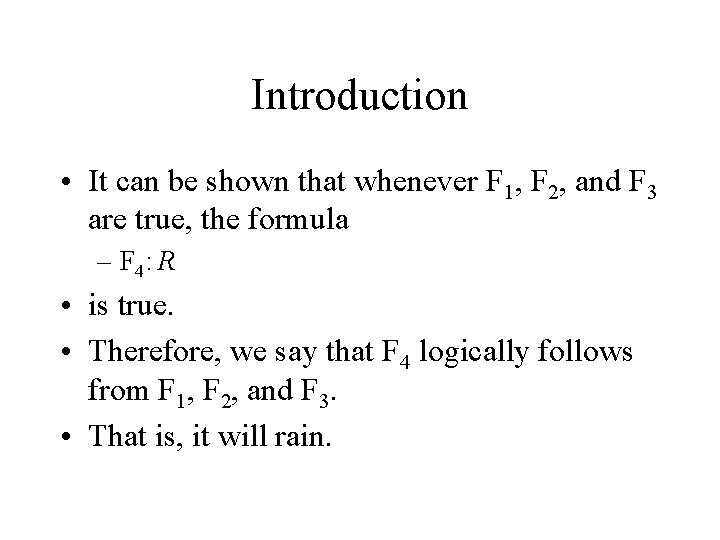
Introduction • It can be shown that whenever F 1, F 2, and F 3 are true, the formula – F 4: R • is true. • Therefore, we say that F 4 logically follows from F 1, F 2, and F 3. • That is, it will rain.
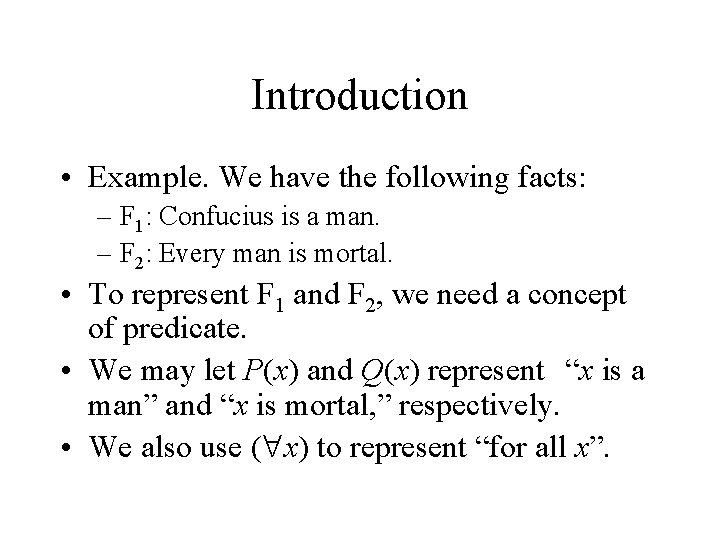
Introduction • Example. We have the following facts: – F 1: Confucius is a man. – F 2: Every man is mortal. • To represent F 1 and F 2, we need a concept of predicate. • We may let P(x) and Q(x) represent “x is a man” and “x is mortal, ” respectively. • We also use ( x) to represent “for all x”.
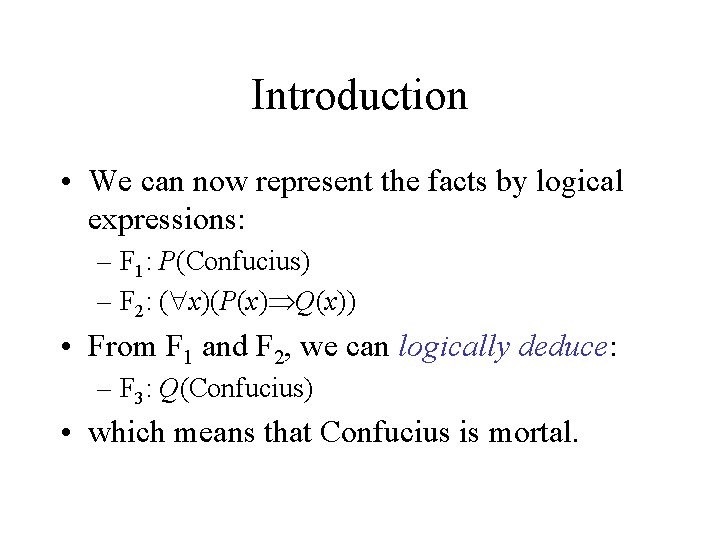
Introduction • We can now represent the facts by logical expressions: – F 1: P(Confucius) – F 2: ( x)(P(x) Q(x)) • From F 1 and F 2, we can logically deduce: – F 3: Q(Confucius) • which means that Confucius is mortal.
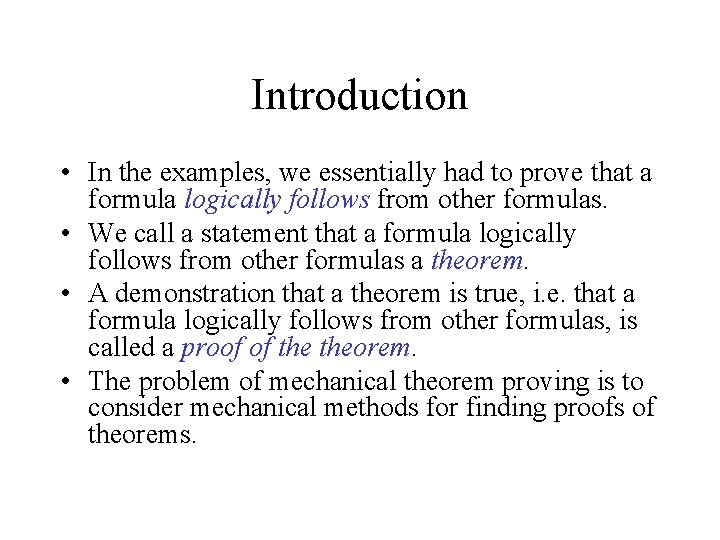
Introduction • In the examples, we essentially had to prove that a formula logically follows from other formulas. • We call a statement that a formula logically follows from other formulas a theorem. • A demonstration that a theorem is true, i. e. that a formula logically follows from other formulas, is called a proof of theorem. • The problem of mechanical theorem proving is to consider mechanical methods for finding proofs of theorems.
- Slides: 12