
Logic Programming PLP 11 3 Prolog Arithmetic Equalities
- Slides: 17
Logic Programming (PLP 11. 3) Prolog: Arithmetic, Equalities, Operators, I/O, Natural Language Parsing Carlos Varela Rennselaer Polytechnic Institute September 10, 2007 C. Varela 1
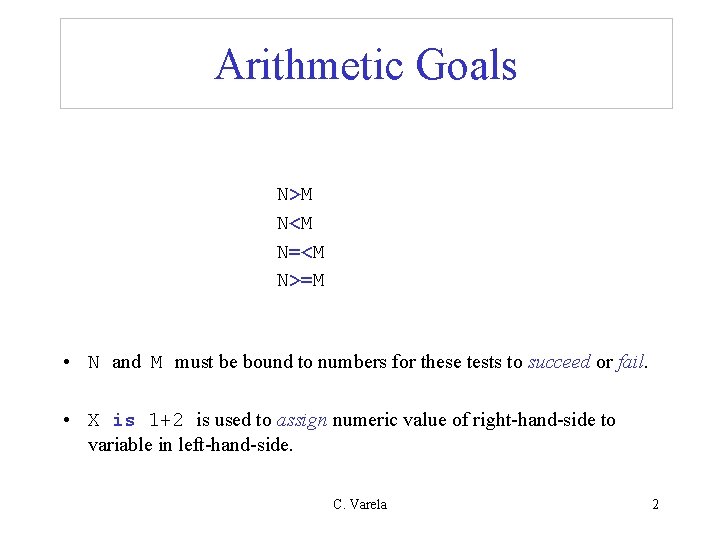
Arithmetic Goals N>M N<M N=<M N>=M • N and M must be bound to numbers for these tests to succeed or fail. • X is 1+2 is used to assign numeric value of right-hand-side to variable in left-hand-side. C. Varela 2
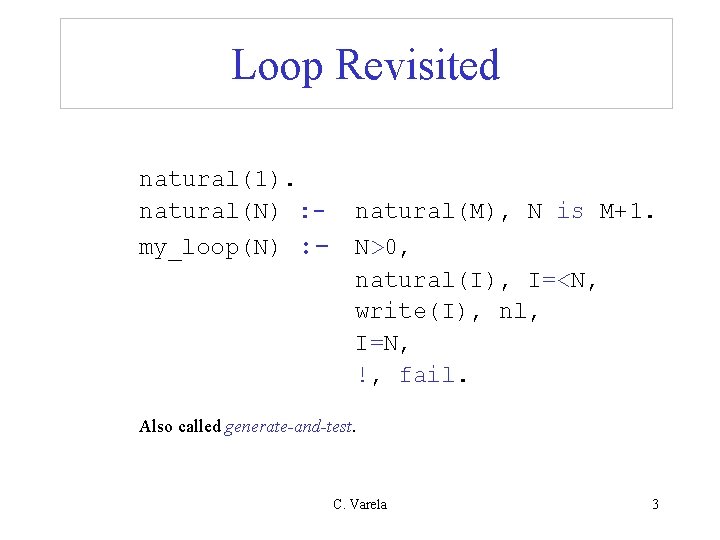
Loop Revisited natural(1). natural(N) : - natural(M), N is M+1. my_loop(N) : - N>0, natural(I), I=<N, write(I), nl, I=N, !, fail. Also called generate-and-test. C. Varela 3
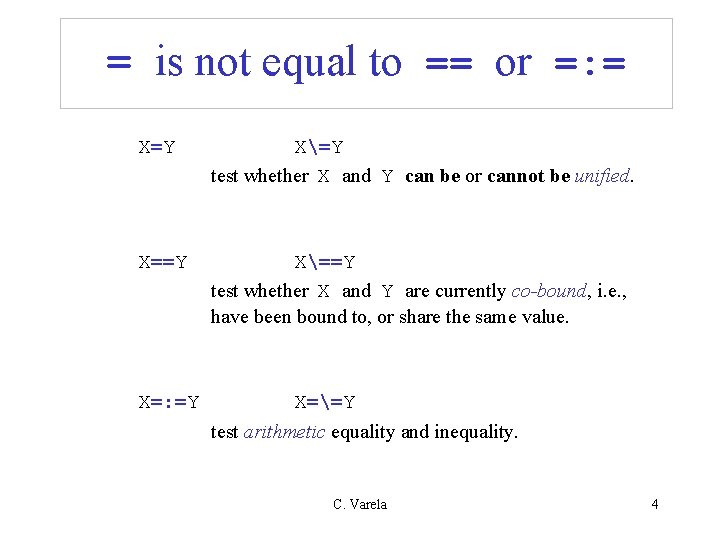
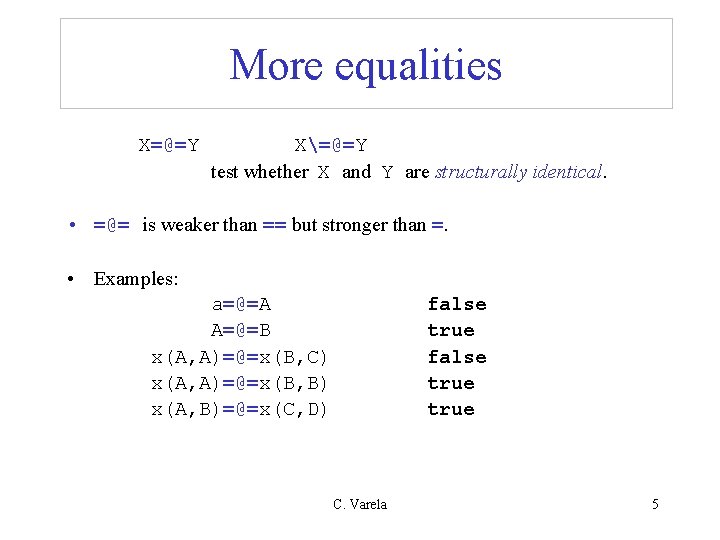
= is not equal to == or =: = X=Y X=Y test whether X and Y can be or cannot be unified. X==Y X==Y test whether X and Y are currently co-bound, i. e. , have been bound to, or share the same value. X=: =Y X==Y test arithmetic equality and inequality. C. Varela 4
More equalities X=@=Y X=@=Y test whether X and Y are structurally identical. • =@= is weaker than == but stronger than =. • Examples: a=@=A A=@=B x(A, A)=@=x(B, C) x(A, A)=@=x(B, B) x(A, B)=@=x(C, D) false true C. Varela 5
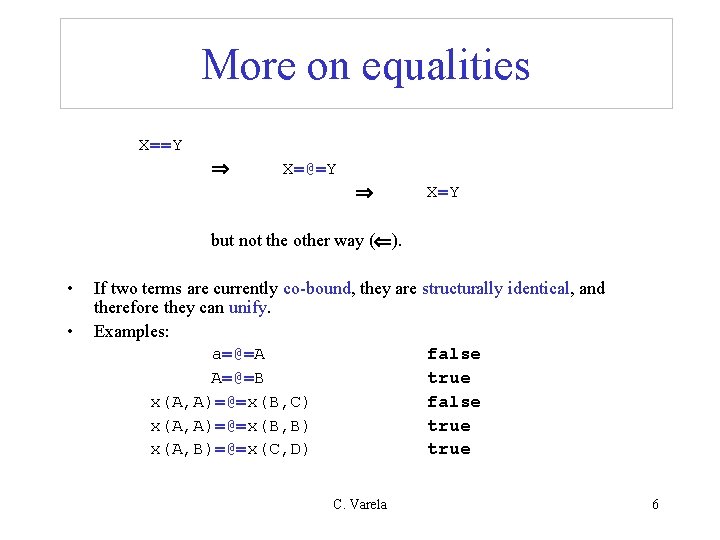
More on equalities X==Y X=@=Y X=Y but not the other way ( ). • • If two terms are currently co-bound, they are structurally identical, and therefore they can unify. Examples: a=@=A false A=@=B true x(A, A)=@=x(B, C) false x(A, A)=@=x(B, B) true x(A, B)=@=x(C, D) true C. Varela 6
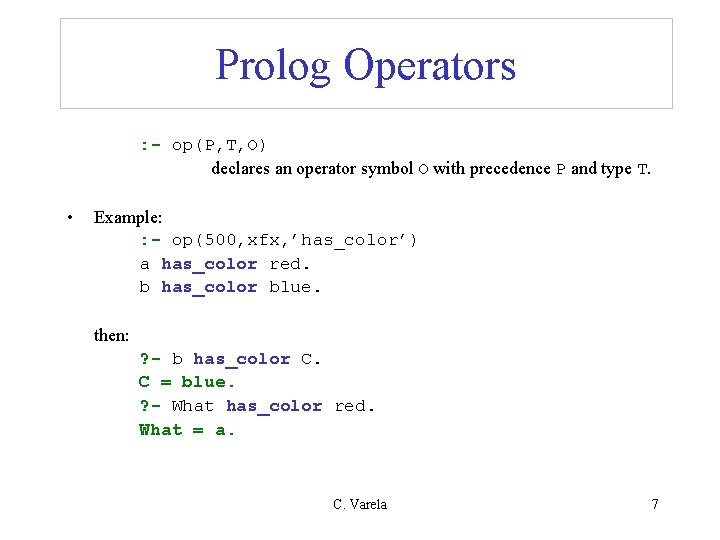
Prolog Operators : - op(P, T, O) declares an operator symbol O with precedence P and type T. • Example: : - op(500, xfx, ’has_color’) a has_color red. b has_color blue. then: ? - b has_color C. C = blue. ? - What has_color red. What = a. C. Varela 7
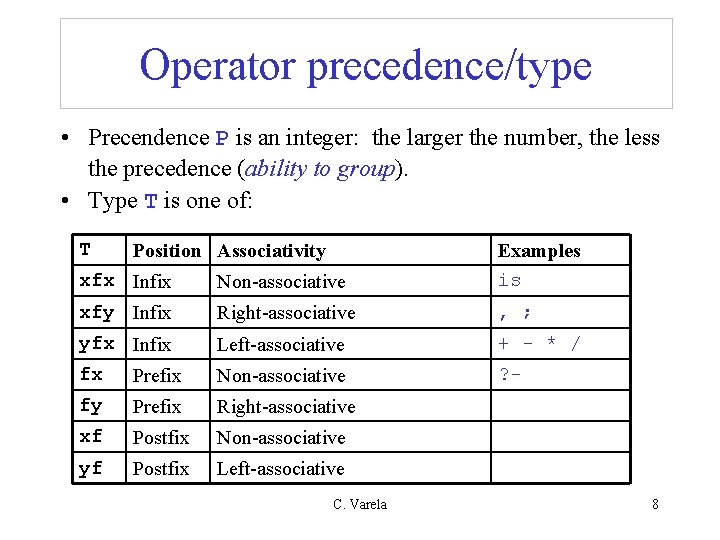
Operator precedence/type • Precendence P is an integer: the larger the number, the less the precedence (ability to group). • Type T is one of: T Position Associativity xfx Infix xfy Infix Non-associative Examples is Right-associative , ; yfx Infix fx Prefix Left-associative + - * / Non-associative ? - fy Prefix Right-associative xf Postfix Non-associative yf Postfix Left-associative C. Varela 8
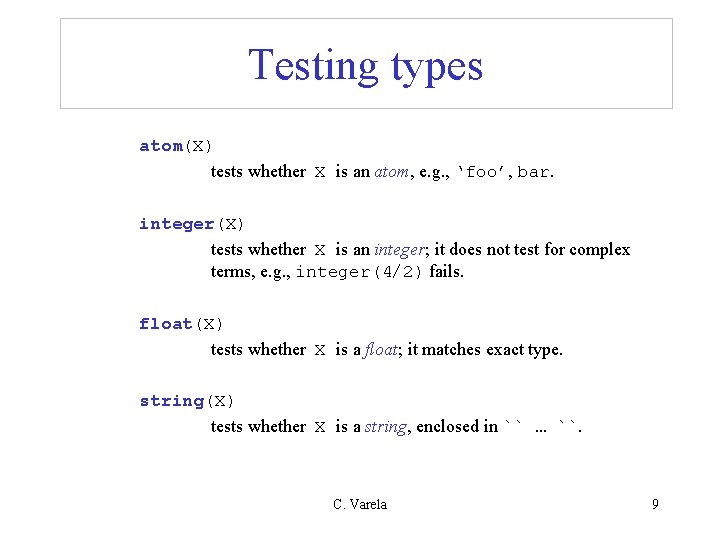
Testing types atom(X) tests whether X is an atom, e. g. , ‘foo’, bar. integer(X) tests whether X is an integer; it does not test for complex terms, e. g. , integer(4/2) fails. float(X) tests whether X is a float; it matches exact type. string(X) tests whether X is a string, enclosed in `` … ``. C. Varela 9
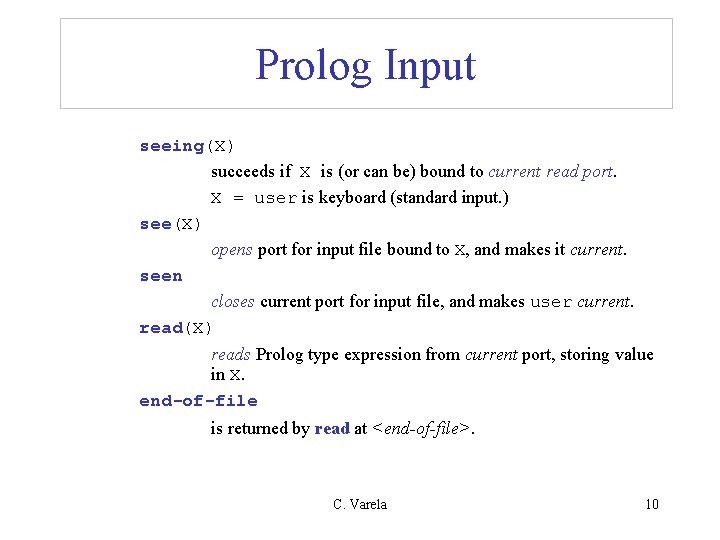
Prolog Input seeing(X) succeeds if X is (or can be) bound to current read port. X = user is keyboard (standard input. ) see(X) opens port for input file bound to X, and makes it current. seen closes current port for input file, and makes user current. read(X) reads Prolog type expression from current port, storing value in X. end-of-file is returned by read at <end-of-file>. C. Varela 10
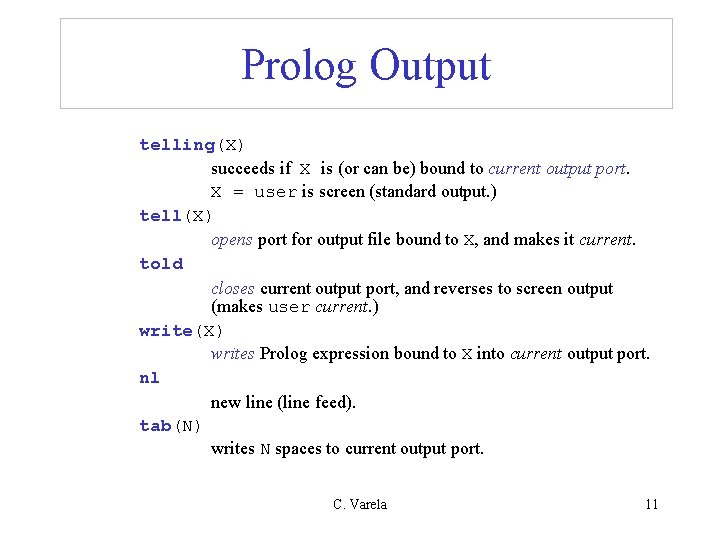
Prolog Output telling(X) succeeds if X is (or can be) bound to current output port. X = user is screen (standard output. ) tell(X) opens port for output file bound to X, and makes it current. told closes current output port, and reverses to screen output (makes user current. ) write(X) writes Prolog expression bound to X into current output port. nl new line (line feed). tab(N) writes N spaces to current output port. C. Varela 11
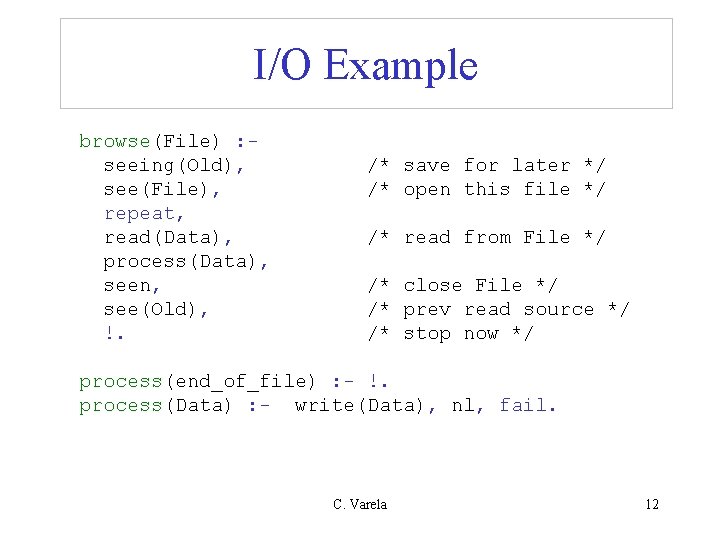
I/O Example browse(File) : seeing(Old), see(File), repeat, read(Data), process(Data), seen, see(Old), !. /* save for later */ /* open this file */ /* read from File */ /* close File */ /* prev read source */ /* stop now */ process(end_of_file) : - !. process(Data) : - write(Data), nl, fail. C. Varela 12
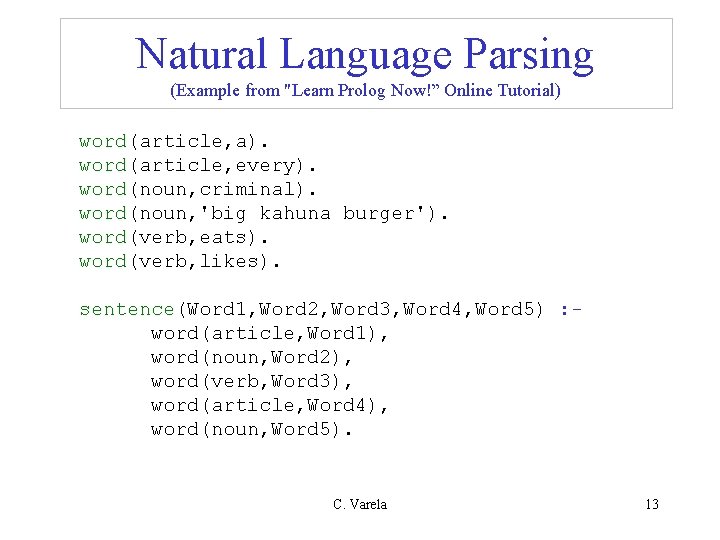
Natural Language Parsing (Example from "Learn Prolog Now!” Online Tutorial) word(article, a). word(article, every). word(noun, criminal). word(noun, 'big kahuna burger'). word(verb, eats). word(verb, likes). sentence(Word 1, Word 2, Word 3, Word 4, Word 5) : word(article, Word 1), word(noun, Word 2), word(verb, Word 3), word(article, Word 4), word(noun, Word 5). C. Varela 13
Parsing natural language • Definite Clause Grammars (DCG) are useful for natural language parsing. • Prolog can load DCG rules and convert them automatically to Prolog parsing rules. C. Varela 14
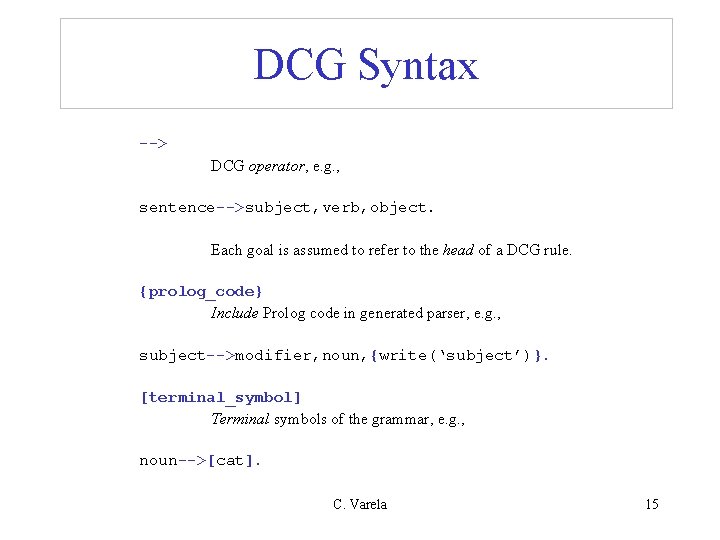
DCG Syntax --> DCG operator, e. g. , sentence-->subject, verb, object. Each goal is assumed to refer to the head of a DCG rule. {prolog_code} Include Prolog code in generated parser, e. g. , subject-->modifier, noun, {write(‘subject’)}. [terminal_symbol] Terminal symbols of the grammar, e. g. , noun-->[cat]. C. Varela 15
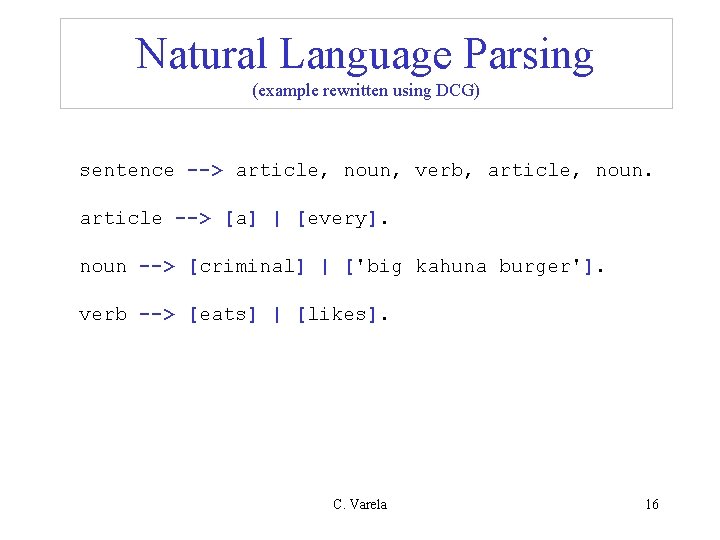
Natural Language Parsing (example rewritten using DCG) sentence --> article, noun, verb, article, noun. article --> [a] | [every]. noun --> [criminal] | ['big kahuna burger']. verb --> [eats] | [likes]. C. Varela 16
Exercises 12. How would you translate DCG rules into Prolog rules? 13. PLP Exercise 11. 26 (pg 655). 14. *PLP Exercise 11. 30 (pg 655). C. Varela 17