
Logic Inductive Reasoning a process of reasoning that
- Slides: 10
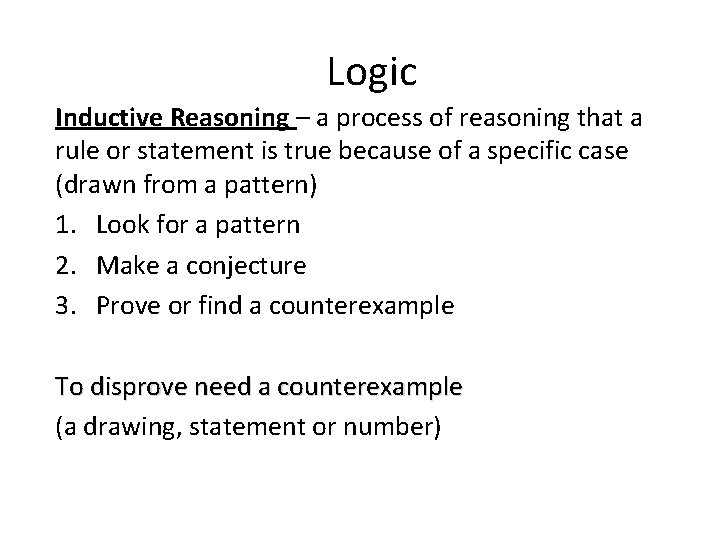
Logic Inductive Reasoning – a process of reasoning that a rule or statement is true because of a specific case (drawn from a pattern) 1. Look for a pattern 2. Make a conjecture 3. Prove or find a counterexample To disprove need a counterexample (a drawing, statement or number)
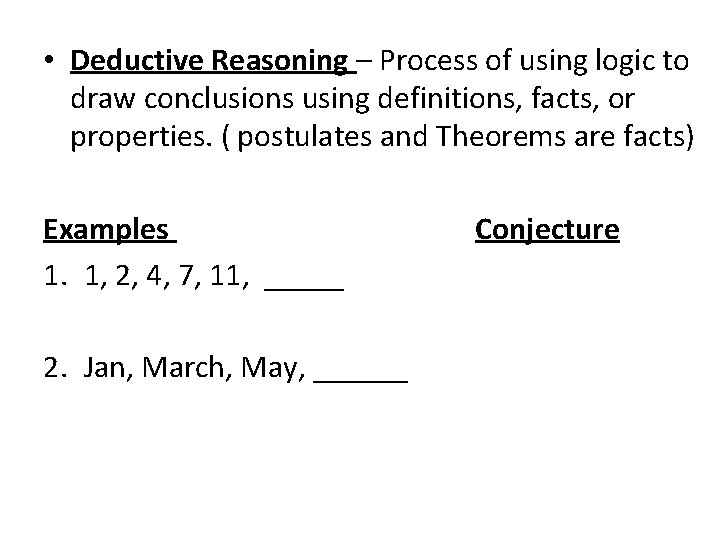
• Deductive Reasoning – Process of using logic to draw conclusions using definitions, facts, or properties. ( postulates and Theorems are facts) Examples 1. 1, 2, 4, 7, 11, _____ 2. Jan, March, May, ______ Conjecture
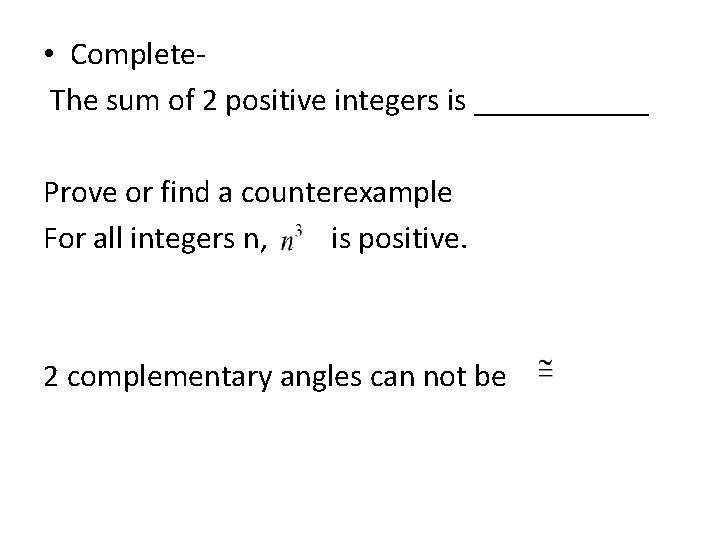
• Complete. The sum of 2 positive integers is ______ Prove or find a counterexample For all integers n, is positive. 2 complementary angles can not be
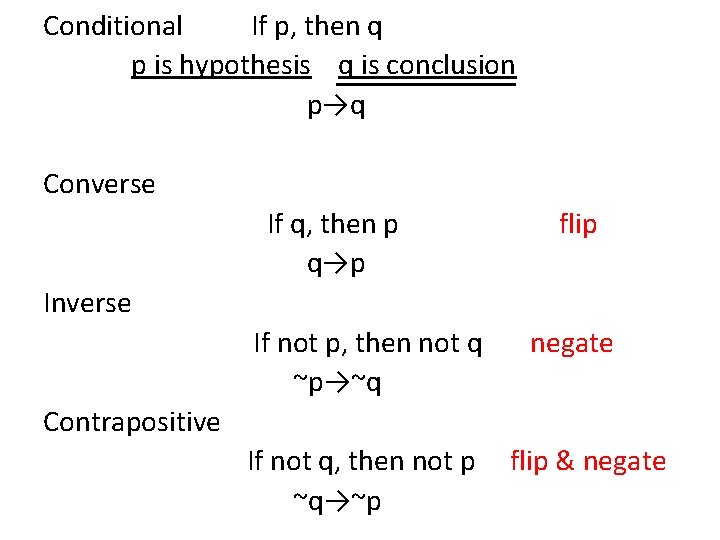
Conditional If p, then q p is hypothesis q is conclusion p→q Converse If q, then p q→p flip Inverse If not p, then not q ~p→~q negate Contrapositive If not q, then not p ~q→~p flip & negate
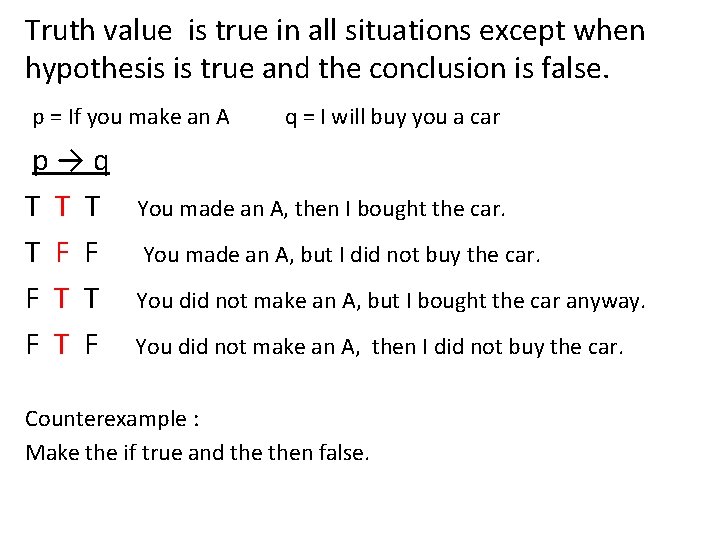
Truth value is true in all situations except when hypothesis is true and the conclusion is false. p = If you make an A p→q T T F F F T T F q = I will buy you a car You made an A, then I bought the car. You made an A, but I did not buy the car. You did not make an A, but I bought the car anyway. You did not make an A, then I did not buy the car. Counterexample : Make the if true and then false.
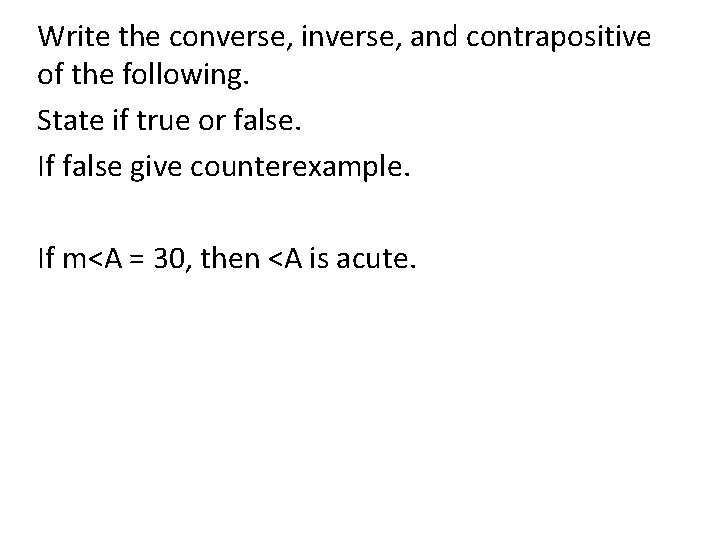
Write the converse, inverse, and contrapositive of the following. State if true or false. If false give counterexample. If m<A = 30, then <A is acute.
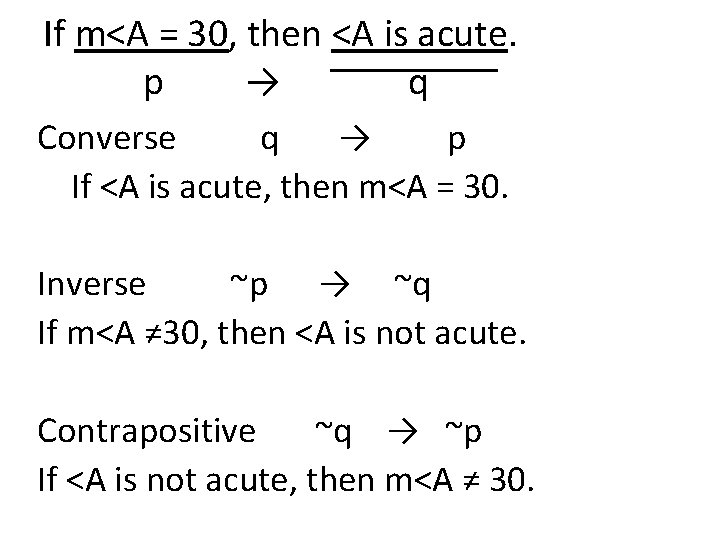
If m<A = 30, then <A is acute. p → q Converse q → p If <A is acute, then m<A = 30. Inverse ~p → ~q If m<A ≠ 30, then <A is not acute. Contrapositive ~q → ~p If <A is not acute, then m<A ≠ 30.
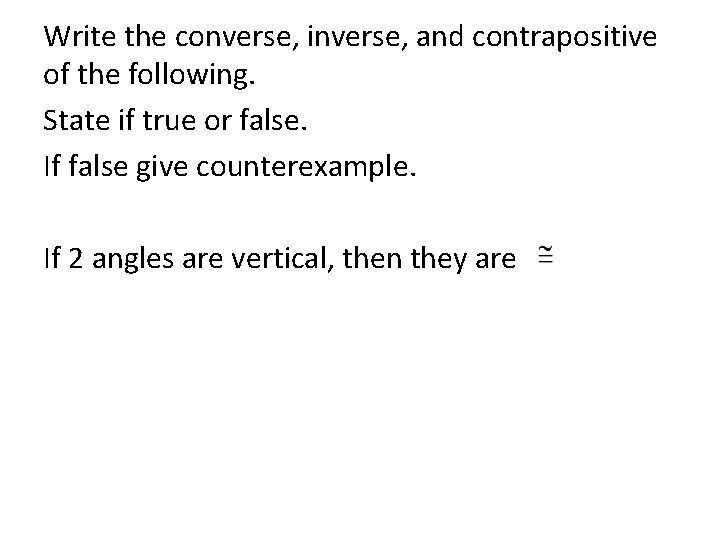
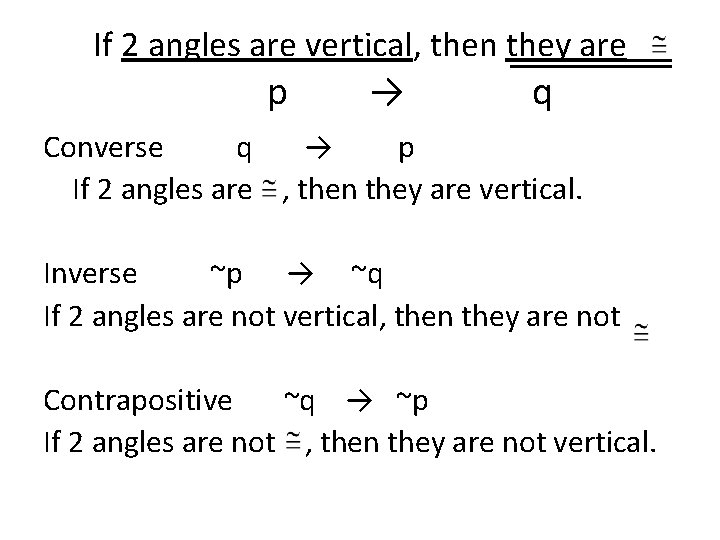
Write the converse, inverse, and contrapositive of the following. State if true or false. If false give counterexample. If 2 angles are vertical, then they are
If 2 angles are vertical, then they are p → q Converse q → p If 2 angles are , then they are vertical. Inverse ~p → ~q If 2 angles are not vertical, then they are not Contrapositive ~q → ~p If 2 angles are not , then they are not vertical.
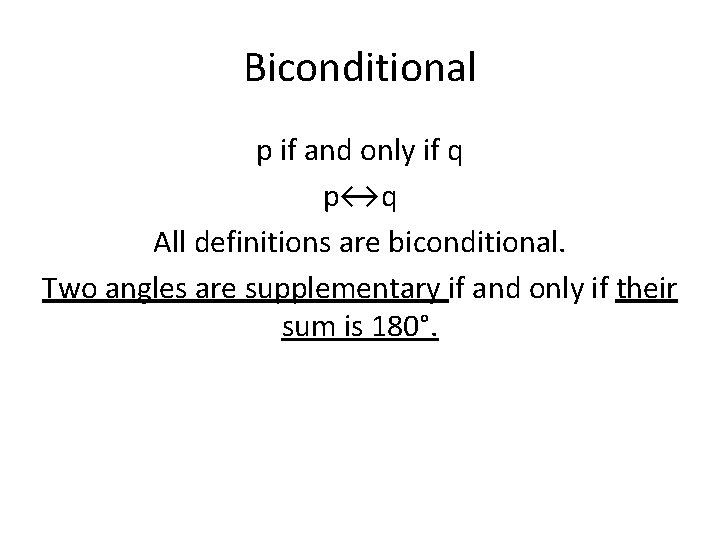
Biconditional p if and only if q p↔q All definitions are biconditional. Two angles are supplementary if and only if their sum is 180°.