
Logic gate level Part 3 minimizing circuits Improving

- Slides: 41
Logic gate level Part 3: minimizing circuits
Improving circuit efficiency • Efficiency of combinatorial circuit depends on number & arrangement of its gates • Sum-of-products expansion can aid in finding set of logic gates to implement circuit, but may contain more terms than necessary • Combining terms in sum-of-products expansion leads to simpler expression of circuit, using fewer gates and inputs
Why minimize circuits? • Reducing number of gates can lead to more reliable, less expensive chip • Minimization means more circuits per chip • Minimization reduces time used by circuit to complete its output • Downside: minimization algorithms are computationally intensive; no algorithm has yet been devised to minimize circuits involving more than 25 variables
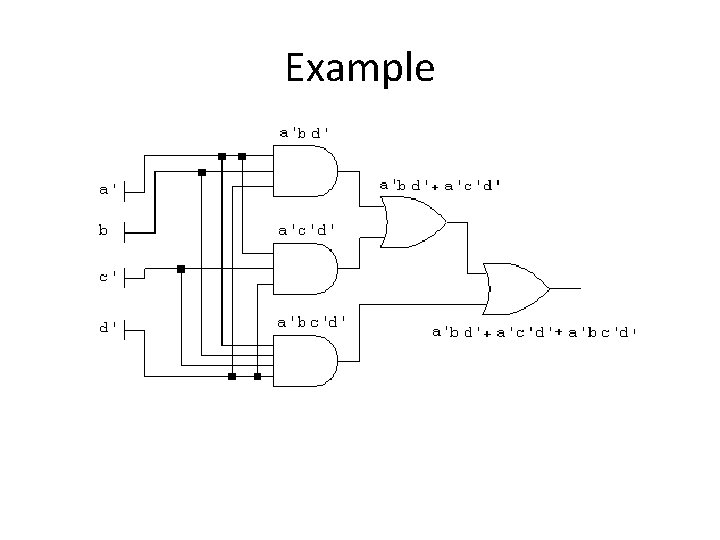
Example
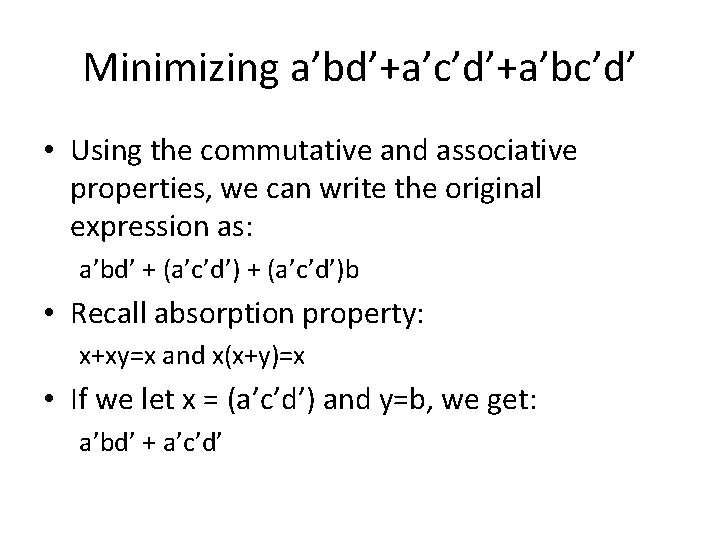
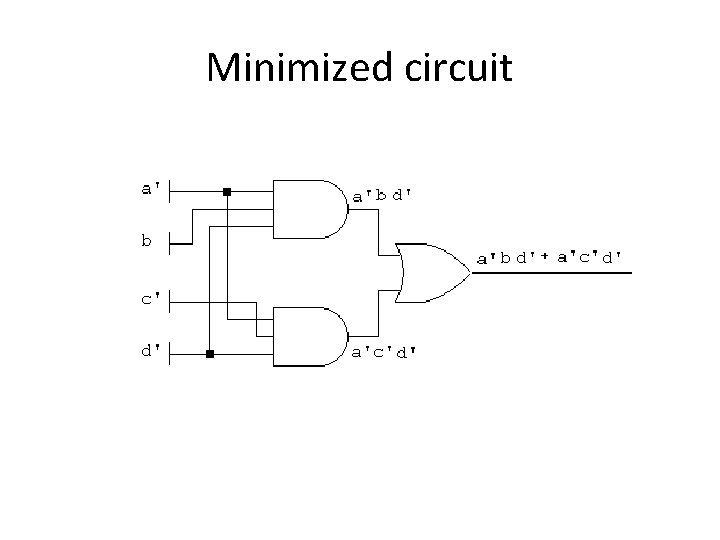
Minimizing a’bd’+a’c’d’+a’bc’d’ • Using the commutative and associative properties, we can write the original expression as: a’bd’ + (a’c’d’)b • Recall absorption property: x+xy=x and x(x+y)=x • If we let x = (a’c’d’) and y=b, we get: a’bd’ + a’c’d’
Minimized circuit
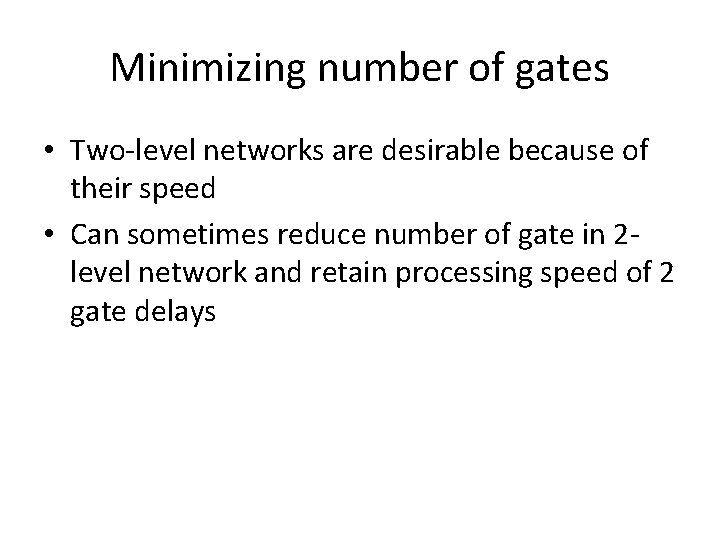
Minimizing number of gates • Two-level networks are desirable because of their speed • Can sometimes reduce number of gate in 2 level network and retain processing speed of 2 gate delays
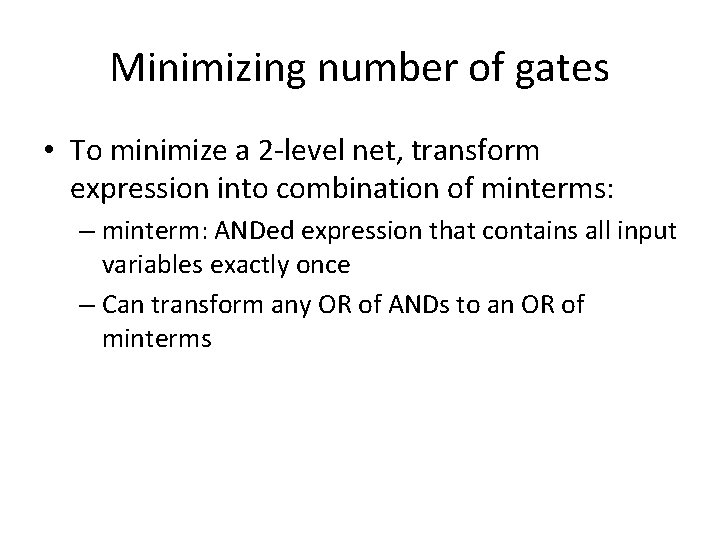
Minimizing number of gates • To minimize a 2 -level net, transform expression into combination of minterms: – minterm: ANDed expression that contains all input variables exactly once – Can transform any OR of ANDs to an OR of minterms
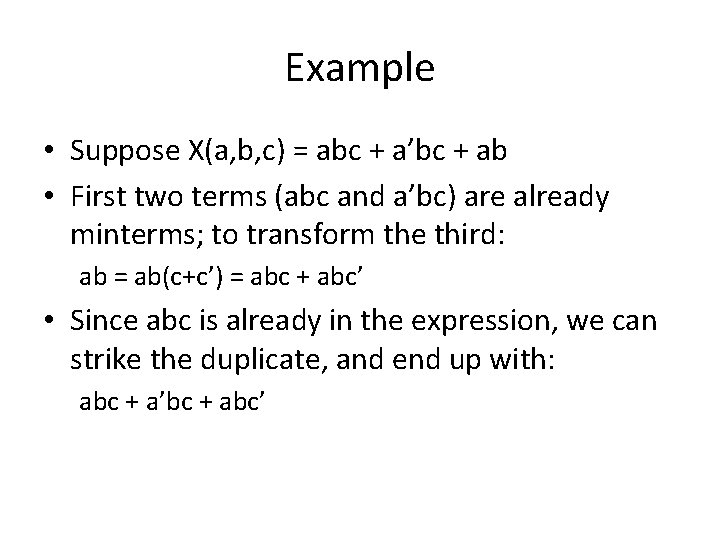
Example • Suppose X(a, b, c) = abc + a’bc + ab • First two terms (abc and a’bc) are already minterms; to transform the third: ab = ab(c+c’) = abc + abc’ • Since abc is already in the expression, we can strike the duplicate, and end up with: abc + a’bc + abc’
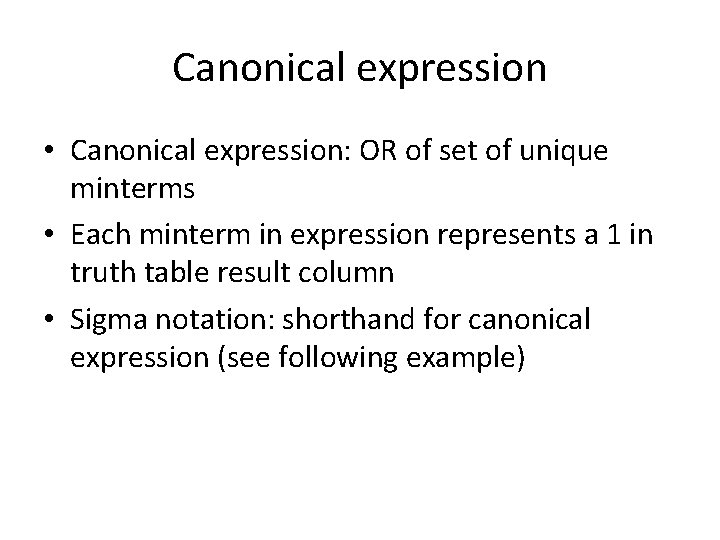
Canonical expression • Canonical expression: OR of set of unique minterms • Each minterm in expression represents a 1 in truth table result column • Sigma notation: shorthand for canonical expression (see following example)
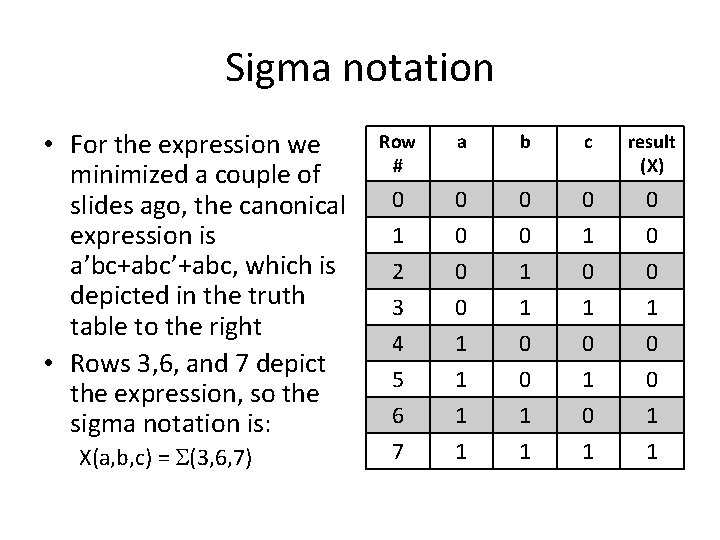
Sigma notation • For the expression we minimized a couple of slides ago, the canonical expression is a’bc+abc’+abc, which is depicted in the truth table to the right • Rows 3, 6, and 7 depict the expression, so the sigma notation is: X(a, b, c) = (3, 6, 7) Row # a b c result (X) 0 0 0 1 2 3 4 0 0 0 1 1 0 1 0 0 0 1 0 5 6 7 1 1 1 0 1 0 1 1
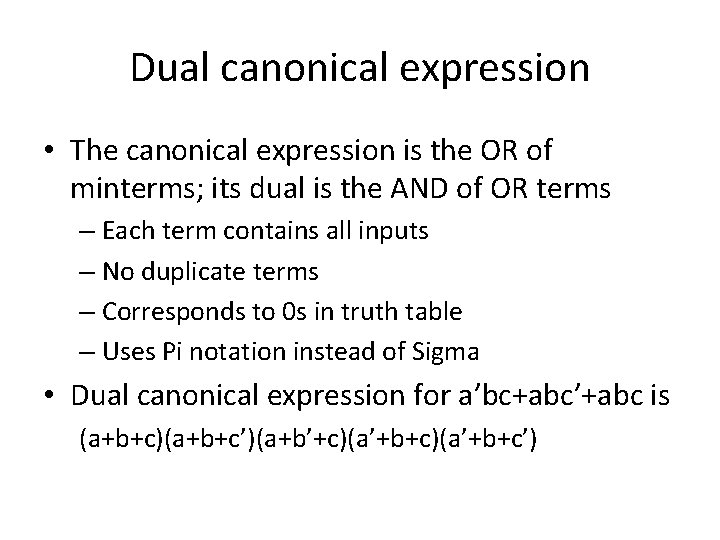
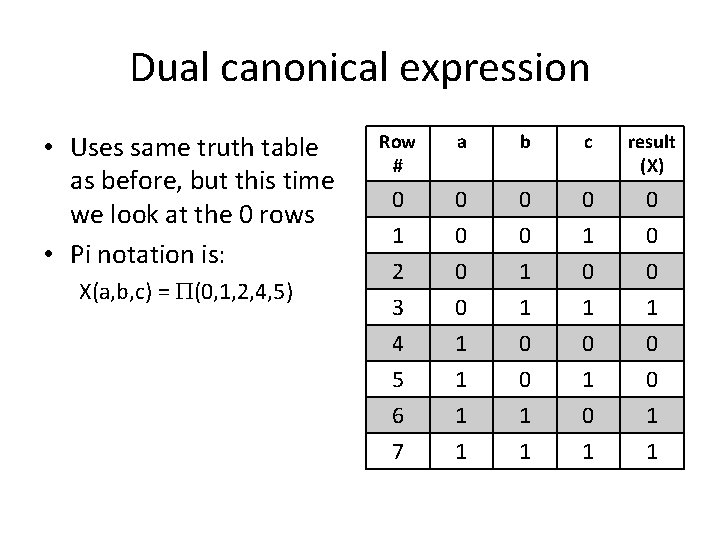
Dual canonical expression • The canonical expression is the OR of minterms; its dual is the AND of OR terms – Each term contains all inputs – No duplicate terms – Corresponds to 0 s in truth table – Uses Pi notation instead of Sigma • Dual canonical expression for a’bc+abc’+abc is (a+b+c)(a+b+c’)(a+b’+c)(a’+b+c’)
Dual canonical expression • Uses same truth table as before, but this time we look at the 0 rows • Pi notation is: X(a, b, c) = (0, 1, 2, 4, 5) Row # a b c result (X) 0 0 0 1 2 3 4 0 0 0 1 1 0 1 0 0 0 1 0 5 6 7 1 1 1 0 1 0 1 1
Karnaugh maps • Minimization of 2 -level networks is based on concept of distance • Distance between 2 minterms is the number of places in which they differ • A Karnaugh map is a kind of truth table arranged so that adjacent entries represent minterms that differ by one
Karnaugh maps • Graphical method for finding terms to combine in a Boolean function involving a relatively small number of variables • For a Boolean function in 2 variables, there are four possible minterms in the sum-of-products expansion • A K-map for such a function consists of 4 cells, with a 1 placed in the cell representing a minterm if it is present in the expansion • An even numbered group of adjacent 1 s represents a term that can be eliminated without changing the outcome of the circuit
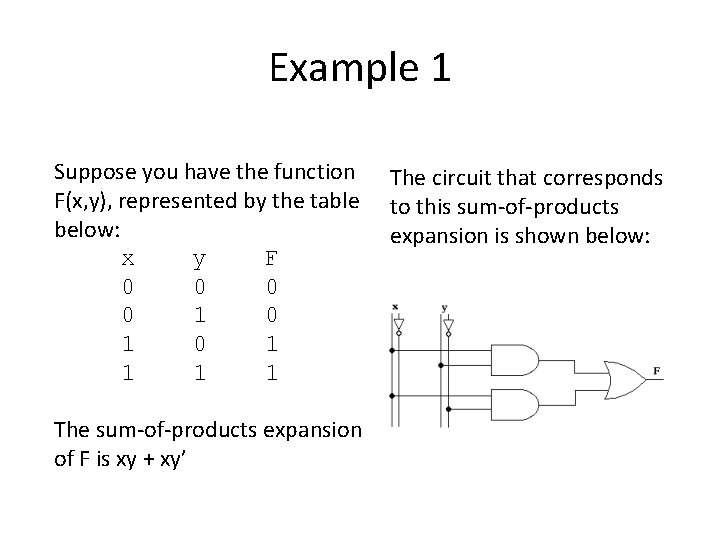
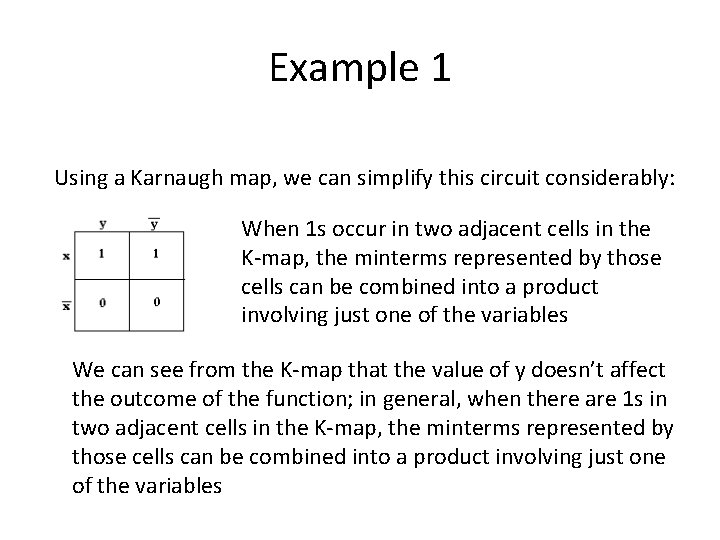
Example 1 Suppose you have the function F(x, y), represented by the table below: x y F 0 0 1 0 1 1 The sum-of-products expansion of F is xy + xy’ The circuit that corresponds to this sum-of-products expansion is shown below:
Example 1 Using a Karnaugh map, we can simplify this circuit considerably: When 1 s occur in two adjacent cells in the K-map, the minterms represented by those cells can be combined into a product involving just one of the variables We can see from the K-map that the value of y doesn’t affect the outcome of the function; in general, when there are 1 s in two adjacent cells in the K-map, the minterms represented by those cells can be combined into a product involving just one of the variables
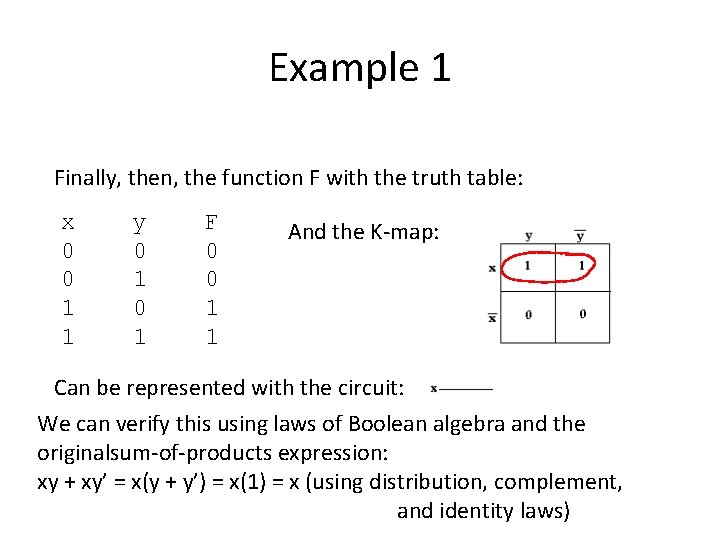
Example 1 Finally, then, the function F with the truth table: x 0 0 1 1 y 0 1 F 0 0 1 1 And the K-map: Can be represented with the circuit: We can verify this using laws of Boolean algebra and the originalsum-of-products expression: xy + xy’ = x(y + y’) = x(1) = x (using distribution, complement, and identity laws)
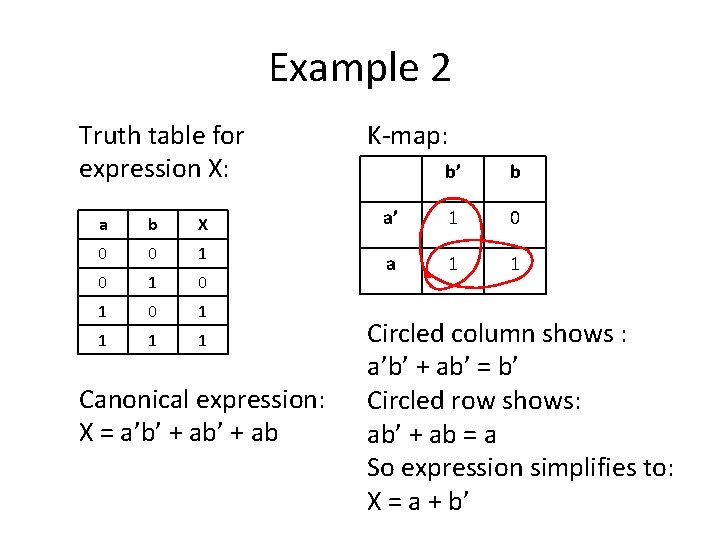
Example 2 Truth table for expression X: a b X 0 0 1 0 1 1 1 1 Canonical expression: X = a’b’ + ab K-map: b’ b a’ 1 0 a 1 1 Circled column shows : a’b’ + ab’ = b’ Circled row shows: ab’ + ab = a So expression simplifies to: X = a + b’
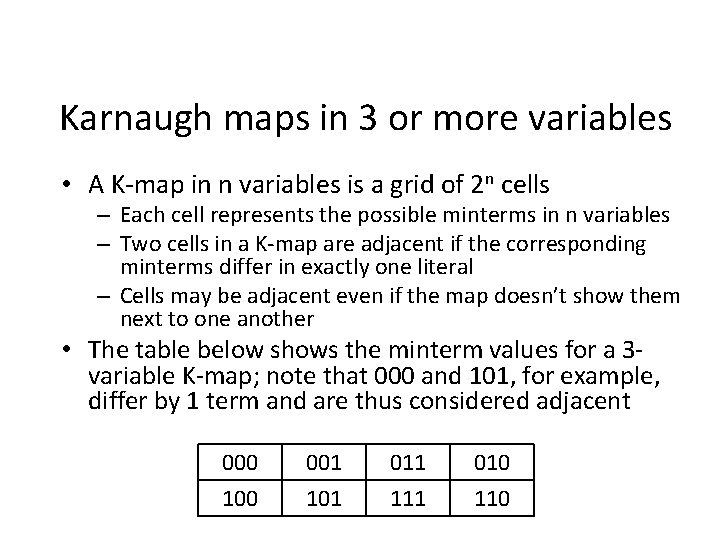
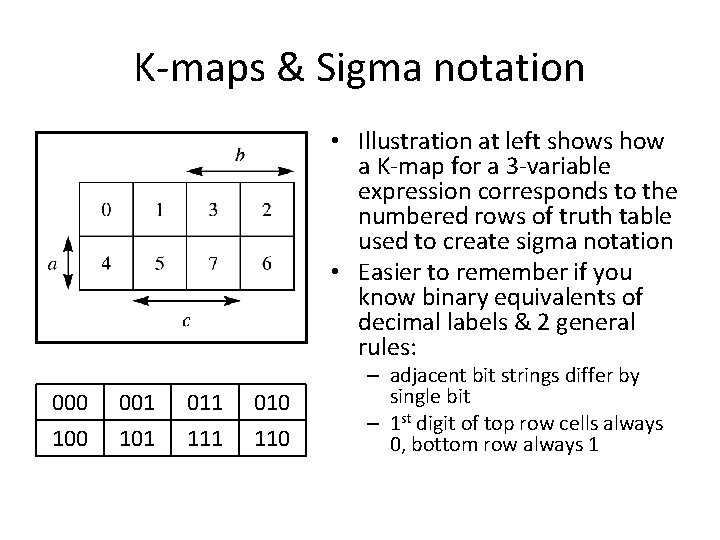
Karnaugh maps in 3 or more variables • A K-map in n variables is a grid of 2 n cells – Each cell represents the possible minterms in n variables – Two cells in a K-map are adjacent if the corresponding minterms differ in exactly one literal – Cells may be adjacent even if the map doesn’t show them next to one another • The table below shows the minterm values for a 3 variable K-map; note that 000 and 101, for example, differ by 1 term and are thus considered adjacent 000 100 001 101 011 111 010 110
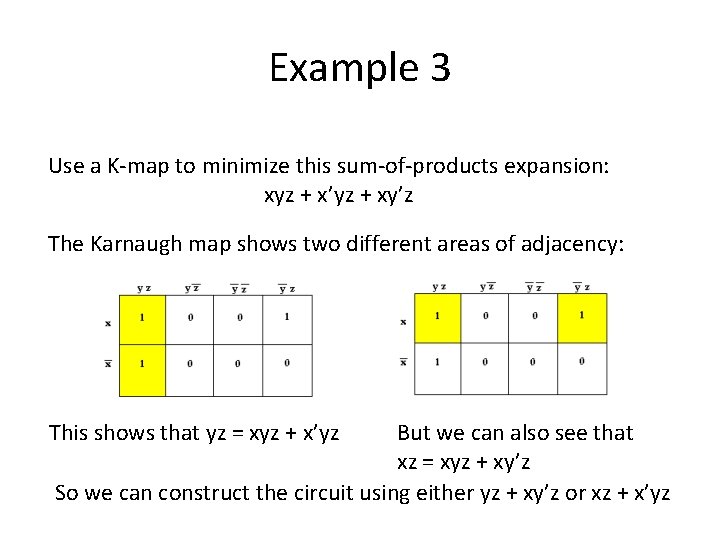
Example 3 Use a K-map to minimize this sum-of-products expansion: xyz + x’yz + xy’z The Karnaugh map shows two different areas of adjacency: This shows that yz = xyz + x’yz But we can also see that xz = xyz + xy’z So we can construct the circuit using either yz + xy’z or xz + x’yz
Implicants • To simplify a sum-of-products expansion, we use a Kmap to identify blocks of minterms we can combine • In a function with 3 variables: – blocks of 2 adjacent cells represent pairs that can be combined in the product of 2 literals – 2 x 2 and 4 x 1 blocks represent minterms that can be combined into a single literal – a block consisting of all 8 cells represents 1 • The product of literals corresponding to a block of 1 s in a K-map is called an implicant of the function
Prime implicants • If a block of 1 s in a K-map is not contained in a larger block of 1 s representing the product of fewer literals, the block is a prime implicant • The goal in using K-maps is to identify the largest possible blocks of 1 s, but we must include blocks representing isolated 1 s; such a block is an essential prime implicant • We can express the sum of products as the sum of prime implicants; as in the previous example, there may be more than one way to do this
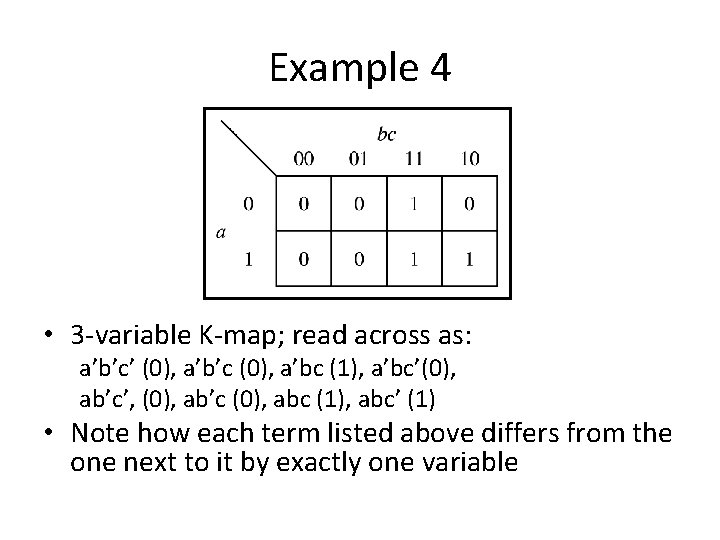
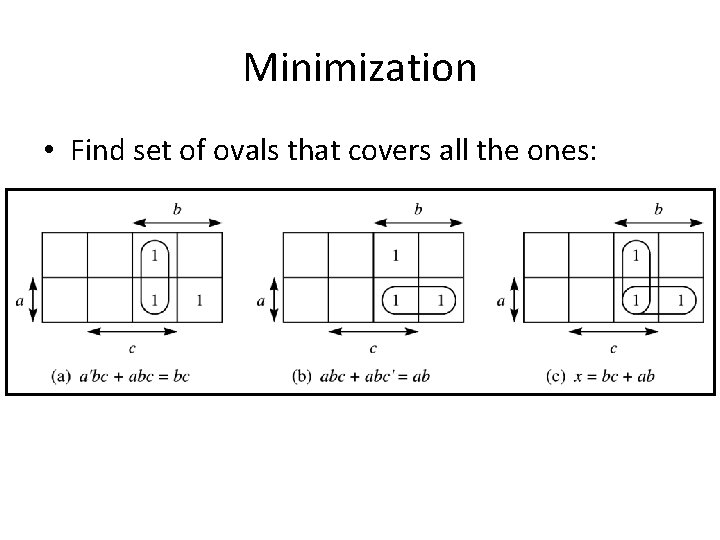
Example 4 • 3 -variable K-map; read across as: a’b’c’ (0), a’b’c (0), a’bc (1), a’bc’(0), ab’c’, (0), ab’c (0), abc (1), abc’ (1) • Note how each term listed above differs from the one next to it by exactly one variable
Minimization • Find set of ovals that covers all the ones:
K-maps & Sigma notation • Illustration at left shows how a K-map for a 3 -variable expression corresponds to the numbered rows of truth table used to create sigma notation • Easier to remember if you know binary equivalents of decimal labels & 2 general rules: 000 100 001 101 011 111 010 110 – adjacent bit strings differ by single bit – 1 st digit of top row cells always 0, bottom row always 1
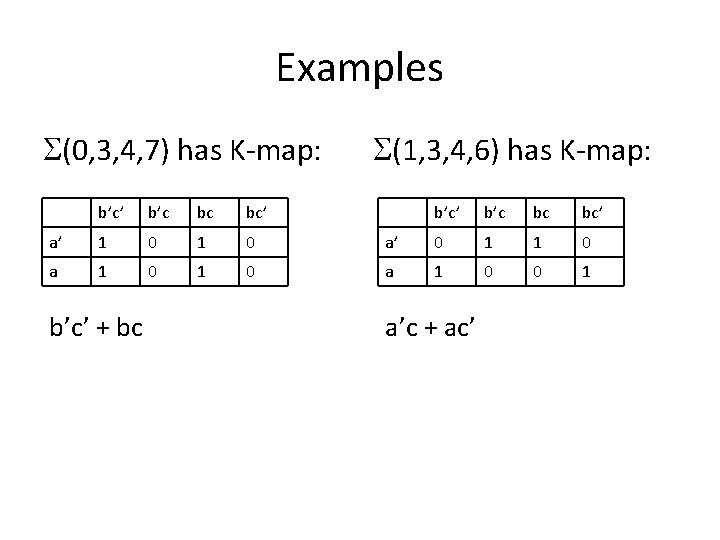
Examples (0, 3, 4, 7) has K-map: b’c’ b’c bc bc’ a’ 1 0 a 1 0 b’c’ + bc (1, 3, 4, 6) has K-map: b’c’ b’c bc bc’ a’ 0 1 1 0 a 1 0 0 1 a’c + ac’
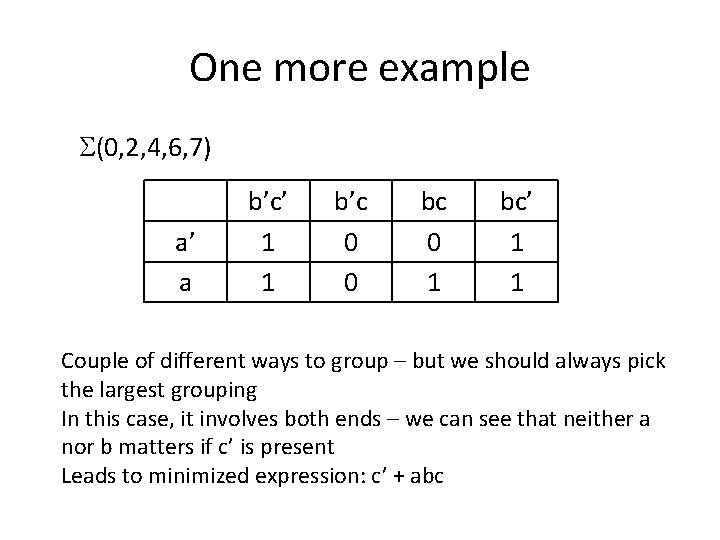
One more example (0, 2, 4, 6, 7) a’ a b’c’ 1 1 b’c 0 0 bc 0 1 bc’ 1 1 Couple of different ways to group – but we should always pick the largest grouping In this case, it involves both ends – we can see that neither a nor b matters if c’ is present Leads to minimized expression: c’ + abc
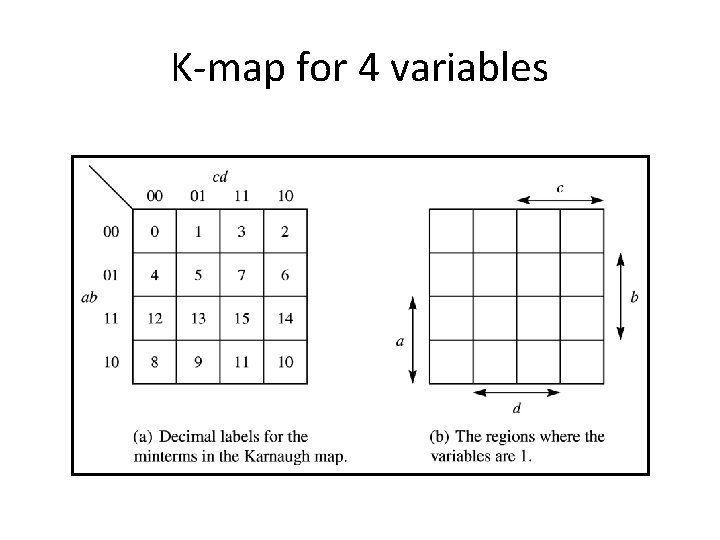
K-map for 4 variables
K-maps: summary • To minimize a Boolean function in n variables, we draw a K-map of appropriate size • Place 1 s in all cells corresponding to minterms of the sum-of-products expansion • Identify all prime implicants: – look for blocks of 2 k clustered cells containing 1 s (where n > k > 1) - these correspond to product of n-k literals
Summary continued • Once all prime implicants identified, find the smallest possible subset that covers all the 1 s in the K-map • Begin by selecting essential prime implicants • Add additional implicants to ensure that all 1 s are covered • Since K-maps are graphical tool, they are difficult to automate
Quine-Mc. Cluskey method • Provides procedure for simplifying sum-ofproducts that can be mechanized • Doesn’t rely on visual inspection (as K-maps do) • Can be used for Boolean functions in any number of variables (K-maps get awkward beyond 5 or 6) • Major disadvantage: algorithm is exponential
Quine-Mc. Cluskey method • Two parts: – Find terms that are candidates for inclusion in minimal expansion as Boolean sum of Boolean products – Determine which of these terms should actually be used
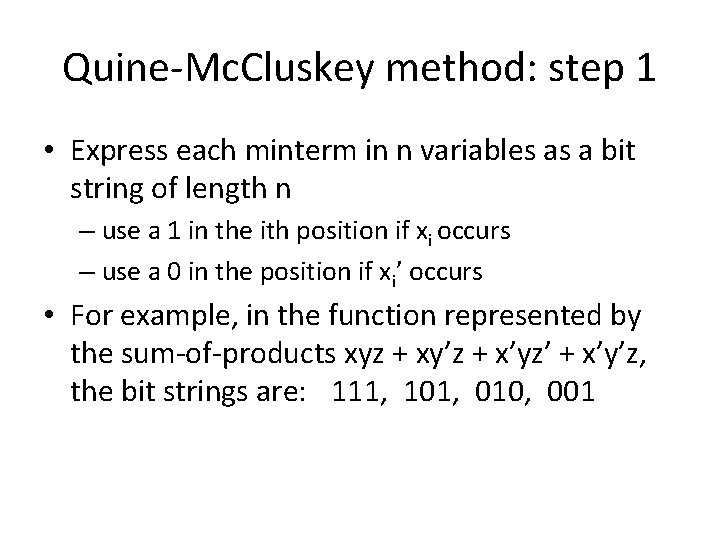
Quine-Mc. Cluskey method: step 1 • Express each minterm in n variables as a bit string of length n – use a 1 in the ith position if xi occurs – use a 0 in the position if xi’ occurs • For example, in the function represented by the sum-of-products xyz + xy’z + x’yz’ + x’y’z, the bit strings are: 111, 101, 010, 001
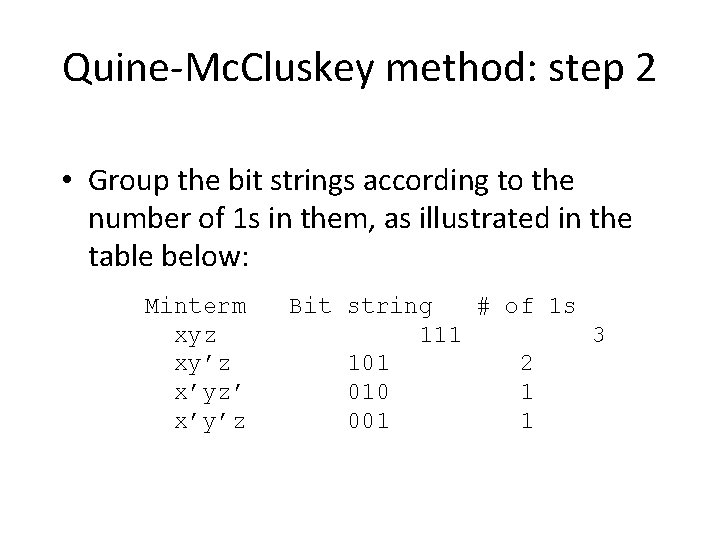
Quine-Mc. Cluskey method: step 2 • Group the bit strings according to the number of 1 s in them, as illustrated in the table below: Minterm xyz xy’z x’yz’ x’y’z Bit string # of 1 s 111 3 101 2 010 1 001 1
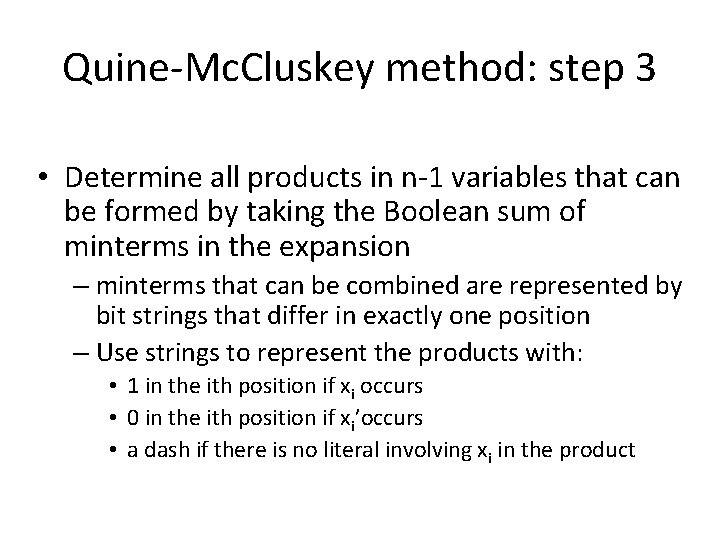
Quine-Mc. Cluskey method: step 3 • Determine all products in n-1 variables that can be formed by taking the Boolean sum of minterms in the expansion – minterms that can be combined are represented by bit strings that differ in exactly one position – Use strings to represent the products with: • 1 in the ith position if xi occurs • 0 in the ith position if xi’occurs • a dash if there is no literal involving xi in the product
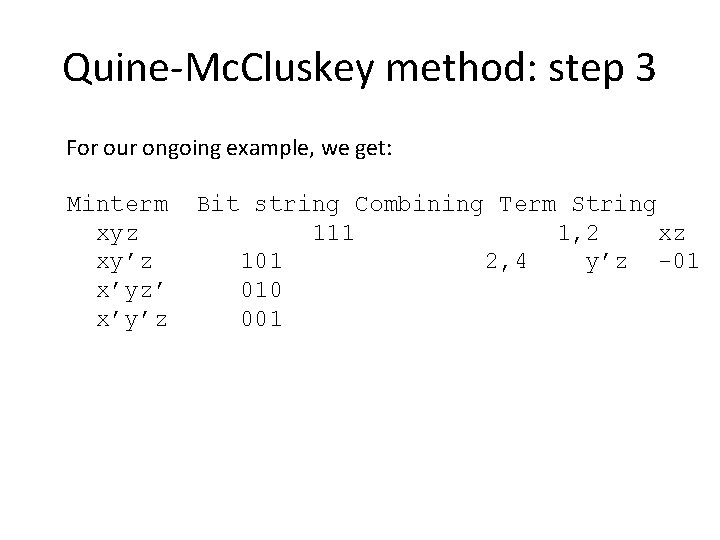
Quine-Mc. Cluskey method: step 3 For our ongoing example, we get: Minterm xyz xy’z x’yz’ x’y’z Bit string Combining Term String 111 1, 2 xz 101 2, 4 y’z -01 010 001
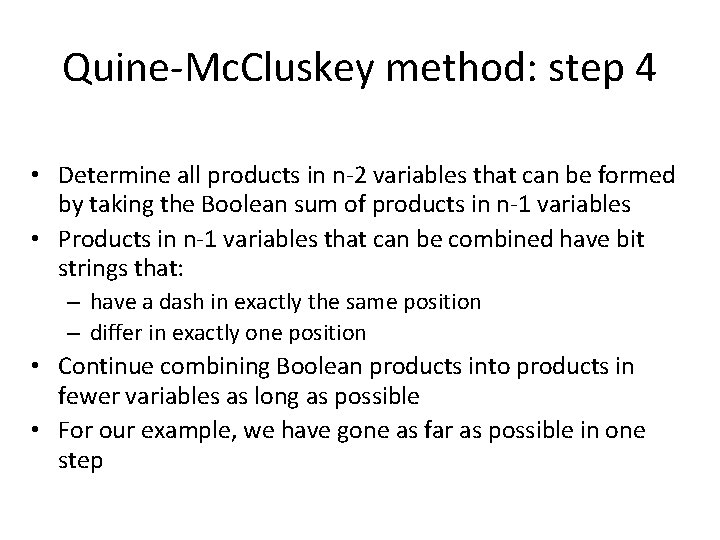
Quine-Mc. Cluskey method: step 4 • Determine all products in n-2 variables that can be formed by taking the Boolean sum of products in n-1 variables • Products in n-1 variables that can be combined have bit strings that: – have a dash in exactly the same position – differ in exactly one position • Continue combining Boolean products into products in fewer variables as long as possible • For our example, we have gone as far as possible in one step
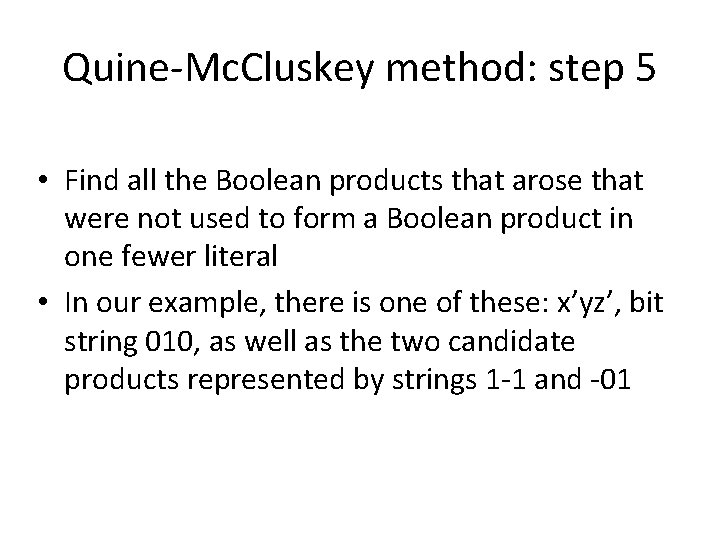
Quine-Mc. Cluskey method: step 5 • Find all the Boolean products that arose that were not used to form a Boolean product in one fewer literal • In our example, there is one of these: x’yz’, bit string 010, as well as the two candidate products represented by strings 1 -1 and -01
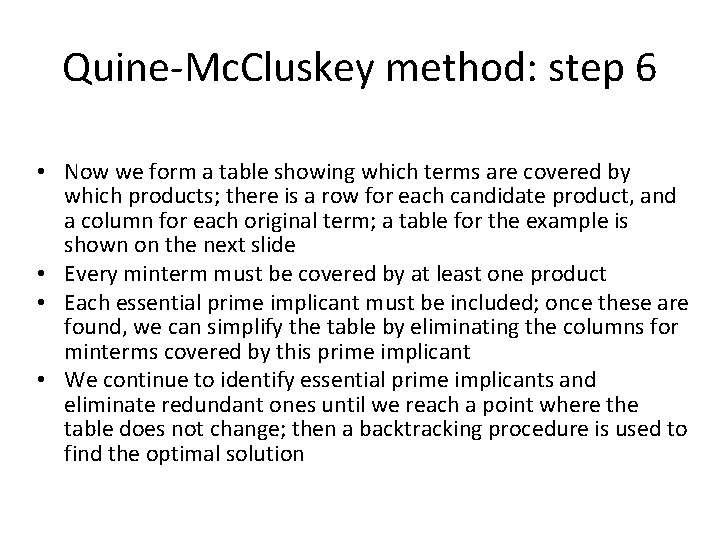
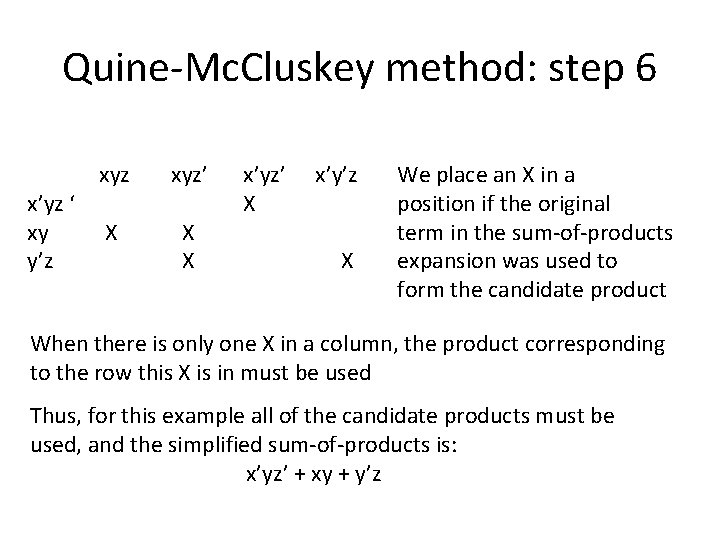
Quine-Mc. Cluskey method: step 6 • Now we form a table showing which terms are covered by which products; there is a row for each candidate product, and a column for each original term; a table for the example is shown on the next slide • Every minterm must be covered by at least one product • Each essential prime implicant must be included; once these are found, we can simplify the table by eliminating the columns for minterms covered by this prime implicant • We continue to identify essential prime implicants and eliminate redundant ones until we reach a point where the table does not change; then a backtracking procedure is used to find the optimal solution
Quine-Mc. Cluskey method: step 6 x’yz ‘ xy y’z xyz’ X X X x’yz’ X x’y’z X We place an X in a position if the original term in the sum-of-products expansion was used to form the candidate product When there is only one X in a column, the product corresponding to the row this X is in must be used Thus, for this example all of the candidate products must be used, and the simplified sum-of-products is: x’yz’ + xy + y’z