
Logic Course Overview Major topics include logic proof
![Negations • Negating formulas for and are analogous: ~ [ x, P(x)] = x,](https://slidetodoc.com/presentation_image_h2/e5b432423a5588e9a087a89478e5c590/image-60.jpg "Negations • Negating formulas for and are analogous: ~ [ x, P(x)] = x,")
- Slides: 69
Logic • Course Overview – Major topics include: logic, proof, sets, counting, functions and relations, recurrences, graphs and trees • Section 2. 1 – statement forms • Commitment: – Try the algebra review – study sections 2. 2 and 2. 3
Introduction • Discrete = math for computer science – Focus on whole number calculations, integers, counting – As opposed to: continuous, real numbers, calculus, measuring • First area of study is logic (a. k. a. boolean algebra) – You see it in programming: && || ! – Also used in computer chip design – And when designing an algorithm: we can use logic to show our method is correct: analysis of if-statements and loops
Logic • Also used to construct a valid argument – Aristotle’s concept of logos • Some of logic looks like algebra, but it’s about statements, not numbers • Statement = basic building block of logic – Definition: a sentence that is true or false but not both! – Truth values could also be written as 1 and 0; yes/no – Examples? • Non-statement would be: question, command, something vague
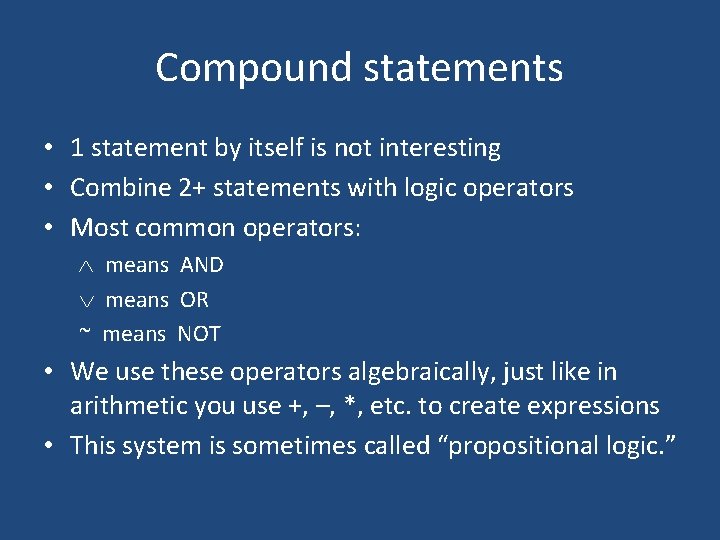
Compound statements • 1 statement by itself is not interesting • Combine 2+ statements with logic operators • Most common operators: means AND means OR ~ means NOT • We use these operators algebraically, just like in arithmetic you use +, –, *, etc. to create expressions • This system is sometimes called “propositional logic. ”
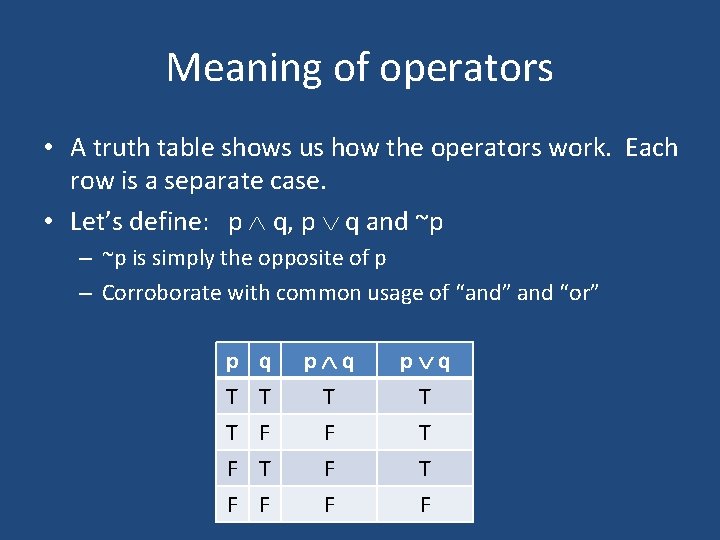
Meaning of operators • A truth table shows us how the operators work. Each row is a separate case. • Let’s define: p q, p q and ~p – ~p is simply the opposite of p – Corroborate with common usage of “and” and “or” p T T F q T F F p q T T T F F
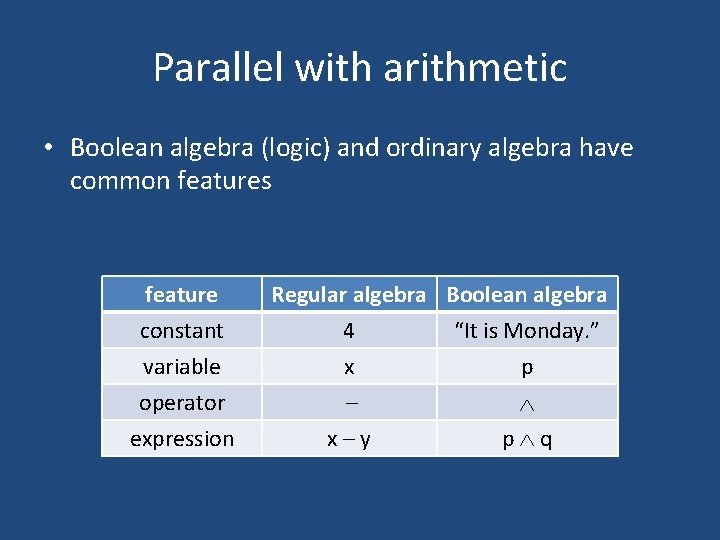
Parallel with arithmetic • Boolean algebra (logic) and ordinary algebra have common features feature constant variable operator expression Regular algebra Boolean algebra 4 “It is Monday. ” x p – x–y p q
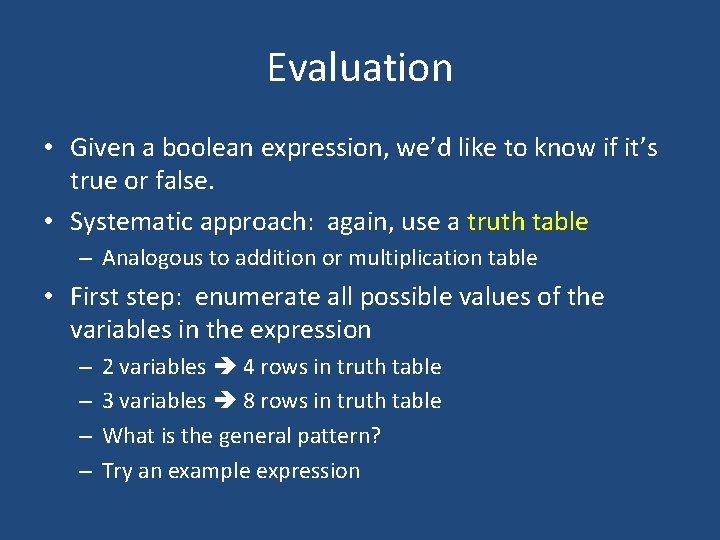
Evaluation • Given a boolean expression, we’d like to know if it’s true or false. • Systematic approach: again, use a truth table – Analogous to addition or multiplication table • First step: enumerate all possible values of the variables in the expression – – 2 variables 4 rows in truth table 3 variables 8 rows in truth table What is the general pattern? Try an example expression
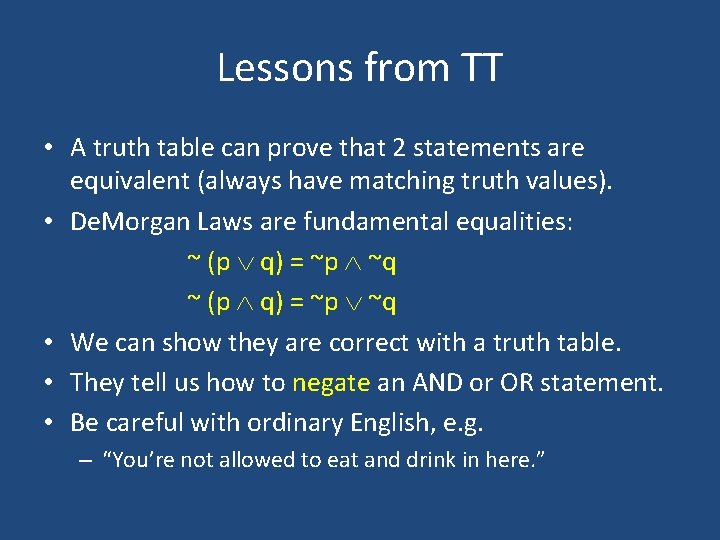
Lessons from TT • A truth table can prove that 2 statements are equivalent (always have matching truth values). • De. Morgan Laws are fundamental equalities: ~ (p q) = ~p ~q • We can show they are correct with a truth table. • They tell us how to negate an AND or OR statement. • Be careful with ordinary English, e. g. – “You’re not allowed to eat and drink in here. ”
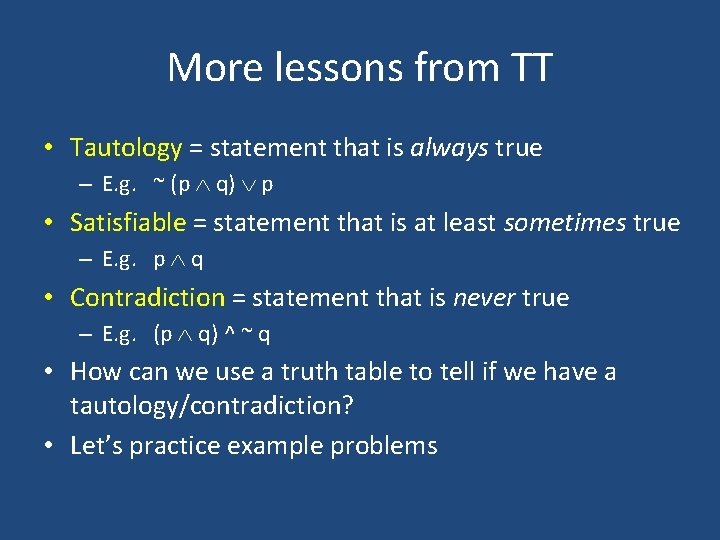
More lessons from TT • Tautology = statement that is always true – E. g. ~ (p q) p • Satisfiable = statement that is at least sometimes true – E. g. p q • Contradiction = statement that is never true – E. g. (p q) ^ ~ q • How can we use a truth table to tell if we have a tautology/contradiction? • Let’s practice example problems
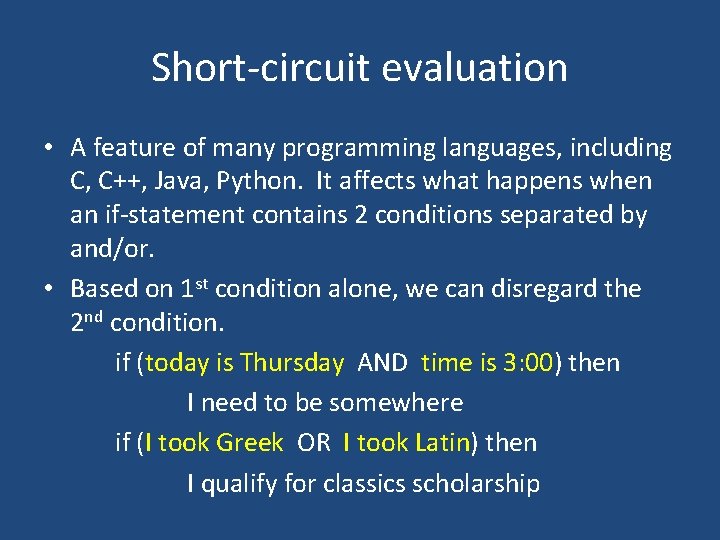
Short-circuit evaluation • A feature of many programming languages, including C, C++, Java, Python. It affects what happens when an if-statement contains 2 conditions separated by and/or. • Based on 1 st condition alone, we can disregard the 2 nd condition. if (today is Thursday AND time is 3: 00) then I need to be somewhere if (I took Greek OR I took Latin) then I qualify for classics scholarship
Practice • Another operator: implication • Different ways to write implications – Equivalence and negation • Arguments – How to tell if valid or invalid – Common forms of valid arguments and fallacies
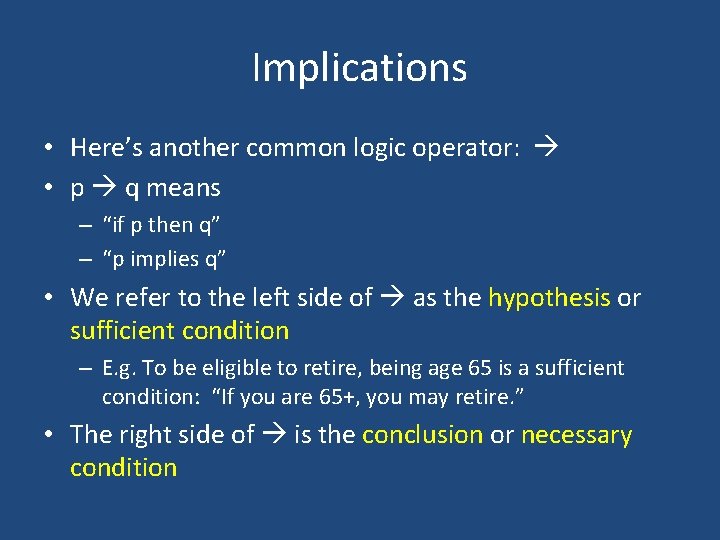
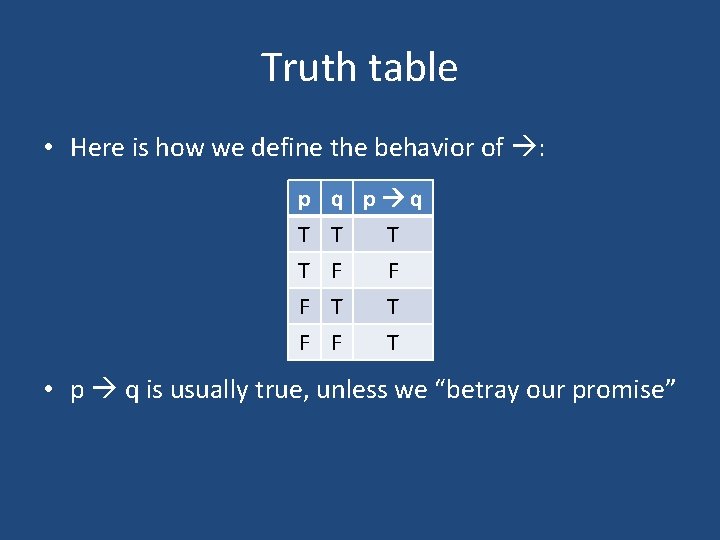
Implications • Here’s another common logic operator: • p q means – “if p then q” – “p implies q” • We refer to the left side of as the hypothesis or sufficient condition – E. g. To be eligible to retire, being age 65 is a sufficient condition: “If you are 65+, you may retire. ” • The right side of is the conclusion or necessary condition
Truth table • Here is how we define the behavior of : p T T F q p q T T F F T • p q is usually true, unless we “betray our promise”
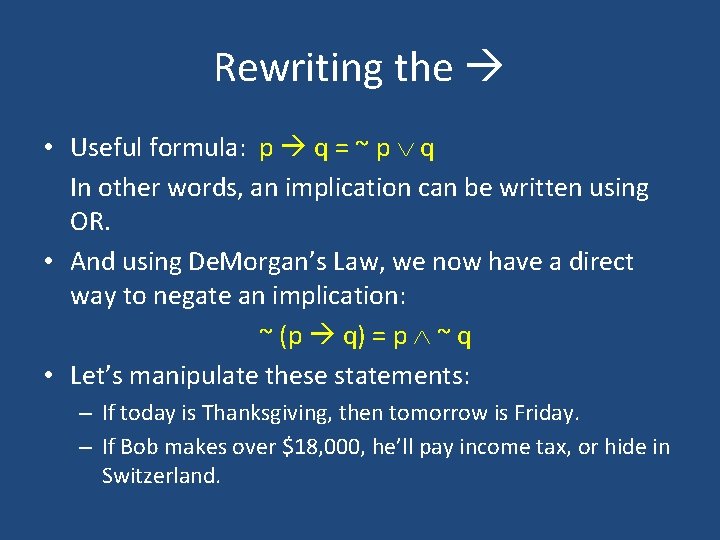
Rewriting the • Useful formula: p q = ~ p q In other words, an implication can be written using OR. • And using De. Morgan’s Law, we now have a direct way to negate an implication: ~ (p q) = p ~ q • Let’s manipulate these statements: – If today is Thanksgiving, then tomorrow is Friday. – If Bob makes over $18, 000, he’ll pay income tax, or hide in Switzerland.
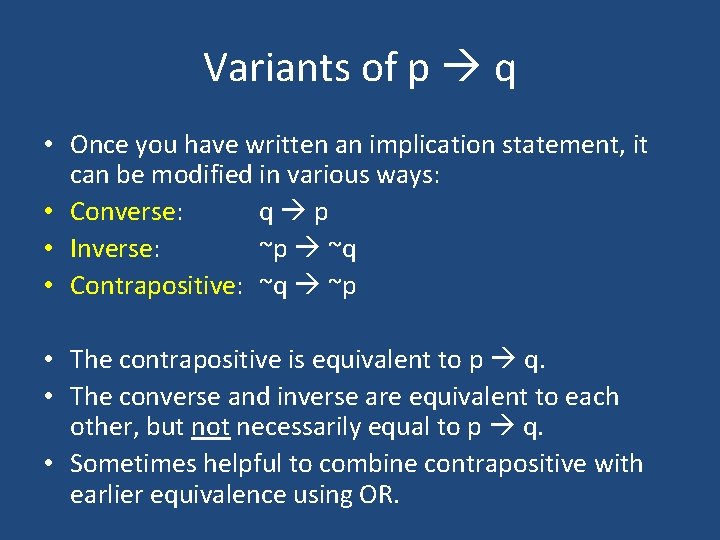
Variants of p q • Once you have written an implication statement, it can be modified in various ways: • Converse: q p • Inverse: ~p ~q • Contrapositive: ~q ~p • The contrapositive is equivalent to p q. • The converse and inverse are equivalent to each other, but not necessarily equal to p q. • Sometimes helpful to combine contrapositive with earlier equivalence using OR.
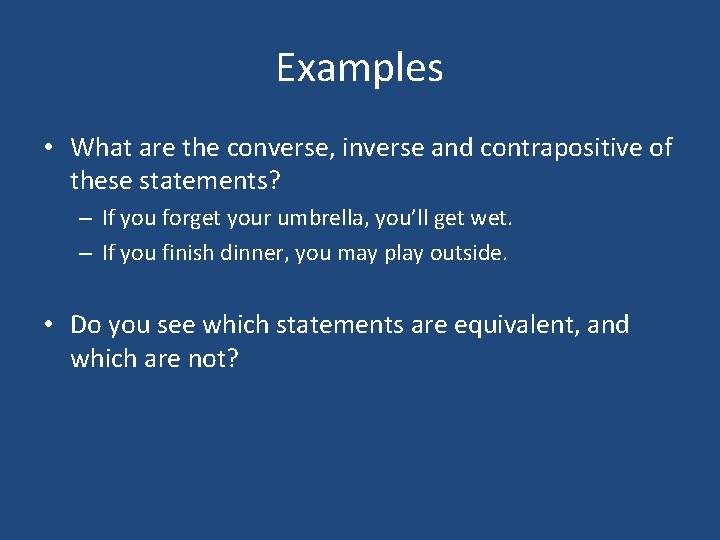
Examples • What are the converse, inverse and contrapositive of these statements? – If you forget your umbrella, you’ll get wet. – If you finish dinner, you may play outside. • Do you see which statements are equivalent, and which are not?
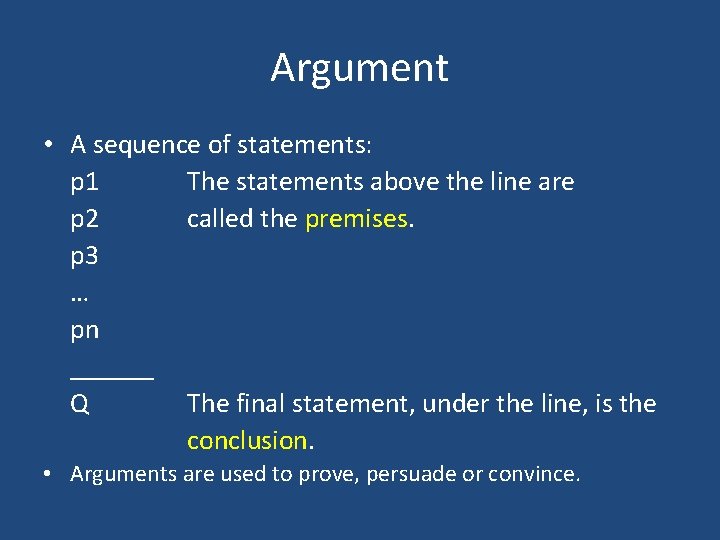
Argument • A sequence of statements: p 1 The statements above the line are p 2 called the premises. p 3 … pn ______ Q The final statement, under the line, is the conclusion. • Arguments are used to prove, persuade or convince.
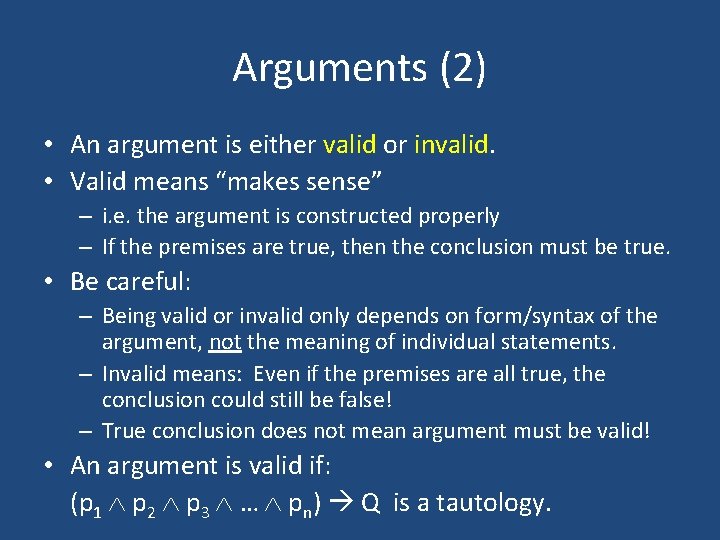
Arguments (2) • An argument is either valid or invalid. • Valid means “makes sense” – i. e. the argument is constructed properly – If the premises are true, then the conclusion must be true. • Be careful: – Being valid or invalid only depends on form/syntax of the argument, not the meaning of individual statements. – Invalid means: Even if the premises are all true, the conclusion could still be false! – True conclusion does not mean argument must be valid! • An argument is valid if: (p 1 p 2 p 3 … pn) Q is a tautology.
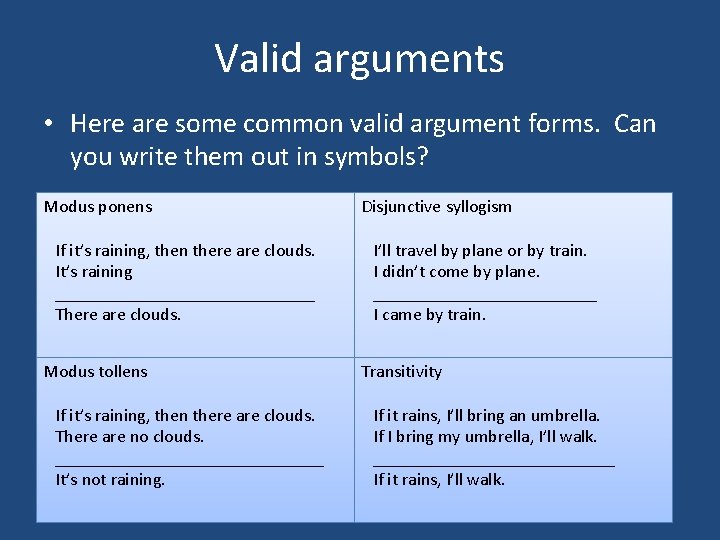
Valid arguments • Here are some common valid argument forms. Can you write them out in symbols? Modus ponens If it’s raining, then there are clouds. It’s raining _______________ There are clouds. Modus tollens If it’s raining, then there are clouds. There are no clouds. _______________ It’s not raining. Disjunctive syllogism I’ll travel by plane or by train. I didn’t come by plane. _____________ I came by train. Transitivity If it rains, I’ll bring an umbrella. If I bring my umbrella, I’ll walk. ______________ If it rains, I’ll walk.
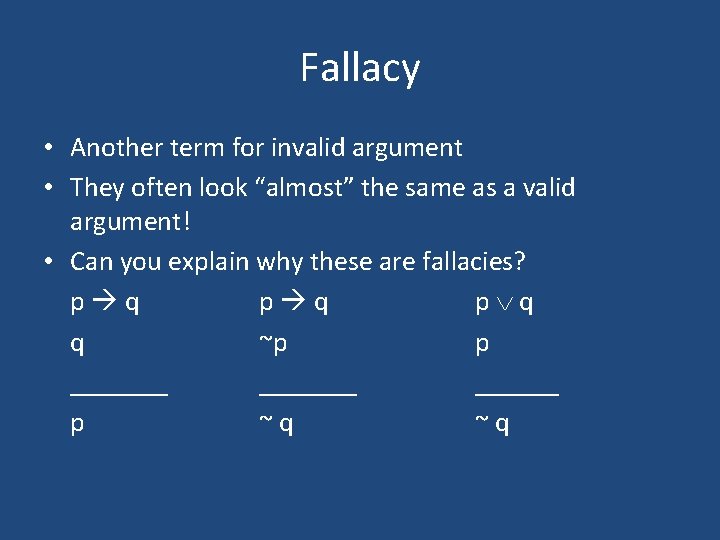
Fallacy • Another term for invalid argument • They often look “almost” the same as a valid argument! • Can you explain why these are fallacies? p q p q q ~p p _______ p ~q ~q
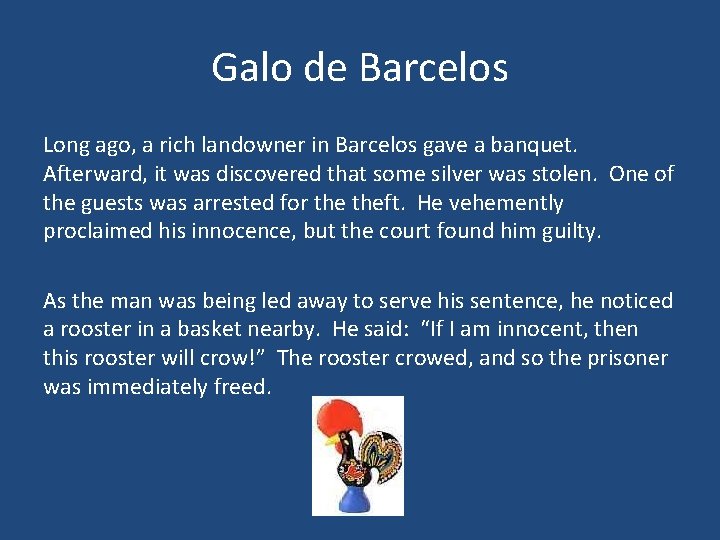
Galo de Barcelos Long ago, a rich landowner in Barcelos gave a banquet. Afterward, it was discovered that some silver was stolen. One of the guests was arrested for theft. He vehemently proclaimed his innocence, but the court found him guilty. As the man was being led away to serve his sentence, he noticed a rooster in a basket nearby. He said: “If I am innocent, then this rooster will crow!” The rooster crowed, and so the prisoner was immediately freed.
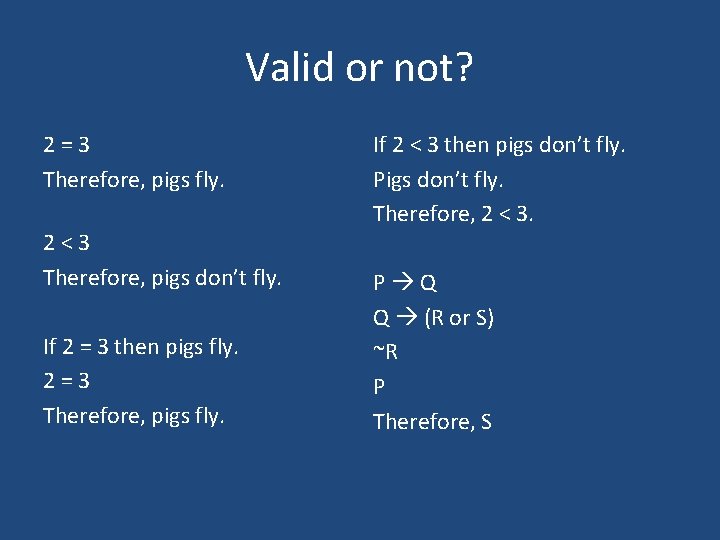
Valid or not? 2=3 Therefore, pigs fly. 2<3 Therefore, pigs don’t fly. If 2 = 3 then pigs fly. 2=3 Therefore, pigs fly. If 2 < 3 then pigs don’t fly. Pigs don’t fly. Therefore, 2 < 3. P Q Q (R or S) ~R P Therefore, S
Puzzle Use truth tables to solve…. A pilgrim came to a fork in the road. One road led to safety, and the other to death. In each fork stood a guardian. They were twins. One twin always spoke the truth and the other always lied. The pilgrim was allowed only one question. And to save his life he had to find out which road led to safety. So what did he ask? Dick Francis. Decider. Putnam (1993), pp. 141 -143.
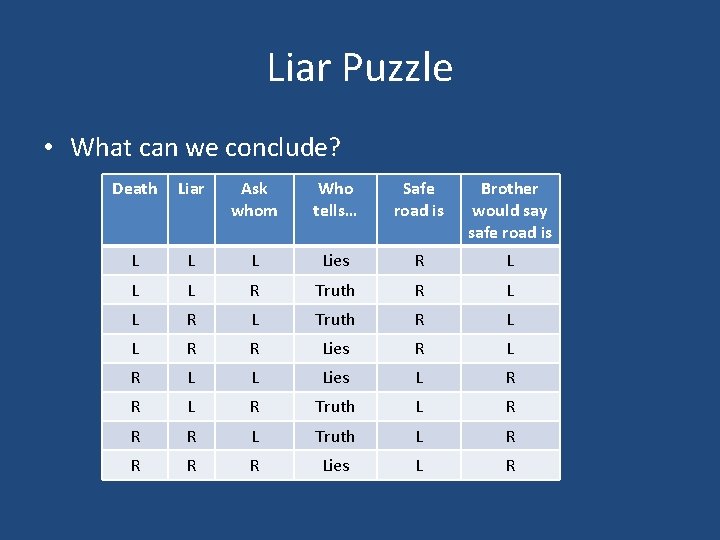
Liar Puzzle • What can we conclude? Death Liar Ask whom Who tells… Safe road is Brother would say safe road is L Lies R L L L R Truth R L L R L Truth R L L R R Lies R L L Lies L R R L R Truth L R R R L Truth L R R Lies L R
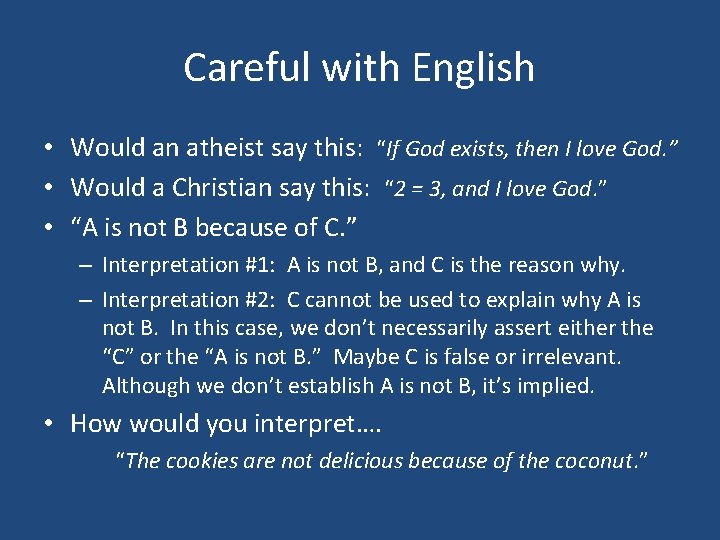
Careful with English • Would an atheist say this: “If God exists, then I love God. ” • Would a Christian say this: “ 2 = 3, and I love God. ” • “A is not B because of C. ” – Interpretation #1: A is not B, and C is the reason why. – Interpretation #2: C cannot be used to explain why A is not B. In this case, we don’t necessarily assert either the “C” or the “A is not B. ” Maybe C is false or irrelevant. Although we don’t establish A is not B, it’s implied. • How would you interpret…. “The cookies are not delicious because of the coconut. ”
Applications of logic • Digital circuits – Notation – Operators become gates – Universal gates • Boolean function digital circuit • Given desired T. T. , construct formula or circuit
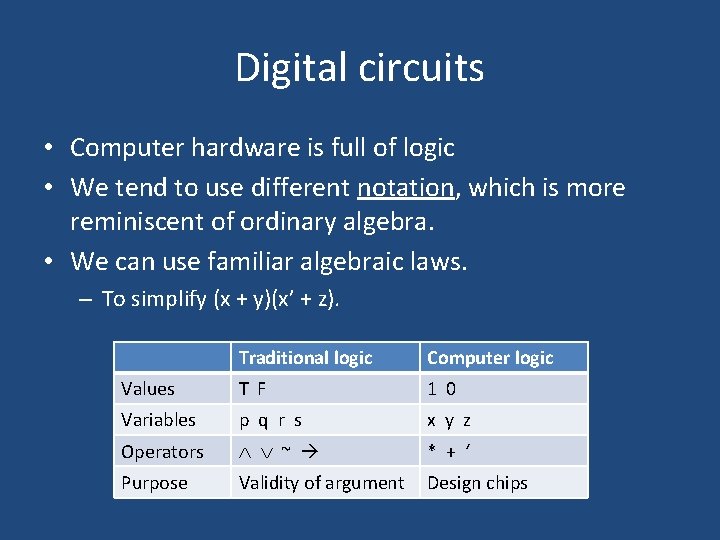
Digital circuits • Computer hardware is full of logic • We tend to use different notation, which is more reminiscent of ordinary algebra. • We can use familiar algebraic laws. – To simplify (x + y)(x’ + z). Traditional logic Computer logic Values T F 1 0 Variables p q r s x y z Operators ~ * + ‘ Purpose Validity of argument Design chips
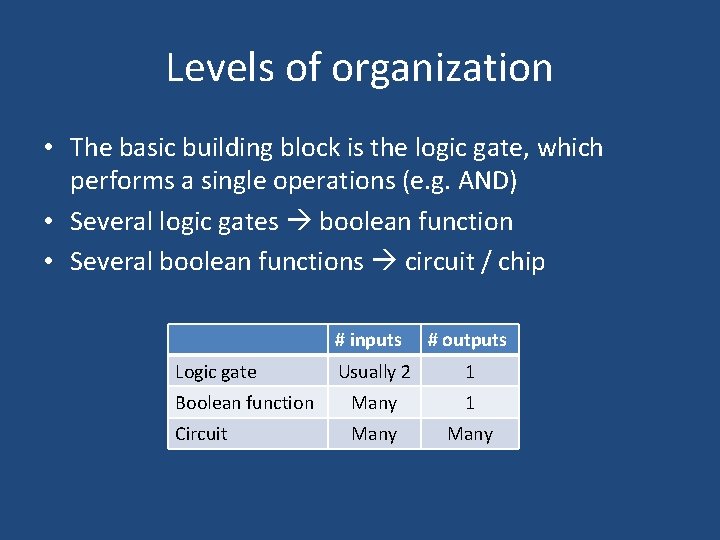
Levels of organization • The basic building block is the logic gate, which performs a single operations (e. g. AND) • Several logic gates boolean function • Several boolean functions circuit / chip # inputs # outputs Usually 2 1 Boolean function Many 1 Circuit Many Logic gate
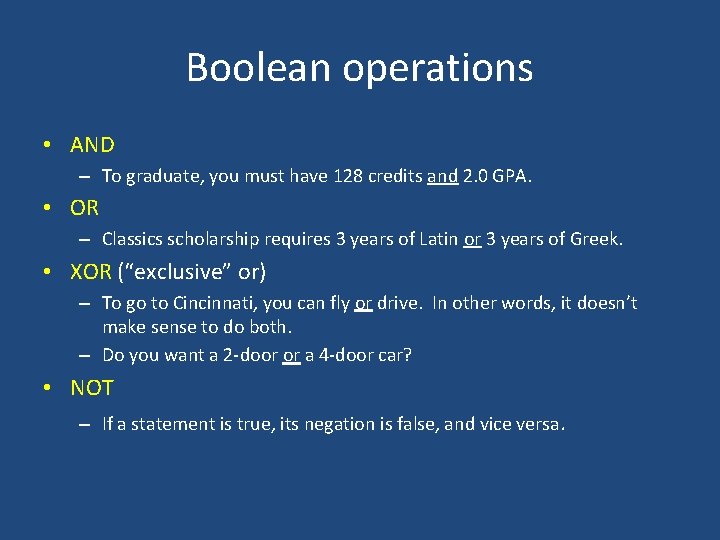
Boolean operations • AND – To graduate, you must have 128 credits and 2. 0 GPA. • OR – Classics scholarship requires 3 years of Latin or 3 years of Greek. • XOR (“exclusive” or) – To go to Cincinnati, you can fly or drive. In other words, it doesn’t make sense to do both. – Do you want a 2 -door or a 4 -door car? • NOT – If a statement is true, its negation is false, and vice versa.
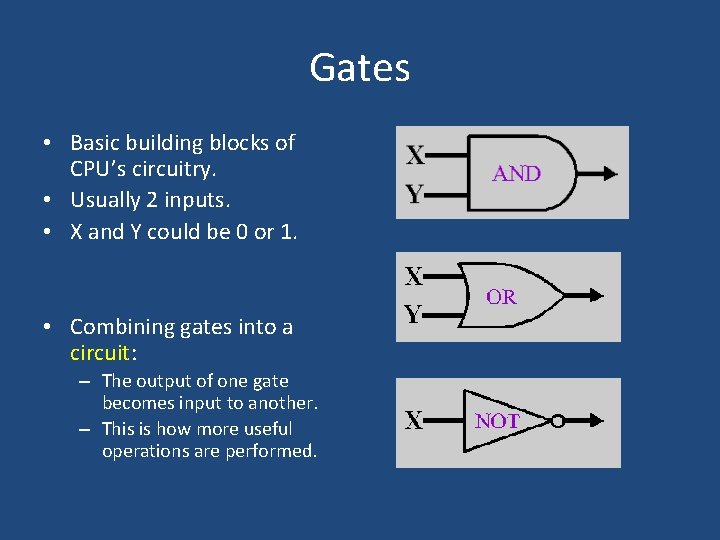
Gates • Basic building blocks of CPU’s circuitry. • Usually 2 inputs. • X and Y could be 0 or 1. • Combining gates into a circuit: – The output of one gate becomes input to another. – This is how more useful operations are performed.
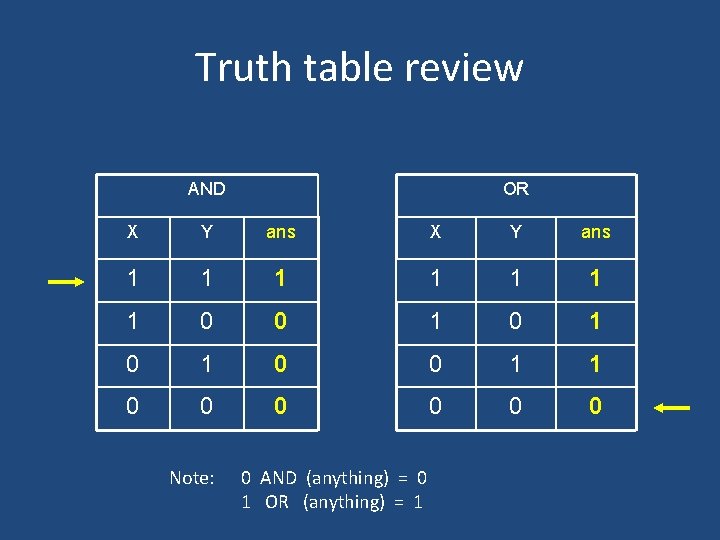
Truth table review AND OR X Y ans 1 1 1 1 0 0 1 0 1 0 0 1 1 0 0 0 Note: 0 AND (anything) = 0 1 OR (anything) = 1
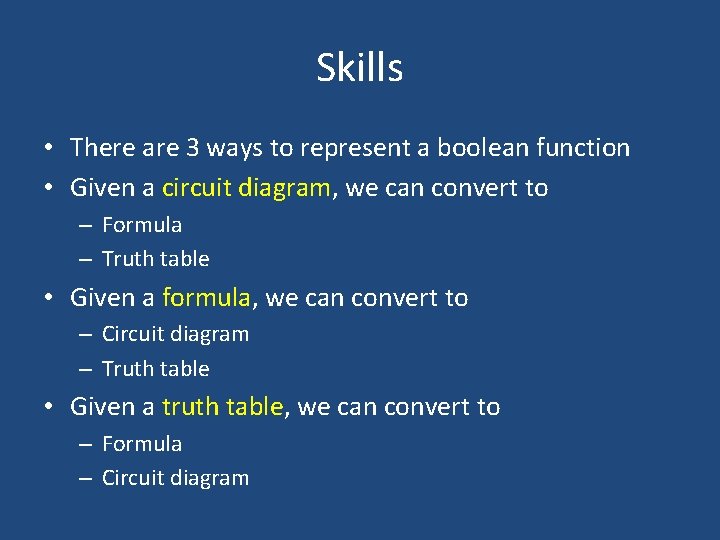
Skills • There are 3 ways to represent a boolean function • Given a circuit diagram, we can convert to – Formula – Truth table • Given a formula, we can convert to – Circuit diagram – Truth table • Given a truth table, we can convert to – Formula – Circuit diagram
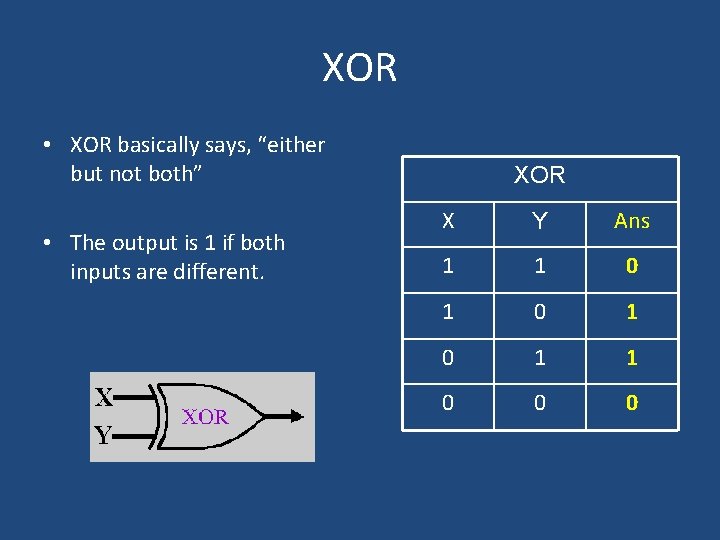
XOR • XOR basically says, “either but not both” • The output is 1 if both inputs are different. XOR X Y Ans 1 1 0 1 0 1 1 0 0 0
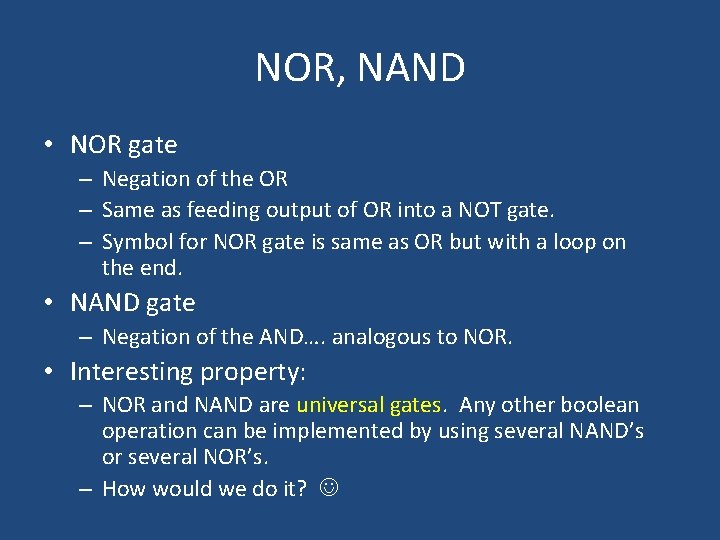
NOR, NAND • NOR gate – Negation of the OR – Same as feeding output of OR into a NOT gate. – Symbol for NOR gate is same as OR but with a loop on the end. • NAND gate – Negation of the AND…. analogous to NOR. • Interesting property: – NOR and NAND are universal gates. Any other boolean operation can be implemented by using several NAND’s or several NOR’s. – How would we do it?
Boolean function • Just another name for a compound statement – Example: F = xy + z’ • Can represent in various ways – Formula – Truth table: focus on which rows yield value of True – Drawing • Skill: if given drawing, we can write the formula • Shorthand: possible for gates to take > 2 inputs
Examples • • I’ll draw a circuit. You figure out the formula. Draw the circuit for F = xyz’ + xy’ How would you rewrite x’ using only NAND? How would you rewrite xy using only NAND?
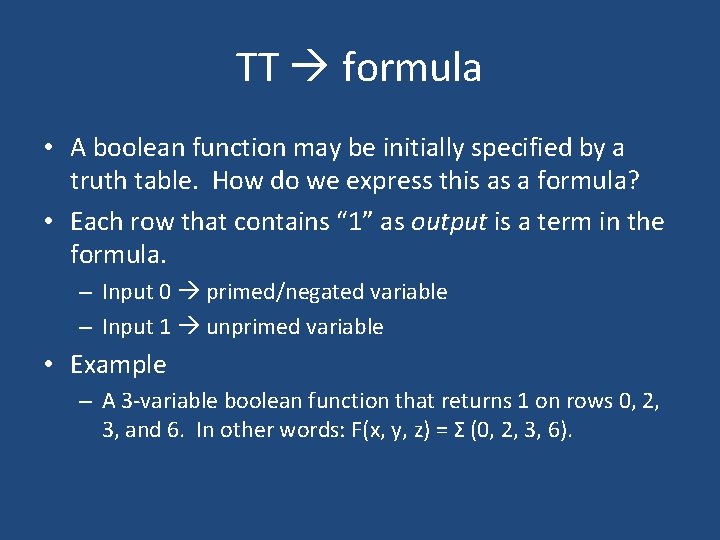
TT formula • A boolean function may be initially specified by a truth table. How do we express this as a formula? • Each row that contains “ 1” as output is a term in the formula. – Input 0 primed/negated variable – Input 1 unprimed variable • Example – A 3 -variable boolean function that returns 1 on rows 0, 2, 3, and 6. In other words: F(x, y, z) = Σ (0, 2, 3, 6).
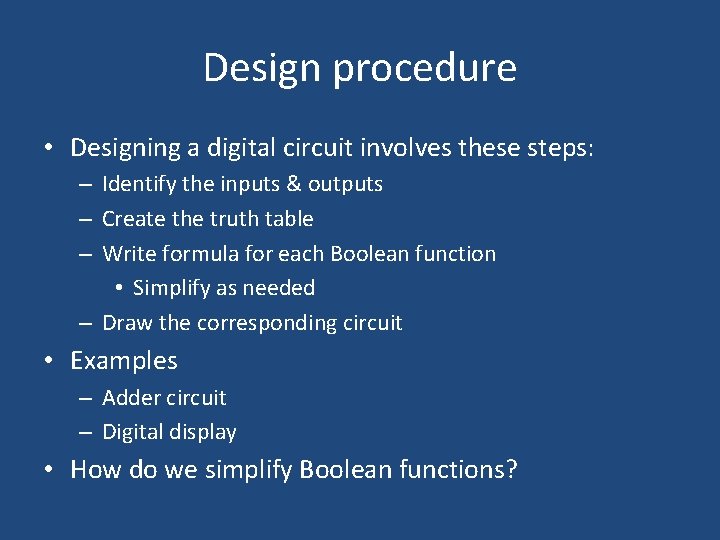
Design procedure • Designing a digital circuit involves these steps: – Identify the inputs & outputs – Create the truth table – Write formula for each Boolean function • Simplify as needed – Draw the corresponding circuit • Examples – Adder circuit – Digital display • How do we simplify Boolean functions?
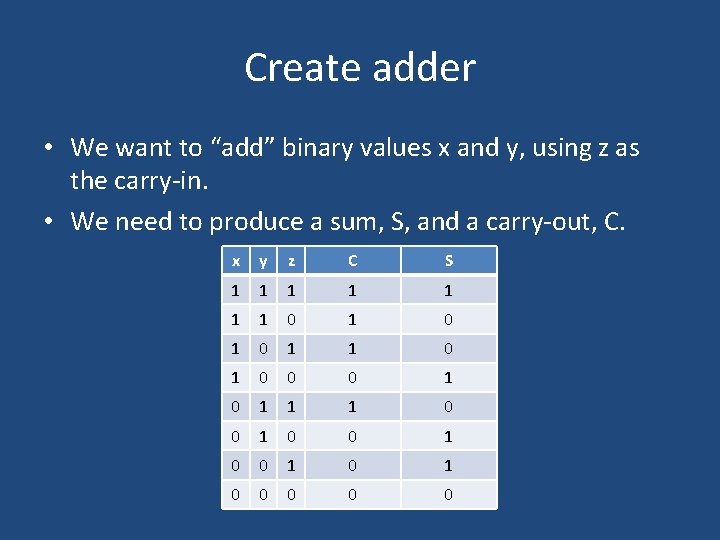
Create adder • We want to “add” binary values x and y, using z as the carry-in. • We need to produce a sum, S, and a carry-out, C. x y z C S 1 1 1 1 0 1 0 1 0 0 0 1 1 1 0 0 1 0 0 0
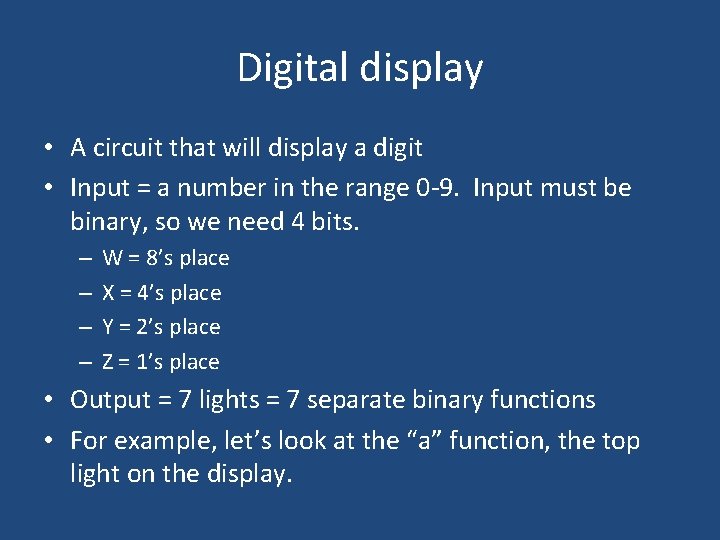
Digital display • A circuit that will display a digit • Input = a number in the range 0 -9. Input must be binary, so we need 4 bits. – – W = 8’s place X = 4’s place Y = 2’s place Z = 1’s place • Output = 7 lights = 7 separate binary functions • For example, let’s look at the “a” function, the top light on the display.
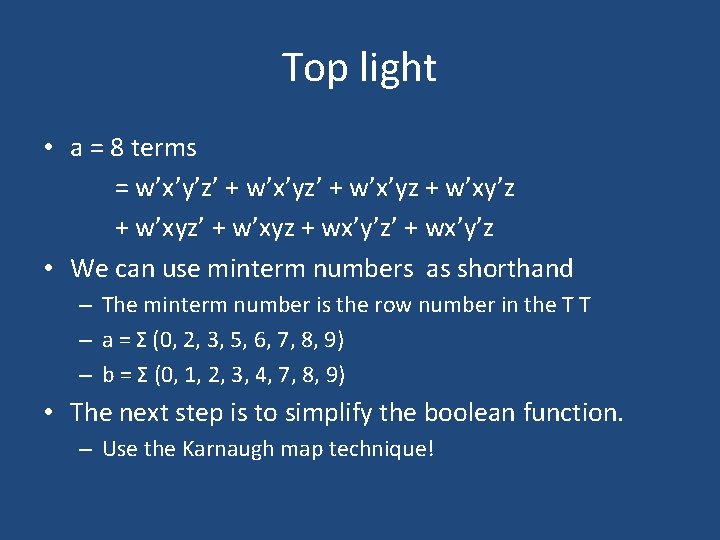
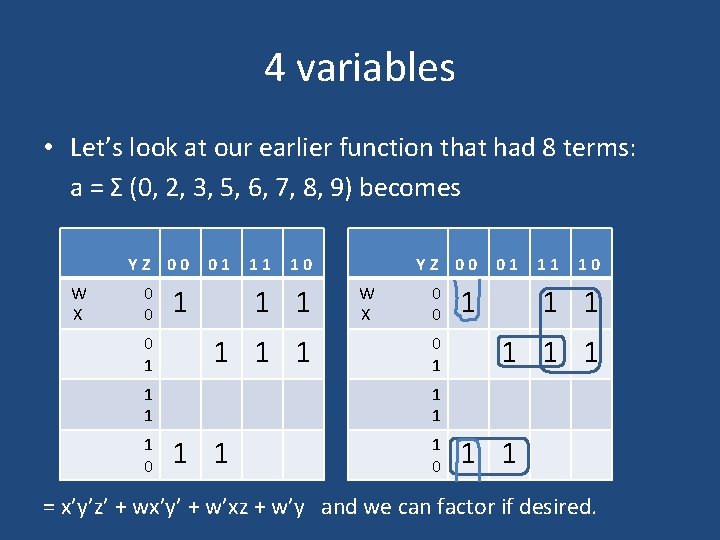
Top light • a = 8 terms = w’x’y’z’ + w’x’yz + w’xy’z + w’xyz’ + w’xyz + wx’y’z’ + wx’y’z • We can use minterm numbers as shorthand – The minterm number is the row number in the T T – a = Σ (0, 2, 3, 5, 6, 7, 8, 9) – b = Σ (0, 1, 2, 3, 4, 7, 8, 9) • The next step is to simplify the boolean function. – Use the Karnaugh map technique!
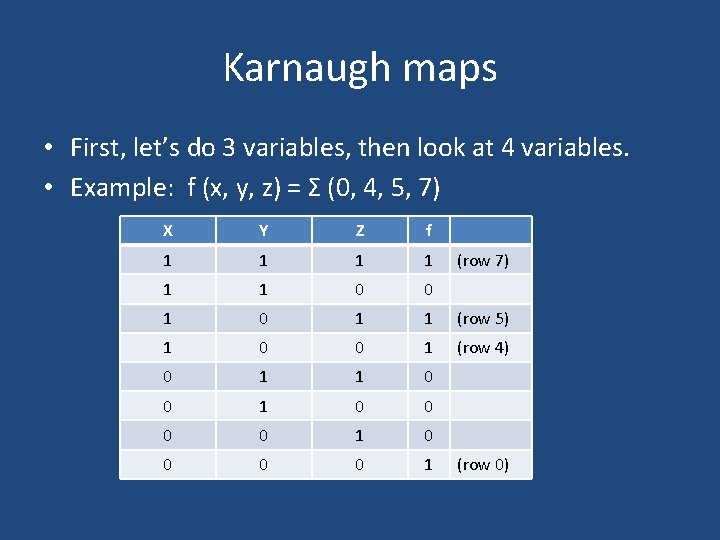
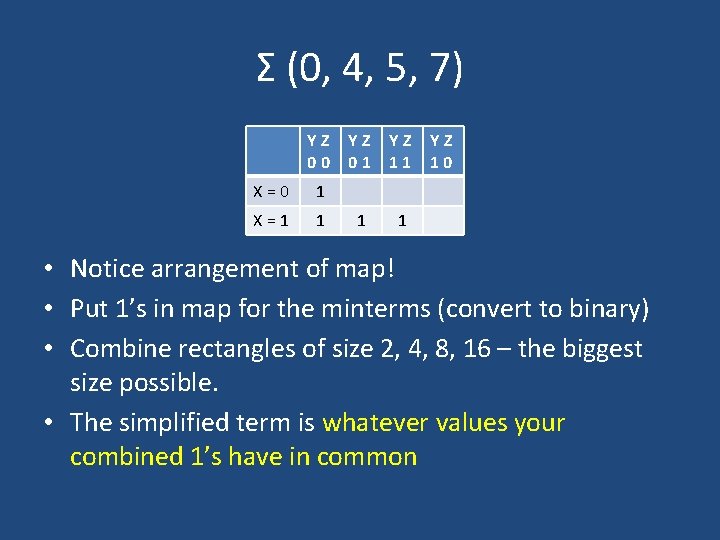
Karnaugh maps • First, let’s do 3 variables, then look at 4 variables. • Example: f (x, y, z) = Σ (0, 4, 5, 7) X Y Z f 1 1 1 0 0 1 1 (row 5) 1 0 0 1 (row 4) 0 1 1 0 0 0 0 1 (row 7) (row 0)
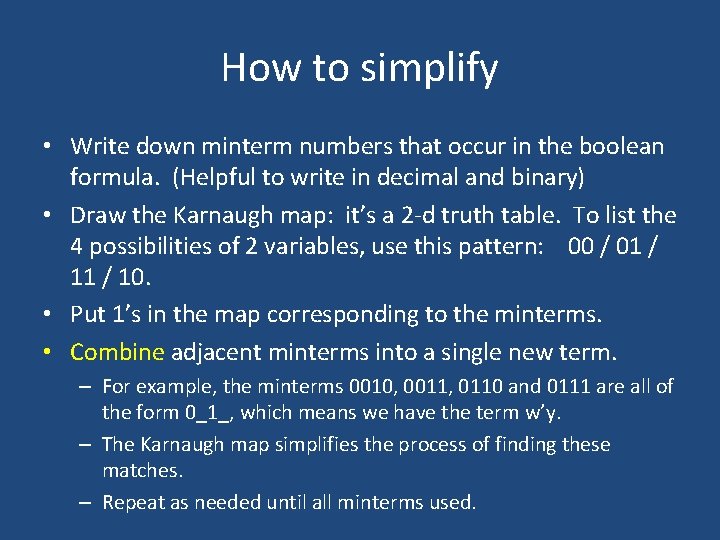
How to simplify • Write down minterm numbers that occur in the boolean formula. (Helpful to write in decimal and binary) • Draw the Karnaugh map: it’s a 2 -d truth table. To list the 4 possibilities of 2 variables, use this pattern: 00 / 01 / 10. • Put 1’s in the map corresponding to the minterms. • Combine adjacent minterms into a single new term. – For example, the minterms 0010, 0011, 0110 and 0111 are all of the form 0_1_, which means we have the term w’y. – The Karnaugh map simplifies the process of finding these matches. – Repeat as needed until all minterms used.
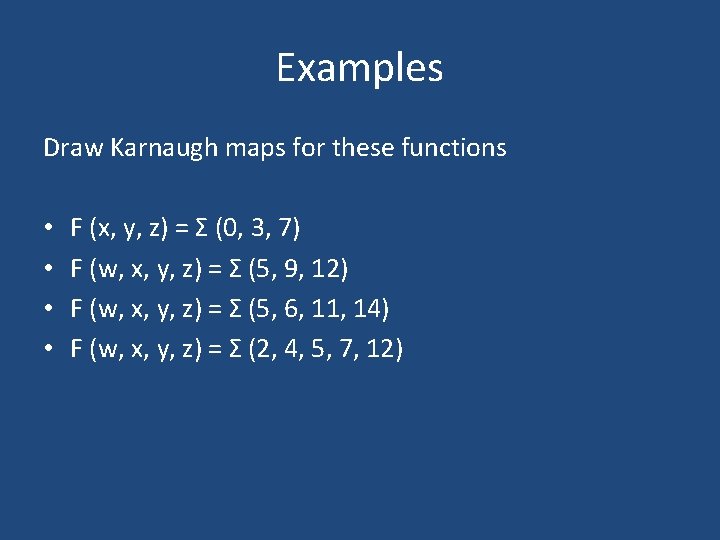
Examples Draw Karnaugh maps for these functions • • F (x, y, z) = Σ (0, 3, 7) F (w, x, y, z) = Σ (5, 9, 12) F (w, x, y, z) = Σ (5, 6, 11, 14) F (w, x, y, z) = Σ (2, 4, 5, 7, 12)
Σ (0, 4, 5, 7) YZ 00 X=0 1 X=1 1 YZ 01 YZ 11 1 1 YZ 10 • Notice arrangement of map! • Put 1’s in map for the minterms (convert to binary) • Combine rectangles of size 2, 4, 8, 16 – the biggest size possible. • The simplified term is whatever values your combined 1’s have in common
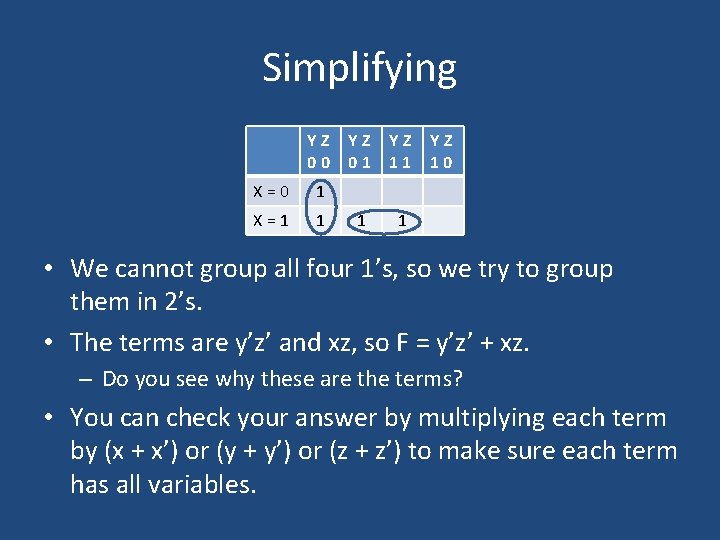
Simplifying YZ 00 X=0 1 X=1 1 YZ 01 YZ 11 1 1 YZ 10 • We cannot group all four 1’s, so we try to group them in 2’s. • The terms are y’z’ and xz, so F = y’z’ + xz. – Do you see why these are the terms? • You can check your answer by multiplying each term by (x + x’) or (y + y’) or (z + z’) to make sure each term has all variables.
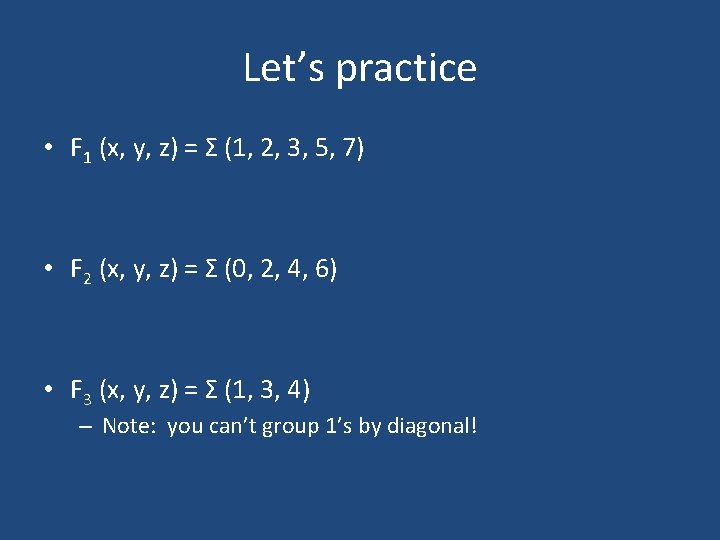
Let’s practice • F 1 (x, y, z) = Σ (1, 2, 3, 5, 7) • F 2 (x, y, z) = Σ (0, 2, 4, 6) • F 3 (x, y, z) = Σ (1, 3, 4) – Note: you can’t group 1’s by diagonal!
4 variables • Let’s look at our earlier function that had 8 terms: a = Σ (0, 2, 3, 5, 6, 7, 8, 9) becomes YZ 00 W X 0 0 0 1 01 1 10 1 1 1 1 0 11 YZ 00 W X 0 0 0 1 01 1 11 10 1 1 1 1 1 0 1 1 = x’y’z’ + wx’y’ + w’xz + w’y and we can factor if desired.
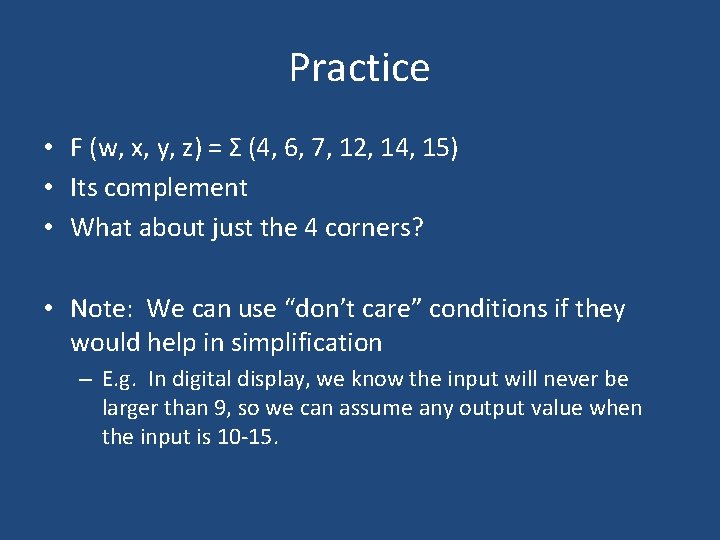
Practice • F (w, x, y, z) = Σ (4, 6, 7, 12, 14, 15) • Its complement • What about just the 4 corners? • Note: We can use “don’t care” conditions if they would help in simplification – E. g. In digital display, we know the input will never be larger than 9, so we can assume any output value when the input is 10 -15.
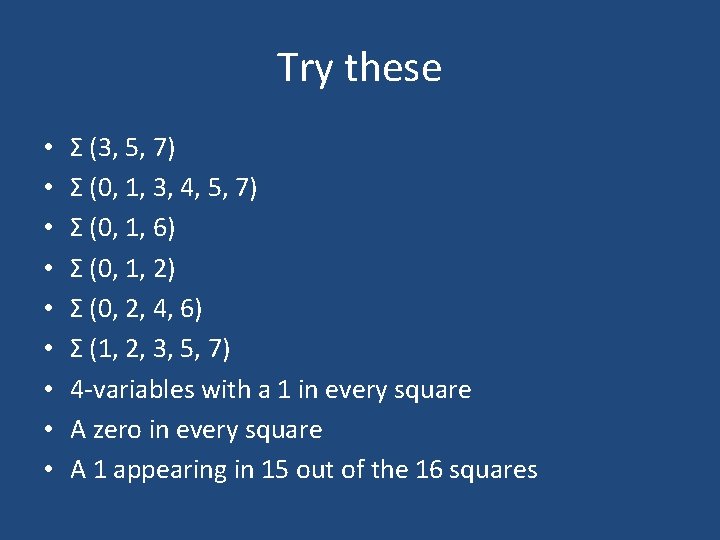
Try these • • • Σ (3, 5, 7) Σ (0, 1, 3, 4, 5, 7) Σ (0, 1, 6) Σ (0, 1, 2) Σ (0, 2, 4, 6) Σ (1, 2, 3, 5, 7) 4 -variables with a 1 in every square A zero in every square A 1 appearing in 15 out of the 16 squares
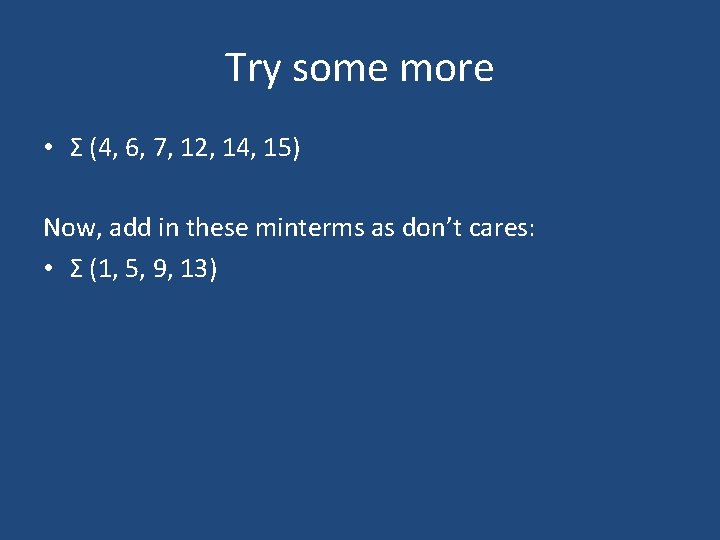
Try some more • Σ (4, 6, 7, 12, 14, 15) Now, add in these minterms as don’t cares: • Σ (1, 5, 9, 13)
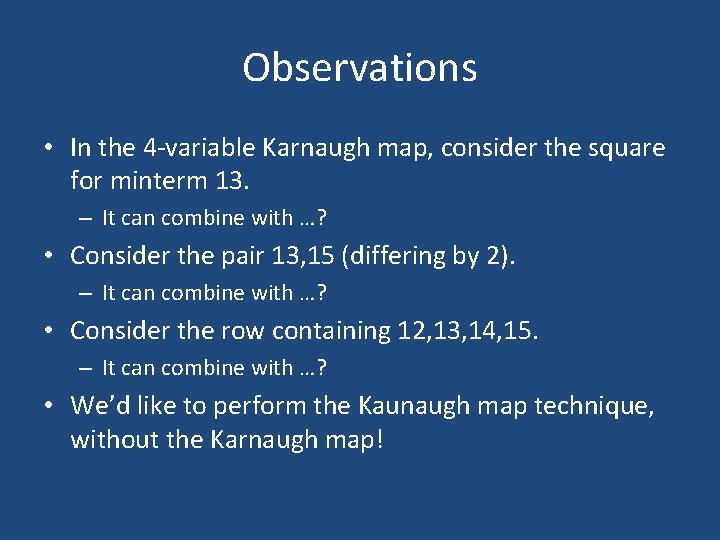
Observations • In the 4 -variable Karnaugh map, consider the square for minterm 13. – It can combine with …? • Consider the pair 13, 15 (differing by 2). – It can combine with …? • Consider the row containing 12, 13, 14, 15. – It can combine with …? • We’d like to perform the Kaunaugh map technique, without the Karnaugh map!
Quine-Mc. Cluskey • Karnaugh maps are difficult to use with > 4 variables. • QM manipulates minterm numbers, can be implemented in computer program. • See handout (Mano pp. 101 -108) • Steps to follow – Group minterms by how many 1’s in their binary rep’n – Combine minterms that differ in exactly 1 bit position. Check them off, and create combined minterm (e. g. “ 0, 2”) – Combine any combined-minterms if they omit the same variable and their bits differ in 1 position. Check them off, and create yet another combined minterm. – When done, all unchecked terms are prime implicants.
Quantified statements • • Convert between English and notation Truth value & negation Vacuous truth Multiple quantifiers • This system is sometimes called “first-order logic”
Quantified statements • Many logical statements contain “all”, “some” or “no” – Similarly for Venn diagram relationships • We use quantifier to turn vague sentence into a logical statement. – “A number is positive. ” “All/some/no numbers are positive. ” – “A person has a dog. ” “Everybody has a dog” “Somebody… “ or “Nobody …” • In logic, we use quantifier symbols (there exists) (for all)
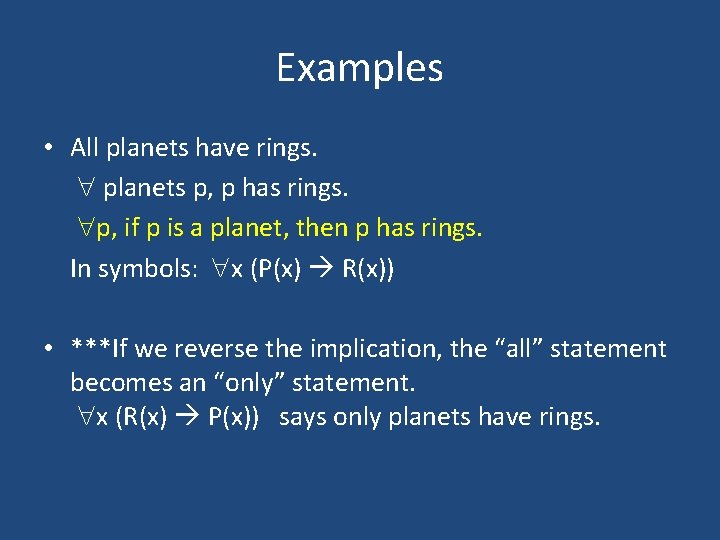
Examples • All planets have rings. planets p, p has rings. p, if p is a planet, then p has rings. In symbols: x (P(x) R(x)) • ***If we reverse the implication, the “all” statement becomes an “only” statement. x (R(x) P(x)) says only planets have rings.
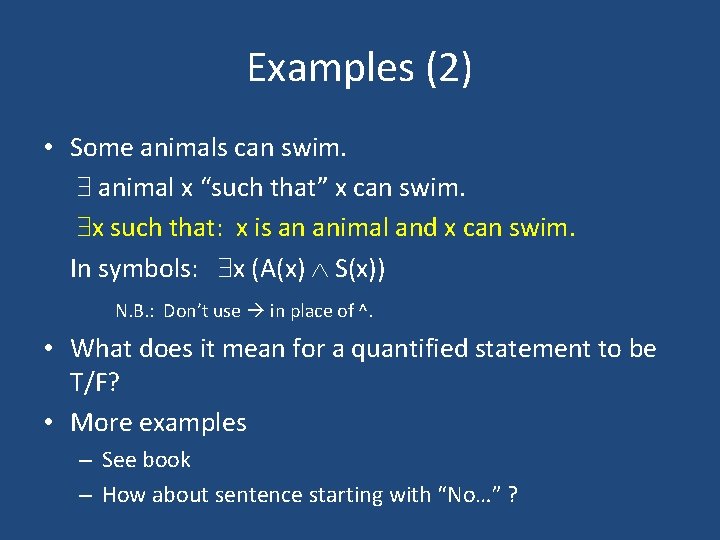
Examples (2) • Some animals can swim. animal x “such that” x can swim. x such that: x is an animal and x can swim. In symbols: x (A(x) S(x)) N. B. : Don’t use in place of ^. • What does it mean for a quantified statement to be T/F? • More examples – See book – How about sentence starting with “No…” ?
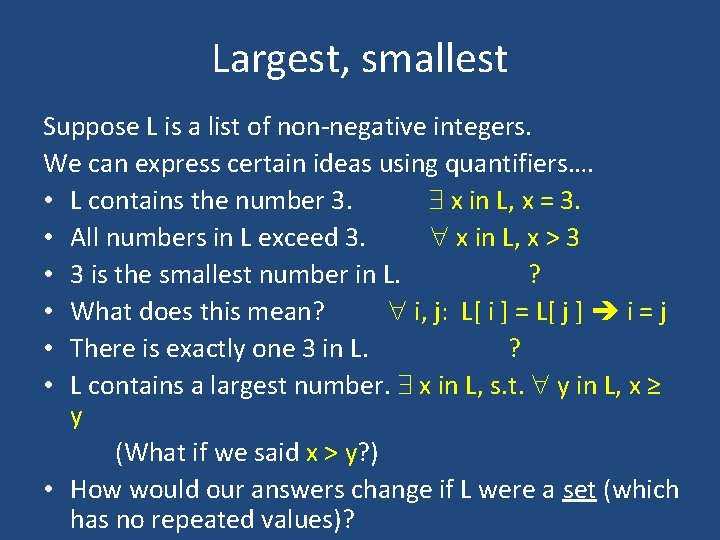
Largest, smallest Suppose L is a list of non-negative integers. We can express certain ideas using quantifiers…. • L contains the number 3. x in L, x = 3. • All numbers in L exceed 3. x in L, x > 3 • 3 is the smallest number in L. ? • What does this mean? i, j: L[ i ] = L[ j ] i = j • There is exactly one 3 in L. ? • L contains a largest number. x in L, s. t. y in L, x ≥ y (What if we said x > y? ) • How would our answers change if L were a set (which has no repeated values)?
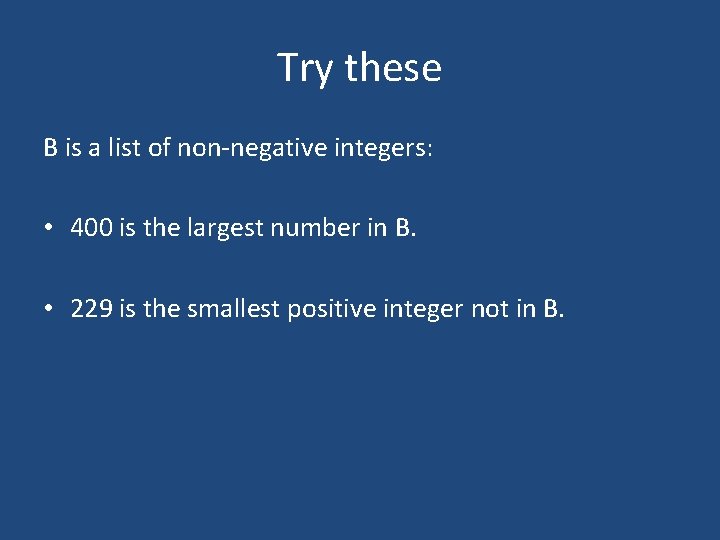
Try these B is a list of non-negative integers: • 400 is the largest number in B. • 229 is the smallest positive integer not in B.
Negations • Negating formulas for and are analogous: ~ [ x, P(x)] = x, ~P(x) • What do these formulas say? • Examples to negate: – Vegemite will put a rose in every cheek. – All dolphins are charming and good looking. – Some snakes are non-venomous.
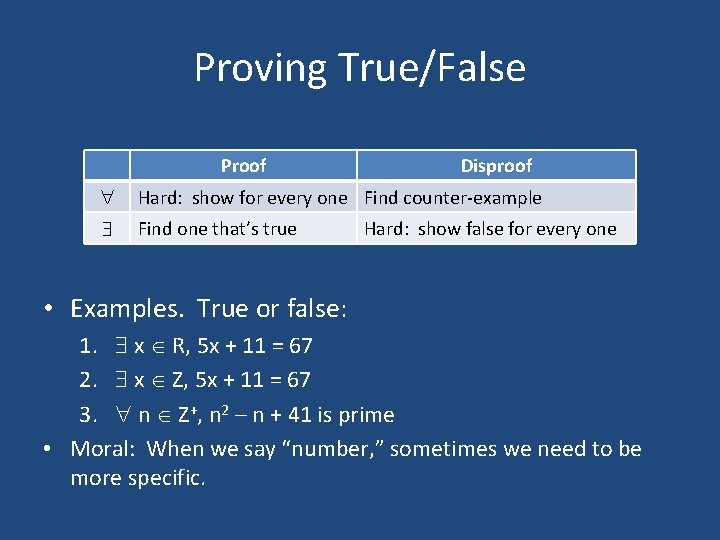
Proving True/False Proof Disproof Hard: show for every one Find counter-example Find one that’s true Hard: show false for every one • Examples. True or false: 1. x R, 5 x + 11 = 67 2. x Z, 5 x + 11 = 67 3. n Z+, n 2 – n + 41 is prime • Moral: When we say “number, ” sometimes we need to be more specific.
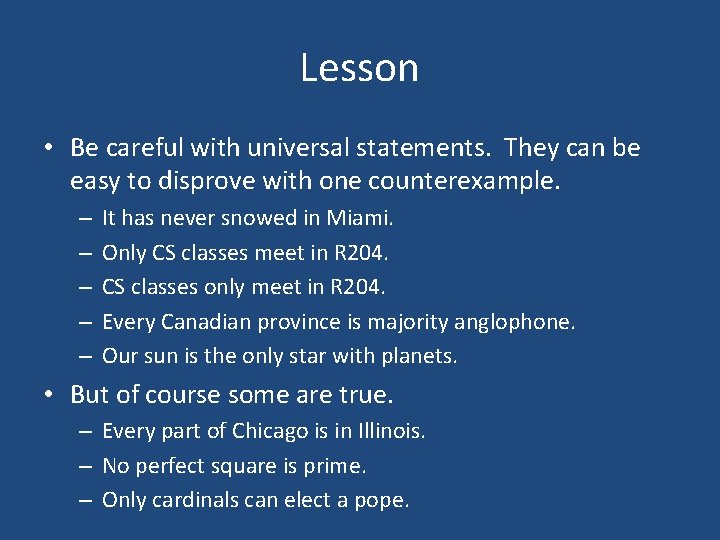
Lesson • Be careful with universal statements. They can be easy to disprove with one counterexample. – – – It has never snowed in Miami. Only CS classes meet in R 204. CS classes only meet in R 204. Every Canadian province is majority anglophone. Our sun is the only star with planets. • But of course some are true. – Every part of Chicago is in Illinois. – No perfect square is prime. – Only cardinals can elect a pope.
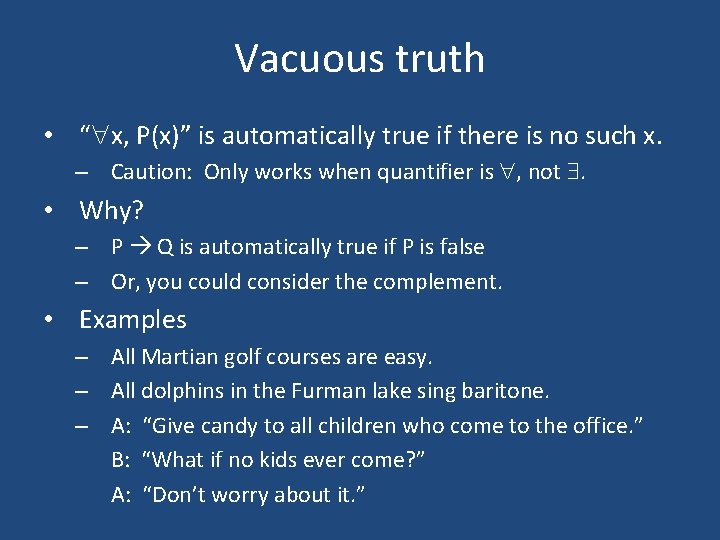
Vacuous truth • “ x, P(x)” is automatically true if there is no such x. – Caution: Only works when quantifier is , not . • Why? – P Q is automatically true if P is false – Or, you could consider the complement. • Examples – All Martian golf courses are easy. – All dolphins in the Furman lake sing baritone. – A: “Give candy to all children who come to the office. ” B: “What if no kids ever come? ” A: “Don’t worry about it. ”
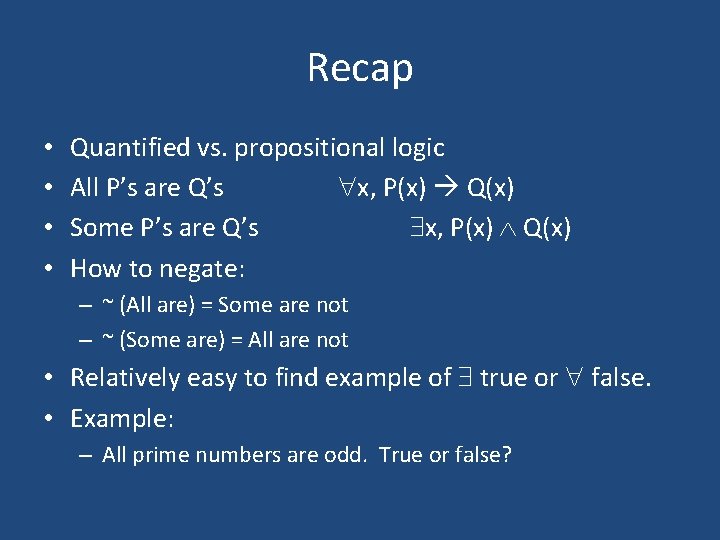
Recap • • Quantified vs. propositional logic All P’s are Q’s x, P(x) Q(x) Some P’s are Q’s x, P(x) Q(x) How to negate: – ~ (All are) = Some are not – ~ (Some are) = All are not • Relatively easy to find example of true or false. • Example: – All prime numbers are odd. True or false?
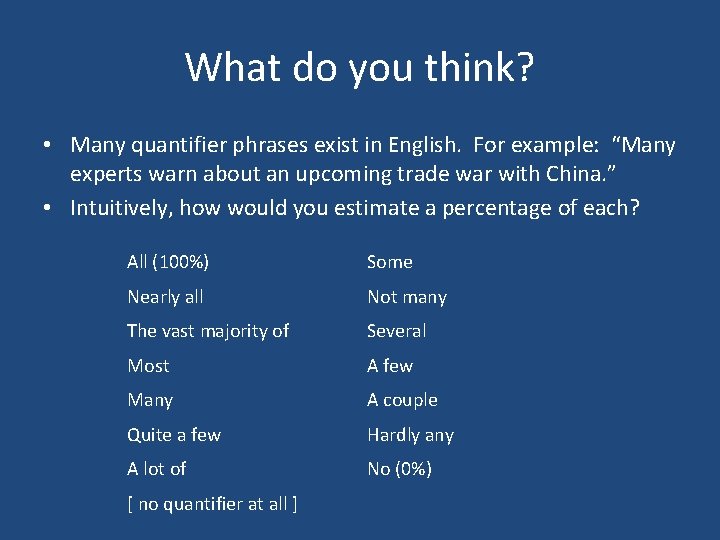
What do you think? • Many quantifier phrases exist in English. For example: “Many experts warn about an upcoming trade war with China. ” • Intuitively, how would you estimate a percentage of each? All (100%) Some Nearly all Not many The vast majority of Several Most A few Many A couple Quite a few Hardly any A lot of No (0%) [ no quantifier at all ]
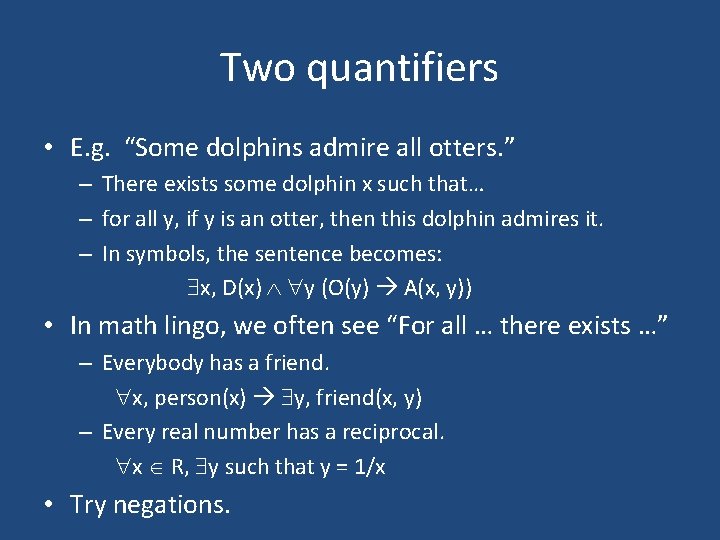
Two quantifiers • E. g. “Some dolphins admire all otters. ” – There exists some dolphin x such that… – for all y, if y is an otter, then this dolphin admires it. – In symbols, the sentence becomes: x, D(x) y (O(y) A(x, y)) • In math lingo, we often see “For all … there exists …” – Everybody has a friend. x, person(x) y, friend(x, y) – Every real number has a reciprocal. x R, y such that y = 1/x • Try negations.
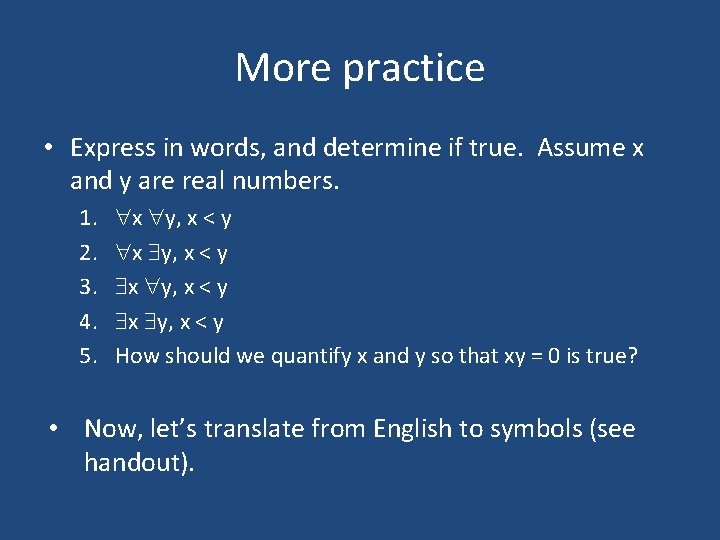
More practice • Express in words, and determine if true. Assume x and y are real numbers. 1. 2. 3. 4. 5. x y, x < y How should we quantify x and y so that xy = 0 is true? • Now, let’s translate from English to symbols (see handout).
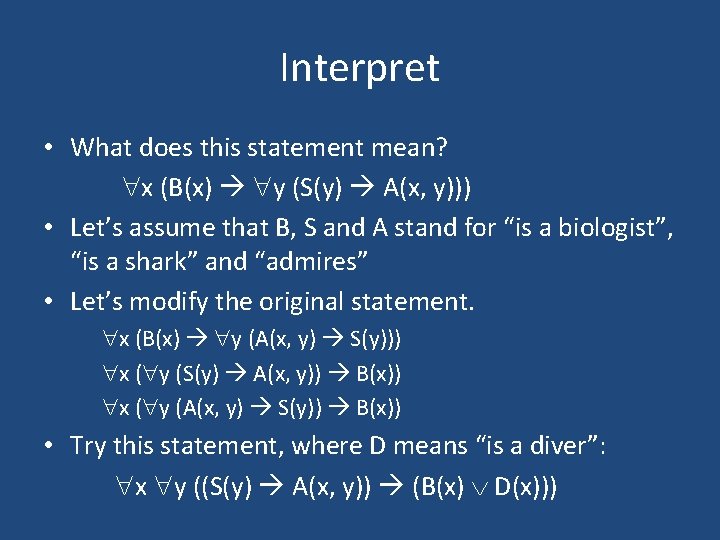
Interpret • What does this statement mean? x (B(x) y (S(y) A(x, y))) • Let’s assume that B, S and A stand for “is a biologist”, “is a shark” and “admires” • Let’s modify the original statement. x (B(x) y (A(x, y) S(y))) x ( y (S(y) A(x, y)) B(x)) x ( y (A(x, y) S(y)) B(x)) • Try this statement, where D means “is a diver”: x y ((S(y) A(x, y)) (B(x) D(x)))
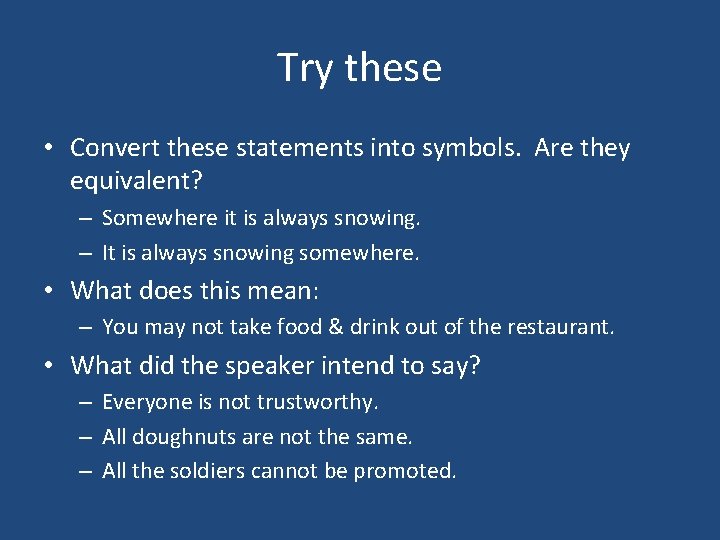
Try these • Convert these statements into symbols. Are they equivalent? – Somewhere it is always snowing. – It is always snowing somewhere. • What does this mean: – You may not take food & drink out of the restaurant. • What did the speaker intend to say? – Everyone is not trustworthy. – All doughnuts are not the same. – All the soldiers cannot be promoted.