
Logic Bottomup Topdown proof procedures CPSC 322 Logic
Logic: Bottom-up & Top-down proof procedures CPSC 322 – Logic 3 Textbook § 5. 2 March 9, 2011
Announcements • Midterm is marked – Will be returned after the lecture • Assignment 2 is taking longer to mark than the TAs thought – Probably will be returned on Friday • Assignment 3 is due in a week – Think of it as a half- assignment on STRIPS (due today) and a half- assignment on logic 2
Lecture Overview • Recap: Soundness, Correctness, Bottom-up proof procedure • Bottom-up Proof Procedure – Soundness proof – Completeness proof • Top-down Proof Procedure 3
(Propositional) Logic: Review of Key ideas • Given a domain that can be represented with n propositions, how many interpretations are there? - 2 n interpretations (similar to possible worlds) • If you do not know anything about the domain you could be in any of those interpretations • If you know that some logical formulae are true (your KB), you know that you can only be in interpretations in which those formulae hold (i. e. in. …. of KB) 4
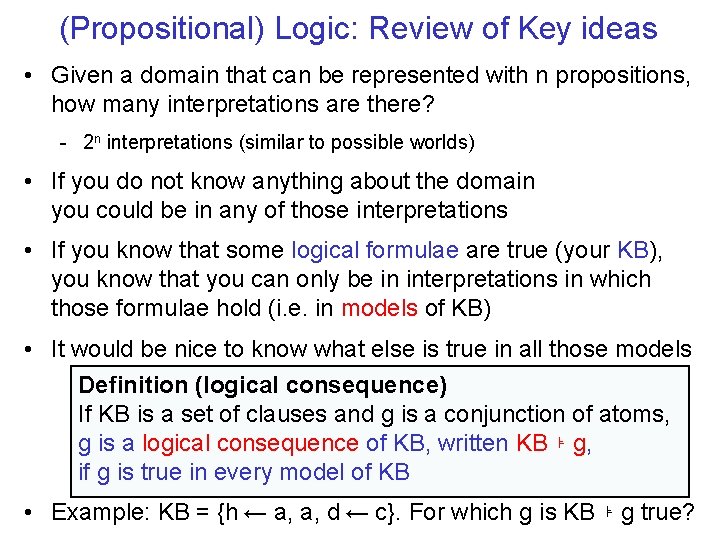
(Propositional) Logic: Review of Key ideas • Given a domain that can be represented with n propositions, how many interpretations are there? - 2 n interpretations (similar to possible worlds) • If you do not know anything about the domain you could be in any of those interpretations • If you know that some logical formulae are true (your KB), you know that you can only be in interpretations in which those formulae hold (i. e. in models of KB) • It would be nice to know what else is true in all those models Definition (logical consequence) If KB is a set of clauses and g is a conjunction of atoms, g is a logical consequence of KB, written KB ⊧ g, if g is true in every model of KB • Example: KB = {h ← a, a, d ← c}. For which g is KB ⊧ g true?
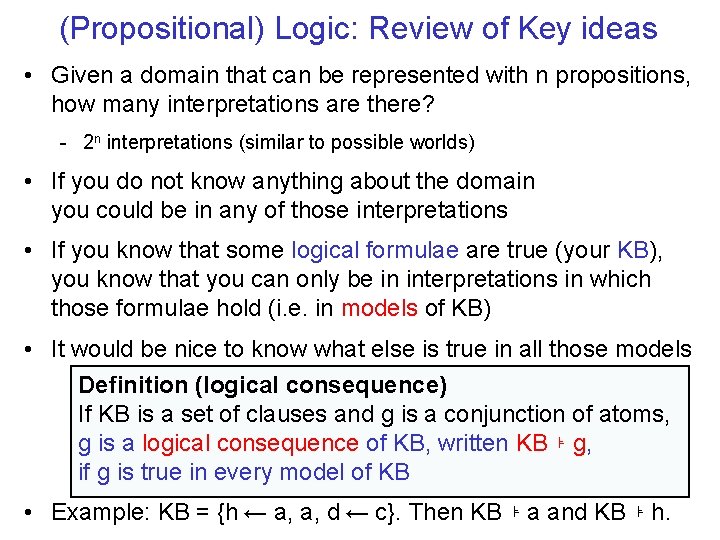
(Propositional) Logic: Review of Key ideas • Given a domain that can be represented with n propositions, how many interpretations are there? - 2 n interpretations (similar to possible worlds) • If you do not know anything about the domain you could be in any of those interpretations • If you know that some logical formulae are true (your KB), you know that you can only be in interpretations in which those formulae hold (i. e. in models of KB) • It would be nice to know what else is true in all those models Definition (logical consequence) If KB is a set of clauses and g is a conjunction of atoms, g is a logical consequence of KB, written KB ⊧ g, if g is true in every model of KB • Example: KB = {h ← a, a, d ← c}. Then KB ⊧ a and KB ⊧ h.
Intended interpretation • User chooses task domain: intended interpretation. – This is the interpretation of the symbols the user has in mind • User tells the system clauses (the knowledge base KB) – Each clause is true in the user’s intended interpretation – Thus, the intended interpretation is a model • The computer does not know the intended interpretation – But if it can derive something that’s true in all models, then it is true in the intended interpretation – Once more, we want to derive logical consequences 7
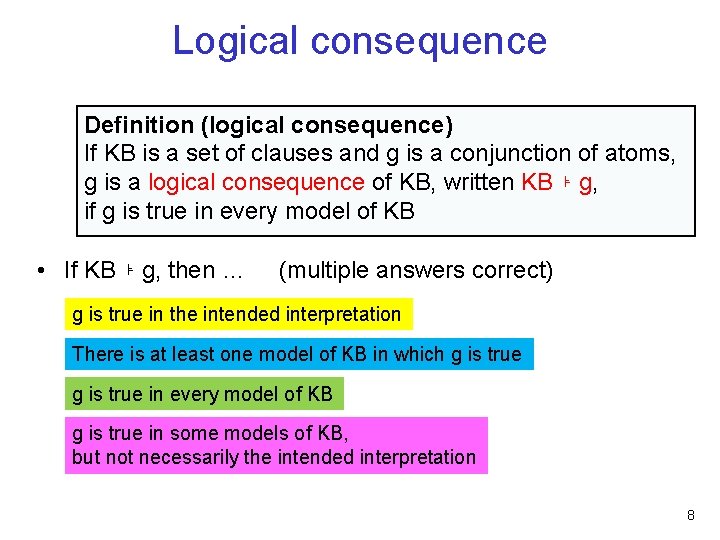
Logical consequence Definition (logical consequence) If KB is a set of clauses and g is a conjunction of atoms, g is a logical consequence of KB, written KB ⊧ g, if g is true in every model of KB • If KB ⊧ g, then … (multiple answers correct) g is true in the intended interpretation There is at least one model of KB in which g is true in every model of KB g is true in some models of KB, but not necessarily the intended interpretation 8
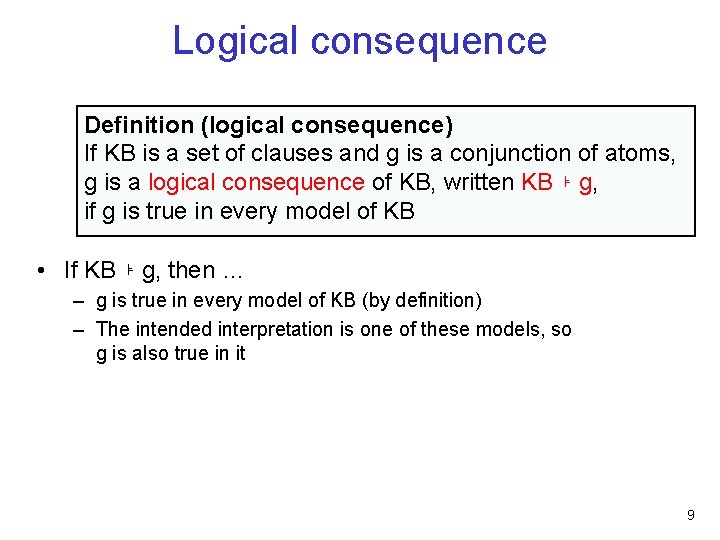
Logical consequence Definition (logical consequence) If KB is a set of clauses and g is a conjunction of atoms, g is a logical consequence of KB, written KB ⊧ g, if g is true in every model of KB • If KB ⊧ g, then … – g is true in every model of KB (by definition) – The intended interpretation is one of these models, so g is also true in it 9
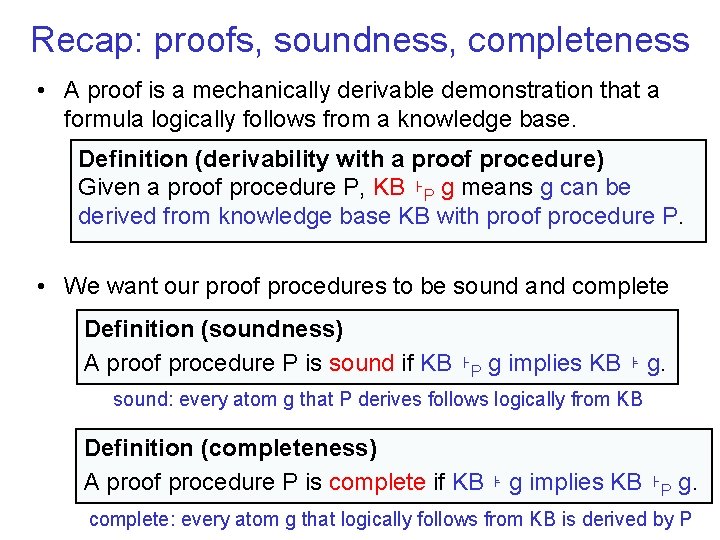
Recap: proofs, soundness, completeness • A proof is a mechanically derivable demonstration that a formula logically follows from a knowledge base. Definition (derivability with a proof procedure) Given a proof procedure P, KB ⊦P g means g can be derived from knowledge base KB with proof procedure P. • We want our proof procedures to be sound and complete Definition (soundness) A proof procedure P is sound if KB ⊦P g implies KB ⊧ g. sound: every atom g that P derives follows logically from KB Definition (completeness) A proof procedure P is complete if KB ⊧ g implies KB ⊦P g. complete: every atom g that logically follows from KB is derived by P
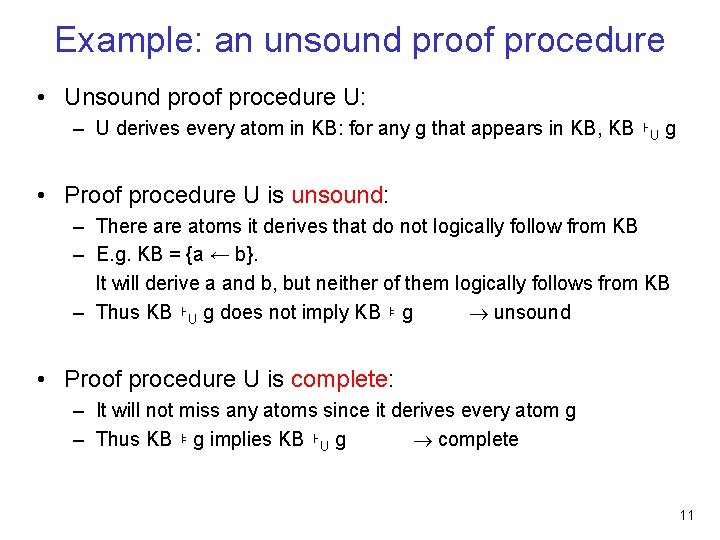
Example: an unsound proof procedure • Unsound proof procedure U: – U derives every atom in KB: for any g that appears in KB, KB ⊦U g • Proof procedure U is unsound: – There atoms it derives that do not logically follow from KB – E. g. KB = {a ← b}. It will derive a and b, but neither of them logically follows from KB – Thus KB ⊦U g does not imply KB ⊧ g unsound • Proof procedure U is complete: – It will not miss any atoms since it derives every atom g – Thus KB ⊧ g implies KB ⊦U g complete 11
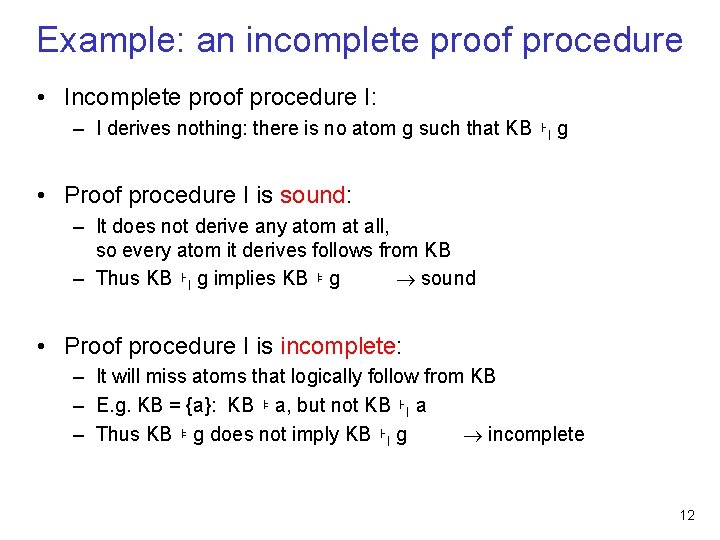
Example: an incomplete proof procedure • Incomplete proof procedure I: – I derives nothing: there is no atom g such that KB ⊦I g • Proof procedure I is sound: – It does not derive any atom at all, so every atom it derives follows from KB – Thus KB ⊦I g implies KB ⊧ g sound • Proof procedure I is incomplete: – It will miss atoms that logically follow from KB – E. g. KB = {a}: KB ⊧ a, but not KB ⊦I a – Thus KB ⊧ g does not imply KB ⊦I g incomplete 12
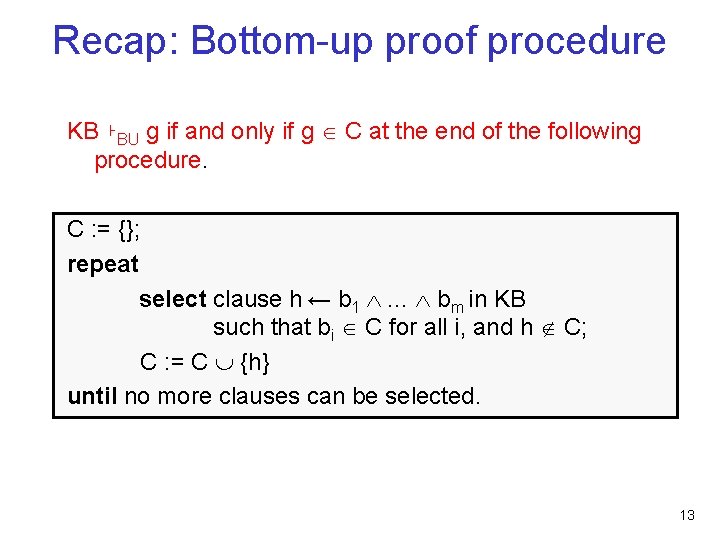
Recap: Bottom-up proof procedure KB ⊦BU g if and only if g C at the end of the following procedure. C : = {}; repeat select clause h ← b 1 … bm in KB such that bi C for all i, and h C; C : = C {h} until no more clauses can be selected. 13

Bottom-up proof procedure: example C : = {}; repeat select clause h ← b 1 … bm in KB such that bi C for all i, and h C; C : = C {h} until no more clauses can be selected. KB ⊦BU g if and only if g C a← b c a← e f b← f k c← e d← k e. f← j e f← c j← c {} {e} {c, e, f} {c, e, f, j} {a, c, e, f, j} Done. 14
Lecture Overview • Recap: Soundness, Correctness, Bottom-up proof procedure • Bottom-up Proof Procedure – Soundness proof – Completeness proof • Top-down Proof Procedure 15
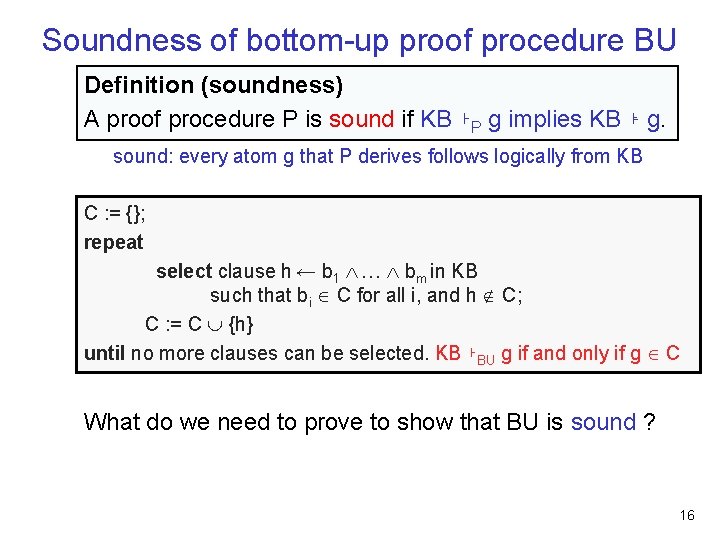
Soundness of bottom-up proof procedure BU Definition (soundness) A proof procedure P is sound if KB ⊦P g implies KB ⊧ g. sound: every atom g that P derives follows logically from KB C : = {}; repeat select clause h ← b 1 … bm in KB such that bi C for all i, and h C; C : = C {h} until no more clauses can be selected. KB ⊦BU g if and only if g C What do we need to prove to show that BU is sound ? 16
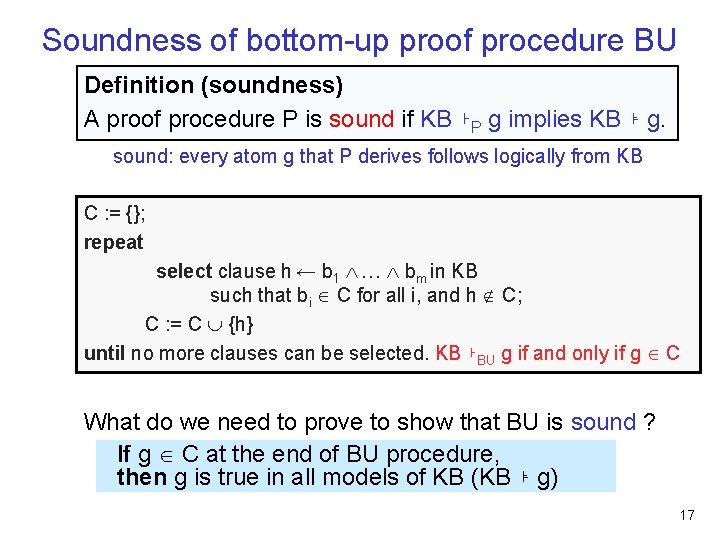
Soundness of bottom-up proof procedure BU Definition (soundness) A proof procedure P is sound if KB ⊦P g implies KB ⊧ g. sound: every atom g that P derives follows logically from KB C : = {}; repeat select clause h ← b 1 … bm in KB such that bi C for all i, and h C; C : = C {h} until no more clauses can be selected. KB ⊦BU g if and only if g C What do we need to prove to show that BU is sound ? If g C at the end of BU procedure, then g is true in all models of KB (KB ⊧ g) 17
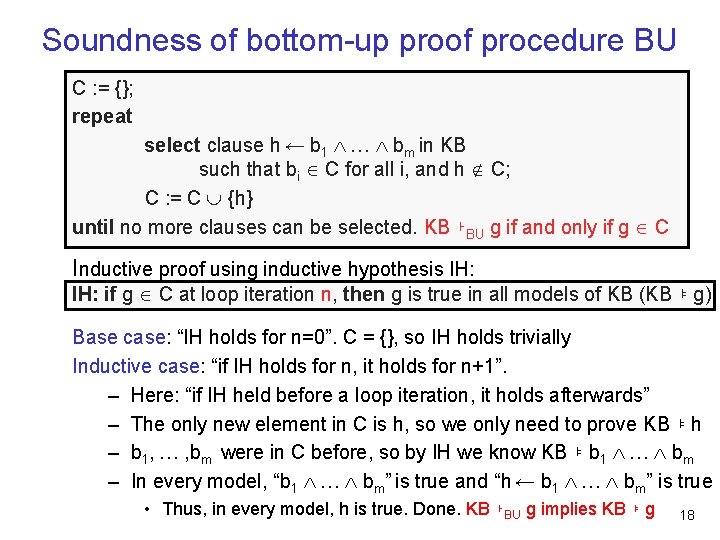
Soundness of bottom-up proof procedure BU C : = {}; repeat select clause h ← b 1 … bm in KB such that bi C for all i, and h C; C : = C {h} until no more clauses can be selected. KB ⊦BU g if and only if g C Inductive proof using inductive hypothesis IH: if g C at loop iteration n, then g is true in all models of KB (KB ⊧ g) Base case: “IH holds for n=0”. C = {}, so IH holds trivially Inductive case: “if IH holds for n, it holds for n+1”. – Here: “if IH held before a loop iteration, it holds afterwards” – The only new element in C is h, so we only need to prove KB ⊧ h – b 1, … , bm were in C before, so by IH we know KB ⊧ b 1 … bm – In every model, “b 1 … bm” is true and “h ← b 1 … bm” is true • Thus, in every model, h is true. Done. KB ⊦BU g implies KB ⊧ g 18
Lecture Overview • Recap: Soundness, Correctness, Bottom-up proof procedure • Bottom-up Proof Procedure – Soundness proof – Completeness proof • Top-down Proof Procedure 19
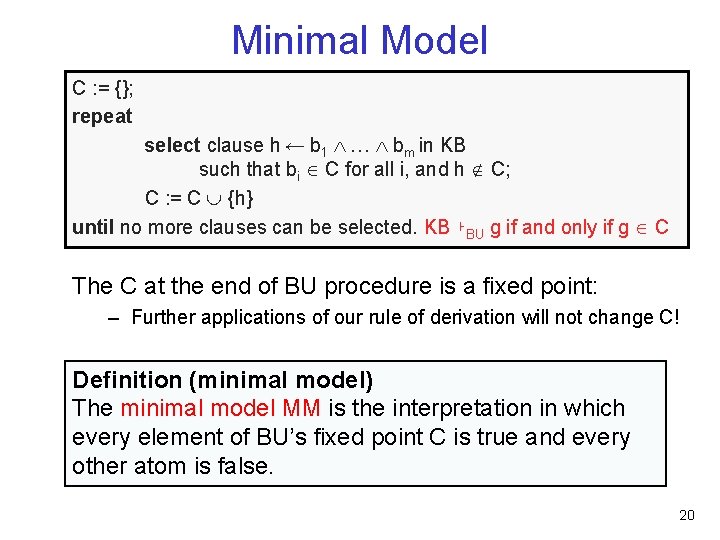
Minimal Model C : = {}; repeat select clause h ← b 1 … bm in KB such that bi C for all i, and h C; C : = C {h} until no more clauses can be selected. KB ⊦BU g if and only if g C The C at the end of BU procedure is a fixed point: – Further applications of our rule of derivation will not change C! Definition (minimal model) The minimal model MM is the interpretation in which every element of BU’s fixed point C is true and every other atom is false. 20
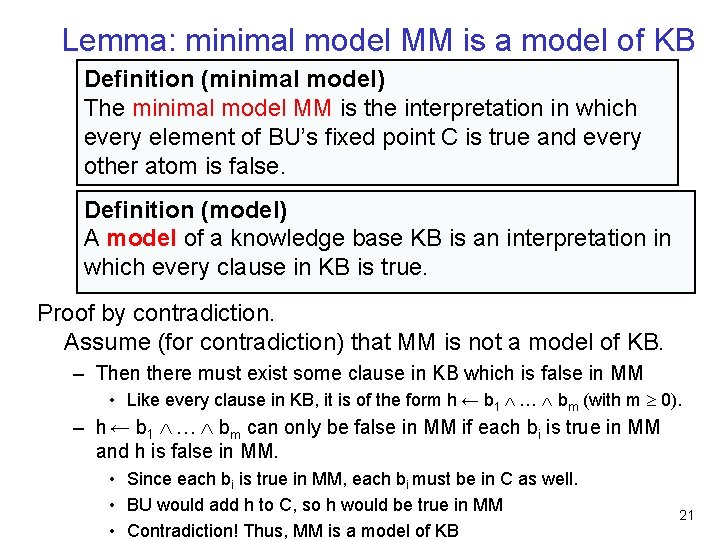
Lemma: minimal model MM is a model of KB Definition (minimal model) The minimal model MM is the interpretation in which every element of BU’s fixed point C is true and every other atom is false. Definition (model) A model of a knowledge base KB is an interpretation in which every clause in KB is true. Proof by contradiction. Assume (for contradiction) that MM is not a model of KB. – Then there must exist some clause in KB which is false in MM • Like every clause in KB, it is of the form h ← b 1 … bm (with m 0). – h ← b 1 … bm can only be false in MM if each bi is true in MM and h is false in MM. • Since each bi is true in MM, each bi must be in C as well. • BU would add h to C, so h would be true in MM • Contradiction! Thus, MM is a model of KB 21
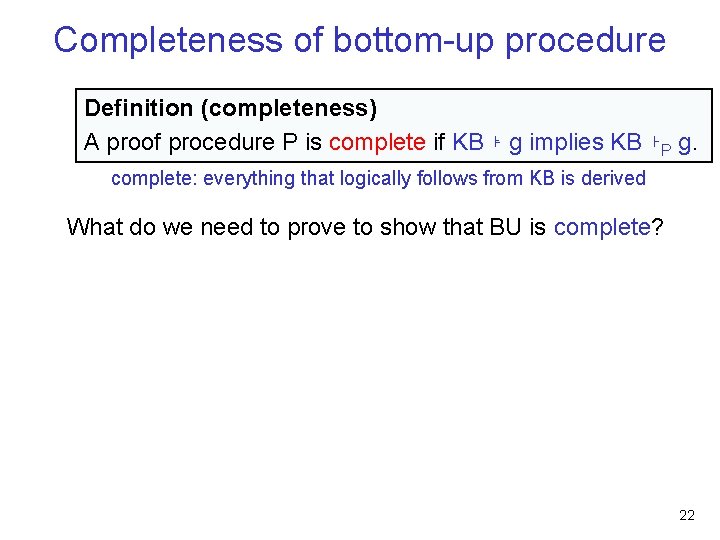
Completeness of bottom-up procedure Definition (completeness) A proof procedure P is complete if KB ⊧ g implies KB ⊦P g. complete: everything that logically follows from KB is derived What do we need to prove to show that BU is complete? 22
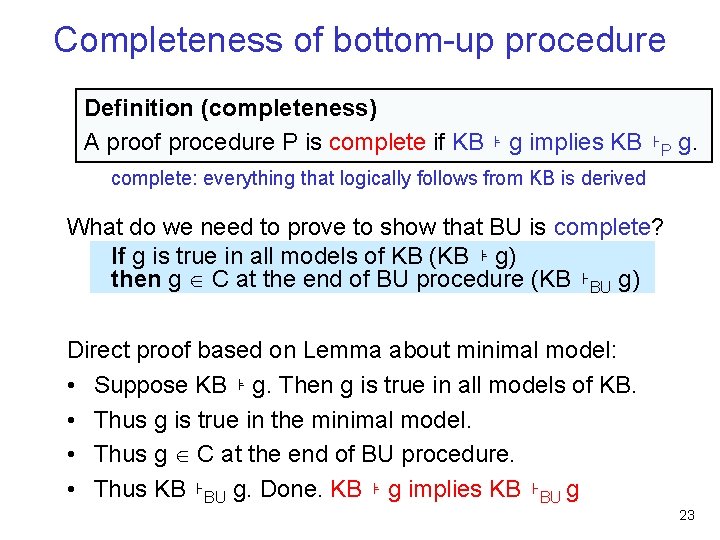
Completeness of bottom-up procedure Definition (completeness) A proof procedure P is complete if KB ⊧ g implies KB ⊦P g. complete: everything that logically follows from KB is derived What do we need to prove to show that BU is complete? If g is true in all models of KB (KB ⊧ g) then g C at the end of BU procedure (KB ⊦BU g) Direct proof based on Lemma about minimal model: • Suppose KB ⊧ g. Then g is true in all models of KB. • Thus g is true in the minimal model. • Thus g C at the end of BU procedure. • Thus KB ⊦BU g. Done. KB ⊧ g implies KB ⊦BU g 23
Summary for bottom-up proof procedure BU • BU is sound: it derives only atoms that logically follow from KB • BU is complete: it derives all atoms that logically follow from KB • Together: it derives exactly the atoms that logically follow from KB • And, it is quite efficient! – Linear in the number of clauses in KB • Each clause is used maximally once by BU 24
Learning Goals Up To Here • PDCL syntax & semantics - Verify whether a logical statement belongs to the language of propositional definite clauses - Verify whether an interpretation is a model of a PDCL KB. - Verify when a conjunction of atoms is a logical consequence of a knowledge base • Bottom-up proof procedure • Define/read/write/trace/debug the Bottom Up (BU) proof procedure • Prove that the BU proof procedure is sound and complete 25
Lecture Overview • Recap: Soundness, Correctness, Bottom-up proof procedure • Bottom-up Proof Procedure – Soundness proof – Completeness proof • Top-down Proof Procedure 26
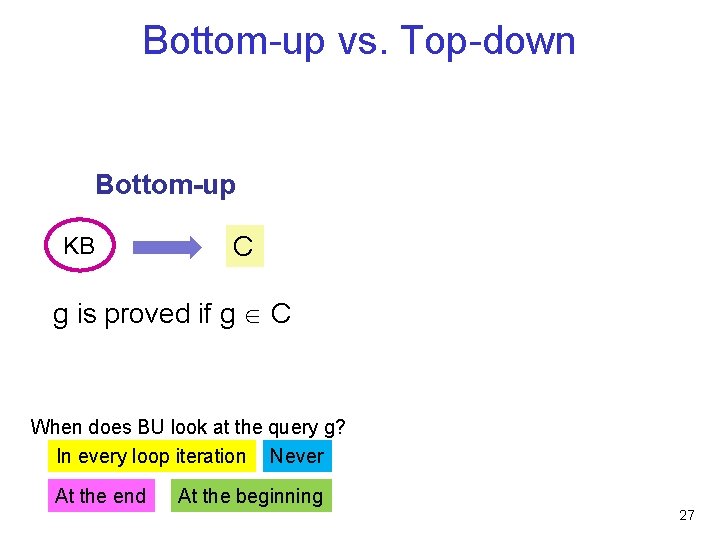
Bottom-up vs. Top-down Bottom-up KB C g is proved if g C When does BU look at the query g? In every loop iteration Never At the end At the beginning 27
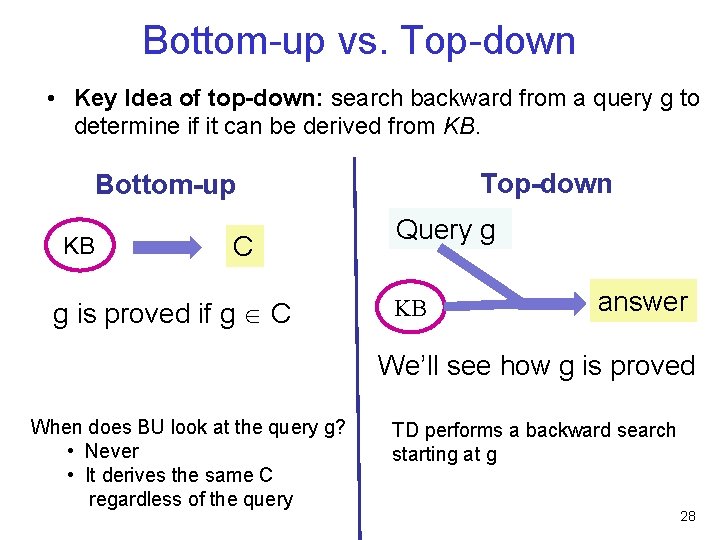
Bottom-up vs. Top-down • Key Idea of top-down: search backward from a query g to determine if it can be derived from KB. Top-down Bottom-up KB C g is proved if g C Query g KB answer We’ll see how g is proved When does BU look at the query g? • Never • It derives the same C regardless of the query TD performs a backward search starting at g 28
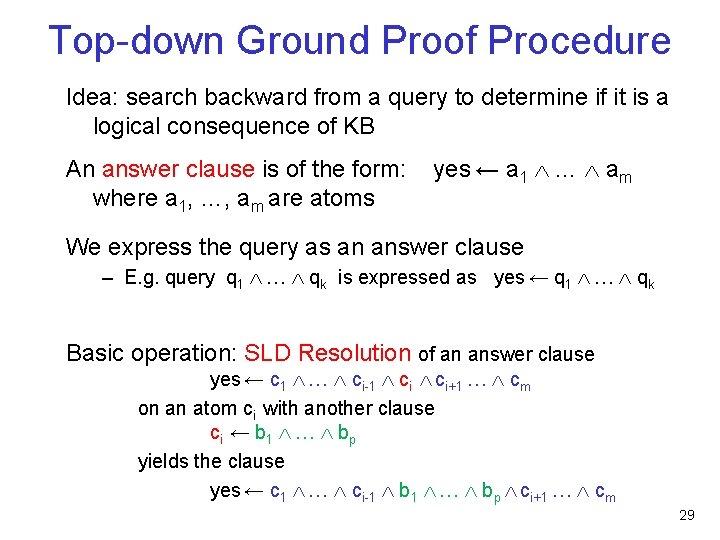
Top-down Ground Proof Procedure Idea: search backward from a query to determine if it is a logical consequence of KB An answer clause is of the form: where a 1, …, am are atoms yes ← a 1 … am We express the query as an answer clause – E. g. query q 1 … qk is expressed as yes ← q 1 … qk Basic operation: SLD Resolution of an answer clause yes ← c 1 … ci-1 ci+1 … cm on an atom ci with another clause ci ← b 1 … bp yields the clause yes ← c 1 … ci-1 b 1 … bp ci+1 … cm 29
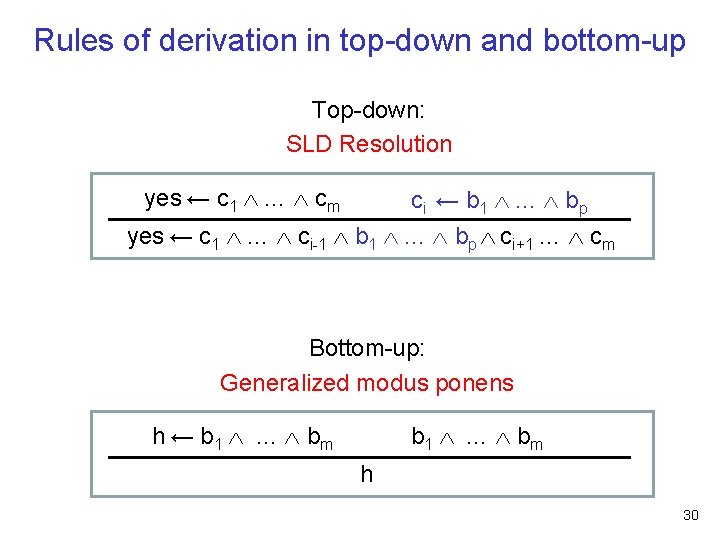
Rules of derivation in top-down and bottom-up Top-down: SLD Resolution yes ← c 1 … cm ci ← b 1 … bp yes ← c 1 … ci-1 b 1 … bp ci+1 … cm Bottom-up: Generalized modus ponens h ← b 1 … bm h 30
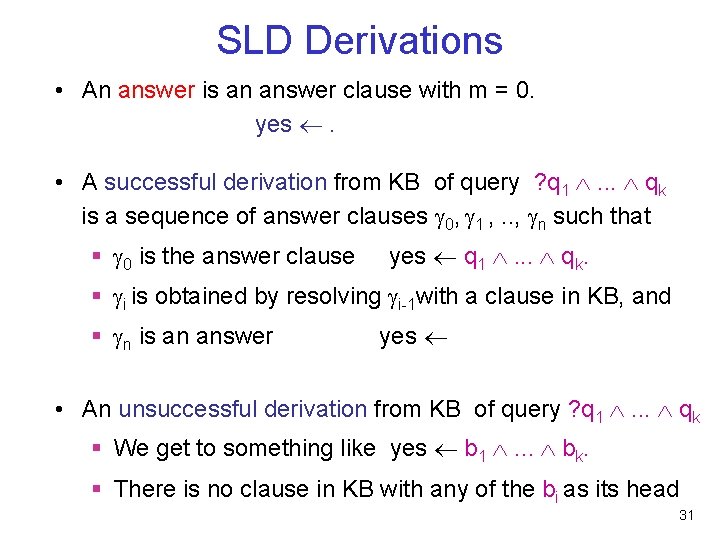
SLD Derivations • An answer is an answer clause with m = 0. yes . • A successful derivation from KB of query ? q 1 . . . qk is a sequence of answer clauses 0, 1 , . . , n such that § 0 is the answer clause yes q 1 . . . qk. § i is obtained by resolving i-1 with a clause in KB, and § n is an answer yes • An unsuccessful derivation from KB of query ? q 1 . . . qk § We get to something like yes b 1 . . . bk. § There is no clause in KB with any of the bi as its head 31
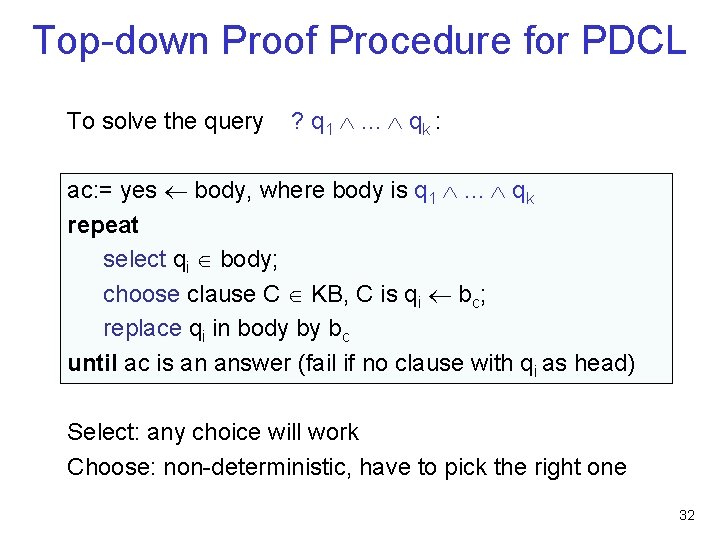
Top-down Proof Procedure for PDCL To solve the query ? q 1 . . . qk : ac: = yes body, where body is q 1 . . . qk repeat select qi body; choose clause C KB, C is qi bc; replace qi in body by bc until ac is an answer (fail if no clause with qi as head) Select: any choice will work Choose: non-deterministic, have to pick the right one 32
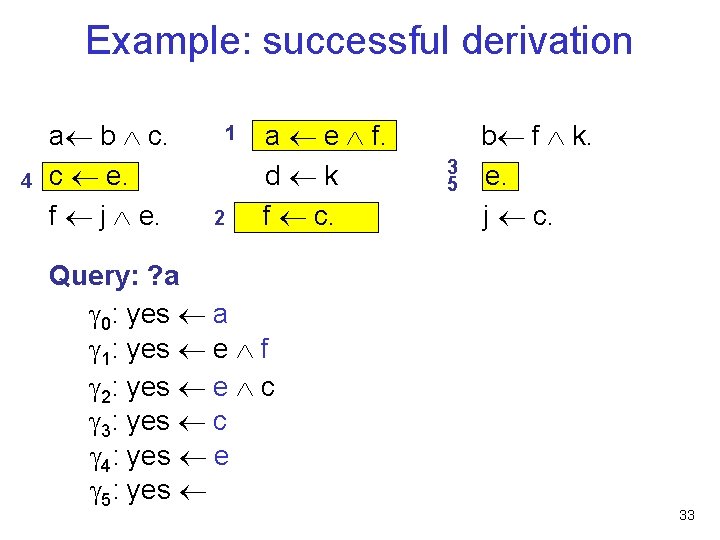
Example: successful derivation 4 a b c. c e. f j e. 1 2 a e f. d k f c. Query: ? a 0: yes a 1: yes e f 2: yes e c 3: yes c 4: yes e 5: yes 3 5 b f k. e. j c. 33
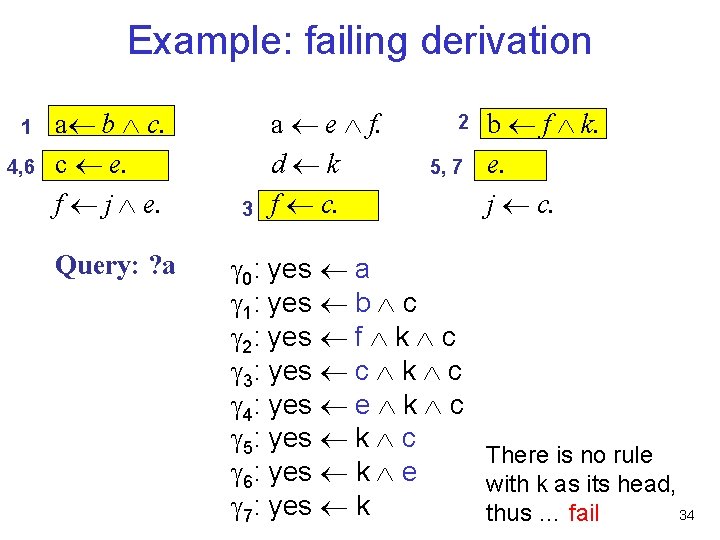
Example: failing derivation 1 4, 6 a b c. c e. f j e. Query: ? a 3 a e f. d k f c. 2 5, 7 b f k. e. j c. 0: yes a 1: yes b c 2: yes f k c 3: yes c k c 4: yes e k c 5: yes k c There is no rule 6: yes k e with k as its head, 7: yes k 34 thus … fail
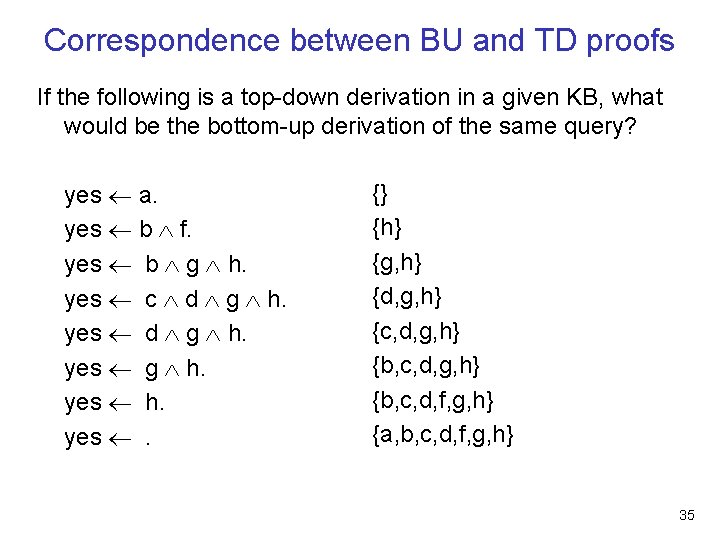
Correspondence between BU and TD proofs If the following is a top-down derivation in a given KB, what would be the bottom-up derivation of the same query? yes a. yes b f. yes b g h. yes c d g h. yes . {} {h} {g, h} {d, g, h} {c, d, g, h} {b, c, d, f, g, h} {a, b, c, d, f, g, h} 35
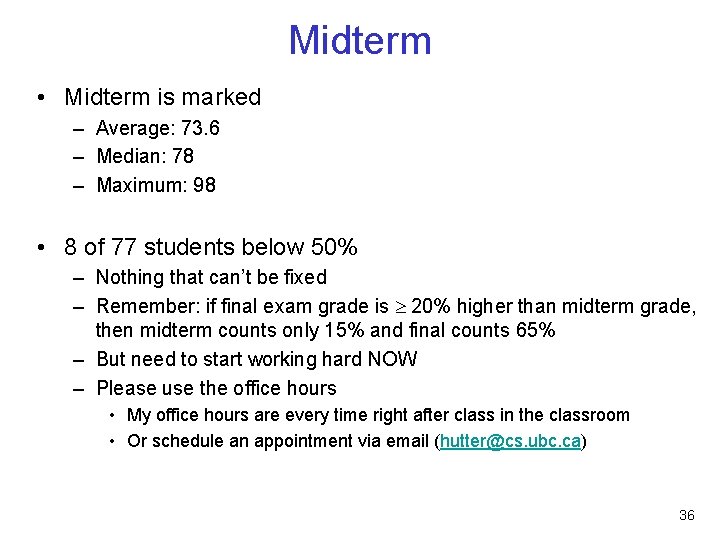
Midterm • Midterm is marked – Average: 73. 6 – Median: 78 – Maximum: 98 • 8 of 77 students below 50% – Nothing that can’t be fixed – Remember: if final exam grade is 20% higher than midterm grade, then midterm counts only 15% and final counts 65% – But need to start working hard NOW – Please use the office hours • My office hours are every time right after class in the classroom • Or schedule an appointment via email (hutter@cs. ubc. ca) 36
- Slides: 36