
Logic and Computer Design Fundamentals Chapter 3 Combinational
Logic and Computer Design Fundamentals Chapter 3 – Combinational Logic Design Part 3 – Arithmetic Functions Charles Kime & Thomas Kaminski © Pearson Education, Inc.
Overview § Part 1 – Design Procedure § Part 2 – Combinational Logic § Part 3 – Arithmetic Functions • Iterative combinational circuits • Binary adders § Half and full adders § Ripple carry and carry lookahead adders • Binary subtraction • Binary adder-subtractors § Signed binary numbers § Signed binary addition and subtraction § Overflow • Binary multiplication • Other arithmetic functions § Design by contraction © Pearson Education, Inc. Chapter 3 - Part 3 2
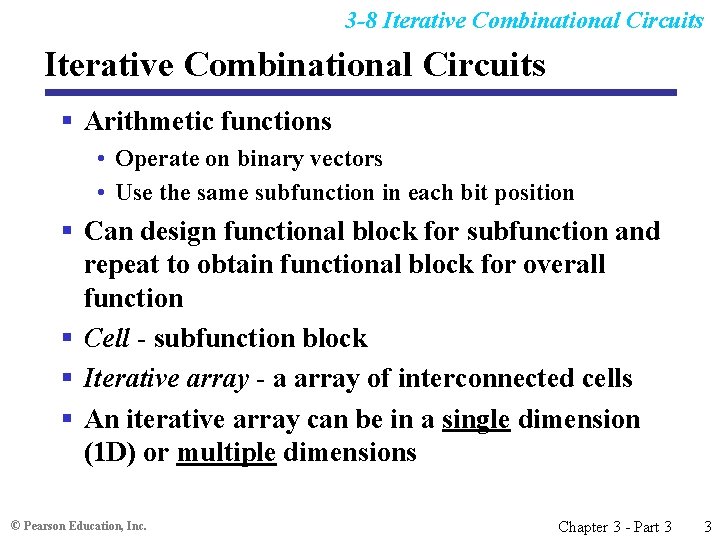
3 -8 Iterative Combinational Circuits § Arithmetic functions • Operate on binary vectors • Use the same subfunction in each bit position § Can design functional block for subfunction and repeat to obtain functional block for overall function § Cell - subfunction block § Iterative array - a array of interconnected cells § An iterative array can be in a single dimension (1 D) or multiple dimensions © Pearson Education, Inc. Chapter 3 - Part 3 3
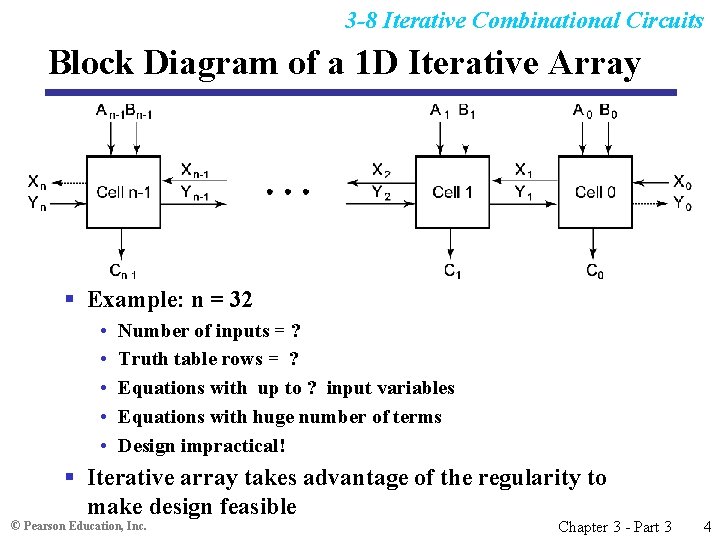
3 -8 Iterative Combinational Circuits Block Diagram of a 1 D Iterative Array § Example: n = 32 • • • Number of inputs = ? Truth table rows = ? Equations with up to ? input variables Equations with huge number of terms Design impractical! § Iterative array takes advantage of the regularity to make design feasible © Pearson Education, Inc. Chapter 3 - Part 3 4

3 -9 Binary Adders Functional Blocks: Addition § Binary addition used frequently § Addition Development: • Half-Adder (HA), a 2 -input bit-wise addition functional block, • Full-Adder (FA), a 3 -input bit-wise addition functional block, • Ripple Carry Adder, an iterative array to perform binary addition, and • Carry-Look-Ahead Adder (CLA), a hierarchical structure to improve performance. © Pearson Education, Inc. Chapter 3 - Part 3 5
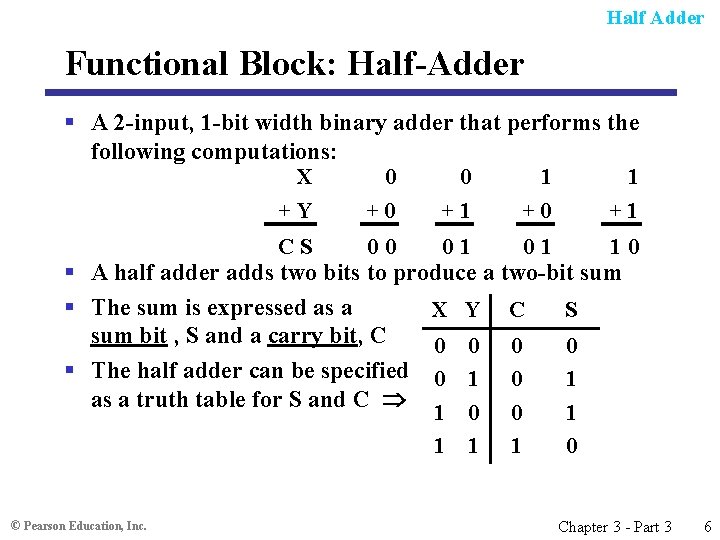
Half Adder Functional Block: Half-Adder § A 2 -input, 1 -bit width binary adder that performs the following computations: X +Y 0 +0 0 +1 1 +0 1 +1 CS 00 01 01 10 § A half adder adds two bits to produce a two-bit sum § The sum is expressed as a X Y sum bit , S and a carry bit, C 0 0 § The half adder can be specified 0 1 as a truth table for S and C 1 0 1 1 © Pearson Education, Inc. C S 0 0 0 1 1 0 Chapter 3 - Part 3 6
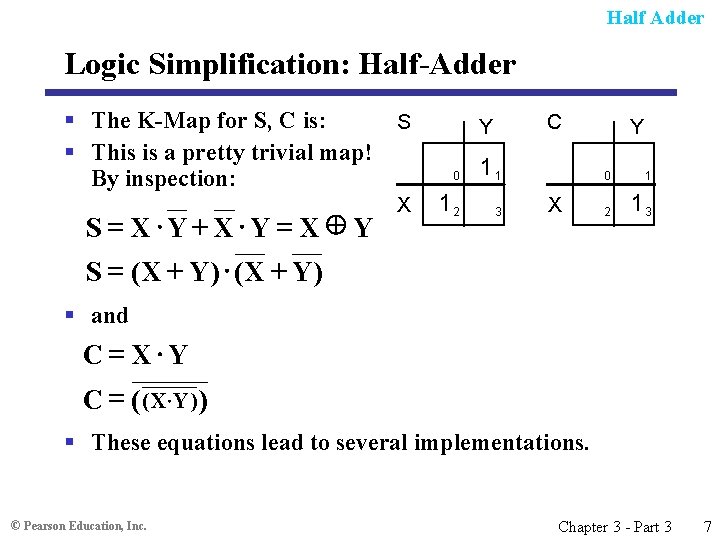
Half Adder Logic Simplification: Half-Adder § The K-Map for S, C is: S § This is a pretty trivial map! By inspection: S = X×Y+ X×Y = X Y S = ( X + Y) × ( X + Y) X C Y 0 11 12 3 X Y 0 1 2 13 § and C = X×Y C = ( ( X ×Y ) ) § These equations lead to several implementations. © Pearson Education, Inc. Chapter 3 - Part 3 7
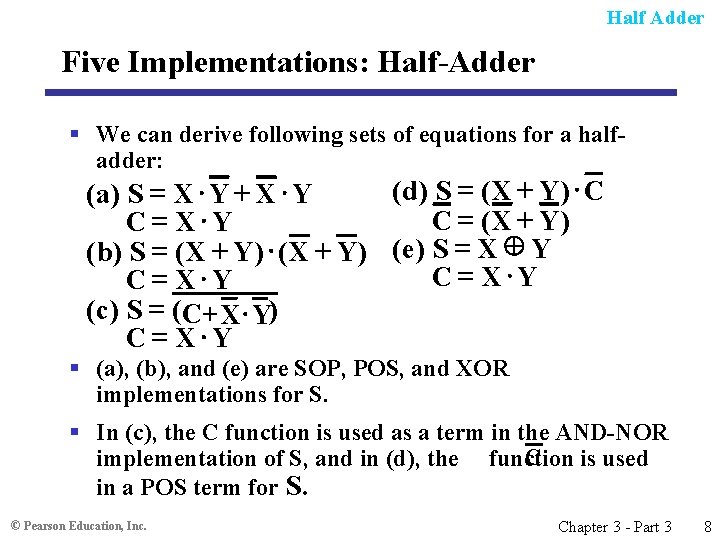
Half Adder Five Implementations: Half-Adder § We can derive following sets of equations for a halfadder: (d ) S = ( X + Y) × C (a) S = X × Y + X × Y C = ( X + Y) C = X×Y ( b) S = ( X + Y) × ( X + Y) (e ) S = X Y C = X×Y ( c ) S = ( C+ X× Y) C = X×Y § (a), (b), and (e) are SOP, POS, and XOR implementations for S. § In (c), the C function is used as a term in the AND-NOR C implementation of S, and in (d), the function is used in a POS term for S. © Pearson Education, Inc. Chapter 3 - Part 3 8
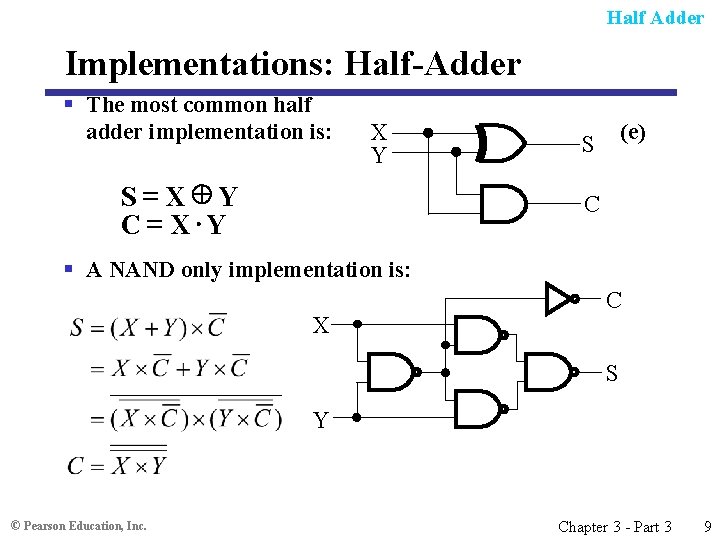
Half Adder Implementations: Half-Adder § The most common half adder implementation is: X Y S = X Y C = X×Y (e) S C § A NAND only implementation is: X C S Y © Pearson Education, Inc. Chapter 3 - Part 3 9
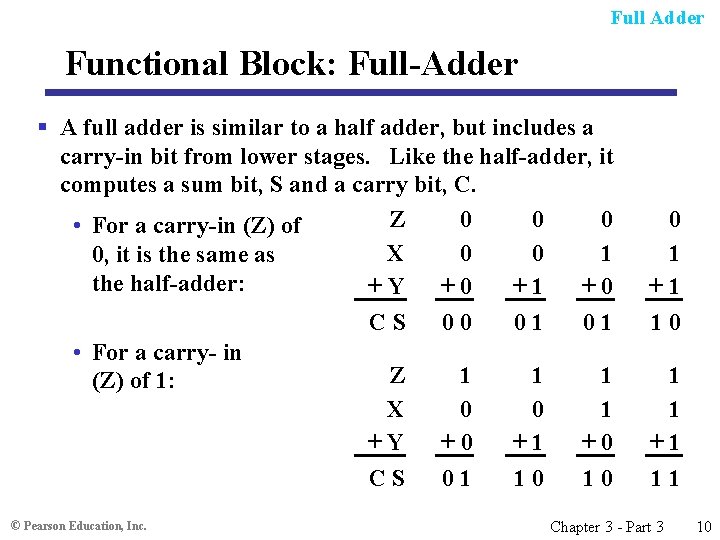
Full Adder Functional Block: Full-Adder § A full adder is similar to a half adder, but includes a carry-in bit from lower stages. Like the half-adder, it computes a sum bit, S and a carry bit, C. Z 0 0 0 • For a carry-in (Z) of X 0 0 1 0, it is the same as the half-adder: +Y +0 +1 +0 CS 00 01 01 • For a carry- in Z 1 1 1 (Z) of 1: X 0 0 1 +Y +0 +1 +0 CS 01 10 10 © Pearson Education, Inc. 0 1 +1 10 1 1 +1 11 Chapter 3 - Part 3 10
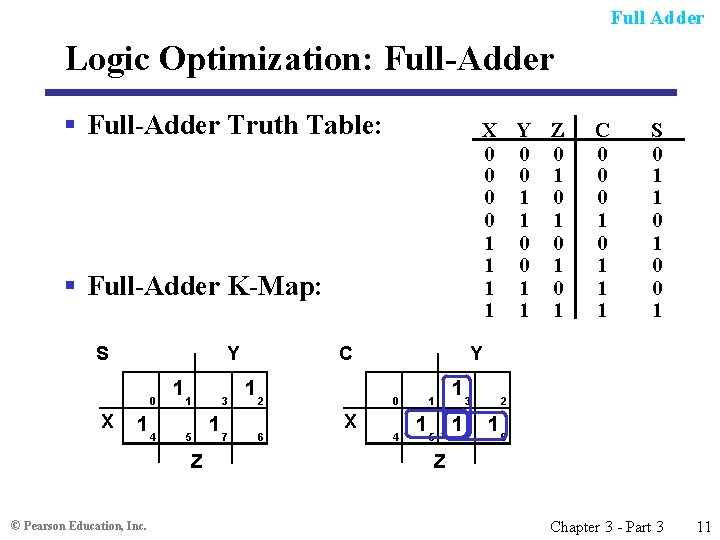
Full Adder Logic Optimization: Full-Adder § Full-Adder Truth Table: X Y Z 0 0 0 1 1 1 0 0 1 1 1 § Full-Adder K-Map: S Y 0 X 14 11 3 5 17 Z © Pearson Education, Inc. C 12 6 S 0 1 1 0 0 1 Y 0 X C 0 0 0 1 1 1 4 1 13 2 15 17 16 Z Chapter 3 - Part 3 11
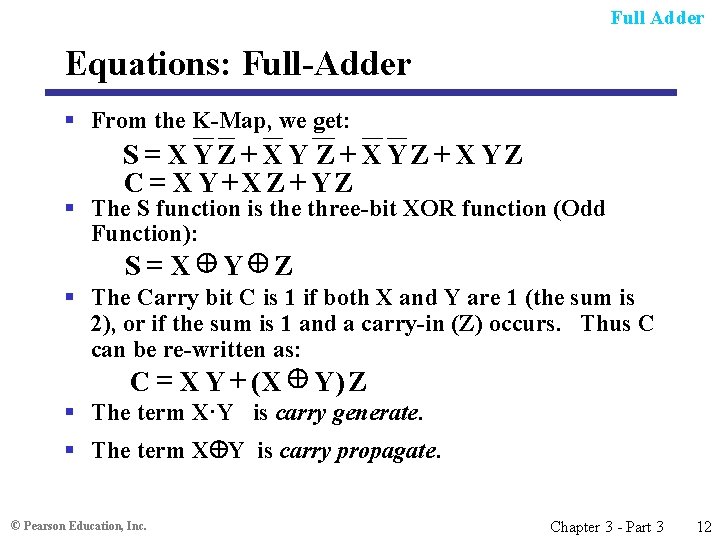
Full Adder Equations: Full-Adder § From the K-Map, we get: S = XYZ+ XYZ C = XY+XZ+YZ § The S function is the three-bit XOR function (Odd Function): S = X Y Z § The Carry bit C is 1 if both X and Y are 1 (the sum is 2), or if the sum is 1 and a carry-in (Z) occurs. Thus C can be re-written as: C = X Y + ( X Y) Z § The term X·Y is carry generate. § The term X Y is carry propagate. © Pearson Education, Inc. Chapter 3 - Part 3 12
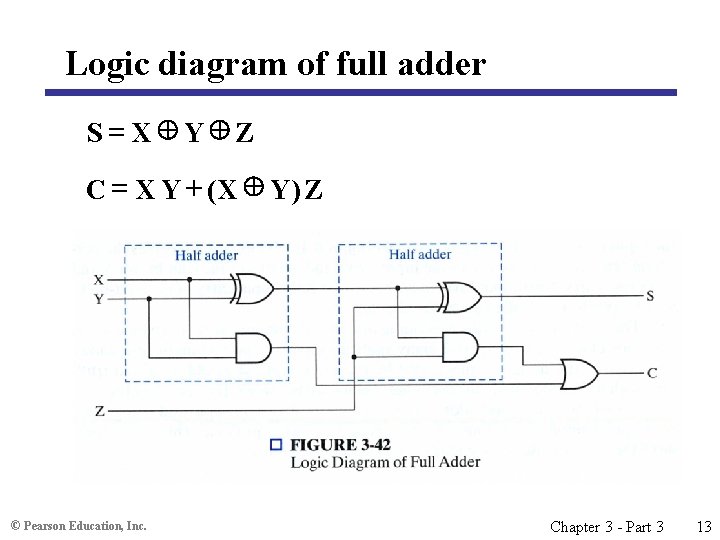
Logic diagram of full adder S = X Y Z C = X Y + ( X Y) Z © Pearson Education, Inc. Chapter 3 - Part 3 13
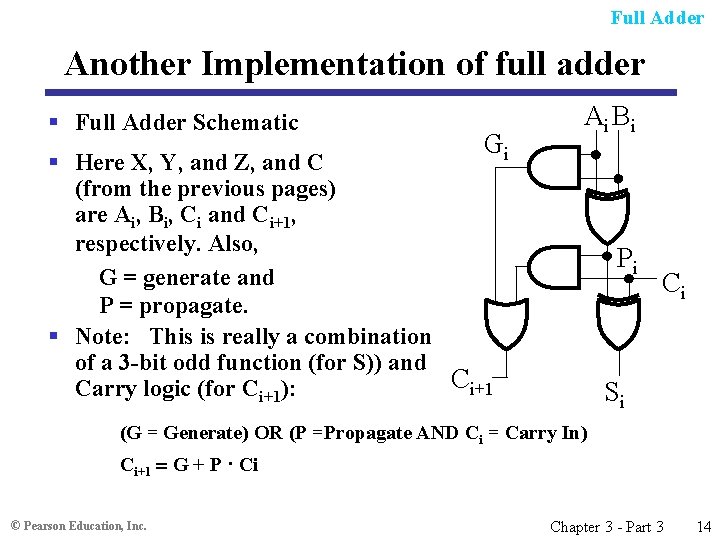
Full Adder Another Implementation of full adder § Full Adder Schematic Gi Ai B i § Here X, Y, and Z, and C (from the previous pages) are Ai, Bi, Ci and Ci+1, respectively. Also, G = generate and P = propagate. § Note: This is really a combination of a 3 -bit odd function (for S)) and Ci+1 Carry logic (for Ci+1): Pi Ci Si (G = Generate) OR (P =Propagate AND Ci = Carry In) Ci+1 = G + P · Ci © Pearson Education, Inc. Chapter 3 - Part 3 14
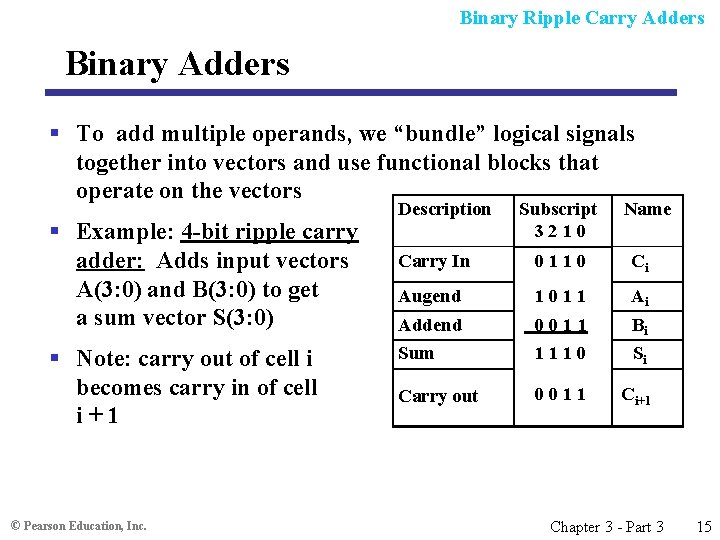
Binary Ripple Carry Adders Binary Adders § To add multiple operands, we “bundle” logical signals together into vectors and use functional blocks that operate on the vectors § Example: 4 -bit ripple carry adder: Adds input vectors A(3: 0) and B(3: 0) to get a sum vector S(3: 0) § Note: carry out of cell i becomes carry in of cell i+1 © Pearson Education, Inc. Description Subscript 3210 Name Carry In 0110 Ci Augend 1011 Ai Addend 0011 Bi Sum 1110 Si Carry out 0011 Ci+1 Chapter 3 - Part 3 15
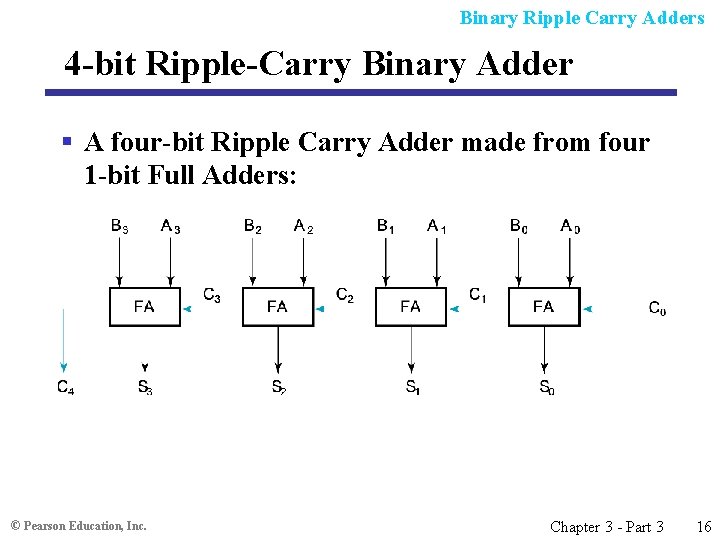
Binary Ripple Carry Adders 4 -bit Ripple-Carry Binary Adder § A four-bit Ripple Carry Adder made from four 1 -bit Full Adders: © Pearson Education, Inc. Chapter 3 - Part 3 16
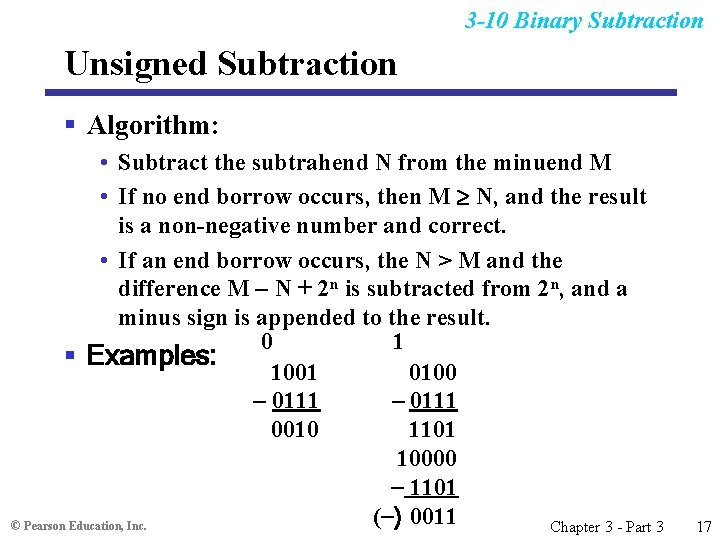
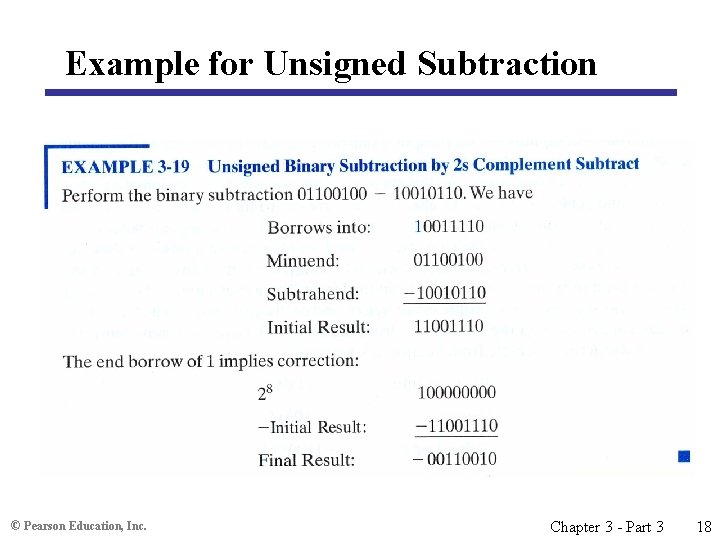
3 -10 Binary Subtraction Unsigned Subtraction § Algorithm: • Subtract the subtrahend N from the minuend M • If no end borrow occurs, then M ³ N, and the result is a non-negative number and correct. • If an end borrow occurs, the N > M and the difference M N + 2 n is subtracted from 2 n, and a minus sign is appended to the result. 0 1 § Examples: 1001 0100 0111 0010 1101 10000 1101 ( ) 0011 © Pearson Education, Inc. Chapter 3 - Part 3 17
Example for Unsigned Subtraction © Pearson Education, Inc. Chapter 3 - Part 3 18
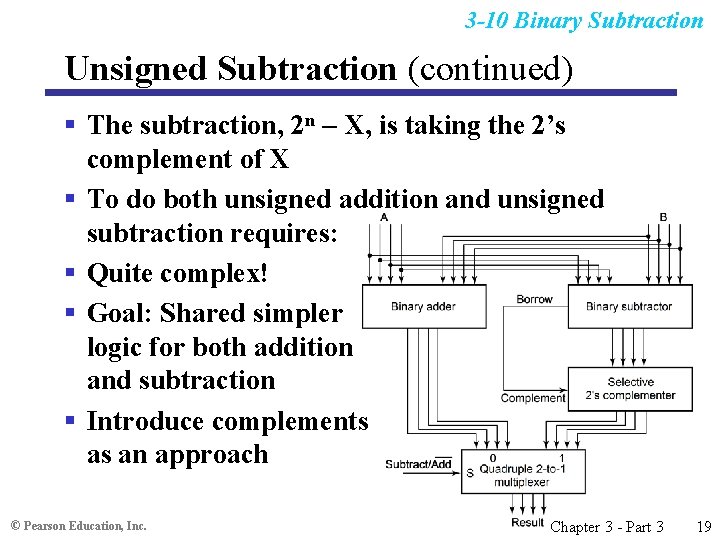
3 -10 Binary Subtraction Unsigned Subtraction (continued) § The subtraction, 2 n X, is taking the 2’s complement of X § To do both unsigned addition and unsigned subtraction requires: § Quite complex! § Goal: Shared simpler logic for both addition and subtraction § Introduce complements as an approach © Pearson Education, Inc. Chapter 3 - Part 3 19
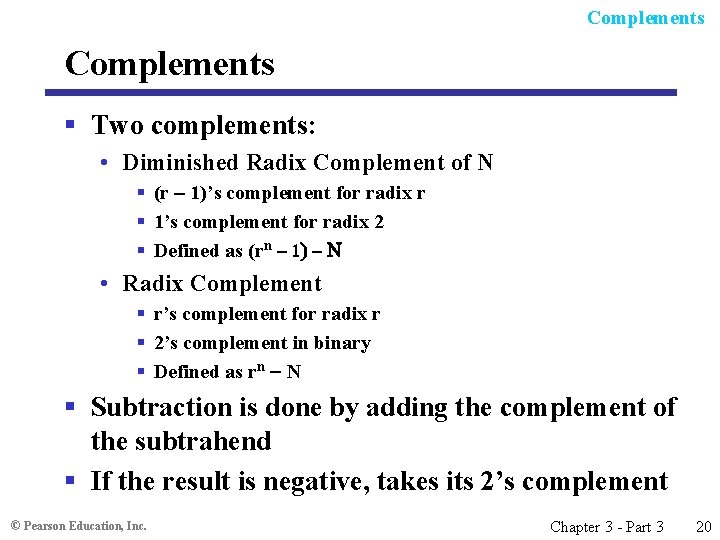
Complements § Two complements: • Diminished Radix Complement of N § (r 1)’s complement for radix r § 1’s complement for radix 2 § Defined as (rn 1) N • Radix Complement § r’s complement for radix r § 2’s complement in binary § Defined as rn N § Subtraction is done by adding the complement of the subtrahend § If the result is negative, takes its 2’s complement © Pearson Education, Inc. Chapter 3 - Part 3 20
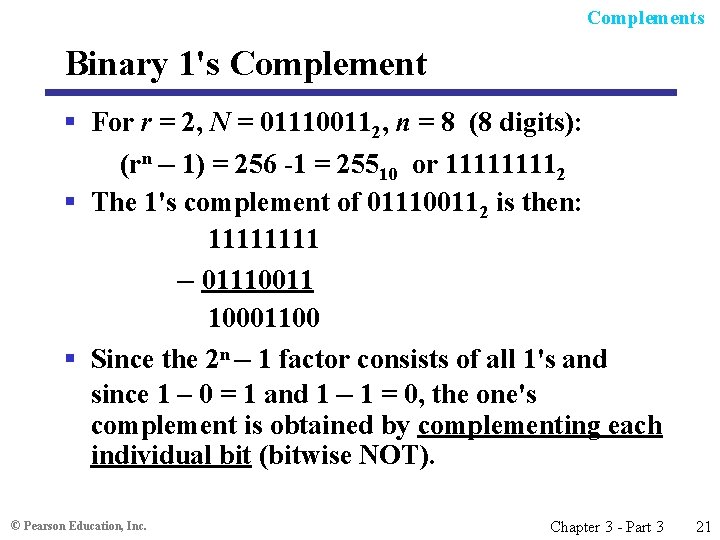
Complements Binary 1's Complement § For r = 2, N = 011100112, n = 8 (8 digits): (rn – 1) = 256 -1 = 25510 or 11112 § The 1's complement of 011100112 is then: 1111 – 01110011 10001100 § Since the 2 n – 1 factor consists of all 1's and since 1 – 0 = 1 and 1 – 1 = 0, the one's complement is obtained by complementing each individual bit (bitwise NOT). © Pearson Education, Inc. Chapter 3 - Part 3 21
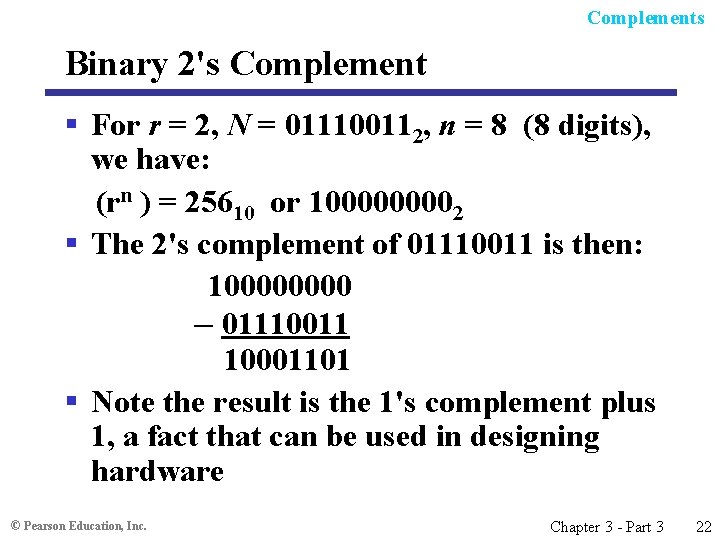
Complements Binary 2's Complement § For r = 2, N = 011100112, n = 8 (8 digits), we have: (rn ) = 25610 or 100002 § The 2's complement of 01110011 is then: 10000 – 01110011 10001101 § Note the result is the 1's complement plus 1, a fact that can be used in designing hardware © Pearson Education, Inc. Chapter 3 - Part 3 22
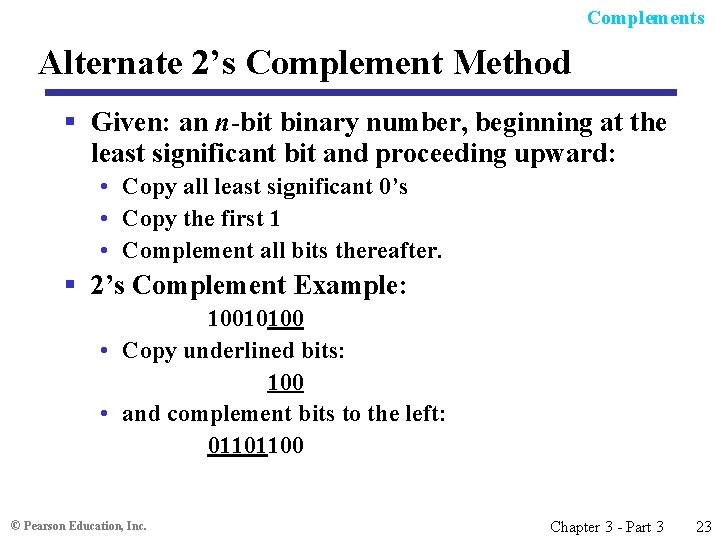
Complements Alternate 2’s Complement Method § Given: an n-bit binary number, beginning at the least significant bit and proceeding upward: • Copy all least significant 0’s • Copy the first 1 • Complement all bits thereafter. § 2’s Complement Example: 10010100 • Copy underlined bits: 100 • and complement bits to the left: 01101100 © Pearson Education, Inc. Chapter 3 - Part 3 23
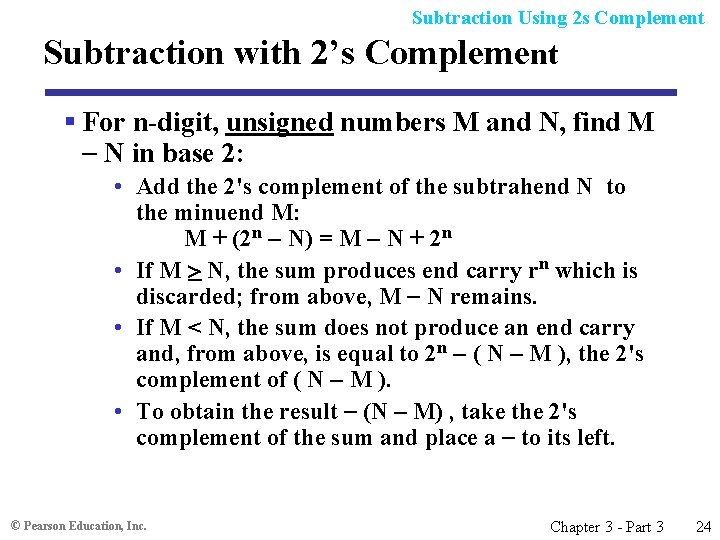
Subtraction Using 2 s Complement Subtraction with 2’s Complement § For n-digit, unsigned numbers M and N, find M N in base 2: • Add the 2's complement of the subtrahend N to the minuend M: M + (2 n N) = M N + 2 n • If M N, the sum produces end carry rn which is discarded; from above, M N remains. • If M < N, the sum does not produce an end carry and, from above, is equal to 2 n ( N M ), the 2's complement of ( N M ). • To obtain the result (N – M) , take the 2's complement of the sum and place a to its left. © Pearson Education, Inc. Chapter 3 - Part 3 24
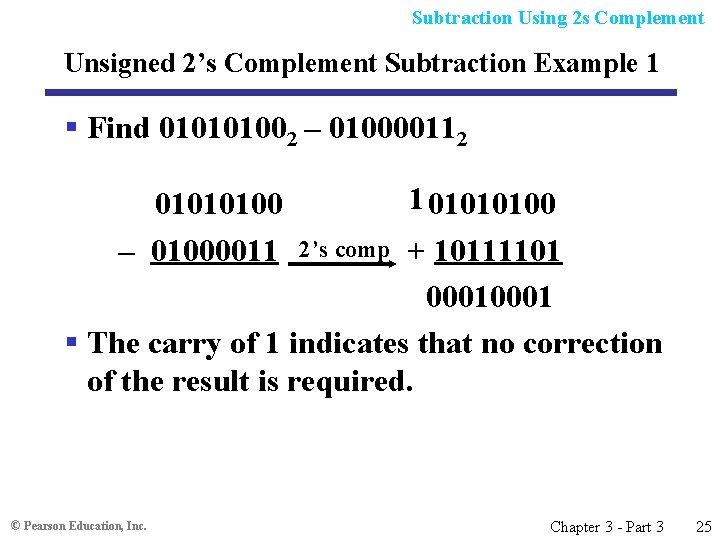
Subtraction Using 2 s Complement Unsigned 2’s Complement Subtraction Example 1 § Find 010101002 – 010000112 01010100 – 01000011 1 01010100 + 10111101 0001 § The carry of 1 indicates that no correction of the result is required. © Pearson Education, Inc. 2’s comp Chapter 3 - Part 3 25
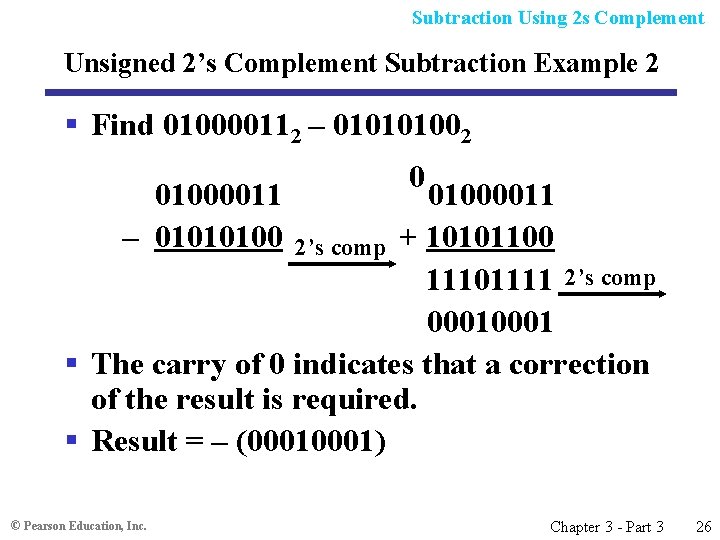
Subtraction Using 2 s Complement Unsigned 2’s Complement Subtraction Example 2 § Find 010000112 – 010101002 01000011 – 01010100 0 01000011 2’s comp + 10101100 11101111 2’s comp 0001 § The carry of 0 indicates that a correction of the result is required. § Result = – (0001) © Pearson Education, Inc. Chapter 3 - Part 3 26
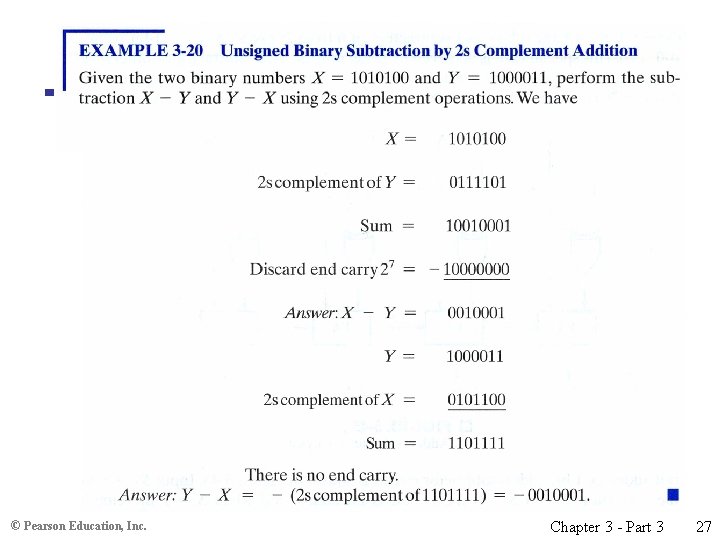
© Pearson Education, Inc. Chapter 3 - Part 3 27
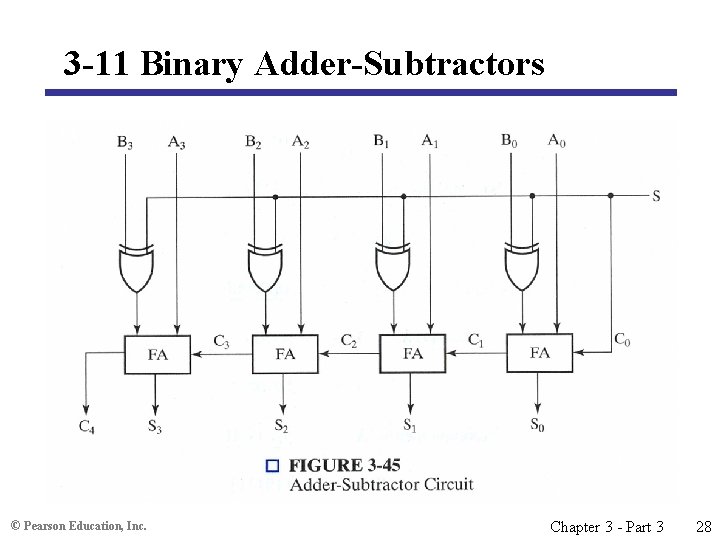
3 -11 Binary Adder-Subtractors ADDER-SUBTRACTORS © Pearson Education, Inc. Chapter 3 - Part 3 28
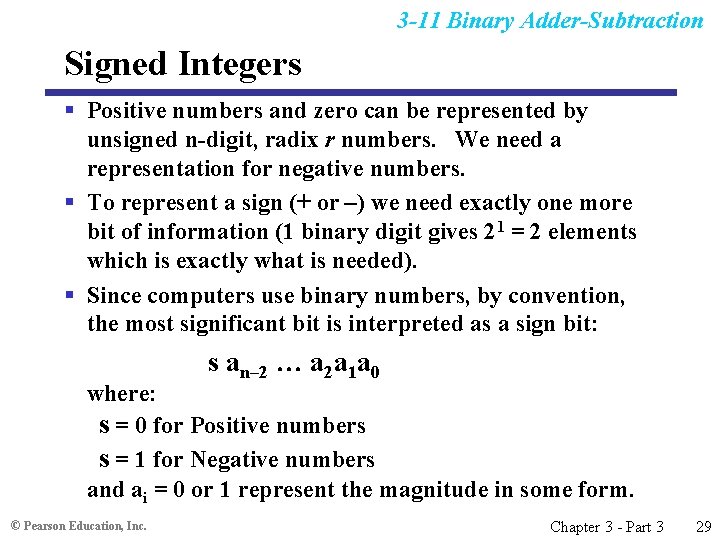
3 -11 Binary Adder-Subtraction Signed Integers § Positive numbers and zero can be represented by unsigned n-digit, radix r numbers. We need a representation for negative numbers. § To represent a sign (+ or –) we need exactly one more bit of information (1 binary digit gives 21 = 2 elements which is exactly what is needed). § Since computers use binary numbers, by convention, the most significant bit is interpreted as a sign bit: s an– 2 a 2 a 1 a 0 where: s = 0 for Positive numbers s = 1 for Negative numbers and ai = 0 or 1 represent the magnitude in some form. © Pearson Education, Inc. Chapter 3 - Part 3 29
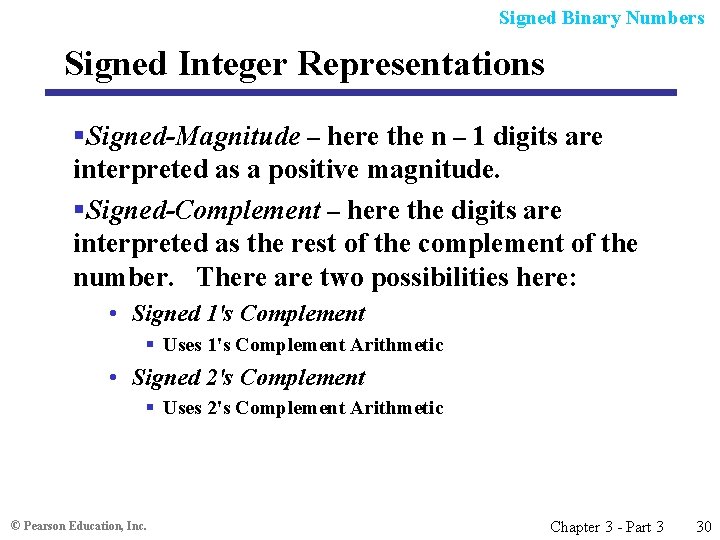
Signed Binary Numbers Signed Integer Representations §Signed-Magnitude – here the n – 1 digits are interpreted as a positive magnitude. §Signed-Complement – here the digits are interpreted as the rest of the complement of the number. There are two possibilities here: • Signed 1's Complement § Uses 1's Complement Arithmetic • Signed 2's Complement § Uses 2's Complement Arithmetic © Pearson Education, Inc. Chapter 3 - Part 3 30
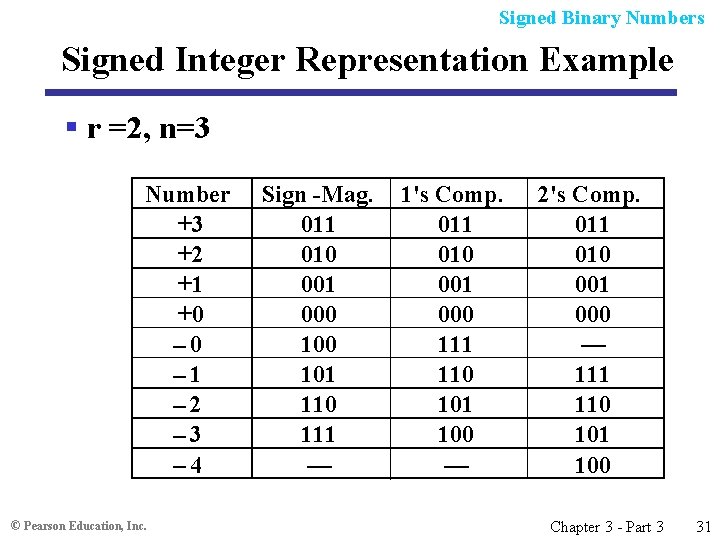
Signed Binary Numbers Signed Integer Representation Example § r =2, n=3 Number +3 +2 +1 +0 – 1 – 2 – 3 – 4 © Pearson Education, Inc. Sign -Mag. 011 010 001 000 101 110 111 — 1's Comp. 011 010 001 000 111 110 101 100 — 2's Comp. 011 010 001 000 — 111 110 101 100 Chapter 3 - Part 3 31
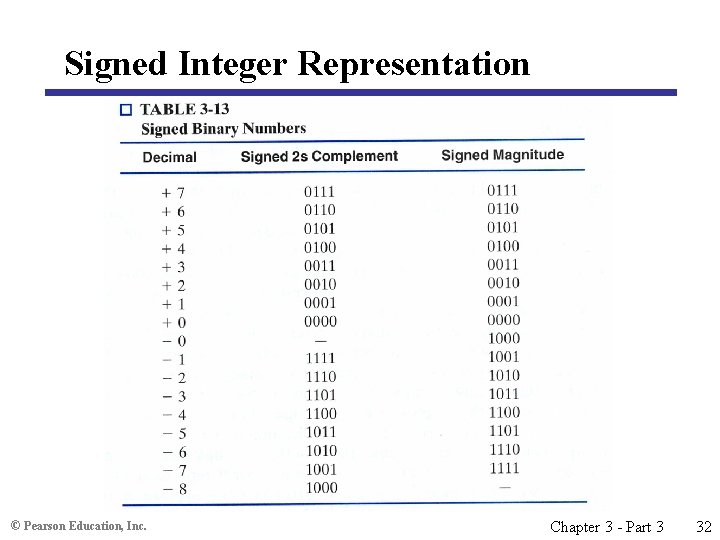
Signed Integer Representation © Pearson Education, Inc. Chapter 3 - Part 3 32
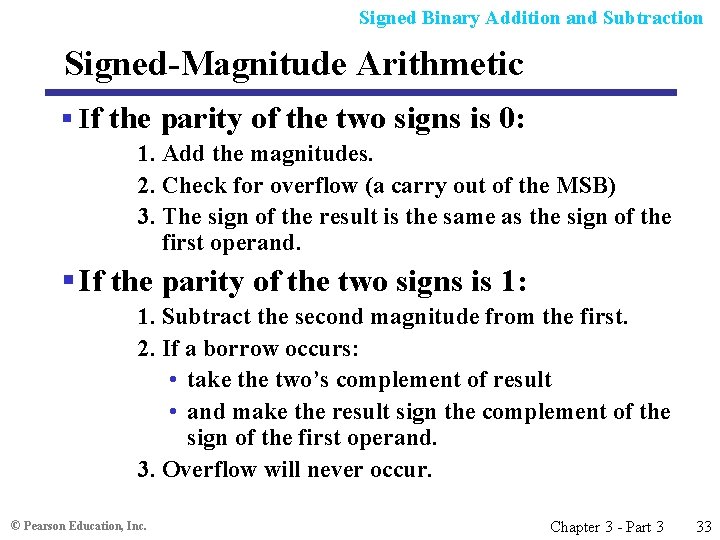
Signed Binary Addition and Subtraction Signed-Magnitude Arithmetic § If the parity of the two signs is 0: 1. Add the magnitudes. 2. Check for overflow (a carry out of the MSB) 3. The sign of the result is the same as the sign of the first operand. § If the parity of the two signs is 1: 1. Subtract the second magnitude from the first. 2. If a borrow occurs: • take the two’s complement of result • and make the result sign the complement of the sign of the first operand. 3. Overflow will never occur. © Pearson Education, Inc. Chapter 3 - Part 3 33
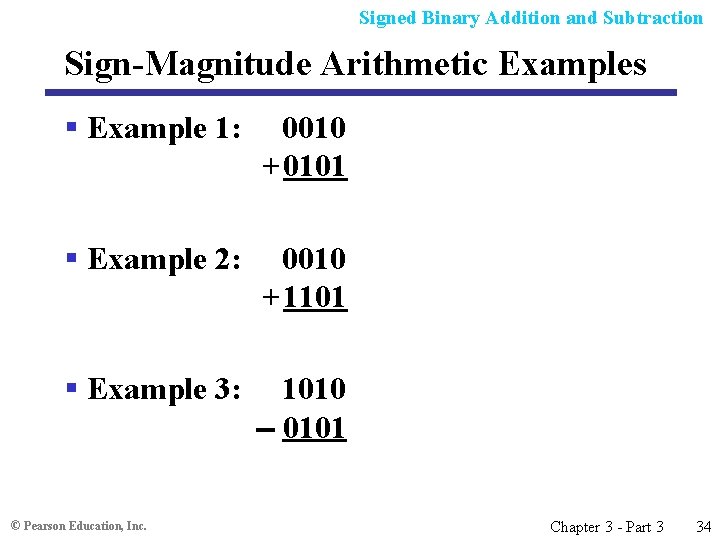
Signed Binary Addition and Subtraction Sign-Magnitude Arithmetic Examples § Example 1: 0010 + 0101 § Example 2: 0010 + 1101 § Example 3: 1010 0101 © Pearson Education, Inc. Chapter 3 - Part 3 34
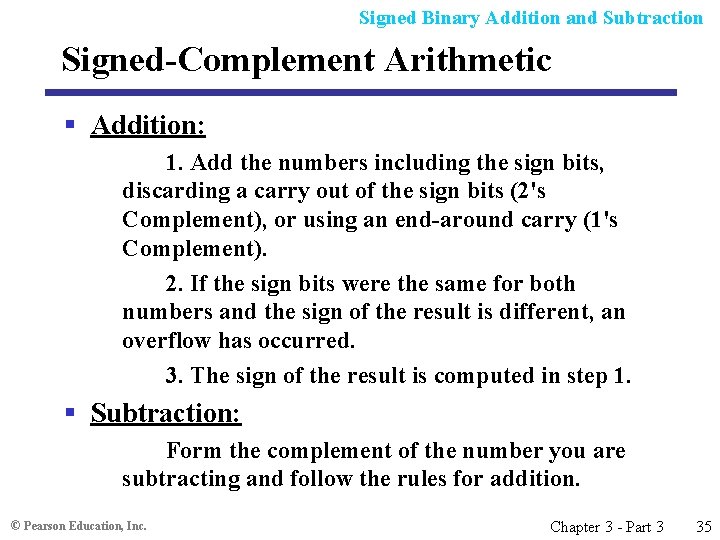
Signed Binary Addition and Subtraction Signed-Complement Arithmetic § Addition: 1. Add the numbers including the sign bits, discarding a carry out of the sign bits (2's Complement), or using an end-around carry (1's Complement). 2. If the sign bits were the same for both numbers and the sign of the result is different, an overflow has occurred. 3. The sign of the result is computed in step 1. § Subtraction: Form the complement of the number you are subtracting and follow the rules for addition. © Pearson Education, Inc. Chapter 3 - Part 3 35
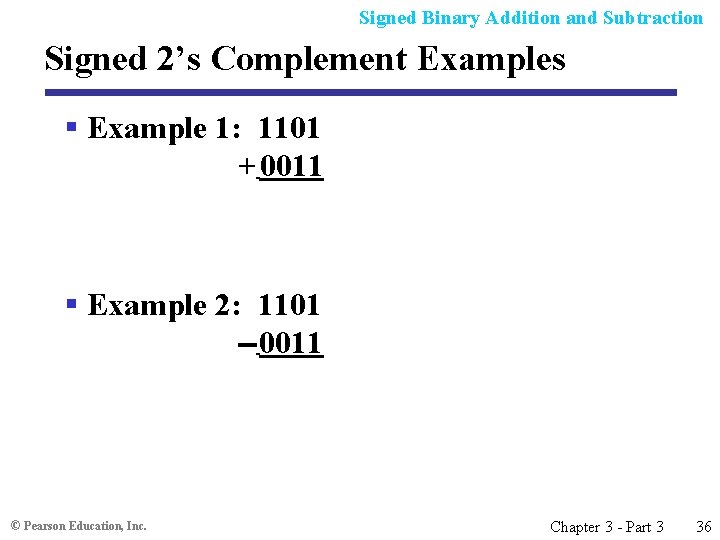
Signed Binary Addition and Subtraction Signed 2’s Complement Examples § Example 1: 1101 + 0011 § Example 2: 1101 0011 © Pearson Education, Inc. Chapter 3 - Part 3 36
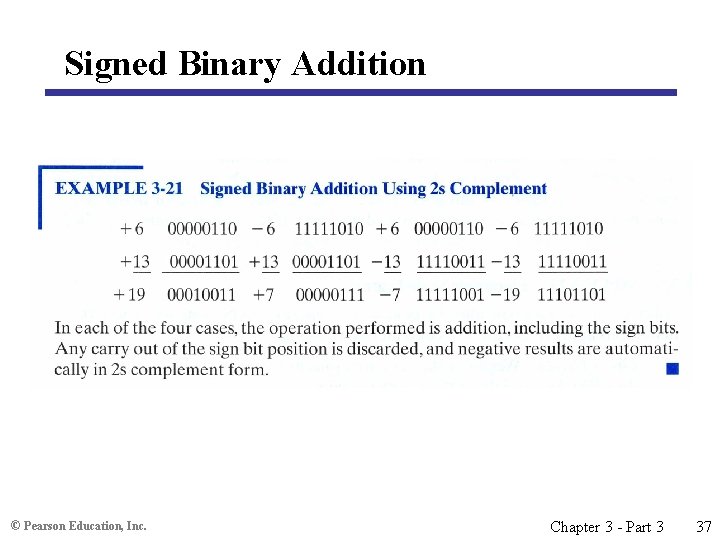
Signed Binary Addition © Pearson Education, Inc. Chapter 3 - Part 3 37
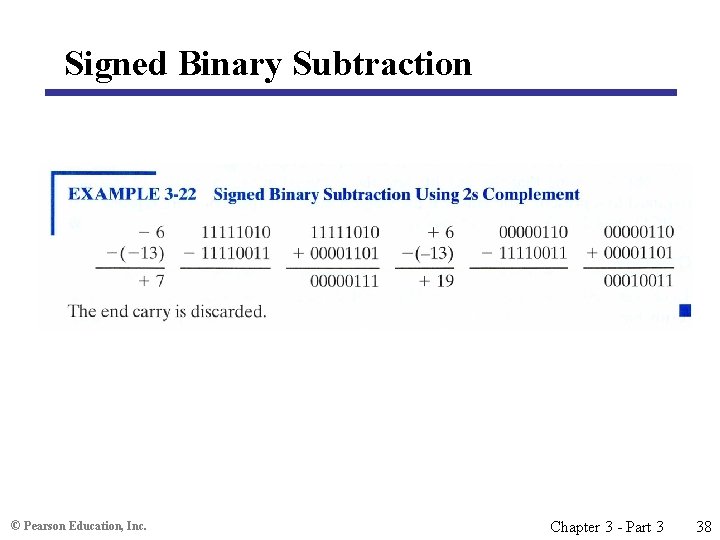
Signed Binary Subtraction © Pearson Education, Inc. Chapter 3 - Part 3 38
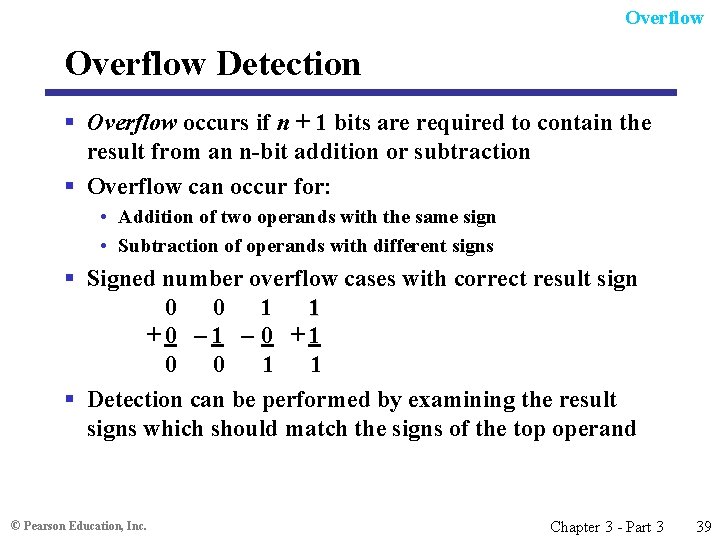
Overflow Detection § Overflow occurs if n + 1 bits are required to contain the result from an n-bit addition or subtraction § Overflow can occur for: • Addition of two operands with the same sign • Subtraction of operands with different signs § Signed number overflow cases with correct result sign 0 0 1 1 +0 1 0 +1 0 0 1 1 § Detection can be performed by examining the result signs which should match the signs of the top operand © Pearson Education, Inc. Chapter 3 - Part 3 39
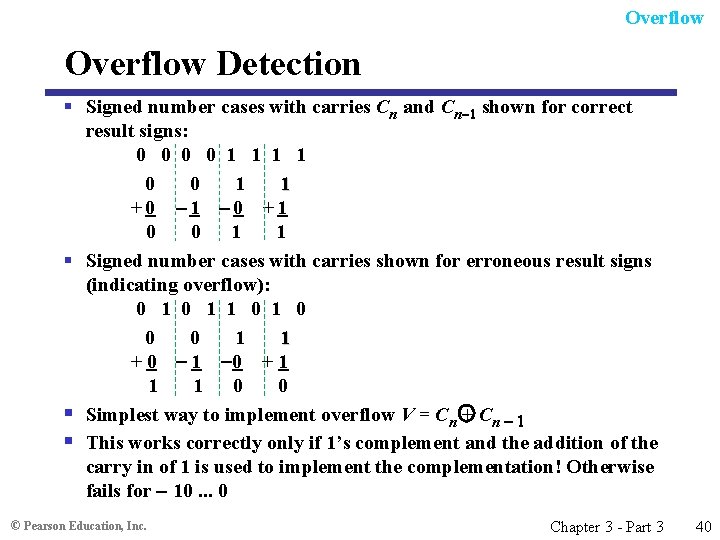
Overflow Detection § Signed number cases with carries Cn and Cn 1 shown for correct result signs: 0 0 1 1 + 0 1 0 + 1 0 0 1 1 § Signed number cases with carries shown for erroneous result signs (indicating overflow): 0 1 1 0 0 0 1 1 + 0 1 0 + 1 1 1 0 0 § Simplest way to implement overflow V = Cn + Cn 1 § This works correctly only if 1’s complement and the addition of the carry in of 1 is used to implement the complementation! Otherwise fails for 10. . . 0 © Pearson Education, Inc. Chapter 3 - Part 3 40
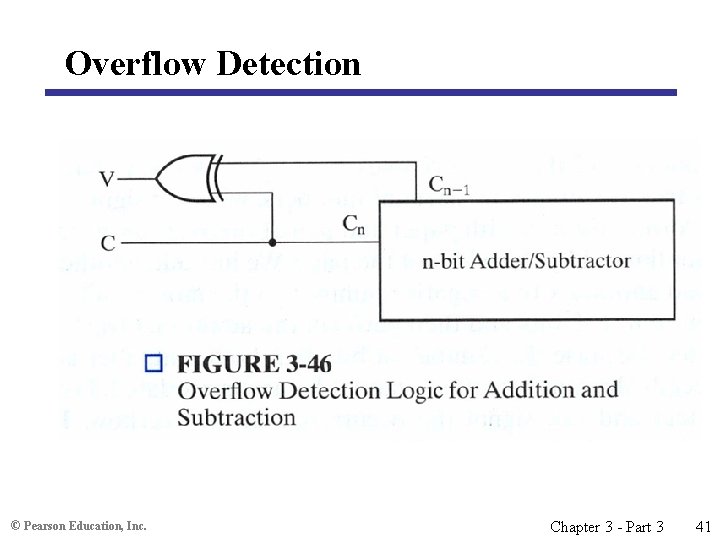
Overflow Detection © Pearson Education, Inc. Chapter 3 - Part 3 41
3 -12 Other Arithmetic Functions § Convenient to design the functional blocks by contraction - removal of redundancy from circuit to which input fixing has been applied § Functions • Incrementing • Decrementing • Multiplication by Constant • Division by Constant • Zero Fill and Extension © Pearson Education, Inc. Chapter 3 - Part 3 42
Design by Contraction § Contraction is a technique for simplifying the logic in a functional block to implement a different function • The new function must be realizable from the original function by applying rudimentary functions to its inputs • Contraction is treated here only for application of 0 s and 1 s (not for X and X) • After application of 0 s and 1 s, equations or the logic diagram are simplified by using rules given on pages 224 - 225 of the text. © Pearson Education, Inc. Chapter 3 - Part 3 43
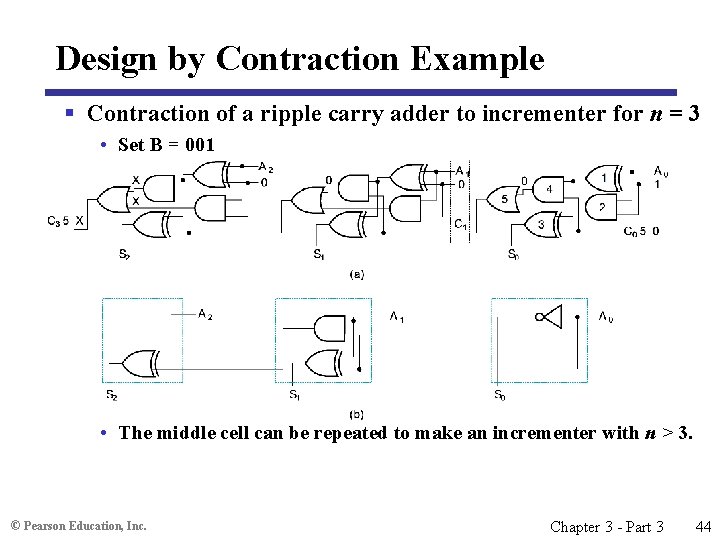
Design by Contraction Example § Contraction of a ripple carry adder to incrementer for n = 3 • Set B = 001 • The middle cell can be repeated to make an incrementer with n > 3. © Pearson Education, Inc. Chapter 3 - Part 3 44
Incrementing & Decrementing § Incrementing • • Adding a fixed value to an arithmetic variable Fixed value is often 1, called counting (up) Examples: A + 1, B + 4 Functional block is called incrementer § Decrementing • • Subtracting a fixed value from an arithmetic variable Fixed value is often 1, called counting (down) Examples: A 1, B 4 Functional block is called decrementer © Pearson Education, Inc. Chapter 3 - Part 3 45
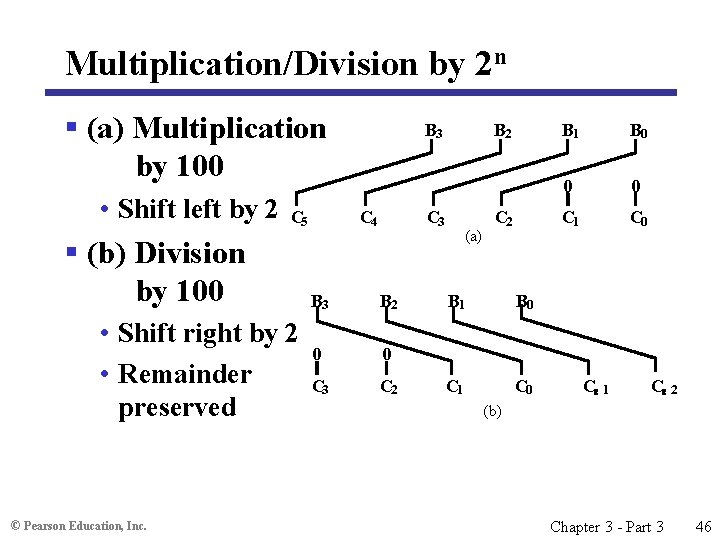
Multiplication/Division by 2 n § (a) Multiplication by 100 • Shift left by 2 C 5 § (b) Division by 100 • Shift right by 2 • Remainder preserved © Pearson Education, Inc. B 3 C 4 B 2 C 3 B 2 0 0 C 3 C 2 (a) C 2 B 1 B 0 C 1 C 0 B 1 B 0 0 0 C 1 C 0 C 2 1 C 2 2 (b) Chapter 3 - Part 3 46
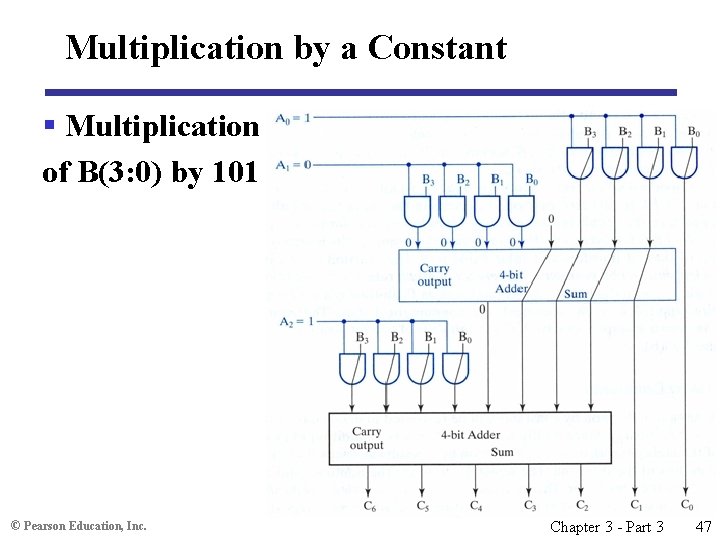
Multiplication by a Constant § Multiplication of B(3: 0) by 101 © Pearson Education, Inc. Chapter 3 - Part 3 47
Zero Fill and Extension Zero Fill § Zero fill - filling an m-bit operand with 0 s to become an n-bit operand with n > m § Filling usually is applied to the MSB end of the operand, but can also be done on the LSB end § Example: 11110101 filled to 16 bits • MSB end: 000011110101 • LSB end: 111101010000 © Pearson Education, Inc. Chapter 3 - Part 3 48
Zero Fill and Extension § Extension - increase in the number of bits at the MSB end of an operand by using a complement representation • Copies the MSB of the operand into the new positions • Positive operand example - 01110101 extended to 16 bits: 000001110101 • Negative operand example - 11110101 extended to 16 bits: 1111110101 © Pearson Education, Inc. Chapter 3 - Part 3 49
- Slides: 49