
Logic and Computer Design Fundamentals Chapter 2 Combinational
Logic and Computer Design Fundamentals Chapter 2 – Combinational Logic Circuits Part 2 – Circuit Optimization Charles Kime & Thomas Kaminski © 2008 Pearson Education, Inc. (Hyperlinks are active in View Show mode)
Overview § Part 1 – Gate Circuits and Boolean Equations • Binary Logic and Gates • Boolean Algebra • Standard Forms § Part 2 – Circuit Optimization • • • Circuit Optimization Karnough Maps Three-Variable Maps Four-Variable Maps Systematic Simplifications § Part 3 – Additional Gates and Circuits • Other Gate Types • Exclusive-OR Operator and Gates • High-Impedance Outputs Chapter 2 - Part 2 2
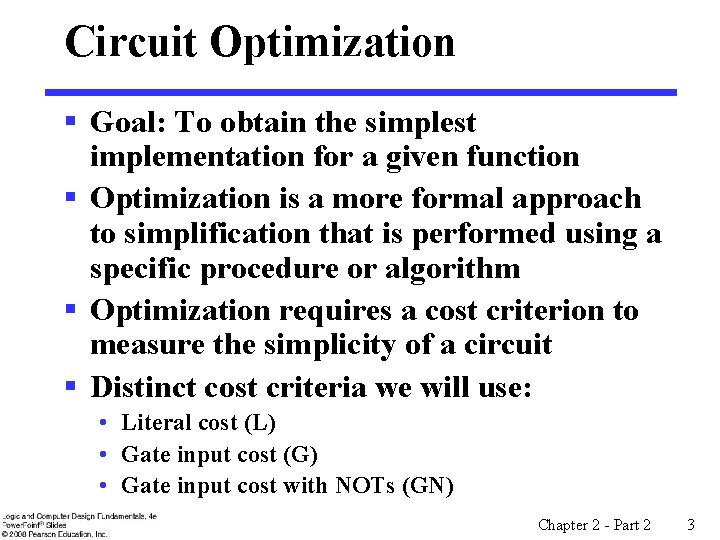
Circuit Optimization § Goal: To obtain the simplest implementation for a given function § Optimization is a more formal approach to simplification that is performed using a specific procedure or algorithm § Optimization requires a cost criterion to measure the simplicity of a circuit § Distinct cost criteria we will use: • Literal cost (L) • Gate input cost (G) • Gate input cost with NOTs (GN) Chapter 2 - Part 2 3
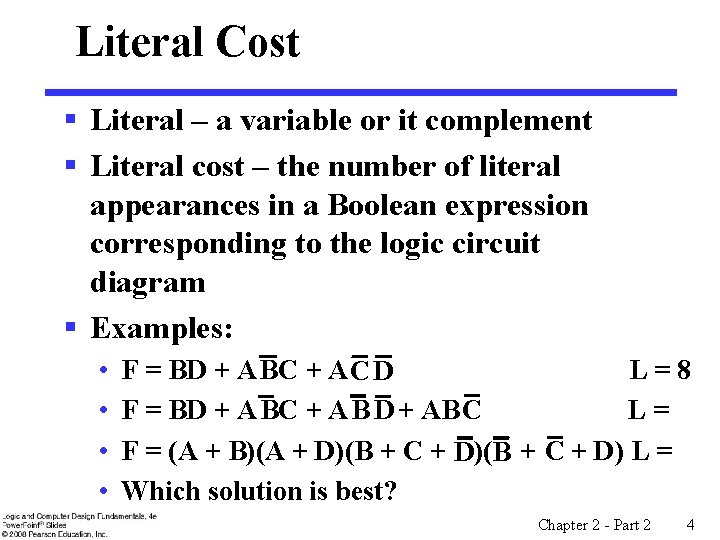
Literal Cost § Literal – a variable or it complement § Literal cost – the number of literal appearances in a Boolean expression corresponding to the logic circuit diagram § Examples: • • F = BD + A B C + A C D L=8 F = BD + A BC + A B D + AB C L= F = (A + B)(A + D)(B + C + D) L = Which solution is best? Chapter 2 - Part 2 4
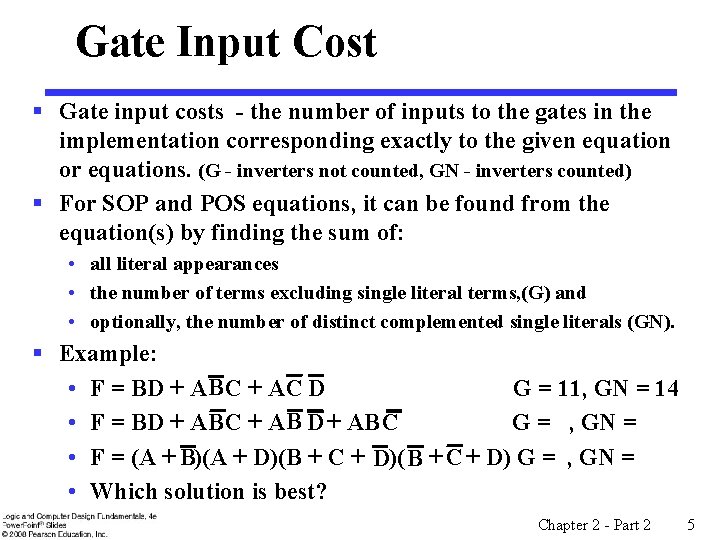
Gate Input Cost § Gate input costs - the number of inputs to the gates in the implementation corresponding exactly to the given equation or equations. (G - inverters not counted, GN - inverters counted) § For SOP and POS equations, it can be found from the equation(s) by finding the sum of: • all literal appearances • the number of terms excluding single literal terms, (G) and • optionally, the number of distinct complemented single literals (GN). § Example: • F = BD + A B C + AC D G = 11, GN = 14 • F = BD + A B C + A B D + AB C G = , GN = • F = (A + B)(A + D)(B + C + D)( B + C + D) G = , GN = • Which solution is best? Chapter 2 - Part 2 5
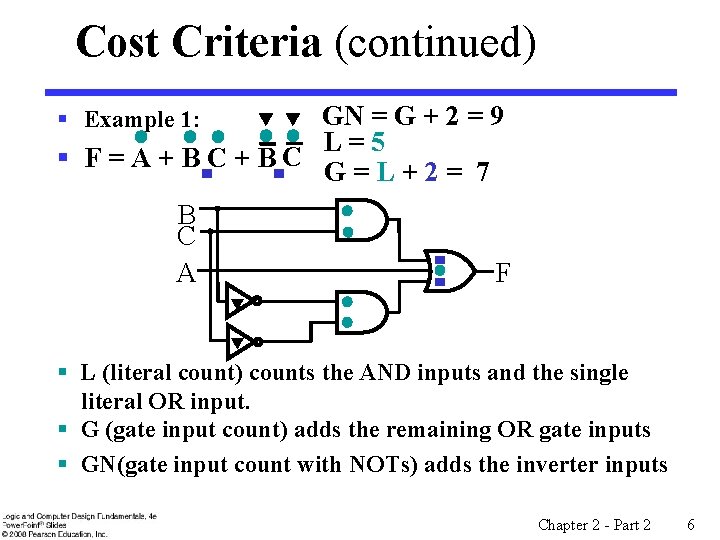
Cost Criteria (continued) GN = G + 2 = 9 L=5 § F=A+BC+ BC G=L+2= 7 § Example 1: B C A F § L (literal count) counts the AND inputs and the single literal OR input. § G (gate input count) adds the remaining OR gate inputs § GN(gate input count with NOTs) adds the inverter inputs Chapter 2 - Part 2 6
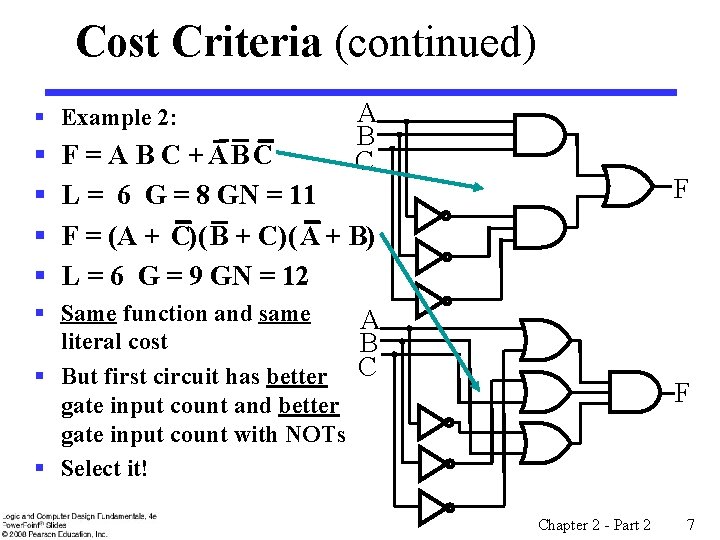
Cost Criteria (continued) § Example 2: § § A B C F = A B C + AB C L = 6 G = 8 GN = 11 F = (A + C)( B + C)( A + B) L = 6 G = 9 GN = 12 F § Same function and same A literal cost B § But first circuit has better C gate input count and better gate input count with NOTs § Select it! F Chapter 2 - Part 2 7
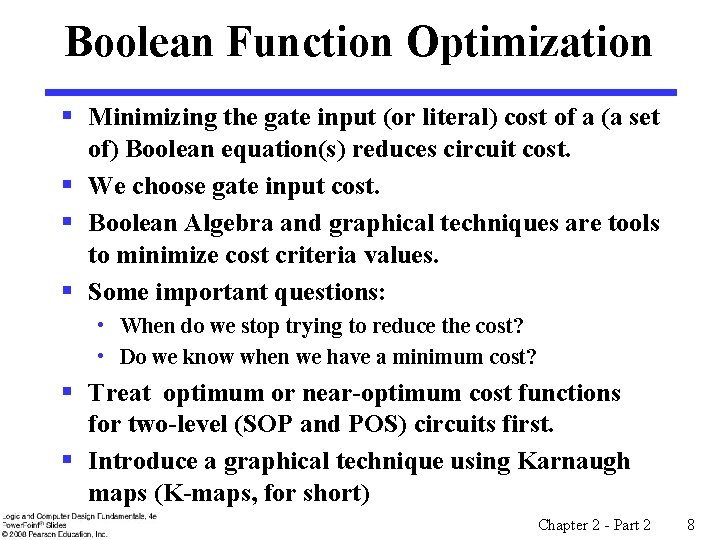
Boolean Function Optimization § Minimizing the gate input (or literal) cost of a (a set of) Boolean equation(s) reduces circuit cost. § We choose gate input cost. § Boolean Algebra and graphical techniques are tools to minimize cost criteria values. § Some important questions: • When do we stop trying to reduce the cost? • Do we know when we have a minimum cost? § Treat optimum or near-optimum cost functions for two-level (SOP and POS) circuits first. § Introduce a graphical technique using Karnaugh maps (K-maps, for short) Chapter 2 - Part 2 8
Overview § Part 1 – Gate Circuits and Boolean Equations • Binary Logic and Gates • Boolean Algebra • Standard Forms § Part 2 – Circuit Optimization • • • Circuit Optimization Karnough Maps Three-Variable Maps Four-Variable Maps Systematic Simplifications § Part 3 – Additional Gates and Circuits • Other Gate Types • Exclusive-OR Operator and Gates • High-Impedance Outputs Chapter 2 - Part 2 9
Karnaugh Maps (K-map) § A K-map is a collection of squares • • Each square represents a minterm The collection of squares is a graphical representation of a Boolean function Adjacent squares differ in the value of one variable Alternative algebraic expressions for the same function are derived by recognizing patterns of squares § The K-map can be viewed as • A reorganized version of the truth table • A topologically-warped Venn diagram as used to visualize sets in algebra of sets Chapter 2 - Part 2 10
Some Uses of K-Maps § Provide a means for: • Finding optimum or near optimum § SOP and POS standard forms, and § two-level AND/OR and OR/AND circuit implementations for functions with small numbers of variables • Visualizing concepts related to manipulating Boolean expressions, and • Demonstrating concepts used by computeraided design programs to simplify large circuits Chapter 2 - Part 2 11
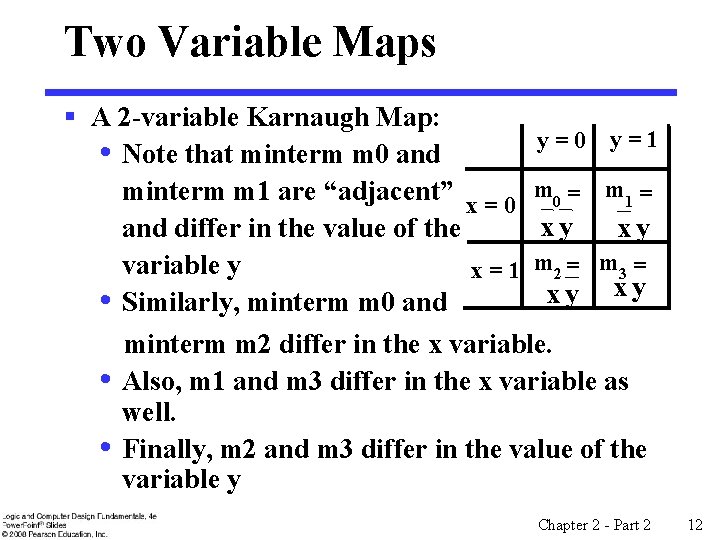
Two Variable Maps § A 2 -variable Karnaugh Map: y=0 y=1 • Note that minterm m 0 and minterm m 1 are “adjacent” x = 0 m 0 = m 1 = xy xy and differ in the value of the variable y x = 1 m 2 = m 3 = xy x y • Similarly, minterm m 0 and minterm m 2 differ in the x variable. • Also, m 1 and m 3 differ in the x variable as well. • Finally, m 2 and m 3 differ in the value of the variable y Chapter 2 - Part 2 12
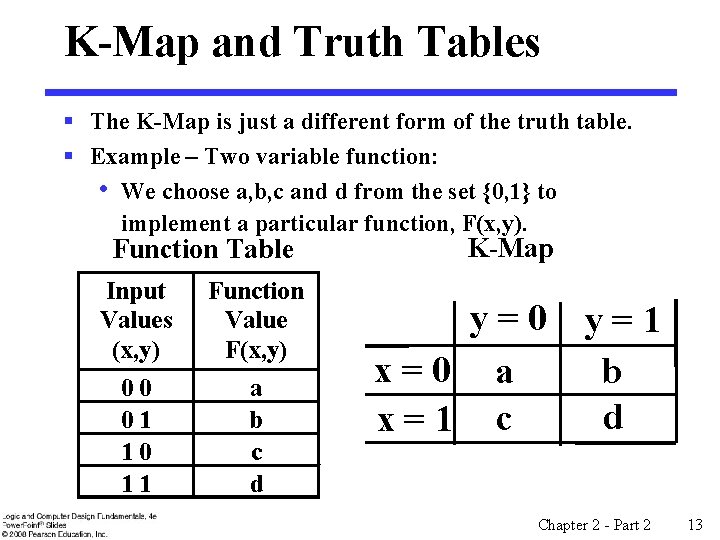
K-Map and Truth Tables § The K-Map is just a different form of the truth table. § Example – Two variable function: • We choose a, b, c and d from the set {0, 1} to implement a particular function, F(x, y). Function Table Input Values (x, y) Function Value F(x, y) 00 01 10 11 a b c d K-Map y=0 x=0 a x=1 c y=1 b d Chapter 2 - Part 2 13
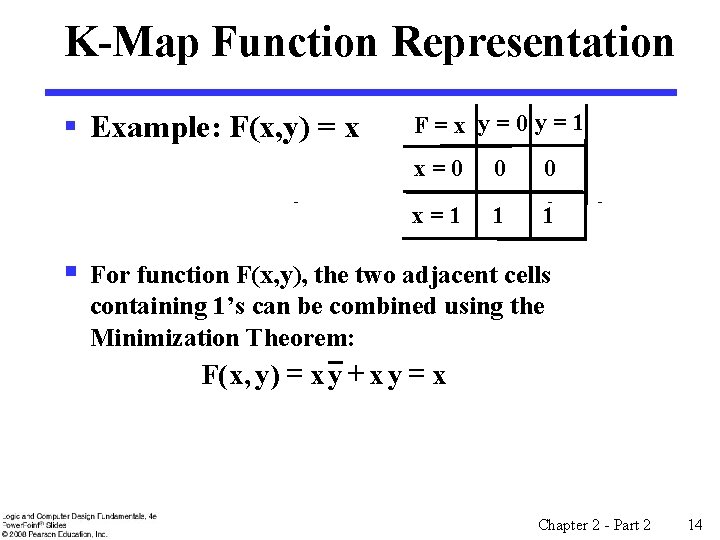
K-Map Function Representation § Example: F(x, y) = x § F=x y=0 y=1 x=0 0 0 x=1 1 1 For function F(x, y), the two adjacent cells containing 1’s can be combined using the Minimization Theorem: F( x , y ) = x y + x y = x Chapter 2 - Part 2 14
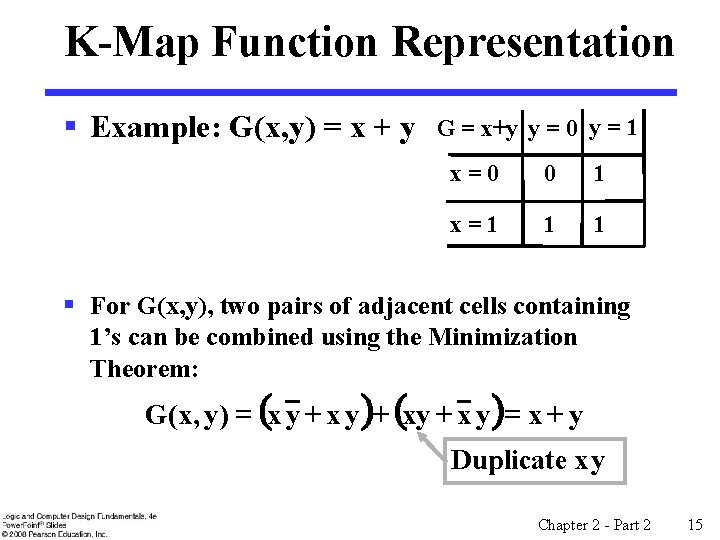
K-Map Function Representation § Example: G(x, y) = x + y G = x+y y = 0 y = 1 x=0 0 1 x=1 1 1 § For G(x, y), two pairs of adjacent cells containing 1’s can be combined using the Minimization Theorem: G( x , y ) = (x y + x y )+ (xy + x y )= x + y Duplicate x y Chapter 2 - Part 2 15
Overview § Part 1 – Gate Circuits and Boolean Equations • Binary Logic and Gates • Boolean Algebra • Standard Forms § Part 2 – Circuit Optimization • • • Circuit Optimization Karnough Maps Three-Variable Maps Four-Variable Maps Systematic Simplifications § Part 3 – Additional Gates and Circuits • Other Gate Types • Exclusive-OR Operator and Gates • High-Impedance Outputs Chapter 2 - Part 2 16
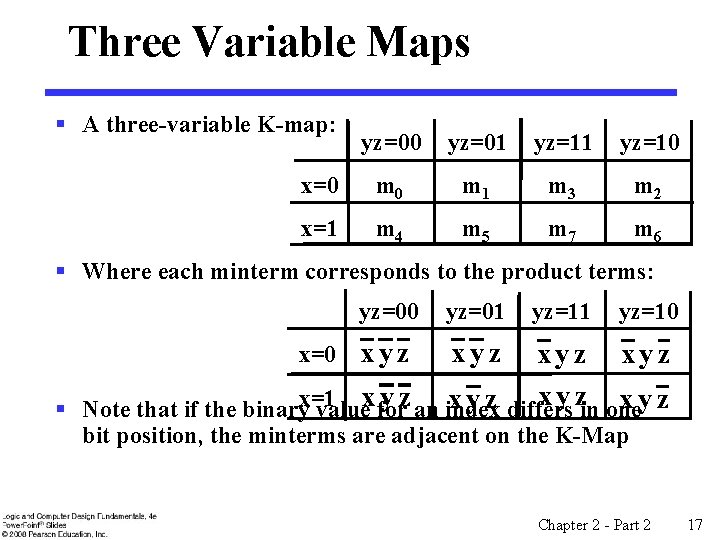
Three Variable Maps § A three-variable K-map: yz=00 yz=01 yz=10 x=0 m 1 m 3 m 2 x=1 m 4 m 5 m 7 m 6 § Where each minterm corresponds to the product terms: yz=00 x=0 x y z yz=01 yz=10 xyz xyz x y zin one y z an index x y z differs xyz § Note that if the binaryx=1 valuex for bit position, the minterms are adjacent on the K-Map Chapter 2 - Part 2 17
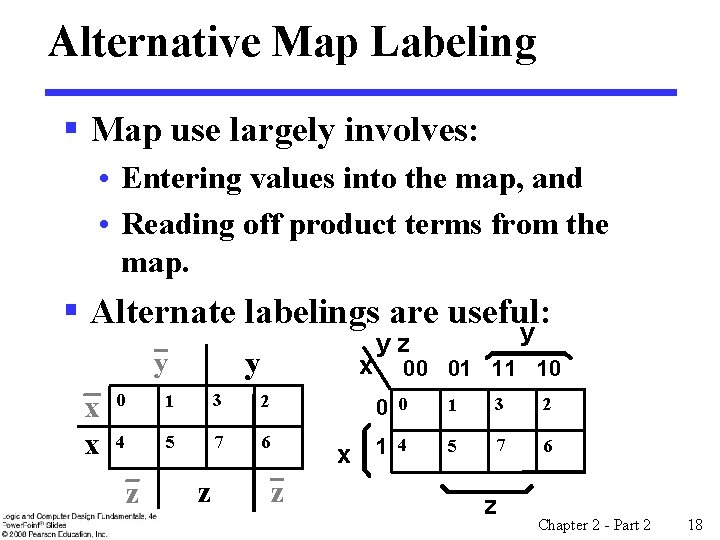
Alternative Map Labeling § Map use largely involves: • Entering values into the map, and • Reading off product terms from the map. § Alternate labelings are useful: y y y x x x 0 1 3 2 4 5 7 6 z z yz 00 01 11 10 0 0 x 1 z 4 1 3 2 5 7 6 z Chapter 2 - Part 2 18
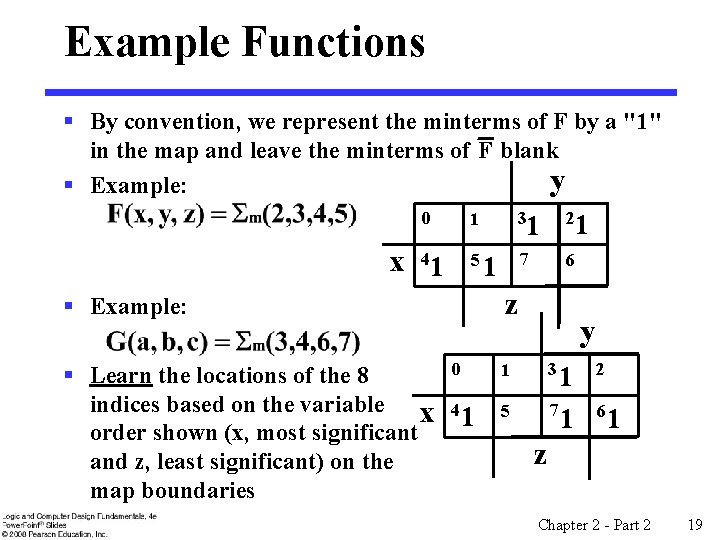
Example Functions § By convention, we represent the minterms of F by a "1" in the map and leave the minterms of F blank y § Example: 0 1 x 41 5 2 7 6 1 1 z § Example: § Learn the locations of the 8 indices based on the variable x order shown (x, most significant and z, least significant) on the map boundaries 3 0 4 1 1 1 y 3 1 7 1 5 2 6 1 z Chapter 2 - Part 2 19
Combining Squares § By combining squares, we reduce number of literals in a product term, reducing the literal cost, thereby reducing the other two cost criteria § On a 3 -variable K-Map: • One square represents a minterm with three variables • Two adjacent squares represent a product term with two variables • Four “adjacent” terms represent a product term with one variable • Eight “adjacent” terms is the function of all ones (no variables) = 1. Chapter 2 - Part 2 20
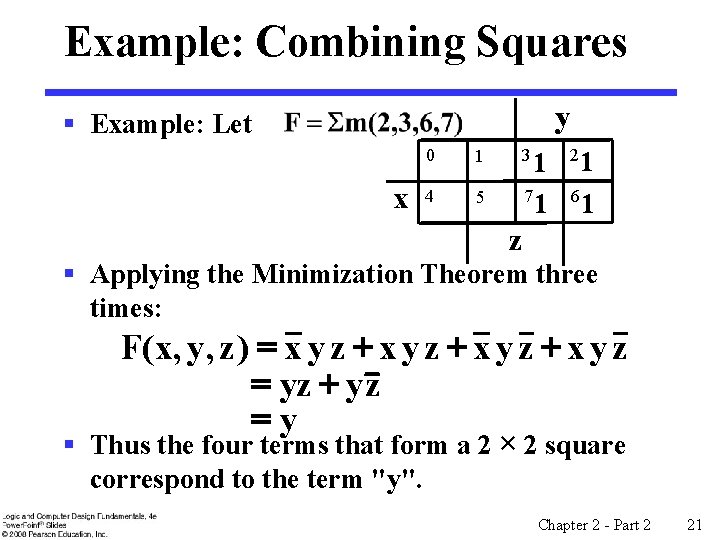
Example: Combining Squares y § Example: Let x 0 1 4 5 3 1 7 1 2 1 6 1 z § Applying the Minimization Theorem three times: F( x , y , z ) = x y z + x y z = yz + y z =y § Thus the four terms that form a 2 × 2 square correspond to the term "y". Chapter 2 - Part 2 21
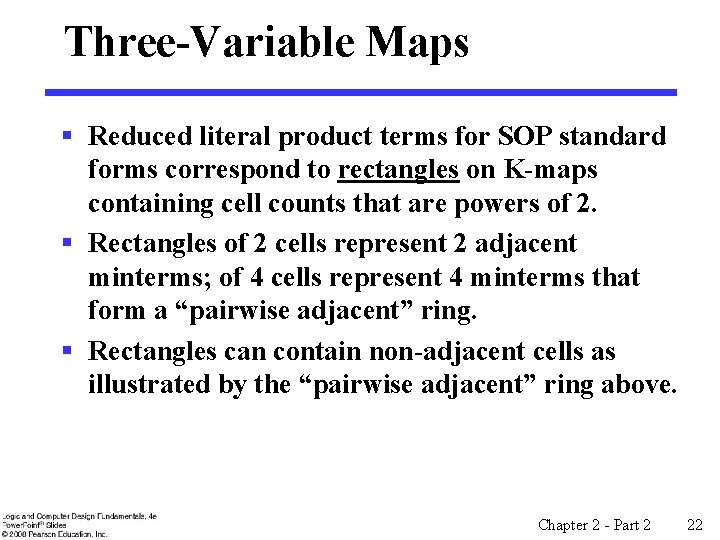
Three-Variable Maps § Reduced literal product terms for SOP standard forms correspond to rectangles on K-maps containing cell counts that are powers of 2. § Rectangles of 2 cells represent 2 adjacent minterms; of 4 cells represent 4 minterms that form a “pairwise adjacent” ring. § Rectangles can contain non-adjacent cells as illustrated by the “pairwise adjacent” ring above. Chapter 2 - Part 2 22
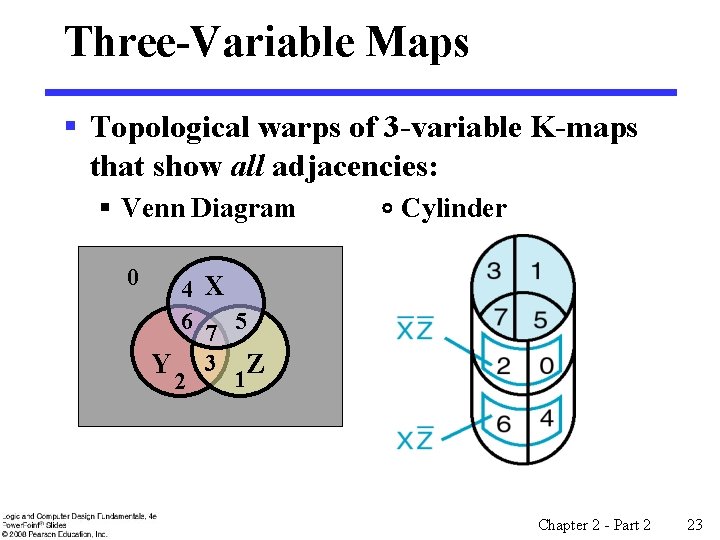
Three-Variable Maps § Topological warps of 3 -variable K-maps that show all adjacencies: § Venn Diagram 0 Cylinder 4 X 6 7 5 Y 3 Z 1 2 Chapter 2 - Part 2 23
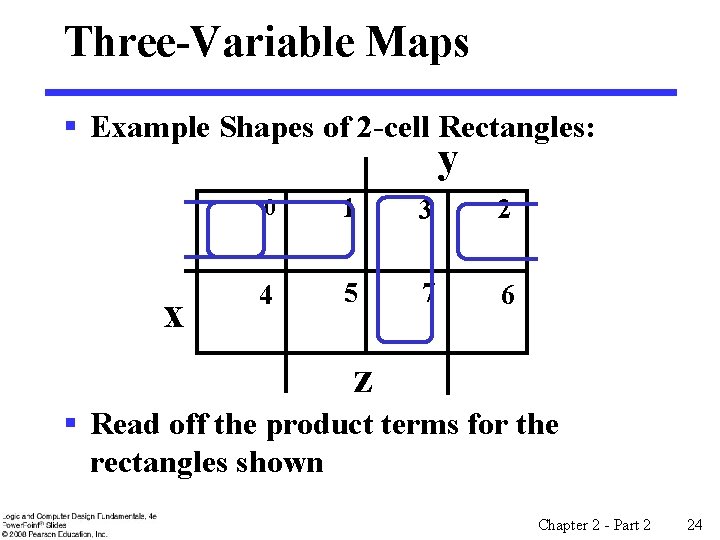
Three-Variable Maps § Example Shapes of 2 -cell Rectangles: y x 0 1 3 2 4 5 7 6 z § Read off the product terms for the rectangles shown Chapter 2 - Part 2 24
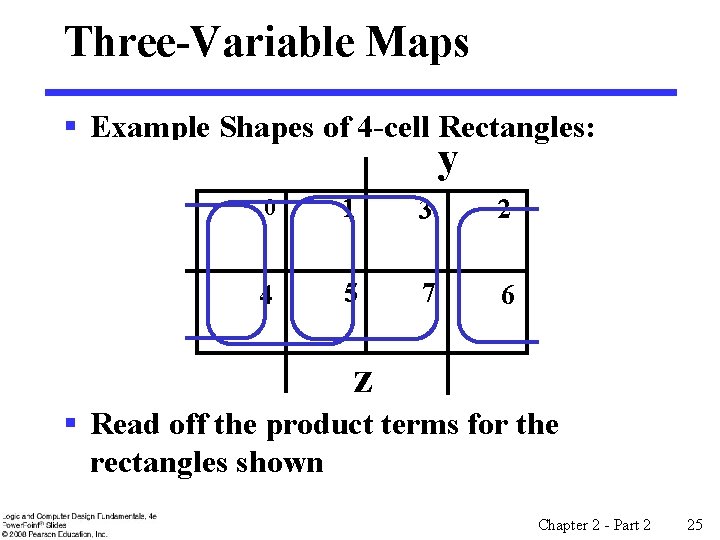
Three-Variable Maps § Example Shapes of 4 -cell Rectangles: y x 0 1 3 2 4 5 7 6 z § Read off the product terms for the rectangles shown Chapter 2 - Part 2 25
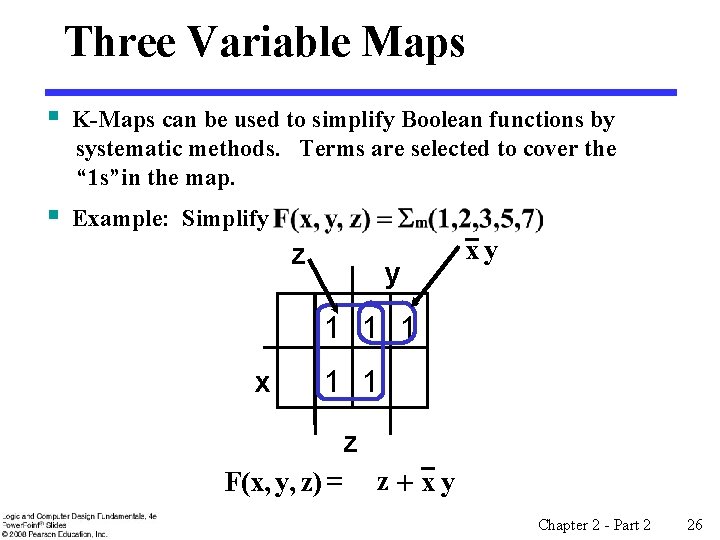
Three Variable Maps § K-Maps can be used to simplify Boolean functions by systematic methods. Terms are selected to cover the “ 1 s”in the map. § Example: Simplify z y xy 1 1 1 x 1 1 z F(x, y, z) = z+xy Chapter 2 - Part 2 26
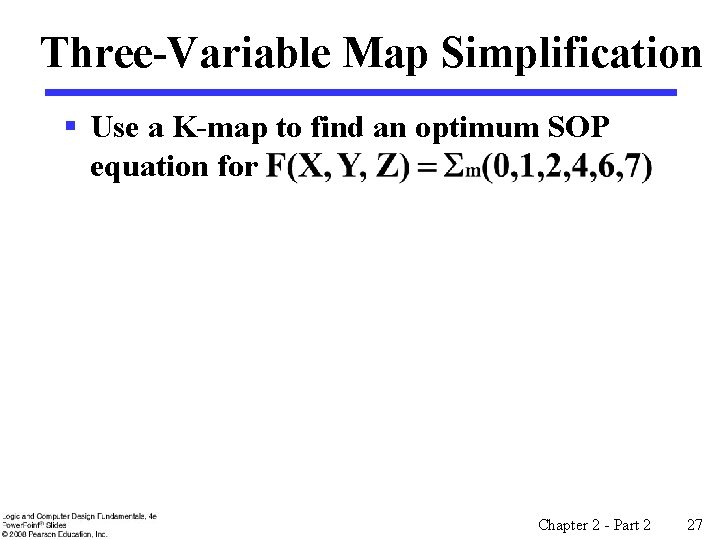
Three-Variable Map Simplification § Use a K-map to find an optimum SOP equation for Chapter 2 - Part 2 27
Overview § Part 1 – Gate Circuits and Boolean Equations • Binary Logic and Gates • Boolean Algebra • Standard Forms § Part 2 – Circuit Optimization • • • Circuit Optimization Karnough Maps Three-Variable Maps Four-Variable Maps Systematic Simplifications § Part 3 – Additional Gates and Circuits • Other Gate Types • Exclusive-OR Operator and Gates • High-Impedance Outputs Chapter 2 - Part 2 28
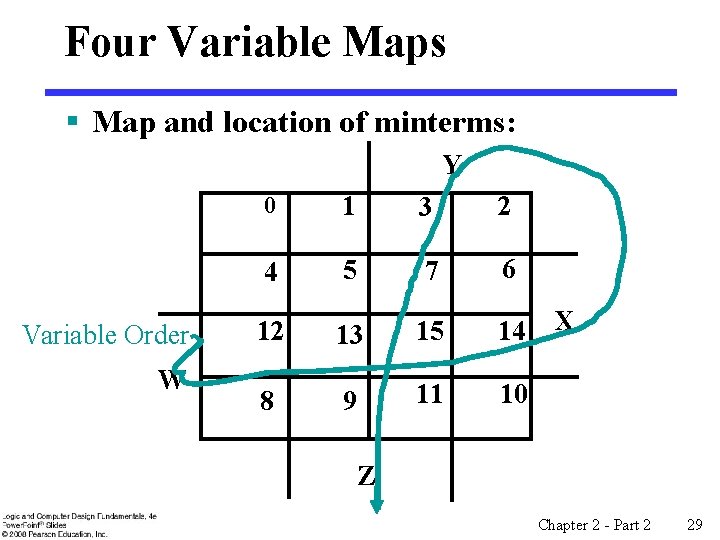
Four Variable Maps § Map and location of minterms: Y Variable Order W 0 1 3 2 4 5 7 6 12 13 15 14 8 9 11 10 X Z Chapter 2 - Part 2 29
Four Variable Terms § Four variable maps can have rectangles corresponding to: • A single 1 = 4 variables, (i. e. Minterm) • Two 1 s = 3 variables, • Four 1 s = 2 variables • Eight 1 s = 1 variable, • Sixteen 1 s = zero variables (i. e. Constant "1") Chapter 2 - Part 2 30
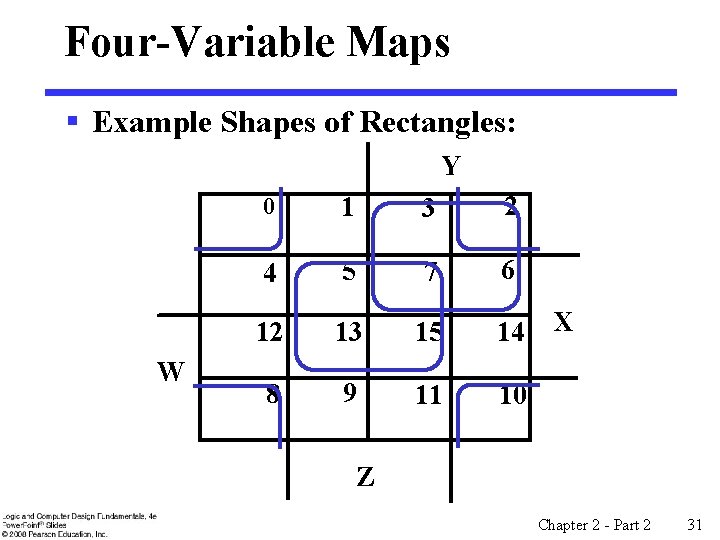
Four-Variable Maps § Example Shapes of Rectangles: Y W 0 1 3 2 4 5 7 6 12 13 15 14 8 9 11 10 X Z Chapter 2 - Part 2 31
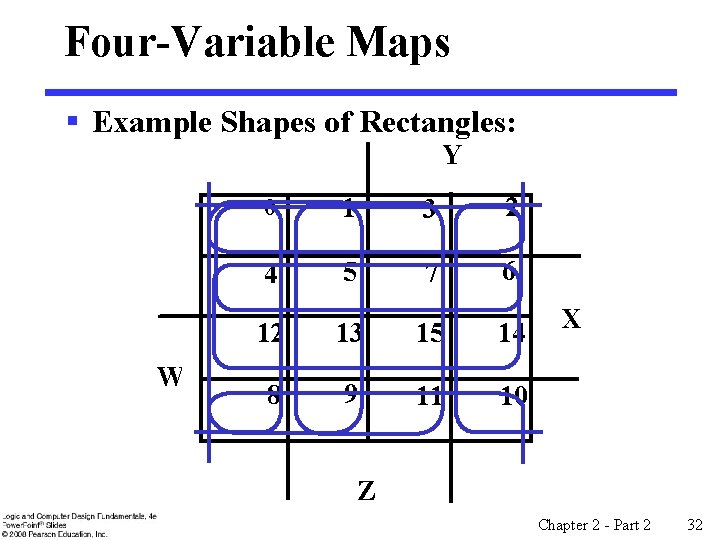
Four-Variable Maps § Example Shapes of Rectangles: Y W 0 1 3 2 4 5 7 6 12 13 15 14 8 9 11 10 X Z Chapter 2 - Part 2 32
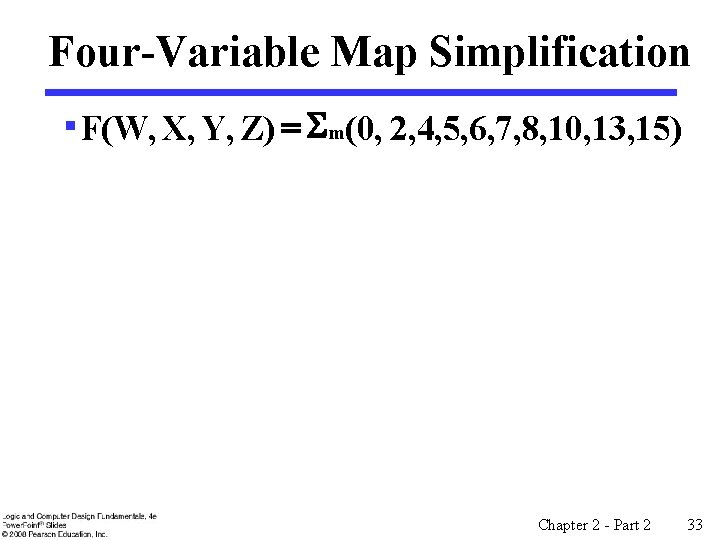
Four-Variable Map Simplification § F(W, X, Y, Z) = Sm(0, 2, 4, 5, 6, 7, 8, 10, 13, 15) Chapter 2 - Part 2 33
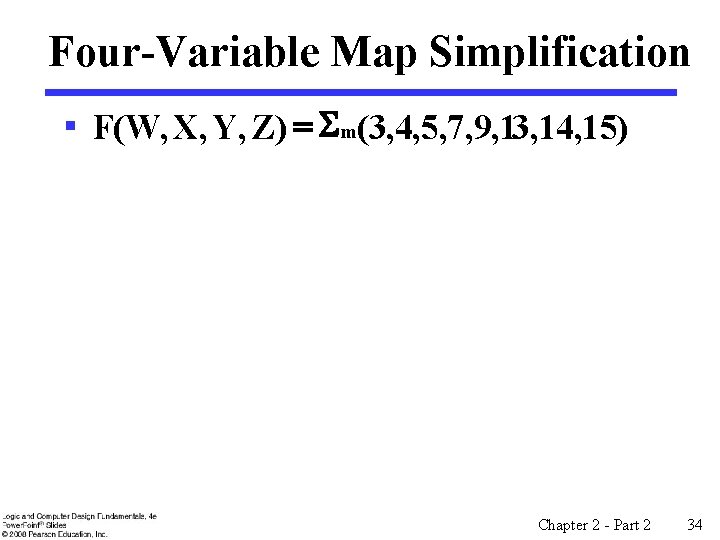
Four-Variable Map Simplification § F(W, X, Y, Z) = Sm(3, 4, 5, 7, 9, 13, 14, 15) Chapter 2 - Part 2 34
Overview § Part 1 – Gate Circuits and Boolean Equations • Binary Logic and Gates • Boolean Algebra • Standard Forms § Part 2 – Circuit Optimization • • • Circuit Optimization Karnough Maps Three-Variable Maps Four-Variable Maps Systematic Simplifications § Part 3 – Additional Gates and Circuits • Other Gate Types • Exclusive-OR Operator and Gates • High-Impedance Outputs Chapter 2 - Part 2 35
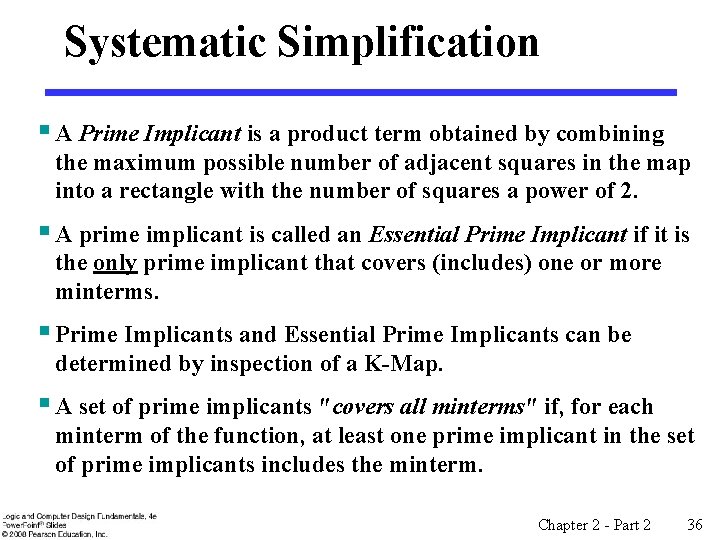
Systematic Simplification § A Prime Implicant is a product term obtained by combining the maximum possible number of adjacent squares in the map into a rectangle with the number of squares a power of 2. § A prime implicant is called an Essential Prime Implicant if it is the only prime implicant that covers (includes) one or more minterms. § Prime Implicants and Essential Prime Implicants can be determined by inspection of a K-Map. § A set of prime implicants "covers all minterms" if, for each minterm of the function, at least one prime implicant in the set of prime implicants includes the minterm. Chapter 2 - Part 2 36
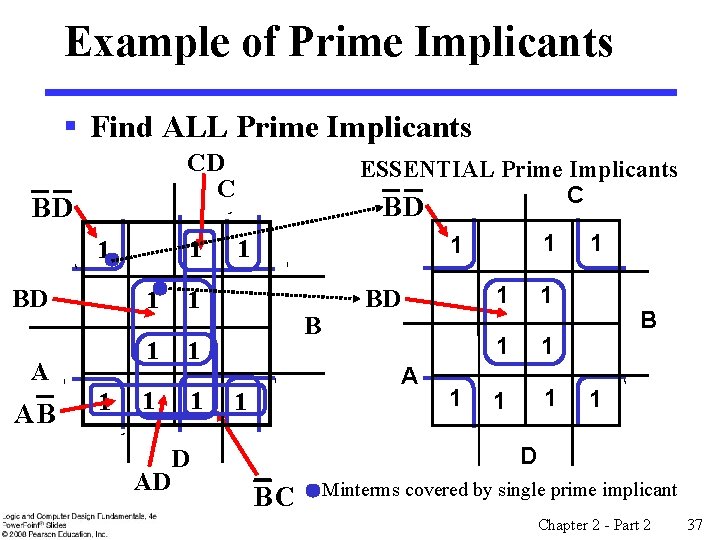
Example of Prime Implicants § Find ALL Prime Implicants CD C BD 1 1 BD A AB 1 1 1 1 D AD ESSENTIAL Prime Implicants C BD 1 1 1 BD 1 B A 1 1 1 1 D BC Minterms covered by single prime implicant Chapter 2 - Part 2 37
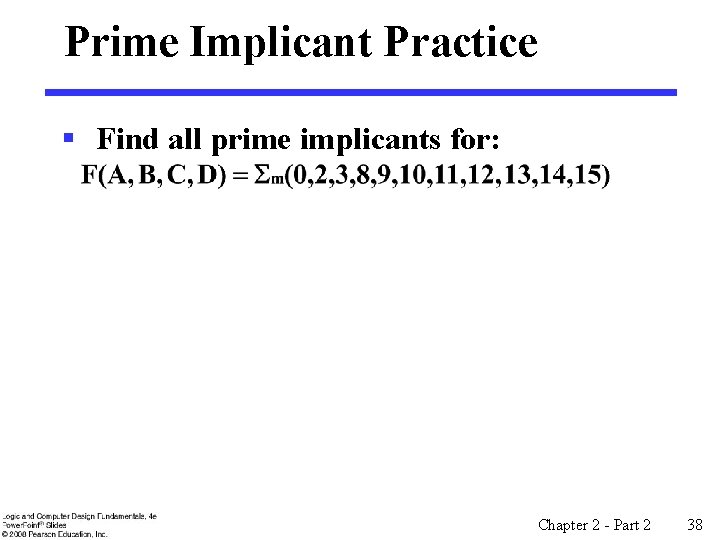
Prime Implicant Practice § Find all prime implicants for: Chapter 2 - Part 2 38
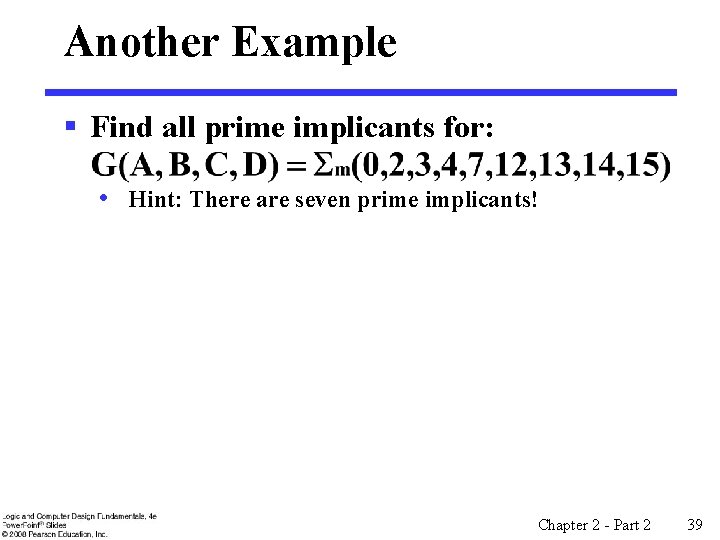
Another Example § Find all prime implicants for: • Hint: There are seven prime implicants! Chapter 2 - Part 2 39
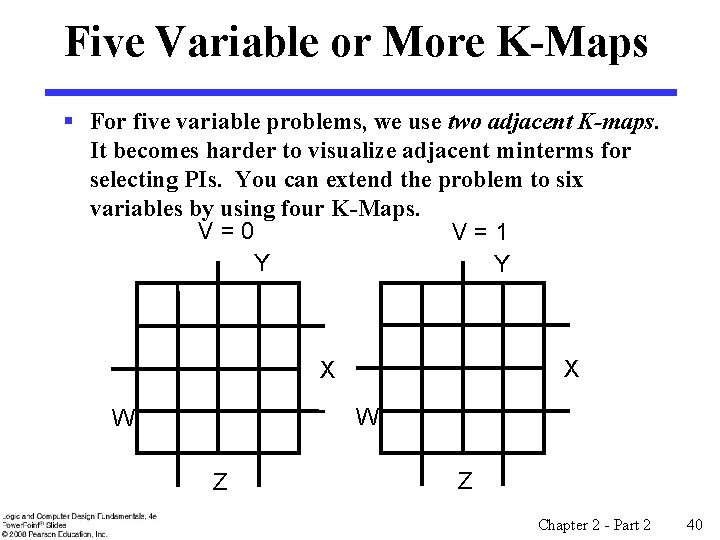
Five Variable or More K-Maps § For five variable problems, we use two adjacent K-maps. It becomes harder to visualize adjacent minterms for selecting PIs. You can extend the problem to six variables by using four K-Maps. V=0 V=1 Y Y X X W W Z Z Chapter 2 - Part 2 40
Don't Cares in K-Maps § Sometimes a function table or map contains entries for which it is known: • the input values for the minterm will never occur, or • The output value for the minterm is not used § In these cases, the output value need not be defined § Instead, the output value is defined as a “don't care” § By placing “don't cares” ( an “x” entry) in the function table or map, the cost of the logic circuit may be lowered. § Example 1: A logic function having the binary codes for the BCD digits as its inputs. Only the codes for 0 through 9 are used. The six codes, 1010 through 1111 never occur, so the output values for these codes are “x” to represent “don’t cares. ” Chapter 2 - Part 2 41
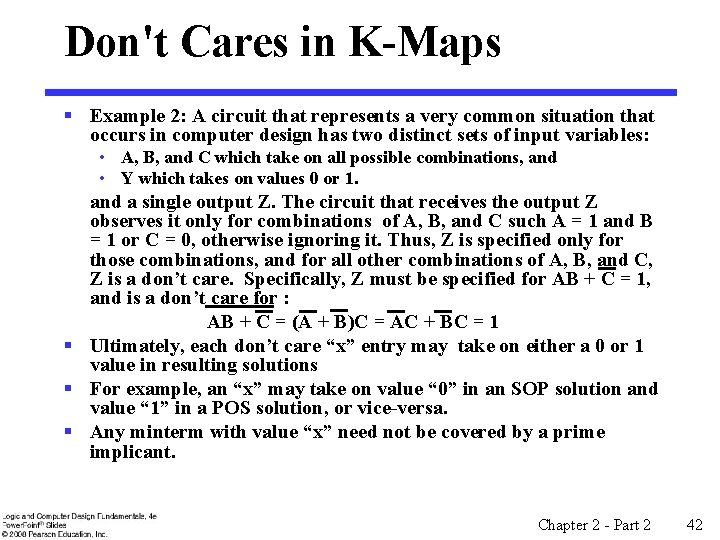
Don't Cares in K-Maps § Example 2: A circuit that represents a very common situation that occurs in computer design has two distinct sets of input variables: • A, B, and C which take on all possible combinations, and • Y which takes on values 0 or 1. and a single output Z. The circuit that receives the output Z observes it only for combinations of A, B, and C such A = 1 and B = 1 or C = 0, otherwise ignoring it. Thus, Z is specified only for those combinations, and for all other combinations of A, B, and C, Z is a don’t care. Specifically, Z must be specified for AB + C = 1, and is a don’t care for : AB + C = (A + B)C = AC + BC = 1 § Ultimately, each don’t care “x” entry may take on either a 0 or 1 value in resulting solutions § For example, an “x” may take on value “ 0” in an SOP solution and value “ 1” in a POS solution, or vice-versa. § Any minterm with value “x” need not be covered by a prime implicant. Chapter 2 - Part 2 42
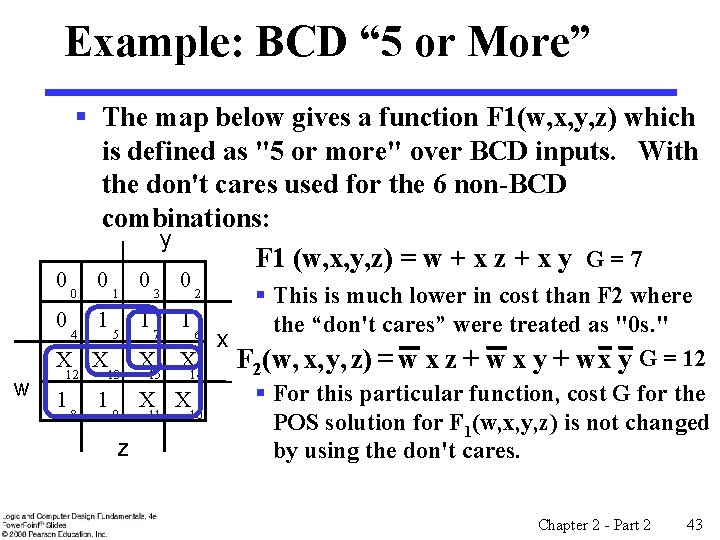
Example: BCD “ 5 or More” § The map below gives a function F 1(w, x, y, z) which is defined as "5 or more" over BCD inputs. With the don't cares used for the 6 non-BCD combinations: y F 1 (w, x, y, z) = w + x z + x y G = 7 00 01 03 02 w § This is much lower in cost than F 2 where 04 15 17 16 the “don't cares” were treated as "0 s. " x X 12 X 13 X 15 X 14 F 2(w, x, y, z) = w x z + w x y G = 12 § For this particular function, cost G for the 1 8 1 9 X 11 X 10 POS solution for F 1(w, x, y, z) is not changed z by using the don't cares. Chapter 2 - Part 2 43
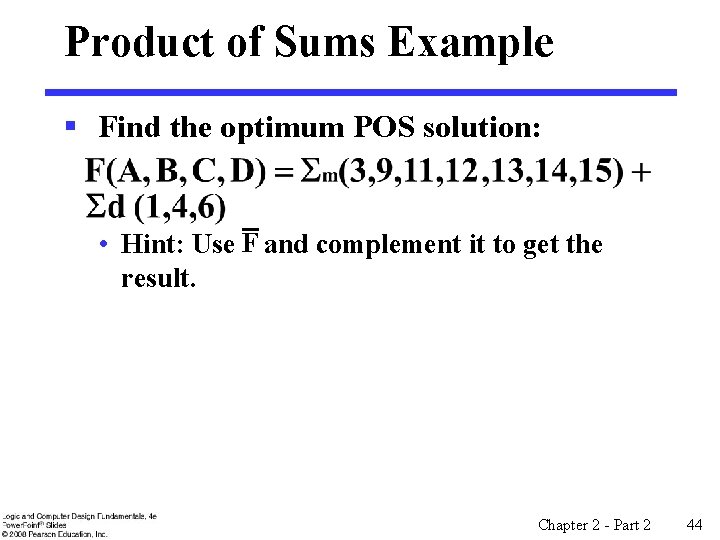
Product of Sums Example § Find the optimum POS solution: • Hint: Use F and complement it to get the result. Chapter 2 - Part 2 44
Optimization Algorithm § Find all prime implicants. § Include all essential prime implicants in the solution § Select a minimum cost set of non-essential prime implicants to cover all minterms not yet covered: • Obtaining an optimum solution: See Reading Supplement - More on Optimization • Obtaining a good simplified solution: Use the Selection Rule Chapter 2 - Part 2 45
Prime Implicant Selection Rule § Minimize the overlap among prime implicants as much as possible. In particular, in the final solution, make sure that each prime implicant selected includes at least one minterm not included in any other prime implicant selected. Chapter 2 - Part 2 46
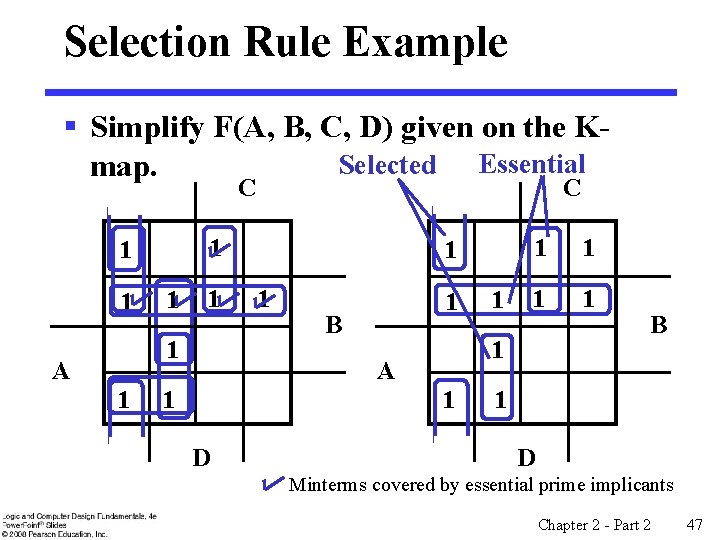
Selection Rule Example § Simplify F(A, B, C, D) given on the KSelected Essential map. C 1 1 1 A 1 C 1 1 1 B 1 D 1 1 A 1 1 1 B 1 D Minterms covered by essential prime implicants Chapter 2 - Part 2 47
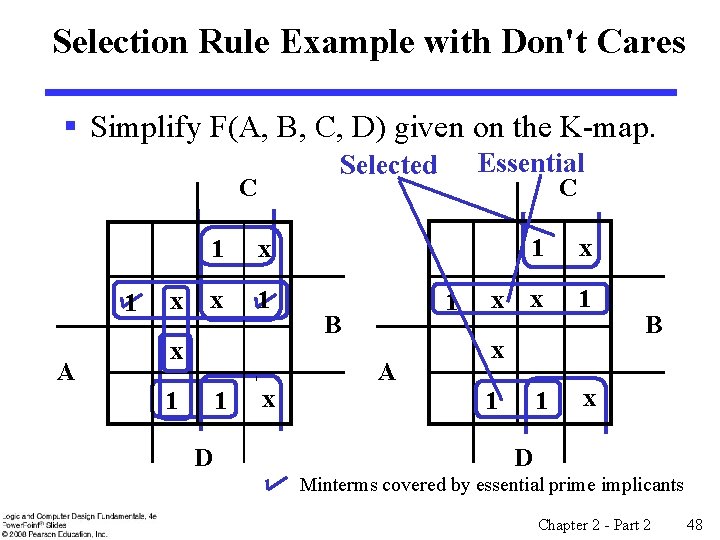
Selection Rule Example with Don't Cares § Simplify F(A, B, C, D) given on the K-map. C 1 A x 1 x 1 1 D Essential Selected x C 1 B A x 1 x x 1 B D Minterms covered by essential prime implicants Chapter 2 - Part 2 48
Terms of Use § All (or portions) of this material © 2008 by Pearson Education, Inc. § Permission is given to incorporate this material or adaptations thereof into classroom presentations and handouts to instructors in courses adopting the latest edition of Logic and Computer Design Fundamentals as the course textbook. § These materials or adaptations thereof are not to be sold or otherwise offered for consideration. § This Terms of Use slide or page is to be included within the original materials or any adaptations thereof. Chapter 2 - Part 2 49
- Slides: 49