
Logic and Computer Design Fundamentals Chapter 2 Combinational
Logic and Computer Design Fundamentals Chapter 2 – Combinational Logic Circuits Part 1 – Gate Circuits and Boolean Equations
Overview § Part 1 – Gate Circuits and Boolean Equations • Binary Logic and Gates • Boolean Algebra • Standard Forms § Part 2 – Circuit Optimization • • Two-Level Optimization Map Manipulation Practical Optimization (Espresso) Multi-Level Circuit Optimization § Part 3 – Additional Gates and Circuits • Other Gate Types • Exclusive-OR Operator and Gates • High-Impedance Outputs 2
Binary Logic and Gates § Binary variables take on one of two values. § Logical operators operate on binary values and binary variables. § Basic logical operators are the logic functions AND, OR and NOT. § Logic gates implement logic functions. § Boolean Algebra: a useful mathematical system for specifying and transforming logic functions. § We study Boolean algebra as a foundation for designing and analyzing digital systems! 3
Binary Variables § Recall that the two binary values have different names: • • True/False On/Off Yes/No 1/0 § We use 1 and 0 to denote the two values. § Variable identifier examples: • A, B, y, z, or X 1 for now • RESET, START_IT, or ADD 1 later 4
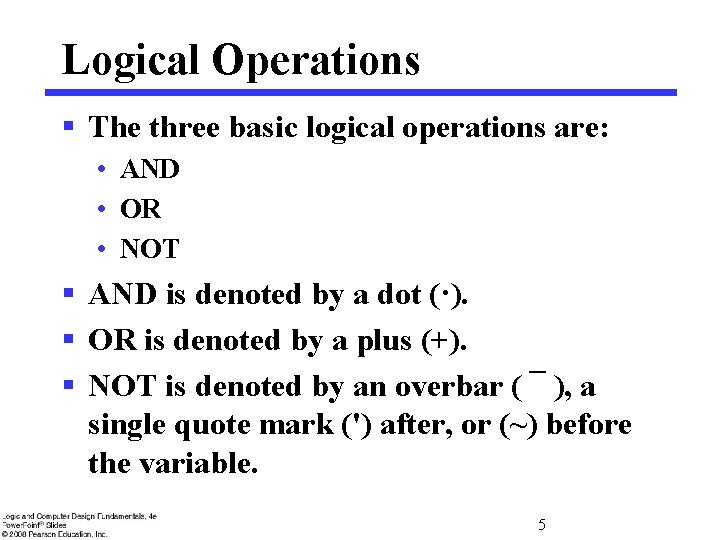
Logical Operations § The three basic logical operations are: • AND • OR • NOT § AND is denoted by a dot (·). § OR is denoted by a plus (+). § NOT is denoted by an overbar ( ¯ ), a single quote mark (') after, or (~) before the variable. 5
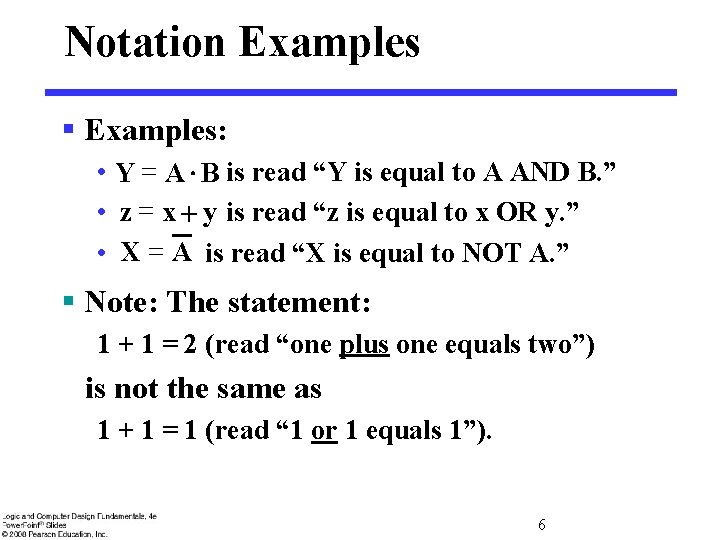
Notation Examples § Examples: • Y = A B is read “Y is equal to A AND B. ” • z = x + y is read “z is equal to x OR y. ” • X = A is read “X is equal to NOT A. ” § Note: The statement: 1 + 1 = 2 (read “one plus one equals two”) is not the same as 1 + 1 = 1 (read “ 1 or 1 equals 1”). 6
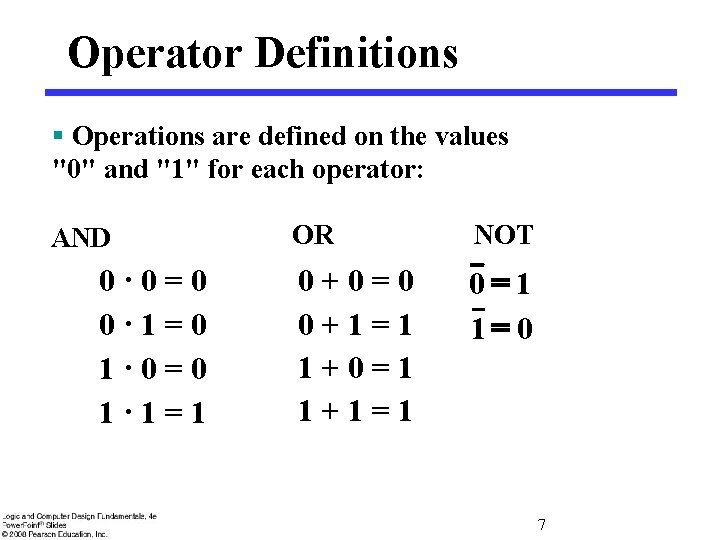
Operator Definitions § Operations are defined on the values "0" and "1" for each operator: AND 0· 0=0 0· 1=0 1· 0=0 1· 1=1 OR NOT 0+0=0 0+1=1 1+0=1 1+1=1 0=1 1=0 7
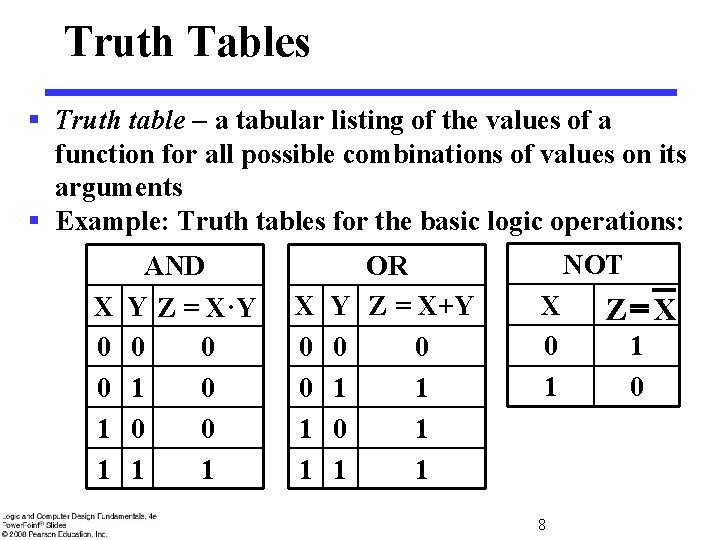
Truth Tables § Truth table - a tabular listing of the values of a function for all possible combinations of values on its arguments § Example: Truth tables for the basic logic operations: X 0 0 1 1 AND Y Z = X·Y 0 0 1 0 0 0 1 1 X 0 0 1 1 Y 0 1 OR Z = X+Y 0 1 1 1 NOT X 0 1 8 Z=X 1 0
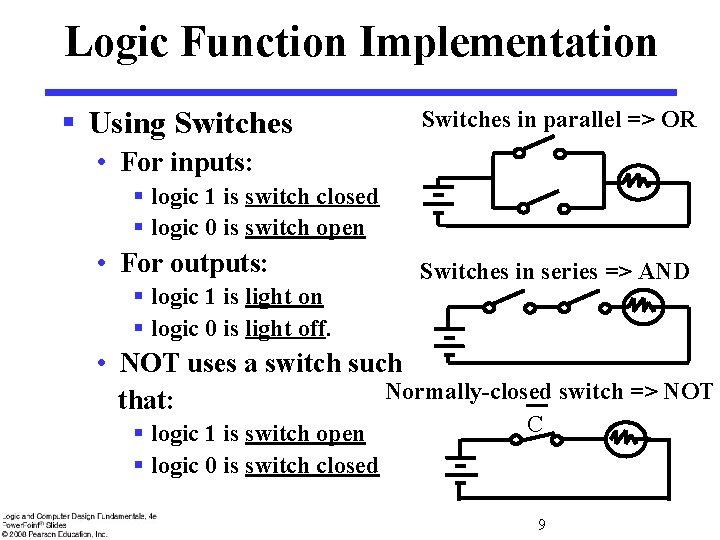
Logic Function Implementation § Using Switches in parallel => OR • For inputs: § logic 1 is switch closed § logic 0 is switch open • For outputs: § logic 1 is light on § logic 0 is light off. Switches in series => AND • NOT uses a switch such Normally-closed switch => NOT that: § logic 1 is switch open § logic 0 is switch closed C 9
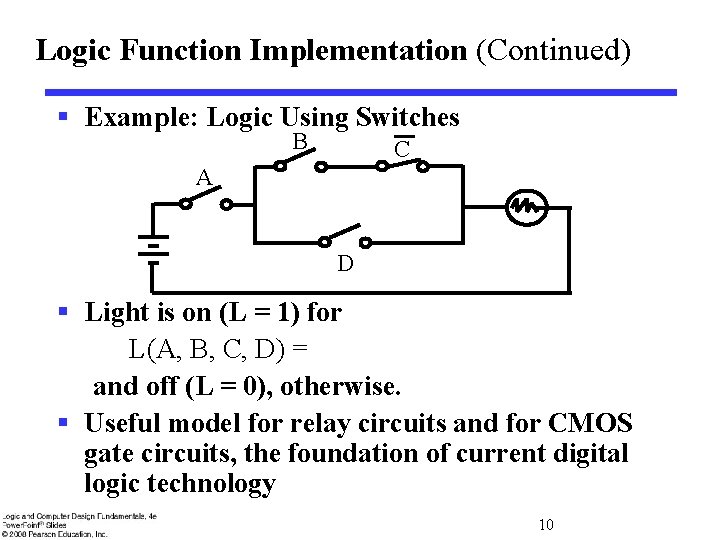
Logic Function Implementation (Continued) § Example: Logic Using Switches B C A D § Light is on (L = 1) for L(A, B, C, D) = and off (L = 0), otherwise. § Useful model for relay circuits and for CMOS gate circuits, the foundation of current digital logic technology 10
Logic Gates § In the earliest computers, switches were opened and closed by magnetic fields produced by energizing coils in relays. The switches in turn opened and closed the current paths. § Later, vacuum tubes that open and close current paths electronically replaced relays. § Today, transistors are used as electronic switches that open and close current paths. § Optional: Chapter 6 – Part 1: The Design Space 11
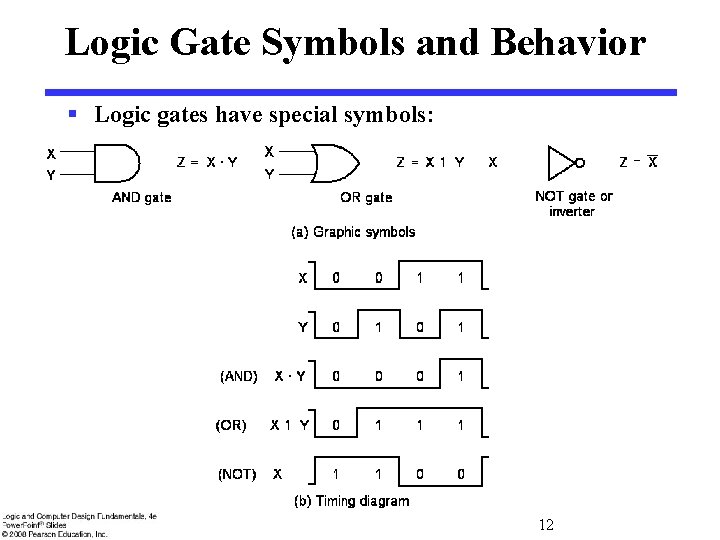
Logic Gate Symbols and Behavior § Logic gates have special symbols: 12
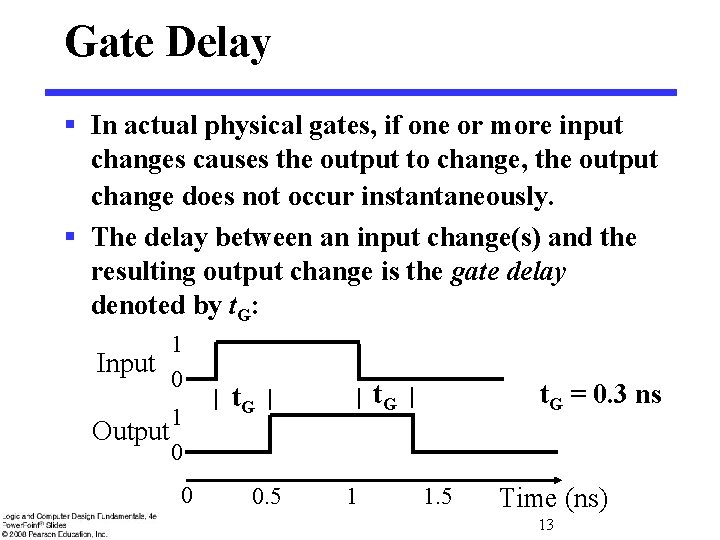
Gate Delay § In actual physical gates, if one or more input changes causes the output to change, the output change does not occur instantaneously. § The delay between an input change(s) and the resulting output change is the gate delay denoted by t. G: 1 Input 0 1 Output 0 0 t. G 0. 5 1 t. G = 0. 3 ns 1. 5 Time (ns) 13
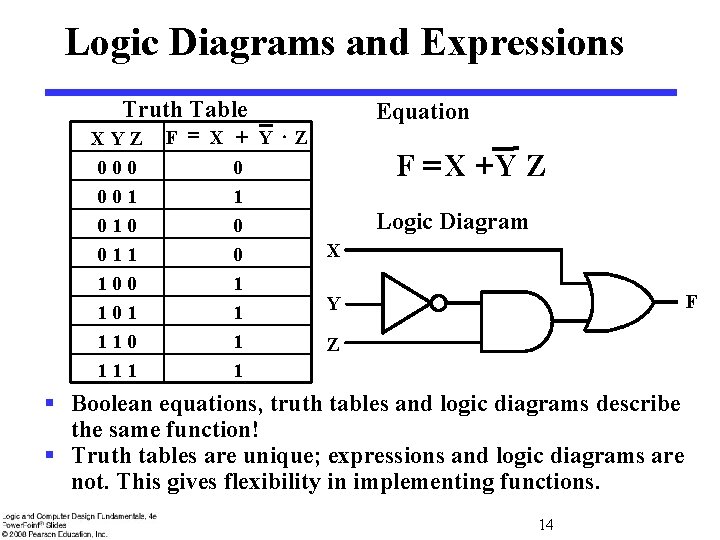
Logic Diagrams and Expressions Truth Table XYZ 000 001 010 011 100 101 110 111 F = X + Y Z 0 1 0 X 0 1 Y 1 1 Z 1 Equation F = X +Y Z Logic Diagram F § Boolean equations, truth tables and logic diagrams describe the same function! § Truth tables are unique; expressions and logic diagrams are not. This gives flexibility in implementing functions. 14
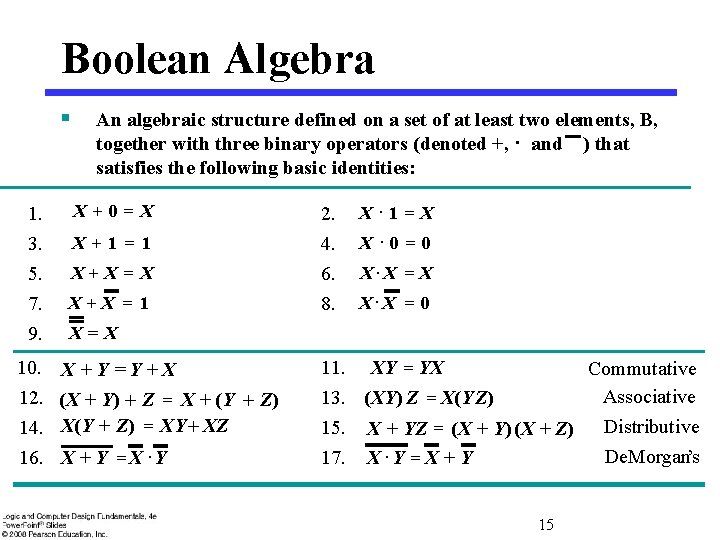
Boolean Algebra § 1. 3. 5. 7. 9. An algebraic structure defined on a set of at least two elements, B, together with three binary operators (denoted +, · and ) that satisfies the following basic identities: X+0= X X+1 =1 X+X =X X+X =1 2. 4. 6. 8. X. 1 =X X. 0 =0 X. X = X X. X = 0 X=X 10. X + Y = Y + X 12. (X + Y) + Z = X + (Y + Z) 14. X(Y + Z) = XY + XZ 16. X + Y = X. Y 11. XY = YX Commutative Associative 13. (XY) Z = X(YZ) 15. X + YZ = (X + Y) (X + Z) Distributive De. Morgan’s 17. X. Y = X + Y 15
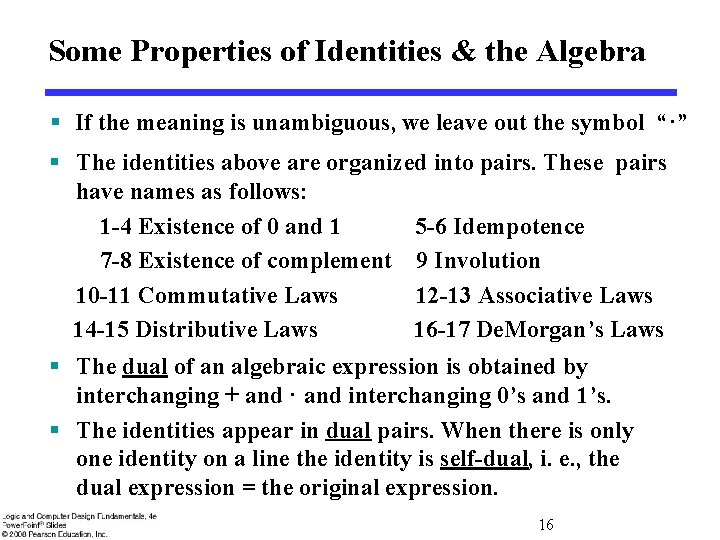
Some Properties of Identities & the Algebra § If the meaning is unambiguous, we leave out the symbol “·” § The identities above are organized into pairs. These pairs have names as follows: 1 -4 Existence of 0 and 1 5 -6 Idempotence 7 -8 Existence of complement 9 Involution 10 -11 Commutative Laws 12 -13 Associative Laws 14 -15 Distributive Laws 16 -17 De. Morgan’s Laws § The dual of an algebraic expression is obtained by interchanging + and · and interchanging 0’s and 1’s. § The identities appear in dual pairs. When there is only one identity on a line the identity is self-dual, i. e. , the dual expression = the original expression. 16
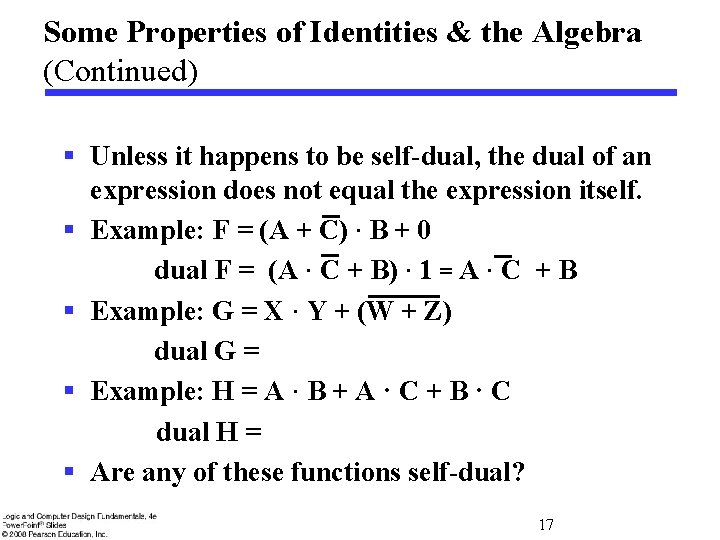
Some Properties of Identities & the Algebra (Continued) § Unless it happens to be self-dual, the dual of an expression does not equal the expression itself. § Example: F = (A + C) · B + 0 dual F = (A · C + B) · 1 = A · C + B § Example: G = X · Y + (W + Z) dual G = § Example: H = A · B + A · C + B · C dual H = § Are any of these functions self-dual? 17
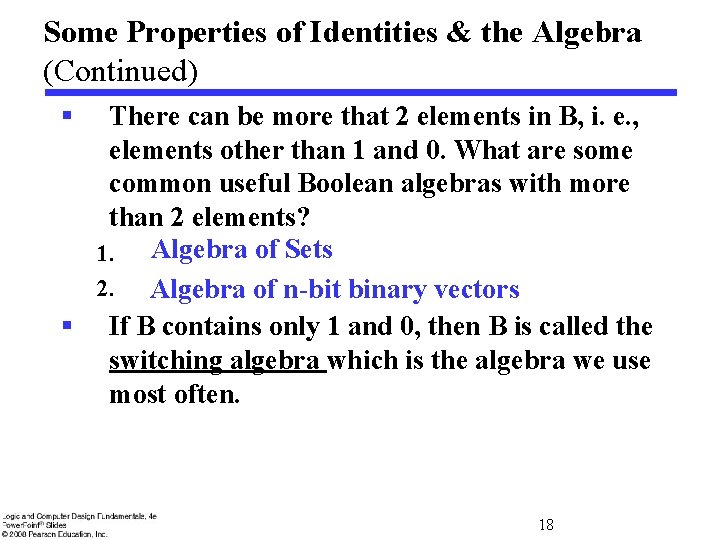
Some Properties of Identities & the Algebra (Continued) § There can be more that 2 elements in B, i. e. , elements other than 1 and 0. What are some common useful Boolean algebras with more than 2 elements? 1. Algebra of Sets 2. Algebra of n-bit binary vectors § If B contains only 1 and 0, then B is called the switching algebra which is the algebra we use most often. 18
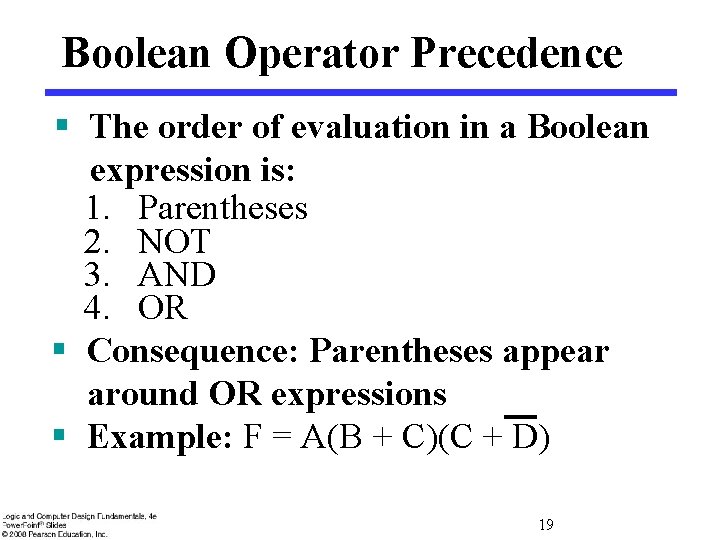
Boolean Operator Precedence § The order of evaluation in a Boolean expression is: 1. Parentheses 2. NOT 3. AND 4. OR § Consequence: Parentheses appear around OR expressions § Example: F = A(B + C)(C + D) 19
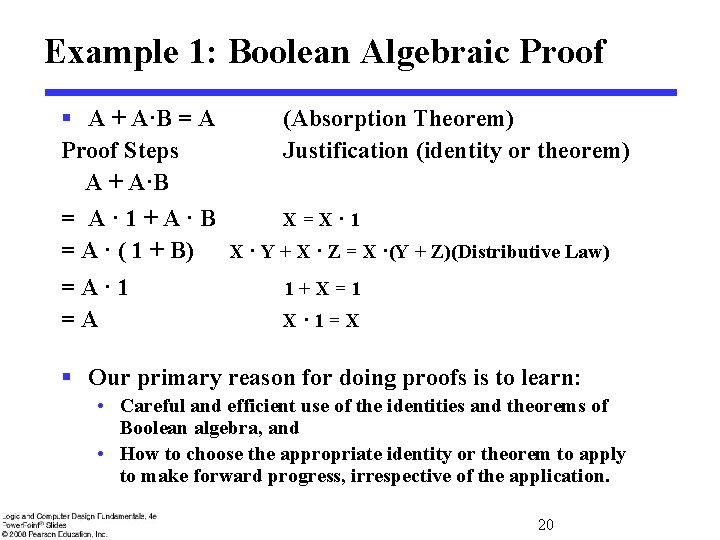
Example 1: Boolean Algebraic Proof § A + A·B = A (Absorption Theorem) Proof Steps Justification (identity or theorem) A + A·B = A· 1+A·B X=X· 1 = A · ( 1 + B) X · Y + X · Z = X ·(Y + Z)(Distributive Law) =A· 1 1+X=1 =A X· 1=X § Our primary reason for doing proofs is to learn: • Careful and efficient use of the identities and theorems of Boolean algebra, and • How to choose the appropriate identity or theorem to apply to make forward progress, irrespective of the application. 20
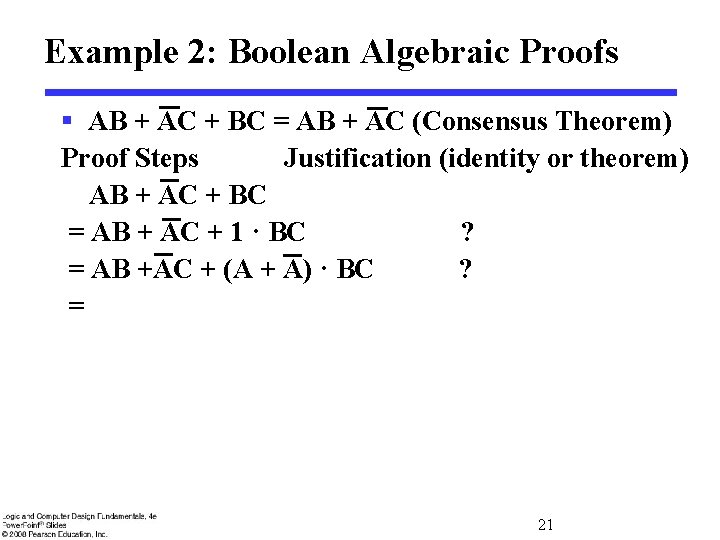
Example 2: Boolean Algebraic Proofs § AB + AC + BC = AB + AC (Consensus Theorem) Proof Steps Justification (identity or theorem) AB + AC + BC = AB + AC + 1 · BC ? = AB +AC + (A + A) · BC ? = 21
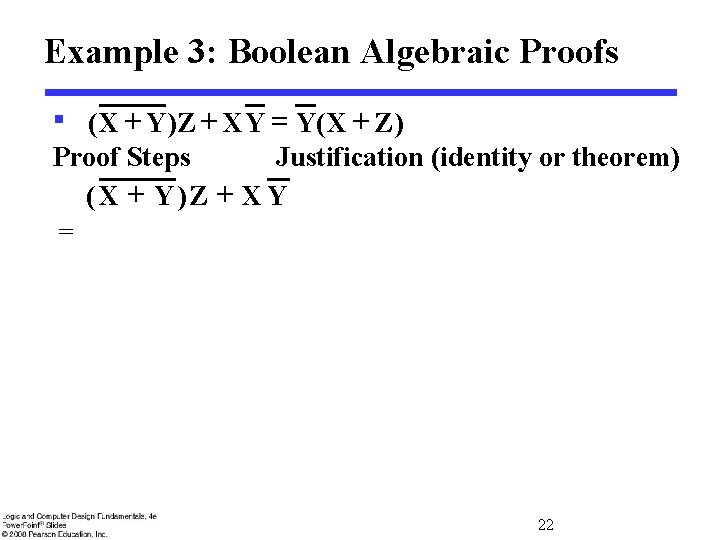
Example 3: Boolean Algebraic Proofs § ( X + Y ) Z + X Y = Y( X + Z ) Proof Steps Justification (identity or theorem) ( X + Y )Z + X Y = 22
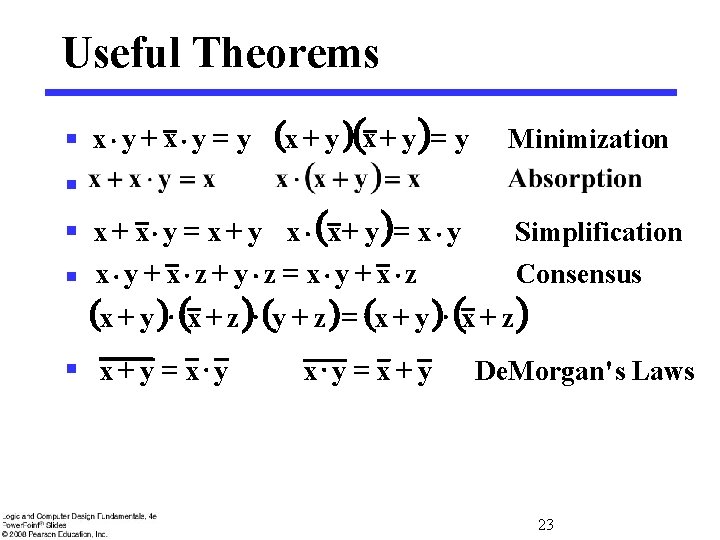
Useful Theorems § x y + x y = y (x + y )= y § § x + x y = x + y x (x + y )= x y § x y + x z + y z = x y + x z Minimization Simplification Consensus (x + y ) (x + z ) (y + z ) = (x + y ) (x + z ) § x + y = x + y De. Morgan' s Laws 23
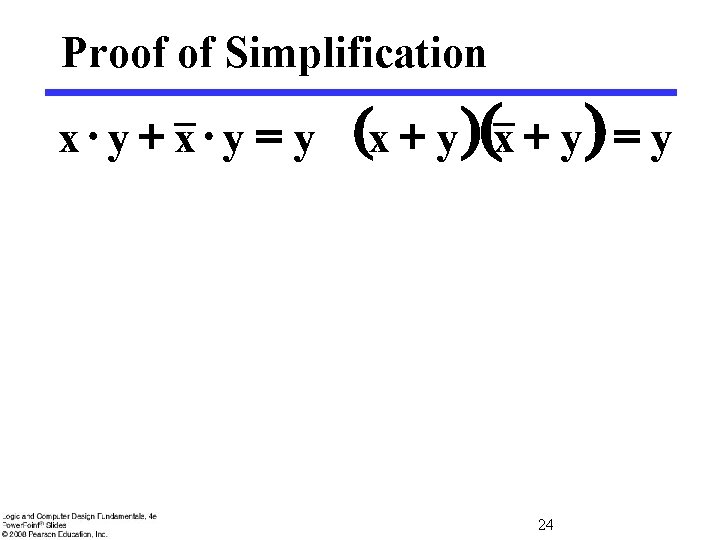
Proof of Simplification x y + x y = y (x + y ) = y 24
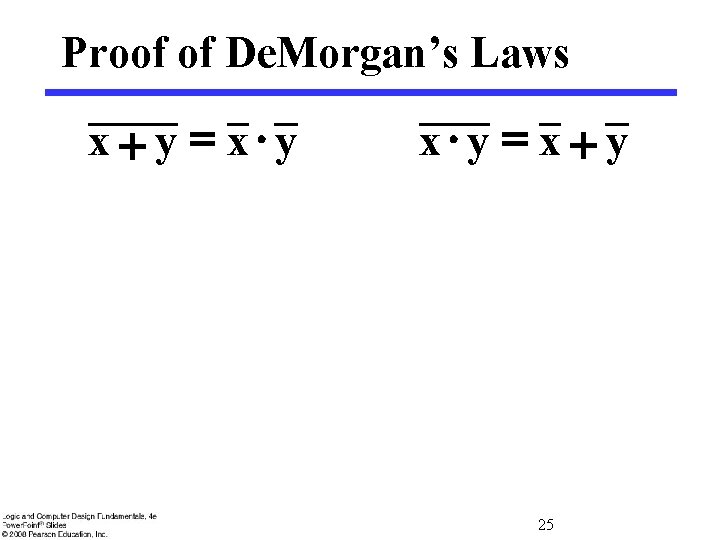
Proof of De. Morgan’s Laws x + y = x + y 25
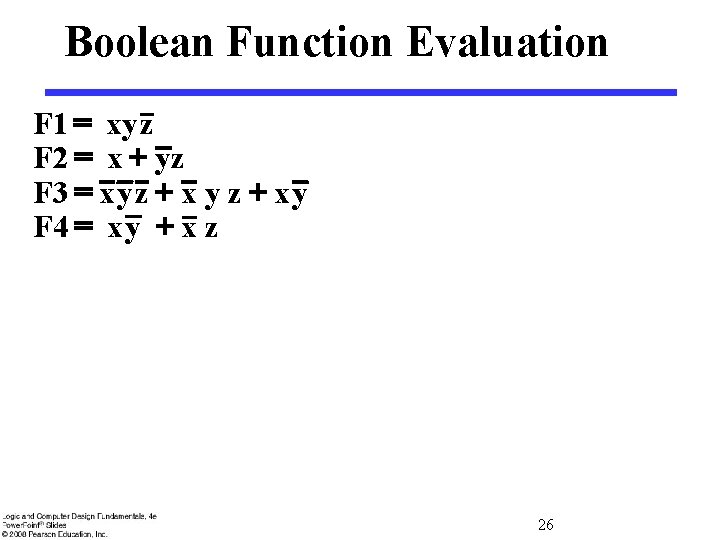
Boolean Function Evaluation F 1 = xy z F 2 = x + yz F 3 = x y z + x y F 4 = x y + x z 26
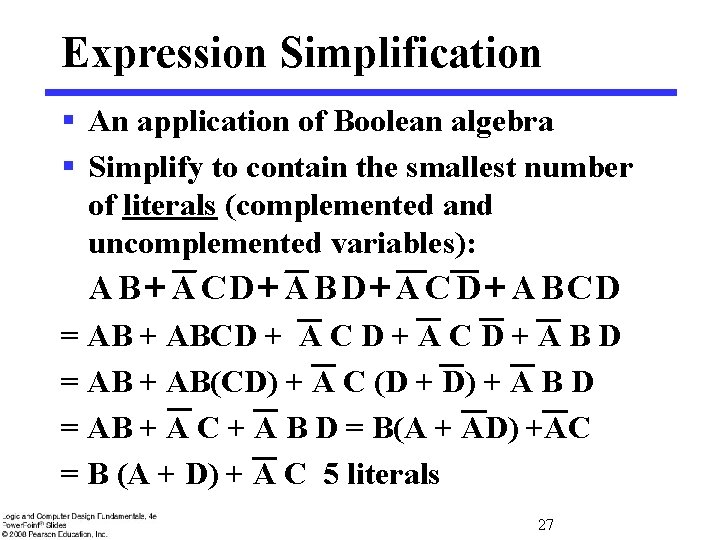
Expression Simplification § An application of Boolean algebra § Simplify to contain the smallest number of literals (complemented and uncomplemented variables): A B + ACD + A BD + AC D + A BCD = AB + ABCD + A C D + A B D = AB + AB(CD) + A C (D + D) + A B D = AB + A C + A B D = B(A + AD) +AC = B (A + D) + A C 5 literals 27
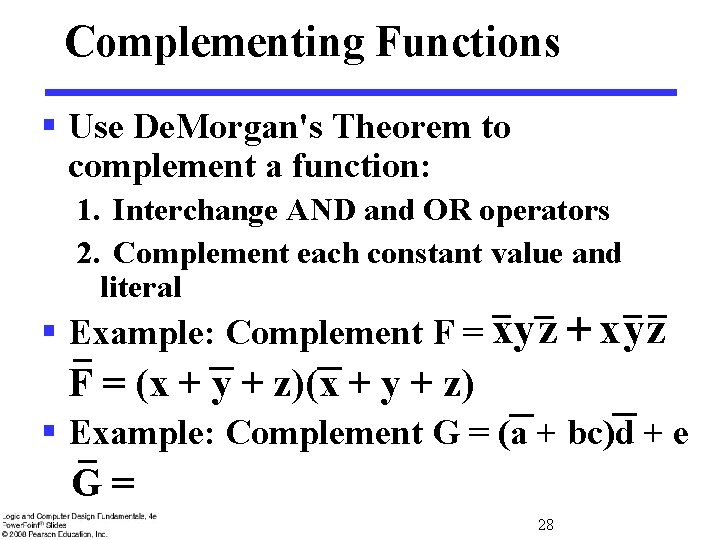
Complementing Functions § Use De. Morgan's Theorem to complement a function: 1. Interchange AND and OR operators 2. Complement each constant value and literal § Example: Complement F = xy z + x y z F = (x + y + z) § Example: Complement G = (a + bc)d + e G= 28
Overview – Canonical Forms § What are Canonical Forms? § Minterms and Maxterms § Index Representation of Minterms and Maxterms § Sum-of-Minterm (SOM) Representations § Product-of-Maxterm (POM) Representations § Representation of Complements of Functions § Conversions between Representations 29
Canonical Forms § It is useful to specify Boolean functions in a form that: • Allows comparison for equality. • Has a correspondence to the truth tables § Canonical Forms in common usage: • Sum of Minterms (SOM) • Product of Maxterms (POM) 30
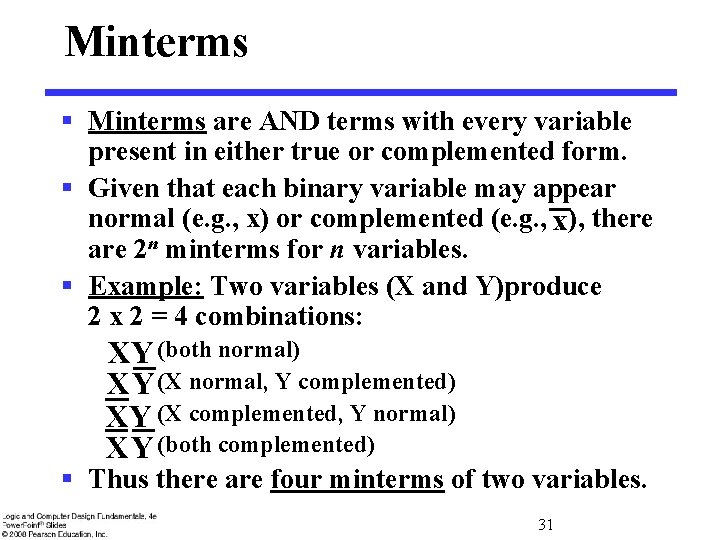
Minterms § Minterms are AND terms with every variable present in either true or complemented form. § Given that each binary variable may appear normal (e. g. , x) or complemented (e. g. , x), there are 2 n minterms for n variables. § Example: Two variables (X and Y)produce 2 x 2 = 4 combinations: XY (both normal) X Y (X normal, Y complemented) XY (X complemented, Y normal) X Y (both complemented) § Thus there are four minterms of two variables. 31
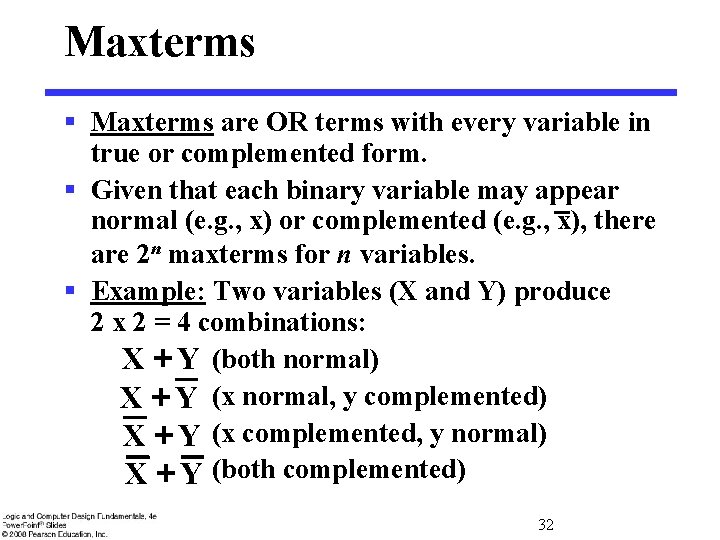
Maxterms § Maxterms are OR terms with every variable in true or complemented form. § Given that each binary variable may appear normal (e. g. , x) or complemented (e. g. , x), there are 2 n maxterms for n variables. § Example: Two variables (X and Y) produce 2 x 2 = 4 combinations: X + Y (both normal) X + Y (x normal, y complemented) X + Y (x complemented, y normal) X + Y (both complemented) 32
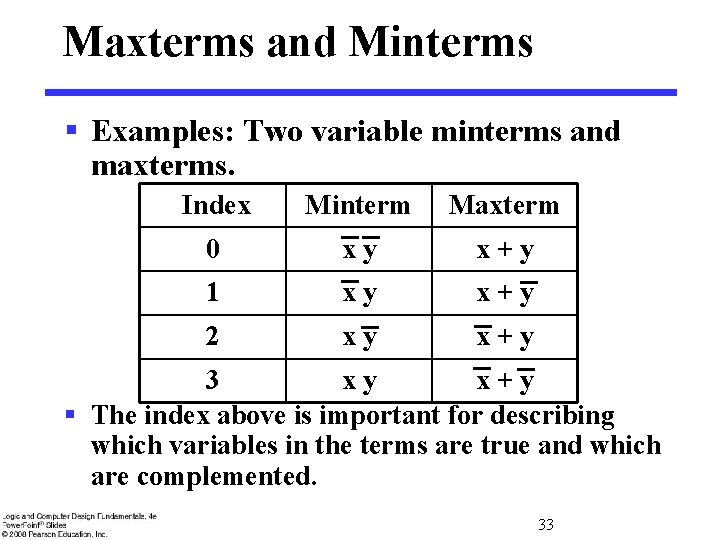
Maxterms and Minterms § Examples: Two variable minterms and maxterms. Index Minterm Maxterm 0 xy x+y 1 xy x+y 2 xy x+y 3 xy x+y § The index above is important for describing which variables in the terms are true and which are complemented. 33
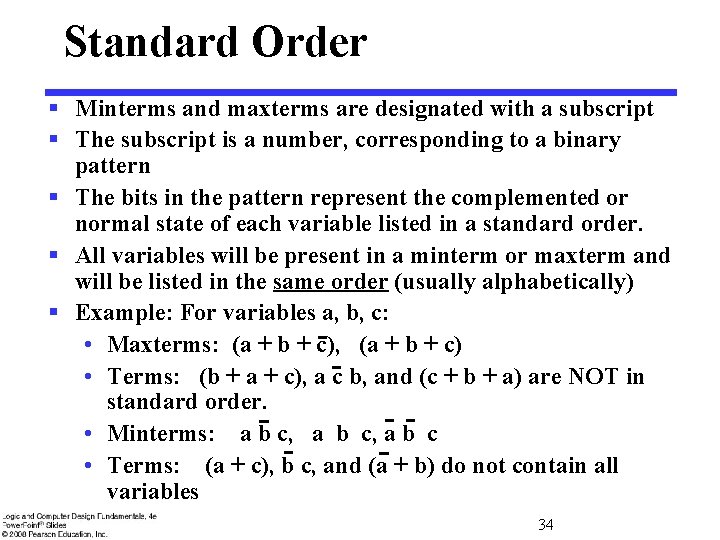
Standard Order § Minterms and maxterms are designated with a subscript § The subscript is a number, corresponding to a binary pattern § The bits in the pattern represent the complemented or normal state of each variable listed in a standard order. § All variables will be present in a minterm or maxterm and will be listed in the same order (usually alphabetically) § Example: For variables a, b, c: • Maxterms: (a + b + c), (a + b + c) • Terms: (b + a + c), a c b, and (c + b + a) are NOT in standard order. • Minterms: a b c, a b c • Terms: (a + c), b c, and (a + b) do not contain all variables 34
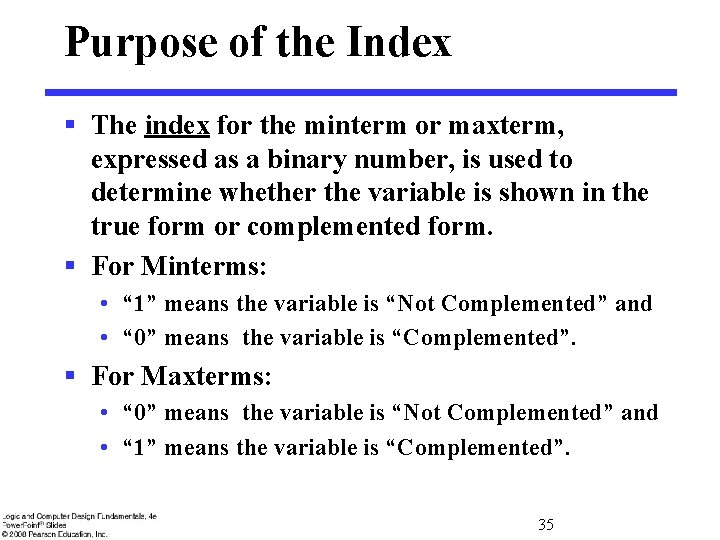
Purpose of the Index § The index for the minterm or maxterm, expressed as a binary number, is used to determine whether the variable is shown in the true form or complemented form. § For Minterms: • “ 1” means the variable is “Not Complemented” and • “ 0” means the variable is “Complemented”. § For Maxterms: • “ 0” means the variable is “Not Complemented” and • “ 1” means the variable is “Complemented”. 35
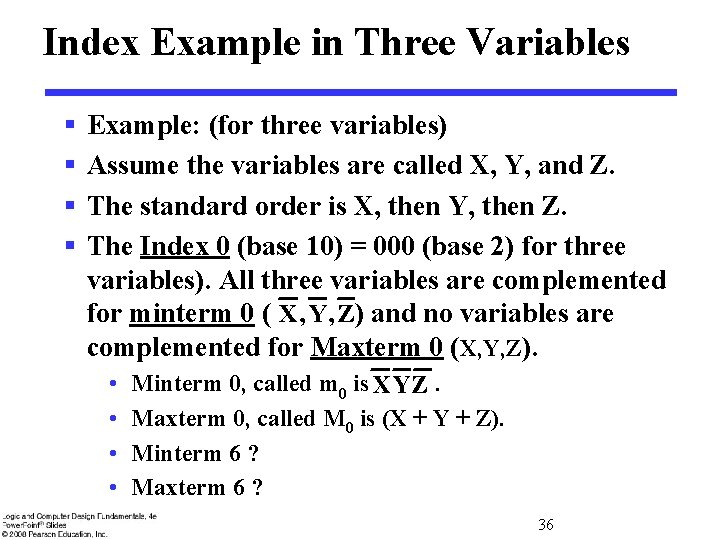
Index Example in Three Variables § § Example: (for three variables) Assume the variables are called X, Y, and Z. The standard order is X, then Y, then Z. The Index 0 (base 10) = 000 (base 2) for three variables). All three variables are complemented for minterm 0 ( X , Y, Z) and no variables are complemented for Maxterm 0 (X, Y, Z). • • Minterm 0, called m 0 is X Y Z. Maxterm 0, called M 0 is (X + Y + Z). Minterm 6 ? Maxterm 6 ? 36
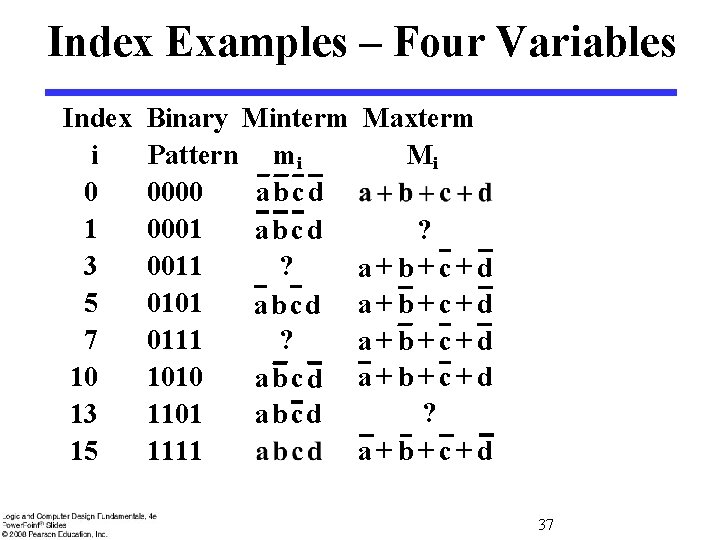
Index Examples – Four Variables Index i 0 1 3 5 7 10 13 15 Binary Minterm Pattern mi abcd 0000 0001 abcd ? 0011 0101 abcd ? 0111 1010 abcd 1101 1111 Maxterm Mi ? a+b+c+d ? a+b+c+d 37
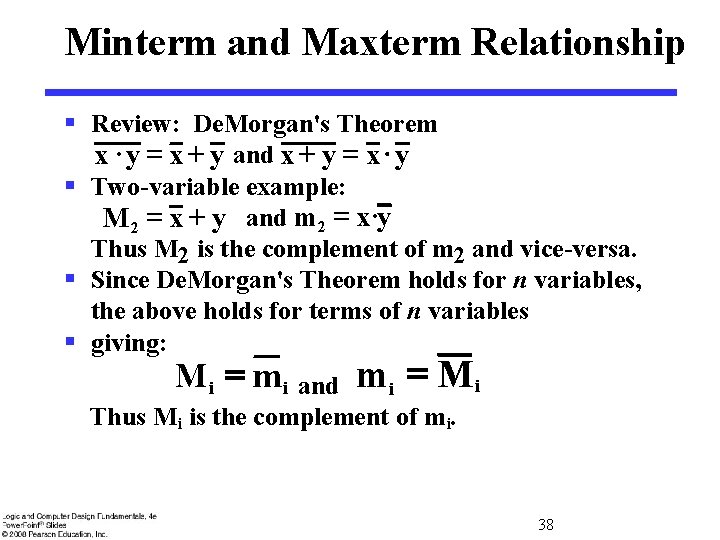
Minterm and Maxterm Relationship § Review: De. Morgan's Theorem x · y = x + y and x + y = x y § Two-variable example: M 2 = x + y and m 2 = x·y Thus M 2 is the complement of m 2 and vice-versa. § Since De. Morgan's Theorem holds for n variables, the above holds for terms of n variables § giving: M i = m i and m i = M i Thus Mi is the complement of mi. 38
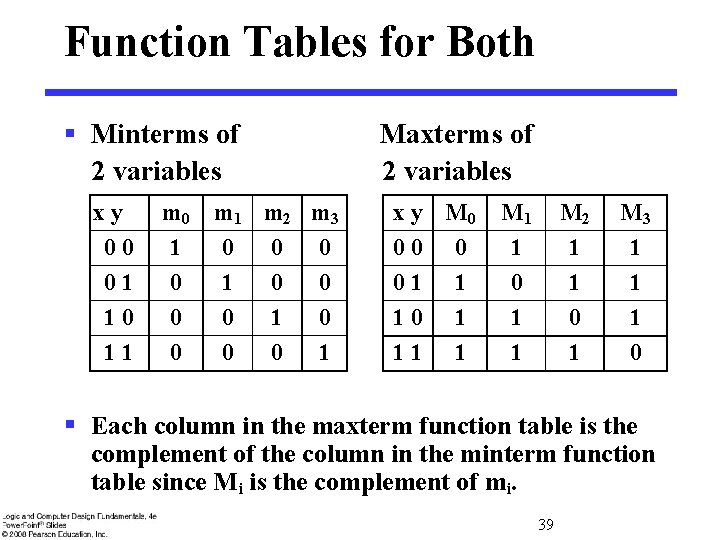
Function Tables for Both § Minterms of 2 variables xy 00 01 10 11 m 0 1 0 0 0 m 1 m 2 m 3 0 0 0 1 Maxterms of 2 variables x y M 0 00 0 01 1 10 1 11 1 M 1 1 0 1 1 M 2 1 1 0 1 M 3 1 1 1 0 § Each column in the maxterm function table is the complement of the column in the minterm function table since Mi is the complement of mi. 39
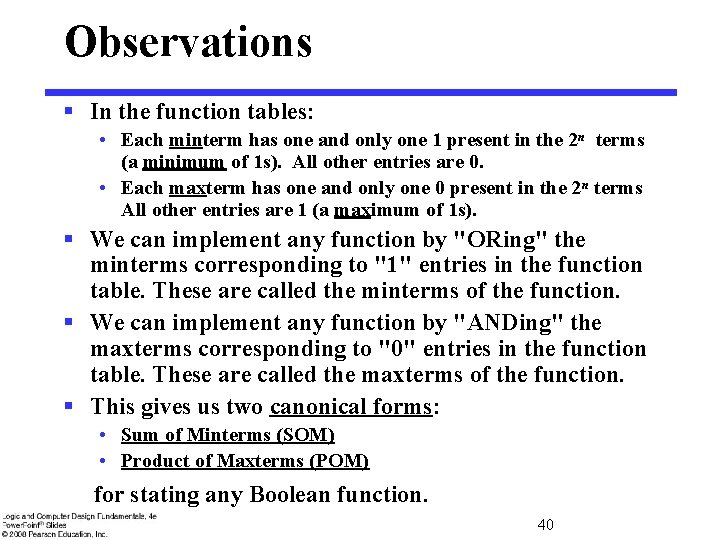
Observations § In the function tables: • Each minterm has one and only one 1 present in the 2 n terms (a minimum of 1 s). All other entries are 0. • Each maxterm has one and only one 0 present in the 2 n terms All other entries are 1 (a maximum of 1 s). § We can implement any function by "ORing" the minterms corresponding to "1" entries in the function table. These are called the minterms of the function. § We can implement any function by "ANDing" the maxterms corresponding to "0" entries in the function table. These are called the maxterms of the function. § This gives us two canonical forms: • Sum of Minterms (SOM) • Product of Maxterms (POM) for stating any Boolean function. 40
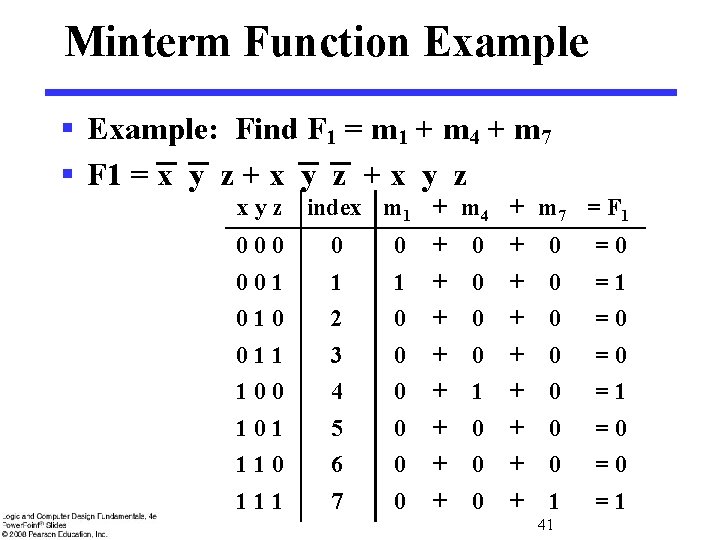
Minterm Function Example § Example: Find F 1 = m 1 + m 4 + m 7 § F 1 = x y z + x y z index m 1 + m 4 + m 7 = F 1 000 0 0 + 0 =0 001 1 1 + 0 =1 010 2 0 + 0 =0 011 3 0 + 0 =0 100 4 0 + 1 + 0 =1 101 5 0 + 0 =0 110 6 0 + 0 =0 111 7 0 + 1 =1 41
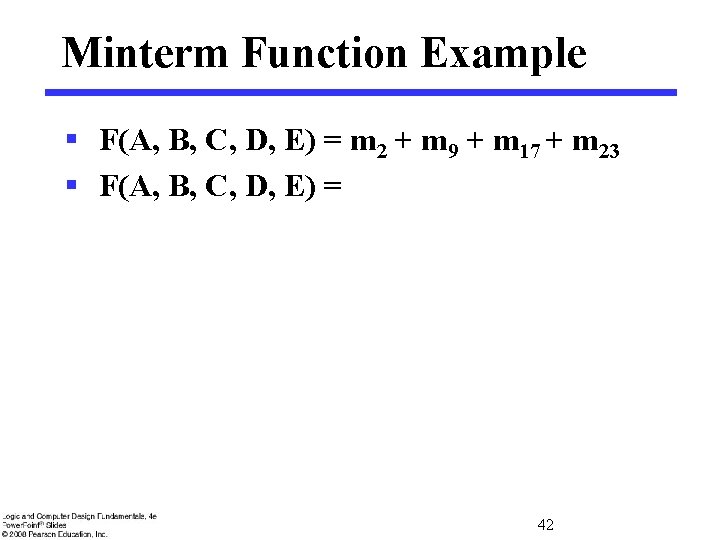
Minterm Function Example § F(A, B, C, D, E) = m 2 + m 9 + m 17 + m 23 § F(A, B, C, D, E) = 42
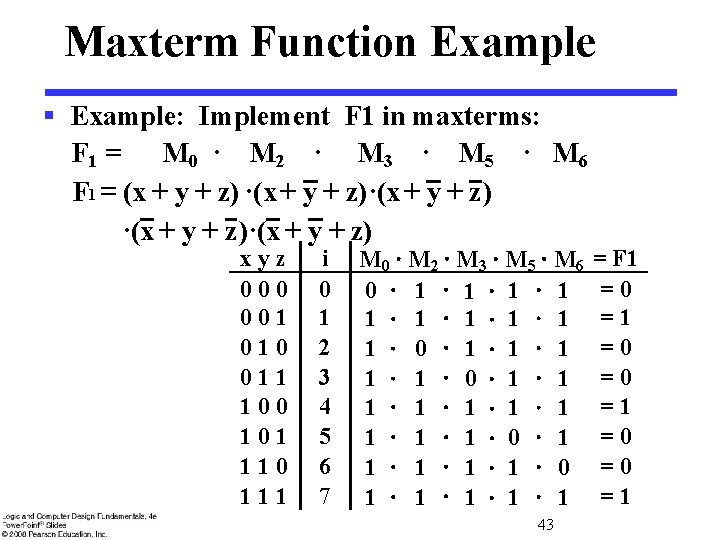
Maxterm Function Example § Example: Implement F 1 in maxterms: F 1 = M 0 · M 2 · M 3 · M 5 · M 6 F 1 = (x + y + z) ·(x + y + z)·(x + y + z )·(x + y + z) xyz 000 001 010 011 100 101 110 111 i 0 1 2 3 4 5 6 7 M 0 M 2 M 3 M 5 M 6 0 1 1 1 0 1 1 1 1 1 0 1 1 1 0 1 1 1 43 = F 1 =0 =0 =1
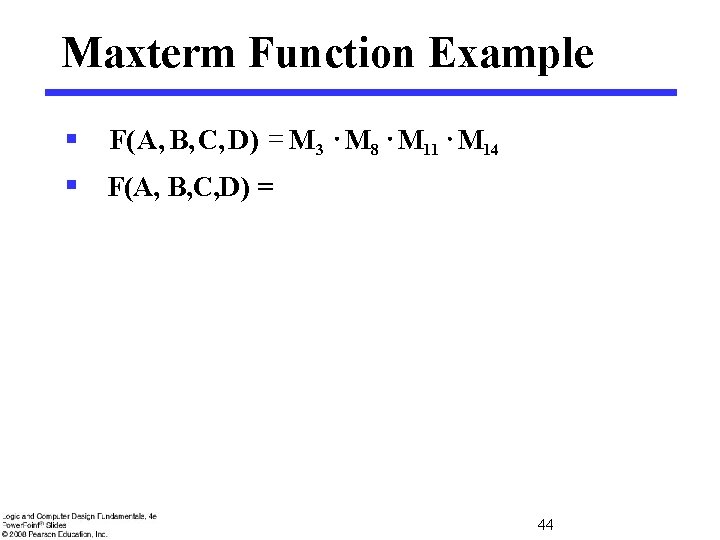
Maxterm Function Example § F( A, B, C, D) = M 3 M 8 M 11 M 14 § F(A, B, C, D) = 44
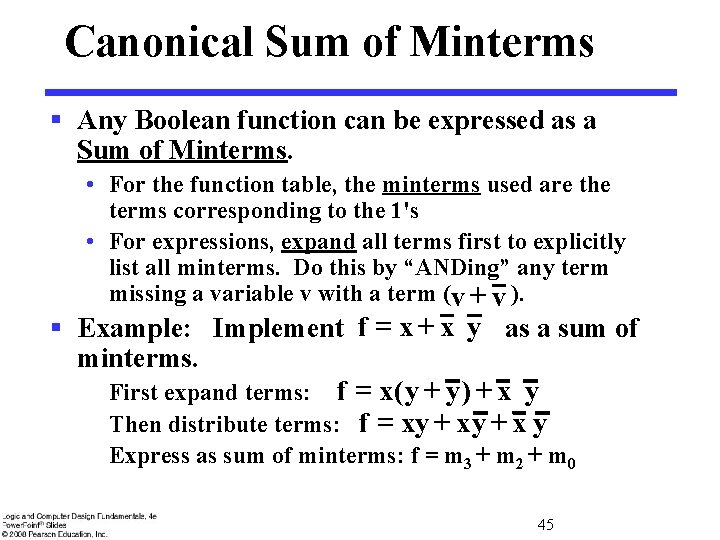
Canonical Sum of Minterms § Any Boolean function can be expressed as a Sum of Minterms. • For the function table, the minterms used are the terms corresponding to the 1's • For expressions, expand all terms first to explicitly list all minterms. Do this by “ANDing” any term missing a variable v with a term (v + v ). § Example: Implement f = x + x y as a sum of minterms. First expand terms: f = x ( y + y ) + x y Then distribute terms: f = xy + x y Express as sum of minterms: f = m 3 + m 2 + m 0 45
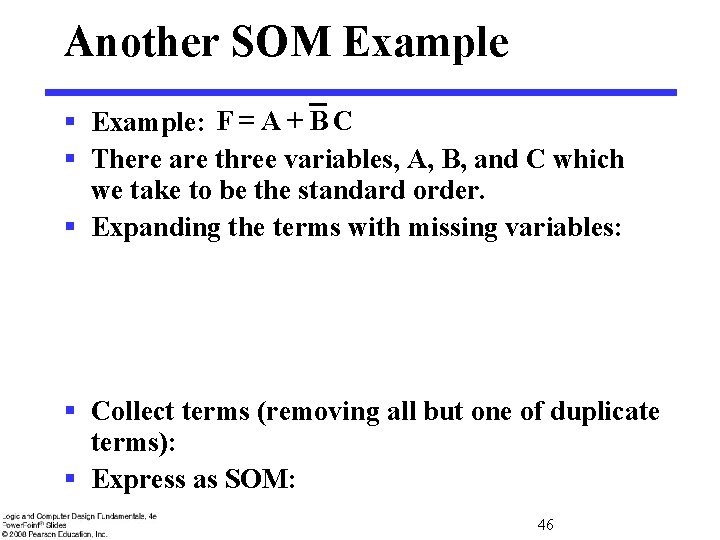
Another SOM Example § Example: F = A + B C § There are three variables, A, B, and C which we take to be the standard order. § Expanding the terms with missing variables: § Collect terms (removing all but one of duplicate terms): § Express as SOM: 46
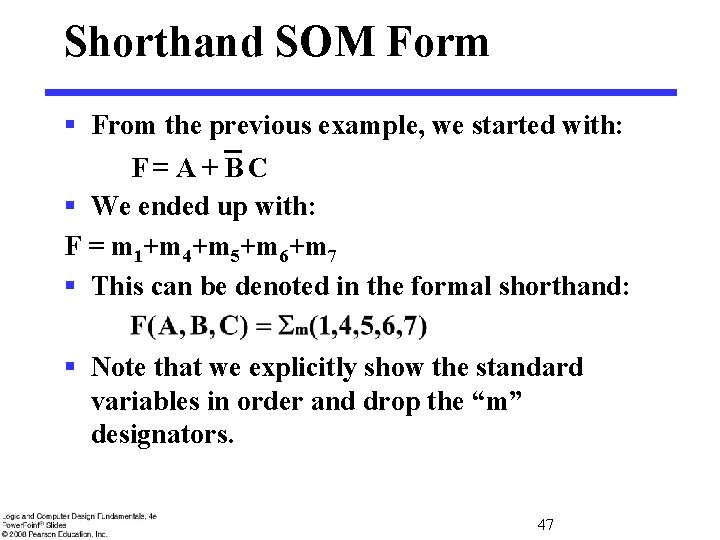
Shorthand SOM Form § From the previous example, we started with: F=A+BC § We ended up with: F = m 1+m 4+m 5+m 6+m 7 § This can be denoted in the formal shorthand: § Note that we explicitly show the standard variables in order and drop the “m” designators. 47
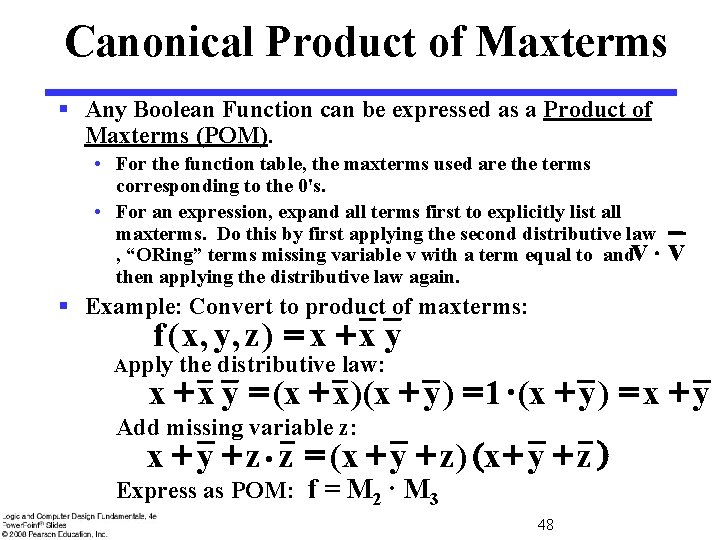
Canonical Product of Maxterms § Any Boolean Function can be expressed as a Product of Maxterms (POM). • For the function table, the maxterms used are the terms corresponding to the 0's. • For an expression, expand all terms first to explicitly list all maxterms. Do this by first applying the second distributive law , “ORing” terms missing variable v with a term equal to and then applying the distributive law again. v v § Example: Convert to product of maxterms: f ( x, y , z ) = x + x y Apply the distributive law: x + x y = (x + x )(x + y ) = 1 (x + y ) = x + y Add missing variable z: x + y + z z = ( x + y + z ) (x + y + z ) Express as POM: f = M 2 · M 3 48
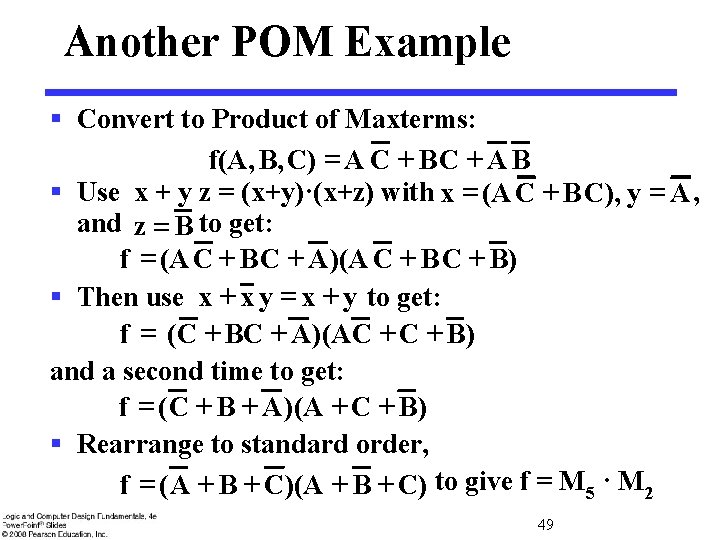
Another POM Example § Convert to Product of Maxterms: f(A, B, C) = A C + B C + A B § Use x + y z = (x+y)·(x+z) with x = (A C + B C), y = A , and z = B to get: f = (A C + B C + A )(A C + B ) § Then use x + x y = x + y to get: f = ( C + BC + A )(A C + B ) and a second time to get: f = ( C + B + A )(A + C + B ) § Rearrange to standard order, f = ( A + B + C)(A + B + C) to give f = M 5 · M 2 49
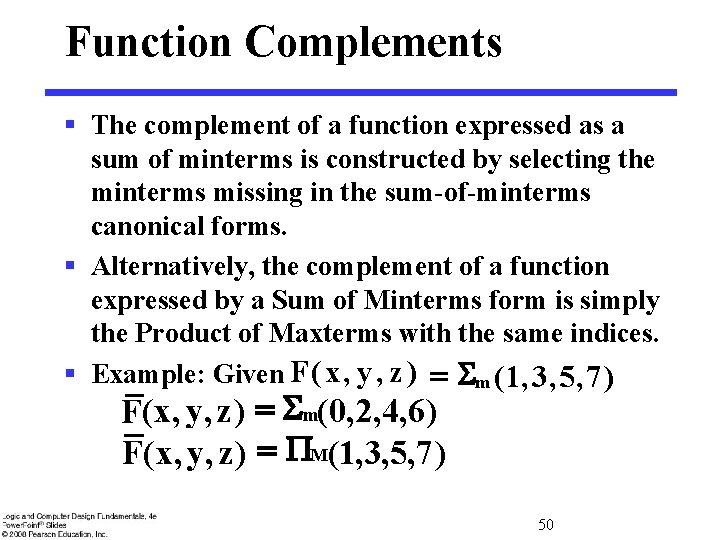
Function Complements § The complement of a function expressed as a sum of minterms is constructed by selecting the minterms missing in the sum-of-minterms canonical forms. § Alternatively, the complement of a function expressed by a Sum of Minterms form is simply the Product of Maxterms with the same indices. § Example: Given F ( x , y , z ) = Sm ( 1, 3 , 5 , 7 ) F( x, y , z ) = Sm( 0, 2, 4, 6) F( x, y , z ) = PM(1, 3, 5, 7 ) 50
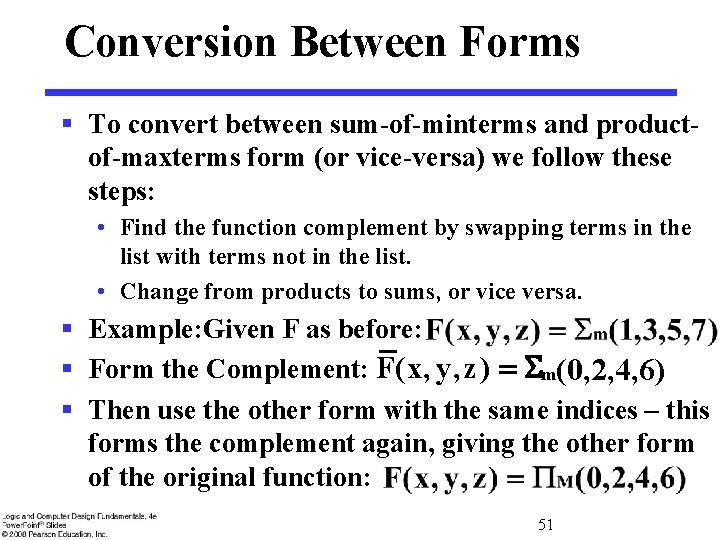
Conversion Between Forms § To convert between sum-of-minterms and productof-maxterms form (or vice-versa) we follow these steps: • Find the function complement by swapping terms in the list with terms not in the list. • Change from products to sums, or vice versa. § Example: Given F as before: § Form the Complement: F( x, y , z ) = Sm( 0, 2, 4, 6) § Then use the other form with the same indices – this forms the complement again, giving the other form of the original function: 51
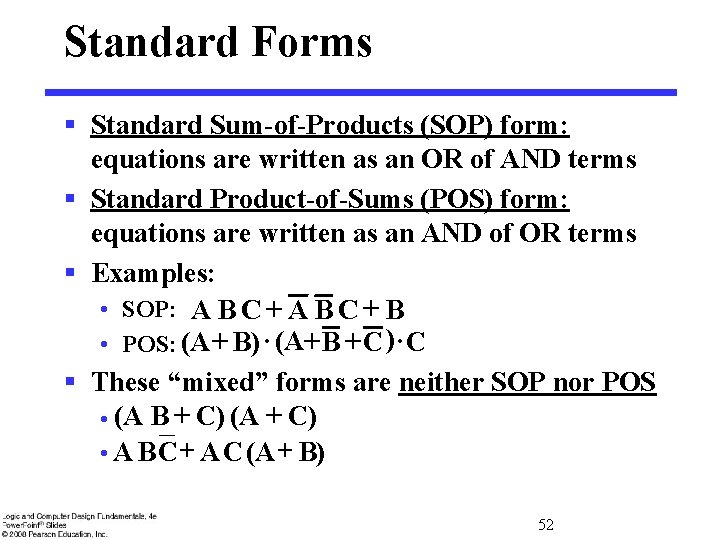
Standard Forms § Standard Sum-of-Products (SOP) form: equations are written as an OR of AND terms § Standard Product-of-Sums (POS) form: equations are written as an AND of OR terms § Examples: • SOP: A B C + B • POS: (A + B) · (A+ B + C )· C § These “mixed” forms are neither SOP nor POS • (A B + C) (A + C) • A B C + A C (A + B) 52
Standard Sum-of-Products (SOP) § A sum of minterms form for n variables can be written down directly from a truth table. • Implementation of this form is a two-level network of gates such that: • The first level consists of n-input AND gates, and • The second level is a single OR gate (with fewer than 2 n inputs). § This form often can be simplified so that the corresponding circuit is simpler. 53
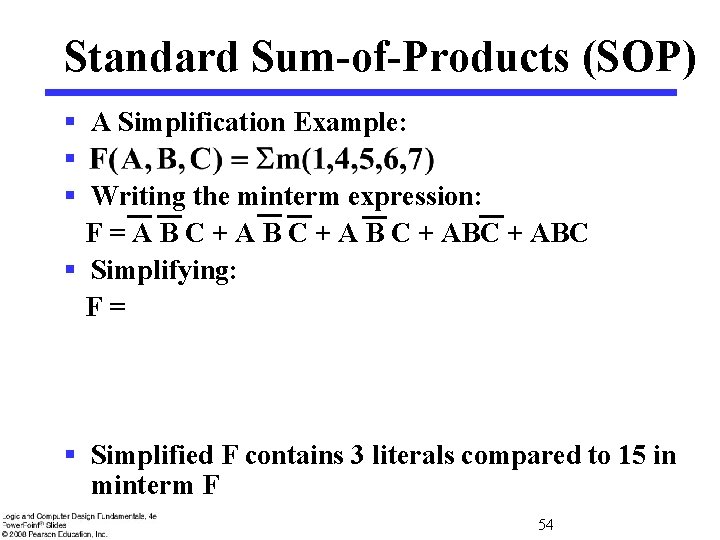
Standard Sum-of-Products (SOP) § A Simplification Example: § § Writing the minterm expression: F = A B C + ABC § Simplifying: F= § Simplified F contains 3 literals compared to 15 in minterm F 54
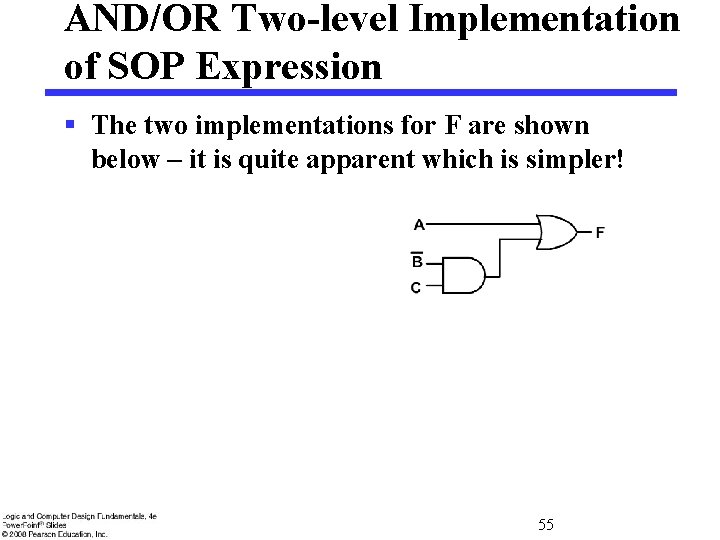
AND/OR Two-level Implementation of SOP Expression § The two implementations for F are shown below – it is quite apparent which is simpler! 55
SOP and POS Observations § The previous examples show that: • Canonical Forms (Sum-of-minterms, Product-of. Maxterms), or other standard forms (SOP, POS) differ in complexity • Boolean algebra can be used to manipulate equations into simpler forms. • Simpler equations lead to simpler two-level implementations § Questions: • How can we attain a “simplest” expression? • Is there only one minimum cost circuit? • The next part will deal with these issues. 56
- Slides: 56