
Logic A Mr B Production Do Nows 415
Logic A Mr. B Production
Do Nows!! 4/15 1. What was Russell’s sense-data? 2. Russell concludes that we can only interact with this physical reality indirectly, through sense-data. True or False. 3. Define the philosophical term certainty?
Reflection Quiz Graded Activity: Due 4/17 • 1. Explain Cognitive Realism in philosophy. • 2. Explain Cognitive Relativism in philosophy. • 3. Decide if you follow either Cognitive Realism or Cognitive Relativism and explain why (you must pick one). • 4. Explain and define philosophical pragmatism and list one of its problems. • Must be uploaded onto my Teacher’s Page homework.
Philosophical moral dilemma • You and your friend are stranded on an island. Unfortunately, you are both fatally ill. It just so happens that you have an antibiotic that can cure your illness. Sadly enough, there is just enough antibiotic to save only one person. • How could you and your friend choose which one of you will take the antibiotic? Do you think that either person who takes it will, or should, feel guilty for the other person dying, although if neither of you take it, you will both die. • What would you do? Insist your friend take the pill or insist on yourself taking the pill? Other possibilities?
Graded: Truth Group Discussion Activity • 1. Can we consider something to be undeniably true? Can you give an example of something that is undeniably true? • 2. Can something be true even if we don’t see it or ever heard about it? Explain • 3. How can we verify if something is true? Explain some possible ideas. • Write down your group number, this must be uploaded into the homework folder. Due 4/15.
Logical Arguments & Argument Structure • How to Argue: Philosophy is first and foremost a discipline that teaches us how to articulate, hold, and defend beliefs that, perhaps, we have always held, but without having spelled them out and argued for them. • Argument: in the philosophical sense, involves a series of assertions meant to demonstrate that a certain claim is true. • Premise: is a method of establishing a rationale for your conclusion. This will include ideas that are expected to be generally acceptable to an audience. (usually followed by “since”) • Conclusion: is the result of linking together each premise in an argument to lead to a specific claim. (usually followed by “therefore”) • Video On Argument Structure
Arguments and Claims • Critical Thinking: the objective analysis and evaluation of an issue in order to form a judgment. • Justified claims: conclusions that are valid and sound based on evidence. • Subjective Opinions: are based on our interpretation of very limited information and making judgment calls before weighing the evidence (often opinions rely on emotional responses and assumptions). • Intuition: coming to a conclusion without a rational explanation or an internal sense of knowing something to be true without knowing why.
Logical Arguments • How to Argue - Philosophical Reasoning: Crash Course Philosophy #2
Reasoning and Logic • Reasoning: is the action of constructing thoughts into a valid argument. • Valid Argument: is reasoning that is comprehensive on the foundation of logic or fact. • Propositional Logic: is a branch of logic that studies ways of joining and/or modifying entire propositions, statements or sentences to form more complicated propositions, statements or sentences. • Both Inductive and Deductive reasoning construct sentences, also known as premises to a conclusion.
Deductive Reasoning • Deductive Reasoning: “The top down approach”, from “general” to • • “specific” 1. Starts with a general statement, theory, or hypotheses. 2. Works its way down to a conclusion based on evidence. Example: 1. I drive a Nissan Pathfinder 2. All Nissan Pathfinders are stinky cars 3. I drive a stinky car. Deductive reasoning can lead to an absolutely true conclusion if and only if the premises that lead to that conclusion are also true.
Inductive Reasoning • Inductive Reasoning: “bottom-up approach”, from “specific” to • • • “general” 1. Starts with a small observation or question. 2. It works its way into a theory by examining the related issues. More exploratory than deductive. The premises are evidence to the hypothesis or conclusion. Inductive reasoning uses specific premises to build a conclusion, the conclusion is probable but not absolutely true.
Example of inductive reasoning • How does Mr. B feel about his philosophy students? • Related issues: The students are always asking questions, the students are simulating discussions, the students are always curious, the students are very intellectual. • Hypothesis: Mr. B enjoys teaching his philosophy class.
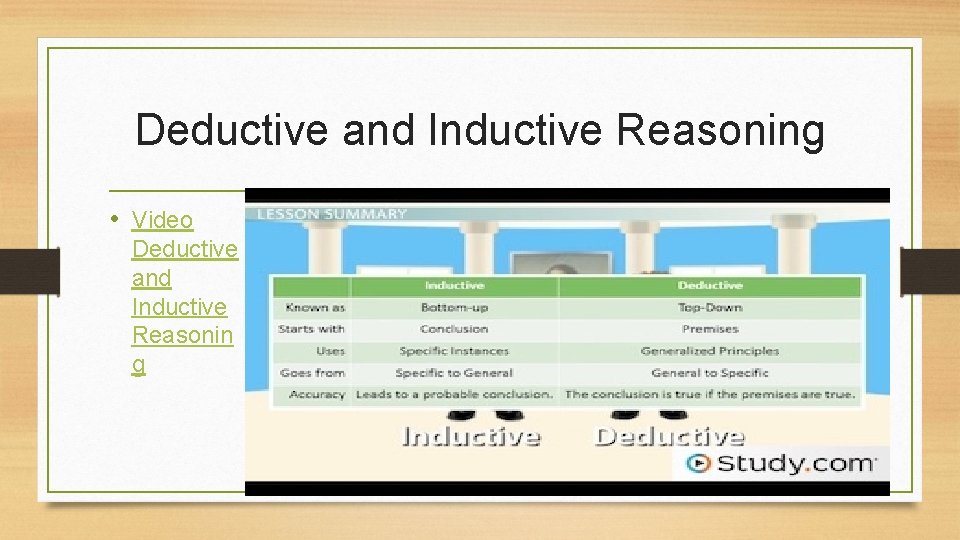
Deductive and Inductive Reasoning • Video Deductive and Inductive Reasonin g
See how Sherlock Holmes does inductive reasoning • https: //www. youtube. co m/watch? v=9 b 3 KM 2 p 1 n. Hs
Abductive Reasoning • • • Created by Charles S. Pierce, an American philosopher. It yields only probable truth like inductive reasoning. Provides explanatory hypothesis. The conclusion that is drawn may or may not be true. Jury duty decisions are an example of abductive reasoning.
Another example of abductive reasoning • You are about to go online to pay for your groceries, you see that all the lines are crowded and you need to get home in time for The Bachelor. There’s a shorter line for self-checkout with only two people on line, which definitely means you can get home in time for The Bachelor. Taking all the information you see, you decide to do the self-checkout line.
Do Nows!! 12/3 1. Which type of logical reasoning follows the “top down approach”? 2. Which type of logical reasoning follows the “bottom up approach”? 3. Which type of logical reasoning preserves the “truth”? 4. Which type of logical reasoning is more of a probability (probably true), then an actual truth?
Activity- Deductive and Inductive Reasoning Worksheet • Working quietly, read and complete the Deductive and Inductive Reasoning Worksheet individually or with a partner. • This may be graded.
Logical Fallacies • Arguing in a circle- Using a conclusion as a premise to prove a conclusion. • Example: Suppose I argue to you that the NHL is the best sport to watch. You ask why. I say because Gary Bettman said so. You ask, why should I care what that idiot has to say? I respond with because Bettman is the commissioner of the NHL.
Argument From Ignorance • This argument is when you cannot prove a proposition to be fake, then the person you’re arguing with can believe it is real. • Example: Since you can’t prove DB Cooper does not exist, I am free to believe DB Cooper does exist.
False Dilemma • It happens when we decrease a number of possibilities to two alternatives. • Example: You are lost in the woods with your friend. Your friend can’t admit that you’re lost, so your friend decides to trust you for getting out of the woods. Your friend says that they know the way out of the woods. Your friend could be wrong, either way you both don’t know the way out of the woods.
Do Nows!! 12/4 1. What is the fallacy of “arguing in a circle”? 2. Explain the fallacy of “argument from ignorance”? 3. What is the fallacy of a “false dilemma”?
Slippery Slope • A series of connected conditional claims that if A is true, then B will follow, then C after will follow, then D the worst possibility will occur. We cannot let A to occur at all. If the conditions hold then it is not a fallacy. • Example: A dad tells his son he has to practice baseball everyday. The son protests and he asks his dad why he has to practice baseball everyday. The dad’s response is if the son doesn’t practice baseball everyday, then he will not make the high school baseball team, and if the son doesn’t make the baseball team then he won’t get a scholarship, then he won’t go to college, and he will spend the rest of his life as a loner.
Straw Man • This happens when someone completely ignores the evidence for a position and attacks the inferior version of the position. • It is a distortion of the other person’s position. • Example: You wake up to a text message from your friend to hang out in the morning. You tell your friend you’re not feeling good and you have work in a couple of hours. Your friend completely goes off on you for this response saying you hate hanging out with them.
Activity- What fallacy appeals to you? • Pair up with a classmate and write your names on one piece of paper • • and answer the following questions. 1. What fallacy appeals to you? 2. Have you ever experienced this fallacy firsthand? Give an example. 3. What fallacy out of the four we learned does not appeal to you and why? This may be graded. We will discuss if time permits.
- Slides: 25