
Logarithm By GP Mumbai Contents 3 1 Definition
Logarithm By GP - Mumbai
Contents: 3. 1 Definition of logarithm 3. 2 Laws of logarithm 3. 3 simple examples based on laws
1. Introduction • Logarithmic functions are the inverses of exponential functions, and any exponential function can be expressed in logarithmic form. • Similarly, all logarithmic functions can be rewritten in exponential form. • Logarithms are really useful in permitting us to work with very large numbers while manipulating numbers of a much more manageable size. • Every exponential function f(x) = a x, with a > 0 and a ≠ 1. is a one-to-one function, therefore has an inverse function (f-1). • The inverse function is called the Logarithmic function with base a and is denoted by loga
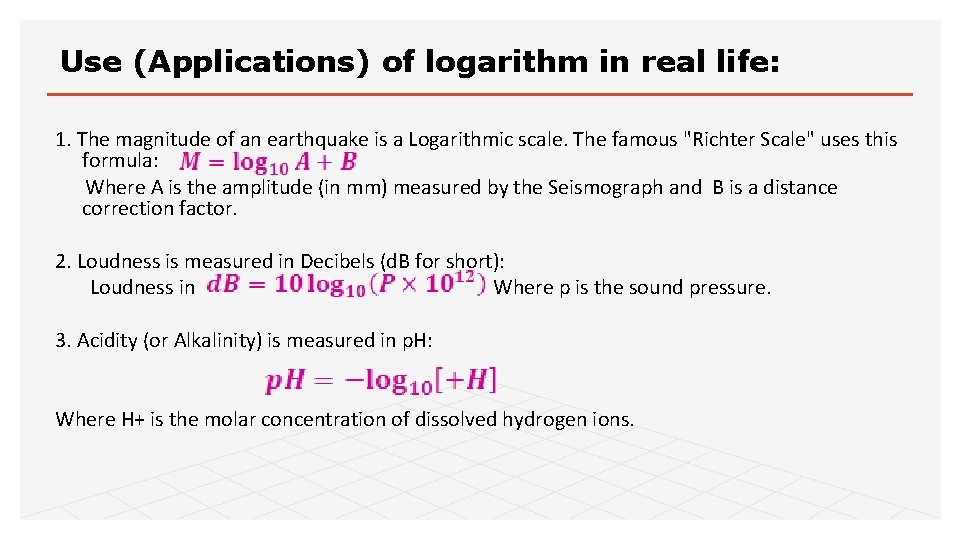
Use (Applications) of logarithm in real life: 1. The magnitude of an earthquake is a Logarithmic scale. The famous "Richter Scale" uses this formula: Where A is the amplitude (in mm) measured by the Seismograph and B is a distance correction factor. 2. Loudness is measured in Decibels (d. B for short): Loudness in Where p is the sound pressure. 3. Acidity (or Alkalinity) is measured in p. H: Where H+ is the molar concentration of dissolved hydrogen ions.
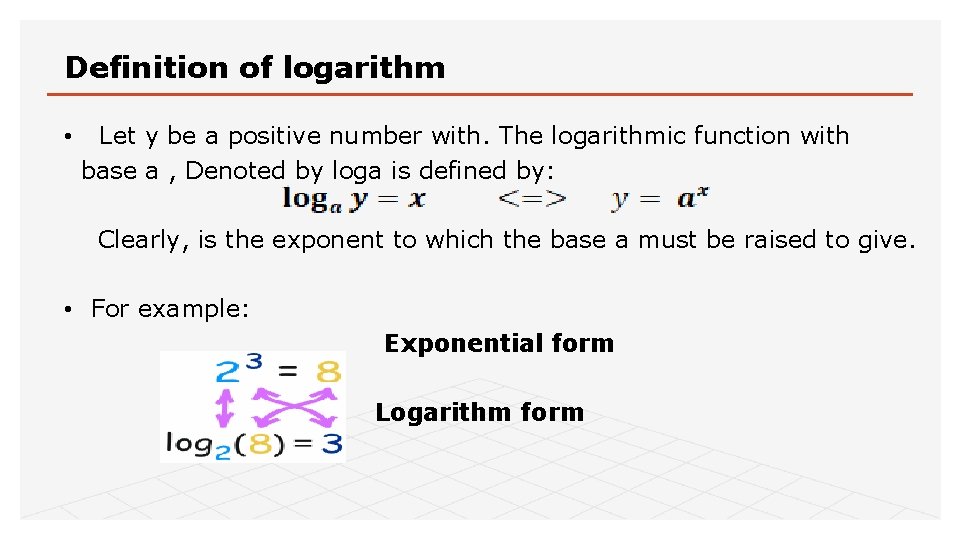
Definition of logarithm • Let y be a positive number with. The logarithmic function with base a , Denoted by loga is defined by: Clearly, is the exponent to which the base a must be raised to give. • For example: Exponential form Logarithm form
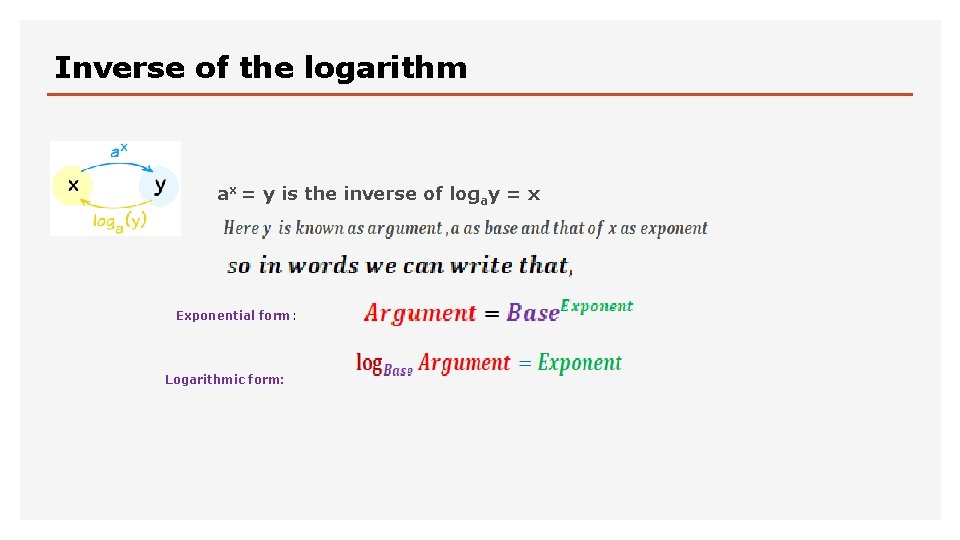
Inverse of the logarithm ax = y is the inverse of logay = x Exponential form: Logarithmic form:
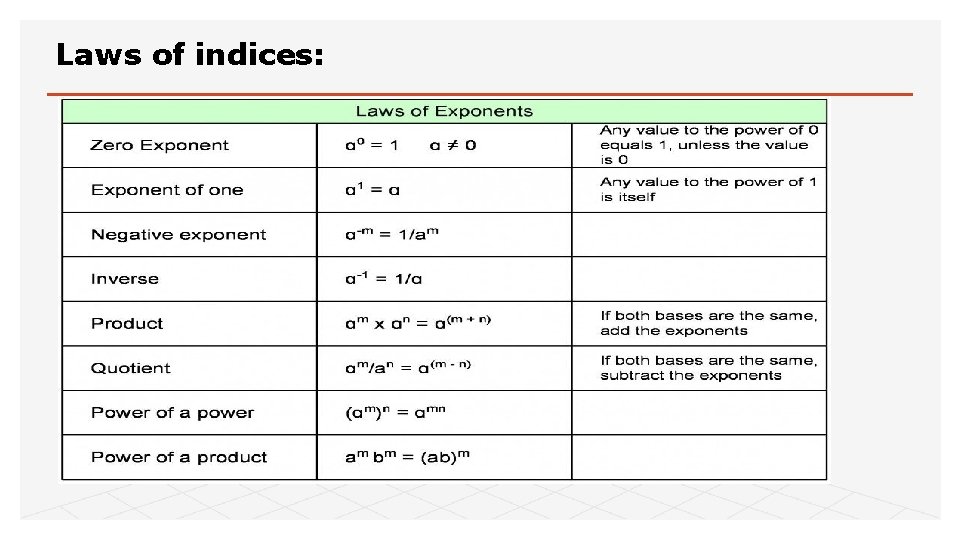
Laws of indices:
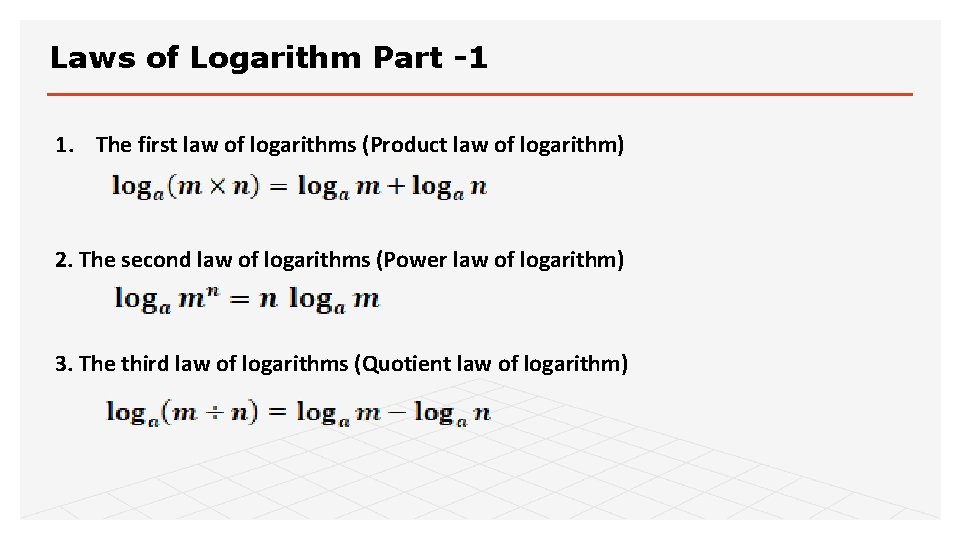
Laws of Logarithm Part -1 1. The first law of logarithms (Product law of logarithm) 2. The second law of logarithms (Power law of logarithm) 3. The third law of logarithms (Quotient law of logarithm)
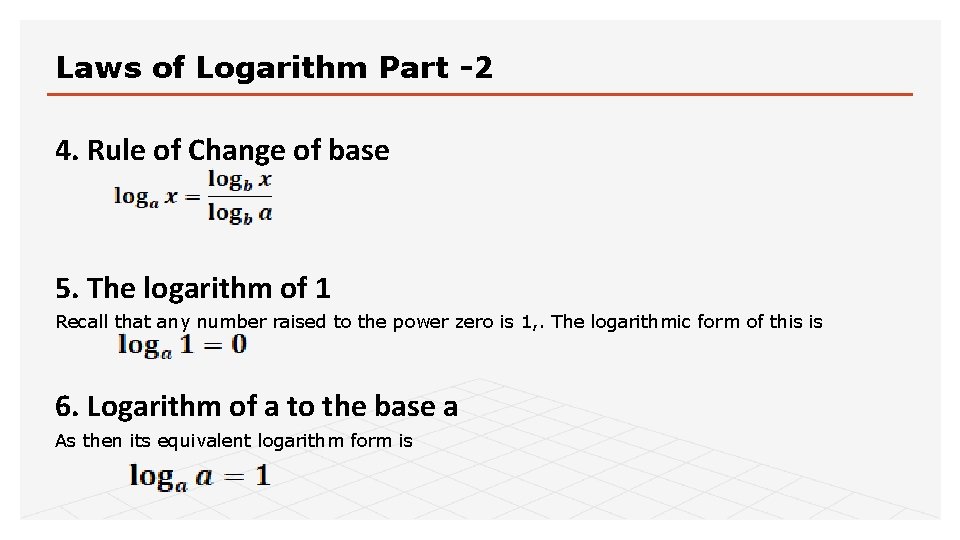
Laws of Logarithm Part -2 4. Rule of Change of base 5. The logarithm of 1 Recall that any number raised to the power zero is 1, . The logarithmic form of this is 6. Logarithm of a to the base a As then its equivalent logarithm form is
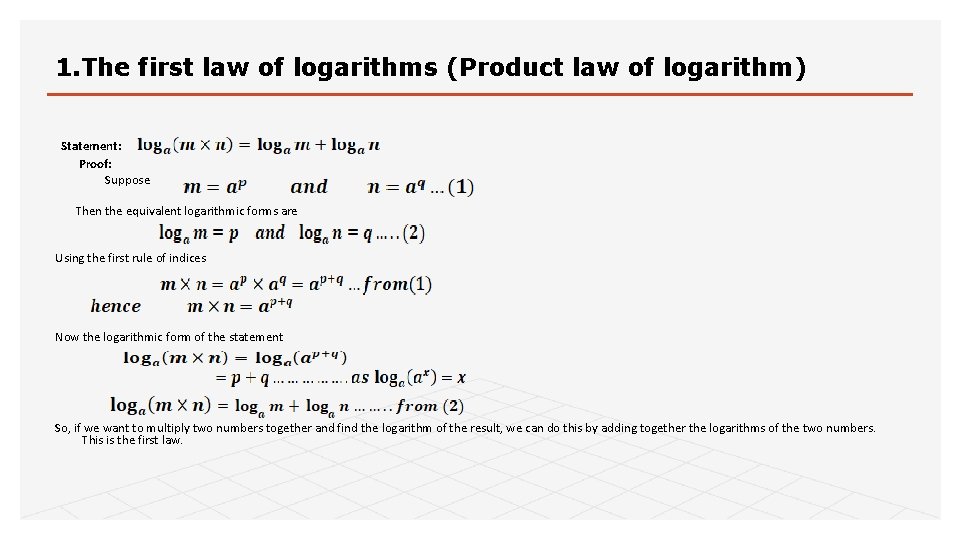
1. The first law of logarithms (Product law of logarithm) Statement: Proof: Suppose Then the equivalent logarithmic forms are Using the first rule of indices Now the logarithmic form of the statement So, if we want to multiply two numbers together and find the logarithm of the result, we can do this by adding together the logarithms of the two numbers. This is the first law.
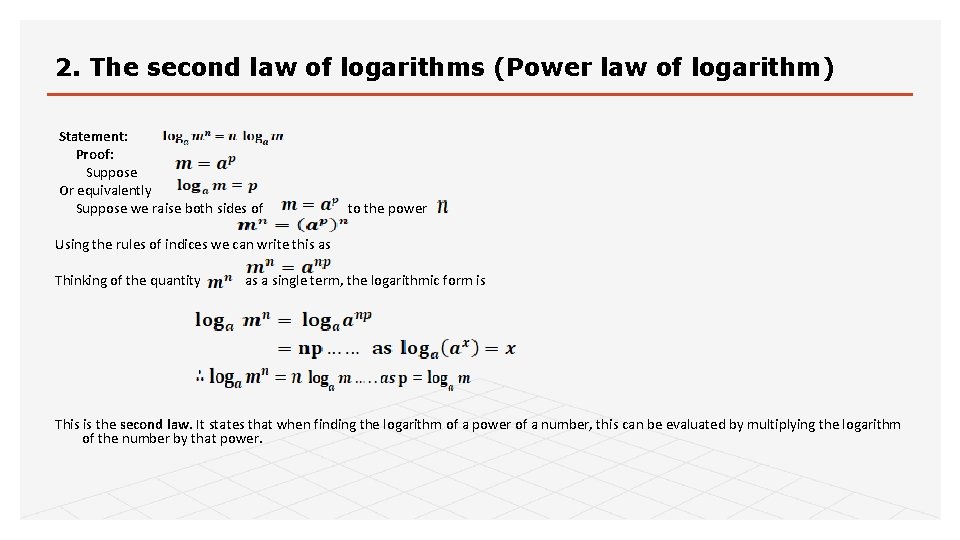
2. The second law of logarithms (Power law of logarithm) Statement: Proof: Suppose Or equivalently Suppose we raise both sides of to the power Using the rules of indices we can write this as Thinking of the quantity as a single term, the logarithmic form is This is the second law. It states that when finding the logarithm of a power of a number, this can be evaluated by multiplying the logarithm of the number by that power.
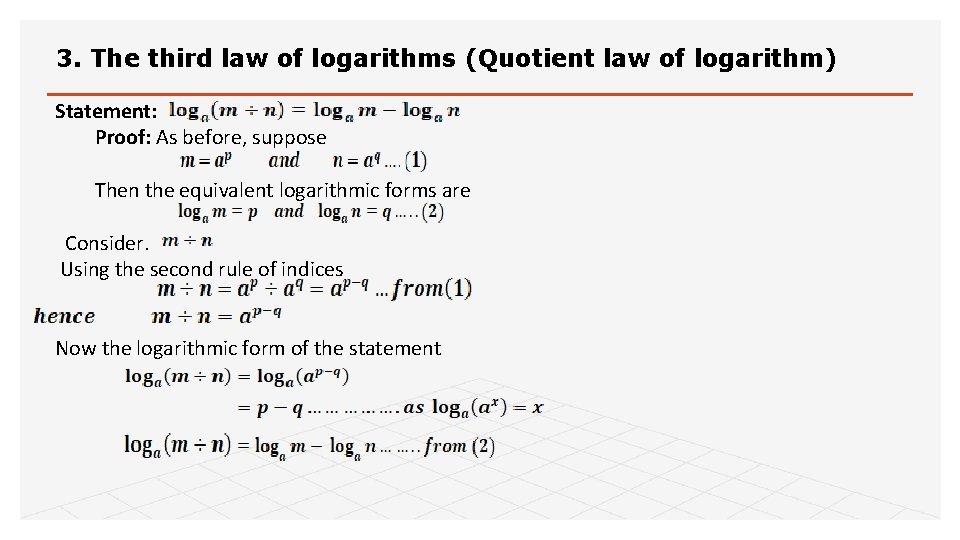
3. The third law of logarithms (Quotient law of logarithm) Statement: Proof: As before, suppose Then the equivalent logarithmic forms are Consider. Using the second rule of indices Now the logarithmic form of the statement
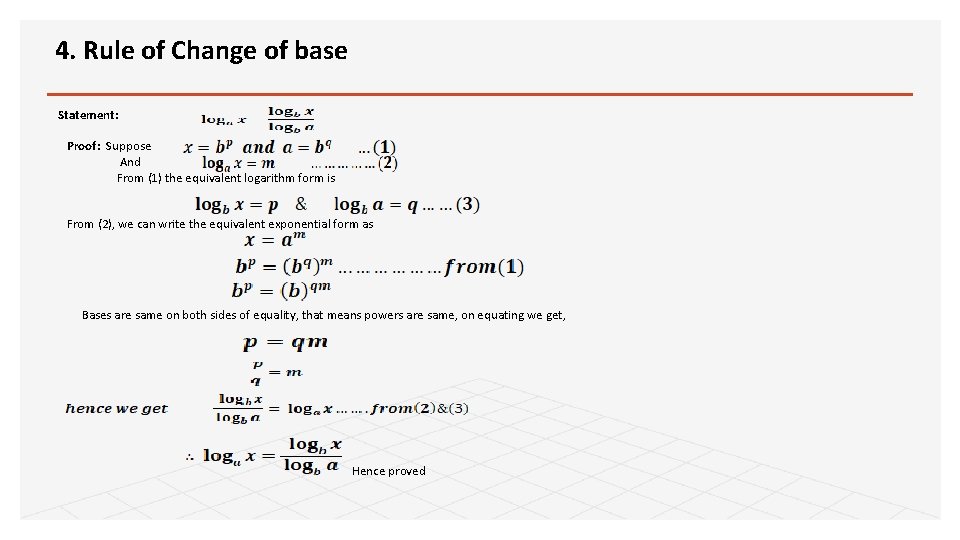
4. Rule of Change of base Statement: Proof: Suppose And From (1) the equivalent logarithm form is From (2), we can write the equivalent exponential form as Bases are same on both sides of equality, that means powers are same, on equating we get, Hence proved

THANK YOU !
- Slides: 14