
Log ft values in Beta Decay Filip G
Log ft values in Beta Decay Filip G. Kondev kondev@anl. gov 2 nd Workshop for DDEP Evaluators, Bucharest, Romania May 12 -15, 2008
Some useful references Books ü“Week interaction and nuclear beta decay”, H. F. Schopper, 1966 ü“Handbook of nuclear spectroscopy”, J. Kantele, 1995 ü“Radiation detection and measurements”, G. F. Knoll, 1989 ü“Alpha-, Beta- and Gamma-ray Spectroscopy”, Ed. K. Siegbahn, 1965 Journal Articles üW. Bambynek et al. , Rev. Mod. Phys. 49 (1977) 77 üN. B. Gove and M. J. Martin, Nuclear Data Tables 10 (1971) 205 üS. Raman and N. B. Gove, Phys. Rev. C 7 (1973) 1995 üB. Singh et al. , Nuclear Data Sheets 84 (1998 487 Plenty of information available on the Web 2

Introduction Beta Decay: universal term for all weak-interaction transitions between two neighboring isobars Takes place is 3 different forms b-, b+ & EC (capture of an atomic electron) b+: p n + e+ + n EC: p + e- n + n b-: n p + e- + n~ a nucleon inside the nucleus is transformed into another 3
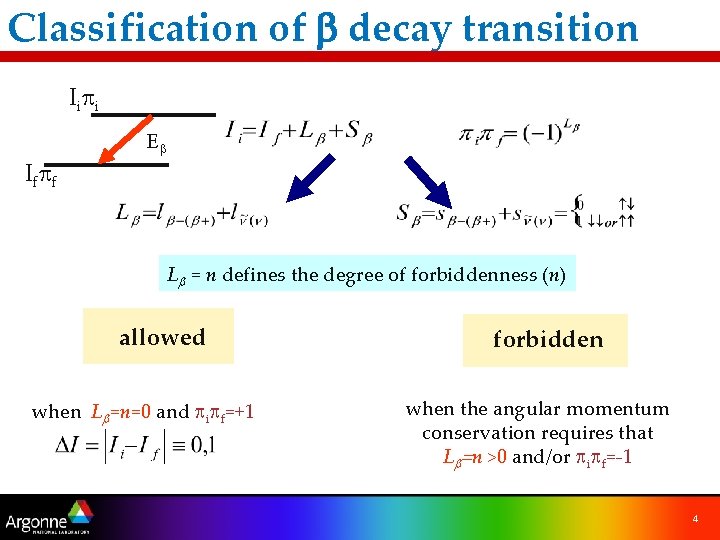
Classification of b decay transition I ip i Eb I fp f Lb = n defines the degree of forbiddenness (n) allowed when Lb=n=0 and pipf=+1 forbidden when the angular momentum conservation requires that Lb=n >0 and/or pipf=-1 4
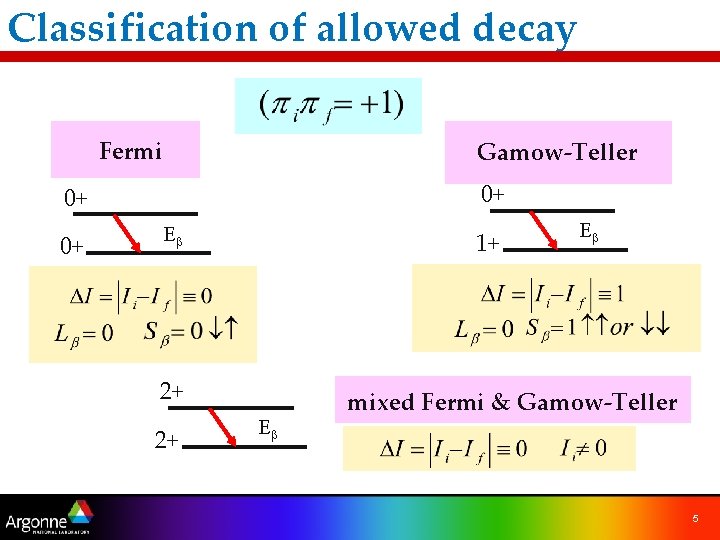
Classification of allowed decay Fermi Gamow-Teller 0+ 0+ 0+ Eb 1+ 2+ 2+ Eb Eb mixed Fermi & Gamow-Teller 5

Classification of b decay transitions Type of transition Order of forbiddenness DI pi pf 0, +1 +1 1 2 3 4. k 2 k 3 k 4 k 5. -1 +1. 1 2 3 4. 0, k 1 k 2 k 3 k 4. -1 +1. Allowed Forbidden unique Forbidden 6

Some useful empirical rules The fifth power beta decay rule: the speed of a b transition increases approximately in proportion to the fifth power of the total transition energy (if other things are being equal, of course) Ii If Eb q depends on spin and parity changes between the initial and final state q additional hindrance due to nuclear structure effects – isospin, “l-forbidden”, “K-forbidden”, etc. 7
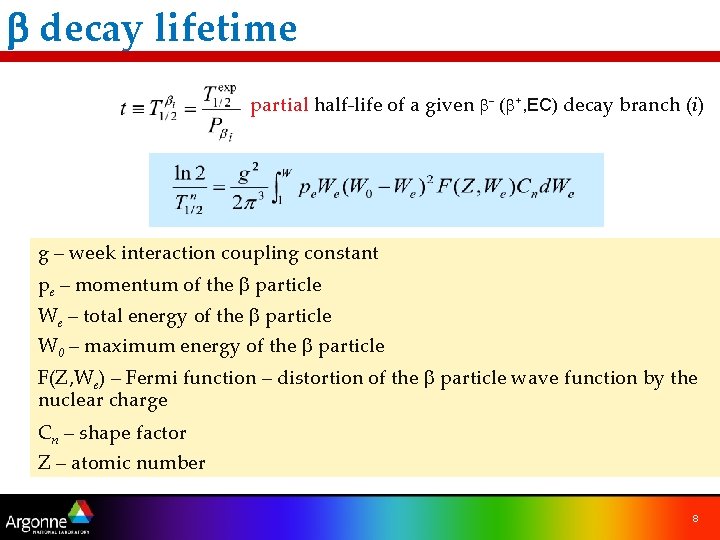
b decay lifetime partial half-life of a given b- (b+, EC) decay branch (i) g – week interaction coupling constant pe – momentum of the b particle We – total energy of the b particle W 0 – maximum energy of the b particle F(Z, We) – Fermi function – distortion of the b particle wave function by the nuclear charge Cn – shape factor Z – atomic number 8
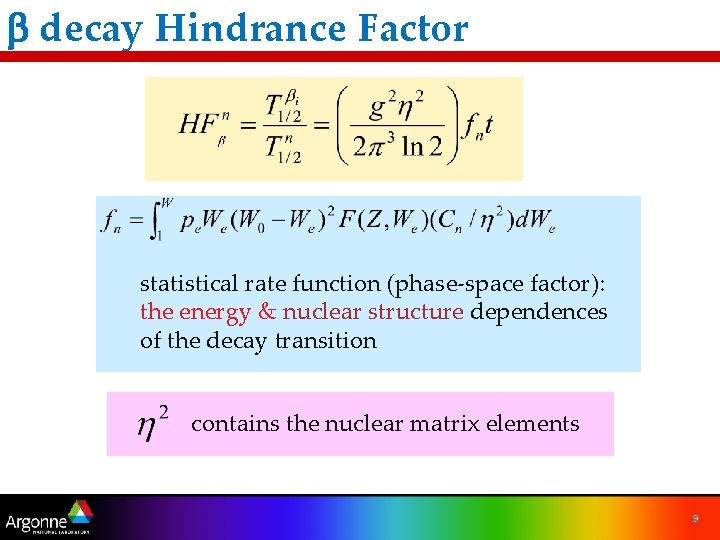
b decay Hindrance Factor statistical rate function (phase-space factor): the energy & nuclear structure dependences of the decay transition contains the nuclear matrix elements 9
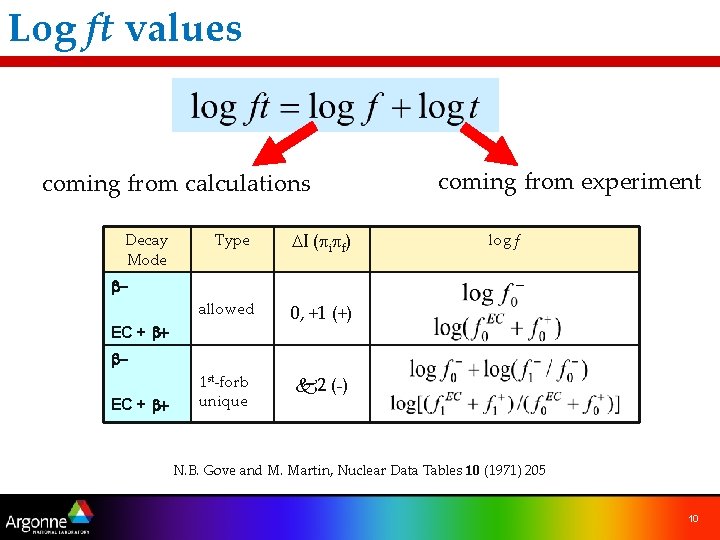
Log ft values coming from calculations Decay Mode Type DI (pipf) allowed 0, +1 (+) 1 st-forb unique k 2 (-) coming from experiment log f b. EC + b+ N. B. Gove and M. Martin, Nuclear Data Tables 10 (1971) 205 10
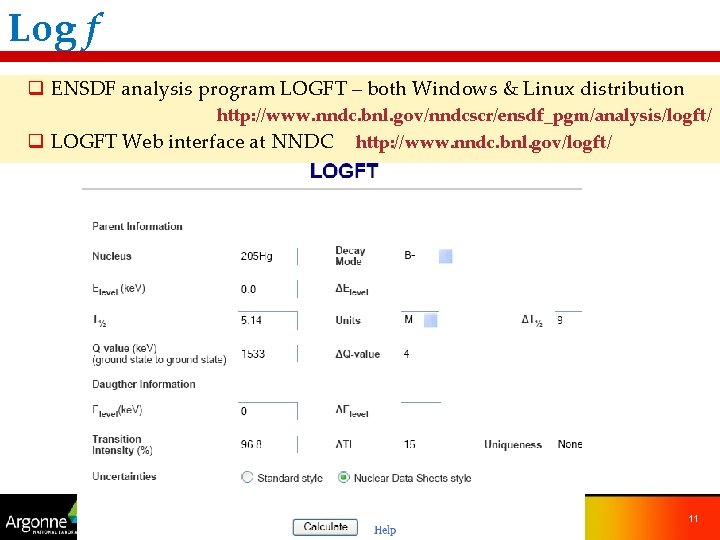
Log f q ENSDF analysis program LOGFT – both Windows & Linux distribution http: //www. nndc. bnl. gov/nndcscr/ensdf_pgm/analysis/logft/ q LOGFT Web interface at NNDC http: //www. nndc. bnl. gov/logft/ 11
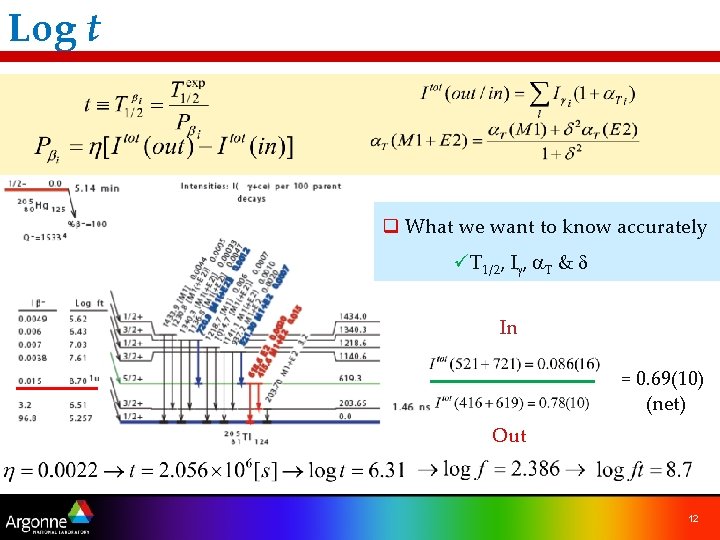
Log t q What we want to know accurately üT 1/2, Ig, a. T & d In = 0. 69(10) (net) Out 12
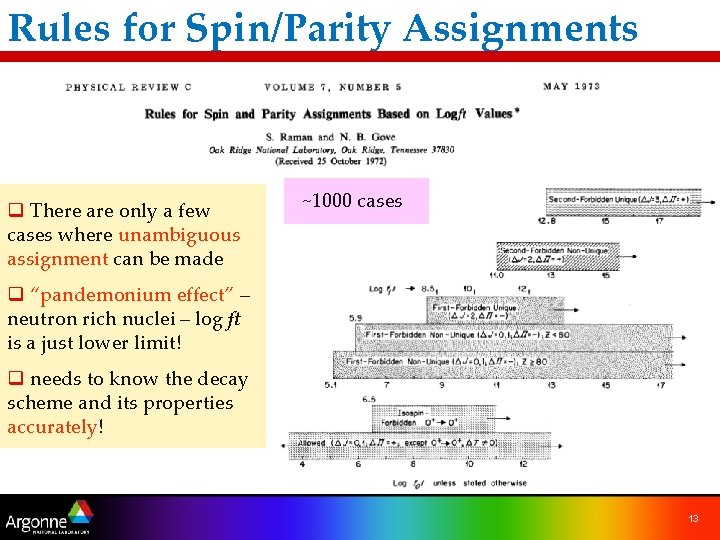
Rules for Spin/Parity Assignments q There are only a few cases where unambiguous assignment can be made ~1000 cases q “pandemonium effect” – neutron rich nuclei – log ft is a just lower limit! q needs to know the decay scheme and its properties accurately! 13
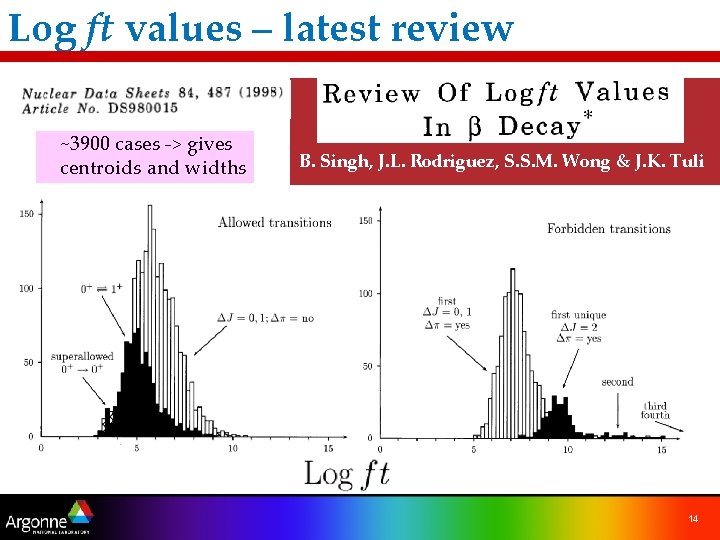
Log ft values – latest review ~3900 cases -> gives centroids and widths B. Singh, J. L. Rodriguez, S. S. M. Wong & J. K. Tuli 14
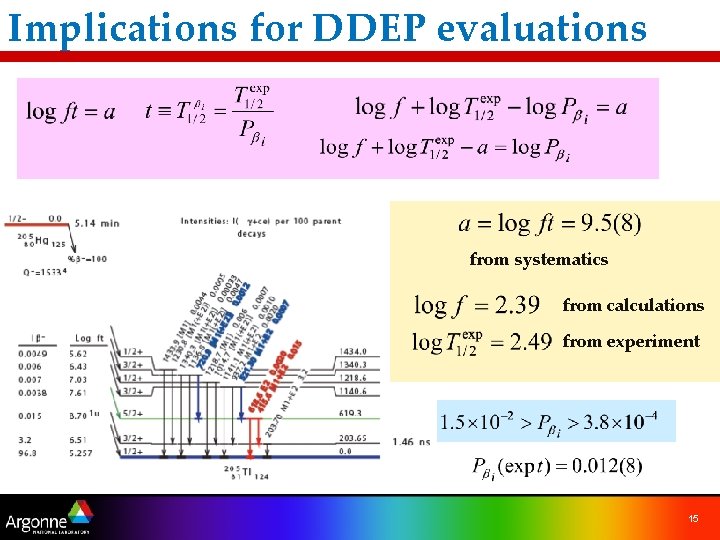
Implications for DDEP evaluations from systematics from calculations from experiment 15
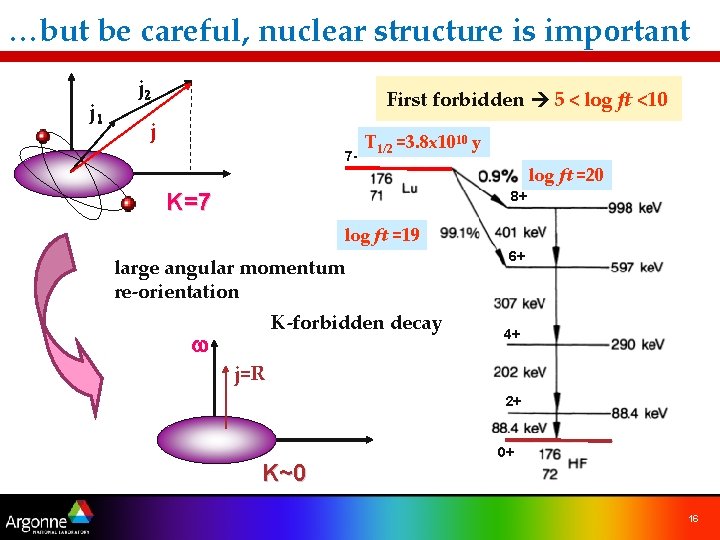
…but be careful, nuclear structure is important j 1 j 2 First forbidden 5 < log ft <10 j 7 - T 1/2 =3. 8 x 10¹⁰ y K=7 log ft =20 8+ log ft =19 large angular momentum re-orientation K-forbidden decay w 6+ 4+ j=R 2+ K~0 0+ 16
- Slides: 16