
Locus of Control SelfEfficacy Measures as Predictors of

- Slides: 22
Locus of Control & Self-Efficacy Measures as Predictors of Resident’s Academic Performance Shailendra Prasad, MD, MPH, & Joseph Brocato, Ph. D, Department of Family Medicine and Community Health
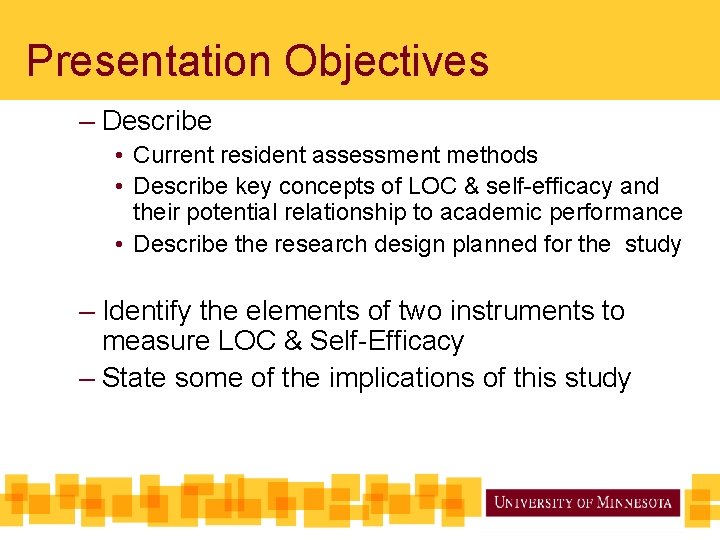
Presentation Objectives – Describe • Current resident assessment methods • Describe key concepts of LOC & self-efficacy and their potential relationship to academic performance • Describe the research design planned for the study – Identify the elements of two instruments to measure LOC & Self-Efficacy – State some of the implications of this study
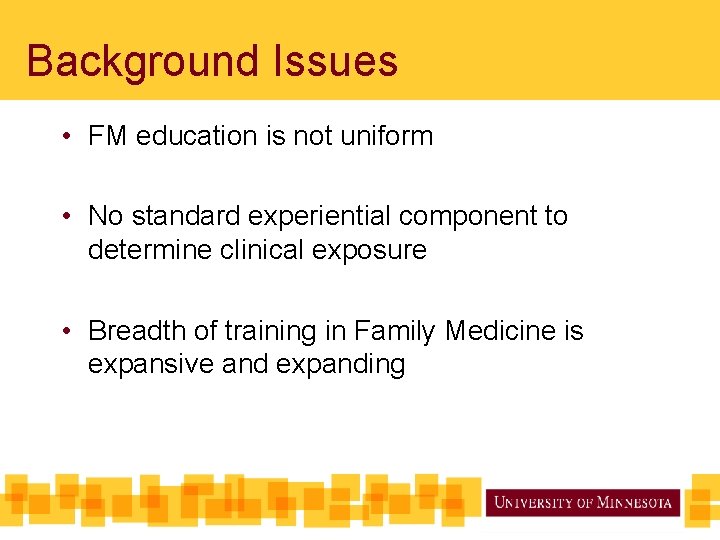
Background Issues • FM education is not uniform • No standard experiential component to determine clinical exposure • Breadth of training in Family Medicine is expansive and expanding
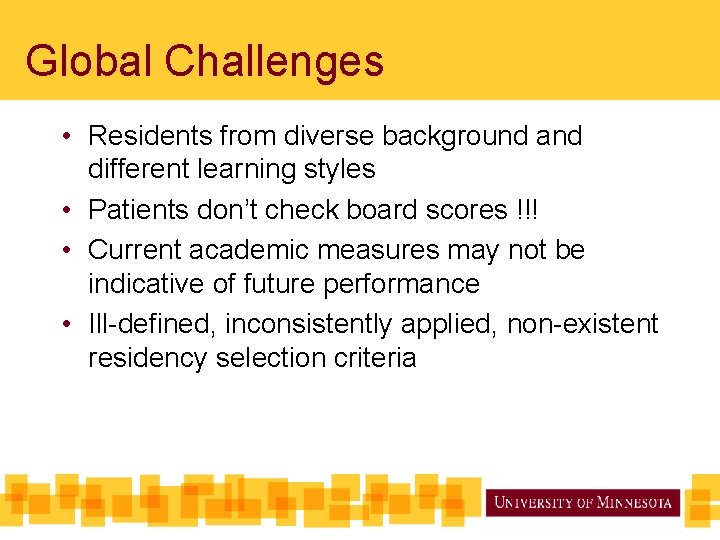
Global Challenges • Residents from diverse background and different learning styles • Patients don’t check board scores !!! • Current academic measures may not be indicative of future performance • Ill-defined, inconsistently applied, non-existent residency selection criteria
Measures of resident’s academic performance • In training examination (ITE) • Board Scores • Rotation based evaluations of medical knowledge • Other evaluations – Structured & Unstructured
Newer Measures?
Key Concept: Locus of Control • Originally described by Rotter in 1950 s • Individual’s perception of underlying causes of events in life • Conceptualized as a unidimensional continuum from an internal to an external
Internal LOC • “Actions are within ones control” • General acceptance that internal LOC is desirable • Studies in the 1980 s - fewer people with internal LOC going into primary care
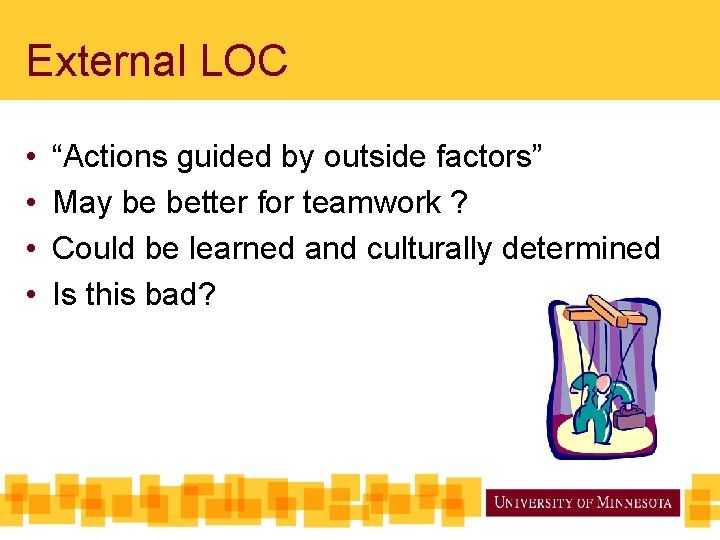
External LOC • • “Actions guided by outside factors” May be better for teamwork ? Could be learned and culturally determined Is this bad?
What do we know about LOC and physicians • LOC may influence communication skills training- Belgian study- Libert et al • Self-confidence and physical exam- Wu et al
Key Concept: Self Efficacy (i. e. , Self-Assessment) • Bandura (1997), Social Cognitive Theory – “Self-efficacy is concerned with people’s beliefs in their capabilities to produce given attainments” (perceived capability). – Note distinguishing principles: can do (capability) versus will do (intention). – People with high self-efficacy - that is, those who believe they can perform well - are more likely to view difficult tasks as something to be mastered rather than something to be avoided.
Research Questions from our Study • What is the LOC & self-efficacy of FM residents (in terms of core knowledge and skill areas in FM)? • Does this LOC & self-efficacy change over time? • Are there differences in LOC & self-efficacy based on demographic differences? • Are LOC & self-efficacy predictors of traditional academic performance during residency?
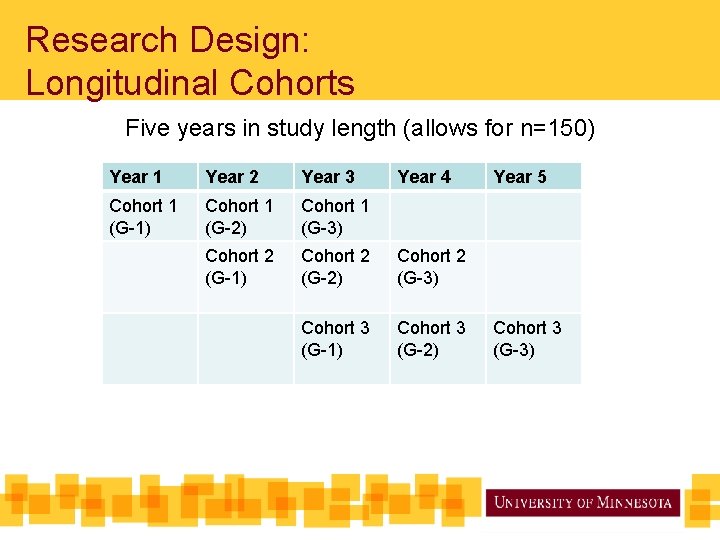
Research Design: Longitudinal Cohorts Five years in study length (allows for n=150) Year 1 Year 2 Year 3 Year 4 Cohort 1 (G-1) Cohort 1 (G-2) Cohort 1 (G-3) Cohort 2 (G-1) Cohort 2 (G-2) Cohort 2 (G-3) Cohort 3 (G-1) Cohort 3 (G-2) Year 5 Cohort 3 (G-3)
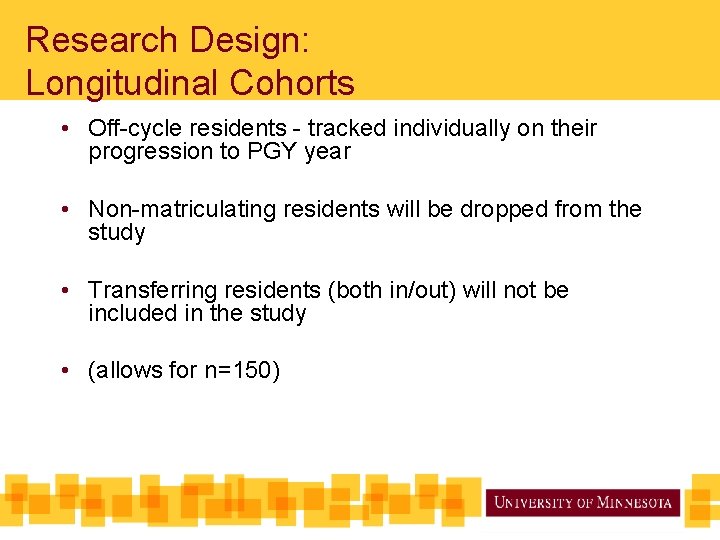
Research Design: Longitudinal Cohorts • Off-cycle residents - tracked individually on their progression to PGY year • Non-matriculating residents will be dropped from the study • Transferring residents (both in/out) will not be included in the study • (allows for n=150)
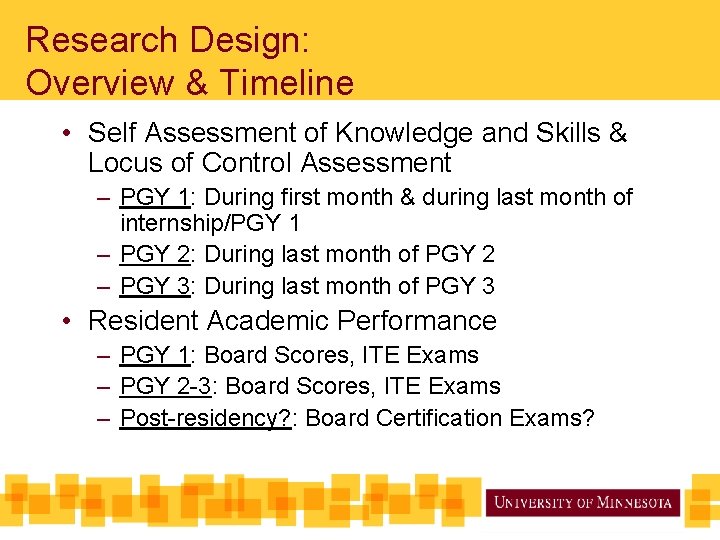
Research Design: Overview & Timeline • Self Assessment of Knowledge and Skills & Locus of Control Assessment – PGY 1: During first month & during last month of internship/PGY 1 – PGY 2: During last month of PGY 2 – PGY 3: During last month of PGY 3 • Resident Academic Performance – PGY 1: Board Scores, ITE Exams – PGY 2 -3: Board Scores, ITE Exams – Post-residency? : Board Certification Exams?
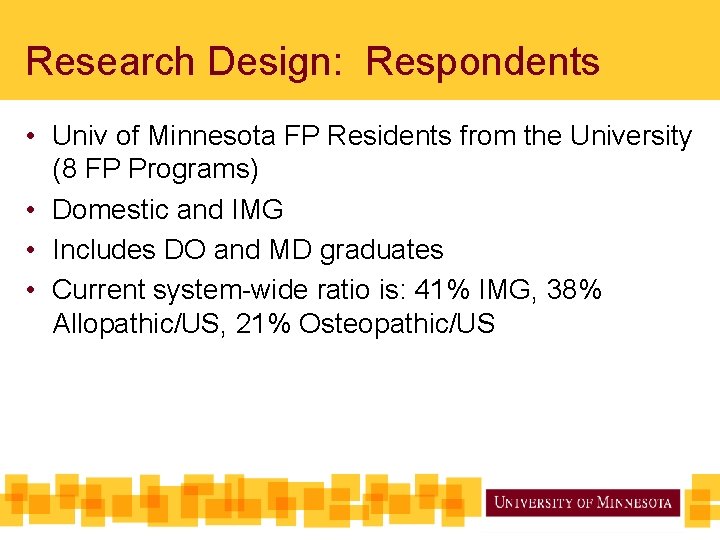
Research Design: Respondents • Univ of Minnesota FP Residents from the University (8 FP Programs) • Domestic and IMG • Includes DO and MD graduates • Current system-wide ratio is: 41% IMG, 38% Allopathic/US, 21% Osteopathic/US
Research Design: Instrumentation • Survey Monkey Longitudinal Resident Self. Assessments – Resident Self-Assessment of Knowledge and Skills – Duttweiler Internal Locus of Control Index
Resident Self Assessment of Knowledge and Skills • Demographics &Tracking information (confidential, not anonymous) • Knowledge areas based on FM program requirement subject matter • Scale for knowledge based upon Bloom’s Taxonomy (recall, comprehension, application, analytical, synthesis, evaluation) • Skills: Core departmental inpatient and outpatient procedures • Skills Scale: Dreyfus Model of Skill Acquisition • Overall self-assessment: ACGME general competencies
Duttweiler Locus of Control Index (1984) • Previously validated instrument of LOC • 28 question survey instrument • Complete questions using scaled responses
Next Steps • Now-July 1, 2009: – Reduce survey length (select core procedures subset) – Continue to refine scaling to simplify – Validate all instrumentation (pilot) – IRB Review • July 1, 2009: Assessment of incoming class of approximately 50 residents begins
Questions? / Feedback
Theoretical References • Bandura, Albert. (1997). Self-efficacy: the Exercise of Control. New York: Freeman Publishers. • Bloom B. S. (1956). Taxonomy of Educational Objectives, Handbook I: The Cognitive Domain. New York: David Mc. Kay Co Inc. • Dreyfus, Stuart E. and Dreyfus, Hubert L. (1980). A Five Stage Model of the Mental Activities Involved in Directed Skill Acquisition. Unpublished Report. University of California-Berkeley/US Air Force. • Duttweiler, Patricia C. (1984). The Internal Control Index: a Newly Developed Measure of Locus of Control. Educational and Psychological Measurement. 44(2), p. 209 -221.