
Locked Nucleic Acid Laura Auchterlonie Rachael Amador Structure
- Slides: 26
Locked Nucleic Acid Laura Auchterlonie & Rachael Amador
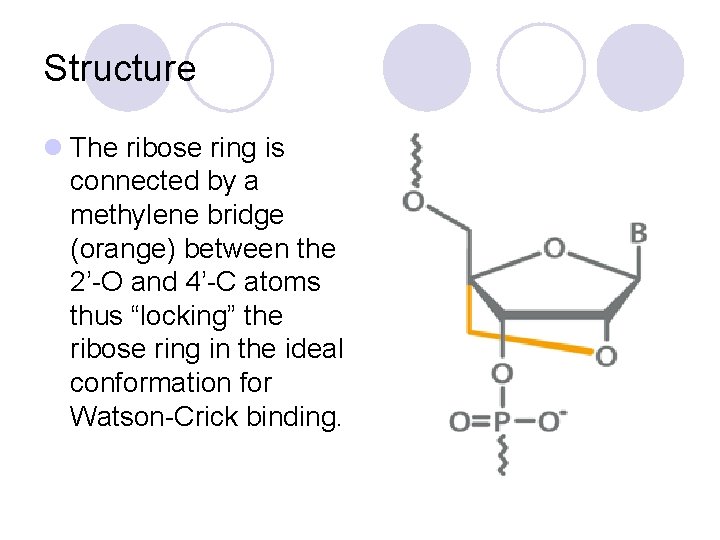
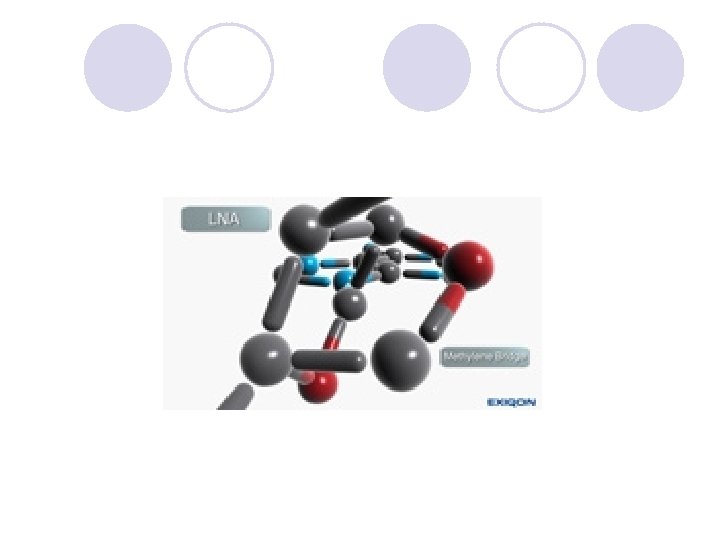
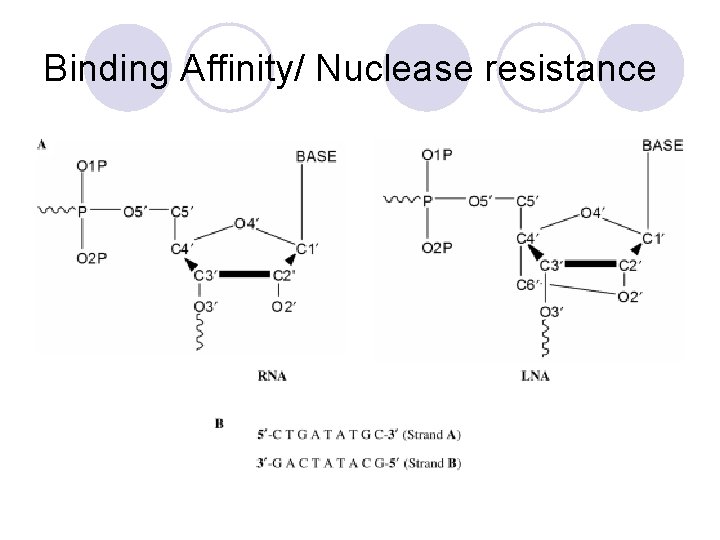
Structure l The ribose ring is connected by a methylene bridge (orange) between the 2’-O and 4’-C atoms thus “locking” the ribose ring in the ideal conformation for Watson-Crick binding.
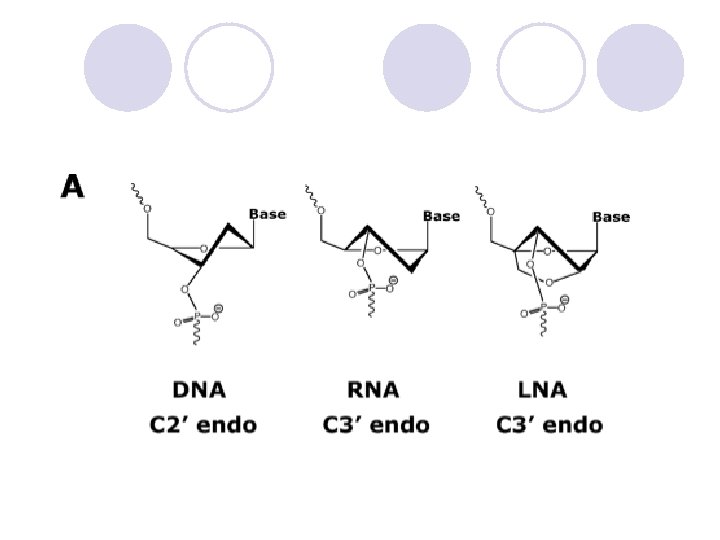
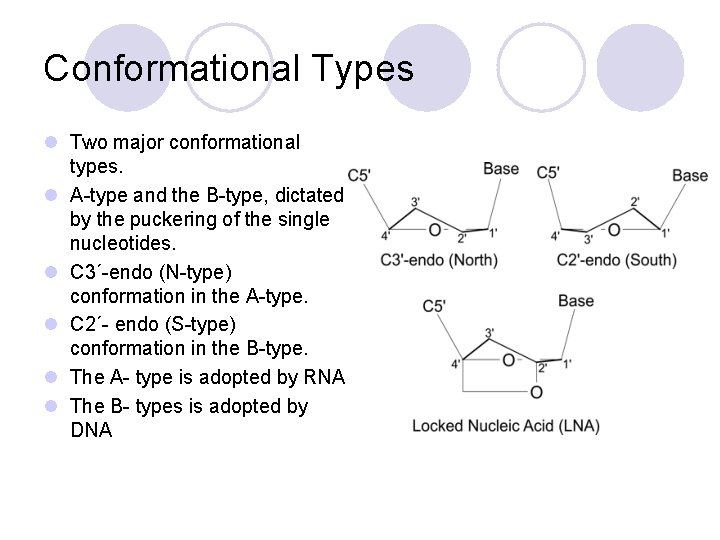
Conformational Types l Two major conformational types. l A-type and the B-type, dictated by the puckering of the single nucleotides. l C 3´-endo (N-type) conformation in the A-type. l C 2´- endo (S-type) conformation in the B-type. l The A- type is adopted by RNA l The B- types is adopted by DNA
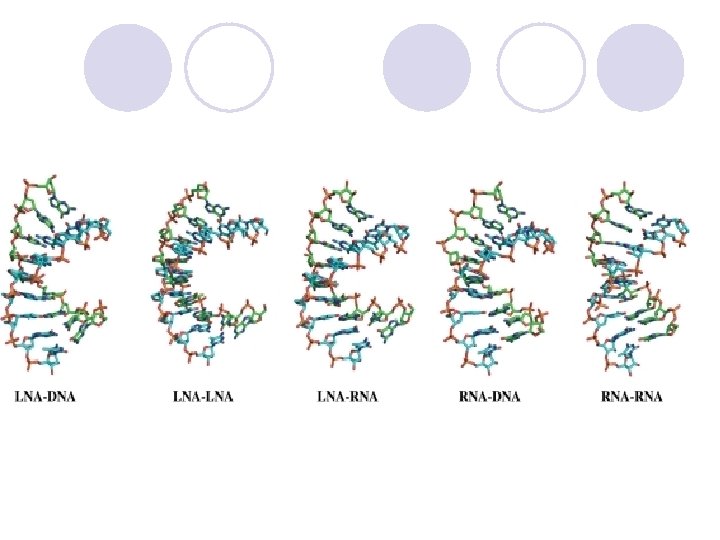
Overall Structure and Dynamics l The general structure of LNA–DNA and LNA–RNA duplexes resemble the RNA–DNA and RNA–RNA duplexes. l LNA–LNA duplex exhibits a slight unwinding of the helix (see twist angles in section on base stacking), resulting in relatively shallower grooves, compared to other duplexes. l Duplexes with an LNA strand have on average longer interstrand phosphate distances compared to RNA–DNA and RNA–RNA duplexes. l Intrastrand phosphate distances in LNA strands are shorter than DNA and slightly shorter than RNA.
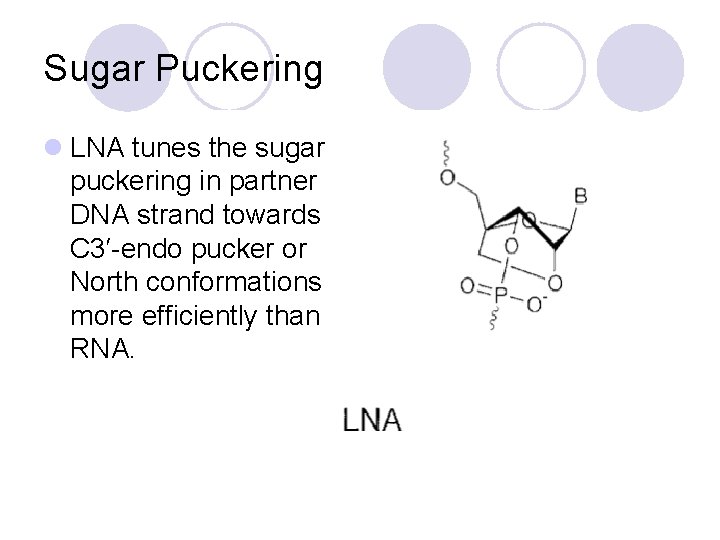
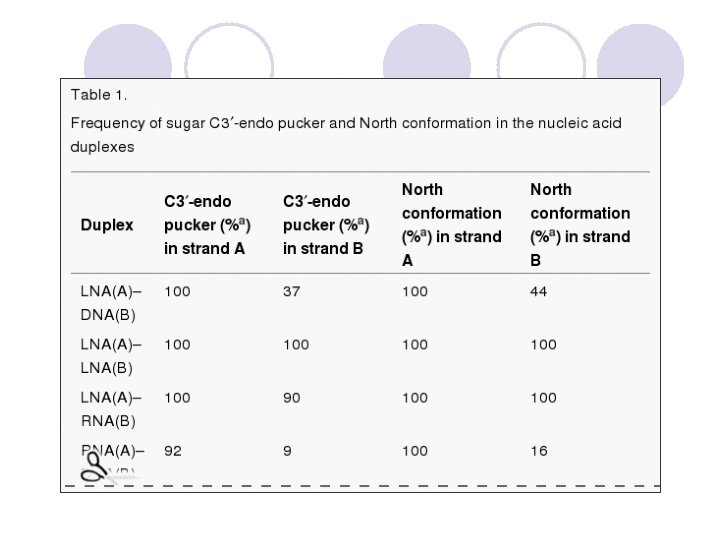
Sugar Puckering l LNA tunes the sugar puckering in partner DNA strand towards C 3′-endo pucker or North conformations more efficiently than RNA.
Backbone Flexibility l The DNA backbone is slightly more flexible than LNA or RNA backbones and LNA does not show any conformational coupling of its reduced backbone flexibility onto partner strands. Also, the LNA–LNA duplex has lesser backbone flexibility compared to the RNA–RNA duplex.
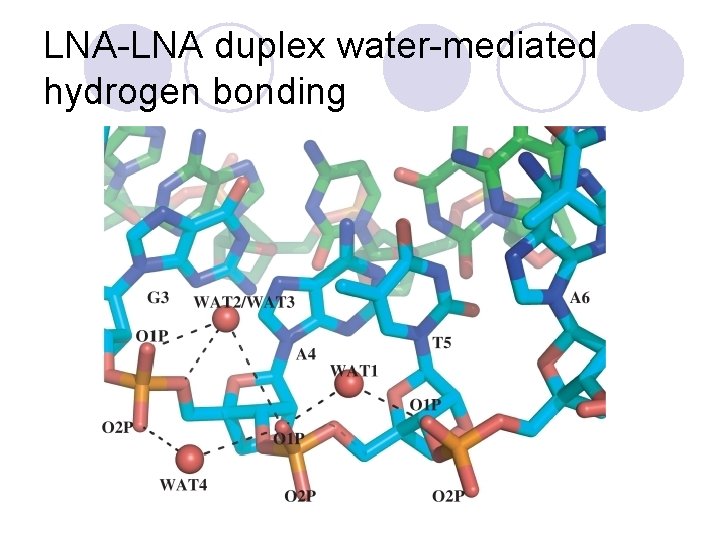
Water Structure and Dynamics l LNA is less hydrated compared to DNA or RNA but has a well-organized water structure, in context of the backbone. l DNA and RNA only form very infrequent multiple hydrogen-bonding bridges via water molecules. l LNA strands have the most frequent hydrogenbonding bridges, resulting in a net higher occupancy of water bridged backbone.
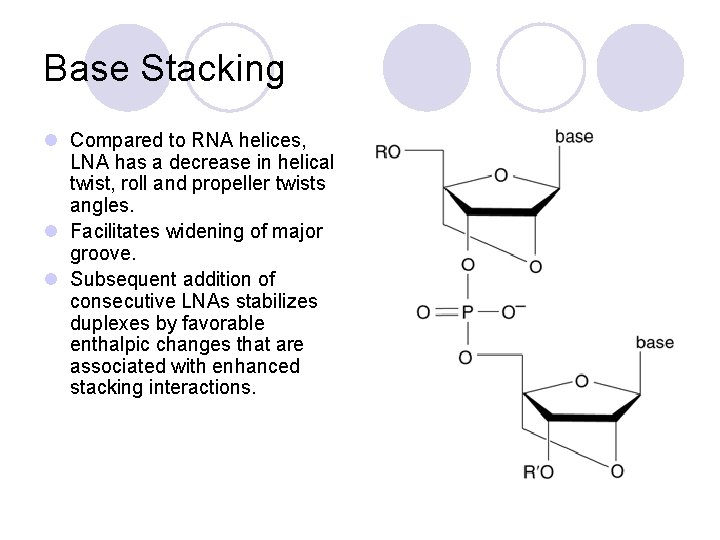
Base Stacking l Compared to RNA helices, LNA has a decrease in helical twist, roll and propeller twists angles. l Facilitates widening of major groove. l Subsequent addition of consecutive LNAs stabilizes duplexes by favorable enthalpic changes that are associated with enhanced stacking interactions.
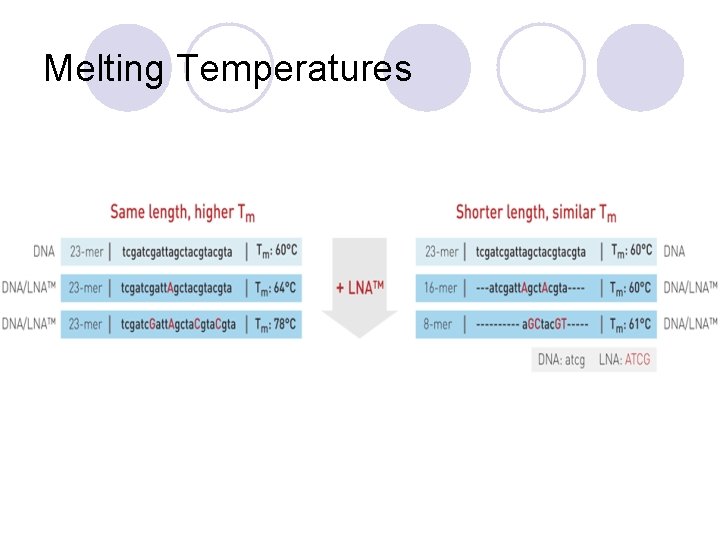
Function/Properties of LNA l High melting temperature/thermal stability. l High solubility l High binding affinity. l Resistant to exo- and endonucleases.
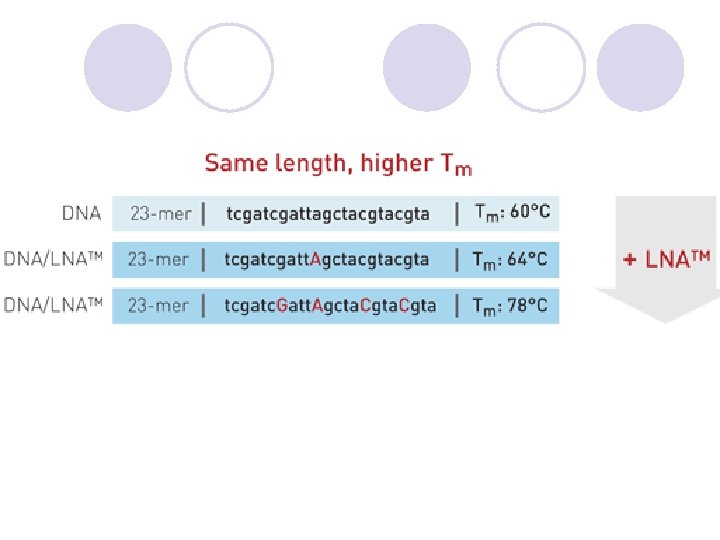
Melting Temperatures
LNA-LNA duplex water-mediated hydrogen bonding
Binding Affinity/ Nuclease resistance
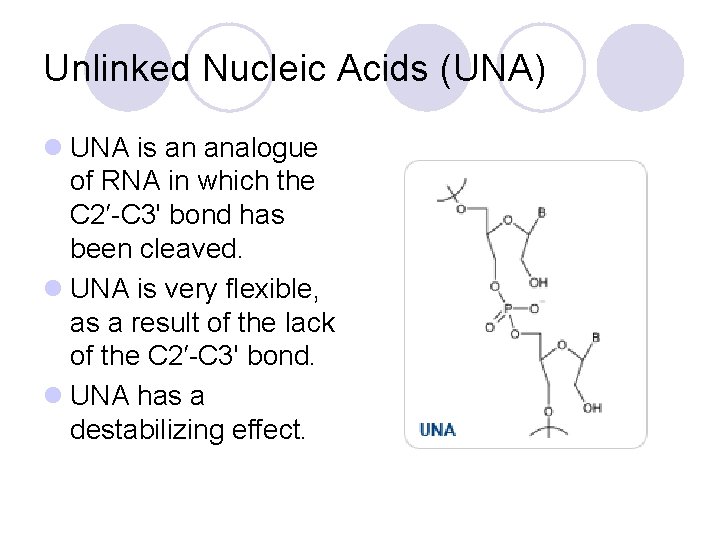
Unlinked Nucleic Acids (UNA) l UNA is an analogue of RNA in which the C 2′-C 3' bond has been cleaved. l UNA is very flexible, as a result of the lack of the C 2′-C 3' bond. l UNA has a destabilizing effect.
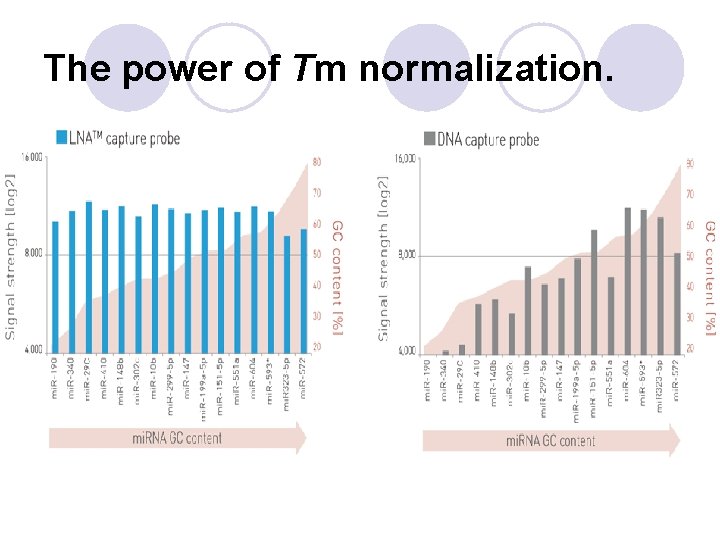
Why Use LNAs? l Tm normalization – robust detection regardless of GC content l Single nucleotide discrimination l Broad applicability
The power of Tm normalization.
Single Nucleotide Discrimination l Intelligent placement of LNA™ monomers l The difference in Tm between a perfectly matched and a mismatched target is described as the delta Tm. l Incorporation of LNA raises delta Tm
Broad Applicability l Strand invasion properties l Physical properties (e. g. water solubility) are very similar to those of RNA and DNA
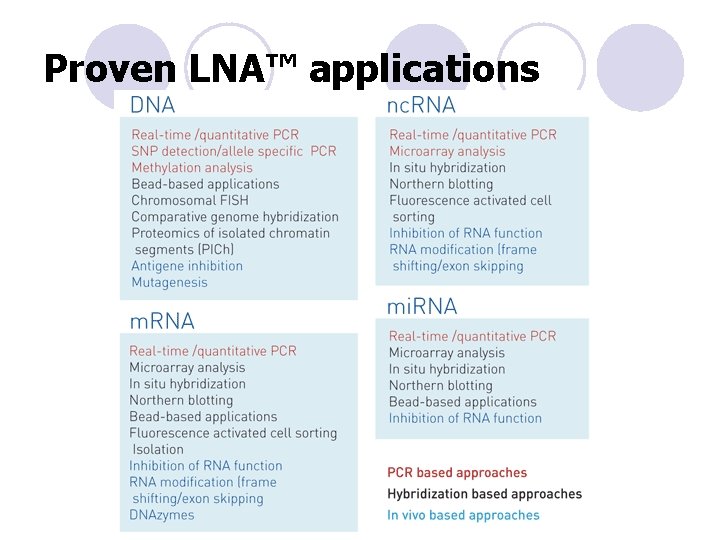
Powerful Tool for Nucleic Acids Research l The unique characteristics of LNA™ make it a powerful tool for detection of low abundance, short or highly similar targets in a number of other applications l The unique ability of LNA™ oligonucleotides to discriminate between highly similar sequences has further been exploited in a number of applications targeting longer RNA sequences such as m. RNA.
Proven LNA™ applications
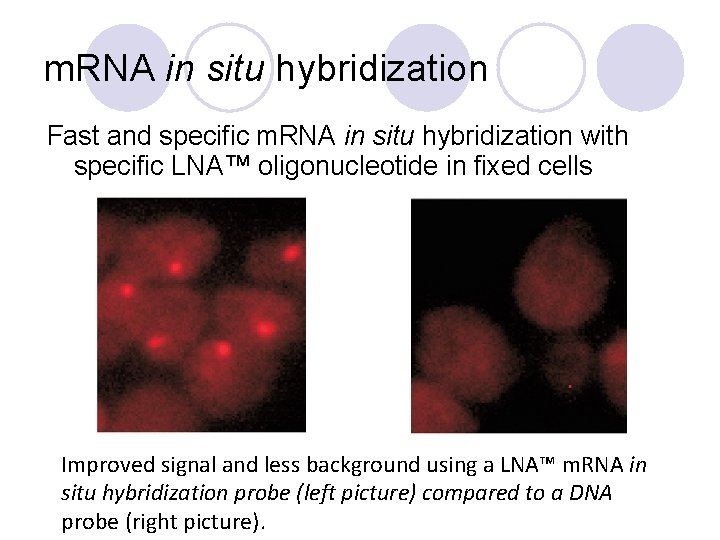
m. RNA in situ hybridization Fast and specific m. RNA in situ hybridization with specific LNA™ oligonucleotide in fixed cells Improved signal and less background using a LNA™ m. RNA in situ hybridization probe (left picture) compared to a DNA probe (right picture).
References l l l Potent and nontoxic antisense oligonucleotides containing locked nucleic acids Claes Wahlestedt*†, Peter Salmi*, Liam Good*, Johanna Kela*, Thomas Johnsson*, Tomas Ho¨ kfelt‡, Christian Broberger‡, Frank Porreca§, Josephine Lai§, Kunkun Ren§, Michael Ossipov§, Alexei Koshkin¶, Nana Jakobsen¶, Jan Skouv¶i, Henrik Oerum¶, Mogens Havsteen Jacobsen¶, and Jesper Wengel** Locked Nucleic Acids (LNA) Gene Link. LNA (Locked Nucleic Acid): High-Affinity Targeting of Complementary RNA and DNA†Birte Vester*‡ and Jesper Wengel§ Nucleic acid analogues. atb. BIO http: //www. atdbio. com/content/12/Nucleic-acid-analogues LNA/DNA chimeric oligomers mimic RNA aptamers targeted to the TAR RNA element of HIV‐ 1 1. Fabien Darfeuille 1, 2, Jens Bo Hansen 3, Henrik Orum 3 Carmelo Di Primo*, 1, 2 and Jean‐Jacques Toulmé 1, 2 Insights into structure, dynamics and hydration of locked nucleic acid (LNA) strand-based duplexes from molecular dynamics simulation Vineet Pande and Lennart Nilsson* LNA (Locked Nucleic Acid): High-Affinity Targeting of Complementary RNA and DNA†Birte Vester*, ‡ and Jesper Wengel Locked and Unlocked Nucleosides in Functional Nucleic Acids. Holger Doessing and Birte Vester http: //www. geneworks. com. au/library/LNA_-_Locked_Nucleic_Acid. pdf http: //www. exiqon. com/lna-technology CONTAINS LNA MOVIE http: //www. exiqon. com/ls/Documents/Scientific/LNA_folder. pdf MORE INFO ON LNA