
Lock acquisition scheme for the Advanced LIGO optical
- Slides: 18
Lock acquisition scheme for the Advanced LIGO optical configuration Amaldi conference June 24, 2005 O. Miyakawa, Caltech and the 40 m collaboration Amaldi conference, June 2005
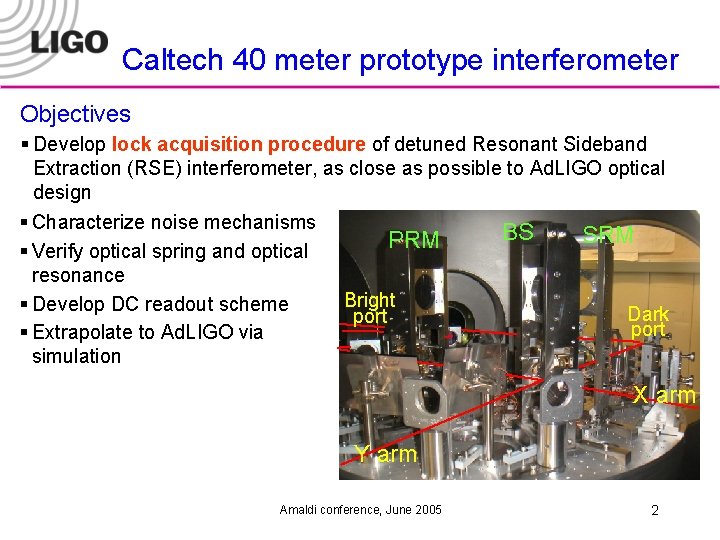
Caltech 40 meter prototype interferometer Objectives § Develop lock acquisition procedure of detuned Resonant Sideband Extraction (RSE) interferometer, as close as possible to Ad. LIGO optical design § Characterize noise mechanisms BS SRM PRM § Verify optical spring and optical resonance Bright § Develop DC readout scheme Dark port § Extrapolate to Ad. LIGO via simulation X arm Y arm Amaldi conference, June 2005 2
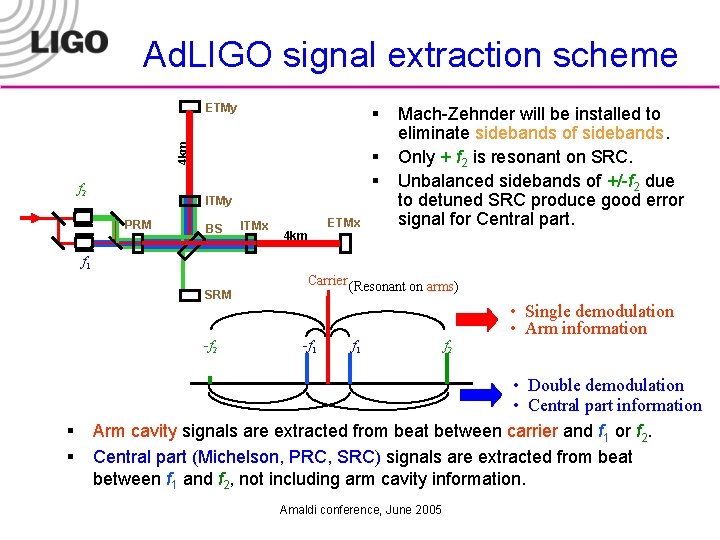
Ad. LIGO signal extraction scheme ETMy 4 km § f 2 § § ITMy PRM BS ITMx 4 km ETMx Mach-Zehnder will be installed to eliminate sidebands of sidebands. Only + f 2 is resonant on SRC. Unbalanced sidebands of +/-f 2 due to detuned SRC produce good error signal for Central part. f 1 SRM -f 2 § § Carrier (Resonant on arms) -f 1 f 2 • Single demodulation • Arm information • Double demodulation • Central part information Arm cavity signals are extracted from beat between carrier and f 1 or f 2. Central part (Michelson, PRC, SRC) signals are extracted from beat between f 1 and f 2, not including arm cavity information. Amaldi conference, June 2005
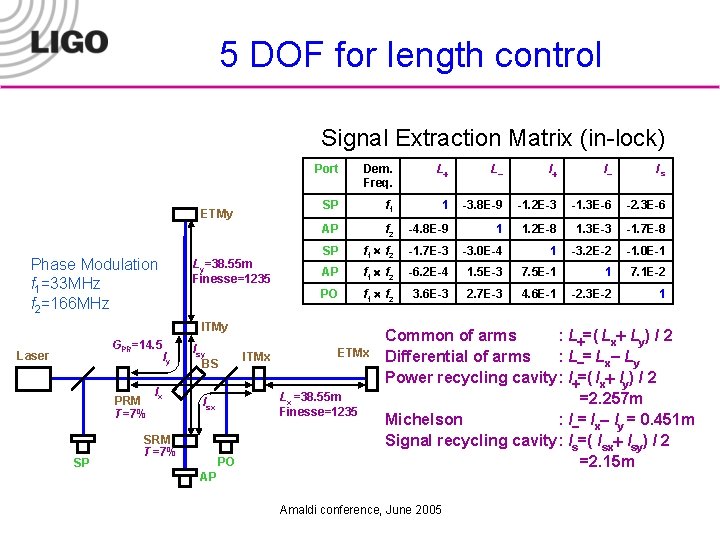
5 DOF for length control Signal Extraction Matrix (in-lock) ETMy Phase Modulation f 1=33 MHz f 2=166 MHz Ly=38. 55 m Finesse=1235 Port Dem. Freq. L L l l ls SP f 1 1 -3. 8 E-9 -1. 2 E-3 -1. 3 E-6 -2. 3 E-6 AP f 2 -4. 8 E-9 1 1. 2 E-8 1. 3 E-3 -1. 7 E-8 SP f 1 f 2 -1. 7 E-3 -3. 0 E-4 1 -3. 2 E-2 -1. 0 E-1 AP f 1 f 2 -6. 2 E-4 1. 5 E-3 7. 5 E-1 1 7. 1 E-2 PO f 1 f 2 3. 6 E-3 2. 7 E-3 4. 6 E-1 -2. 3 E-2 1 ITMy GPR=14. 5 Laser PRM T =7% SP ly lx lsy BS PO AP ETMx Lx =38. 55 m Finesse=1235 lsx SRM T =7% ITMx Common of arms : L =( Lx Ly) / 2 Differential of arms : L = Lx Ly Power recycling cavity : l =( lx ly) / 2 =2. 257 m Michelson : l = lx ly = 0. 451 m Signal recycling cavity : ls=( lsx lsy) / 2 =2. 15 m Amaldi conference, June 2005
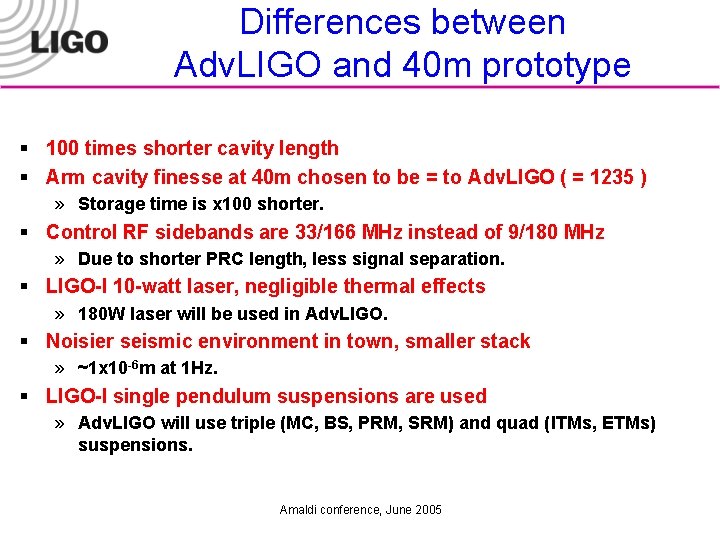
Differences between Adv. LIGO and 40 m prototype § 100 times shorter cavity length § Arm cavity finesse at 40 m chosen to be = to Adv. LIGO ( = 1235 ) » Storage time is x 100 shorter. § Control RF sidebands are 33/166 MHz instead of 9/180 MHz » Due to shorter PRC length, less signal separation. § LIGO-I 10 -watt laser, negligible thermal effects » 180 W laser will be used in Adv. LIGO. § Noisier seismic environment in town, smaller stack » ~1 x 10 -6 m at 1 Hz. § LIGO-I single pendulum suspensions are used » Adv. LIGO will use triple (MC, BS, PRM, SRM) and quad (ITMs, ETMs) suspensions. Amaldi conference, June 2005
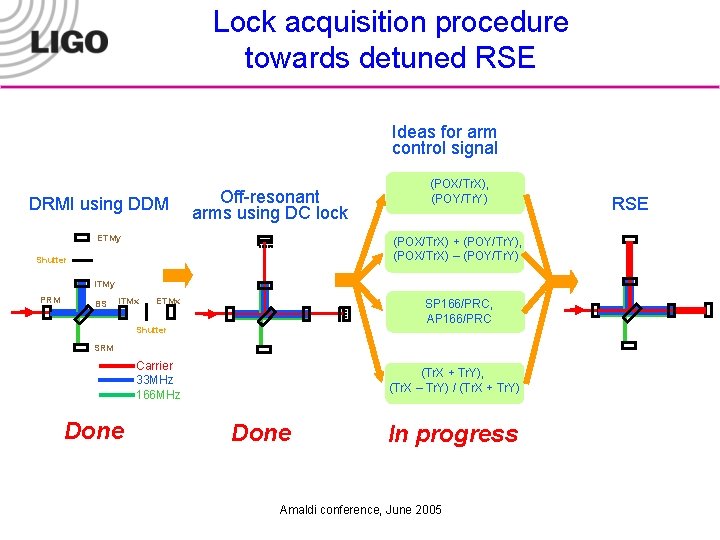
Lock acquisition procedure towards detuned RSE Ideas for arm control signal DRMI using DDM Off-resonant arms using DC lock ETMy (POX/Tr. X), (POY/Tr. Y) (POX/Tr. X) + (POY/Tr. Y), (POX/Tr. X) – (POY/Tr. Y) Shutter ITMy PRM BS ITMx ETMx SP 166/PRC, AP 166/PRC Shutter SRM Carrier 33 MHz 166 MHz Done (Tr. X + Tr. Y), (Tr. X – Tr. Y) / (Tr. X + Tr. Y) Done In progress Amaldi conference, June 2005 RSE
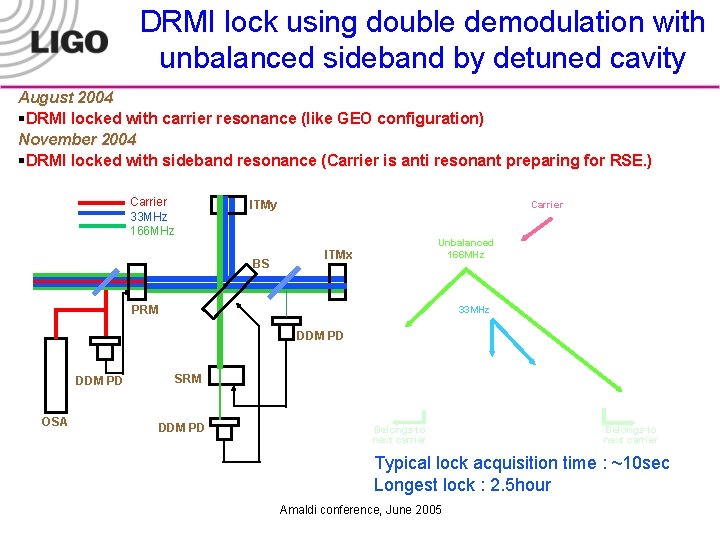
DRMI lock using double demodulation with unbalanced sideband by detuned cavity August 2004 §DRMI locked with carrier resonance (like GEO configuration) November 2004 §DRMI locked with sideband resonance (Carrier is anti resonant preparing for RSE. ) Carrier 33 MHz 166 MHz ITMy BS Carrier Unbalanced 166 MHz ITMx PRM 33 MHz DDM PD OSA SRM DDM PD Belongs to next carrier Typical lock acquisition time : ~10 sec Longest lock : 2. 5 hour Amaldi conference, June 2005
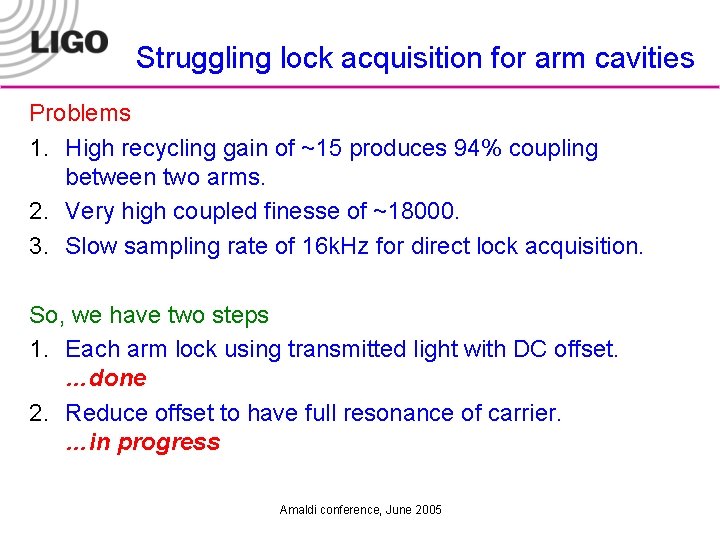
Struggling lock acquisition for arm cavities Problems 1. High recycling gain of ~15 produces 94% coupling between two arms. 2. Very high coupled finesse of ~18000. 3. Slow sampling rate of 16 k. Hz for direct lock acquisition. So, we have two steps 1. Each arm lock using transmitted light with DC offset. …done 2. Reduce offset to have full resonance of carrier. …in progress Amaldi conference, June 2005
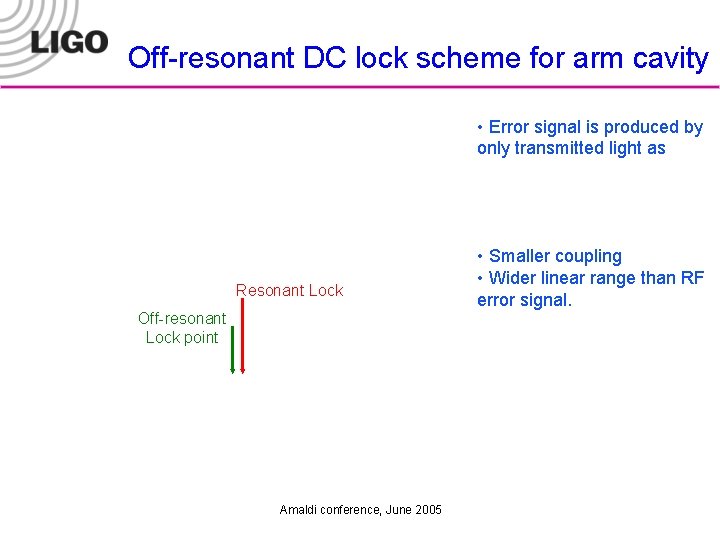
Off-resonant DC lock scheme for arm cavity • Error signal is produced by only transmitted light as Resonant Lock Off-resonant Lock point Amaldi conference, June 2005 • Smaller coupling • Wider linear range than RF error signal.
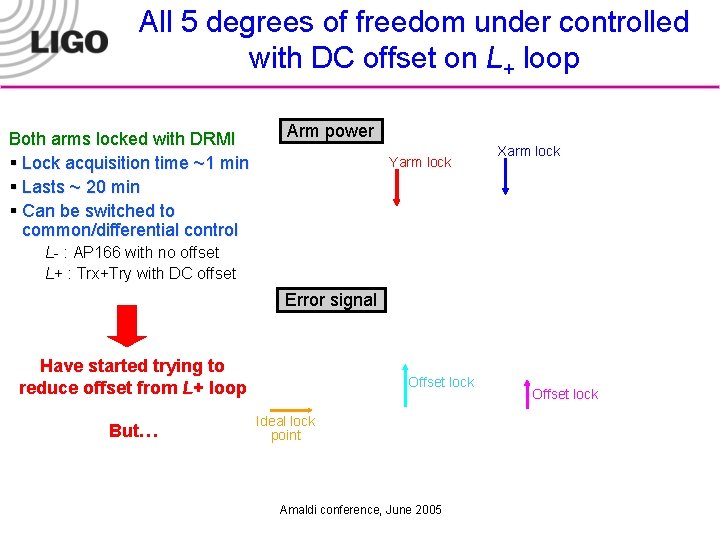
All 5 degrees of freedom under controlled with DC offset on L+ loop Both arms locked with DRMI § Lock acquisition time ~1 min § Lasts ~ 20 min § Can be switched to common/differential control Arm power Yarm lock Xarm lock L- : AP 166 with no offset L+ : Trx+Try with DC offset Error signal Have started trying to reduce offset from L+ loop But… Offset lock Ideal lock point Amaldi conference, June 2005 Offset lock
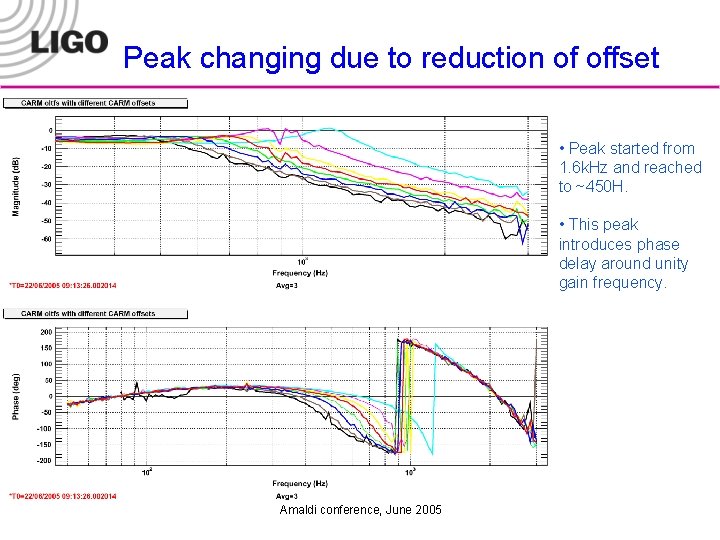
Peak changing due to reduction of offset • Peak started from 1. 6 k. Hz and reached to ~450 H. • This peak introduces phase delay around unity gain frequency. Amaldi conference, June 2005
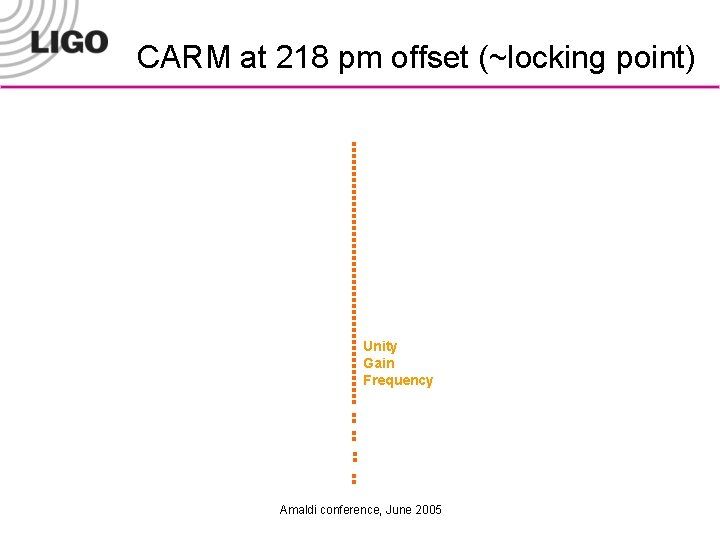
CARM at 218 pm offset (~locking point) Unity Gain Frequency Amaldi conference, June 2005
CARM at 118 pm offset Unity Gain Frequency Amaldi conference, June 2005
CARM offset at 59 pm (losing lock) Unity Gain Frequency Amaldi conference, June 2005
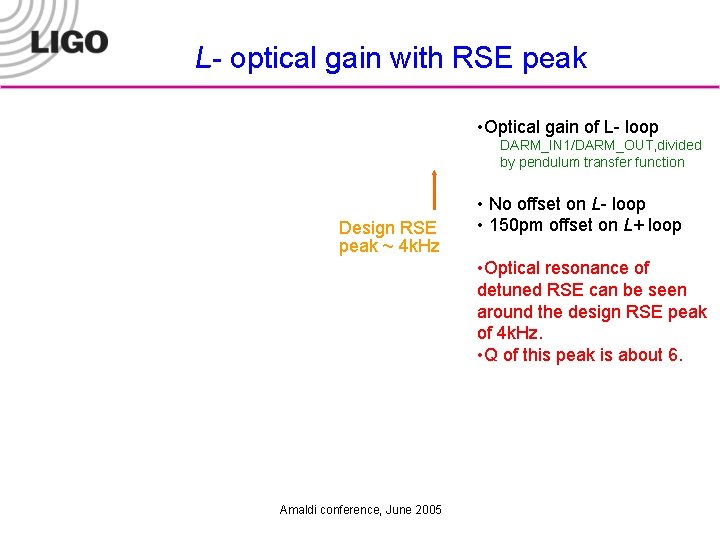
L- optical gain with RSE peak • Optical gain of L- loop DARM_IN 1/DARM_OUT, divided by pendulum transfer function Design RSE peak ~ 4 k. Hz • No offset on L- loop • 150 pm offset on L+ loop • Optical resonance of detuned RSE can be seen around the design RSE peak of 4 k. Hz. • Q of this peak is about 6. Amaldi conference, June 2005
DARM, operating point Amaldi conference, June 2005
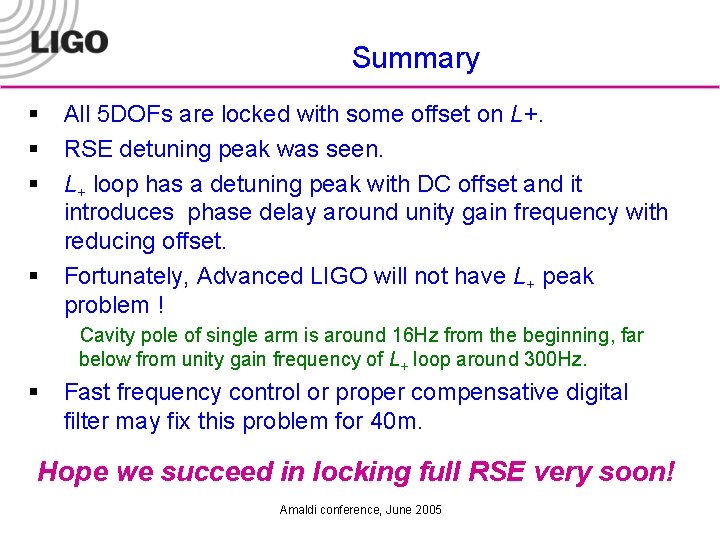
Summary § § All 5 DOFs are locked with some offset on L+. RSE detuning peak was seen. L+ loop has a detuning peak with DC offset and it introduces phase delay around unity gain frequency with reducing offset. Fortunately, Advanced LIGO will not have L+ peak problem ! Cavity pole of single arm is around 16 Hz from the beginning, far below from unity gain frequency of L+ loop around 300 Hz. § Fast frequency control or proper compensative digital filter may fix this problem for 40 m. Hope we succeed in locking full RSE very soon! Amaldi conference, June 2005
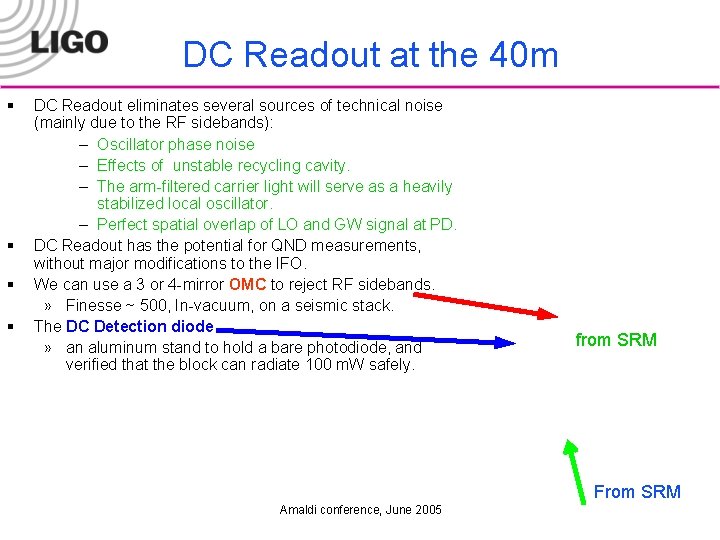
DC Readout at the 40 m § § DC Readout eliminates several sources of technical noise (mainly due to the RF sidebands): – Oscillator phase noise – Effects of unstable recycling cavity. – The arm-filtered carrier light will serve as a heavily stabilized local oscillator. – Perfect spatial overlap of LO and GW signal at PD. DC Readout has the potential for QND measurements, without major modifications to the IFO. We can use a 3 or 4 -mirror OMC to reject RF sidebands. » Finesse ~ 500, In-vacuum, on a seismic stack. The DC Detection diode » an aluminum stand to hold a bare photodiode, and verified that the block can radiate 100 m. W safely. from SRM From SRM Amaldi conference, June 2005