
Localizing Vocalizations in fisheating southern resident killer whales

- Slides: 22
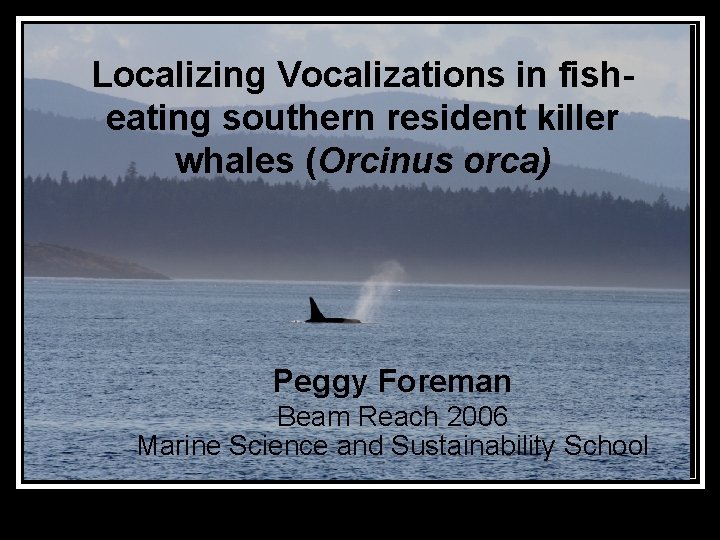
Localizing Vocalizations in fisheating southern resident killer whales (Orcinus orca) Peggy Foreman Beam Reach 2006 Marine Science and Sustainability School
Social Arrangements • Pod- primary social unit of matrilineal groups • Subpods and matrilines (J, K, and L) • Communities- frequent associations with one or more pods, yet have different distributions with other communities (J + K + L) • Clans- acoustically related; shared vocal tradition (J clan)
Vocal Clans • Complex repertoire of whistles, clicks, and calls • Calls are pulsed signals generated in high repetition rates and most fall into discrete categories • These discrete calls are the most common sound type when individuals are widely spread out (cohesion)
Gender • 86 whales (~14 sexually mature males and ~23 reproductive females) • Sexual dimorphism • Predict lower frequency fundamental for males • May spatially segregate to some degree when foraging • Shorter duration of calls • Changes in harmonic frequency
Questions • Are there any variations in calls in regards to gender? Call Characteristics: Call duration, Fundamental Frequency, and variations in the first harmonic of a call
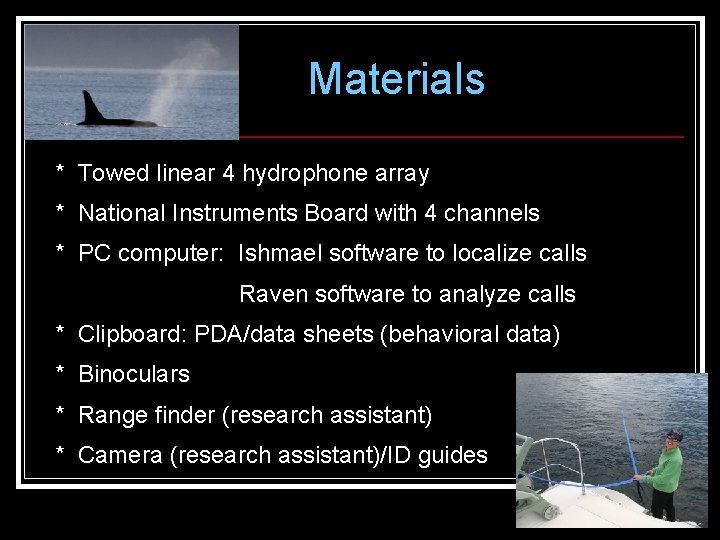
Materials * Towed linear 4 hydrophone array * National Instruments Board with 4 channels * PC computer: Ishmael software to localize calls Raven software to analyze calls * Clipboard: PDA/data sheets (behavioral data) * Binoculars * Range finder (research assistant) * Camera (research assistant)/ID guides
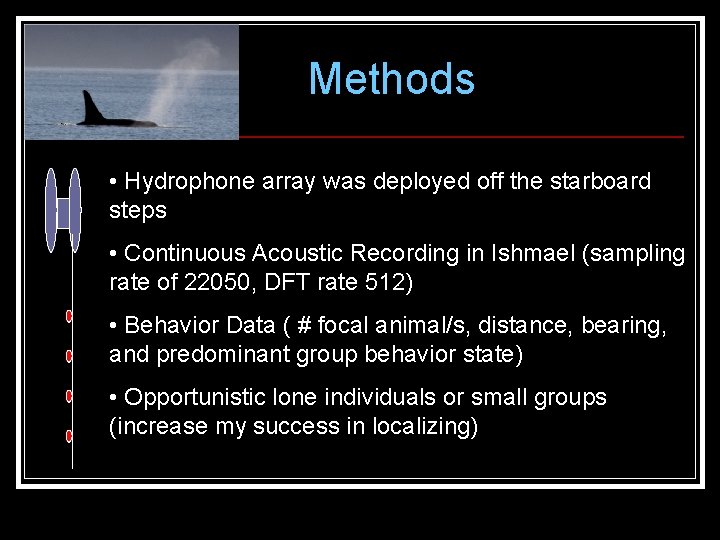
Methods • Hydrophone array was deployed off the starboard steps • Continuous Acoustic Recording in Ishmael (sampling rate of 22050, DFT rate 512) • Behavior Data ( # focal animal/s, distance, bearing, and predominant group behavior state) • Opportunistic lone individuals or small groups (increase my success in localizing)
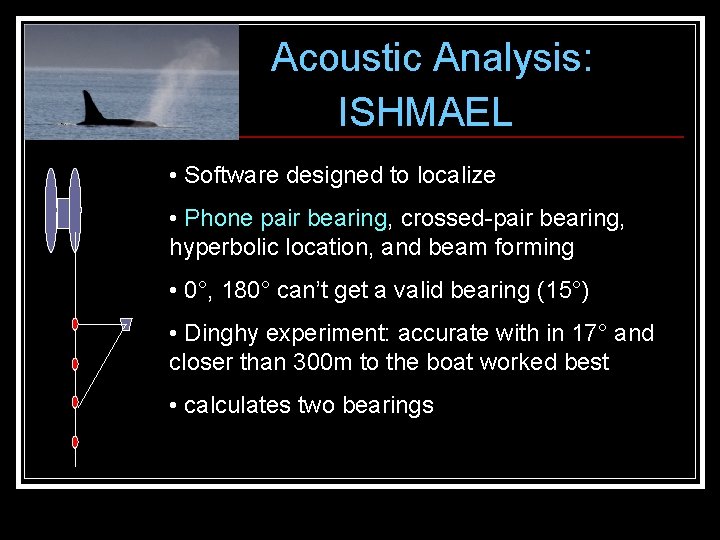
Acoustic Analysis: ISHMAEL • Software designed to localize • Phone pair bearing, crossed-pair bearing, hyperbolic location, and beam forming • 0°, 180° can’t get a valid bearing (15°) • Dinghy experiment: accurate with in 17° and closer than 300 m to the boat worked best • calculates two bearings
Acoustic Analysis: ISHMAEL
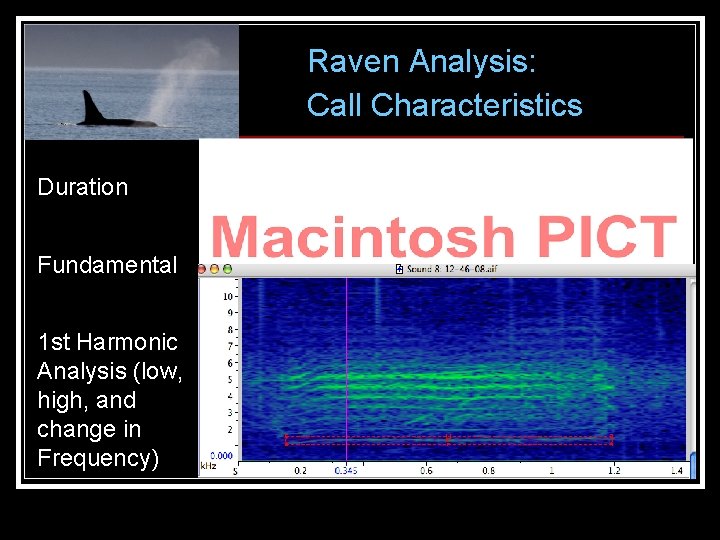
Raven Analysis: Call Characteristics Duration Fundamental 1 st Harmonic Analysis (low, high, and change in Frequency)
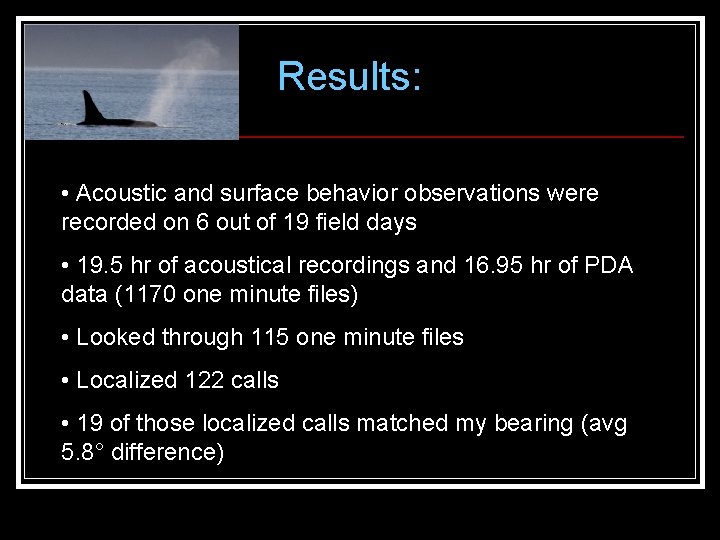
Results: • Acoustic and surface behavior observations were recorded on 6 out of 19 field days • 19. 5 hr of acoustical recordings and 16. 95 hr of PDA data (1170 one minute files) • Looked through 115 one minute files • Localized 122 calls • 19 of those localized calls matched my bearing (avg 5. 8° difference)
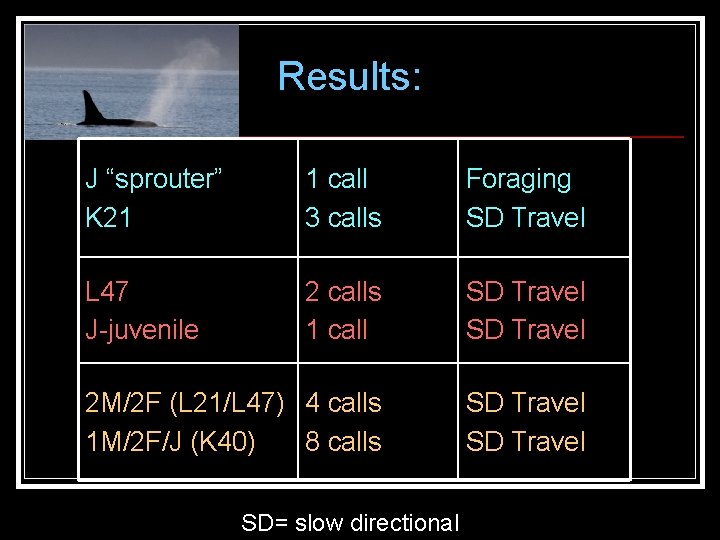
Results: J “sprouter” K 21 1 call 3 calls Foraging SD Travel L 47 J-juvenile 2 calls 1 call SD Travel 2 M/2 F (L 21/L 47) 4 calls 1 M/2 F/J (K 40) 8 calls SD Travel SD= slow directional
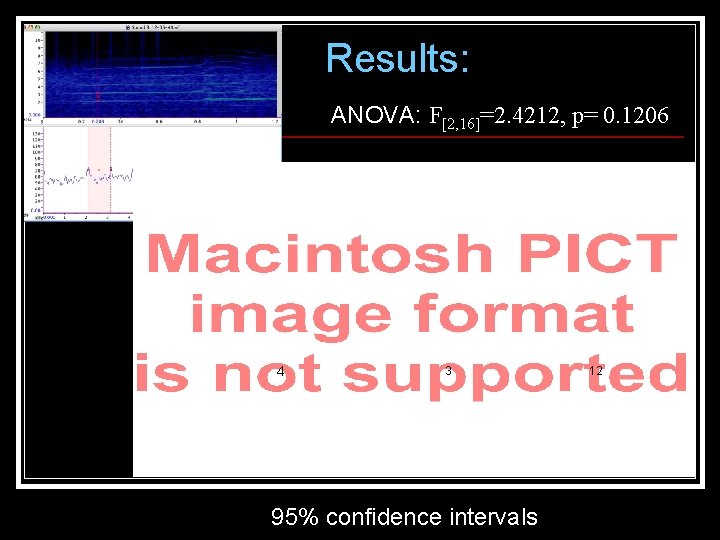
Results: ANOVA: F[2, 16]=2. 4212, p= 0. 1206 4 3 95% confidence intervals 12
Results: ANOVA: F[2, 16]=1. 8183, p= 0. 1943 4 3 12
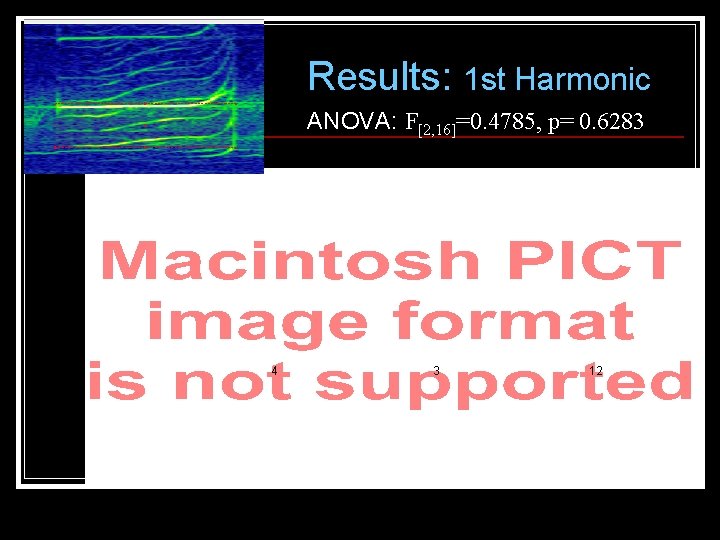
Results: 1 st Harmonic ANOVA: F[2, 16]=0. 4785, p= 0. 6283 4 3 12
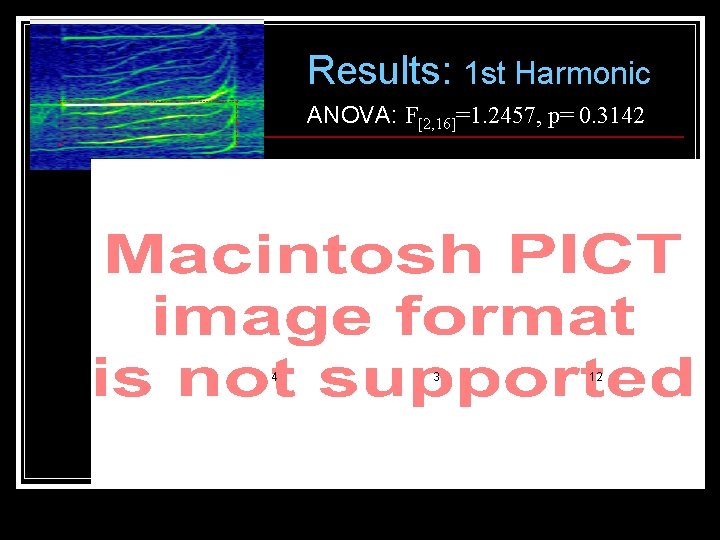
Results: 1 st Harmonic ANOVA: F[2, 16]=1. 2457, p= 0. 3142 4 3 12
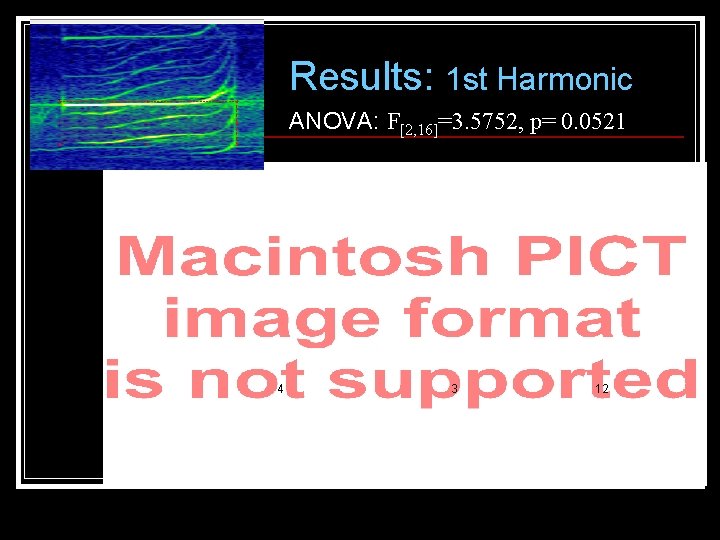
Results: 1 st Harmonic ANOVA: F[2, 16]=3. 5752, p= 0. 0521 4 12 3 4 3 12
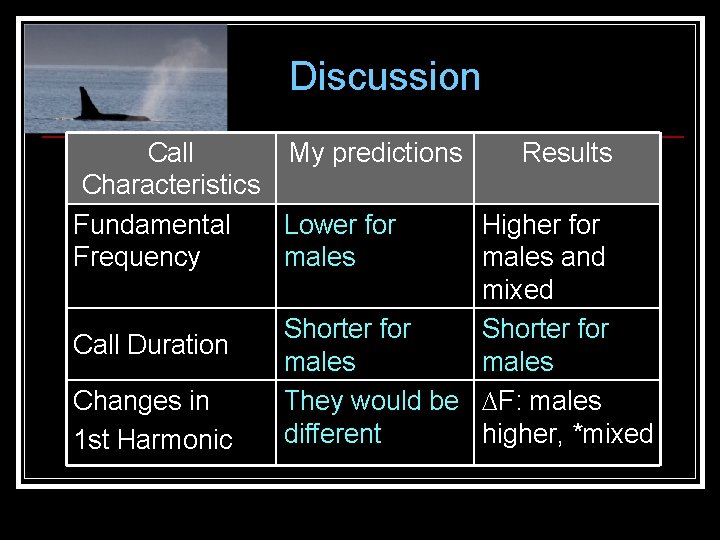
Discussion Call My predictions Results Characteristics Fundamental Lower for Higher for Frequency males and mixed Shorter for Call Duration males Changes in They would be ∆F: males different higher, *mixed 1 st Harmonic
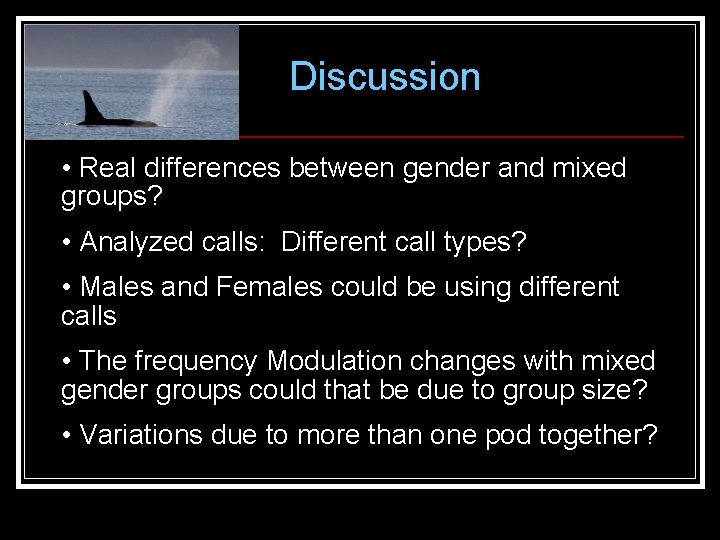
Discussion • Real differences between gender and mixed groups? • Analyzed calls: Different call types? • Males and Females could be using different calls • The frequency Modulation changes with mixed gender groups could that be due to group size? • Variations due to more than one pod together?
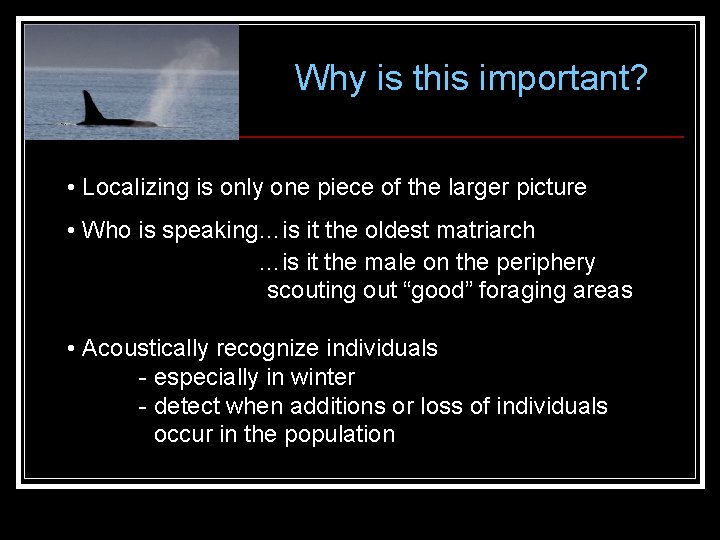
Why is this important? • Localizing is only one piece of the larger picture • Who is speaking…is it the oldest matriarch …is it the male on the periphery scouting out “good” foraging areas • Acoustically recognize individuals - especially in winter - detect when additions or loss of individuals occur in the population
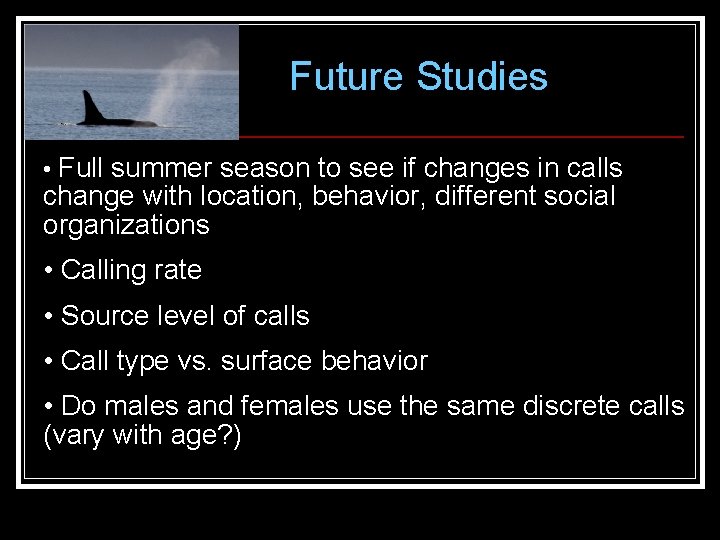
Future Studies • Full summer season to see if changes in calls change with location, behavior, different social organizations • Calling rate • Source level of calls • Call type vs. surface behavior • Do males and females use the same discrete calls (vary with age? )
Acknowledgements • Huge thank you to the instructors of Beam Reach (Jason Wood, Donna Hauser, Scott Veirs, and Val Veirs) • Beam Reach colleagues (Rena Escobedo, Emily Pierson, Erin Soucy, Colleen Barry, and Juliette Nash) • Todd, Mike, Glenn for the use and safe navigation of the Gato Verde • Puyallup Tribe of Indians for your financial support