
Localization of phonons in chains of trapped ions


- Slides: 19
Localization of phonons in chains of trapped ions Alejandro Bermúdez, Miguel Ángel Martín-Delgado and Diego Porras Department of Theoretical Physics Universidad Complutense de Madrid
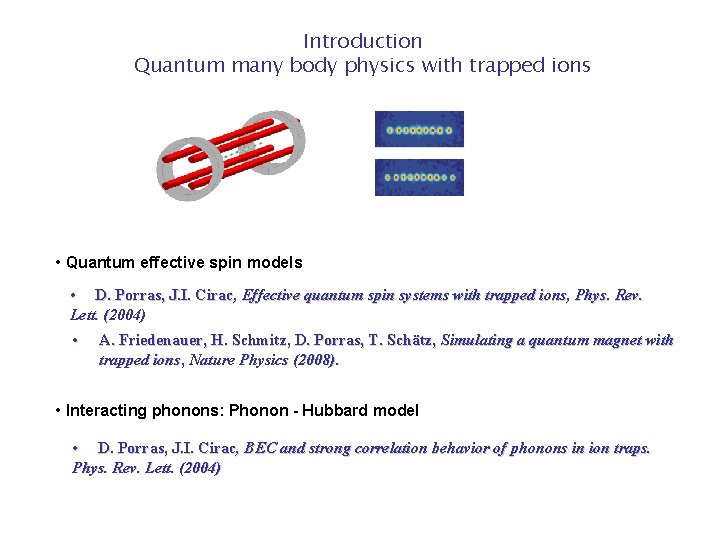
Introduction Quantum many body physics with trapped ions • Quantum effective spin models • D. Porras, J. I. Cirac, Effective quantum spin systems with trapped ions, Phys. Rev. Lett. (2004) • A. Friedenauer, H. Schmitz, D. Porras, T. Schätz, Simulating a quantum magnet with trapped ions, Nature Physics (2008). • Interacting phonons: Phonon - Hubbard model • D. Porras, J. I. Cirac, BEC and strong correlation behavior of phonons in ion traps. Phys. Rev. Lett. (2004)
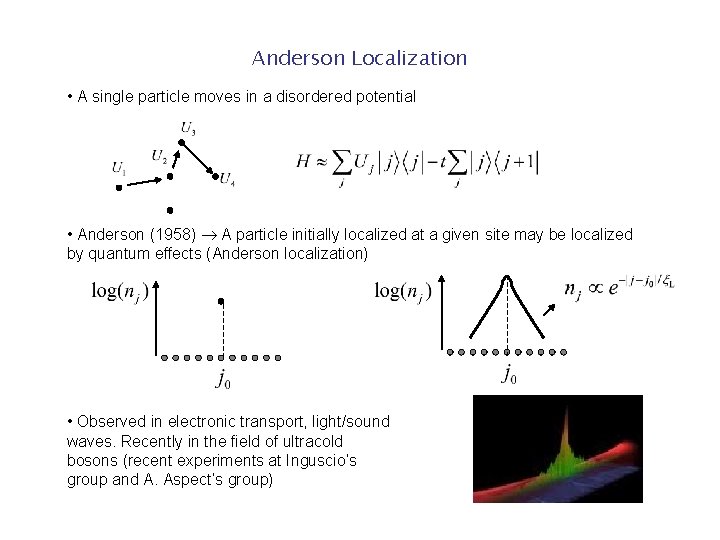
Anderson Localization • A single particle moves in a disordered potential • Anderson (1958) A particle initially localized at a given site may be localized by quantum effects (Anderson localization) • Observed in electronic transport, light/sound waves. Recently in the field of ultracold bosons (recent experiments at Inguscio‘s group and A. Aspect‘s group)
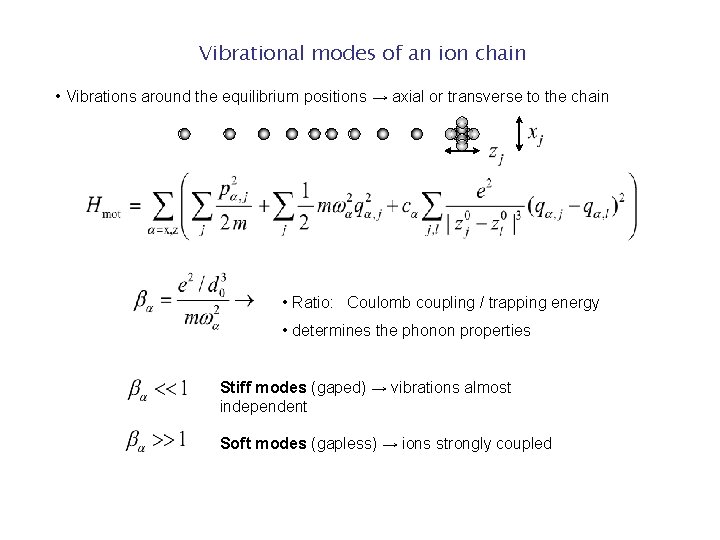
Vibrational modes of an ion chain • Vibrations around the equilibrium positions → axial or transverse to the chain • Ratio: Coulomb coupling / trapping energy • determines the phonon properties Stiff modes (gaped) → vibrations almost independent Soft modes (gapless) → ions strongly coupled
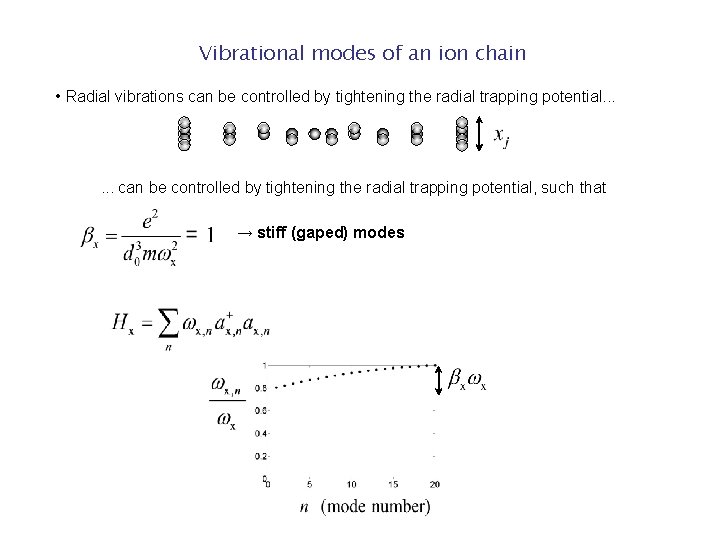
Vibrational modes of an ion chain • Radial vibrations can be controlled by tightening the radial trapping potential. . . can be controlled by tightening the radial trapping potential, such that → stiff (gaped) modes
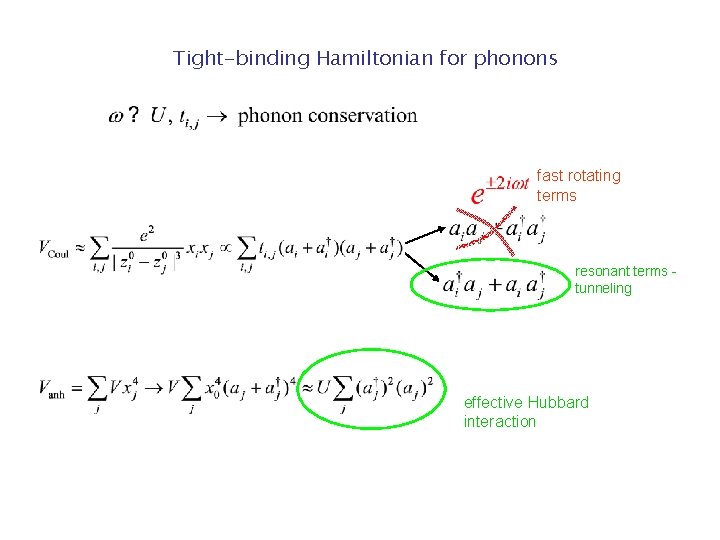
Tight-binding Hamiltonian for phonons fast rotating terms resonant terms tunneling effective Hubbard interaction
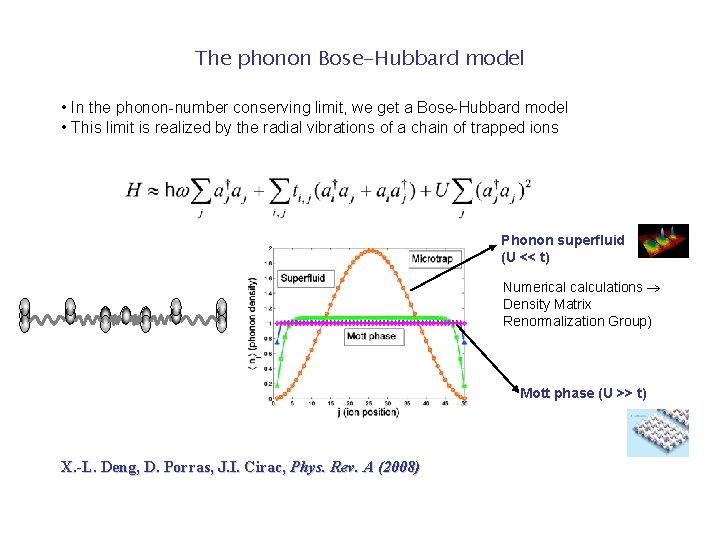
The phonon Bose-Hubbard model • In the phonon-number conserving limit, we get a Bose-Hubbard model • This limit is realized by the radial vibrations of a chain of trapped ions Phonon superfluid (U << t) Numerical calculations Density Matrix Renormalization Group) Mott phase (U >> t) X. -L. Deng, D. Porras, J. I. Cirac, Phys. Rev. A (2008)
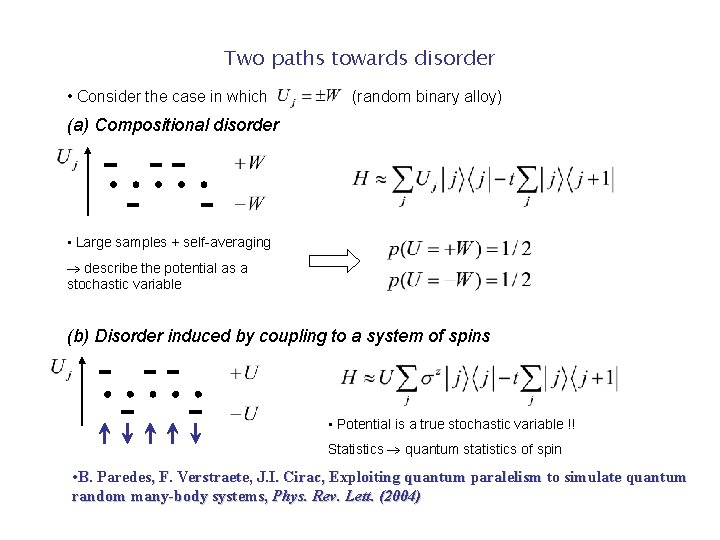
Two paths towards disorder • Consider the case in which (random binary alloy) (a) Compositional disorder • Large samples + self-averaging describe the potential as a stochastic variable (b) Disorder induced by coupling to a system of spins • Potential is a true stochastic variable !! Statistics quantum statistics of spin • B. Paredes, F. Verstraete, J. I. Cirac, Exploiting quantum paralelism to simulate quantum random many-body systems, Phys. Rev. Lett. (2004)
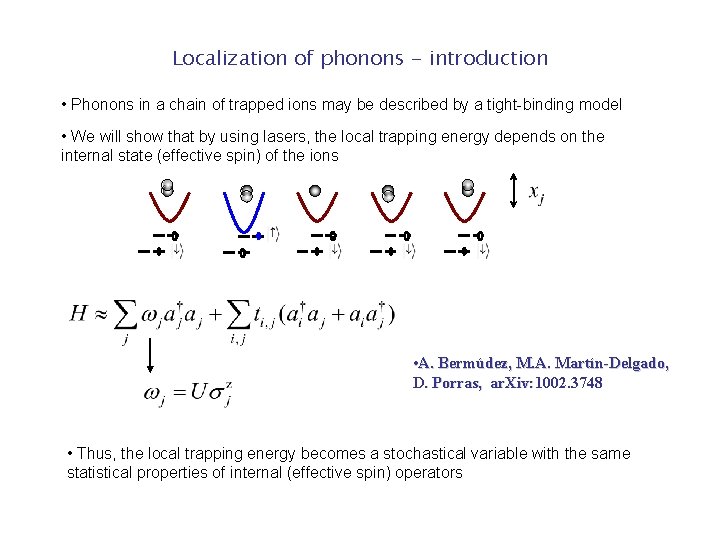
Localization of phonons - introduction • Phonons in a chain of trapped ions may be described by a tight-binding model • We will show that by using lasers, the local trapping energy depends on the internal state (effective spin) of the ions • A. Bermúdez, M. A. Martín-Delgado, D. Porras, ar. Xiv: 1002. 3748 • Thus, the local trapping energy becomes a stochastical variable with the same statistical properties of internal (effective spin) operators
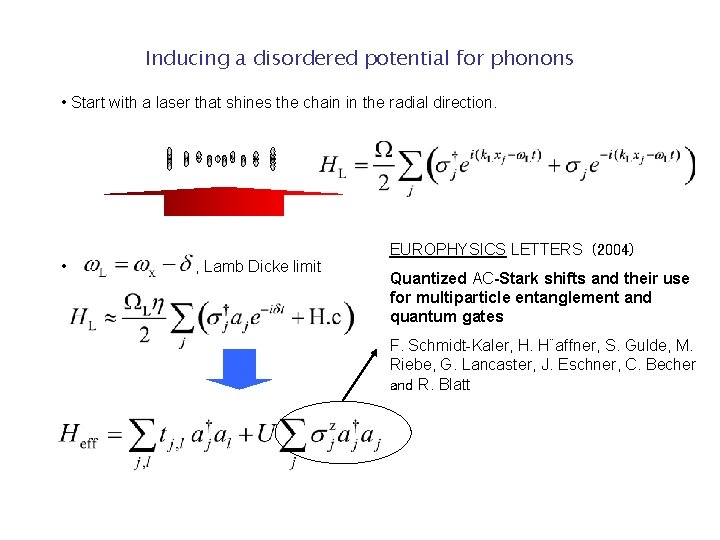
Inducing a disordered potential for phonons • Start with a laser that shines the chain in the radial direction. • , Lamb Dicke limit EUROPHYSICS LETTERS (2004) Quantized AC-Stark shifts and their use for multiparticle entanglement and quantum gates F. Schmidt-Kaler, H. H¨affner, S. Gulde, M. Riebe, G. Lancaster, J. Eschner, C. Becher and R. Blatt
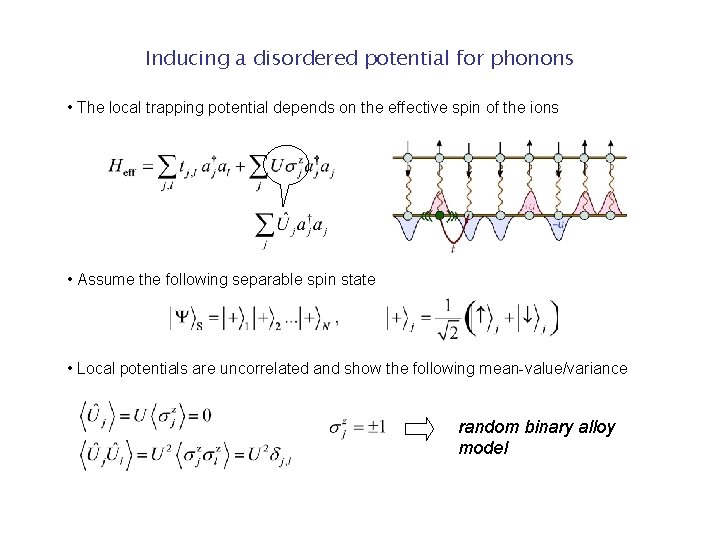
Inducing a disordered potential for phonons • The local trapping potential depends on the effective spin of the ions • Assume the following separable spin state • Local potentials are uncorrelated and show the following mean-value/variance random binary alloy model
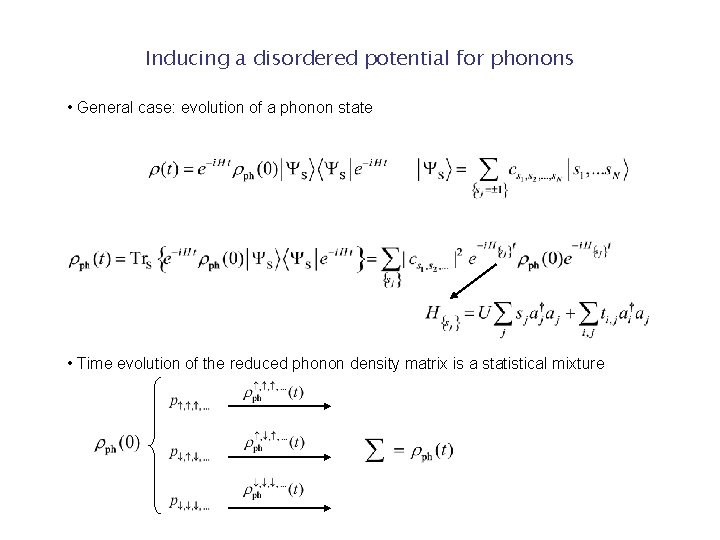
Inducing a disordered potential for phonons • General case: evolution of a phonon state • Time evolution of the reduced phonon density matrix is a statistical mixture
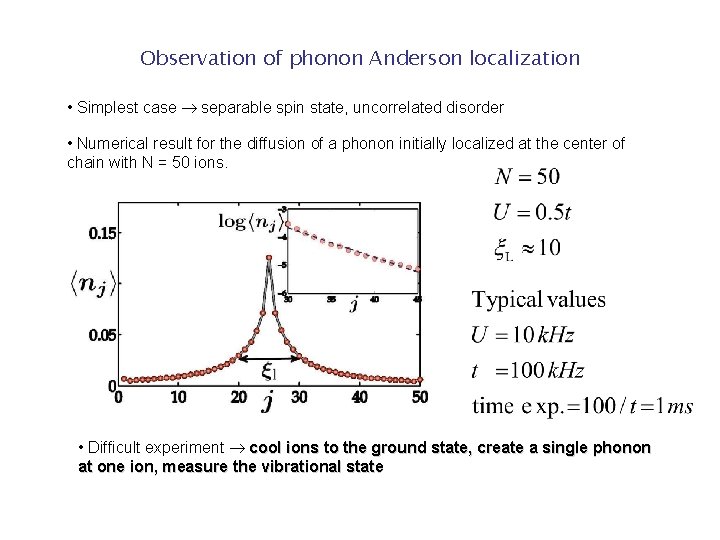
Observation of phonon Anderson localization • Simplest case separable spin state, uncorrelated disorder • Numerical result for the diffusion of a phonon initially localized at the center of chain with N = 50 ions. • Difficult experiment cool ions to the ground state, create a single phonon at one ion, measure the vibrational state
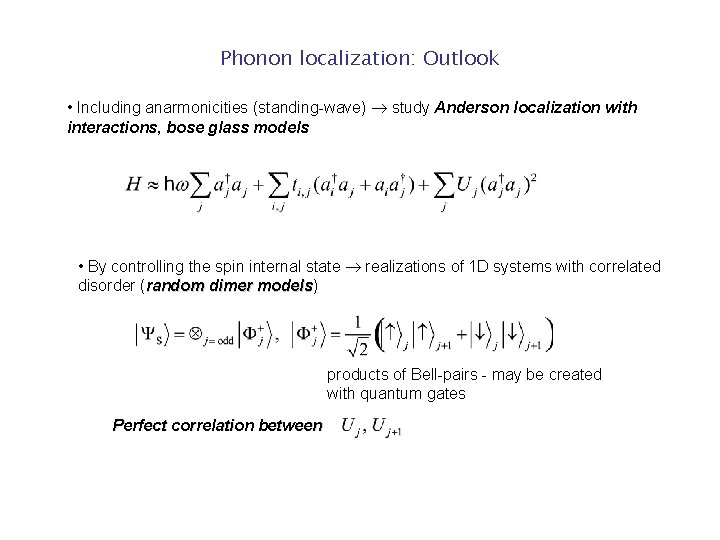
Phonon localization: Outlook • Including anarmonicities (standing-wave) study Anderson localization with interactions, bose glass models • By controlling the spin internal state realizations of 1 D systems with correlated disorder (random dimer models) models products of Bell-pairs - may be created with quantum gates Perfect correlation between
Thanks for your attention
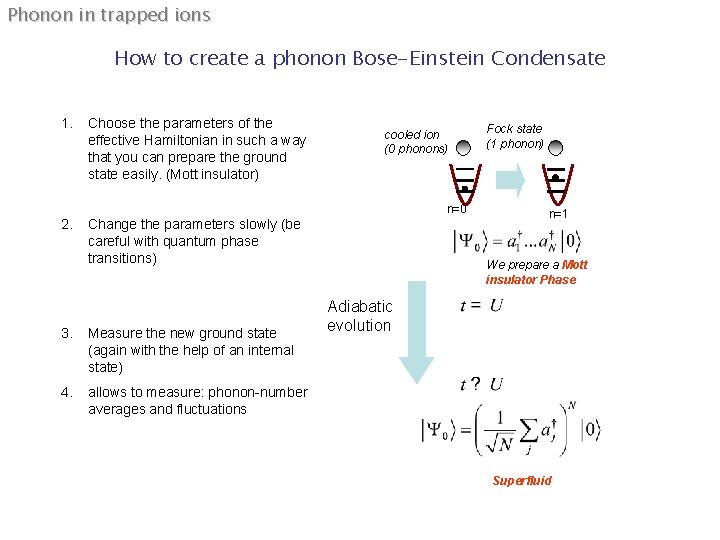
Phonon in trapped ions How to create a phonon Bose-Einstein Condensate 1. Choose the parameters of the effective Hamiltonian in such a way that you can prepare the ground state easily. (Mott insulator) cooled ion (0 phonons) n=0 2. Change the parameters slowly (be careful with quantum phase transitions) 3. Measure the new ground state (again with the help of an internal state) 4. allows to measure: phonon-number averages and fluctuations Fock state (1 phonon) n=1 We prepare a Mott insulator Phase Adiabatic evolution Superfluid
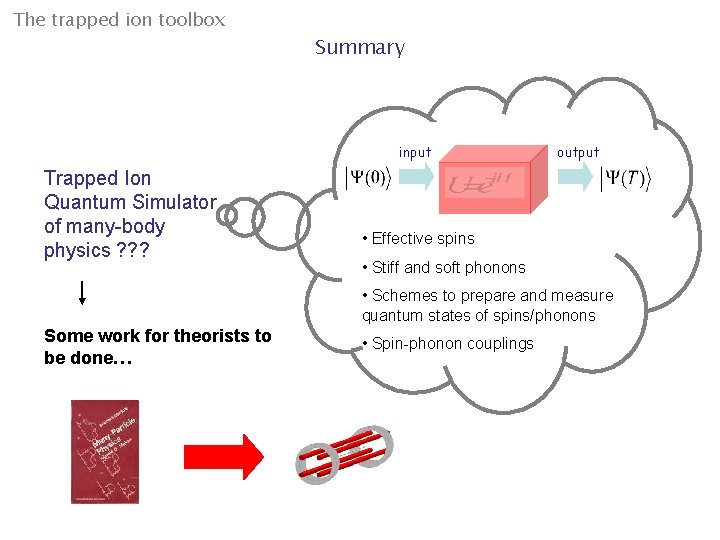
The trapped ion toolbox Summary input Trapped Ion Quantum Simulator of many-body physics ? ? ? output • Effective spins • Stiff and soft phonons • Schemes to prepare and measure quantum states of spins/phonons Some work for theorists to be done… • Spin-phonon couplings
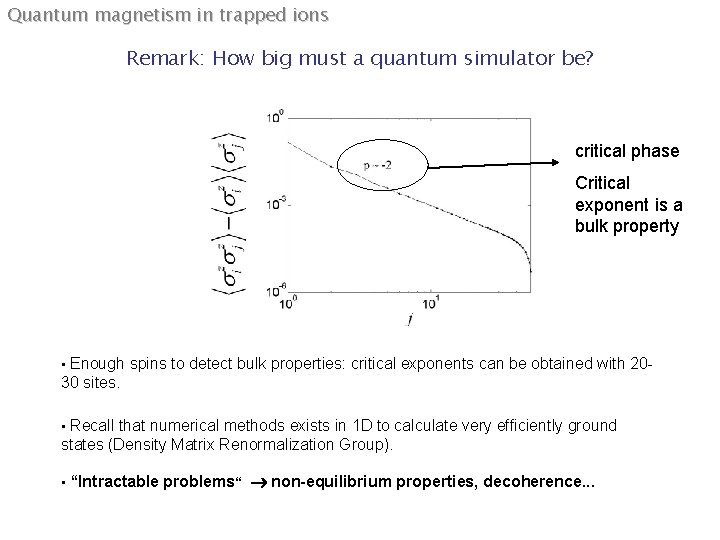
Quantum magnetism in trapped ions Remark: How big must a quantum simulator be? critical phase Critical exponent is a bulk property • Enough spins to detect bulk properties: critical exponents can be obtained with 20 - 30 sites. • Recall that numerical methods exists in 1 D to calculate very efficiently ground states (Density Matrix Renormalization Group). • “Intractable problems“ non-equilibrium properties, decoherence. . .
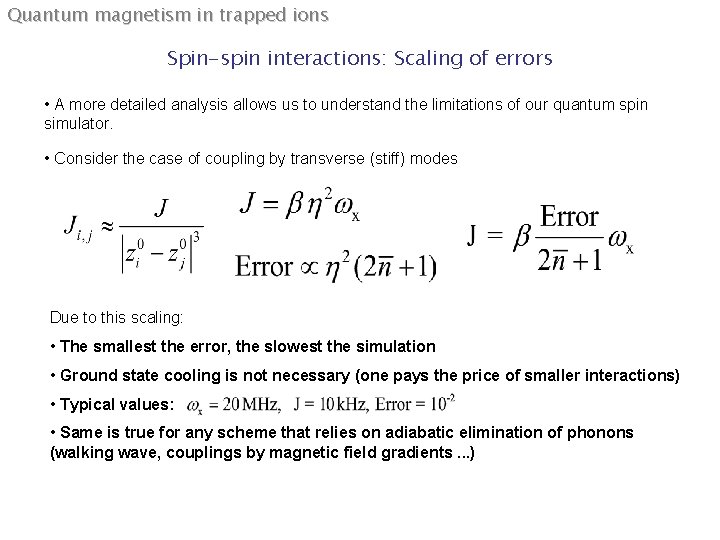
Quantum magnetism in trapped ions Spin-spin interactions: Scaling of errors • A more detailed analysis allows us to understand the limitations of our quantum spin simulator. • Consider the case of coupling by transverse (stiff) modes Due to this scaling: • The smallest the error, the slowest the simulation • Ground state cooling is not necessary (one pays the price of smaller interactions) • Typical values: • Same is true for any scheme that relies on adiabatic elimination of phonons (walking wave, couplings by magnetic field gradients. . . )