
LOCAL GOVERNMENT MANAGEMENT IMPROVEMENT MODEL LGMIM State of






- Slides: 19
LOCAL GOVERNMENT MANAGEMENT IMPROVEMENT MODEL (LGMIM) State of Management Practices in 41 Municipalities for 2016/17
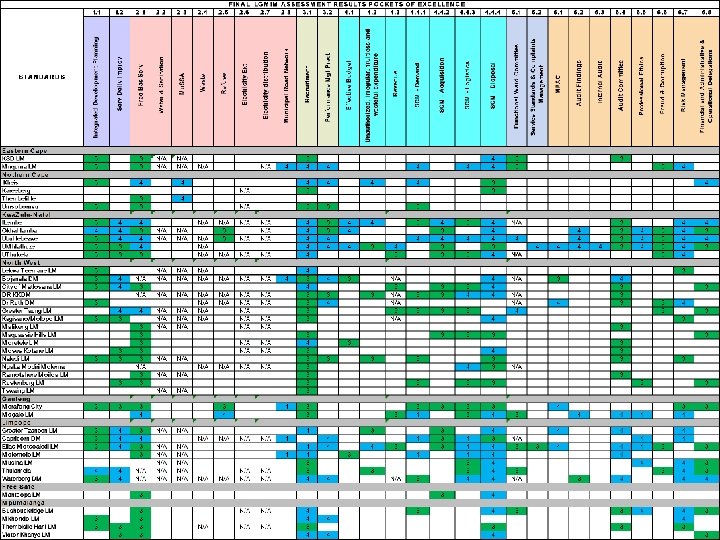
What this presentation covers: • LGMIM Concept • 216/17 Enrolments • 2016/17 Heat maps • LGMIM findings per KPA • Improvement Planning • 2017/18 enrolments • Conclusion 2
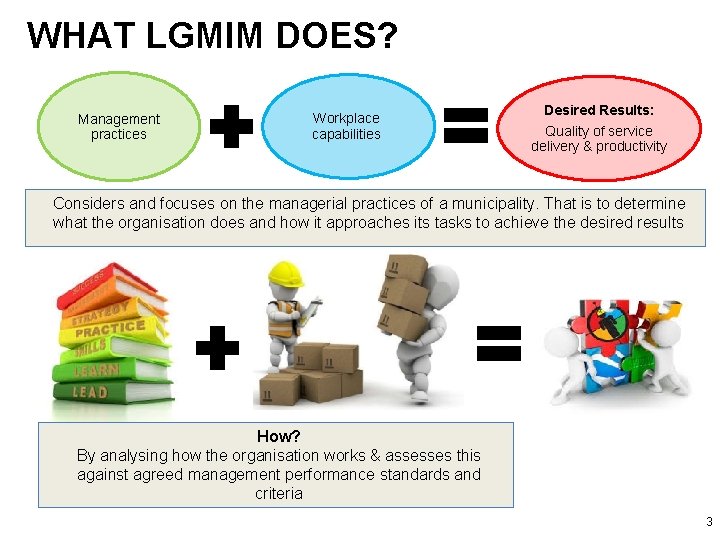
WHAT LGMIM DOES? Management practices Workplace capabilities Desired Results: Quality of service delivery & productivity Considers and focuses on the managerial practices of a municipality. That is to determine what the organisation does and how it approaches its tasks to achieve the desired results How? By analysing how the organisation works & assesses this against agreed management performance standards and criteria 3
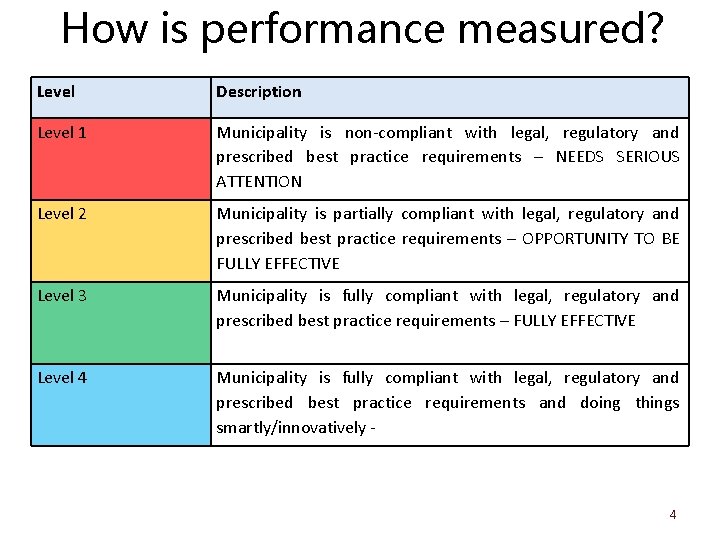
How is performance measured? Level Description Level 1 Municipality is non-compliant with legal, regulatory and prescribed best practice requirements – NEEDS SERIOUS ATTENTION Level 2 Municipality is partially compliant with legal, regulatory and prescribed best practice requirements – OPPORTUNITY TO BE FULLY EFFECTIVE Level 3 Municipality is fully compliant with legal, regulatory and prescribed best practice requirements – FULLY EFFECTIVE Level 4 Municipality is fully compliant with legal, regulatory and prescribed best practice requirements and doing things smartly/innovatively - 4
The LGMIM Journey LGMIM launch Improve Feedback Self assessment Moderation 5
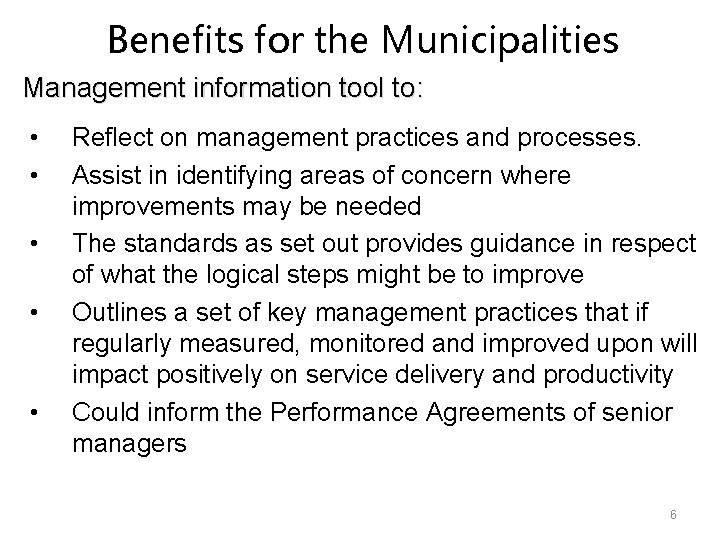
Benefits for the Municipalities Management information tool to: • • • Reflect on management practices and processes. Assist in identifying areas of concern where improvements may be needed The standards as set out provides guidance in respect of what the logical steps might be to improve Outlines a set of key management practices that if regularly measured, monitored and improved upon will impact positively on service delivery and productivity Could inform the Performance Agreements of senior managers 6
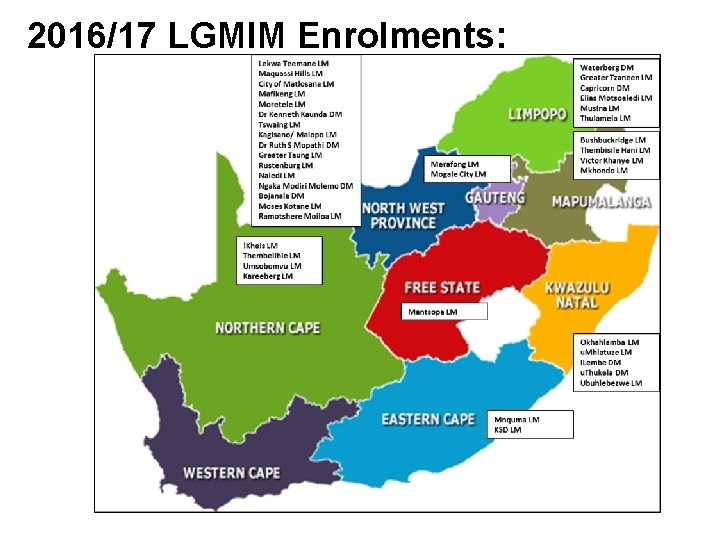
2016/17 LGMIM Enrolments:
KPA 1: INTEGRATED DEVELOPMENT PLANNING AND IMPLEMENTATION This KPA comprises of two standards namely: • Standard 1. 1: • Standard 1. 2: Reporting Integrated Development Planning Service Delivery Implementation, Monitoring and
KPA 2: SERVICE DELIVERY The Service Delivery KPA is monitored through eight standards dealing with the planning, project packaging, budgeting and monitoring of: • • Standard 2. 1: Standard 2. 2: Standard 2. 3: Standard 2. 4: Standard 2. 5: Standard 2. 6: Standard 2. 7: Standard 2. 8: Access to free basic services Extension of water and sanitation services/facilities (only 22 of the 41 municipalities are WSAs) Moderated Performance against Municipal Strategic Self-assessment (Mu. SSA) Waste handling Refuse removal Extension of electricity Distribution, operation, maintenance and refurbishment of the municipal electricity infrastructure Municipal road system
KPA 3: HUMAN RESOURCE DEVELOPMENT The Human Resource Management KPA is monitored through two standards: • Standard 3. 1: Application of Prescribed Recruitment Practices • Standard 3. 2: Implementation of prescribed Performance Management Practices for the Municipal Manager (MM) and Section 56 Managers (Managers reporting directly to the MM).
KPA 4: FINANCIAL MANAGEMENT The Financial Management KPA is monitored through seven standards dealing with: • • Effective Budget Planning and Management of Unauthorised, Irregular and/or Fruitless and Wasteful Expenditure Revenue Management SCM: Demand Management SCM: Acquisition Management SCM: Logistics Management SCM: Disposal Management
KPA 5: COMMUNITY ENGAGEMENT/PARTICIPATION The Community engagement/participation KPA is monitored through two standards: • Standard 5. 1: • Standard 5. 2: Functional Ward Committees Service Standards and Complaints Management respectively
KPA 6: GOVERNANCE The Governance KPA is monitored through eight standards dealing with: • • Assessment of Accountability Mechanisms: MPAC Assessment of responses to External Audit Findings Assessment of Internal Audit Assessment of the Audit Committee Assessment of Policies and Systems to ensure Professional Ethics Prevention and combatting of Fraud and Corruption Risk Management Administrative and Financial Delegations
Improvement Planning • Completing an assessment is just one step in the LGMIM process. Key is how the assessment is used to identify the root causes of the underperformance and what must be done by who and when to address the root causes • DPME has designed an improvement planning guide and provides training for municipalities and provinces on how to prepare an improvement plan using the LGMIM assessment results. • In addition, DPME is directly working with 5 municipalities; 4 of whom have completed their improvement plans. Implementation is being monitored by the provincial Co. GTA and DPME • Our expectation is that all participating provinces support municipalities to develop improvement plans. However, not all provinces have been forthcoming in this regard.
Improvement planning process flow
Conclusion • Dedicated managers and leaders value organisational assessments and diagnostics as a source of valuable insights into the health of their organisations. • For the benefit and potential of LGMIM to be realised, municipalities must be willing to utilise the results of the LGMIM as critical management information and develop improvement action plans and strategies in the areas where performance gaps were observed. • Provincial departments responsible for Local Government for their part will have to step up their involvement and support municipalities in this regard. Should the above requirements be met, indications are that the LGMIM can serve as a powerful management information tool for the municipal leadership to reflect on how the municipality approaches its tasks in key management areas with a view to shaping management and administrative practices to deliver quality services.
Ke ya leboga Ke a leboha Ke a leboga Ngiyabonga Ndiyabulela Ngiyathokoza Ngiyabonga Inkomu Ndi khou livhuha Thank you Dankie 19