
Local Government in Texas The County System Texas
- Slides: 9
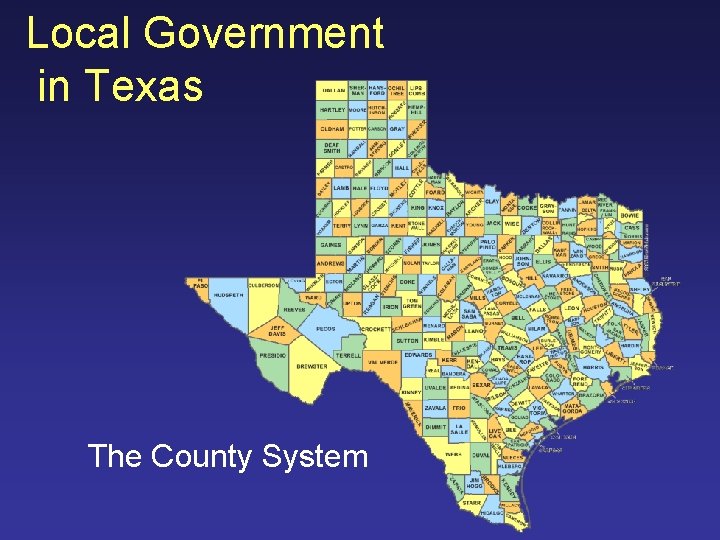
Local Government in Texas The County System
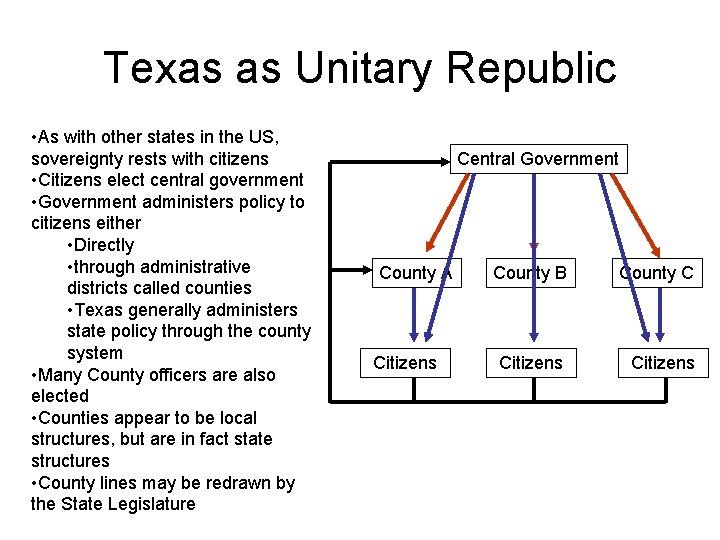
Texas as Unitary Republic • As with other states in the US, sovereignty rests with citizens • Citizens elect central government • Government administers policy to citizens either • Directly • through administrative districts called counties • Texas generally administers state policy through the county system • Many County officers are also elected • Counties appear to be local structures, but are in fact state structures • County lines may be redrawn by the State Legislature Central Government County A Citizens County B County C Citizens
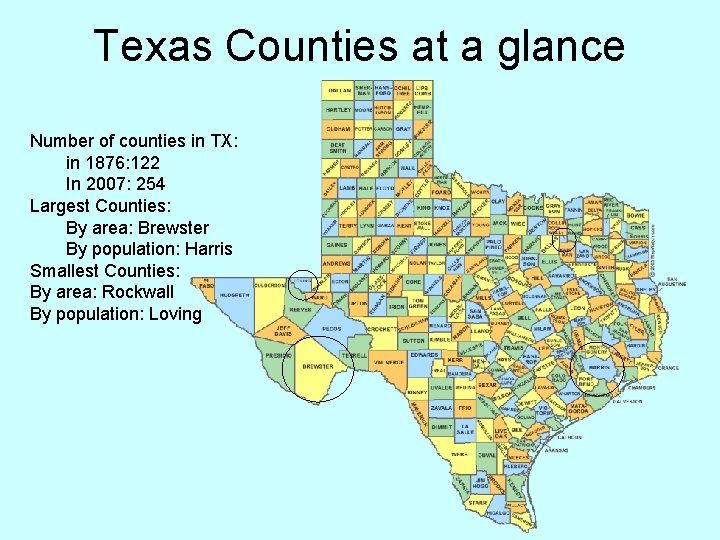
Texas Counties at a glance Number of counties in TX: in 1876: 122 In 2007: 254 Largest Counties: By area: Brewster By population: Harris Smallest Counties: By area: Rockwall By population: Loving
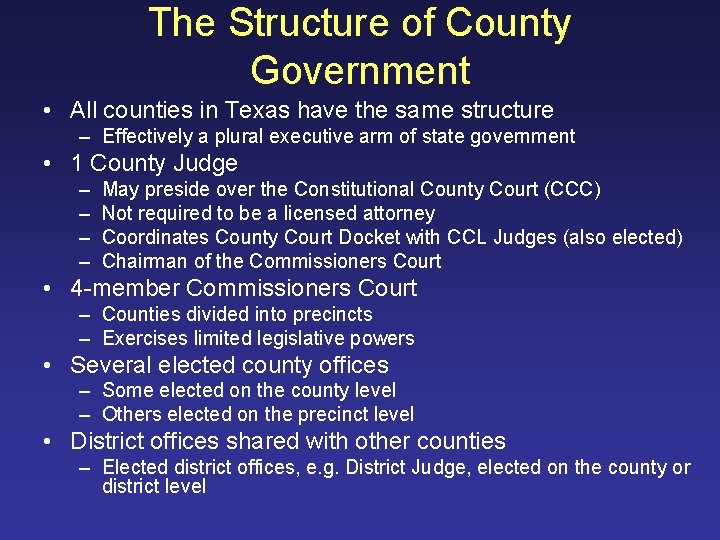
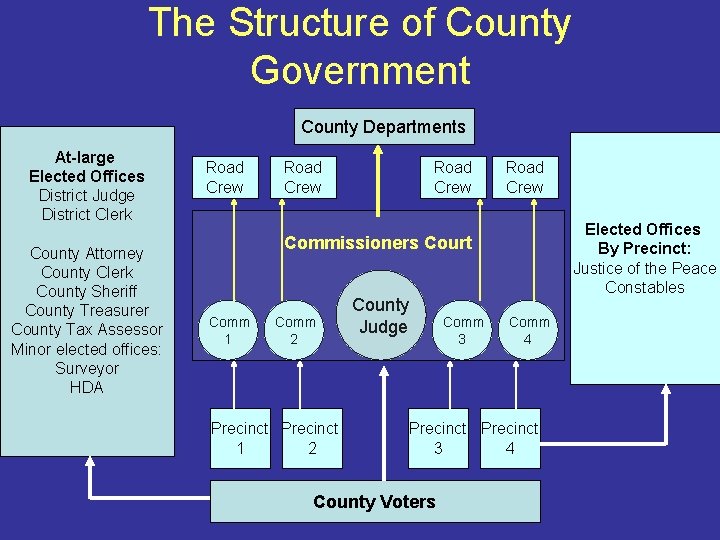
The Structure of County Government • All counties in Texas have the same structure – Effectively a plural executive arm of state government • 1 County Judge – – May preside over the Constitutional County Court (CCC) Not required to be a licensed attorney Coordinates County Court Docket with CCL Judges (also elected) Chairman of the Commissioners Court • 4 -member Commissioners Court – Counties divided into precincts – Exercises limited legislative powers • Several elected county offices – Some elected on the county level – Others elected on the precinct level • District offices shared with other counties – Elected district offices, e. g. District Judge, elected on the county or district level
The Structure of County Government County Departments At-large Elected Offices District Judge District Clerk County Attorney County Clerk County Sheriff County Treasurer County Tax Assessor Minor elected offices: Surveyor HDA Road Crew Elected Offices By Precinct: Justice of the Peace Constables Commissioners Court Comm 1 Comm 2 Precinct 1 2 County Judge Comm 3 Comm 4 Precinct 3 4 County Voters
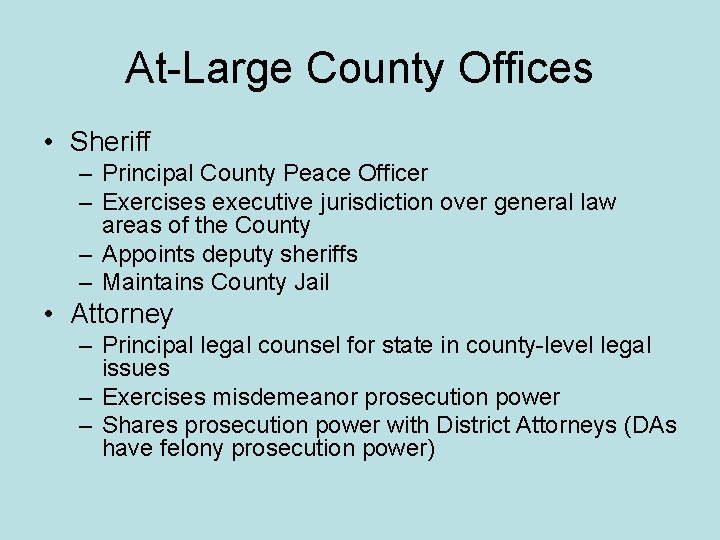
At-Large County Offices • Sheriff – Principal County Peace Officer – Exercises executive jurisdiction over general law areas of the County – Appoints deputy sheriffs – Maintains County Jail • Attorney – Principal legal counsel for state in county-level legal issues – Exercises misdemeanor prosecution power – Shares prosecution power with District Attorneys (DAs have felony prosecution power)
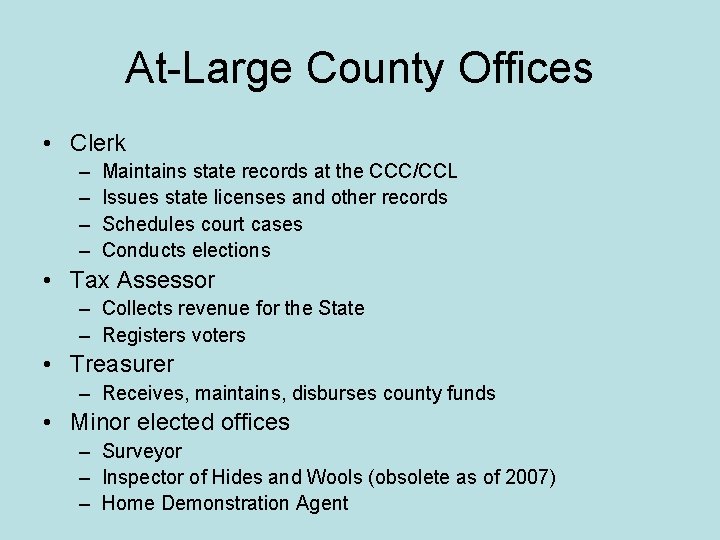
At-Large County Offices • Clerk – – Maintains state records at the CCC/CCL Issues state licenses and other records Schedules court cases Conducts elections • Tax Assessor – Collects revenue for the State – Registers voters • Treasurer – Receives, maintains, disburses county funds • Minor elected offices – Surveyor – Inspector of Hides and Wools (obsolete as of 2007) – Home Demonstration Agent
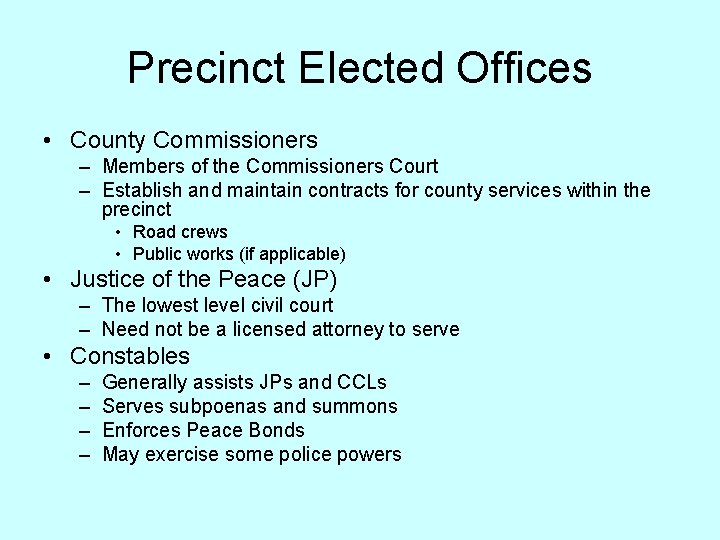
Precinct Elected Offices • County Commissioners – Members of the Commissioners Court – Establish and maintain contracts for county services within the precinct • Road crews • Public works (if applicable) • Justice of the Peace (JP) – The lowest level civil court – Need not be a licensed attorney to serve • Constables – – Generally assists JPs and CCLs Serves subpoenas and summons Enforces Peace Bonds May exercise some police powers
Political Features of County Government • Absence of centralized authority – Elected officials often act independently of each other • The Three “P’s” of County Politics – Precincts – Parties – Patronage • Urban v. Rural Counties – County Governments have less autonomy than Municipal Governments – Counties unable to provide urban-style services – County Government less prominent in urban counties – Often defers to city government – May also yield to special regulatory districts