
Local Government in England Overview Structure Nature Autonomy



- Slides: 57
Local Government in England
Overview • • • Structure Nature Autonomy – constitutional position Size Personnel – Mayors, councillors and officers Electoral system(s) Public engagement LEPs and Combined Authorities Parish Councils Funding Conclusions
Overview • These two sessions will be based around a book chapter on English Local Government, in the forthcoming Modern Guide to Local and Regional Politics, edited by Colin Copus, Richard Kerley and Alistair Jones
Why England? • Scotland, Wales and Northern Ireland are different • Devolution • Their structures are under the control of the devolved bodies • Currently, their structures are uniform, unlike England
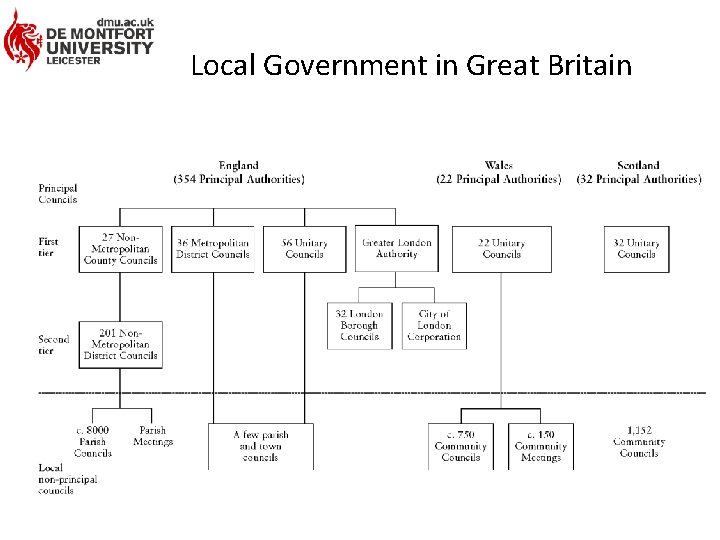
Elected Local Government in Great Britain
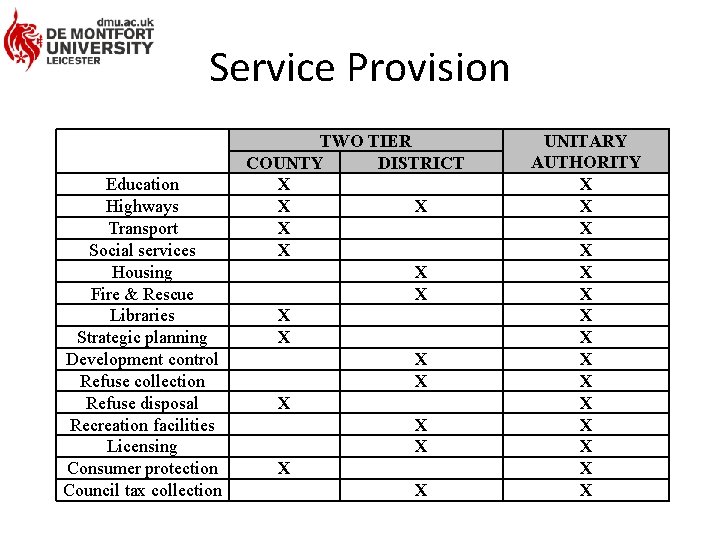
Service Provision Education Highways Transport Social services Housing Fire & Rescue Libraries Strategic planning Development control Refuse collection Refuse disposal Recreation facilities Licensing Consumer protection Council tax collection TWO TIER COUNTY DISTRICT X X X X UNITARY AUTHORITY X X X X
Service Provision • Councils do not necessarily provide all of their services • Legislation dating back to the late 1980 s compelled councils to put some of their services up to tender – Compulsory Competitive Tendering • Consequently, some councils do not directly provide any services eg Peterborough City Council
Service Provision • In Leicester City Council, rubbish bins are not emptied by the council • This job was contracted out in 2002 to a private company – Biffa – for 25 years • Question: – Who is accountable for refuse collection in Leicester?
Autonomy • How autonomous is local government in the Czech Republic, Slovakia, or whatever country from which you come?
Autonomy • The underpinning of the UK constitution is Parliamentary Sovereignty • This means Parliament is the supreme law making body in the UK (even when the UK was a member of the EU)
Autonomy • Consequently, Parliament can legislate to create, restructure or abolish local government – Local Government Act 1888 created county councils – Local Government Act 1894 created county borough councils (in cities) – Local Government Act 1972 established tiered local government – Local Government Act 1985 abolished the six metropolitan county councils and the Greater London Council – 1996 -98 saw 46 new unitary authorities established – 2007 -9 saw 9 new unitary authorities established https: //www. google. com/url? sa=t&rct=j&q=&esrc=s&source=web&cd=7&ved=2 ah. UKEwikk 9 j 45 v Ho. Ah. Xs. Uh. UIHb 8 LDCYQFj. AGeg. QIBBAB&url=http%3 A%2 F%2 Fresearchbriefings. files. parliame nt. uk%2 Fdocuments%2 FSN 07104. pdf&usg=AOv. Vaw 2 Ep. Hclb 9 eqk_J 6 c. Gllttf. I
Size • England has some of the largest local authorities in terms of population size in Europe • There is also an issue as to the number of councillors, and the number of people they each represent
Size • Currently there are 343 councils in England around 17 700 councillors • Chris Game has written a piece on how the numbers of councillors in England is being reduced https: //www. democraticaudit. com/2018/04/27/englands-local-elections-how-councillornumbers-are-being-reduced-by-stealth/
Size • The average population of shire districts over 10 times the average of the lower tier in Europe. . . (Stewart, Modernising British Local Government 2003, p. 181), writing about the 1972 legislation – and many have since become bigger • England – 150 000 people per council (on average) • USA – 50 000 • Sweden – 30 000 • Australia – 20 000 • In the early 2000 s, England had around 350 councils • Germany – 15 000 • France – 36 000 Milliband, Minister for Communities, speaking at the New Local Government Network annual conference, 18 January 2006.
Size • If you want to read more about this debate on the size of councils, I will send you a copy of: Copus and Jones (2014); “Welsh Local Government Association: Literature Review on Council Size”
Personnel • As per councils everywhere, there is a clear distinction between the different roles: – Mayors – Councillors – Officers
Mayors • This is a little complicated in the UK • All councils will have either a Mayor or a Lord Mayor. These post-holders chair council meetings and perform ceremonial duties • Sixteen councils have a directly elected mayor, who leads the council. A further three councils have held a local referendum and removed the post
Mayors • The sixteen mayors, including the mayor of London, wield the full range of powers of the council • They appoint deputy or assistant mayors, who act like a cabinet, with the elected mayor akin to the prime minister
Mayors • Discussion point: – What are the benefits of having a directly elected mayor? – What are the drawbacks?
Councillors • The role of a councillor is that of the elected representative • The role of councillors, as seen through the eyes of councillors, was explored in the Councillor Commission https: //www. google. com/url? sa=t&rct=j&q=&esrc=s&source=web&cd=2&ve d=2 ah. UKEwj 479 Lc 7 PHo. Ah. UWSBUIHTgn. AQYQFj. ABeg. QIAx. AB&url=https%3 A%2 F%2 Fwww. cfps. org. uk%2 Fwp-content%2 Fuploads%2 FCC-Interim. Report-OCT-16. pdf&usg=AOv. Vaw 2 v. I 7 Cm. Nwn 0 SW 8 L 2 WKpz. GLw
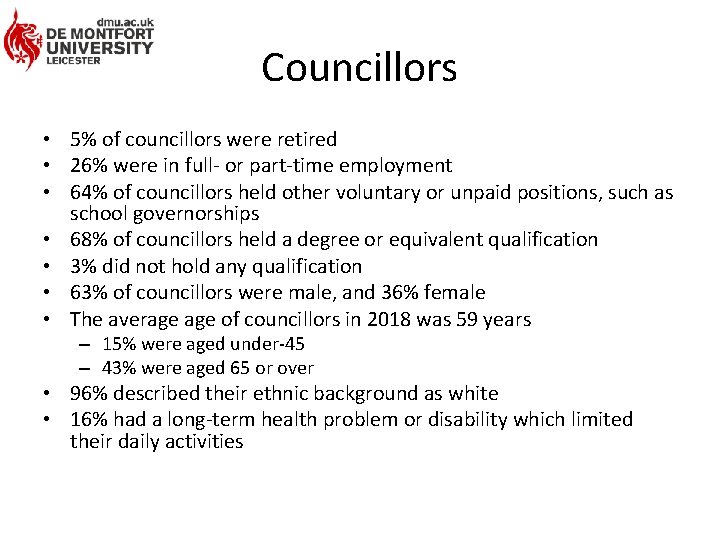
Councillors • 5% of councillors were retired • 26% were in full- or part-time employment • 64% of councillors held other voluntary or unpaid positions, such as school governorships • 68% of councillors held a degree or equivalent qualification • 3% did not hold any qualification • 63% of councillors were male, and 36% female • The average of councillors in 2018 was 59 years – 15% were aged under-45 – 43% were aged 65 or over • 96% described their ethnic background as white • 16% had a long-term health problem or disability which limited their daily activities
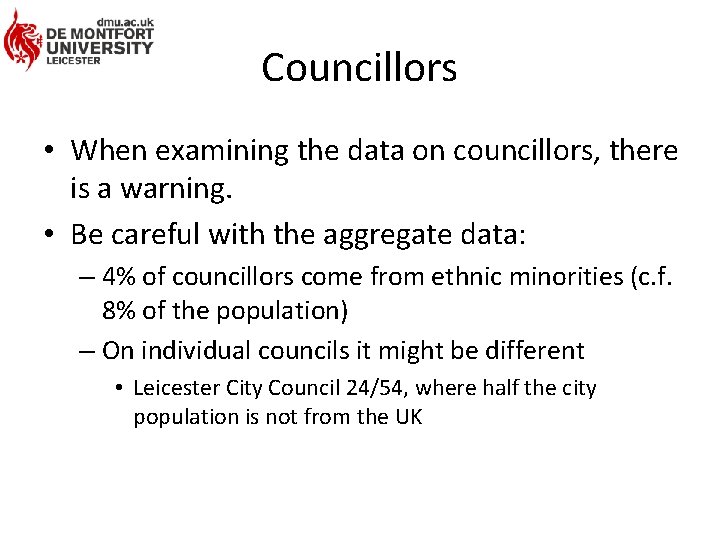
Councillors • When examining the data on councillors, there is a warning. • Be careful with the aggregate data: – 4% of councillors come from ethnic minorities (c. f. 8% of the population) – On individual councils it might be different • Leicester City Council 24/54, where half the city population is not from the UK
Officers • The role of council officers is to implement the political decisions of councillors and the council (and the mayor) • They should be impartial and non-political
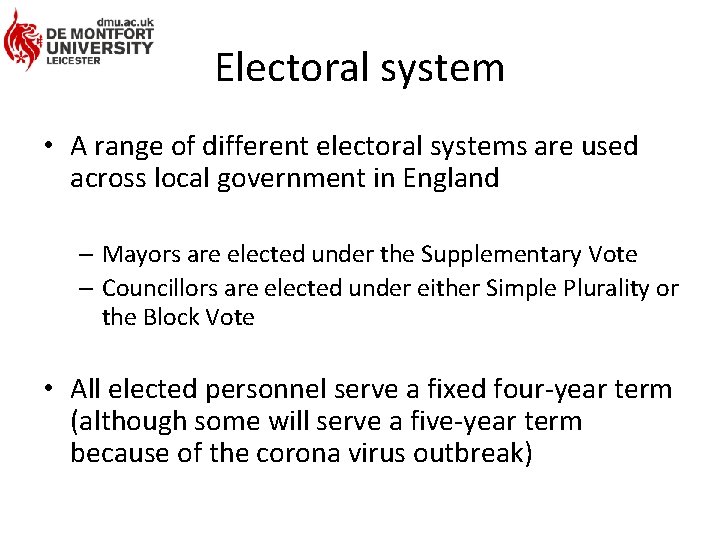
Electoral system • A range of different electoral systems are used across local government in England – Mayors are elected under the Supplementary Vote – Councillors are elected under either Simple Plurality or the Block Vote • All elected personnel serve a fixed four-year term (although some will serve a five-year term because of the corona virus outbreak)
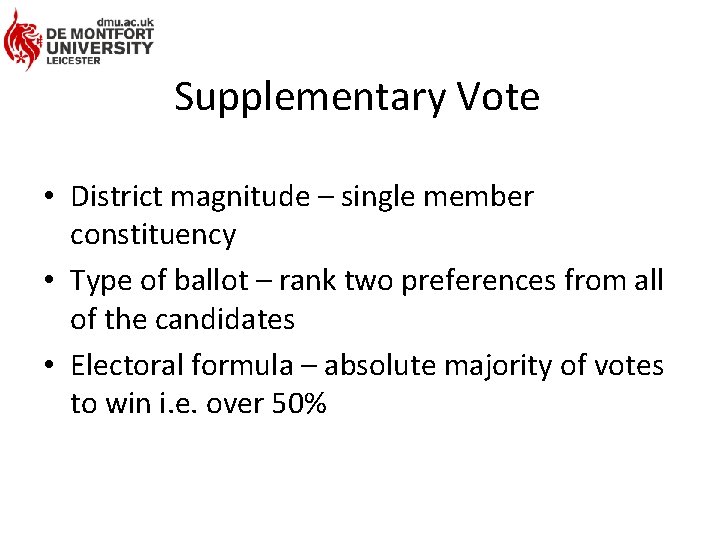
Supplementary Vote • District magnitude – single member constituency • Type of ballot – rank two preferences from all of the candidates • Electoral formula – absolute majority of votes to win i. e. over 50%
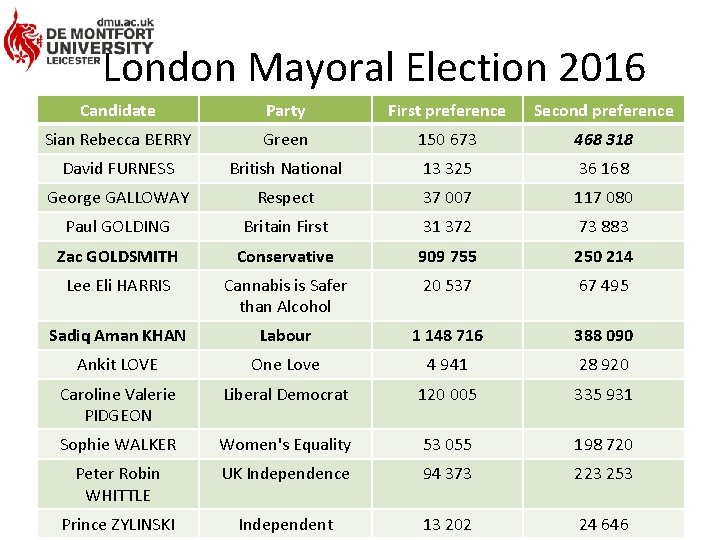
London Mayoral Election 2016 Candidate Party First preference Second preference Sian Rebecca BERRY Green 150 673 468 318 David FURNESS British National 13 325 36 168 George GALLOWAY Respect 37 007 117 080 Paul GOLDING Britain First 31 372 73 883 Zac GOLDSMITH Conservative 909 755 250 214 Lee Eli HARRIS Cannabis is Safer than Alcohol 20 537 67 495 Sadiq Aman KHAN Labour 1 148 716 388 090 Ankit LOVE One Love 4 941 28 920 Caroline Valerie PIDGEON Liberal Democrat 120 005 335 931 Sophie WALKER Women's Equality 53 055 198 720 Peter Robin WHITTLE UK Independence 94 373 223 253 Prince ZYLINSKI Independent 13 202 24 646
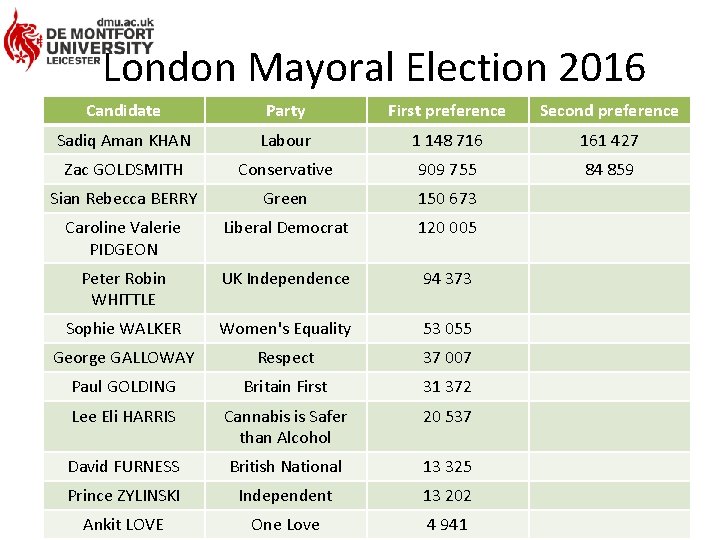
London Mayoral Election 2016 Candidate Party First preference Second preference Sadiq Aman KHAN Labour 1 148 716 161 427 Zac GOLDSMITH Conservative 909 755 84 859 Sian Rebecca BERRY Green 150 673 Caroline Valerie PIDGEON Liberal Democrat 120 005 Peter Robin WHITTLE UK Independence 94 373 Sophie WALKER Women's Equality 53 055 George GALLOWAY Respect 37 007 Paul GOLDING Britain First 31 372 Lee Eli HARRIS Cannabis is Safer than Alcohol 20 537 David FURNESS British National 13 325 Prince ZYLINSKI Independent 13 202 Ankit LOVE One Love 4 941
Block Vote • District magnitude – multi-member constituencies • Type of ballot – multiple categoric votes • Electoral formula – the candidates with the most votes win e. g. in a two-member constituency, the top two vote winners gain election
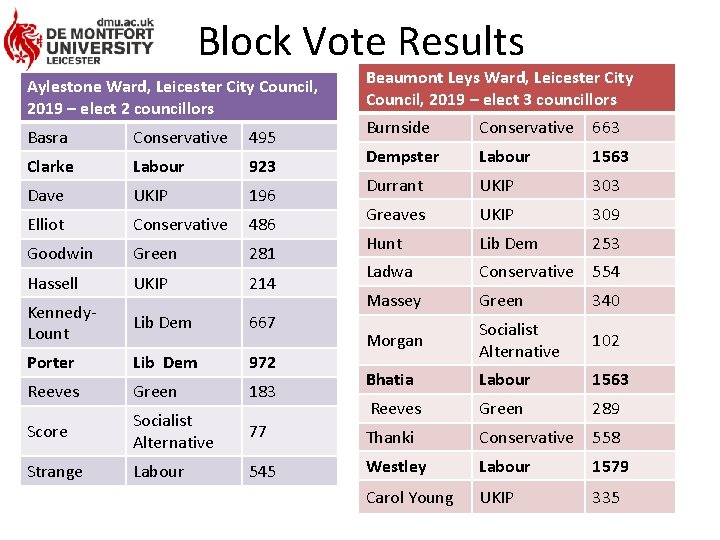
Block Vote Results Aylestone Ward, Leicester City Council, 2019 – elect 2 councillors Beaumont Leys Ward, Leicester City Council, 2019 – elect 3 councillors Burnside Conservative 663 Dempster Labour 1563 Durrant UKIP 303 Greaves UKIP 309 Hunt Lib Dem 253 Ladwa Conservative 554 Massey Green 340 Morgan Socialist Alternative 102 Bhatia Labour 1563 Reeves Green 289 77 Thanki Conservative 558 545 Westley Labour 1579 Carol Young UKIP 335 Basra Conservative 495 Clarke Labour 923 Dave UKIP 196 Elliot Conservative 486 Goodwin Green 281 Hassell UKIP 214 Kennedy. Lount Lib Dem 667 Porter Lib Dem 972 Reeves Green 183 Score Socialist Alternative Strange Labour
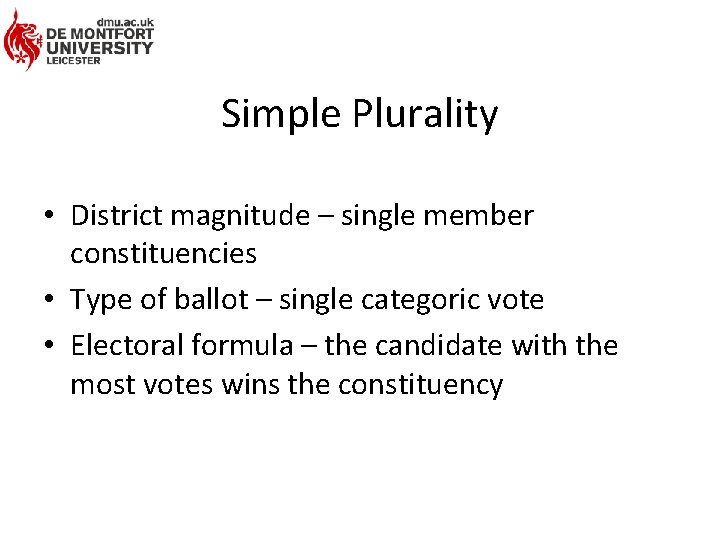
Simple Plurality • District magnitude – single member constituencies • Type of ballot – single categoric vote • Electoral formula – the candidate with the most votes wins the constituency
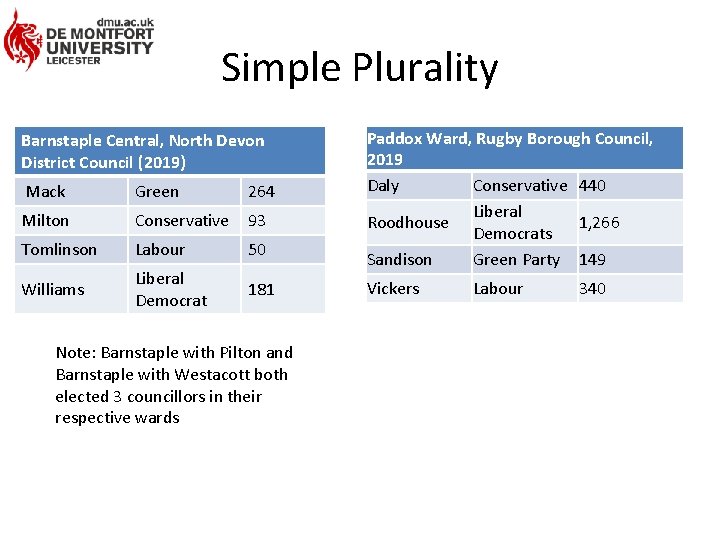
Simple Plurality Barnstaple Central, North Devon District Council (2019) Mack Green 264 Milton Conservative 93 Tomlinson Labour 50 Williams Liberal Democrat 181 Note: Barnstaple with Pilton and Barnstaple with Westacott both elected 3 councillors in their respective wards Paddox Ward, Rugby Borough Council, 2019 Daly Conservative 440 Liberal Roodhouse 1, 266 Democrats Sandison Green Party 149 Vickers Labour 340
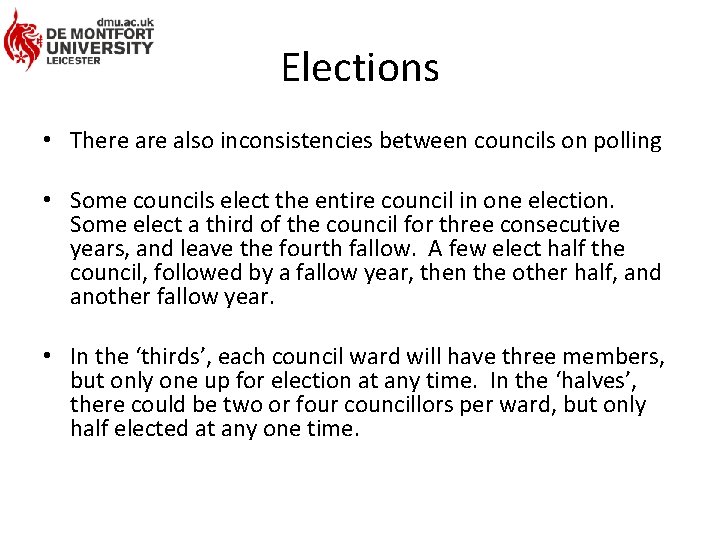
Elections • There also inconsistencies between councils on polling • Some councils elect the entire council in one election. Some elect a third of the council for three consecutive years, and leave the fourth fallow. A few elect half the council, followed by a fallow year, then the other half, and another fallow year. • In the ‘thirds’, each council ward will have three members, but only one up for election at any time. In the ‘halves’, there could be two or four councillors per ward, but only half elected at any one time.
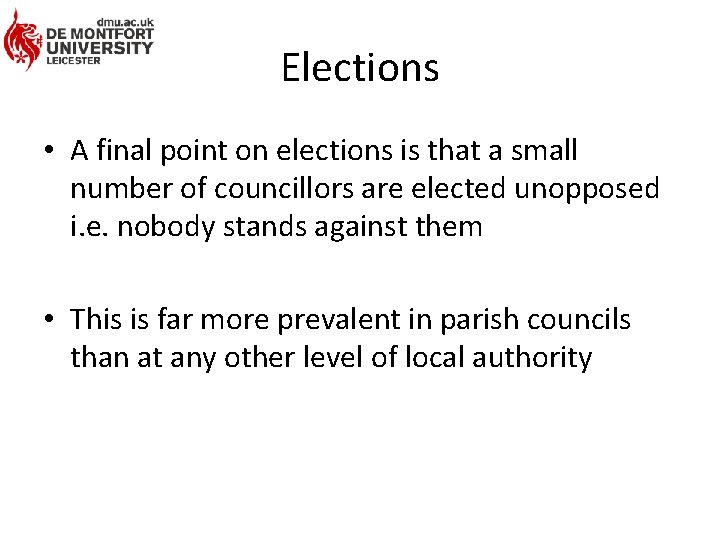
Elections • A final point on elections is that a small number of councillors are elected unopposed i. e. nobody stands against them • This is far more prevalent in parish councils than at any other level of local authority
Public Engagement • Apart from voting, there a number of ways in which the public can get involved in local government. – Ward forum or meeting is very popular. These may be held quarterly, bi-annually or even annually, with the councillors from each ward engaging with the public. Discussions may include the allocation of funding to benefit schemes in the ward, as well as informing the public of the different issues that may arise. Included here could be the local police, council housing, roads and transportation and so forth.
Public Engagement • Ward councillors will also normally hold 'surgeries' in their ward, where members of the local community can approach them about issues pertaining to them and to the community. • This interaction with the local community sets local councillors apart from other elected personnel, in relation to the frequency and prominence of these meetings.
Public Engagement • More formally, at the full council level, meetings are open to the public. • • Any member of the public may attend, for example, a full council meeting. • There are no opportunities for members of the public to participate on the day of the meeting, unless they have submitted a question in advance of the meeting, and it has been accepted.
Public Engagement • There are very few occasions where members of the public are not allowed to attend council meetings. • These are in relation to confidential third party information and to issues around national security. • There is also exempt information, which may involve the identity of a given individual, their business affairs and so forth. • Conversely, that information may not remain exempt if it pertains to a proposed development which may involve planning permission.
LEPs and Combined Authorities • Local Economic Partnerships • Currently, there are 38 LEPs across England. • Each council must be on a LEP, although it is possible for a council to sit on more than one LEP. • LEPs are involved in ‘regional’ economic regeneration (see Jones and Copus in Teles et al) • The emphasis is very much upon business. The Leicester and Leicestershire LEP, for example, hold quarterly Business Leaders’ Network meetings, around economic development and strategic planning
LEPs and Combined Authorities • Combined Authorities have also been established across parts of England. • Currently, there are ten such bodies, eight with a directly-elected mayor at their head (known as metro-mayors), and two without.
LEPs and Combined Authorities • The requirement from central government that the Combined Authorities must have an elected mayor has caused problems. • It has been a contributing factor to some Combined Authority plans stalling - as in the case of Leicester, Leicestershire and Rutland. • Conversely, in the case of the West of England Combined Authority, residents who live in the city of Bristol have two elected mayors - one for the city, and one for the combined authority.
LEPs and Combined Authorities • Combined Authorities have an economic focus are set up by two or more neighbouring councils wishing to coordinate responsibilities and powers over services, including aspects of transport, housing and social care. • Eight combined authorities are mayoral combined authorities, which means that they are led by metro mayors who are directly elected via supplementary vote. • All mayoral combined authorities have agreed devolution deals with central government, in which additional powers and budgets have been transferred to the authorities from Westminster. Metro mayors were introduced as a requirement of these deals to ensure that the process of devolution remained accountable.
LEPs and Combined Authorities with elected mayors • Cambridgeshire and Peterborough (@Cambs. Pboro. CA) • Greater Manchester (@Greatermcr) • Liverpool City Region @Lpool. City. Region) • North of Tyne (@North. Tyne. CA) • Sheffield City Region (@Sheff. City. Region) • Tees Valley (@Tees. Valley. CA) • West Midlands (@West. Mids_CA) • West of England(@Westof. England. CA) Combined Authorities without a directly elected mayor • North East Combined Authority (@North. East. CA) • West Yorkshire Combined Authority (@West. Yorkshire. CA)
LEPs and Combined Authorities • There is no consistency in the powers granted to each of the Combined Authorities • Each one differs • There also issues around funding
Parish Councils • Parish councils, which comprise the lowest tier of local government in England, provide the fewest services and wield the fewest powers (see Jones, 2020). • They tend to be associated with rural communities, although it is possible for urban communities to establish such a council. • Approximately 30% of England has parish councils, although they may also be called town or city councils (as in the case of the City of Ely council). Eight parish councils have 'city' status in England.
Parish Councils
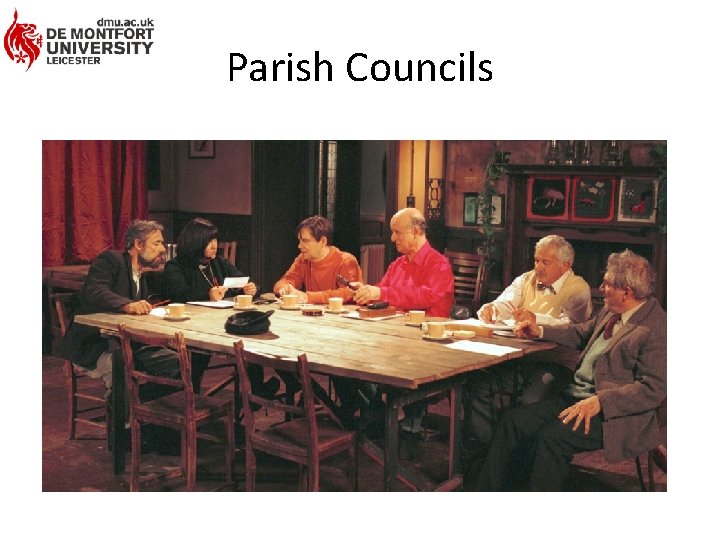
Parish Councils • As per the Vicar of Dibley, parish councils get very bad press • They are the most 'local' form of local government, and are seen to have a far better connection with the local community than any other tier of government. • The idea of enhancing the role of parish councils appears at odds with how they are portrayed, and how they are sometimes treated by people working in principal authorities
Parish Councils • Parish councils ceased to exist in London from 1936, while the 1963 Greater London Act stated that no parish councils could be established in the Greater London area. • This ban was repealed by the Local Government and Public Involvement in Health Act of 2007. • It was only with the establishment of the Queen's Park Parish Council in 2014 that parish councils returned to London. • Attempts have been made to establish a parish council in Tower Hamlets, but without success
Parish Councils • Parish councils in England can be dated back to the 1500 s • Their modern role and structure comes from the Local Government Act 1894 • It is summed up by Chandler (2007) Explaining Local Government: "Parishes could own property, establish allotments, consent to the opening and closing of rights of way, repair footpaths and create and care for recreation grounds, but they had limited resources for achieving such ends".
Parish Councils • There has been a resurgence in parish councils in England – Size of local authorities – Austerity – Localism legislation See Jones, 2020
Funding • Funding of local government in England is complex • Councils raise revenue through two taxes: – Council Tax – Business Rates • This is raised by district or borough councils and unitary authorities
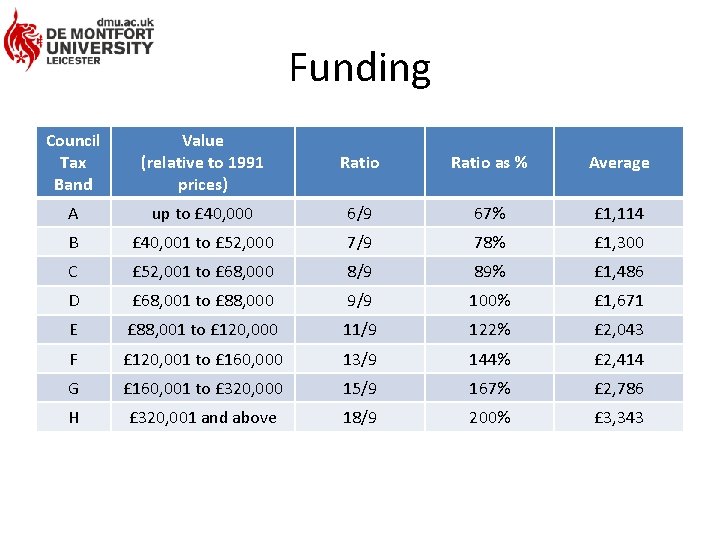
Funding Council Tax Band Value (relative to 1991 prices) Ratio as % Average A up to £ 40, 000 6/9 67% £ 1, 114 B £ 40, 001 to £ 52, 000 7/9 78% £ 1, 300 C £ 52, 001 to £ 68, 000 8/9 89% £ 1, 486 D £ 68, 001 to £ 88, 000 9/9 100% £ 1, 671 E £ 88, 001 to £ 120, 000 11/9 122% £ 2, 043 F £ 120, 001 to £ 160, 000 13/9 144% £ 2, 414 G £ 160, 001 to £ 320, 000 15/9 167% £ 2, 786 H £ 320, 001 and above 18/9 200% £ 3, 343
Funding • Any plans to raise council tax above 2. 99% in a year must go to a local referendum • All taxes are handed in to central government • The centre then allocates funding to each council • Over the past decade, central government has cut the amount of money allocated to local government
Funding • There has been some exploration to find alternative ways of funding local councils – Tourist Tax – Local Income Tax • Central Government is very reluctant to hand out any more financial powers to local authorities • If you would like to read a short piece on this from the Municipal Journal, just ask me
Funding • Parish councils raise their funds by the precept. • This goes on council tax bills, but may only be spent on the parish • There are no restrictions as to how much money can be raised this way
Conclusions • Local Government in England is complicated • We have touched upon some aspects in these sessions • Areas such as Local Health or the Police and Crime Commissioners have been omitted
Conclusions • Local Government in England needs a fundamental overhaul, from its structures to its finances • The problem is the centre is the body who will initiate such changes • They are loathe to hand too many powers down to local government