
LOCAL ECONOMIC DEVELOPMENT AND YOUTH EMPLOYMENT WORKSHOP CAPACITY



- Slides: 15
LOCAL ECONOMIC DEVELOPMENT AND YOUTH EMPLOYMENT WORKSHOP CAPACITY OF LOCAL GOVERNMENT TO SUPPORT YOUTH EMPOWERMENT-Presentation by David Gengan: MSUNDUZI MUNICIPALITY
THE ROLES OF MUNICIPALITIES � National Youth Economic Empowerment Strategy ◦ To promote and support youth economic empowerment in the municipalities; ◦ To develop youth economic empowerment policies, strategies and programmes aligned with the NYEES; ◦ To mainstream youth in all their core LED and IDP programmes; ◦ To establish youth directorates/desks in the districts and local municipalities to coordinate and facilitate youth economic development activities;
CAPACITY OF LOCAL GOVERNMENT TO SUPPORT YOUTH EMPLOYMENT � Key ◦ ◦ ◦ Performance Areas of Local Government Municipal transformation and institutional development Financial viability and management Infrastructure development and service delivery Social and economic development Good governance and community participation � This is an onerous responsibility placed on municipalities � Social and economic development is a new mandate ◦ Struggle to fulfill this mandate, especially by the smaller municipalities
CAPACITY OF LOCAL GOVERNMENT TO SUPPORT YOUTH EMPLOYMENT � Local government is the face of government to the people � We are the point of delivery � Yet, local government, in the main, does not have the capacity to raise the financial and human resources to deliver on its mandate � Limited funding sources: property rates, profits from service charges, grants � 87% of municipalities in the country are in serious financial trouble
CAPACITY OF LOCAL GOVERNMENT TO SUPPORT YOUTH EMPLOYMENT ◦ Proposed interventions: �Improving basic education �Assistance with job searching �Access to start up funds for small enterprises �Wage subsidies �Employer subsidies �Learnerships, apprenticeships and internships �Improved government policies and programmes �Targetted skills development programmes �Career guidance and counselling �Labour market interventions �Private sector commitment
CAPACITY OF LOCAL GOVERNMENT TO SUPPORT YOUTH EMPLOYMENT ◦ Notwithstanding the capacity challenges faced by municipalities, there are some innovative support programmes that are being implemented in some municipalities – from case studies presented ◦ A potential major area of support is in the procurement of goods and services �All municipalities procure goods and services �Preferential procurement policies must reflect support for youth owned businesses �Specific targets should be set annually, and monitored
CAPACITY OF LOCAL GOVERNMENT TO SUPPORT YOUTH EMPLOYMENT � Community based maintenance and service delivery projects – unskilled unemployed youth, ward based ◦ Most municipalities are struggling to provide a basic level of service – refuse removal, grass cutting, road maintenance, street cleaning � Environmental management – public open spaces, alien vegetation � Increasing the number of internships, apprenticeships and learnerships
CAPACITY OF LOCAL GOVERNMENT TO SUPPORT YOUTH EMPLOYMENT � Targetted skills training – external, in partnership with tertiary institutions � Creating a conducive environment for small business development – incentives programme � Well resourced Youth Advisory Centres ◦ Job search information access ◦ Identification of potential entrepreneurs
MSUNDUZI INTERVENTIONS � Municipality has signed an MOU with the NYDA � Local Youth Advisory Centre was re-launched in March 2012 � Staffing: ◦ 3 staff members: �Officer for Economic Development �Officer for Career Guidance �Officer for Outreach Programmes � The NYDA provided training for the staff
MSUNDUZI INTERVENTIONS � The Advisory Centre follows the programme of the NYDA � In the main services of business support and career guidance are provided � July 2012 – 91 youth contacted the centre ◦ Computer training – 23 ◦ Business support – 36 ◦ Job Information – 16 � Community based service projects � Skills training – ICT � Mainstreaming – capital projects
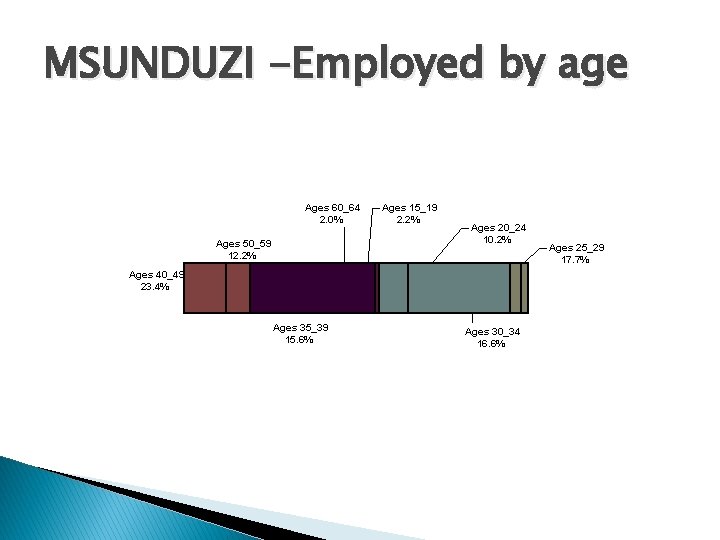
MSUNDUZI -Employed by age Ages 60_64 2. 0% Ages 50_59 12. 2% Ages 15_19 2. 2% Ages 20_24 10. 2% Ages 40_49 23. 4% Ages 35_39 15. 6% Ages 30_34 16. 6% Ages 25_29 17. 7%
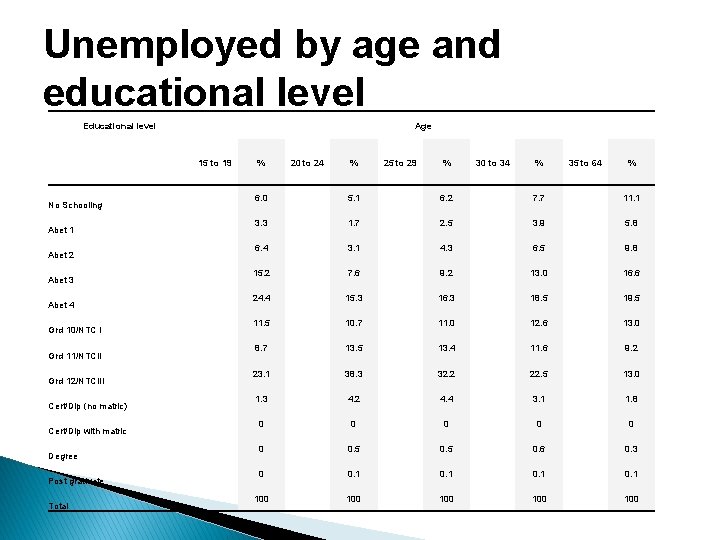
Unemployed by age and educational level Educational level Age 15 to 19 % 20 to 24 % 25 to 29 % 30 to 34 % 35 to 64 % No Schooling Abet 1 Abet 2 Abet 3 Abet 4 Grd 10/NTC I Grd 11/NTCII Grd 12/NTCIII Cert/Dip (no matric) Cert/Dip with matric Degree Post graduate Total 6. 0 5. 1 6. 2 7. 7 11. 1 3. 3 1. 7 2. 5 3. 9 5. 8 6. 4 3. 1 4. 3 6. 5 9. 8 15. 2 7. 6 9. 2 13. 0 16. 6 24. 4 15. 3 16. 3 18. 5 19. 5 11. 5 10. 7 11. 0 12. 6 13. 0 8. 7 13. 5 13. 4 11. 6 9. 2 23. 1 38. 3 32. 2 22. 5 13. 0 1. 3 4. 2 4. 4 3. 1 1. 8 0 0 0 0. 5 0. 6 0. 3 0 0. 1 100 100 100
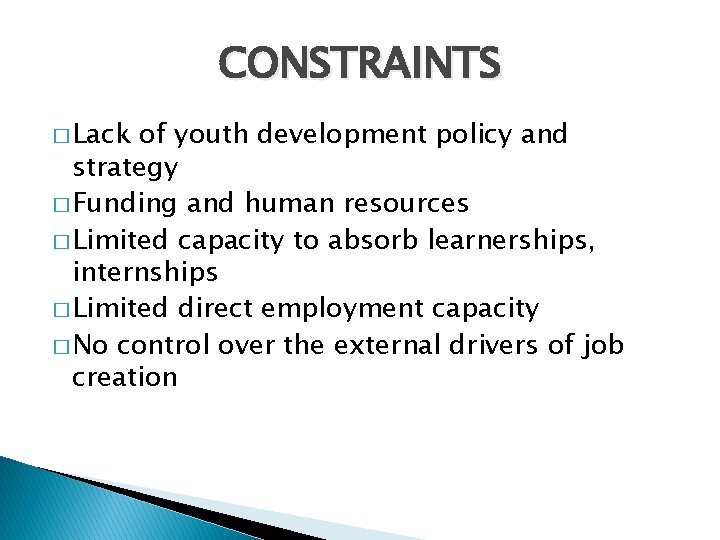
CONSTRAINTS � Lack of youth development policy and strategy � Funding and human resources � Limited capacity to absorb learnerships, internships � Limited direct employment capacity � No control over the external drivers of job creation
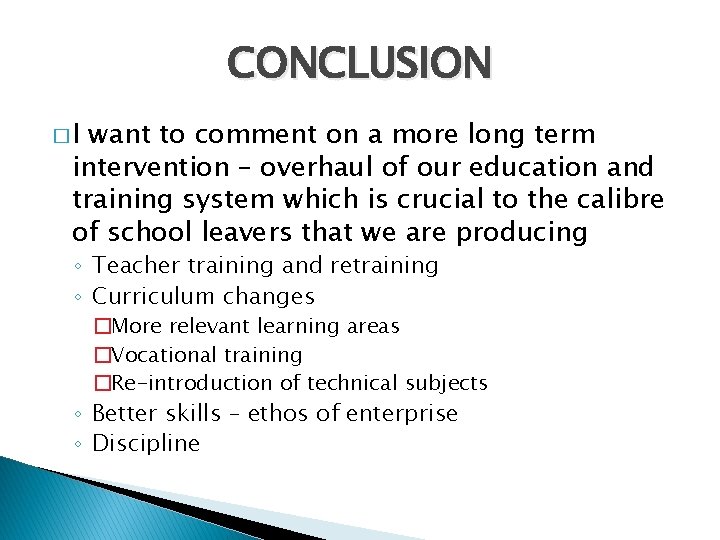
CONCLUSION �I want to comment on a more long term intervention – overhaul of our education and training system which is crucial to the calibre of school leavers that we are producing ◦ Teacher training and retraining ◦ Curriculum changes �More relevant learning areas �Vocational training �Re-introduction of technical subjects ◦ Better skills – ethos of enterprise ◦ Discipline
THANK YOU