
Local Color and Regionalism 1865 1895 Definitions n
- Slides: 7
Local Color and Regionalism 1865 -1895
Definitions n Focuses on the characters, dialect, customs, topography, and other features particular to a specific region. n Weaknesses may include nostalgia or sentimentality. n Customary forms: sketch, short story, and occasionally the novel n http: //public. wsu. edu/~campbelld/amlit/lcolor. html
Purposes n Contributed to the reunification of the country after the Civil War. n Contributed to the building of national identity toward the end of the nineteenth century. n Reassured urban dwellers that amid social change, there was a geographic repository of traditional “American” values. n Satisfied the desire of readers to experience quaint or exotic settings and characters: a kind of travel literature that introduced readers to their own nation.
Characteristics n Characters: Concerned character of the district or region rather than with the individual: n Characters may become character types, sometimes quaint or stereotypical. n The characters marked by their adherence to the old ways, by dialect, and by particular personality traits central to the region.
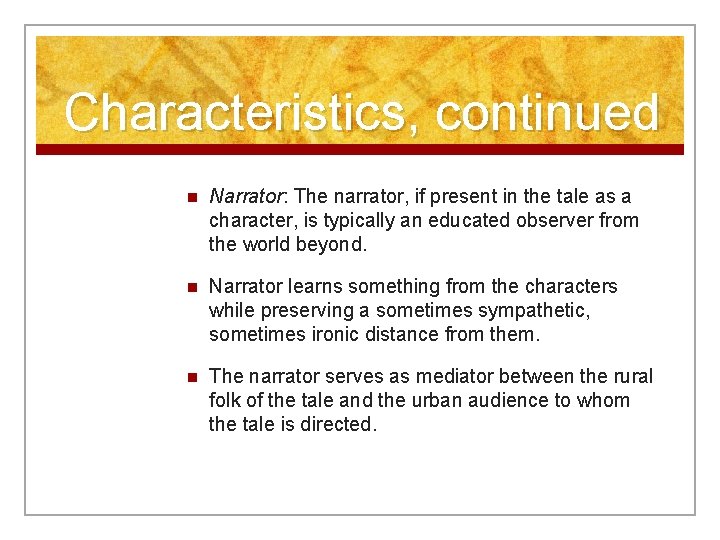
Characteristics, continued n Narrator: The narrator, if present in the tale as a character, is typically an educated observer from the world beyond. n Narrator learns something from the characters while preserving a sometimes sympathetic, sometimes ironic distance from them. n The narrator serves as mediator between the rural folk of the tale and the urban audience to whom the tale is directed.
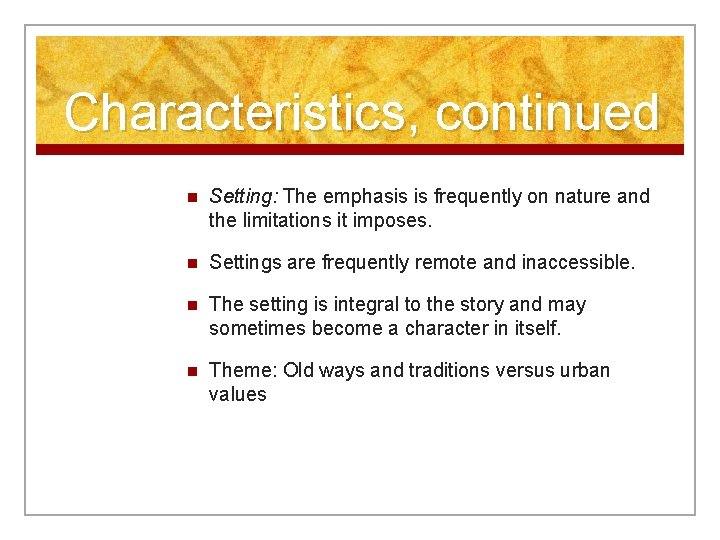
Characteristics, continued n Setting: The emphasis is frequently on nature and the limitations it imposes. n Settings are frequently remote and inaccessible. n The setting is integral to the story and may sometimes become a character in itself. n Theme: Old ways and traditions versus urban values
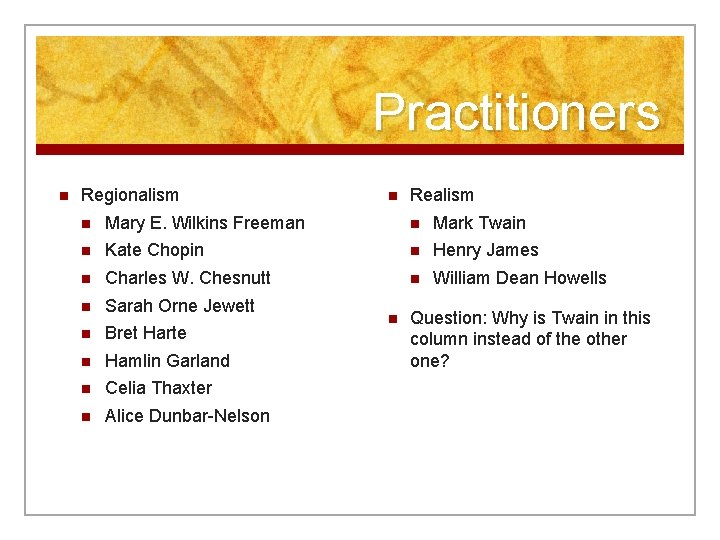
Practitioners n Regionalism n Realism n Mary E. Wilkins Freeman n Mark Twain n Kate Chopin n Henry James n Charles W. Chesnutt n William Dean Howells n Sarah Orne Jewett n Bret Harte n Hamlin Garland n Celia Thaxter n Alice Dunbar-Nelson n Question: Why is Twain in this column instead of the other one?