
LOCAL AREA NETWORK SECURITY Jeff Warnock COSC 352
- Slides: 10
LOCAL AREA NETWORK SECURITY Jeff Warnock COSC 352 Indiana University of Pennsylvania Spring 2010
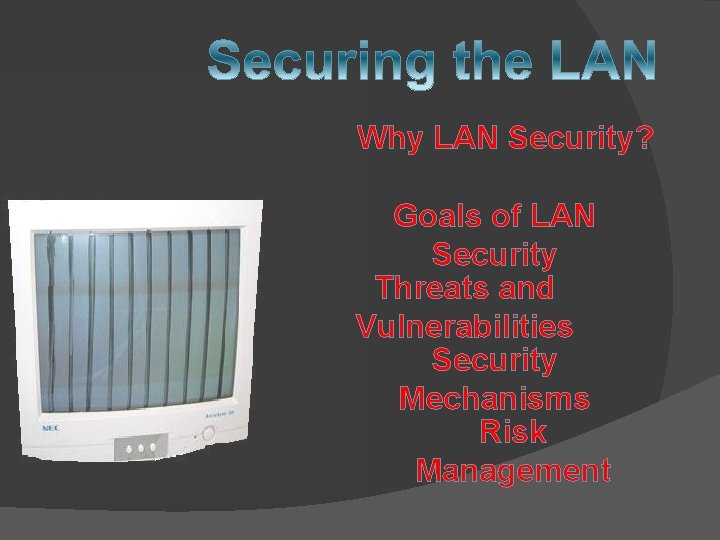
Why LAN Security? Goals of LAN Security Threats and Vulnerabilities Security Mechanisms Risk Management
� LANs share data, processing and communication � As the area a LAN spans becomes greater, so does the chance of interception � Information security – Protecting data traveling throughout the network �Authentication, confidentiality, access control � Mail v E-mail
Applications � Distributed Downfalls File Sharing �Client access control to server �Protected server to unprotected client � Remote computing �Authentication and access restrictions � Messaging services �Confidentiality and integrity of messages Home
� Goals of stored, processed and transmitted data �Confidentiality �Integrity �Availability � Goals of information sharing �Authentication of senders and receivers Home
� Access � Unauthorized � Inappropriate � Disclosure � Data � Traffic � Unauthorized Modification � LAN Spoofing � LAN Disruption Home
� Authentication � Access control � Confidentiality � Integrity � Non-repudiation � Logging and Monitoring Home
� Estimate losses �Use or dependency � Analyze threats and vulnerabilities � Determine security mechanisms Reduce risk to acceptable level
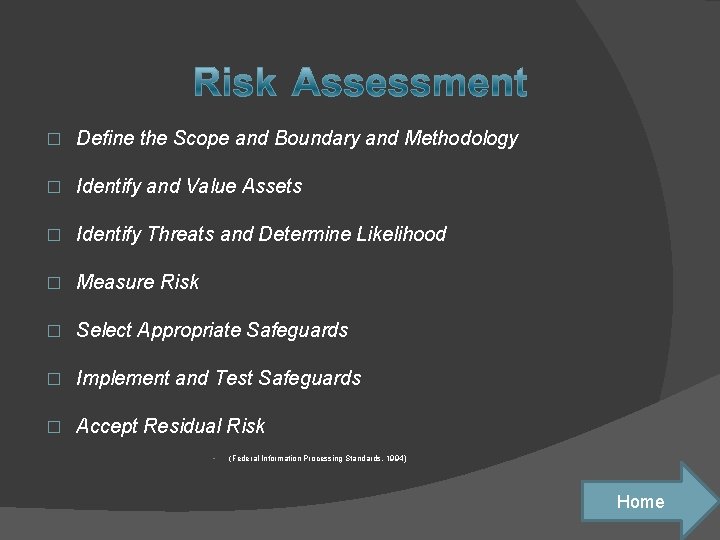
� Define the Scope and Boundary and Methodology � Identify and Value Assets � Identify Threats and Determine Likelihood � Measure Risk � Select Appropriate Safeguards � Implement and Test Safeguards � Accept Residual Risk • (Federal Information Processing Standards, 1994) Home
Federal Information Processing Standards. (1994). Guideline for The Analysis Local Area Network Security. Federal Information Processing Standards Publication 191 , 6 -30