
Local anesthetics DR FATIMAH ALMAHASNEH DEPARTMENT OF BASIC

Local anesthetics DR. FATIMAH ALMAHASNEH DEPARTMENT OF BASIC MEDICAL SCIENCES FACULTY OF MEDICINE – YARMOUK UNIVERSITY 1
Local anesthesia • Is the loss of sensation in a limited region of the body. • It is accomplished by disruption of afferent neural traffic via inhibition of impulse generation or propagation. ◦ may bring with it other physiologic changes (such as muscle paralysis and suppression of somatic or visceral reflexes) might be desirable or undesirable. • Local anesthetics are often used as analgesics, but they provide complete loss of all sensory modalities. • Drug is delivered directly to the target organ, and the systemic circulation serves only to diminish or terminate its effect. 2
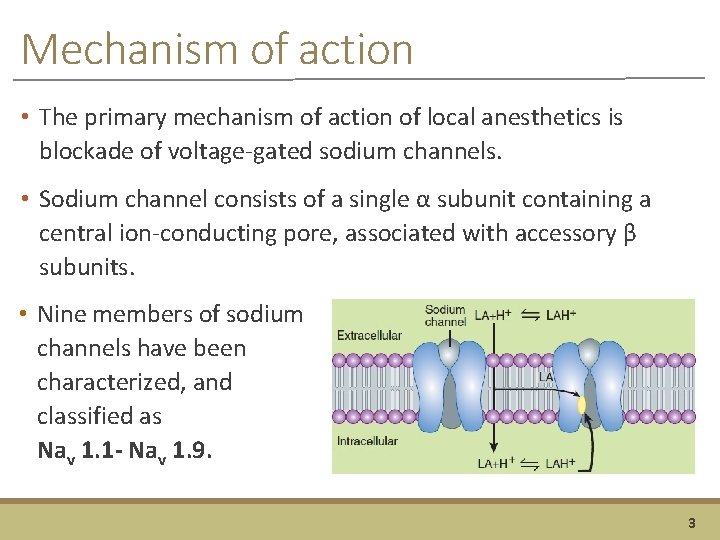
Mechanism of action • The primary mechanism of action of local anesthetics is blockade of voltage-gated sodium channels. • Sodium channel consists of a single α subunit containing a central ion-conducting pore, associated with accessory β subunits. • Nine members of sodium channels have been characterized, and classified as Nav 1. 1 - Nav 1. 9. 3

Mechanism of action • When progressively increasing concentrations of a local anesthetic are applied to a nerve fiber ◦ the threshold for excitation increases ◦ impulse conduction slows ◦ the rate of rise of the action potential declines Ø finally, the ability to generate an action potential is completely abolished. 4
Mechanism of action • These progressive effects result from binding of the local anesthetic to more and more sodium channels. • If the sodium current is blocked over a critical length of the nerve propagation across the blocked area is no longer possible. 5
Mechanism of action • The blockade of sodium channels by most local anesthetics is both voltage and time dependent: ◦ the effect of a given drug concentration is more marked in rapidly firing axons than in resting fibers. ◦ the refractory period is lengthened and the nerve conducts fewer action potentials 6
Mechanism of action • Local anesthetics bind to the sodium channel with low affinity and poor specificity they are potentially active at other: ◦ channels (eg, potassium and calcium), ◦ enzymes (eg, adenylate cyclase), ◦ receptors (eg, N -methyl- D -aspartate [NMDA], G proteincoupled, 5 -HT 3, neurokinin-1 [substance P receptor]). contribute to achieving anesthesia, and produce additional beneficial effects and adverse effects. 7
Neuronal factors affecting block • With central neuraxial techniques (spinal or epidural): • motor paralysis may impair respiratory activity • autonomic nerve blockade may promote hypotension. 8
Neuronal factors affecting block • Motor paralysis may be desirable during surgery, but it may be disadvantageous in other settings. ◦ Epidural anesthesia during obstetrical labor motor weakness may limit the ability of the patient to push during delivery. ◦ After surgery: ◦ muscle weakness hampers ability to ambulate without assistance and poses a risk of falling. ◦ residual autonomic blockade may interfere with bladder function urinary retention and need for bladder catheterization. 9
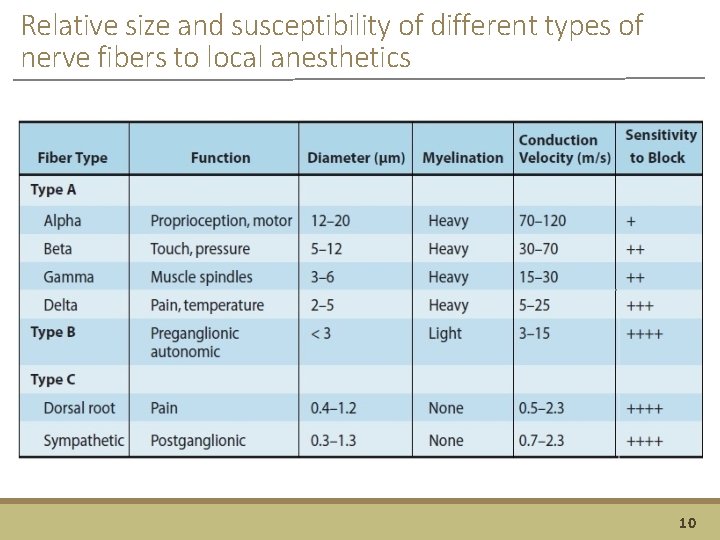
Relative size and susceptibility of different types of nerve fibers to local anesthetics 10
Route of administration • The usual routes of administration of local anesthetics include: 1. topical application (eg, nasal mucosa, wound [incision site] margins) 2. injection close to peripheral nerve endings (perineural infiltration) and major nerve trunks (blocks) 3. injection into the epidural or subarachnoid spaces surrounding the spinal cord. 11

Schematic diagram of the typical sites of injection of local anesthetics in and around the spinal canal When local anesthetics are injected extradurally, it is referred to as an epidural block. A caudal block is a specific type of epidural block in which a needle is inserted into the caudal canal via the sacral hiatus. Injections around peripheral nerves are known as perineural blocks (eg, paravertebral block). Finally, injection into cerebrospinal fluid in the subarachnoid (intrathecal) space is referred to as a spinal block. 12
Clinical block characteristics • In clinical practice, there is generally an orderly evolution of block components: 1. sympathetic transmission 2. temperature 3. pain 4. light touch 5. motor block • But exceptions may occur. 13
Effect of added vasoconstrictors • Localized neuronal uptake is enhanced because of higher sustained local tissue concentrations longer duration block. • Peak blood levels will be lowered as absorption is more closely matched to metabolism and elimination the risk of systemic toxic effects is reduced. 14
Effect of added vasoconstrictors • When use with spinal anesthetic, epinephrine also exert a direct analgesic effect mediated by postsynaptic α 2 adrenoceptors within the spinal cord clinical use of the α 2 agonist clonidine as a local anesthetic adjuvant for spinal anesthesia. • However, the addition of epinephrine to anesthetic solutions can potentiate the neurotoxicity of local anesthetics used for peripheral nerve blocks or spinal anesthesia. 15
Intentional use of systemic local anesthetics • Sometimes, local anesthetics are deliberately administered systemically at low doses for their suppressive effects on pain processing Ø reductions in anesthetic requirement and postoperative pain Ø treatment of chronic pain 16
Systemic toxicity • The dose of local anesthetic used for epidural anesthesia or high volume peripheral blocks is sufficient to produce major clinical toxicity, even death Ø maximum doses for each drug for each general application have been recommended. • Inadvertent intravascular injection (occasionally into an artery, but more commonly a vein) may happen. 17
CNS toxicity • When high plasma concentrations result from rapid absorption or inadvertent intravascular administration all local anesthetics can produce: ◦ sedation ◦ light-headedness ◦ visual and auditory disturbances ◦ restlessness 18
CNS toxicity • Local anesthetics apparently cause depression of cortical inhibitory pathways unopposed activity of excitatory neuronal pathways may cause seizures. • When large doses of a local anesthetic are required premedication with a parenteral benzodiazepine (eg, diazepam or midazolam) prevents CNS toxicity. ◦ Little effect on cardiovascular toxicity delays recognition of lifethreatening overdose. 19
Cardiotoxicity • Local anesthetics may have profound effects on cardiac conduction and function. • 0. 75 % bupivacaine in the obstetrics setting had been associated with cardiac arrests banned in obstetrics and used at lower concentrations in other settings. • The enantiomers of the racemic mixture bupivacaine are not equivalent with respect to cardiotoxicity: ◦ the S (-) enantiomer has better therapeutic advantage subsequent marketing of levobupivacaine and later, ropivacaine. Ø reduction in toxicity afforded by these compounds is only modest. 20
Reversal of bupivacaine toxicity • Resistant bupivacaine cardiotoxicity may be treated using an IV infusion of lipid ◦ Also useful for cardiac or CNS toxicity caused by any lipid-soluble drug. • Lipid infusion can extract a lipophilic drug from aqueous plasma and tissue targets, a mechanism termed lipid sink. • Regarding bupivacaine cardiotoxicity, lipid infusion also restores energy to the myocardium by overcoming bupivacaine-induced inhibition of fatty acid transport. 21
Localized neural toxicity It is usually caused by: • inadvertent administration of local anesthetics intrathecally rather than epidurally ◦ because the dose required for spinal anesthesia is roughly an order of magnitude less than for epidural anesthesia. • continuous spinal anesthesia (CSA) ◦ because repetitive doses are administered to a small area of the subarachnoid space. 22
Localized neural toxicity • Mechanisms of local neurotoxicity: ◦ conduction failure, membrane damage, enzyme leakage, cytoskeletal disruption, accumulation of intracellular calcium, disruption of axonal transport, and apoptosis. • Local anesthetic may also cause transient pain or dysesthesia (impairment of sensitivity especially to touch). 23
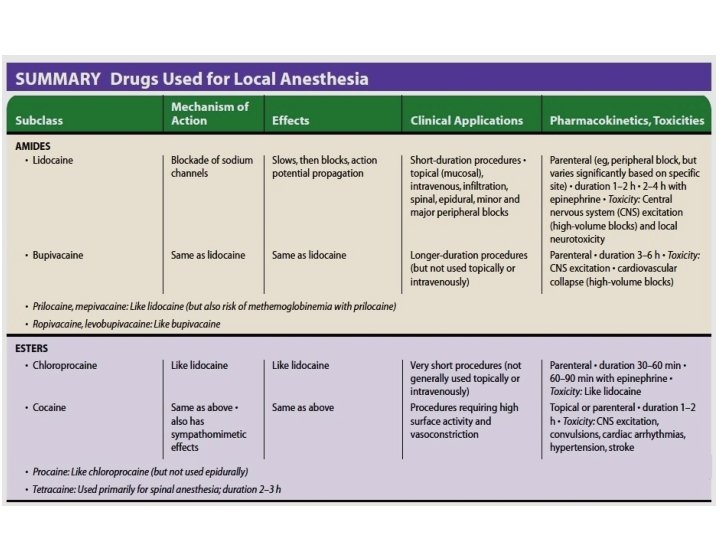
Commonly used local anesthetics 24
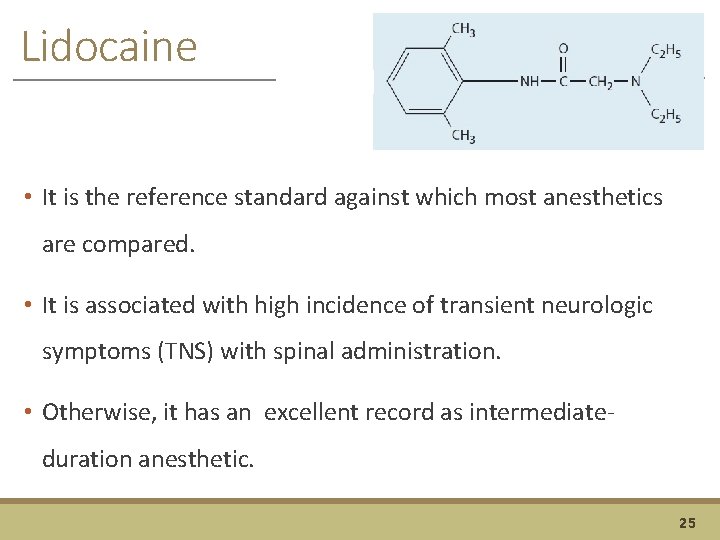
Lidocaine • It is the reference standard against which most anesthetics are compared. • It is associated with high incidence of transient neurologic symptoms (TNS) with spinal administration. • Otherwise, it has an excellent record as intermediateduration anesthetic. 25
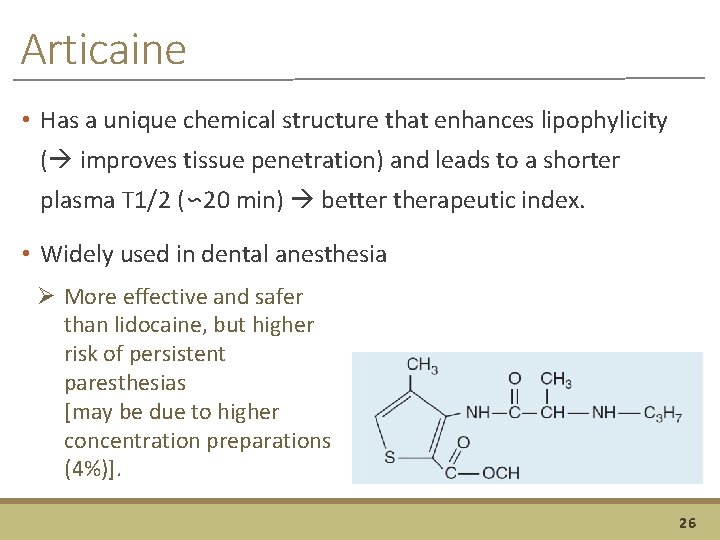
Articaine • Has a unique chemical structure that enhances lipophylicity ( improves tissue penetration) and leads to a shorter plasma T 1/2 (∽ 20 min) better therapeutic index. • Widely used in dental anesthesia Ø More effective and safer than lidocaine, but higher risk of persistent paresthesias [may be due to higher concentration preparations (4%)]. 26
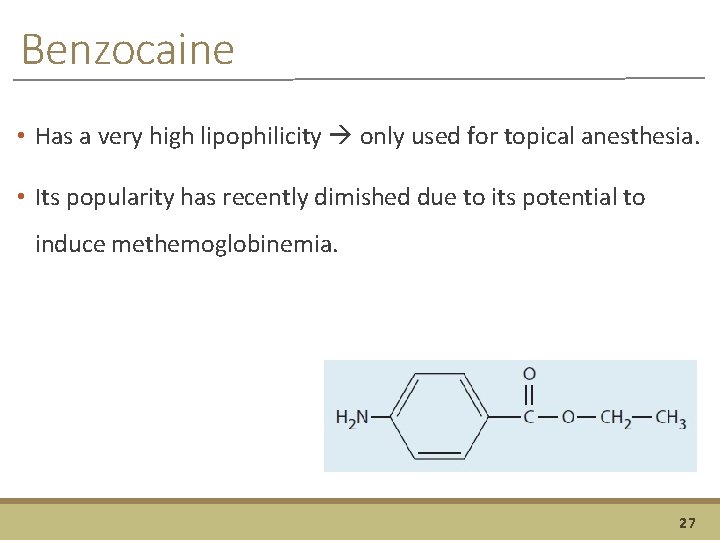
Benzocaine • Has a very high lipophilicity only used for topical anesthesia. • Its popularity has recently dimished due to its potential to induce methemoglobinemia. 27
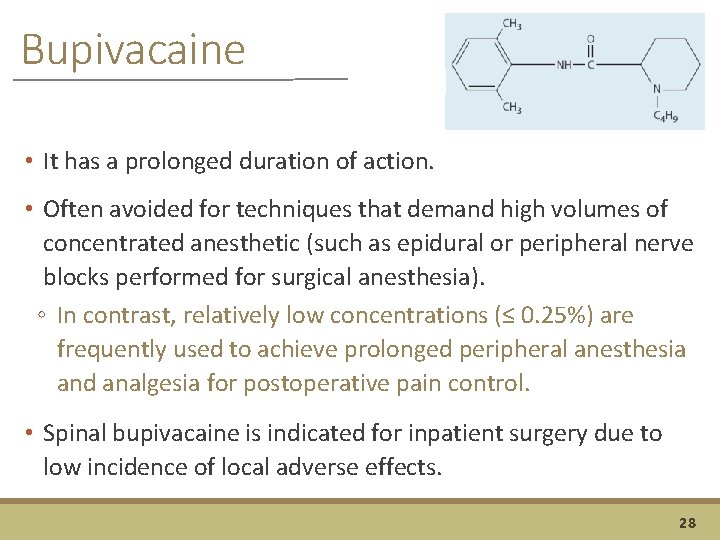
Bupivacaine • It has a prolonged duration of action. • Often avoided for techniques that demand high volumes of concentrated anesthetic (such as epidural or peripheral nerve blocks performed for surgical anesthesia). ◦ In contrast, relatively low concentrations (≤ 0. 25%) are frequently used to achieve prolonged peripheral anesthesia and analgesia for postoperative pain control. • Spinal bupivacaine is indicated for inpatient surgery due to low incidence of local adverse effects. 28
Chloroprocaine • It was extensively used in the past for obstetric anesthesia, but was later abandoned due to reports of neurologic injury. • However, it may be a good substitute for lidocaine as a spinal anesthetic. Ø Shorter onset and duration of action than lidocaine with little risk of transient neurologic symptoms. 29
Levobupivacaine • This S (–) enantiomer of bupivacaine is somewhat less cardiotoxic than the racemic mixture. • It is also less potent, and tends to have a longer duration of action ◦ but the magnitude of these effects is too small to have any substantial clinical significance. • It is more responsive to lipid sink. 30
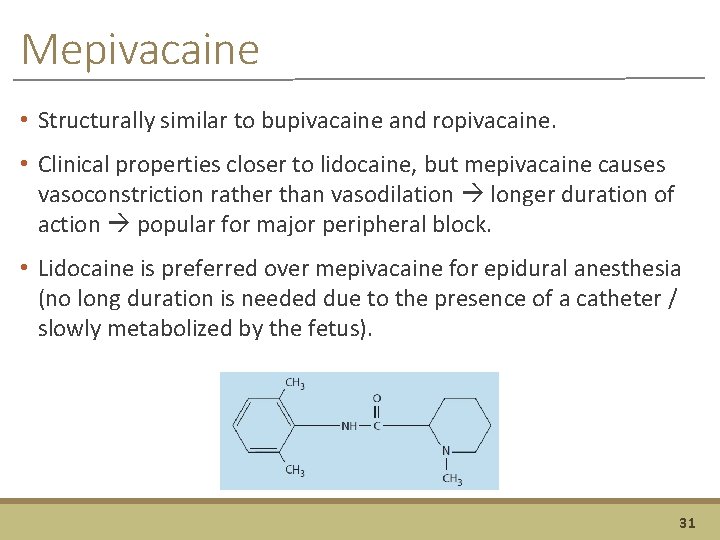
Mepivacaine • Structurally similar to bupivacaine and ropivacaine. • Clinical properties closer to lidocaine, but mepivacaine causes vasoconstriction rather than vasodilation longer duration of action popular for major peripheral block. • Lidocaine is preferred over mepivacaine for epidural anesthesia (no long duration is needed due to the presence of a catheter / slowly metabolized by the fetus). 31
Prilocaine • Has the highest clearance of the amino-amide anesthetics imparting reduced risk of systemic toxicity. ◦ However, it may induce methemoglobinemia. • Used for spinal anesthesia. • Longer duration of action than lidocaine. • Low risk of TNS. 32
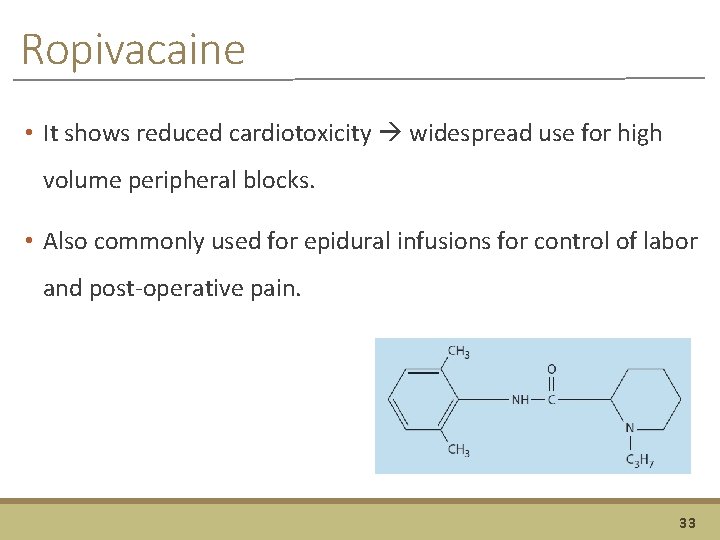
Ropivacaine • It shows reduced cardiotoxicity widespread use for high volume peripheral blocks. • Also commonly used for epidural infusions for control of labor and post-operative pain. 33
EMLA • EMLA (Eutectic Mixture of Local Anesthetics) is a mixture of 2. 5% lidocaine and 2. 5% prilocaine). ◦ Eutectic mixtures are mixtures in which the combination of elements has a lower melting temperature than its component elements. • EMLA allows penetration of the keratinized layer of the skin produces localized numbness. • Commonly used in pediatrics to anesthetize the skin prior to venipuncture for intravenous catheter placement. 34
Future developments • Drug delivery systems that can slowly release anesthetic extended duration without the drawbacks of a catheter and reducing systemic toxicity. • Agents with higher selectivity to sodium channels ◦ because anesthetic neurotoxicity does not result from blockade of the voltage-gated sodium channel effect and tissue toxicity are not mediated by a common mechanism. 35
36

Thank you for your attention 37
- Slides: 37