
Lobo Links Introduction Lobo Links Designed for students
Lobo Links Introduction
Lobo Links • Designed for students who have frequent and ongoing disruptive classroom behaviors throughout the day • Most appropriate when disruptive behaviors are motivated by adult/peer attention • Students “check-in” with an adult at the start of each school day • Students “check-out” with an adult at the conclusion of each school day • Students receive descriptive feedback from teachers throughout the day
Lobo Links ● Lobos Links Specialist and Coordinator teach expected behaviors during initial meeting and daily check-in and check-out
Lobo Links ● Students have 3 target behaviors. The coordinator and the student choose one target in each of the schoolwide expectation attributes: ○ Be Real ■ Calm ■ Open ■ Engaged ■ Truthful ○ Make Positive Choices ■ Kind ■ Respectul ■ Patient ■ Appropriate ○ Own It ■ Take Pride ■ Earn it ■ Responsible ■ Have Purpose
Lobo Links ● Typical student goal is to achieve at least 80% of the daily available points ● Students on CICO have a point card they pick up at the beginning of each day ● Students take the point card to each class ● Adults in each setting award the student 0 -2 points for appropriate behavior during the period ● Students return the CICO card to the CICO checkout adult at the end of the school day
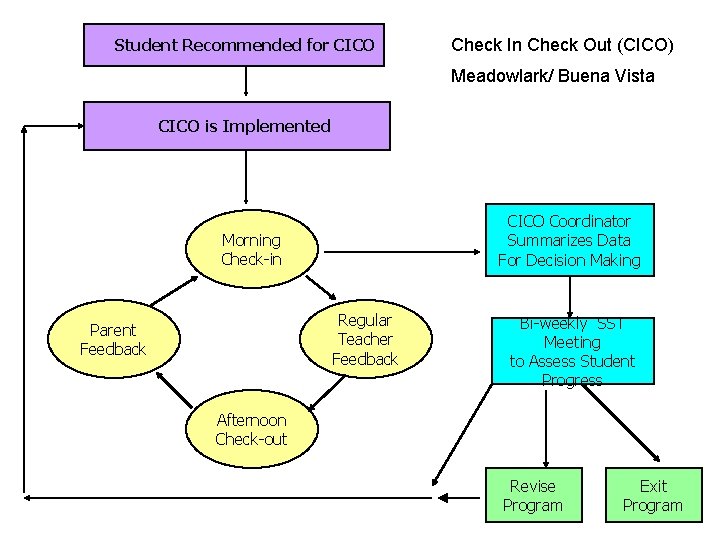
Student Recommended for CICO Check In Check Out (CICO) Meadowlark/ Buena Vista CICO is Implemented CICO Coordinator Summarizes Data For Decision Making Morning Check-in Regular Teacher Feedback Parent Feedback Bi-weekly SST Meeting to Assess Student Progress Afternoon Check-out Revise Program Exit Program
Class by Class Check-In • Student gives CICO card to teacher at the beginning of class – Location in room that does not draw peer attention – Greet student positively… • “Nice to see you today, Joe. Great job being on time. ” – Depending on time, may or may not give a brief prompt about class. • “Today we’re talking about photosynthesis. We’re going to take notes and then complete a worksheet together. ”
Class by Class Check-In • Within last 5 minutes of class: – Teacher provides a SCORE that reflects class behaviors (in consideration of schoolwide rules) • Teacher can provide a comment – positive comments encouraged • “Thanks for being on time!” • “Great questions!” • Nice work having homework done. ”
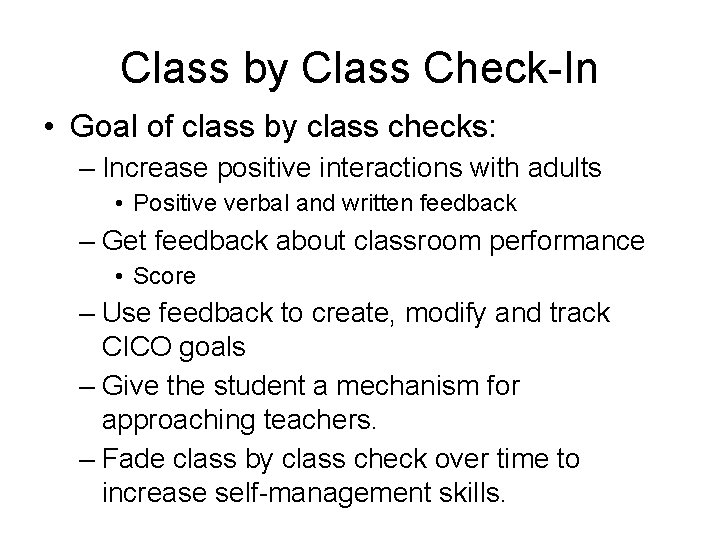
Class by Class Check-In • Goal of class by class checks: – Increase positive interactions with adults • Positive verbal and written feedback – Get feedback about classroom performance • Score – Use feedback to create, modify and track CICO goals – Give the student a mechanism for approaching teachers. – Fade class by class check over time to increase self-management skills.
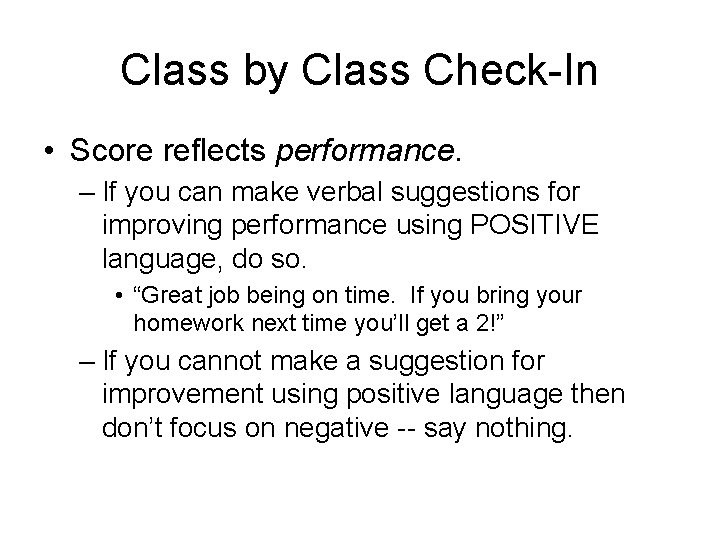
Class by Class Check-In • Score reflects performance. – If you can make verbal suggestions for improving performance using POSITIVE language, do so. • “Great job being on time. If you bring your homework next time you’ll get a 2!” – If you cannot make a suggestion for improvement using positive language then don’t focus on negative -- say nothing.
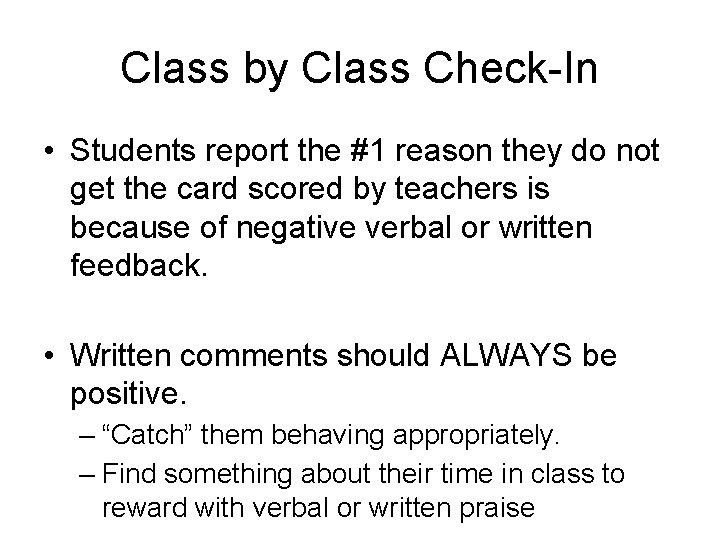
Class by Class Check-In • Students report the #1 reason they do not get the card scored by teachers is because of negative verbal or written feedback. • Written comments should ALWAYS be positive. – “Catch” them behaving appropriately. – Find something about their time in class to reward with verbal or written praise
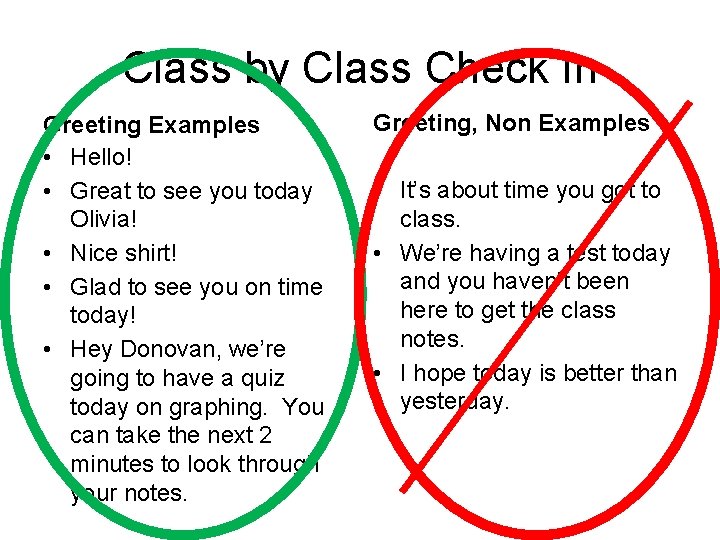
Class by Class Check In Greeting Examples • Hello! • Great to see you today Olivia! • Nice shirt! • Glad to see you on time today! • Hey Donovan, we’re going to have a quiz today on graphing. You can take the next 2 minutes to look through your notes. Greeting, Non Examples • It’s about time you got to class. • We’re having a test today and you haven’t been here to get the class notes. • I hope today is better than yesterday.
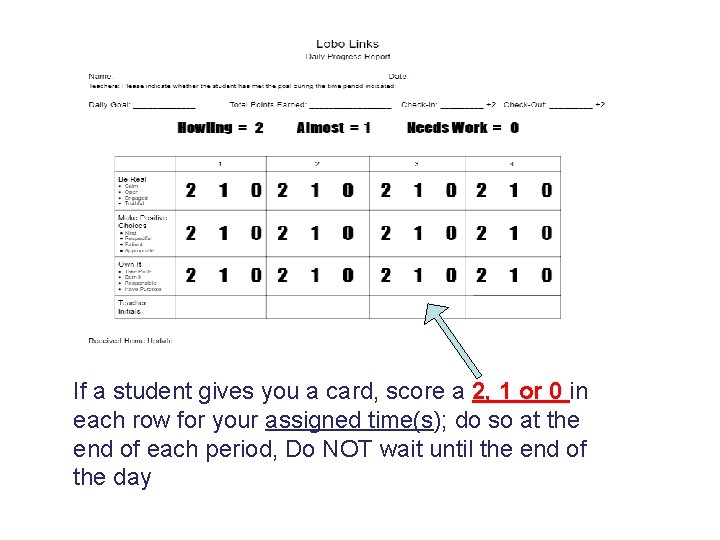
If a student gives you a card, score a 2, 1 or 0 in each row for your assigned time(s); do so at the end of each period, Do NOT wait until the end of the day
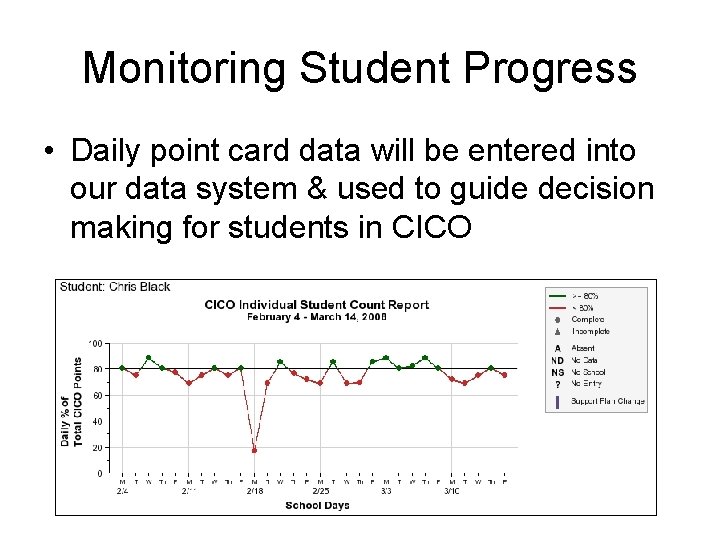
Monitoring Student Progress • Daily point card data will be entered into our data system & used to guide decision making for students in CICO Baseline Check In Check Out
Rewards & Home Component • Students earn rewards once they have earned enough points. Points needed to earn specific rewards are negotiated with the CICO coordinator
Home Component • Students take the CICO card home each night* • Parents sign the CICO card and prompt the student to return the card • Parents are asked to provide acknowledgement and praise when the student has a good day • Parents are asked not to reprimand the student after an unsuccessful day • The CICO card is to praise desirable behavior and not re-punish inappropriate behaviors
Questions or Suggestions • Thank you!
- Slides: 17