
Loading PorousWall Hollow Glass Microspheres for Security Printing
- Slides: 1
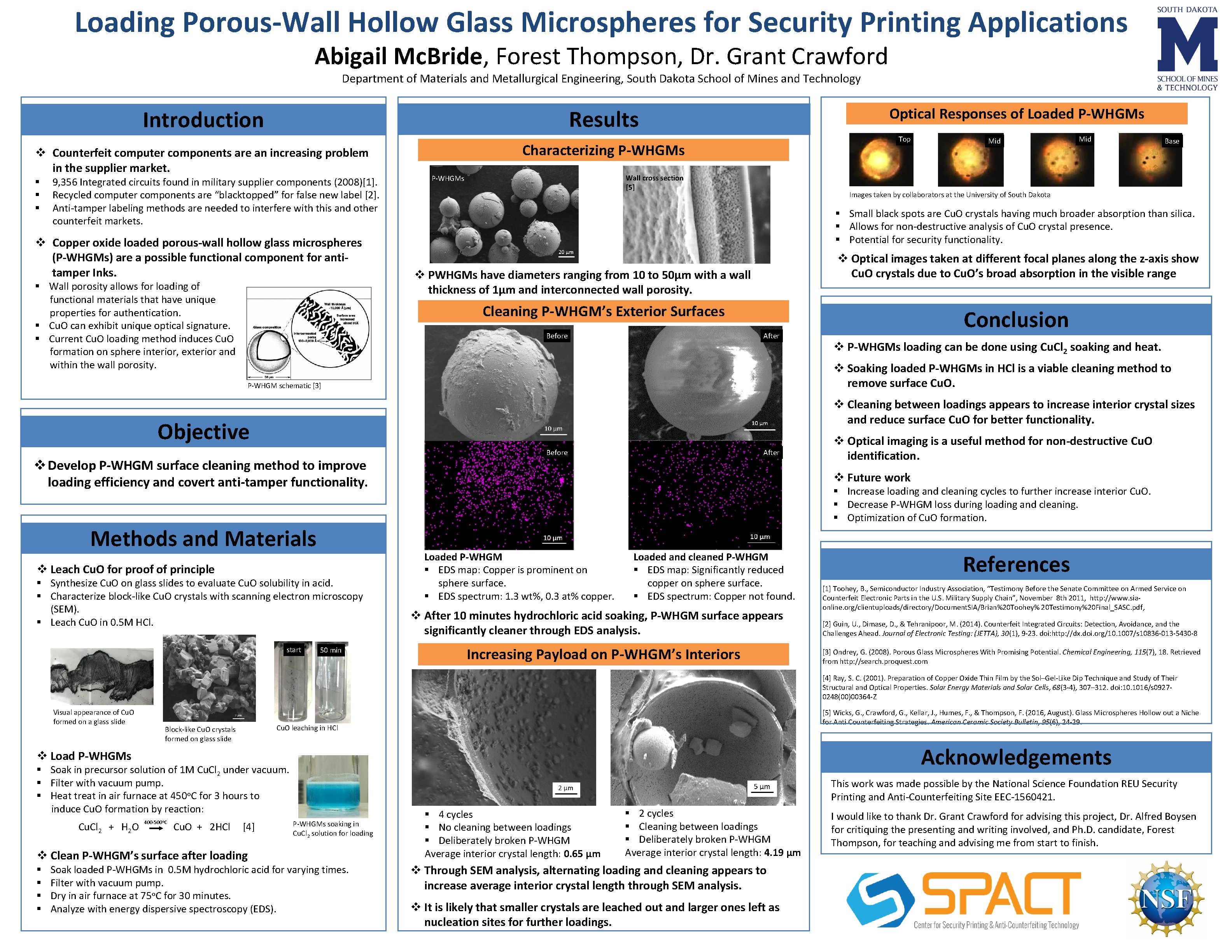
Loading Porous-Wall Hollow Glass Microspheres for Security Printing Applications Abigail Mc. Bride, Forest Thompson, Dr. Grant Crawford Department of Materials and Metallurgical Engineering, South Dakota School of Mines and Technology Results Introduction v Counterfeit computer components are an increasing problem in the supplier market. § § § Optical Responses of Loaded P-WHGMs 9, 356 Integrated circuits found in military supplier components (2008)[1]. Recycled computer components are “blacktopped” for false new label [2]. Anti-tamper labeling methods are needed to interfere with this and other counterfeit markets. v Copper oxide loaded porous-wall hollow glass microspheres (P-WHGMs) are a possible functional component for antitamper Inks. § Wall porosity allows for loading of functional materials that have unique properties for authentication. § Cu. O can exhibit unique optical signature. § Current Cu. O loading method induces Cu. O formation on sphere interior, exterior and within the wall porosity. Top Characterizing P-WHGMs Wall cross section [5] P-WHGMs Mid Base Images taken by collaborators at the University of South Dakota § Small black spots are Cu. O crystals having much broader absorption than silica. § Allows for non-destructive analysis of Cu. O crystal presence. § Potential for security functionality. v Optical images taken at different focal planes along the z-axis show Cu. O crystals due to Cu. O’s broad absorption in the visible range v PWHGMs have diameters ranging from 10 to 50μm with a wall thickness of 1μm and interconnected wall porosity. Cleaning P-WHGM’s Exterior Surfaces Before After Conclusion v P-WHGMs loading can be done using Cu. Cl 2 soaking and heat. v Soaking loaded P-WHGMs in HCl is a viable cleaning method to remove surface Cu. O. P-WHGM schematic [3] v Cleaning between loadings appears to increase interior crystal sizes and reduce surface Cu. O for better functionality. Objective v Develop P-WHGM surface cleaning method to improve loading efficiency and covert anti-tamper functionality. Methods and Materials v Leach Cu. O for proof of principle § Synthesize Cu. O on glass slides to evaluate Cu. O solubility in acid. § Characterize block-like Cu. O crystals with scanning electron microscopy (SEM). § Leach Cu. O in 0. 5 M HCl. start 50 min Before After v Optical imaging is a useful method for non-destructive Cu. O identification. v Future work § Increase loading and cleaning cycles to further increase interior Cu. O. § Decrease P-WHGM loss during loading and cleaning. § Optimization of Cu. O formation. Loaded P-WHGM § EDS map: Copper is prominent on sphere surface. § EDS spectrum: 1. 3 wt%, 0. 3 at% copper. Loaded and cleaned P-WHGM § EDS map: Significantly reduced copper on sphere surface. § EDS spectrum: Copper not found. v After 10 minutes hydrochloric acid soaking, P-WHGM surface appears significantly cleaner through EDS analysis. Increasing Payload on P-WHGM’s Interiors References [1] Toohey, B. , Semiconductor Industry Association, “Testimony Before the Senate Committee on Armed Service on Counterfeit Electronic Parts in the U. S. Military Supply Chain”, November 8 th 2011, http: //www. siaonline. org/clientuploads/directory/Document. SIA/Brian%20 Toohey% 20 Testimony%20 Final_SASC. pdf, [2] Guin, U. , Dimase, D. , & Tehranipoor, M. (2014). Counterfeit Integrated Circuits: Detection, Avoidance, and the Challenges Ahead. Journal of Electronic Testing: (JETTA), 30(1), 9 -23. doi: http: //dx. doi. org/10. 1007/s 10836 -013 -5430 -8 [3] Ondrey, G. (2008). Porous Glass Microspheres With Promising Potential. Chemical Engineering, 115(7), 18. Retrieved from http: //search. proquest. com [4] Ray, S. C. (2001). Preparation of Copper Oxide Thin Film by the Sol–Gel-Like Dip Technique and Study of Their Structural and Optical Properties. Solar Energy Materials and Solar Cells, 68(3 -4), 307– 312. doi: 10. 1016/s 09270248(00)00364 -Z Visual appearance of Cu. O formed on a glass slide [5] Wicks, G. , Crawford, G. , Kellar, J. , Humes, F. , & Thompson, F. (2016, August). Glass Microspheres Hollow out a Niche for Anti Counterfeiting Strategies. American Ceramic Society Bulletin, 95(6), 24 -29. Cu. O leaching in HCl Block-like Cu. O crystals formed on glass slide Acknowledgements v Load P-WHGMs § Soak in precursor solution of 1 M Cu. Cl 2 under vacuum. § Filter with vacuum pump. § Heat treat in air furnace at 450 o. C for 3 hours to induce Cu. O formation by reaction: Cu. Cl 2 + H 2 O 400 -500 o. C Cu. O + 2 HCl [4] v Clean P-WHGM’s surface after loading § § This work was made possible by the National Science Foundation REU Security Printing and Anti-Counterfeiting Site EEC-1560421. P-WHGMs soaking in Cu. Cl 2 solution for loading Soak loaded P-WHGMs in 0. 5 M hydrochloric acid for varying times. Filter with vacuum pump. Dry in air furnace at 75 o. C for 30 minutes. Analyze with energy dispersive spectroscopy (EDS). § 4 cycles § No cleaning between loadings § Deliberately broken P-WHGM Average interior crystal length: 0. 65 μm § 2 cycles § Cleaning between loadings § Deliberately broken P-WHGM Average interior crystal length: 4. 19 μm v Through SEM analysis, alternating loading and cleaning appears to increase average interior crystal length through SEM analysis. v It is likely that smaller crystals are leached out and larger ones left as nucleation sites for further loadings. I would like to thank Dr. Grant Crawford for advising this project, Dr. Alfred Boysen for critiquing the presenting and writing involved, and Ph. D. candidate, Forest Thompson, for teaching and advising me from start to finish.