
Loading and Unloading the School Bus Safely KEEPING
Loading and Unloading the School Bus Safely KEEPING OUR CHILDREN SAFE, AND WHAT DO THOSE FLASHING LIGHTS REALLY MEAN?
Introduction Bus drivers have the responsibility of inspecting the school bus each morning to ensure that it is safe to operate. They also must manage the behavior of kids on the bus while operating the bus in a safe and defensive manner, loading and unloading the school bus several times each school day. The most dangerous part of a school bus ride is loading and unloading children. As bus drivers, parents, educators and drivers on the road, we all need to do our part in keeping our children safe.
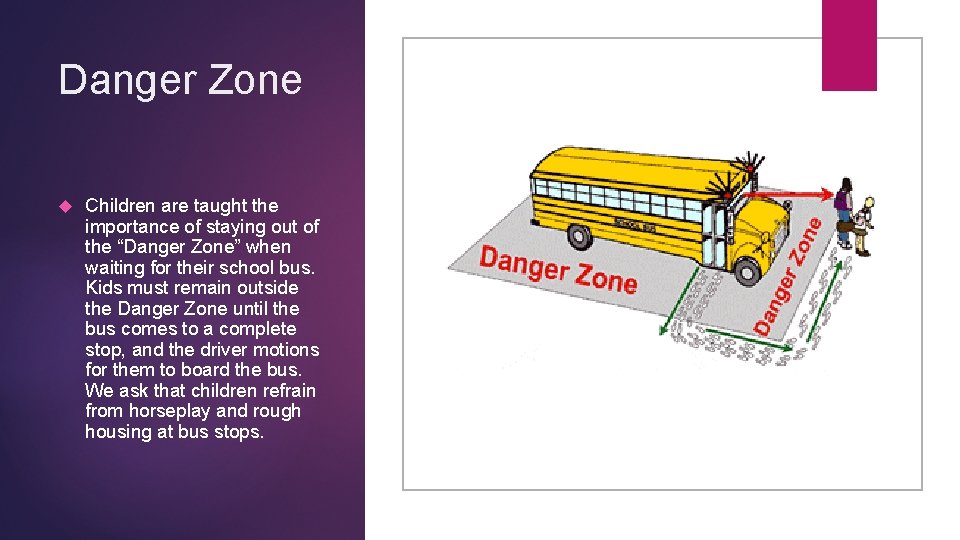
Danger Zone Children are taught the importance of staying out of the “Danger Zone” when waiting for their school bus. Kids must remain outside the Danger Zone until the bus comes to a complete stop, and the driver motions for them to board the bus. We ask that children refrain from horseplay and rough housing at bus stops.
Loading and Unloading Students Safely When children are waiting for their bus, they must wait outside of the Danger Zone and away from the road. If a student is on the other side of the road from the bus, they must wait until traffic is clear and their bus driver signals them to cross. It is important for the student to make eye contact with the driver. When boarding the bus, children should use the handrail. Children must walk to their seats, not run. Once at their seat, they should remove their back pack, ensure all loose items are stowed away in their pack and place their pack on their lap, sitting up straight with their feet in front them. It is important that children use a quiet voice on the bus, so not to provide distraction to the driver. Students must remain seated for the duration of the trip.
What are those flashing lights for? Each School Bus is equipped with yellow amber warning lights and red stop lights as well as a stop sign and crossing arm. But what do these mean? A school bus driver is required to activate their flashing amber warning lights approx. 150 -250 feet from where they will be stopping the bus to pick up a child. These lights indicate to the drivers behind approaching them, to SLOW DOWN and prepare to STOP. These lights do not mean to speed up and try to pass the bus. As the bus is coming to a complete stop, they will indicate that with their Red Lights, Stop Sign and Crossing Arm. All traffic must now stop and remain stopped until the school bus turns off the lights and resumes operating.
What happens if a driver does not stop? More and more buses are being equipped with cameras that will capture footage and a license plates of vehicles that do not adhere to Load Lights (amber and red lights). What does the Transportation Department do with that info? ALL Load Light Violations are reported to the RCMP. There is a zero tolerance for these violations. Failure to stop for a school bus may result in a $368 fine and 3 points on your drivers license, even though it may appear that no one is watching. If that isn't enough to encourage you to stop for a school bus, how would you feel if you struck a child because you were “In a hurry”, or just had to “quickly reply to a text”. Perhaps you didn’t know what the flashing lights on a school bus meant. No excuses. Lets keep our children SAFE!
Things to consider Weather Distractions Road Conditions All drivers need to be aware that the weather and road conditions greatly impact a vehicles stopping distance and capabilities. For instance, if the sun is glaring in your eyes, you may notice the bus activate their load lights. As drivers, we have distractions in our own vehicles to be aware of, such as, music, passengers talking and conversations. Perhaps your drinking your morning coffee or eating your breakfast. As a responsible driver, your only focus while behind the wheel should be the road. All it takes is be distracted for a moment and you may change your life or someone else’s life forever. If the roads are icy, you will require greater stopping distance than you would on bare pavement. Ensure that you know how to operate a vehicle safely in all road conditions.
Pop Quiz 1). The most dangerous part of a school bus ride for students is getting on and off the bus. TRUE or FALSE 2). Amber lights should be activated from: a). 50 -150 feet before reaching stop b). 150 -250 feet before reaching stop c). 250 -350 feet before reaching stop 3). Students only use a handrail if their backpacks are too heavy. TRUE or FALSE 4). Even if a buses red lights are on, emergency vehicles have the right of way. TRUE or FALSE
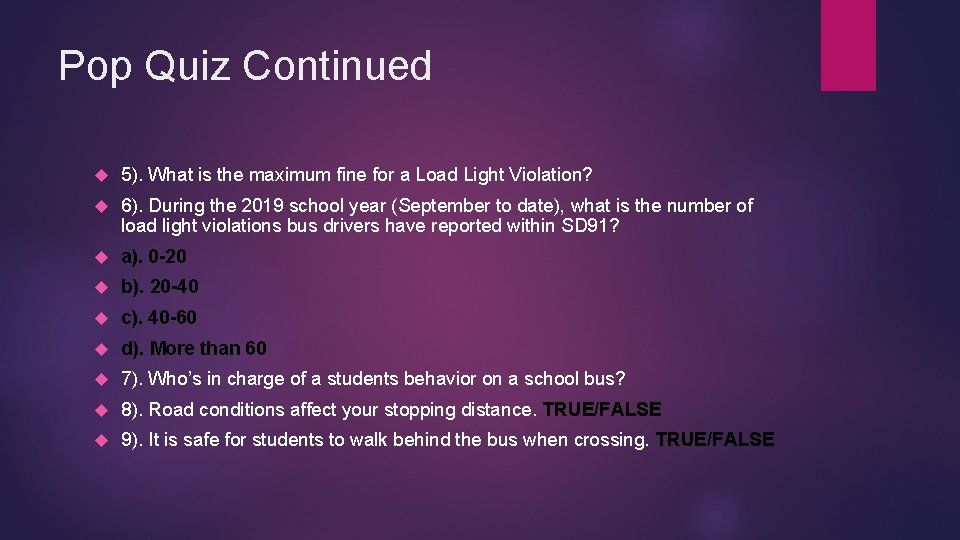
Pop Quiz Continued 5). What is the maximum fine for a Load Light Violation? 6). During the 2019 school year (September to date), what is the number of load light violations bus drivers have reported within SD 91? a). 0 -20 b). 20 -40 c). 40 -60 d). More than 60 7). Who’s in charge of a students behavior on a school bus? 8). Road conditions affect your stopping distance. TRUE/FALSE 9). It is safe for students to walk behind the bus when crossing. TRUE/FALSE
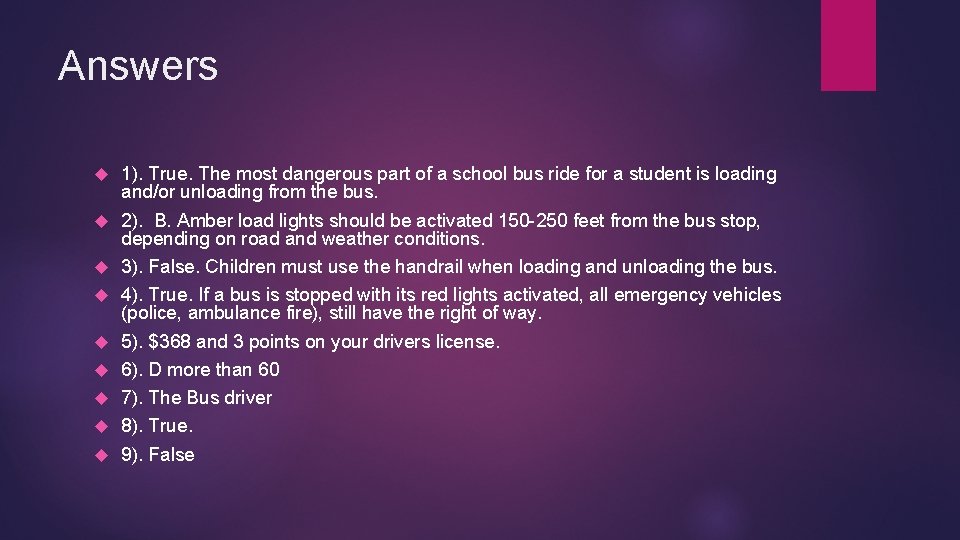
Answers 1). True. The most dangerous part of a school bus ride for a student is loading and/or unloading from the bus. 2). B. Amber load lights should be activated 150 -250 feet from the bus stop, depending on road and weather conditions. 3). False. Children must use the handrail when loading and unloading the bus. 4). True. If a bus is stopped with its red lights activated, all emergency vehicles (police, ambulance fire), still have the right of way. 5). $368 and 3 points on your drivers license. 6). D more than 60 7). The Bus driver 8). True. 9). False
- Slides: 10