
LOAD SAFETY A LOAD RESTRAINT GUIDE FOR DRIVERS

- Slides: 28
LOAD SAFETY A LOAD RESTRAINT GUIDE FOR DRIVERS and THEIR SUPERVISORS JUNE 2002 June 2002 1
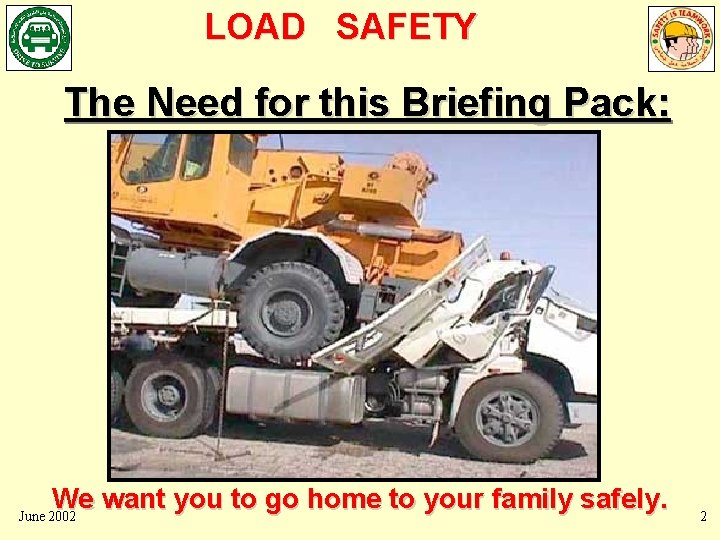
LOAD SAFETY The Need for this Briefing Pack: We want you to go home to your family safely. June 2002 2
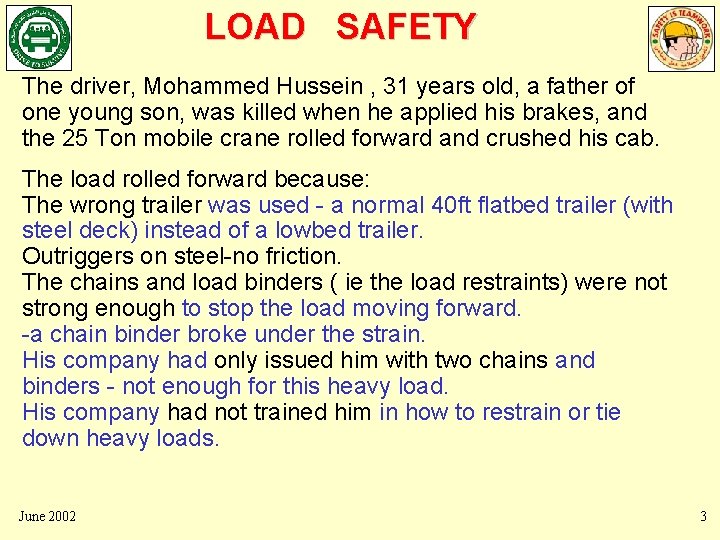
LOAD SAFETY The driver, Mohammed Hussein , 31 years old, a father of one young son, was killed when he applied his brakes, and the 25 Ton mobile crane rolled forward and crushed his cab. The load rolled forward because: The wrong trailer was used - a normal 40 ft flatbed trailer (with steel deck) instead of a lowbed trailer. Outriggers on steel-no friction. The chains and load binders ( ie the load restraints) were not strong enough to stop the load moving forward. -a chain binder broke under the strain. His company had only issued him with two chains and binders - not enough for this heavy load. His company had not trained him in how to restrain or tie down heavy loads. June 2002 3
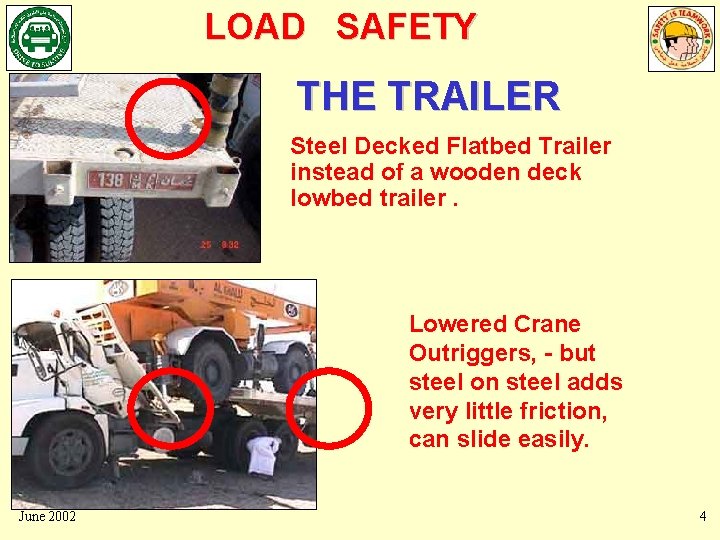
LOAD SAFETY THE TRAILER Steel Decked Flatbed Trailer instead of a wooden deck lowbed trailer. Lowered Crane Outriggers, - but steel on steel adds very little friction, can slide easily. June 2002 4
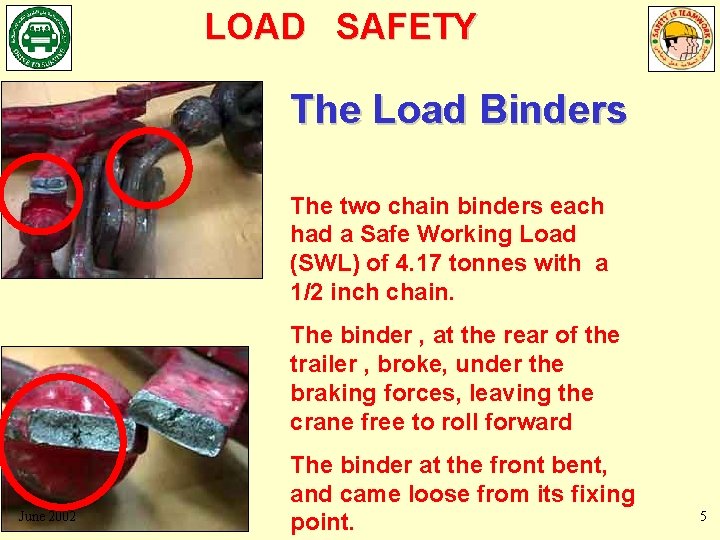
LOAD SAFETY The Load Binders The two chain binders each had a Safe Working Load (SWL) of 4. 17 tonnes with a 1/2 inch chain. The binder , at the rear of the trailer , broke, under the braking forces, leaving the crane free to roll forward June 2002 The binder at the front bent, and came loose from its fixing point. 5
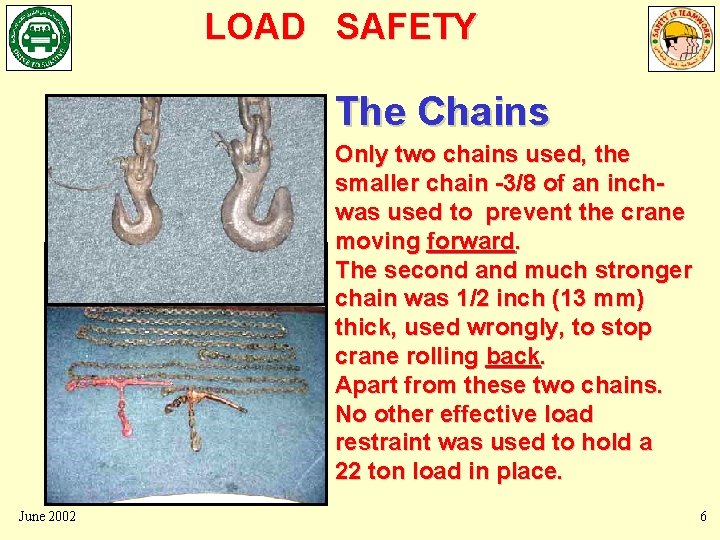
LOAD SAFETY The Chains Only two chains used, the smaller chain -3/8 of an inchwas used to prevent the crane moving forward. The second and much stronger chain was 1/2 inch (13 mm) thick, used wrongly, to stop crane rolling back. Apart from these two chains. No other effective load restraint was used to hold a 22 ton load in place. June 2002 6
LOAD SAFETY To summarise this fatal accident: • The crane, weighing 22 Tonnes was inadequately restrained from moving in a forward direction • Inadequate chainage, not enough of them, wrong angle, wrong size. • No chocks at the wheels to add resistance/friction • Wrong Trailer, no protection for driver if things went wrong • Steel trailer deck meant steel crane outriggers added only minimal resistance compared to a wooden deck. • The managers, supervisors and drivers did not know how to transport and restrain such a load correctly. Mohammed did not have to die. June 2002 7
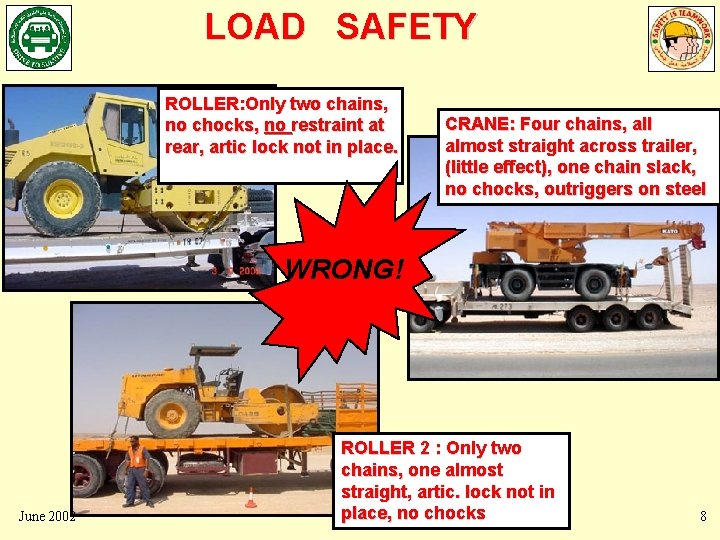
LOAD SAFETY ROLLER: Only two chains, no chocks, no restraint at rear, artic lock not in place. CRANE: Four chains, all almost straight across trailer, (little effect), one chain slack, no chocks, outriggers on steel WRONG! June 2002 ROLLER 2 : Only two chains, one almost straight, artic. lock not in place, no chocks 8
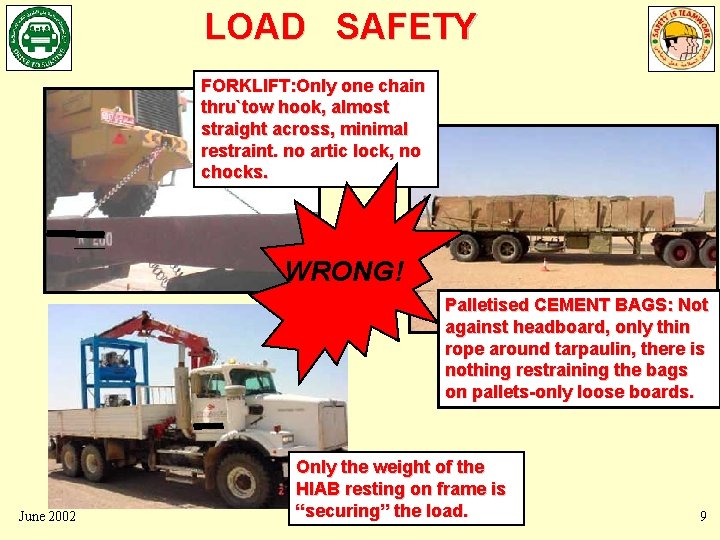
LOAD SAFETY FORKLIFT: Only one chain thru`tow hook, almost straight across, minimal restraint. no artic lock, no chocks. WRONG! Palletised CEMENT BAGS: Not against headboard, only thin rope around tarpaulin, there is nothing restraining the bags on pallets-only loose boards. June 2002 Only the weight of the HIAB resting on frame is “securing” the load. 9
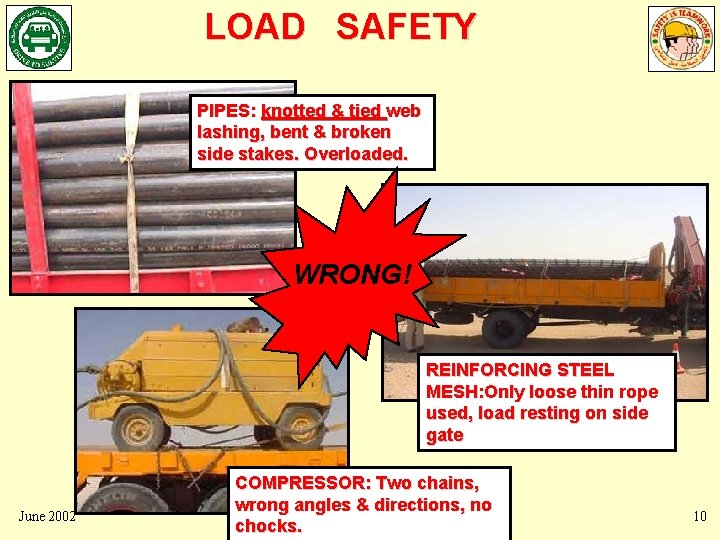
LOAD SAFETY PIPES: knotted & tied web lashing, bent & broken side stakes. Overloaded. WRONG! REINFORCING STEEL MESH: Only loose thin rope used, load resting on side gate June 2002 COMPRESSOR: Two chains, wrong angles & directions, no chocks. 10
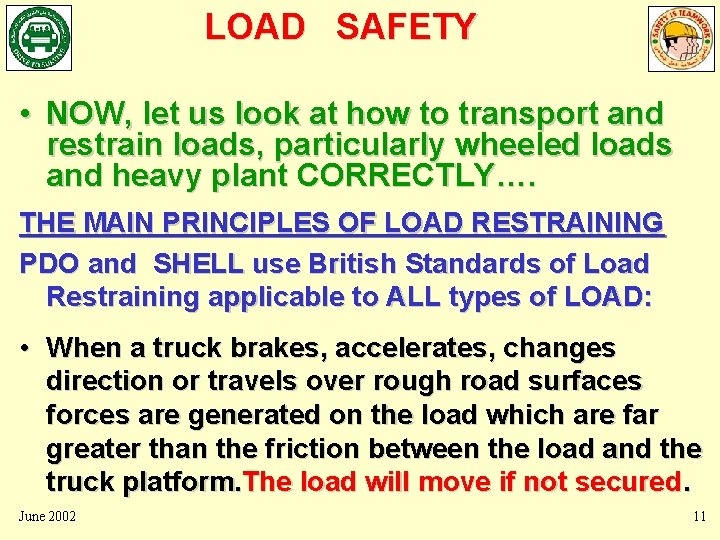
LOAD SAFETY • NOW, let us look at how to transport and restrain loads, particularly wheeled loads and heavy plant CORRECTLY…. THE MAIN PRINCIPLES OF LOAD RESTRAINING PDO and SHELL use British Standards of Load Restraining applicable to ALL types of LOAD: • When a truck brakes, accelerates, changes direction or travels over rough road surfaces forces are generated on the load which are far greater than the friction between the load and the truck platform. The load will move if not secured. June 2002 11
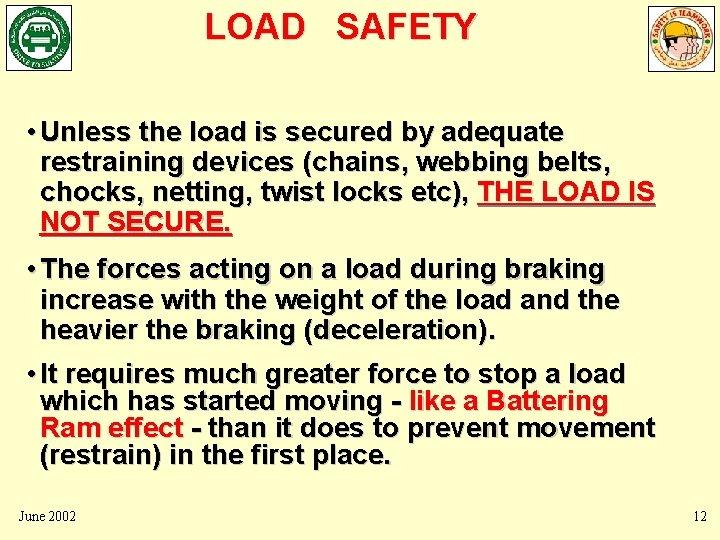
LOAD SAFETY • Unless the load is secured by adequate restraining devices (chains, webbing belts, chocks, netting, twist locks etc), THE LOAD IS NOT SECURE. • The forces acting on a load during braking increase with the weight of the load and the heavier the braking (deceleration). • It requires much greater force to stop a load which has started moving - like a Battering Ram effect - than it does to prevent movement (restrain) in the first place. June 2002 12
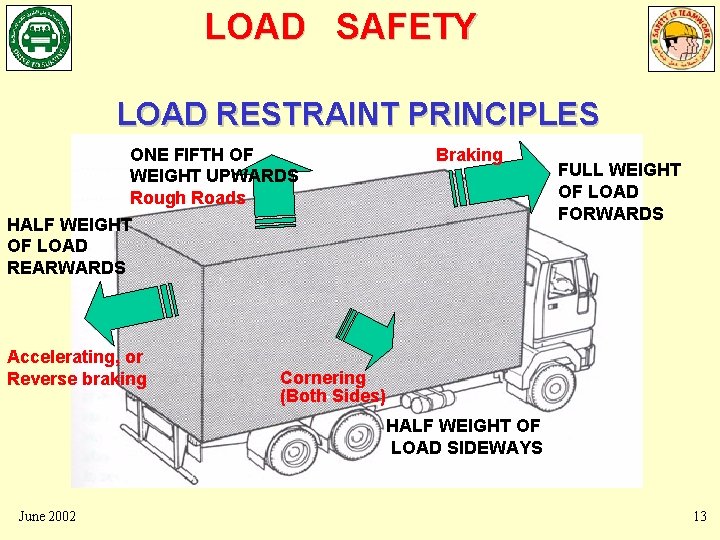
LOAD SAFETY LOAD RESTRAINT PRINCIPLES ONE FIFTH OF WEIGHT UPWARDS Rough Roads HALF WEIGHT OF LOAD REARWARDS Accelerating, or Reverse braking Braking FULL WEIGHT OF LOAD FORWARDS Cornering (Both Sides) HALF WEIGHT OF LOAD SIDEWAYS June 2002 13
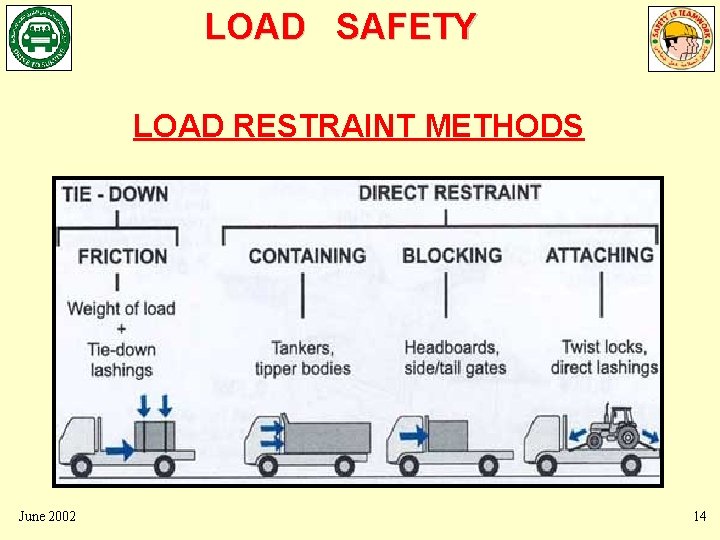
LOAD SAFETY LOAD RESTRAINT METHODS June 2002 14
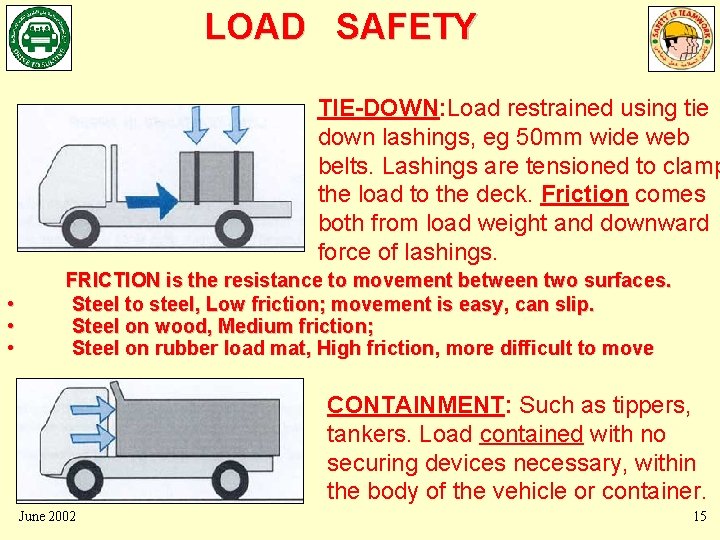
LOAD SAFETY TIE-DOWN: Load restrained using tie down lashings, eg 50 mm wide web belts. Lashings are tensioned to clamp the load to the deck. Friction comes both from load weight and downward force of lashings. • • • FRICTION is the resistance to movement between two surfaces. Steel to steel, Low friction; movement is easy, can slip. Steel on wood, Medium friction; Steel on rubber load mat, High friction, more difficult to move CONTAINMENT: Such as tippers, tankers. Load contained with no securing devices necessary, within the body of the vehicle or container. June 2002 15
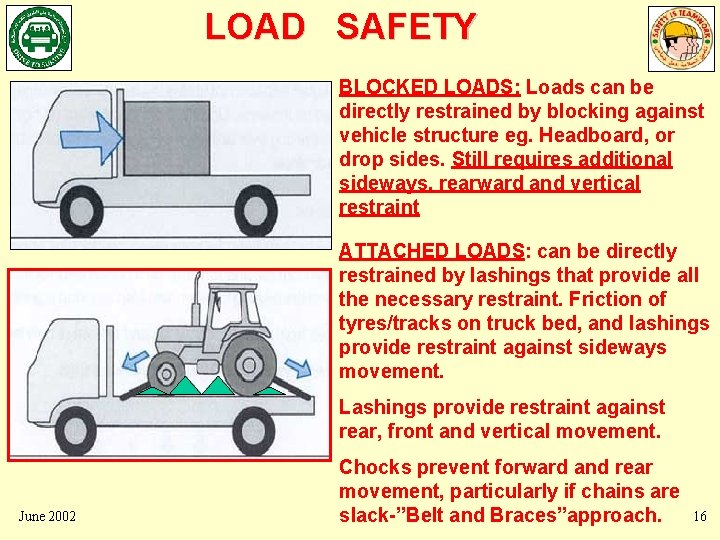
LOAD SAFETY BLOCKED LOADS: Loads can be directly restrained by blocking against vehicle structure eg. Headboard, or drop sides. Still requires additional sideways, rearward and vertical restraint ATTACHED LOADS: can be directly restrained by lashings that provide all the necessary restraint. Friction of tyres/tracks on truck bed, and lashings provide restraint against sideways movement. Lashings provide restraint against rear, front and vertical movement. June 2002 Chocks prevent forward and rear movement, particularly if chains are slack-”Belt and Braces”approach. 16
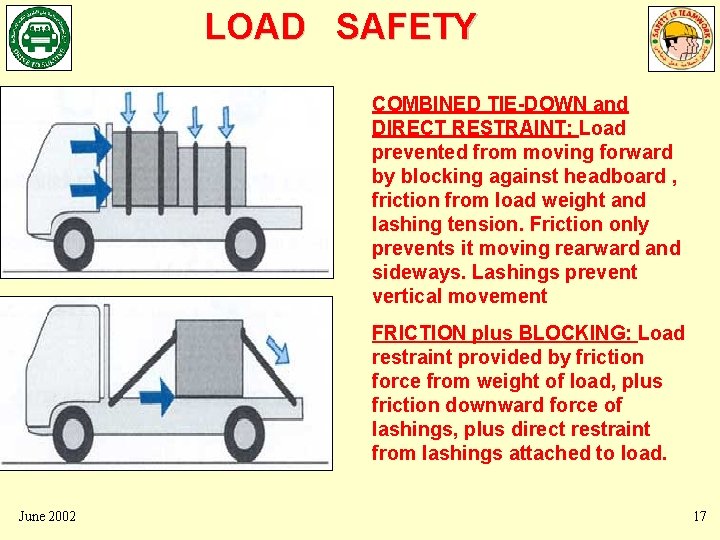
LOAD SAFETY COMBINED TIE-DOWN and DIRECT RESTRAINT: Load prevented from moving forward by blocking against headboard , friction from load weight and lashing tension. Friction only prevents it moving rearward and sideways. Lashings prevent vertical movement FRICTION plus BLOCKING: Load restraint provided by friction force from weight of load, plus friction downward force of lashings, plus direct restraint from lashings attached to load. June 2002 17
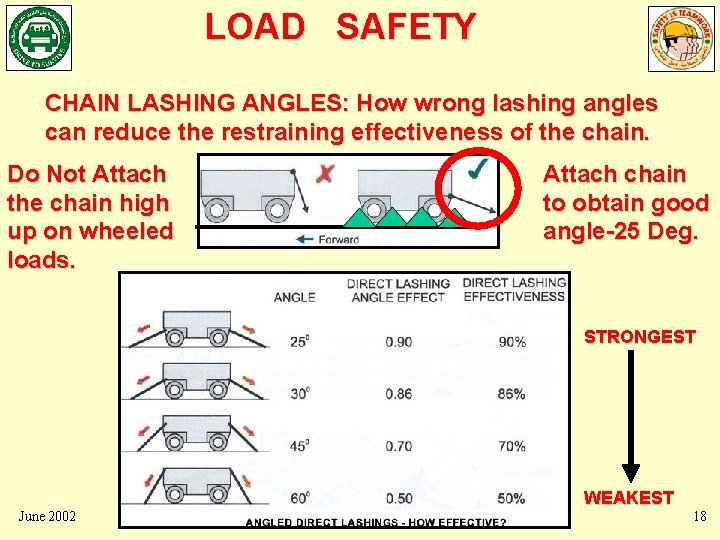
LOAD SAFETY CHAIN LASHING ANGLES: How wrong lashing angles can reduce the restraining effectiveness of the chain. Do Not Attach the chain high up on wheeled loads. Attach chain to obtain good angle-25 Deg. STRONGEST WEAKEST June 2002 18
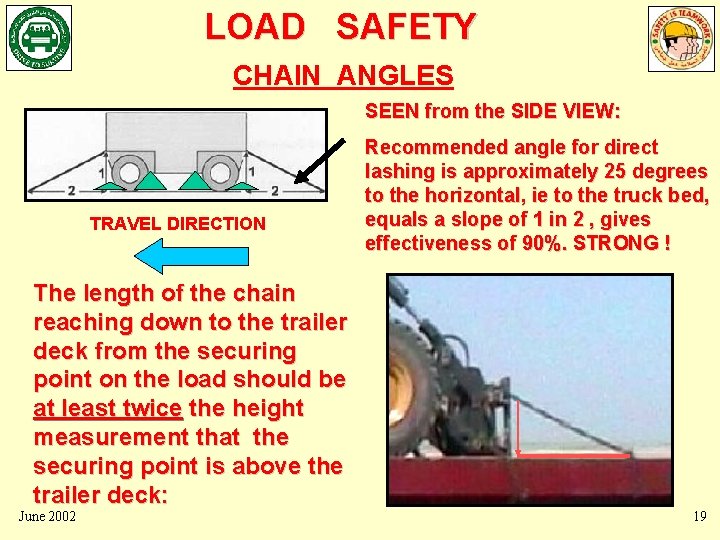
LOAD SAFETY CHAIN ANGLES SEEN from the SIDE VIEW: TRAVEL DIRECTION Recommended angle for direct lashing is approximately 25 degrees to the horizontal, ie to the truck bed, equals a slope of 1 in 2 , gives effectiveness of 90%. STRONG ! The length of the chain reaching down to the trailer deck from the securing point on the load should be at least twice the height measurement that the securing point is above the trailer deck: June 2002 19
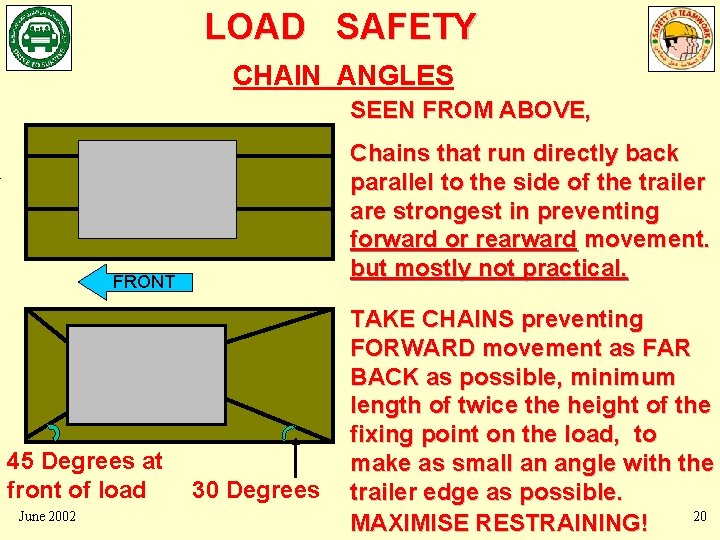
LOAD SAFETY CHAIN ANGLES SEEN FROM ABOVE, TRAVEL DIRECTION FRONT 45 Degrees at front of load June 2002 30 Degrees Chains that run directly back parallel to the side of the trailer are strongest in preventing forward or rearward movement. but mostly not practical. TAKE CHAINS preventing FORWARD movement as FAR BACK as possible, minimum length of twice the height of the fixing point on the load, to make as small an angle with the trailer edge as possible. 20 MAXIMISE RESTRAINING!
LOAD SAFETY CHAINS: • Use I/2 inch, (13 mm chains), not smaller. Always carry a minimum of four chains (USE THEM!) and four binders. Minimum of two chains preventing forward movement. • Get the correct chain to load angles as per previous slides- both in height and direction-to maximise effect. • NEVER put chains straight across trailer between load and securing point. Totally ineffective. • KEEP CHAINS TIGHT, STOP AND CHECK: • On Blacktop roads -every 50 Kilometres • On graded roads - every 25 Kms • The Driver is responsible for the securing of his load. June 2002 21
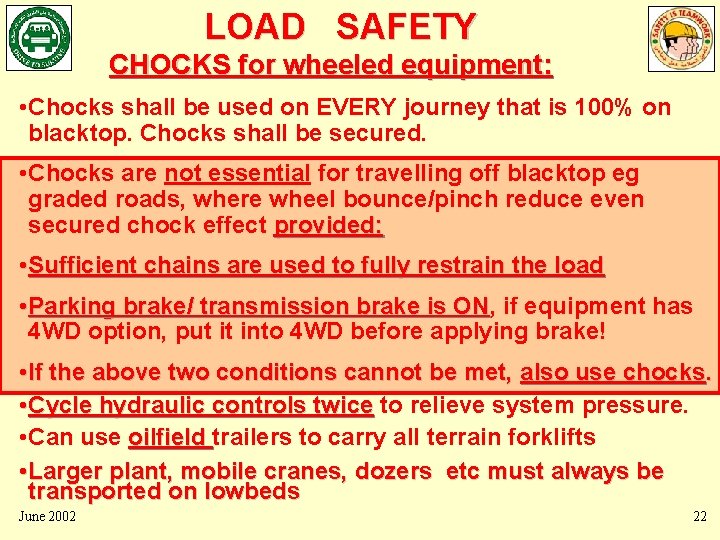
LOAD SAFETY CHOCKS for wheeled equipment: • Chocks shall be used on EVERY journey that is 100% on blacktop. Chocks shall be secured. • Chocks are not essential for travelling off blacktop eg graded roads, where wheel bounce/pinch reduce even secured chock effect provided: • Sufficient chains are used to fully restrain the load • Parking brake/ transmission brake is ON, ON if equipment has 4 WD option, put it into 4 WD before applying brake! • If the above two conditions cannot be met, also use chocks. • Cycle hydraulic controls twice to relieve system pressure. • Can use oilfield trailers to carry all terrain forklifts • Larger plant, mobile cranes, dozers etc must always be transported on lowbeds June 2002 22
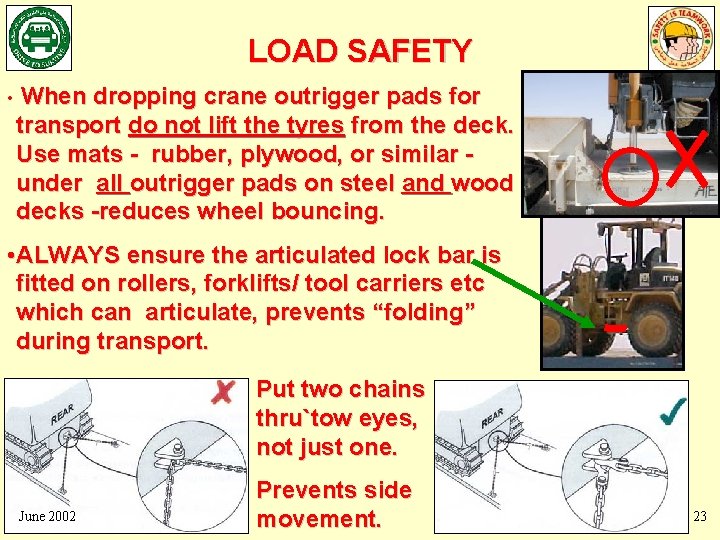
LOAD SAFETY • When dropping crane outrigger pads for transport do not lift the tyres from the deck. Use mats - rubber, plywood, or similar under all outrigger pads on steel and wood decks -reduces wheel bouncing. • ALWAYS ensure the articulated lock bar is fitted on rollers, forklifts/ tool carriers etc which can articulate, prevents “folding” during transport. Put two chains thru`tow eyes, not just one. June 2002 Prevents side movement. 23
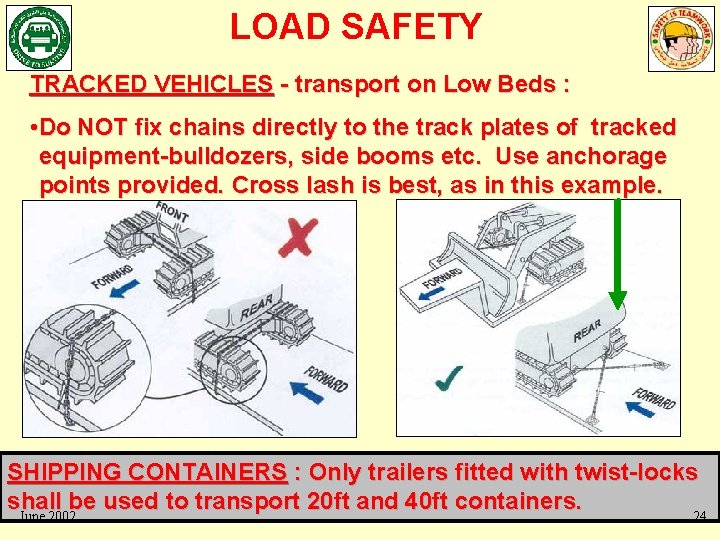
LOAD SAFETY TRACKED VEHICLES - transport on Low Beds : • Do NOT fix chains directly to the track plates of tracked equipment-bulldozers, side booms etc. Use anchorage points provided. Cross lash is best, as in this example. SHIPPING CONTAINERS : Only trailers fitted with twist-locks shall be used to transport 20 ft and 40 ft containers. June 2002 24
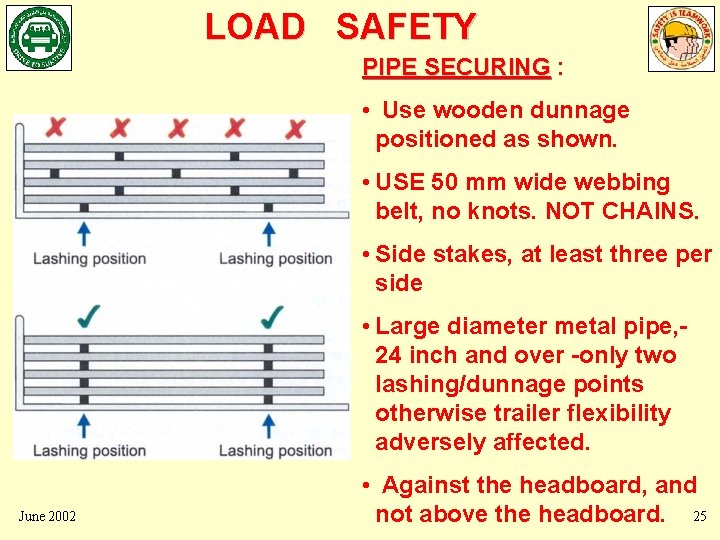
LOAD SAFETY PIPE SECURING : • Use wooden dunnage positioned as shown. • USE 50 mm wide webbing belt, no knots. NOT CHAINS. • Side stakes, at least three per side • Large diameter metal pipe, 24 inch and over -only two lashing/dunnage points otherwise trailer flexibility adversely affected. June 2002 • Against the headboard, and not above the headboard. 25
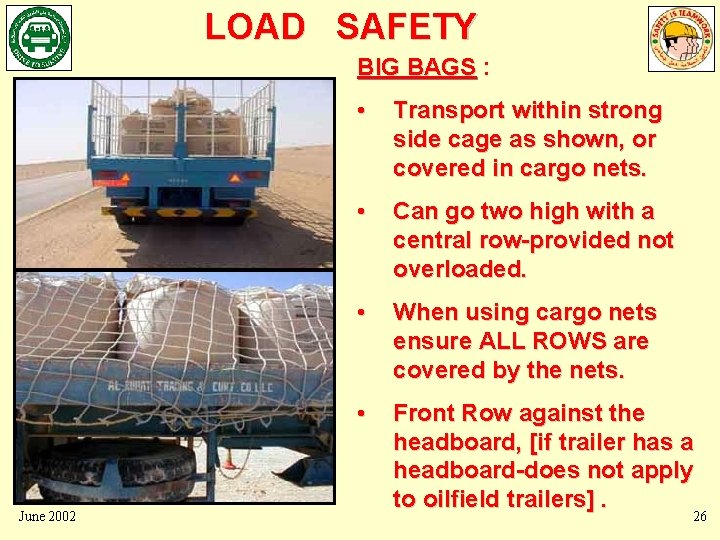
LOAD SAFETY BIG BAGS : June 2002 • Transport within strong side cage as shown, or covered in cargo nets. • Can go two high with a central row-provided not overloaded. • When using cargo nets ensure ALL ROWS are covered by the nets. • Front Row against the headboard, [if trailer has a headboard-does not apply to oilfield trailers]. 26
LOAD SAFETY NOTE to Managers/Supervisors: This presentation on load safety and load securing gives load securing principles and guidelines -- highlights and typical oilfield load examples only --these slides cannot possibly cover such a large subject in its entirety. Follow the guidelines, prevent further accidents due to faulty load securing. A more detailed PDO Spec. will be issued by end 2003. SHELL and PDO follow the British Department of Transport Load Securing Code of Practice which is on the PDO web: http: //www. pdo. co. om/hseforcontractors/dts/documents/load-DETR-COP. pdf User Name: pdohse 01 | Password: contractor 01 Another very good load securing guide with more pictures and diagrams is also available on the web : http: //www. pdo. co. om/hseforcontractors/dts/documents/load-Aust-guide. pdf User Name: pdohse 01 | Password: contractor 01 June 2002 27
LOAD SAFETY FOLLOW THE LOAD SECURING GUIDELINES The End June 2002 28