
Load Participation in SCED v 1 Overview Refresher

- Slides: 35
Load Participation in SCED v 1 Overview & Refresher ERCOT Staff DSWG Loads in SCEDv 1 April 23, 2014
Loads in SCED v 1 • Three-legged stool: – NPRR 555 – Load Resource Participation in SCED – NPRR 532 – Load Resource Participation in Non-spin – Other Binding Document – Aggregate Load Resources • All were approved in Sept. 2013 and will go live on June 1, 2014 – NOTE: ERCOT is proposing modifications to OBD – On TAC agenda for April 24 (tomorrow) April 23, 2014 2 DSWG Loads in SCEDv 1
High-level summary • Eligibility to participate: LSE QSEs representing Load Resources capable of following 5 -minute SCED base point instructions – Existing or new single-site Controllable Load Resources (CLRs) • SCED qualification will be a new attribute for redefined CLR – Aggregate Load Resources (ALRs) composed of multiple sites within single ERCOT Load Zone (subset of CLR) • Will not support direct participation by third-party DR QSEs • Will not support DR with temporal constraints or block energy bids – If LR’s bid is on the margin, base point instructions could require LR to move up or down incrementally every 5 minutes to any level between its LPC and MPC – SCED will honor LR’s telemetered ramp rates April 23, 2014 3 DSWG Loads in SCEDv 1
High-level summary (cont. ) • • QSEs with LRs in SCED will submit Bids to buy (not Offers to sell) Bids will reflect LR’s willingness to consume “up to” a specified five-minute Load Zone LMP May be a curve or a MW bid at single strike price Bid will modify the SCED demand curve and have ability to set price – SCED Generation to be Dispatched (GTBD) will be adjusted to accommodate LR participation – This will ensure proper price formation and reduce the likelihood of oscillating dispatch instructions Bids from LRs capped at the System Wide Offer Cap – This is to avoid stranded AS and PRC ‘Bid to buy’ creates settlement outcomes equivalent to the “volumetric flow” LMP minus G methodology endorsed by TAC, while avoiding need for ERCOT to “send back” the DR value to the LSE SCED will dispatch LRs for power balance and congestion management using the applicable Load Zone Shift Factor April 23, 2014 4 DSWG Loads in SCEDv 1
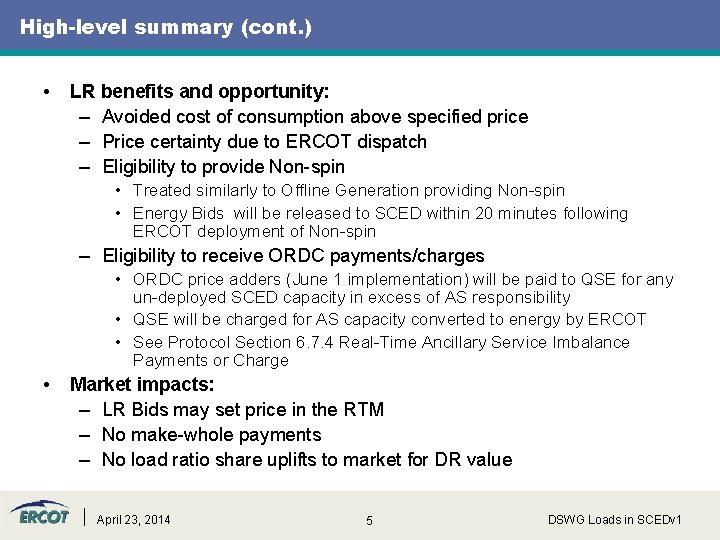
High-level summary (cont. ) • LR benefits and opportunity: – Avoided cost of consumption above specified price – Price certainty due to ERCOT dispatch – Eligibility to provide Non-spin • Treated similarly to Offline Generation providing Non-spin • Energy Bids will be released to SCED within 20 minutes following ERCOT deployment of Non-spin – Eligibility to receive ORDC payments/charges • ORDC price adders (June 1 implementation) will be paid to QSE for any un-deployed SCED capacity in excess of AS responsibility • QSE will be charged for AS capacity converted to energy by ERCOT • See Protocol Section 6. 7. 4 Real-Time Ancillary Service Imbalance Payments or Charge • Market impacts: – LR Bids may set price in the RTM – No make-whole payments – No load ratio share uplifts to market for DR value April 23, 2014 5 DSWG Loads in SCEDv 1
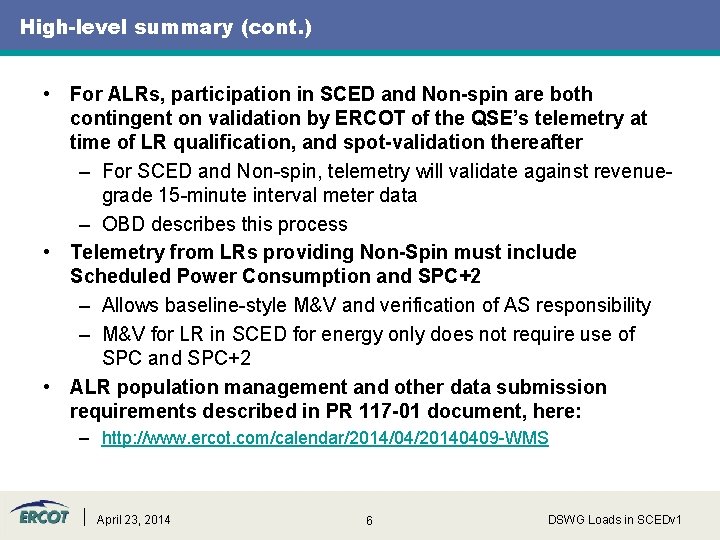
High-level summary (cont. ) • For ALRs, participation in SCED and Non-spin are both contingent on validation by ERCOT of the QSE’s telemetry at time of LR qualification, and spot-validation thereafter – For SCED and Non-spin, telemetry will validate against revenuegrade 15 -minute interval meter data – OBD describes this process • Telemetry from LRs providing Non-Spin must include Scheduled Power Consumption and SPC+2 – Allows baseline-style M&V and verification of AS responsibility – M&V for LR in SCED for energy only does not require use of SPC and SPC+2 • ALR population management and other data submission requirements described in PR 117 -01 document, here: – http: //www. ercot. com/calendar/2014/04/20140409 -WMS April 23, 2014 6 DSWG Loads in SCEDv 1
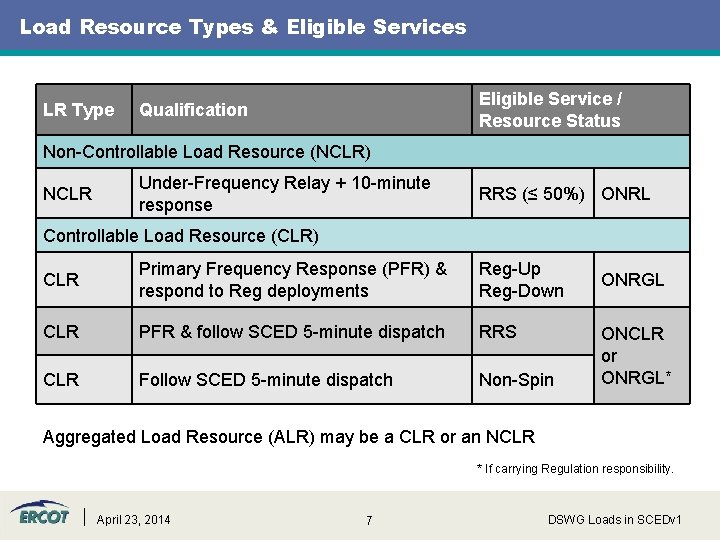
Load Resource Types & Eligible Services LR Type Eligible Service / Resource Status Qualification Non-Controllable Load Resource (NCLR) NCLR Under-Frequency Relay + 10 -minute response RRS (≤ 50%) ONRL Controllable Load Resource (CLR) CLR Primary Frequency Response (PFR) & respond to Reg deployments Reg-Up Reg-Down CLR PFR & follow SCED 5 -minute dispatch RRS CLR Follow SCED 5 -minute dispatch Non-Spin ONRGL ONCLR or ONRGL* Aggregated Load Resource (ALR) may be a CLR or an NCLR * If carrying Regulation responsibility. April 23, 2014 7 DSWG Loads in SCEDv 1
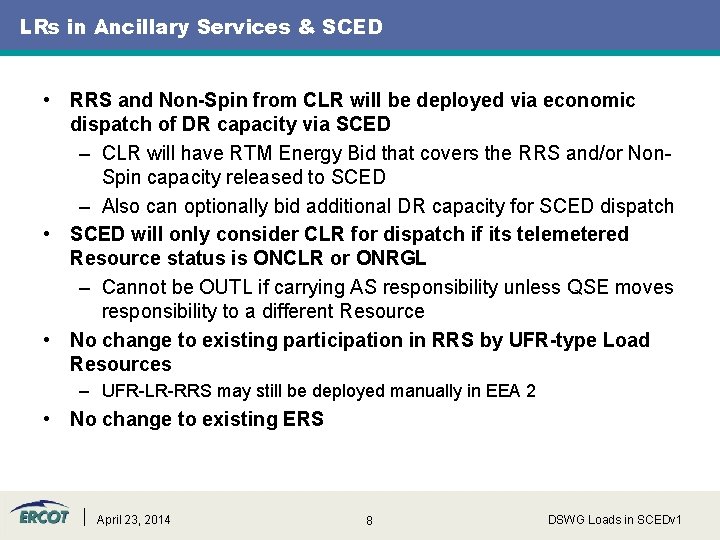
LRs in Ancillary Services & SCED • RRS and Non-Spin from CLR will be deployed via economic dispatch of DR capacity via SCED – CLR will have RTM Energy Bid that covers the RRS and/or Non. Spin capacity released to SCED – Also can optionally bid additional DR capacity for SCED dispatch • SCED will only consider CLR for dispatch if its telemetered Resource status is ONCLR or ONRGL – Cannot be OUTL if carrying AS responsibility unless QSE moves responsibility to a different Resource • No change to existing participation in RRS by UFR-type Load Resources – UFR-LR-RRS may still be deployed manually in EEA 2 • No change to existing ERS April 23, 2014 8 DSWG Loads in SCEDv 1
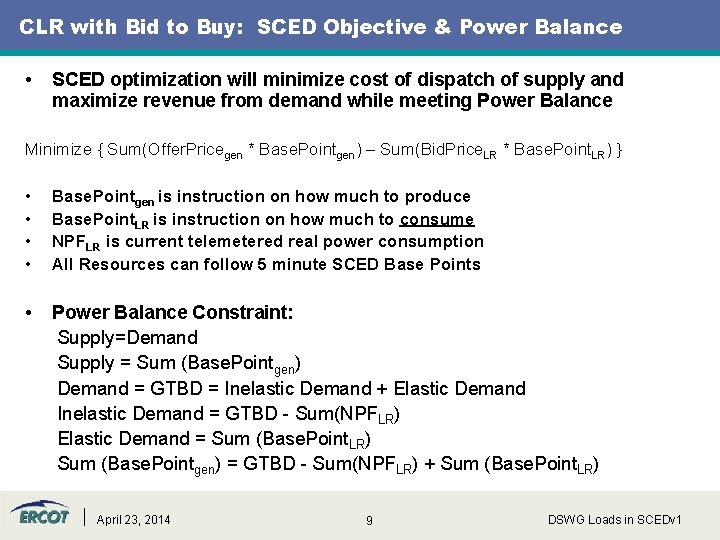
CLR with Bid to Buy: SCED Objective & Power Balance • SCED optimization will minimize cost of dispatch of supply and maximize revenue from demand while meeting Power Balance Minimize { Sum(Offer. Pricegen * Base. Pointgen) – Sum(Bid. Price. LR * Base. Point. LR) } • • Base. Pointgen is instruction on how much to produce Base. Point. LR is instruction on how much to consume NPFLR is current telemetered real power consumption All Resources can follow 5 minute SCED Base Points • Power Balance Constraint: Supply=Demand Supply = Sum (Base. Pointgen) Demand = GTBD = Inelastic Demand + Elastic Demand Inelastic Demand = GTBD - Sum(NPFLR) Elastic Demand = Sum (Base. Point. LR) Sum (Base. Pointgen) = GTBD - Sum(NPFLR) + Sum (Base. Point. LR) April 23, 2014 9 DSWG Loads in SCEDv 1
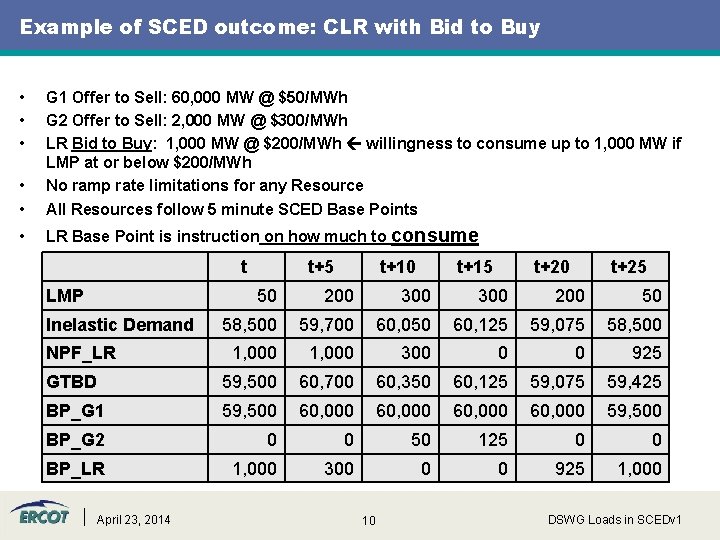
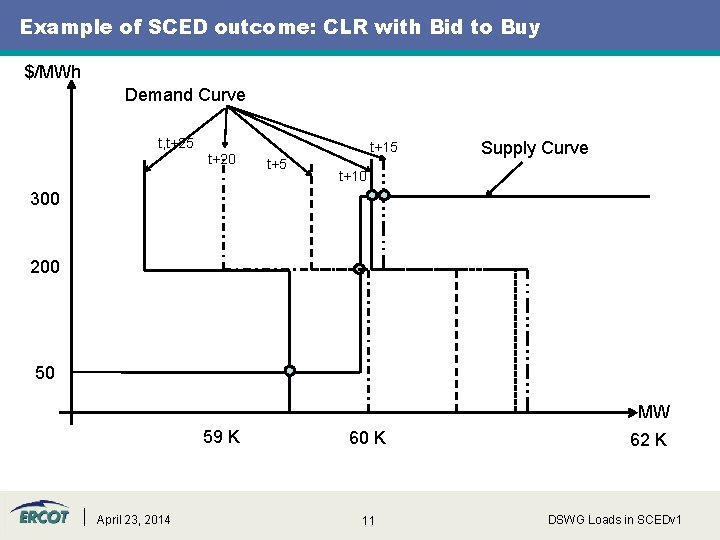
Example of SCED outcome: CLR with Bid to Buy • • • G 1 Offer to Sell: 60, 000 MW @ $50/MWh G 2 Offer to Sell: 2, 000 MW @ $300/MWh LR Bid to Buy: 1, 000 MW @ $200/MWh willingness to consume up to 1, 000 MW if LMP at or below $200/MWh No ramp rate limitations for any Resource All Resources follow 5 minute SCED Base Points • LR Base Point is instruction on how much to consume t LMP t+5 t+10 t+15 t+20 t+25 50 200 300 200 50 58, 500 59, 700 60, 050 60, 125 59, 075 58, 500 1, 000 300 0 0 925 GTBD 59, 500 60, 700 60, 350 60, 125 59, 075 59, 425 BP_G 1 59, 500 60, 000 59, 500 BP_G 2 0 0 50 125 0 0 BP_LR 1, 000 300 0 0 925 1, 000 Inelastic Demand NPF_LR April 23, 2014 10 DSWG Loads in SCEDv 1
Example of SCED outcome: CLR with Bid to Buy $/MWh Demand Curve t, t+25 t+20 t+15 t+5 Supply Curve t+10 300 200 50 MW 59 K April 23, 2014 60 K 11 62 K DSWG Loads in SCEDv 1
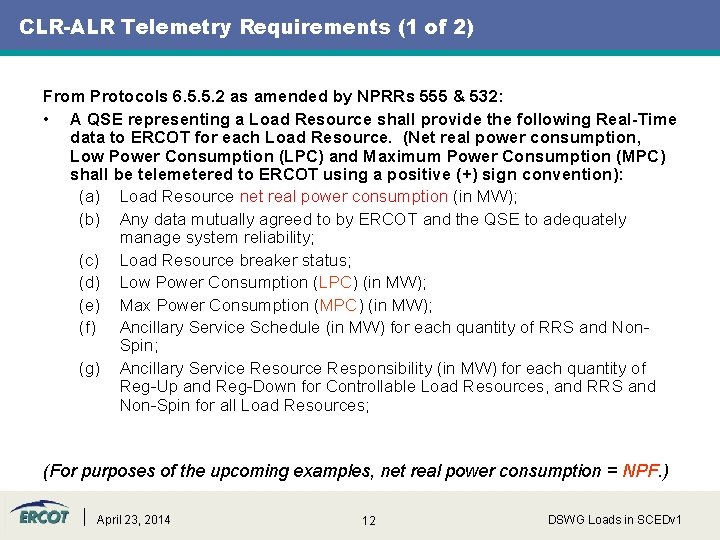
CLR-ALR Telemetry Requirements (1 of 2) From Protocols 6. 5. 5. 2 as amended by NPRRs 555 & 532: • A QSE representing a Load Resource shall provide the following Real-Time data to ERCOT for each Load Resource. (Net real power consumption, Low Power Consumption (LPC) and Maximum Power Consumption (MPC) shall be telemetered to ERCOT using a positive (+) sign convention): (a) Load Resource net real power consumption (in MW); (b) Any data mutually agreed to by ERCOT and the QSE to adequately manage system reliability; (c) Load Resource breaker status; (d) Low Power Consumption (LPC) (in MW); (e) Max Power Consumption (MPC) (in MW); (f) Ancillary Service Schedule (in MW) for each quantity of RRS and Non. Spin; (g) Ancillary Service Resource Responsibility (in MW) for each quantity of Reg-Up and Reg-Down for Controllable Load Resources, and RRS and Non-Spin for all Load Resources; (For purposes of the upcoming examples, net real power consumption = NPF. ) April 23, 2014 12 DSWG Loads in SCEDv 1
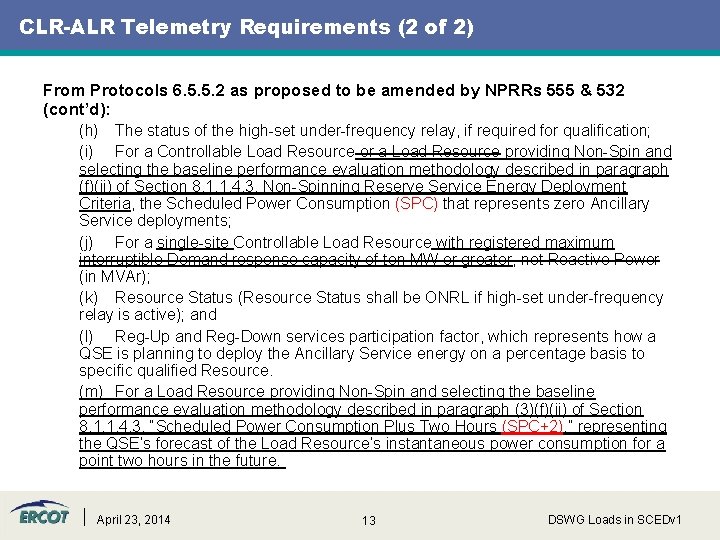
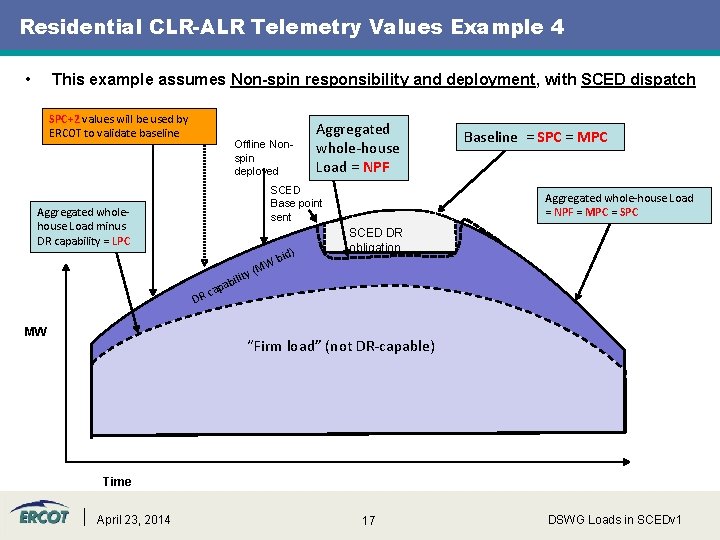
CLR-ALR Telemetry Requirements (2 of 2) From Protocols 6. 5. 5. 2 as proposed to be amended by NPRRs 555 & 532 (cont’d): (h) The status of the high-set under-frequency relay, if required for qualification; (i) For a Controllable Load Resource or a Load Resource providing Non-Spin and selecting the baseline performance evaluation methodology described in paragraph (f)(ii) of Section 8. 1. 1. 4. 3, Non-Spinning Reserve Service Energy Deployment Criteria, the Scheduled Power Consumption (SPC) that represents zero Ancillary Service deployments; (j) For a single-site Controllable Load Resource with registered maximum interruptible Demand response capacity of ten MW or greater, net Reactive Power (in MVAr); (k) Resource Status (Resource Status shall be ONRL if high-set under-frequency relay is active); and (l) Reg-Up and Reg-Down services participation factor, which represents how a QSE is planning to deploy the Ancillary Service energy on a percentage basis to specific qualified Resource. (m) For a Load Resource providing Non-Spin and selecting the baseline performance evaluation methodology described in paragraph (3)(f)(ii) of Section 8. 1. 1. 4. 3, “Scheduled Power Consumption Plus Two Hours (SPC+2), ” representing the QSE’s forecast of the Load Resource’s instantaneous power consumption for a point two hours in the future. April 23, 2014 13 DSWG Loads in SCEDv 1
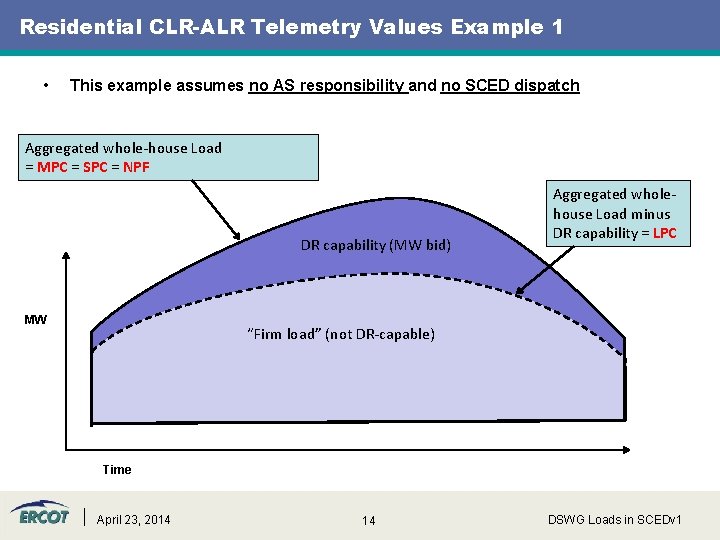
Residential CLR-ALR Telemetry Values Example 1 • This example assumes no AS responsibility and no SCED dispatch Aggregated whole-house Load = MPC = SPC = NPF DR capability (MW bid) MW Aggregated wholehouse Load minus DR capability = LPC “Firm load” (not DR-capable) Time April 23, 2014 14 DSWG Loads in SCEDv 1
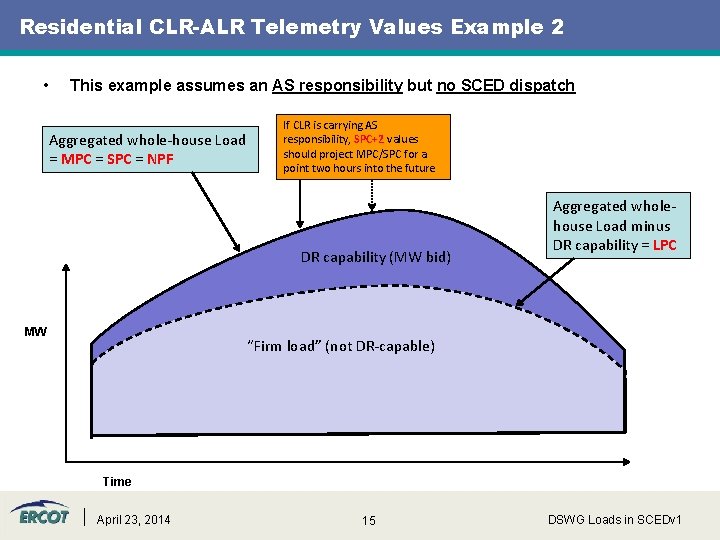
Residential CLR-ALR Telemetry Values Example 2 • This example assumes an AS responsibility but no SCED dispatch Aggregated whole-house Load = MPC = SPC = NPF If CLR is carrying AS responsibility, SPC+2 values should project MPC/SPC for a point two hours into the future DR capability (MW bid) MW Aggregated wholehouse Load minus DR capability = LPC “Firm load” (not DR-capable) Time April 23, 2014 15 DSWG Loads in SCEDv 1
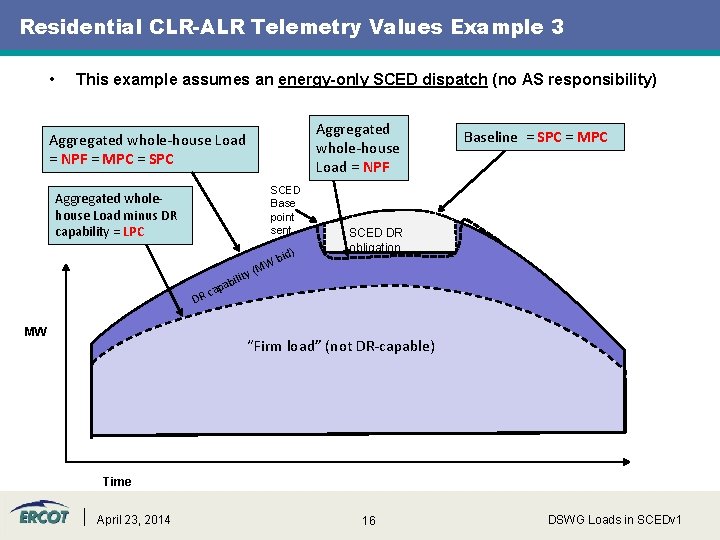
Residential CLR-ALR Telemetry Values Example 3 • This example assumes an energy-only SCED dispatch (no AS responsibility) Aggregated whole-house Load = NPF = MPC = SPC SCED Base point sent Aggregated wholehouse Load minus DR capability = LPC id) DR MW SCED DR obligation ty ( ili pab ca b MW Baseline = SPC = MPC “Firm load” (not DR-capable) Time April 23, 2014 16 DSWG Loads in SCEDv 1
Residential CLR-ALR Telemetry Values Example 4 • This example assumes Non-spin responsibility and deployment, with SCED dispatch SPC+2 values will be used by ERCOT to validate baseline Offline Nonspin deployed SCED Base point sent Aggregated wholehouse Load minus DR capability = LPC id) DR MW Aggregated whole-house Load = NPF = MPC = SPC SCED DR obligation ty ( ili pab ca b MW Baseline = SPC = MPC “Firm load” (not DR-capable) Time April 23, 2014 17 DSWG Loads in SCEDv 1
ALR Telemetry Validation • The preceding slides assume the ALR telemetry consists of aggregated premise-level Load • Modifications to the ALR OBD would also permit ALR telemetry to consist of device-level Load April 23, 2014 18 DSWG Loads in SCEDv 1
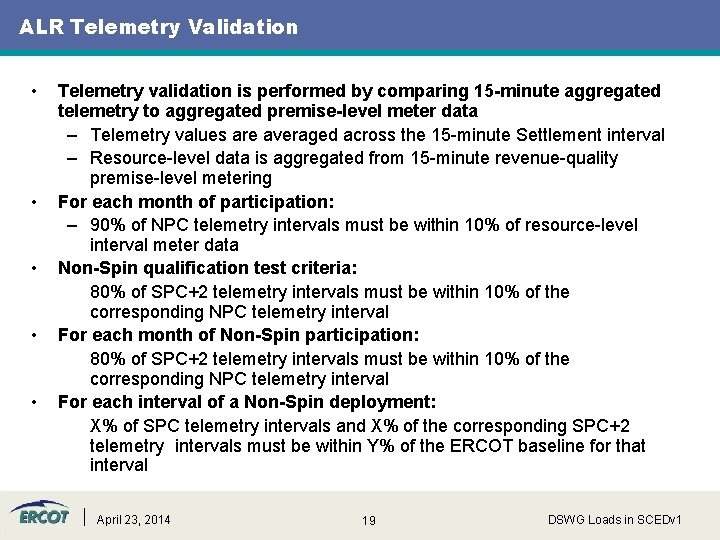
ALR Telemetry Validation • • • Telemetry validation is performed by comparing 15 -minute aggregated telemetry to aggregated premise-level meter data – Telemetry values are averaged across the 15 -minute Settlement interval – Resource-level data is aggregated from 15 -minute revenue-quality premise-level metering For each month of participation: – 90% of NPC telemetry intervals must be within 10% of resource-level interval meter data Non-Spin qualification test criteria: 80% of SPC+2 telemetry intervals must be within 10% of the corresponding NPC telemetry interval For each month of Non-Spin participation: 80% of SPC+2 telemetry intervals must be within 10% of the corresponding NPC telemetry interval For each interval of a Non-Spin deployment: X% of SPC telemetry intervals and X% of the corresponding SPC+2 telemetry intervals must be within Y% of the ERCOT baseline for that interval April 23, 2014 19 DSWG Loads in SCEDv 1
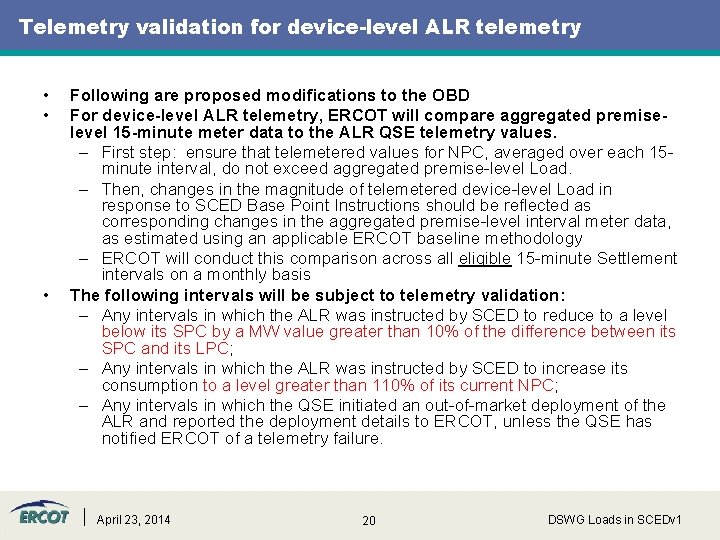
Telemetry validation for device-level ALR telemetry • • • Following are proposed modifications to the OBD For device-level ALR telemetry, ERCOT will compare aggregated premiselevel 15 -minute meter data to the ALR QSE telemetry values. – First step: ensure that telemetered values for NPC, averaged over each 15 minute interval, do not exceed aggregated premise-level Load. – Then, changes in the magnitude of telemetered device-level Load in response to SCED Base Point Instructions should be reflected as corresponding changes in the aggregated premise-level interval meter data, as estimated using an applicable ERCOT baseline methodology – ERCOT will conduct this comparison across all eligible 15 -minute Settlement intervals on a monthly basis The following intervals will be subject to telemetry validation: – Any intervals in which the ALR was instructed by SCED to reduce to a level below its SPC by a MW value greater than 10% of the difference between its SPC and its LPC; – Any intervals in which the ALR was instructed by SCED to increase its consumption to a level greater than 110% of its current NPC; – Any intervals in which the QSE initiated an out-of-market deployment of the ALR and reported the deployment details to ERCOT, unless the QSE has notified ERCOT of a telemetry failure. April 23, 2014 20 DSWG Loads in SCEDv 1
Bid Characteristics and Participation Scenarios
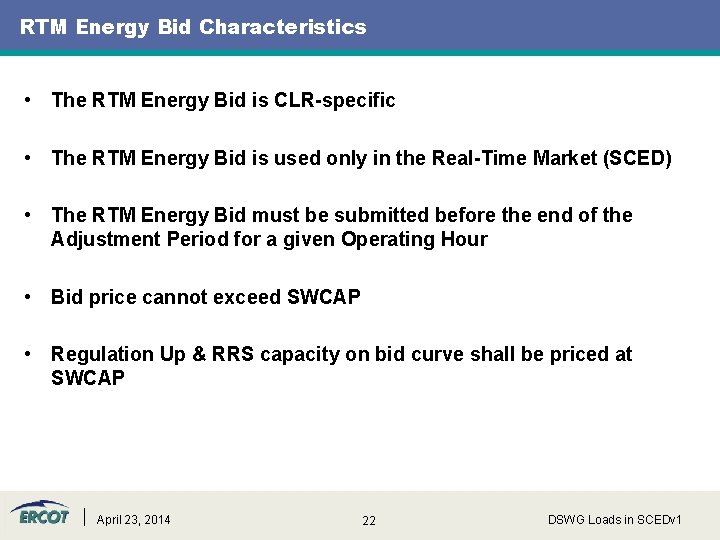
RTM Energy Bid Characteristics • The RTM Energy Bid is CLR-specific • The RTM Energy Bid is used only in the Real-Time Market (SCED) • The RTM Energy Bid must be submitted before the end of the Adjustment Period for a given Operating Hour • Bid price cannot exceed SWCAP • Regulation Up & RRS capacity on bid curve shall be priced at SWCAP April 23, 2014 22 DSWG Loads in SCEDv 1
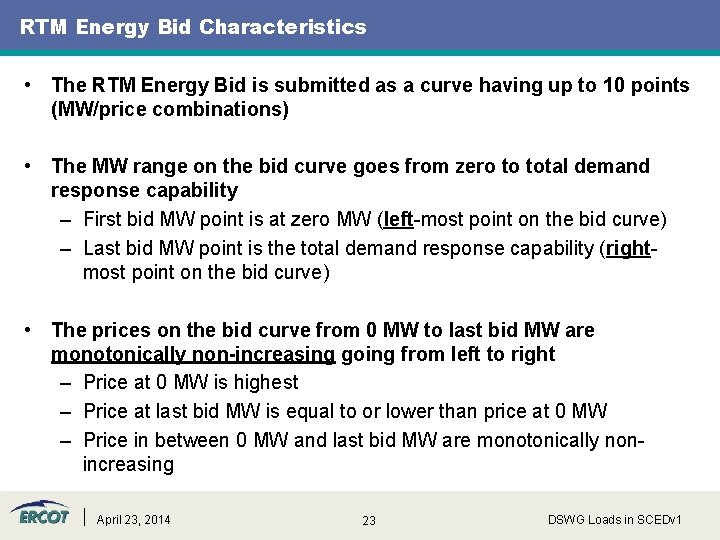
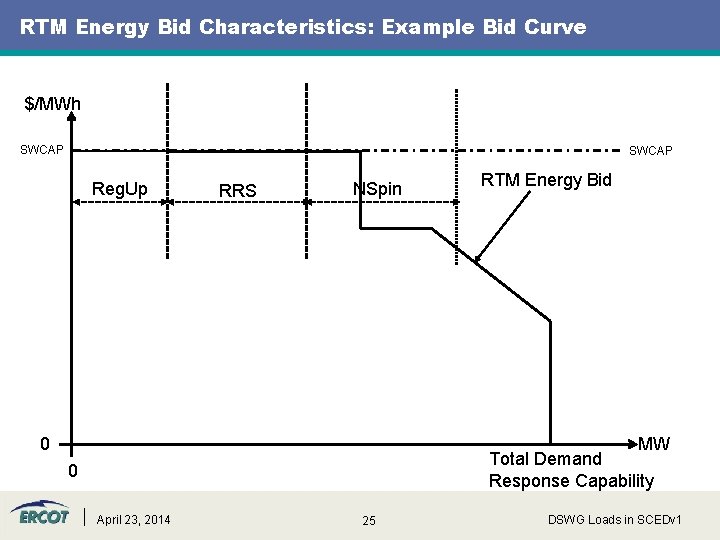
RTM Energy Bid Characteristics • The RTM Energy Bid is submitted as a curve having up to 10 points (MW/price combinations) • The MW range on the bid curve goes from zero to total demand response capability – First bid MW point is at zero MW (left-most point on the bid curve) – Last bid MW point is the total demand response capability (rightmost point on the bid curve) • The prices on the bid curve from 0 MW to last bid MW are monotonically non-increasing going from left to right – Price at 0 MW is highest – Price at last bid MW is equal to or lower than price at 0 MW – Price in between 0 MW and last bid MW are monotonically nonincreasing April 23, 2014 23 DSWG Loads in SCEDv 1
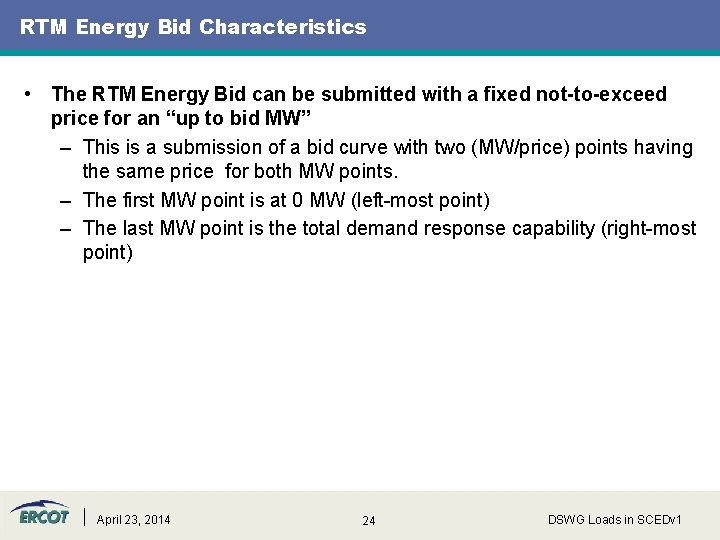
RTM Energy Bid Characteristics • The RTM Energy Bid can be submitted with a fixed not-to-exceed price for an “up to bid MW” – This is a submission of a bid curve with two (MW/price) points having the same price for both MW points. – The first MW point is at 0 MW (left-most point) – The last MW point is the total demand response capability (right-most point) April 23, 2014 24 DSWG Loads in SCEDv 1
RTM Energy Bid Characteristics: Example Bid Curve $/MWh SWCAP Reg. Up RRS NSpin 0 RTM Energy Bid MW Total Demand Response Capability 0 April 23, 2014 25 DSWG Loads in SCEDv 1
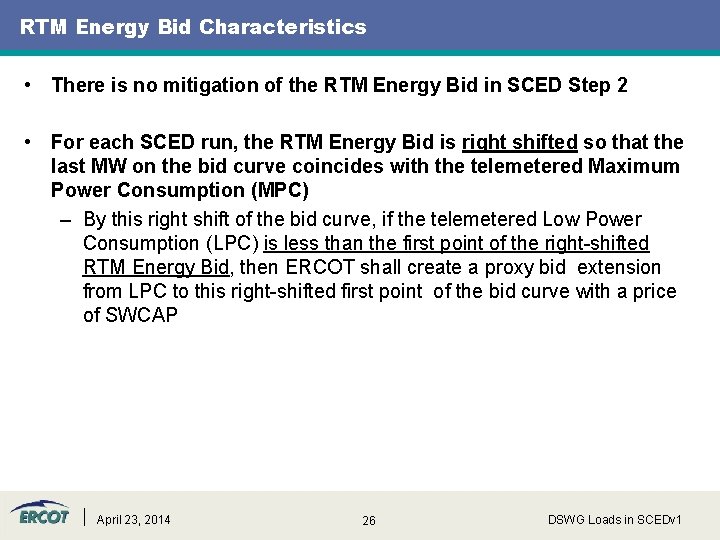
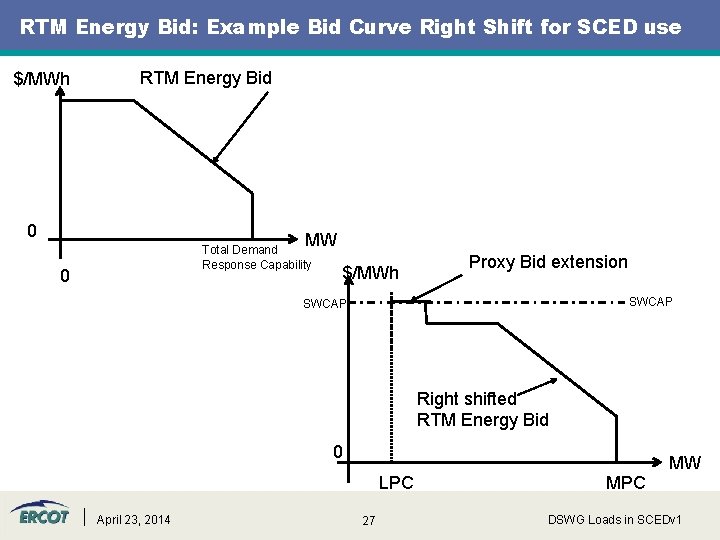
RTM Energy Bid Characteristics • There is no mitigation of the RTM Energy Bid in SCED Step 2 • For each SCED run, the RTM Energy Bid is right shifted so that the last MW on the bid curve coincides with the telemetered Maximum Power Consumption (MPC) – By this right shift of the bid curve, if the telemetered Low Power Consumption (LPC) is less than the first point of the right-shifted RTM Energy Bid, then ERCOT shall create a proxy bid extension from LPC to this right-shifted first point of the bid curve with a price of SWCAP April 23, 2014 26 DSWG Loads in SCEDv 1
RTM Energy Bid: Example Bid Curve Right Shift for SCED use $/MWh RTM Energy Bid 0 MW Total Demand Response Capability 0 $/MWh Proxy Bid extension SWCAP Right shifted RTM Energy Bid 0 LPC April 23, 2014 27 MPC MW DSWG Loads in SCEDv 1
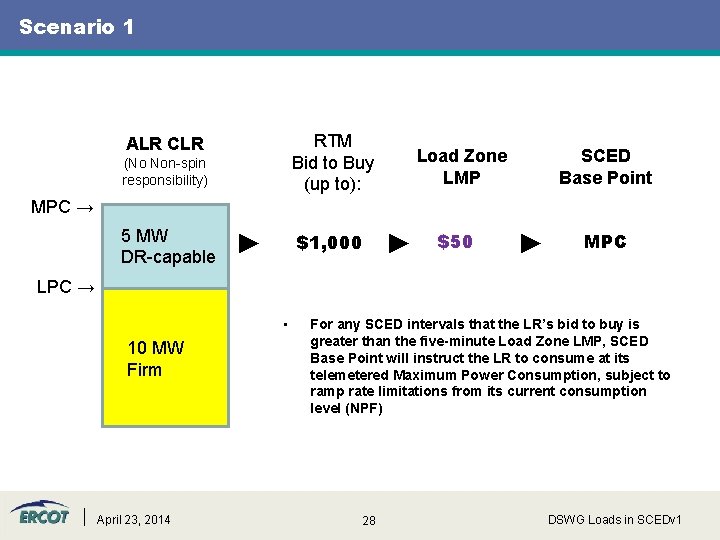
Scenario 1 RTM Bid to Buy (up to): ALR CLR (No Non-spin responsibility) Load Zone LMP SCED Base Point MPC → 5 MW DR-capable ► $1, 000 ► $50 ► MPC LPC → • 10 MW Firm April 23, 2014 For any SCED intervals that the LR’s bid to buy is greater than the five-minute Load Zone LMP, SCED Base Point will instruct the LR to consume at its telemetered Maximum Power Consumption, subject to ramp rate limitations from its current consumption level (NPF) 28 DSWG Loads in SCEDv 1
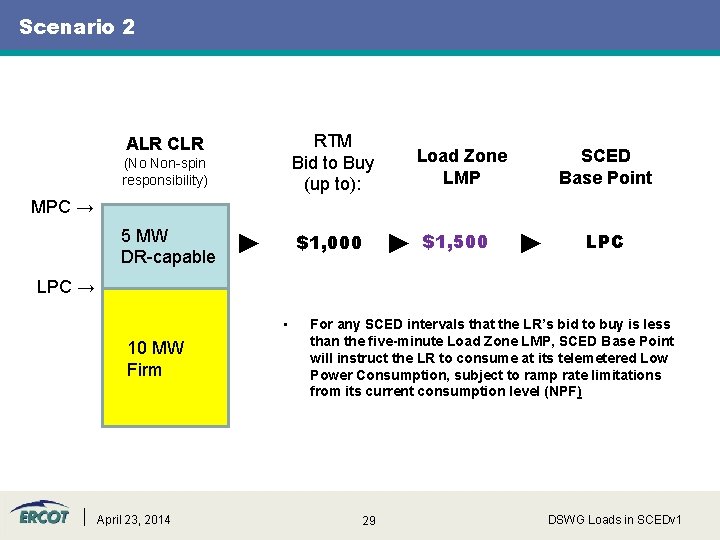
Scenario 2 RTM Bid to Buy (up to): ALR CLR (No Non-spin responsibility) Load Zone LMP SCED Base Point MPC → 5 MW DR-capable ► $1, 000 ► $1, 500 ► LPC → • 10 MW Firm April 23, 2014 For any SCED intervals that the LR’s bid to buy is less than the five-minute Load Zone LMP, SCED Base Point will instruct the LR to consume at its telemetered Low Power Consumption, subject to ramp rate limitations from its current consumption level (NPF) 29 DSWG Loads in SCEDv 1
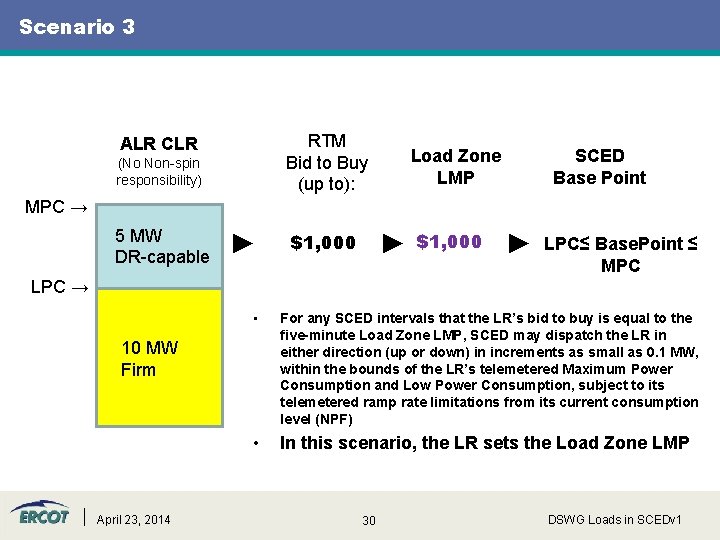
Scenario 3 RTM Bid to Buy (up to): ALR CLR (No Non-spin responsibility) Load Zone LMP SCED Base Point MPC → 5 MW DR-capable ► ► $1, 000 ► LPC≤ Base. Point ≤ MPC LPC → • For any SCED intervals that the LR’s bid to buy is equal to the five-minute Load Zone LMP, SCED may dispatch the LR in either direction (up or down) in increments as small as 0. 1 MW, within the bounds of the LR’s telemetered Maximum Power Consumption and Low Power Consumption, subject to its telemetered ramp rate limitations from its current consumption level (NPF) • In this scenario, the LR sets the Load Zone LMP 10 MW Firm April 23, 2014 30 DSWG Loads in SCEDv 1
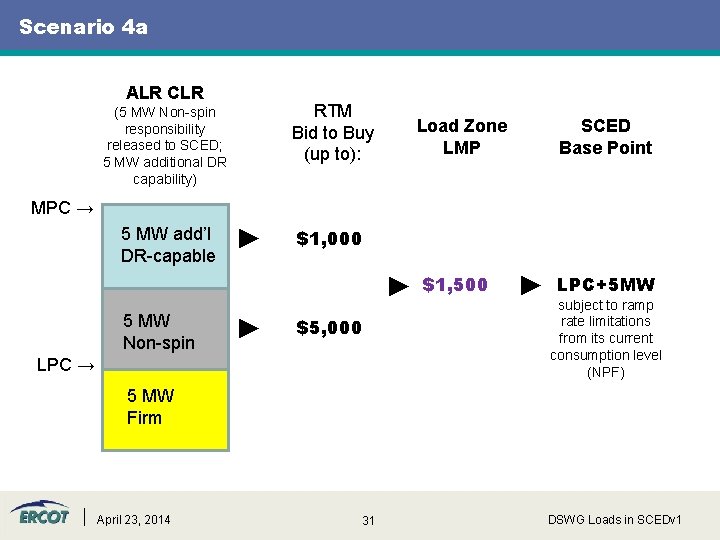
Scenario 4 a ALR CLR RTM Bid to Buy (up to): (5 MW Non-spin responsibility released to SCED; 5 MW additional DR capability) Load Zone LMP SCED Base Point MPC → 5 MW add’l DR-capable ► $1, 000 ► 5 MW Non-spin ► $5, 000 LPC → $1, 500 ► LPC+5 MW subject to ramp rate limitations from its current consumption level (NPF) 5 MW Firm April 23, 2014 31 DSWG Loads in SCEDv 1
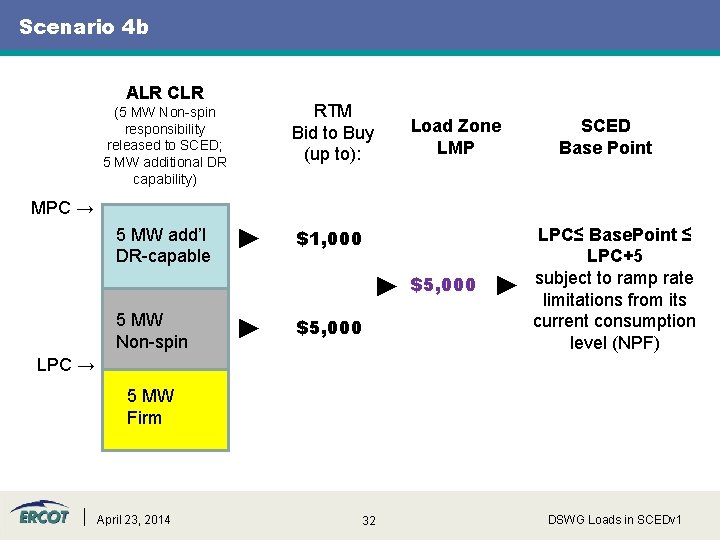
Scenario 4 b ALR CLR RTM Bid to Buy (up to): (5 MW Non-spin responsibility released to SCED; 5 MW additional DR capability) Load Zone LMP SCED Base Point MPC → 5 MW add’l DR-capable ► $1, 000 ► 5 MW Non-spin ► $5, 000 ► LPC≤ Base. Point ≤ LPC+5 subject to ramp rate limitations from its current consumption level (NPF) LPC → 5 MW Firm April 23, 2014 32 DSWG Loads in SCEDv 1
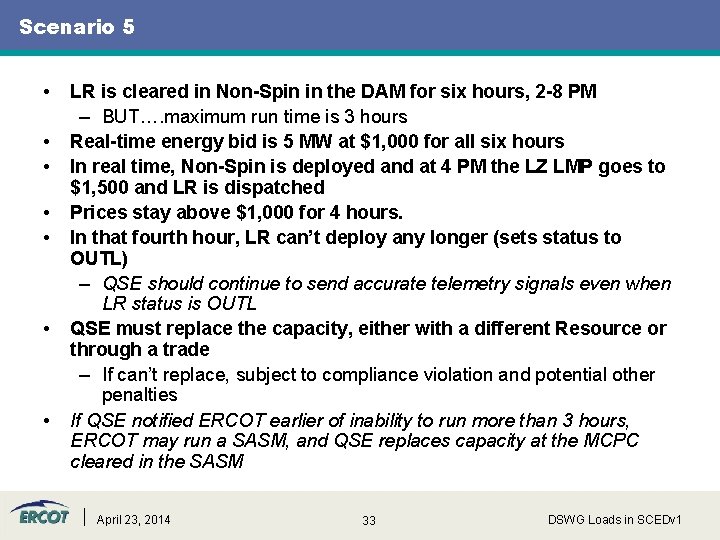
Scenario 5 • • LR is cleared in Non-Spin in the DAM for six hours, 2 -8 PM – BUT…. maximum run time is 3 hours Real-time energy bid is 5 MW at $1, 000 for all six hours In real time, Non-Spin is deployed and at 4 PM the LZ LMP goes to $1, 500 and LR is dispatched Prices stay above $1, 000 for 4 hours. In that fourth hour, LR can’t deploy any longer (sets status to OUTL) – QSE should continue to send accurate telemetry signals even when LR status is OUTL QSE must replace the capacity, either with a different Resource or through a trade – If can’t replace, subject to compliance violation and potential other penalties If QSE notified ERCOT earlier of inability to run more than 3 hours, ERCOT may run a SASM, and QSE replaces capacity at the MCPC cleared in the SASM April 23, 2014 33 DSWG Loads in SCEDv 1
Scenario 6 • Same LR, same energy bid, same scenario as previous • Difference: this time LR does not have Non-Spin responsibility (did not offer into DAM) • After LR deployed for the three hours LR hits maximum run time, QSE changes telemetry to OUTL status • SCED can no longer dispatch • QSE should continue to send accurate telemetry signals even when LR status is OUTL April 23, 2014 34 DSWG Loads in SCEDv 1
Questions? ON OFF paul. wattles@ercot. com sainath. moorty@ercot. com April 23, 2014 35 512/248 -6578 512/248 -6633 DSWG Loads in SCEDv 1