
Load Flow Analysis LFA OER Team Nibedita Sahoo
Load Flow Analysis (LFA) OER Team Nibedita Sahoo Smaranika dash Santosh Tripathy PPT submitted by RC_1308_791, RIT, Berhampur is licensed under the http: //creativecommons. org/licenses/by-sa/4. 0/You are free to use, distribute and modify it, including for commercial purposes, provided you acknowledge the source and share-alike. To view a copy of this license, visit http: //creativecommons. org/licenses/by-sa/4. 0/
Load Flow Analysis (LFA)
Contents What is Load Flow Analysis? Need Bus & it’s Classification Constraints Steps for LFA
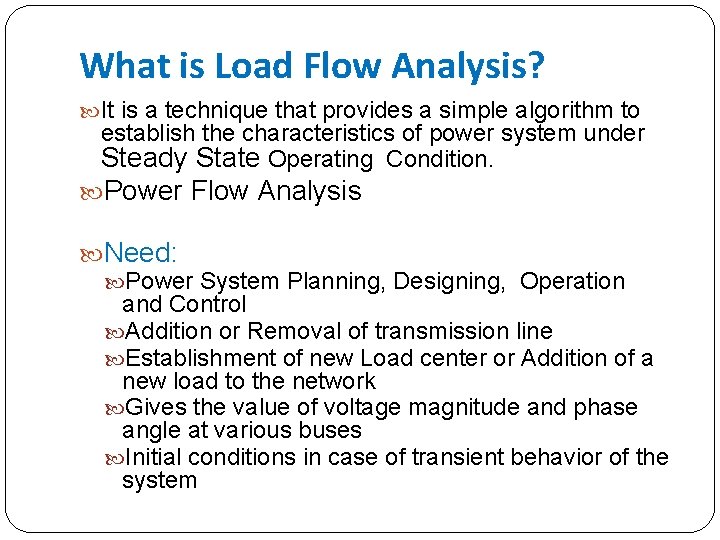
What is Load Flow Analysis? It is a technique that provides a simple algorithm to establish the characteristics of power system under Steady State Operating Condition. Power Flow Analysis Need: Power System Planning, Designing, Operation and Control Addition or Removal of transmission line Establishment of new Load center or Addition of a new load to the network Gives the value of voltage magnitude and phase angle at various buses Initial conditions in case of transient behavior of the system
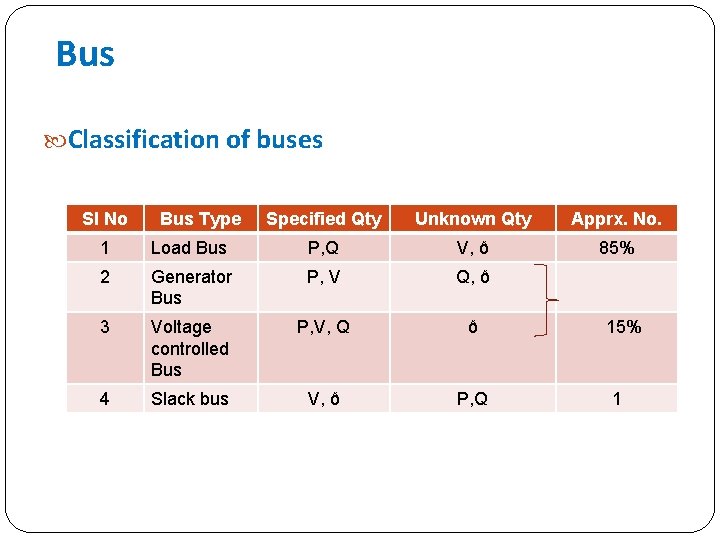
Bus Classification of buses Sl No Bus Type Specified Qty Unknown Qty Apprx. No. 85% 1 Load Bus P, Q V, ð 2 Generator Bus P, V Q, ð 3 Voltage controlled Bus P, V, Q ð 4 Slack bus V, ð P, Q 15% 1
Reflection Spot: Think & Write Question is: Why the conventional circuit analysis methods are not suitable for load flow study? What are the constraints related to it? Pause for a while continue
Reflection Spot: Think & Write Question is: Why the conventional circuit analysis methods are not suitable for load flow study? What are the constraints related to it? Pause for a while continue
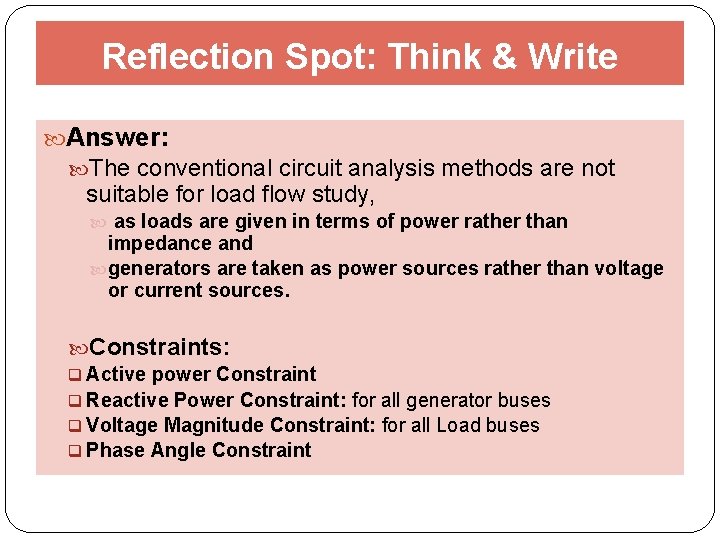
Reflection Spot: Think & Write Answer: The conventional circuit analysis methods are not suitable for load flow study, as loads are given in terms of power rather than impedance and generators are taken as power sources rather than voltage or current sources. Constraints: q Active power Constraint q Reactive Power Constraint: for all generator buses q Voltage Magnitude Constraint: for all Load buses q Phase Angle Constraint
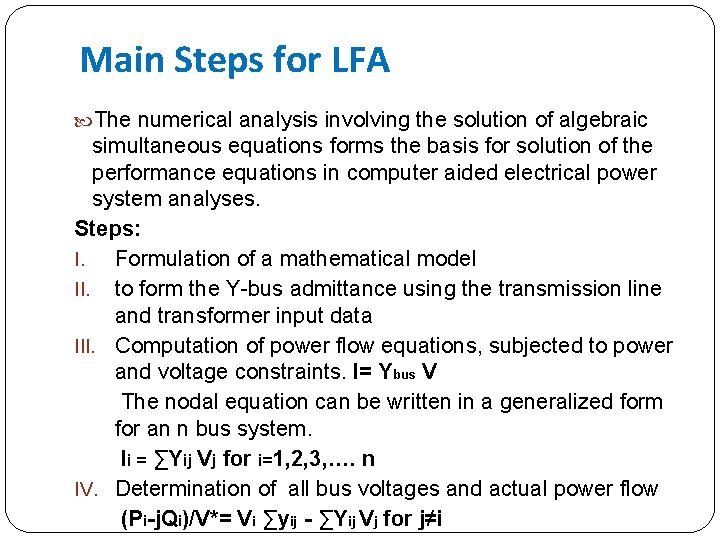
Main Steps for LFA The numerical analysis involving the solution of algebraic simultaneous equations forms the basis for solution of the performance equations in computer aided electrical power system analyses. Steps: I. Formulation of a mathematical model II. to form the Y-bus admittance using the transmission line and transformer input data III. Computation of power flow equations, subjected to power and voltage constraints. I= Ybus V The nodal equation can be written in a generalized form for an n bus system. Ii = ∑Yij Vj for i=1, 2, 3, …. n IV. Determination of all bus voltages and actual power flow (Pi-j. Qi)/V*= Vi ∑yij - ∑Yij Vj for j≠i
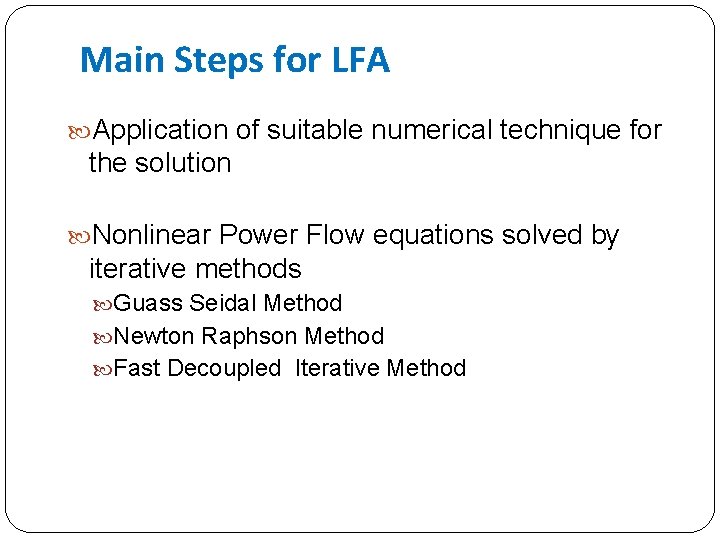
Main Steps for LFA Application of suitable numerical technique for the solution Nonlinear Power Flow equations solved by iterative methods Guass Seidal Method Newton Raphson Method Fast Decoupled Iterative Method

Thank you…….
- Slides: 11