
Load Determination Process Casing Design Workshop Chapter Objectives
Load Determination Process Casing Design Workshop
Chapter Objectives § Learn about possible load cases for burst and collapse § Calculate loads for example problem

Chapter 5 Outline § Casing Categories • Conductor, Surface, Intermediate, Production, Liners, Tie-backs § Load Types • Collapse, Burst, Axial § Operational Phases • Installation, Drilling, Production § Examples • Surface, Intermediate, Production

Casing Design Procedure § Select casing depths You Are Here § Select casing sizes § Calculate collapse and burst loads § Make preliminary casing selection § Calculate axial loads (tens. /compr. ) § Adjust preliminary selection for axial loads § Calculate combined load effects § Adjust and make final selection
Our Load Approach § Casing Category – conductor, surface, intermediate, production, liners, tie-back § Load Types – burst, collapse, axial § Operations Phase – installation, drilling, production

Casing Categories Review § Conductor • • • First casing string ~ 20 – 500 ft Cemented or driven Maintains integrity of soft surface formations Prevents washout under rig No pressure control (but may have annular diverter offshore) Not present in some wells (e. g. , shallow wells)

Casing Categories Cont. § Surface Casing • • • First pressure control Protects weak formation from fracture Protects fresh water aquifers Usually subject to depth, cementing, WOC, and test regulations Usually cemented to surface (top job may be required)
Casing Categories Cont. § Intermediate Casing • Similar to surface casing • Usually protects weaker upper formations from higher pressure deeper formations • Sometimes isolates deeper low pressure formations from higher pressure upper formations • Isolates unstable zones
Casing Categories Cont. § Production Casing • • Maintains borehole integrity to bottom Serves as conduit for tubing Provides full pressure backup for tubing Provides isolation of producing zones
Casing Categories Cont. § Liners and Tie-backs • Serve as extensions of other strings – Loads are determined as if they are part of the string they are extending • May serve as more than one category – Loads should address all categories of service

Casing Load Types and Conventions § Differential Collapse Loads: • Dependent on the well pressures and circulating fluids § Differential Burst Loads ─ • Dependent on the well pressures and circulating fluids § Basic level casing design is adequate with differential pressure loads, Dp § More critical design may require specifying both pi and po (Chapters 7 & 8 in textbook)

Casing Load Types and Conventions § Axial Loads ─ gravitational forces and borehole friction • • Tension – positive Compression – negative Dependent on the casing string (gravity and friction) Dependent on the well path (friction)

Design Loads § Load Sources for Conductor, Surface, Intermediate, Production Casing • • Internal pressure External pressure Axial load (plus planar bending in some wells) Other loads (not covered in this course) – – Thermal Rotational Lateral buckling Borehole collapse
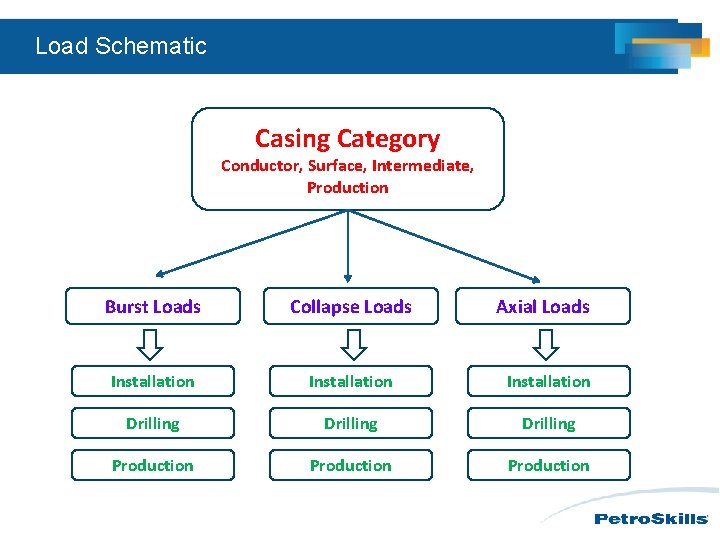
Load Schematic Casing Category Conductor, Surface, Intermediate, Production Burst Loads Collapse Loads Axial Loads Installation Drilling Production
Operational Phases § Installation • Running/Circulating • Cementing • Testing § Drilling • Lost circulation • Kick § Production • Tubing back-up • Stimulations
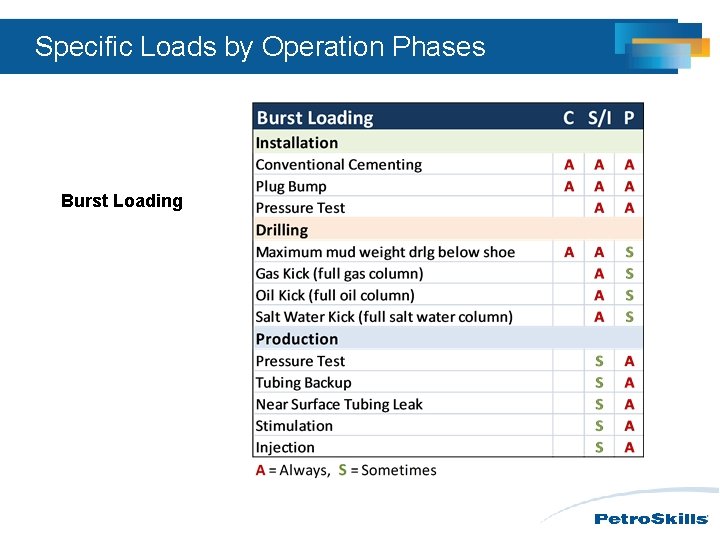
Specific Loads by Operation Phases Burst Loading
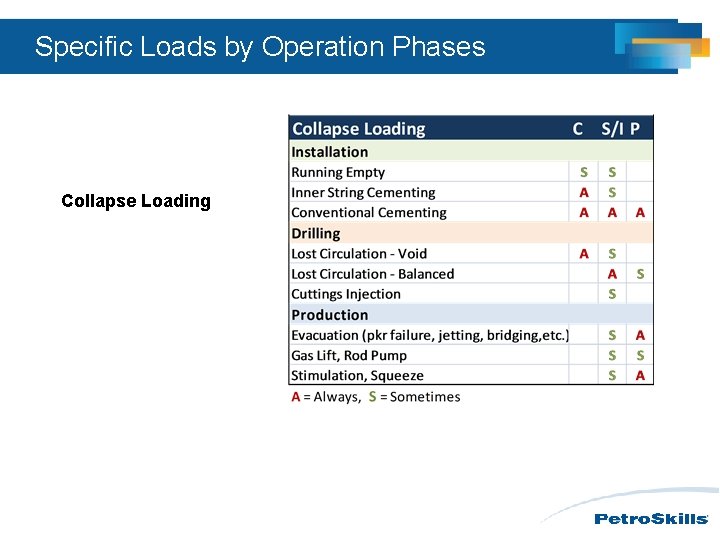
Specific Loads by Operation Phases Collapse Loading
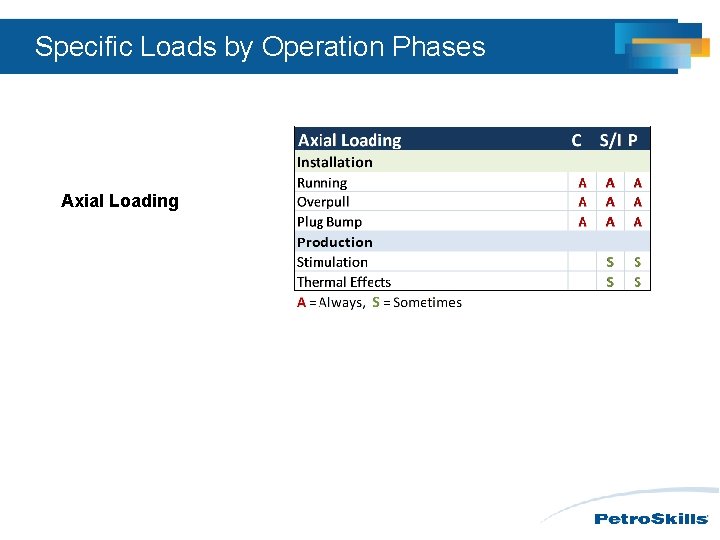
Specific Loads by Operation Phases Axial Loading
Some Example Calculations § Reminder About Round Off: • Normally we round pressures to the nearest 10 psi (API/ISO practice) • Normally we round depths to the nearest 10 ft, 50 ft or even 100 ft depending on the application • In this course we will not round off often so that you can see the calculations and check your results without having to determine whether we rounded or not
Reminder § Important Note About Depths: • Most of the illustrations in this course show vertical well bores (easier to visualize) • Always use vertical depths (not measured depths) in your calculations – Pressure calculations – Axial weight calculations (buoyed and un-buoyed) • Used measured depths for actual casing section lengths (purchasing and running)
- Slides: 20