
LO To compare alpha beta and gamma radiation
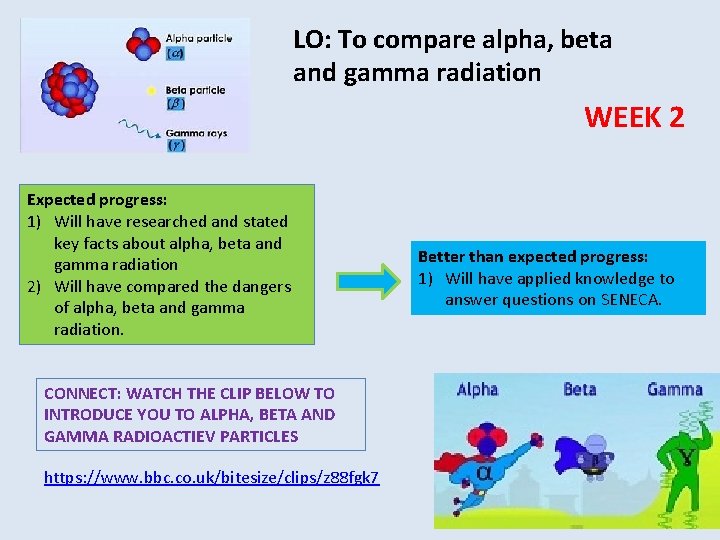
LO: To compare alpha, beta and gamma radiation WEEK 2 Expected progress: 1) Will have researched and stated key facts about alpha, beta and gamma radiation 2) Will have compared the dangers of alpha, beta and gamma radiation. CONNECT: WATCH THE CLIP BELOW TO INTRODUCE YOU TO ALPHA, BETA AND GAMMA RADIOACTIEV PARTICLES https: //www. bbc. co. uk/bitesize/clips/z 88 fgk 7 Better than expected progress: 1) Will have applied knowledge to answer questions on SENECA.
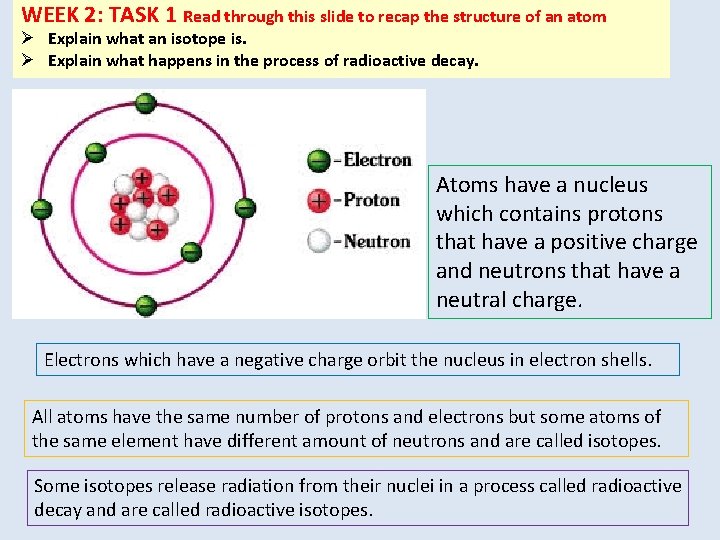
WEEK 2: TASK 1 Read through this slide to recap the structure of an atom Ø Explain what an isotope is. Ø Explain what happens in the process of radioactive decay. Atoms have a nucleus which contains protons that have a positive charge and neutrons that have a neutral charge. Electrons which have a negative charge orbit the nucleus in electron shells. All atoms have the same number of protons and electrons but some atoms of the same element have different amount of neutrons and are called isotopes. Some isotopes release radiation from their nuclei in a process called radioactive decay and are called radioactive isotopes.
WEEK 2: TASK 2 Use the next few slides to produce fact sheets (on paper or power point/word/publisher) for alpha, beta and gamma radiation. For each radioactive particle include the following information: Ø A diagram Ø A symbol Ø A description of the structure Ø Penetration power (what materials can it pass through) Ø What materials absorb it (or stop it passing through) Ø How ionising is it Ø How fast is it/how far can it travel in the air Make a poster/leaflet warning people of the dangers of alpha, beta and gamma radiation. Include: Ø Which is the most dangerous outside the body Ø Which is the most dangerous inside the body Ø What damage can each cause

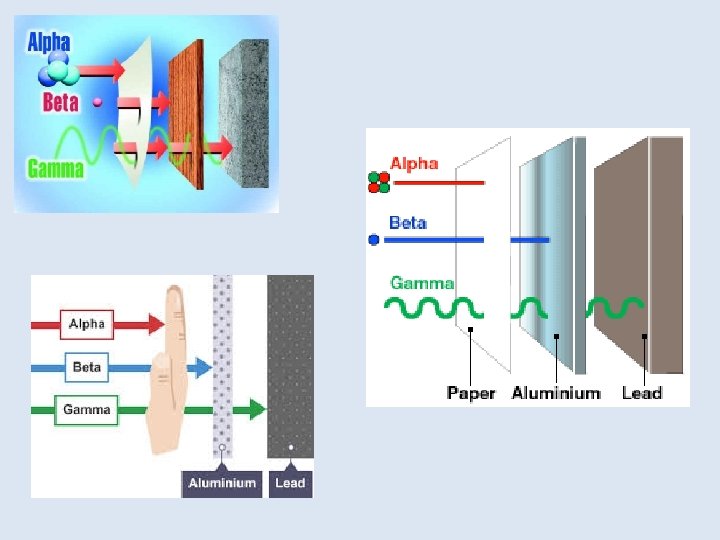
Type of radiation Diagram of the radiation type Description of the radiation type Penetration Power of the radiation type Alpha It has 2 protons and 2 neutrons which is the same as a helium nucleus It is the least It can be penetrating and it absorbed by can only go sheet of paper through air a few centimetres. It moves slowly. It is the most ionising Beta It is an electron which is released from a nucleus after a neutron splits It can penetrate It is absorbed by air and paper and thin aluminium travels quickly It is strongly ionising It can penetrate It is absorbed by air paper and thin thick lead or metals and it concrete travels at the speed of light It is the least ionising. Gamma It has no mass or charge and it is part of the EM spectrum What is it absorbed by? What is the ionising power?

Alpha, beta and gamma radiation • Alpha radiation is the safest outside the body because it cannot pass through the skin. However, inside the body it is absorbed by cells so is very dangerous. • Alpha radiation is used in smoke alarms and in the treatment of cancer cells. • Beta and gamma radiation are more dangerous outside the body because they can pass through the skin but inside the body they are less dangerous because they passes through the cells and aren’t absorbed. • Beta is used to test the thickness of paper and foil and is used as medical tracers. • Gamma radiation is used to sterilise medical equipment and also to kill cancer cells.

The dangers of alpha, beta and gamma radiation. Alpha radiation • If alpha enters an organ, it can cause damage to the tissues of that organ. It can cause kidney damage. • Alpha radiation can also damage the DNA of cells making the cells divide out of control which causes tumours, for example if alpha is inhaled then it can cause lung cancer. • Gamma radiation is not as dangerous to cells and tissues inside the body as gamma radiation is not as easily absorbed by cells as alpha and beta radiation. • Gamma radiation damages skin cells and tissues by altering the DNA or altering the cell function. Beta radiation • When beta particles enter the cells they alter the cell function. • When they penetrate deeper into tissues like the tissues that form skin they alter the DNA of the cell and cause the cells to divide too quickly which causes cancers such as bone cancer.
- Slides: 7