
LO 1 Define a hypothesis LO 2 Explain

- Slides: 21
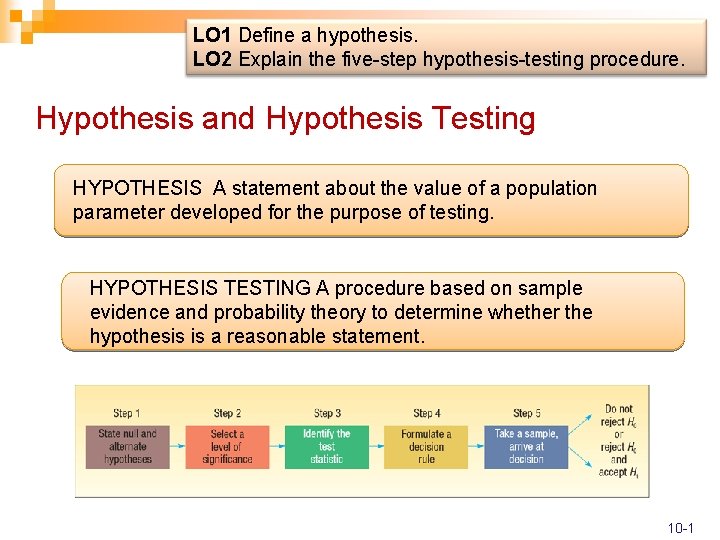
LO 1 Define a hypothesis. LO 2 Explain the five-step hypothesis-testing procedure. Hypothesis and Hypothesis Testing HYPOTHESIS A statement about the value of a population parameter developed for the purpose of testing. HYPOTHESIS TESTING A procedure based on sample evidence and probability theory to determine whether the hypothesis is a reasonable statement. 10 -1
LO 2 Null and Alternate Hypothesis NULL HYPOTHESIS A statement about the value of a population parameter developed for the purpose of testing numerical evidence. ALTERNATE HYPOTHESIS A statement that is accepted if the sample data provide sufficient evidence that the null hypothesis is false. 10 -2
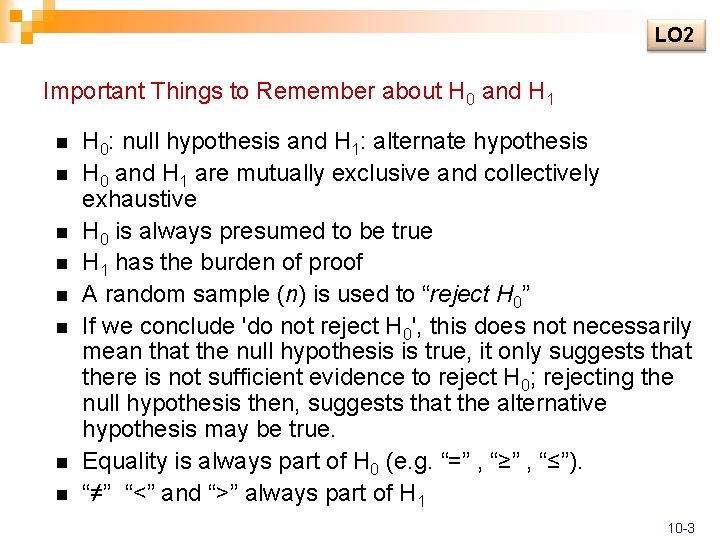
LO 2 Important Things to Remember about H 0 and H 1 n n n n H 0: null hypothesis and H 1: alternate hypothesis H 0 and H 1 are mutually exclusive and collectively exhaustive H 0 is always presumed to be true H 1 has the burden of proof A random sample (n) is used to “reject H 0” If we conclude 'do not reject H 0', this does not necessarily mean that the null hypothesis is true, it only suggests that there is not sufficient evidence to reject H 0; rejecting the null hypothesis then, suggests that the alternative hypothesis may be true. Equality is always part of H 0 (e. g. “=” , “≥” , “≤”). “≠” “<” and “>” always part of H 1 10 -3
LO 4 Define the term test statistics and explain how it is used. Test Statistic versus Critical Value TEST STATISTIC A value, determined from sample information, used to determine whether to reject the null hypothesis. Example: z, t, F, 2 CRITICAL VALUE The dividing point between the region where the null hypothesis is rejected and the region where it is not rejected. 10 -4
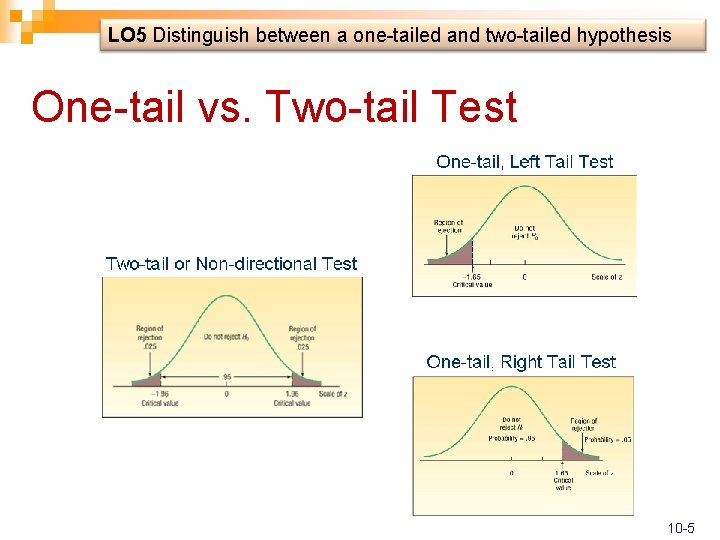
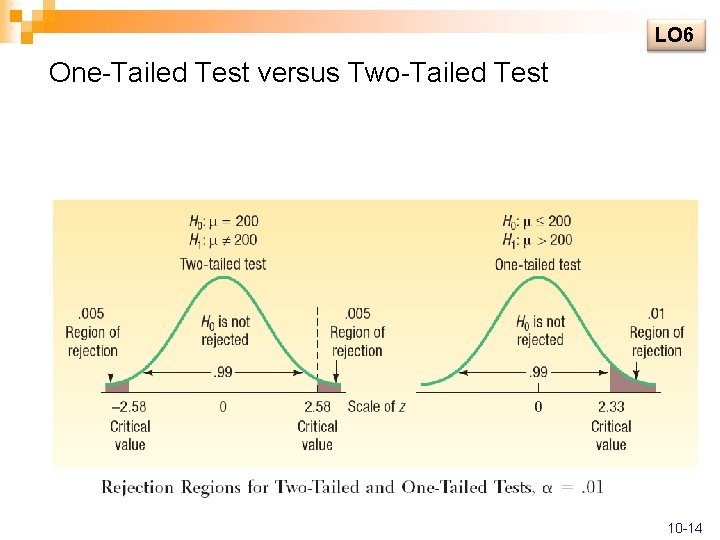
LO 5 Distinguish between a one-tailed and two-tailed hypothesis One-tail vs. Two-tail Test 10 -5
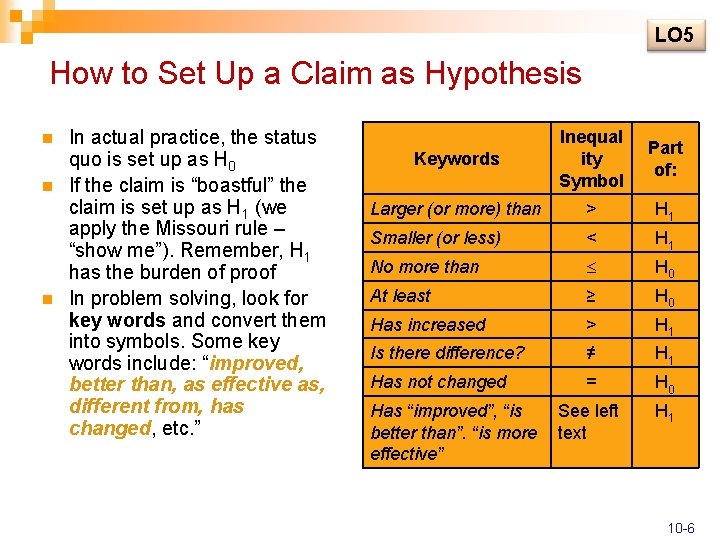
LO 5 How to Set Up a Claim as Hypothesis n n n In actual practice, the status quo is set up as H 0 If the claim is “boastful” the claim is set up as H 1 (we apply the Missouri rule – “show me”). Remember, H 1 has the burden of proof In problem solving, look for key words and convert them into symbols. Some key words include: “improved, better than, as effective as, different from, has changed, etc. ” Keywords Inequal ity Symbol Part of: Larger (or more) than > H 1 Smaller (or less) < H 1 No more than H 0 At least ≥ H 0 Has increased > H 1 Is there difference? ≠ H 1 Has not changed = H 0 See left text H 1 Has “improved”, “is better than”. “is more effective” 10 -6
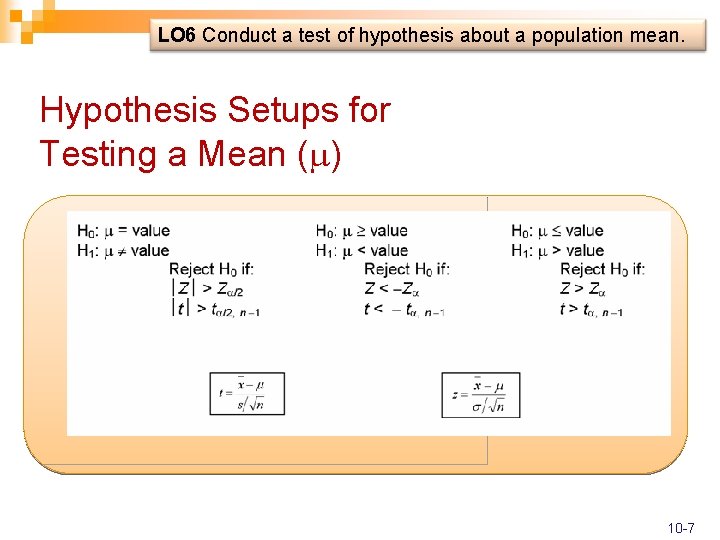
LO 6 Conduct a test of hypothesis about a population mean. Hypothesis Setups for Testing a Mean ( ) 10 -7
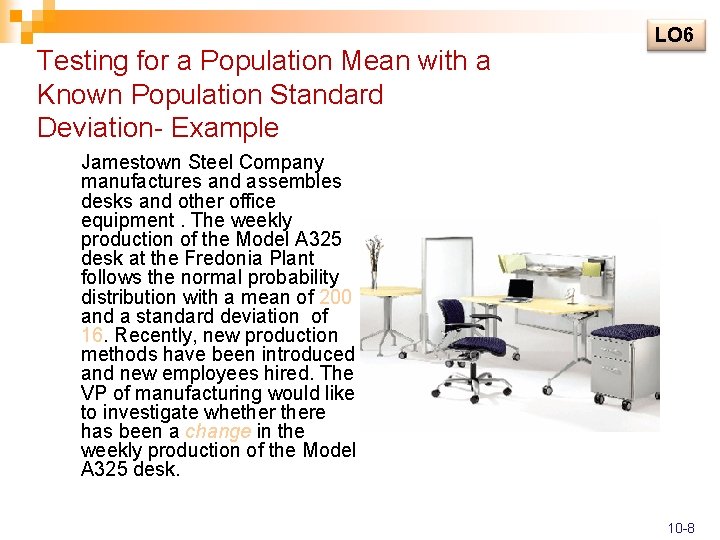
Testing for a Population Mean with a Known Population Standard Deviation- Example LO 6 Jamestown Steel Company manufactures and assembles desks and other office equipment. The weekly production of the Model A 325 desk at the Fredonia Plant follows the normal probability distribution with a mean of 200 and a standard deviation of 16. Recently, new production methods have been introduced and new employees hired. The VP of manufacturing would like to investigate whethere has been a change in the weekly production of the Model A 325 desk. 10 -8
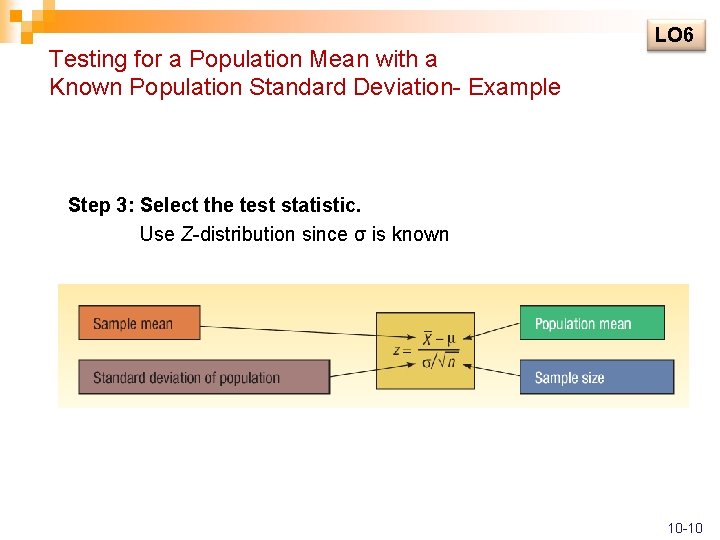
Testing for a Population Mean with a Known Population Standard Deviation- Example LO 6 Step 1: State the null hypothesis and the alternate hypothesis. H 0: = 200 H 1: ≠ 200 (note: keyword in the problem “has changed”) Step 2: Select the level of significance. α = 0. 01 as stated in the problem Step 3: Select the test statistic. Use Z-distribution since σ is known 10 -9
Testing for a Population Mean with a Known Population Standard Deviation- Example LO 6 Step 3: Select the test statistic. Use Z-distribution since σ is known 10 -10
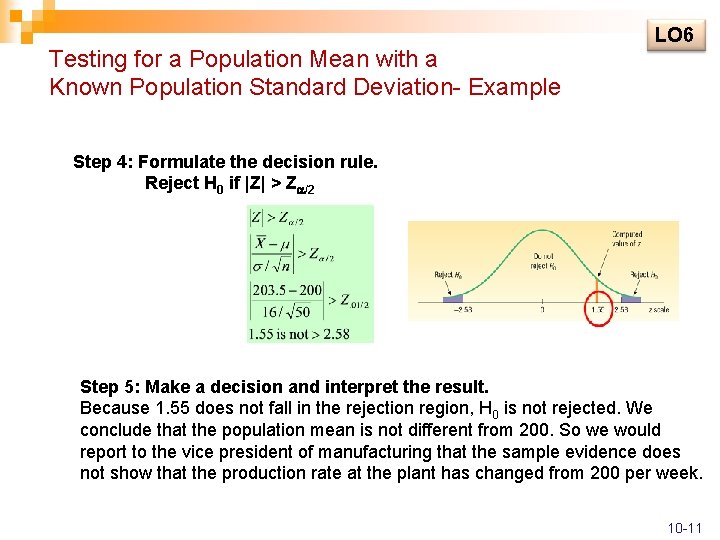
Testing for a Population Mean with a Known Population Standard Deviation- Example LO 6 Step 4: Formulate the decision rule. Reject H 0 if |Z| > Z /2 Step 5: Make a decision and interpret the result. Because 1. 55 does not fall in the rejection region, H 0 is not rejected. We conclude that the population mean is not different from 200. So we would report to the vice president of manufacturing that the sample evidence does not show that the production rate at the plant has changed from 200 per week. 10 -11
LO 6 Testing for a Population Mean with a Known Population Standard Deviation- Another Example Suppose in the previous problem the vice president wants to know whethere has been an increase in the number of units assembled. To put it another way, can we conclude, because of the improved production methods, that the mean number of desks assembled in the last 50 weeks was more than 200? Recall: σ=16, n=200, α=. 01 10 -12
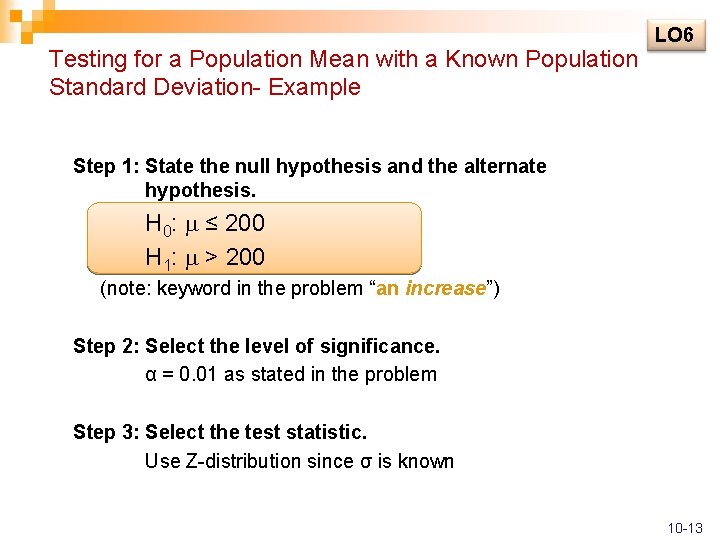
Testing for a Population Mean with a Known Population Standard Deviation- Example LO 6 Step 1: State the null hypothesis and the alternate hypothesis. H 0: ≤ 200 H 1: > 200 (note: keyword in the problem “an increase”) Step 2: Select the level of significance. α = 0. 01 as stated in the problem Step 3: Select the test statistic. Use Z-distribution since σ is known 10 -13
LO 6 One-Tailed Test versus Two-Tailed Test 10 -14
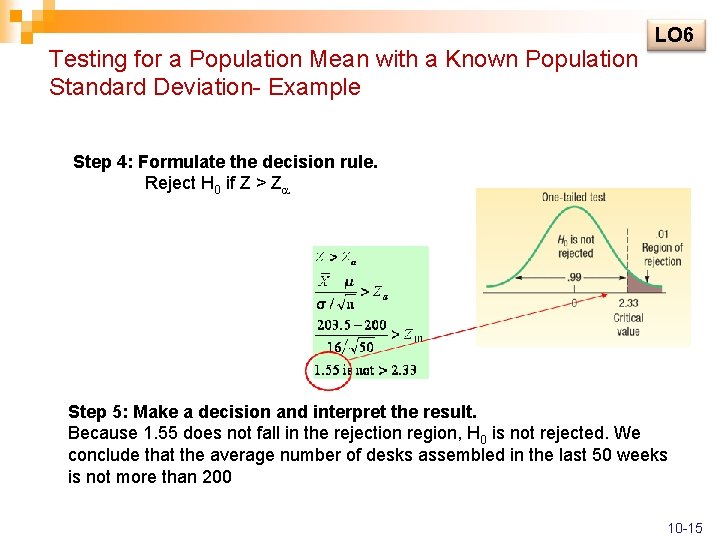
Testing for a Population Mean with a Known Population Standard Deviation- Example LO 6 Step 4: Formulate the decision rule. Reject H 0 if Z > Z Step 5: Make a decision and interpret the result. Because 1. 55 does not fall in the rejection region, H 0 is not rejected. We conclude that the average number of desks assembled in the last 50 weeks is not more than 200 10 -15
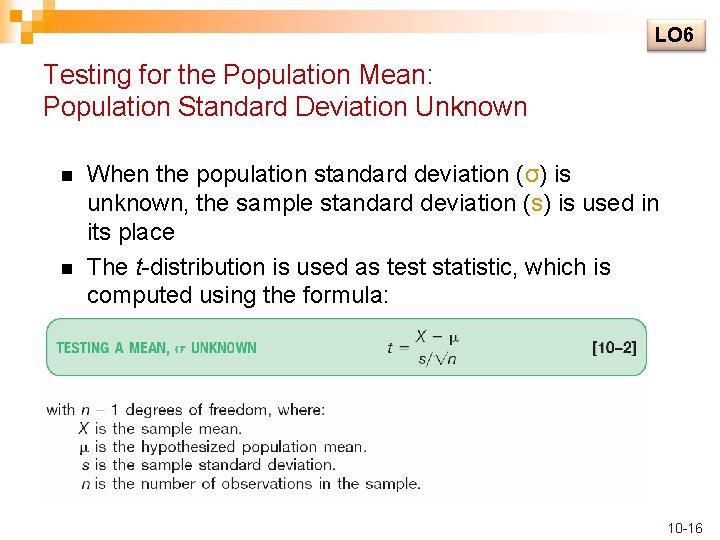
LO 6 Testing for the Population Mean: Population Standard Deviation Unknown n n When the population standard deviation (σ) is unknown, the sample standard deviation (s) is used in its place The t-distribution is used as test statistic, which is computed using the formula: 10 -16
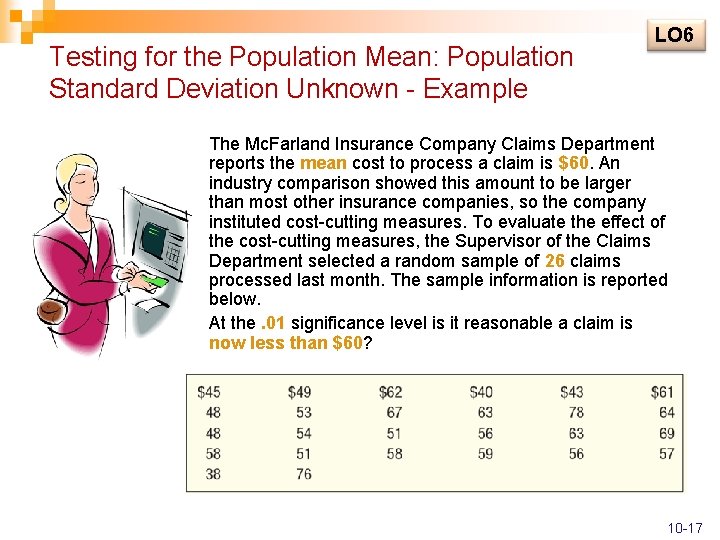
Testing for the Population Mean: Population Standard Deviation Unknown - Example LO 6 The Mc. Farland Insurance Company Claims Department reports the mean cost to process a claim is $60. An industry comparison showed this amount to be larger than most other insurance companies, so the company instituted cost-cutting measures. To evaluate the effect of the cost-cutting measures, the Supervisor of the Claims Department selected a random sample of 26 claims processed last month. The sample information is reported below. At the. 01 significance level is it reasonable a claim is now less than $60? 10 -17
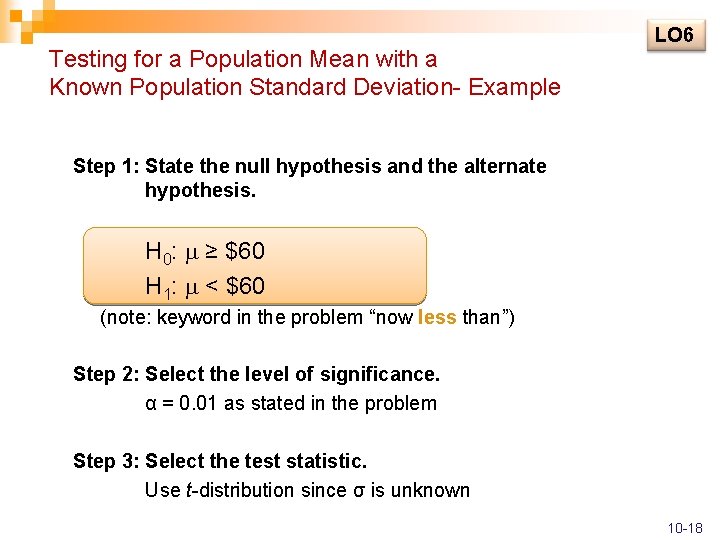
Testing for a Population Mean with a Known Population Standard Deviation- Example LO 6 Step 1: State the null hypothesis and the alternate hypothesis. H 0: ≥ $60 H 1: < $60 (note: keyword in the problem “now less than”) Step 2: Select the level of significance. α = 0. 01 as stated in the problem Step 3: Select the test statistic. Use t-distribution since σ is unknown 10 -18
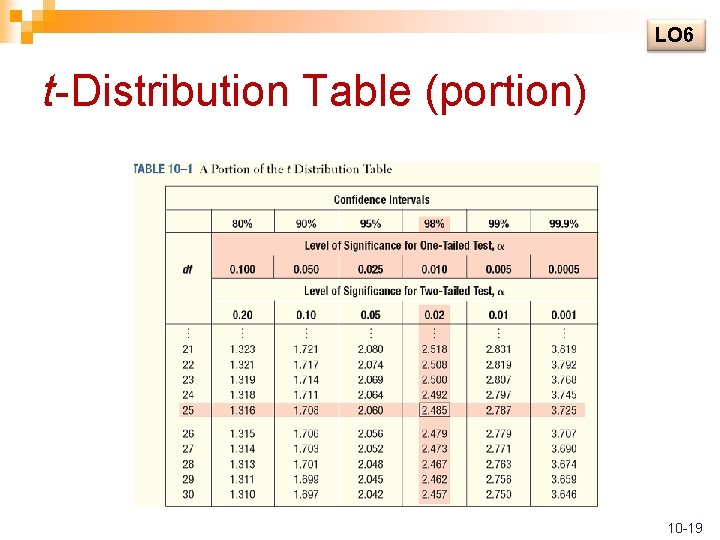
LO 6 t-Distribution Table (portion) 10 -19
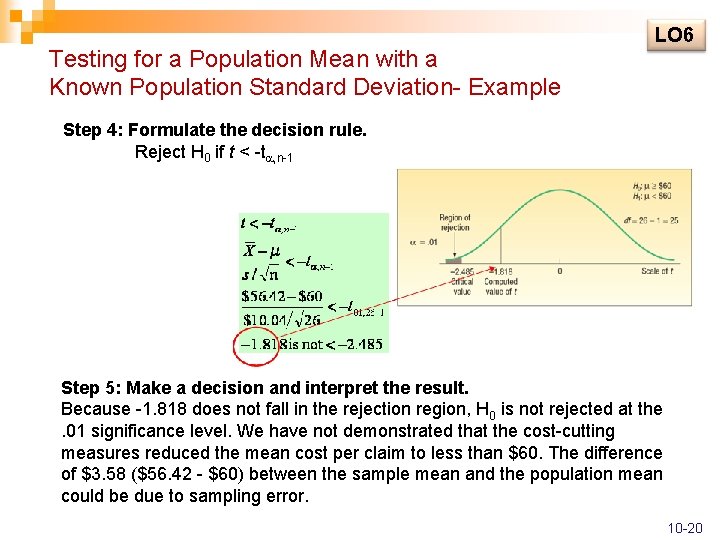
Testing for a Population Mean with a Known Population Standard Deviation- Example LO 6 Step 4: Formulate the decision rule. Reject H 0 if t < -t , n-1 Step 5: Make a decision and interpret the result. Because -1. 818 does not fall in the rejection region, H 0 is not rejected at the. 01 significance level. We have not demonstrated that the cost-cutting measures reduced the mean cost per claim to less than $60. The difference of $3. 58 ($56. 42 - $60) between the sample mean and the population mean could be due to sampling error. 10 -20
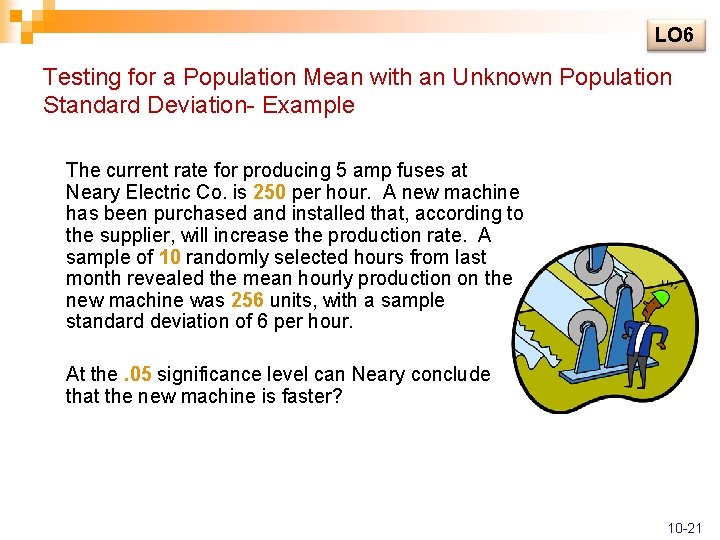
LO 6 Testing for a Population Mean with an Unknown Population Standard Deviation- Example The current rate for producing 5 amp fuses at Neary Electric Co. is 250 per hour. A new machine has been purchased and installed that, according to the supplier, will increase the production rate. A sample of 10 randomly selected hours from last month revealed the mean hourly production on the new machine was 256 units, with a sample standard deviation of 6 per hour. At the. 05 significance level can Neary conclude that the new machine is faster? 10 -21