
LMI for Reemployment Can LMI be used to
LMI for Reemployment Can LMI be used to aid in dealing with disasters or unusual economic situations? 1. This is a web-based training module. 2. Screens will automatically advance; however, you can always backspace to review material again. 3. Many of the slides have audio narratives to clarify the information. 4. Some slides have embedded links which allow you to access internet sites. LMI for Reemployment United States Department of Labor
Module 4: Fundamentals of LMI Series LMI and Reemployment § Summary – A look at the strategic value of using available workforce information when developing a reemployment strategy following an economic downturn or disaster § Average duration: 40 minutes LMI for Reemployment United States Department of Labor

Data Series: The Fundamentals of LMI § Labor market information (LMI) defined; primary sources and types of LMI; where LMI is located; and how LMI is used 1. The Basics of Labor Market Information (a prerequisite for the following modules) 2. LMI for the Job Seeker You should have already 3. LMI for Assessing Skills completed Module One. four in the This is module 4. LMI and Reemployment Fundamentals of LMI series. 5. LMI for Business LMI for Reemployment United States Department of Labor
Goals for this Module In completing this module, participants will be exposed to the following: § Understand the value of using LMI and related workforce information when developing reemployment strategies § Articulate data needs in support of strategy development § Differentiate between traditional and non-traditional LMI § Determine how and when to collaborate with state LMI shops § Understand the benefits of including relevant LMI to obtain grant funding LMI for Reemployment United States Department of Labor
When the Economy Falters or Disaster Hits… § § What will change? How will the changes emerge? How can you expedite recovery? As a local planner or policy maker, YOU will be expected to have answers to these and other similar questions. LMI for Reemployment United States Department of Labor
LMI Can Help! § There’s so much data out there, where do I start looking? § How can I know which information is relevant to this situation? § What are some things I can do to prepare for disasters and downturns? § Who is going to help me evaluate the data we collect? § What should my first priorities be? LMI for Reemployment United States Department of Labor
Okay, so LMI will be useful but where do I start? LMI can provide planners with a starting point from which they can chart a course of action leading to recovery. LMI for Reemployment United States Department of Labor
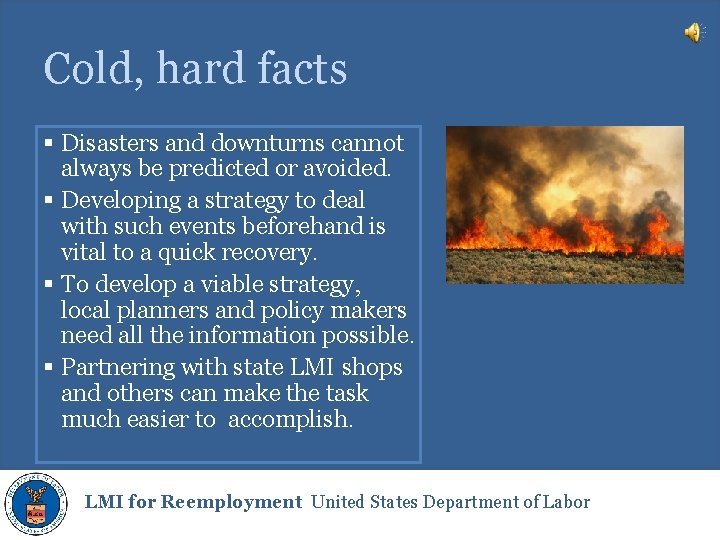
Cold, hard facts § Disasters and downturns cannot always be predicted or avoided. § Developing a strategy to deal with such events beforehand is vital to a quick recovery. § To develop a viable strategy, local planners and policy makers need all the information possible. § Partnering with state LMI shops and others can make the task much easier to accomplish. LMI for Reemployment United States Department of Labor
So which types of LMI are relevant for these kinds of situations? § The occupational and industry mix for your area § Projected growth or decline by industry and occupation § Skill sets possessed by workers in your area § List of available training providers and courses offered § Local Employment Dynamics (LED) data for your area LMI for Reemployment United States Department of Labor
These data sets are very important in developing long-term strategies. § The occupational and industry mix for your area § Which industry sectors employ the most people in your area § The occupational distribution within each industry sector § An employer database showing specific employers by industry sector § These are particularly valuable when dealing with dislocated worker events. LMI for Reemployment United States Department of Labor
These can have a huge impact on how you plan for the future. § Projected growth or decline by industry and occupation § Industry sectors that are growing or declining § Both long- and short-term projections by industry and occupation § Occupations projected to grow rapidly and the industries where they can be found § These are particularly valuable when dealing with supply/demand issues. LMI for Reemployment United States Department of Labor
These can prove invaluable in times of crisis. § Skill sets possessed by workers in your area § Industry staffing patterns that reveal common occupations § Using O*Net to identify common skill sets for these occupations § Using the above, develop a “census” of skill sets for workers in your area § These are particularly valuable when dealing with disasters or major layoffs. LMI for Reemployment United States Department of Labor
These should be kept available for use and updated frequently. § List of available training providers and courses offered § Compile a matrix of providers and training offered § Match courses offered to specific occupational groups § Look at projected growth by occupation to determine if adequate training will be available. § These are very useful when dealing with major closures or downturns. LMI for Reemployment United States Department of Labor
This data source is often overlooked. Use it to “update” other data sets. § Local Employment Dynamics (LED) data for your area. § Combines LMI data sets with Census information to show recent changes in the economy and workforce. § Reports can be easily customized § Helps get a handle on labor turnover and other local economic dynamics § These are important elements in developing overall strategies. LMI for Reemployment United States Department of Labor
That sounds like stuff I can compile BEFORE a crisis occurs. Exactly! The more advanced preparation you do, the easier your task when facing a big layoff or disaster. LMI for Reemployment United States Department of Labor
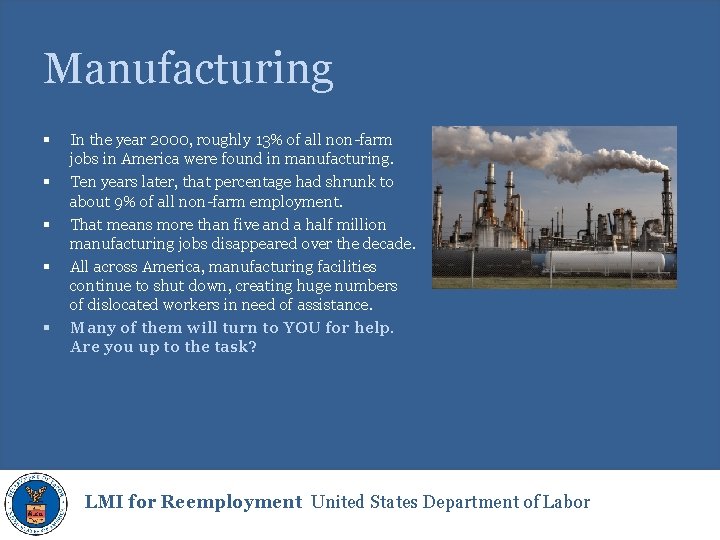
Manufacturing § § § In the year 2000, roughly 13% of all non-farm jobs in America were found in manufacturing. Ten years later, that percentage had shrunk to about 9% of all non-farm employment. That means more than five and a half million manufacturing jobs disappeared over the decade. All across America, manufacturing facilities continue to shut down, creating huge numbers of dislocated workers in need of assistance. Many of them will turn to YOU for help. Are you up to the task? LMI for Reemployment United States Department of Labor
So what do I need to do? There is a fourstep method for preparing to reach this goal. LMI for Reemployment United States Department of Labor
Four-Step Procedure 1. Identify the industry that is experiencing the mass layoff or other dislocation. 2. Find industry staffing patterns. 3. Determine which workers are likely to be able to transfer their skills to new companies in the same industry, and which may need to transfer skills to other industries but stay in the same occupation. 4. Identify job seekers’ transferable skills. LMI for Reemployment United States Department of Labor
A Real-World Example § § You are the WIB chairperson, and this will have a significant impact on the local economy. What workforce information would you need to assist the dislocated workers? News Flash - United Motors announced today that it will be phasing out its local manufacturing facility over the next 12 months. More than 2, 200 plant employees will be laid off in several phases. An additional 1, 500 workers at local suppliers could also be affected. The first layoff is expected in 60 days. LMI for Reemployment United States Department of Labor
Step 1: Identify the Industry What data set would help you determine the industry sector? § If you answered “QCEW or CES, ” you would be correct. If in doubt, a quick call to your state LMI shop or One-Stop Center would also do the trick. In this case, it happens to be Motor Vehicle Manufacturing § Many times the employer will gladly furnish a list of occupations affected by the layoff. That is not the case in this situation so your next step would be what? § If you know the industry sector, you can get a list of occupations commonly found therein by accessing either the National Employment Matrix or a similar data set from your state’s LMI website. § For our purposes, we’ll use the NEM to accomplish Step 2. LMI for Reemployment United States Department of Labor
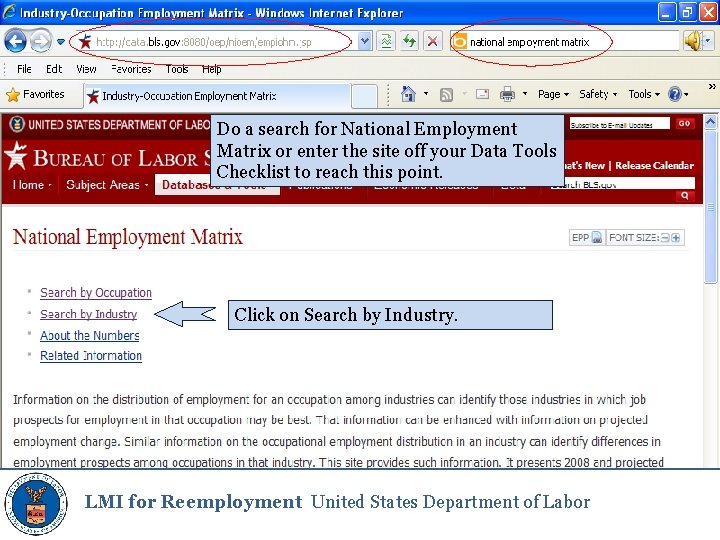
Do a search for National Employment Matrix or enter the site off your Data Tools Checklist to reach this point. Click on Search by Industry. LMI for Reemployment United States Department of Labor
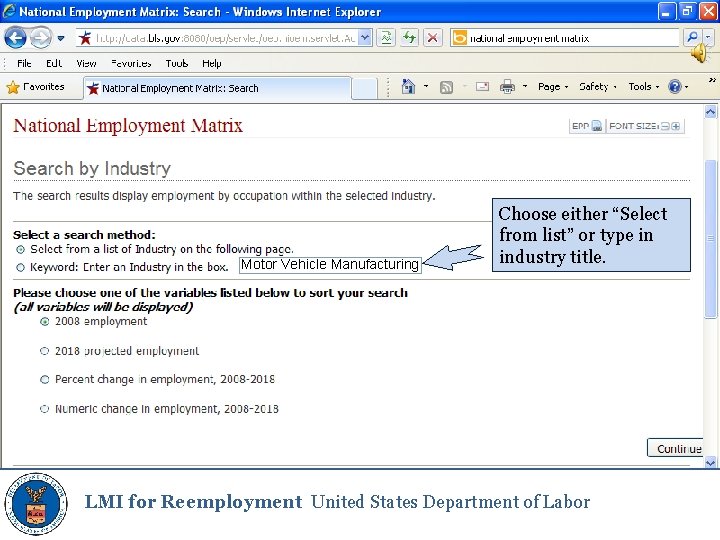
Motor Vehicle Manufacturing Choose either “Select from list” or type in industry title. LMI for Reemployment United States Department of Labor
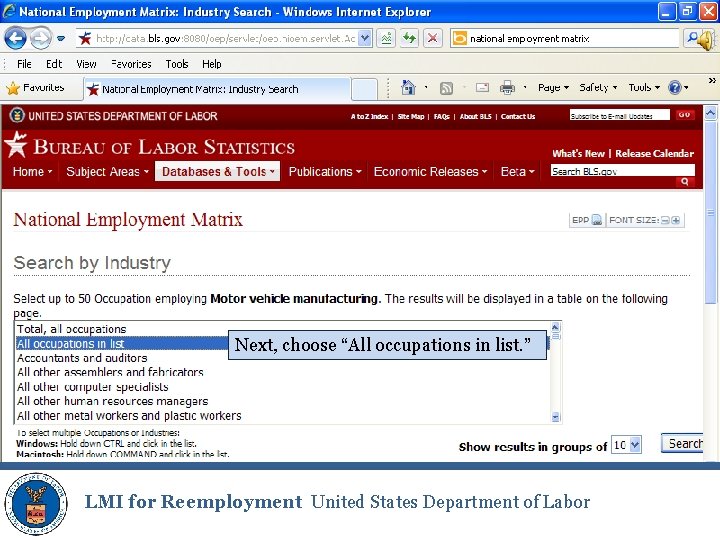
Next, choose “All occupations in list. ” LMI for Reemployment United States Department of Labor
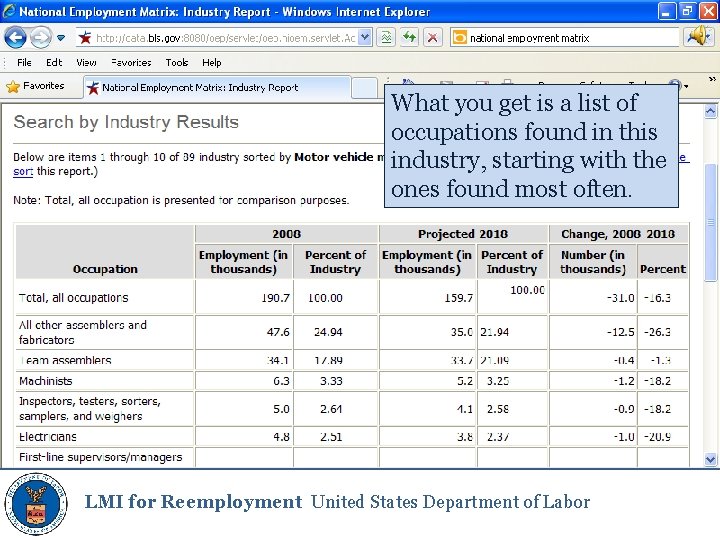
What you get is a list of occupations found in this industry, starting with the ones found most often. LMI for Reemployment United States Department of Labor
Simple enough – what is next? Now that we have completed Step 2 in the process, let’s move to Step 3. Here you will focus on the most common occupations and learn about their skill sets, etc. LMI for Reemployment United States Department of Labor
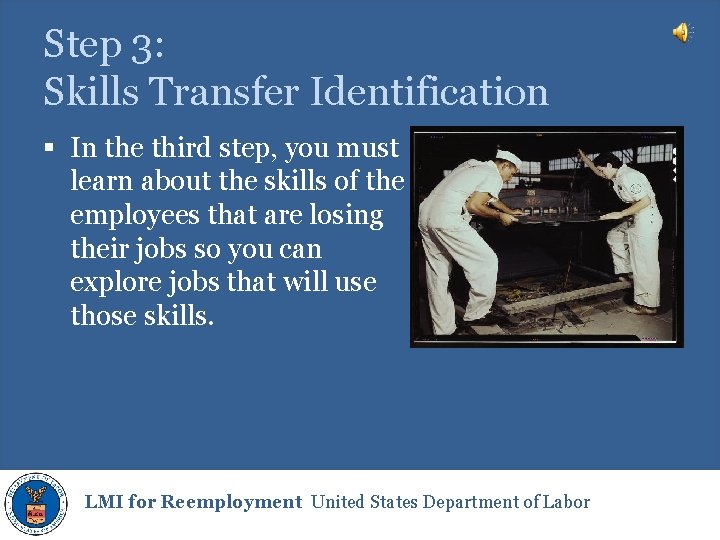
Step 3: Skills Transfer Identification § In the third step, you must learn about the skills of the employees that are losing their jobs so you can explore jobs that will use those skills. LMI for Reemployment United States Department of Labor
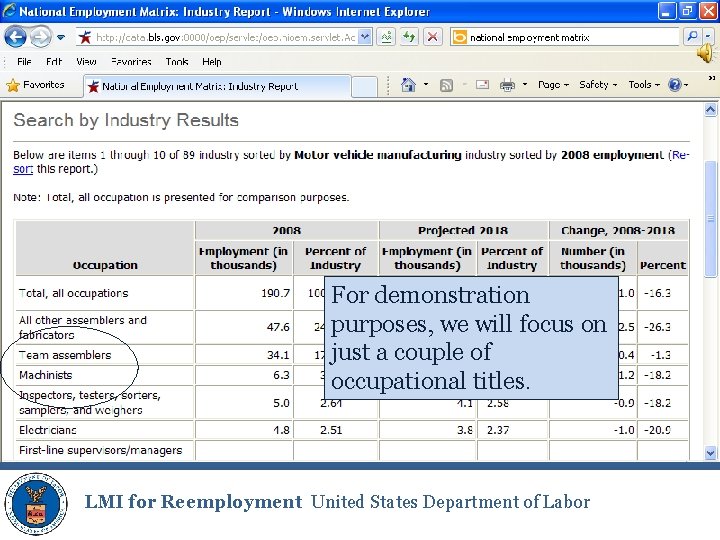
For demonstration purposes, we will focus on just a couple of occupational titles. LMI for Reemployment United States Department of Labor
§ Back on the opening page of the National Employment Matrix, we did a search by industry. § You would now also want to do a search by occupation - in this case, “Team Assembler. ” § It may well be that there are other industries in your area that also employ “Team Assemblers. ” § Transferring to a similar job in a different industry is often a good fit for the worker. § Don’t forget to also check for other employers in the SAME industry sector. LMI for Reemployment United States Department of Labor
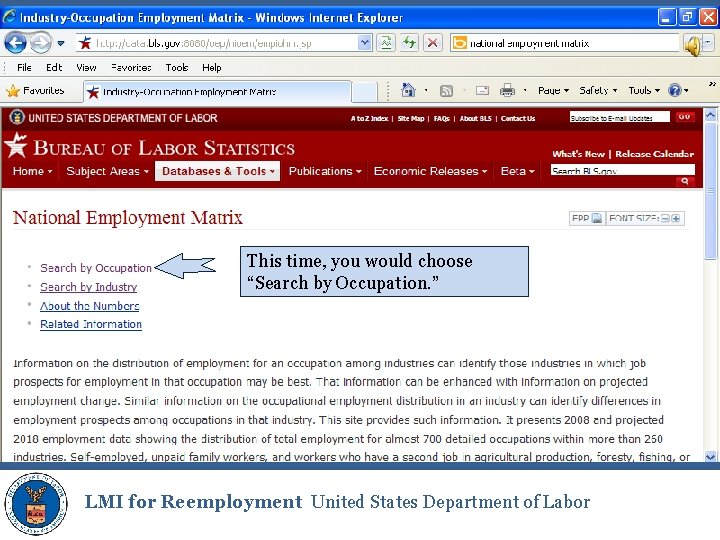
This time, you would choose “Search by Occupation. ” LMI for Reemployment United States Department of Labor
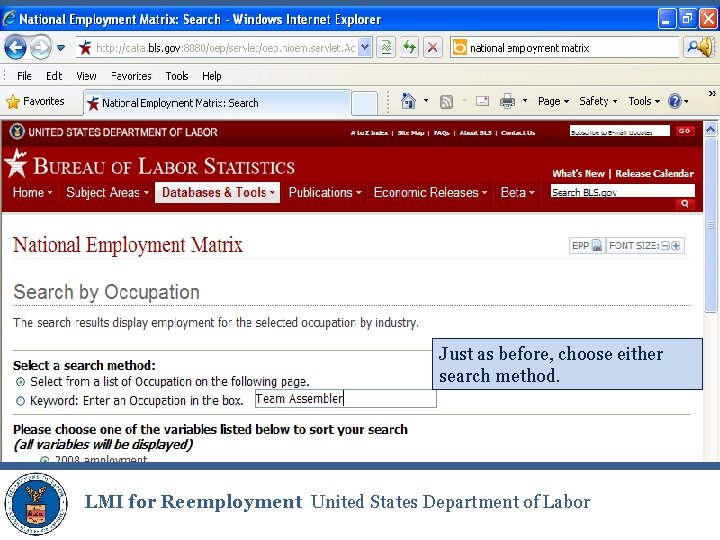
Just as before, choose either search method. LMI for Reemployment United States Department of Labor
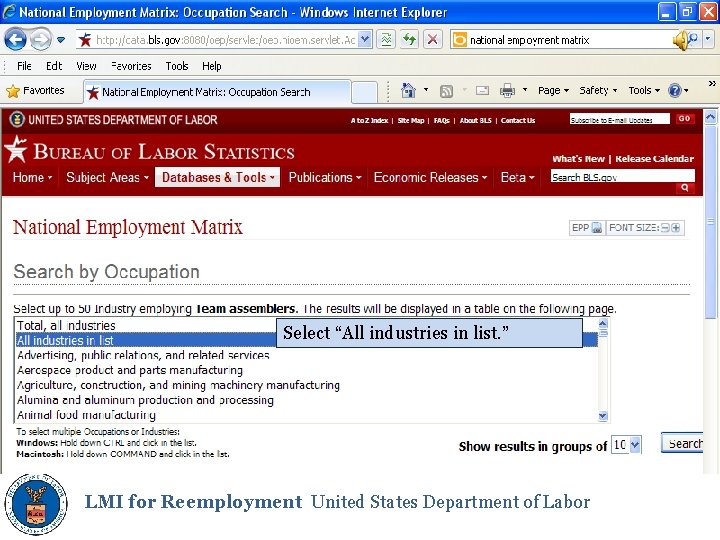
Select “All industries in list. ” LMI for Reemployment United States Department of Labor
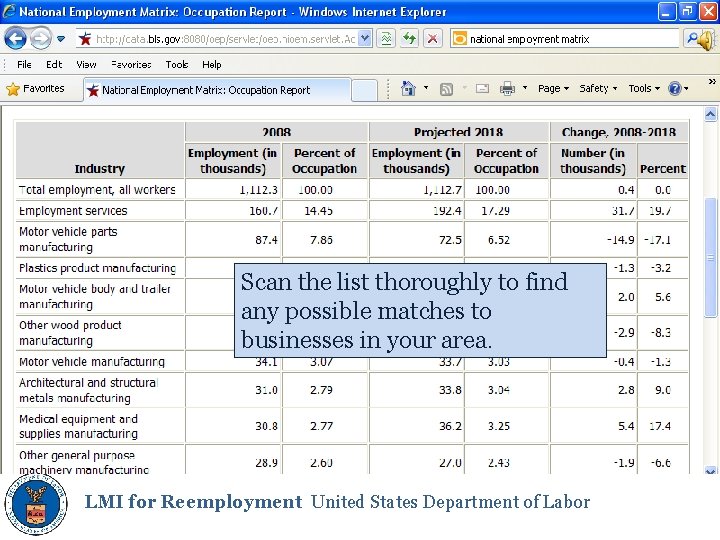
Scan the list thoroughly to find any possible matches to businesses in your area. LMI for Reemployment United States Department of Labor
Step 3: Skills Transfer Identification What data tools would you use to determine which skills will transfer to existing jobs? § If you can identify local industries or employers that employ the same occupations, that is a great place to begin trying to place the dislocated workers. § Many times there will be no local matches. In that case, what would be your next step? § Using O*Net, you can identify skills, etc. , relevant to the occupations and sometimes check for closely-related occupations. § When workers can utilize skills from a previous job in a new occupation, the transition is usually much easier. LMI for Reemployment United States Department of Labor
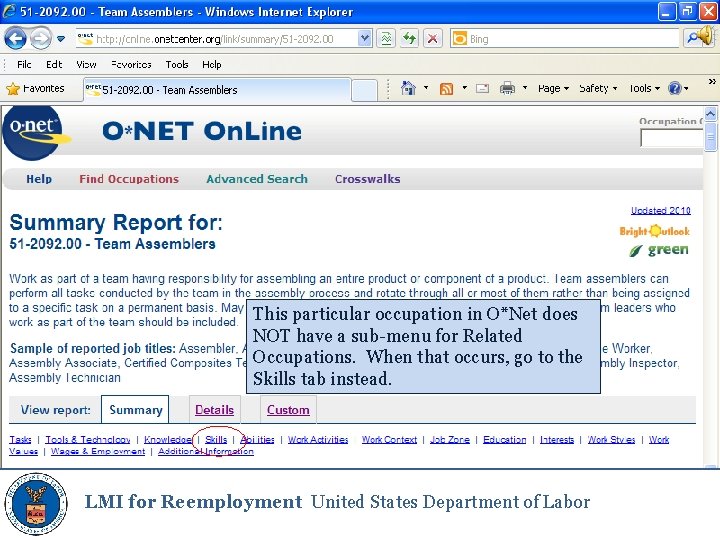
This particular occupation in O*Net does NOT have a sub-menu for Related Occupations. When that occurs, go to the Skills tab instead. LMI for Reemployment United States Department of Labor
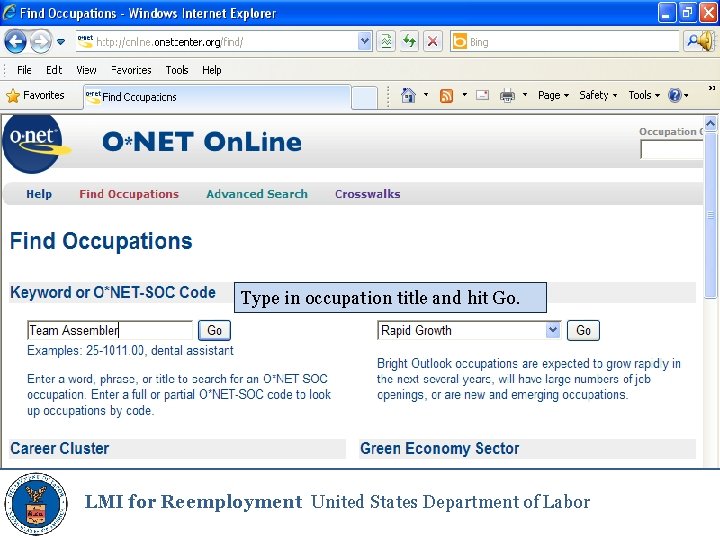
Type in occupation title and hit Go. LMI for Reemployment United States Department of Labor
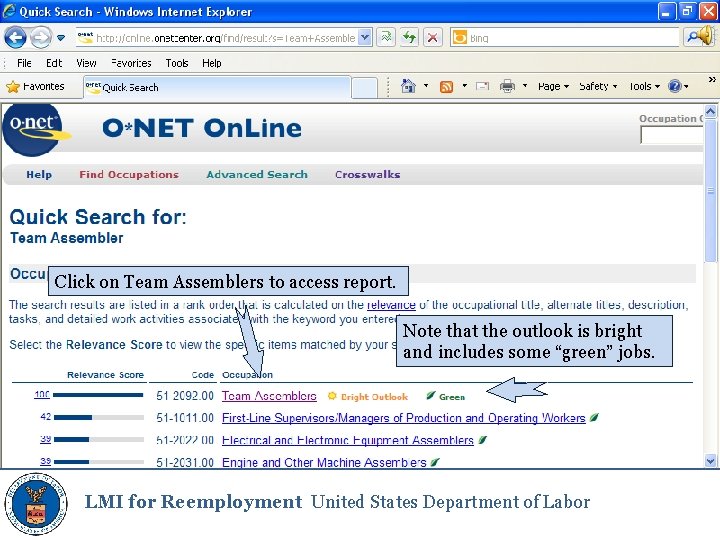
Click on Team Assemblers to access report. Note that the outlook is bright and includes some “green” jobs. LMI for Reemployment United States Department of Labor
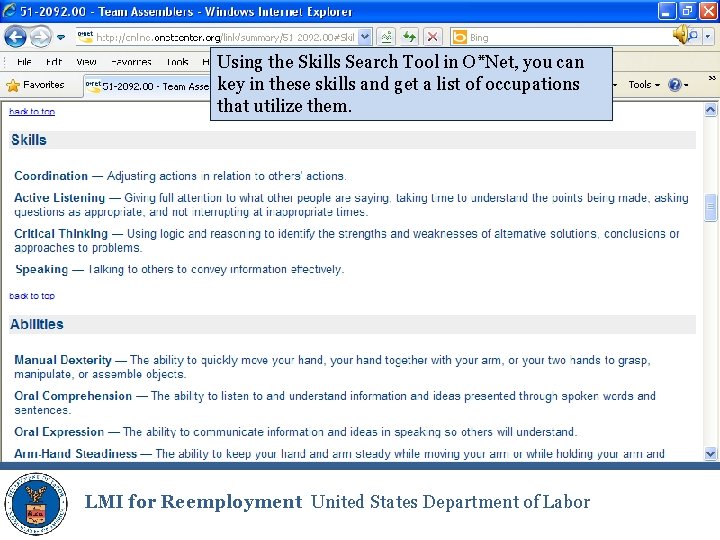
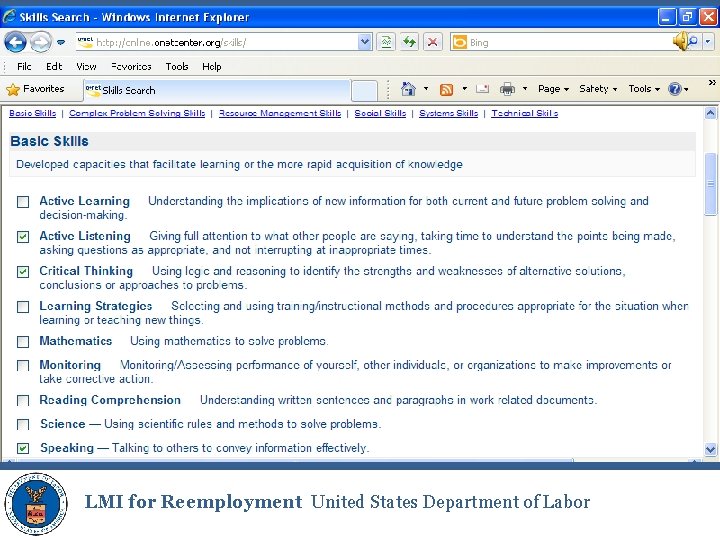
Using the Skills Search Tool in O*Net, you can key in these skills and get a list of occupations that utilize them. LMI for Reemployment United States Department of Labor
LMI for Reemployment United States Department of Labor
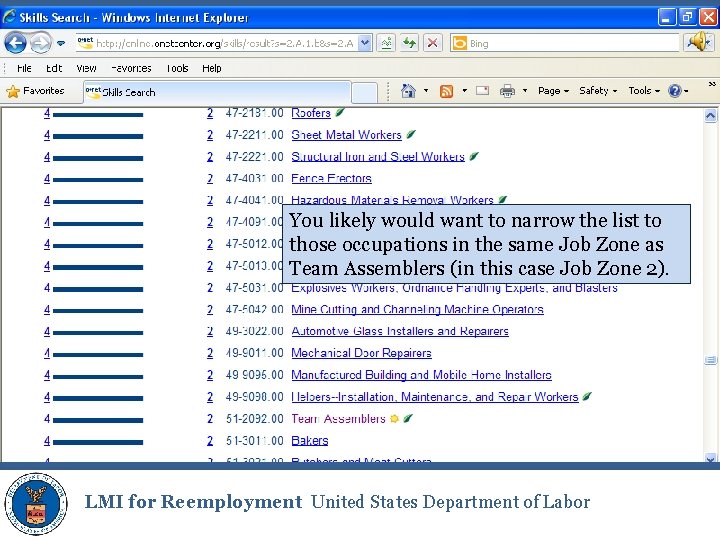
You likely would want to narrow the list to those occupations in the same Job Zone as Team Assemblers (in this case Job Zone 2). LMI for Reemployment United States Department of Labor
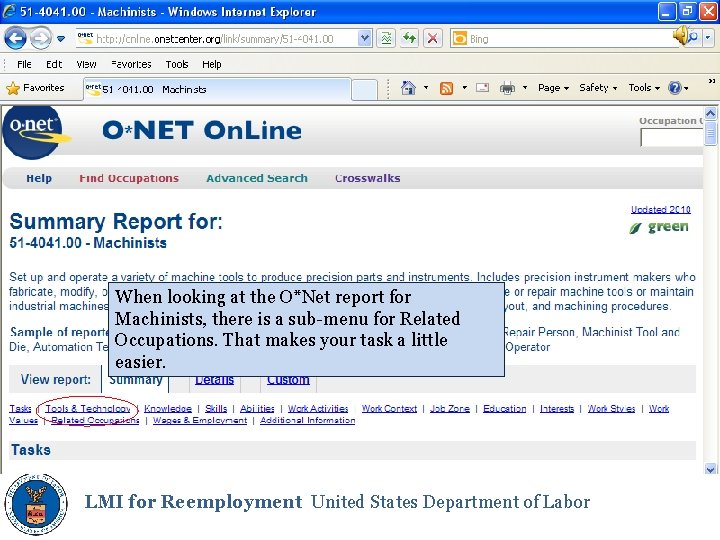
When looking at the O*Net report for Machinists, there is a sub-menu for Related Occupations. That makes your task a little easier. LMI for Reemployment United States Department of Labor
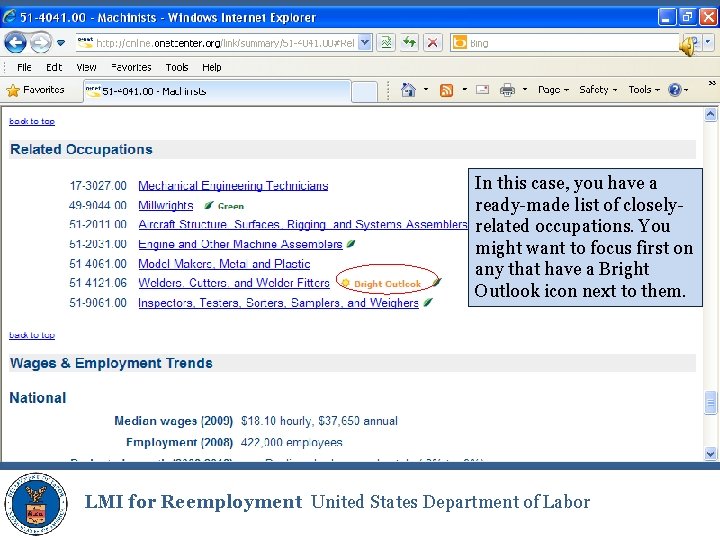
In this case, you have a ready-made list of closelyrelated occupations. You might want to focus first on any that have a Bright Outlook icon next to them. LMI for Reemployment United States Department of Labor
I would repeat this process for all the occupations in the layoff? Correct. It can be time consuming, but in the long run, we as workforce professionals owe it to those we serve. LMI for Reemployment United States Department of Labor
In Summary § Doing as much data compilation as possible beforehand makes the task easier when a crisis occurs. § Using the various tools discussed, you can compile a pretty good list of possible job matches for the dislocated workers. § Knowing in which industries to look can make job placements a lot easier. § Even if no comparable jobs exist locally, knowing the skill sets of the laid-off workers will ease the task of placing them in some other type of occupation. LMI for Reemployment United States Department of Labor
What if there are no matching jobs locally? Good point. There are differences in career planning when dealing with large groups as opposed to individuals. LMI for Reemployment United States Department of Labor
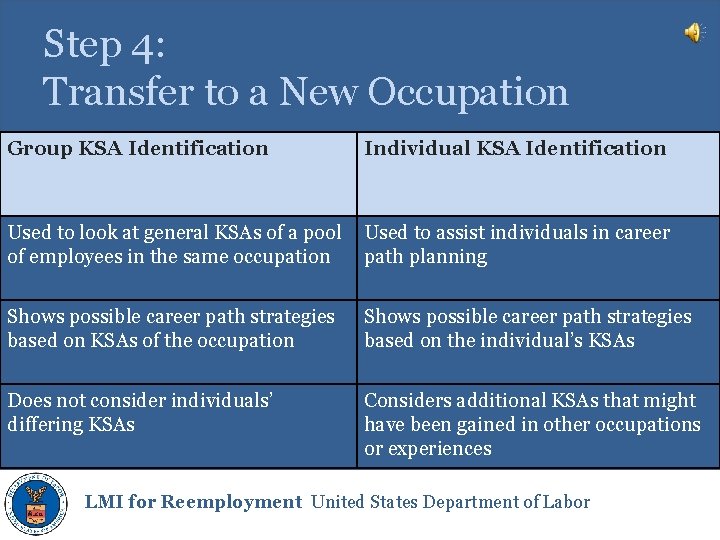
Step 4: Transfer to a New Occupation Group KSA Identification Individual KSA Identification Used to look at general KSAs of a pool of employees in the same occupation Used to assist individuals in career path planning Shows possible career path strategies based on KSAs of the occupation Shows possible career path strategies based on the individual’s KSAs Does not consider individuals’ differing KSAs Considers additional KSAs that might have been gained in other occupations or experiences LMI for Reemployment United States Department of Labor
Step 4: Transfer to New Occupation § What data tools would you use to help those whose skills will not transfer easily to other available jobs? § Using group characteristics is not as effective as using individual attributes. § However, when dealing with large numbers of individuals, time will simply not permit customized individual service at the outset. § Over time, if the layoffs persist, you may be able to work with individuals, using the techniques learned in Module 3 to customize a career path. § Initially, you will just have to work with the general characteristics of the group and find the best fits possible. LMI for Reemployment United States Department of Labor
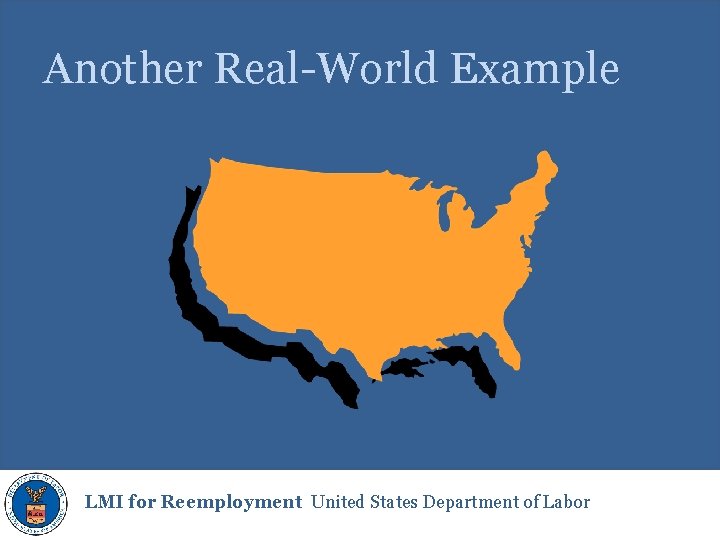
Another Real-World Example LMI for Reemployment United States Department of Labor
§ You are the local WIB chairman. In this scenario, what workforce information would be useful as you plan for disaster recovery? § News Flash - A strong Category 4 hurricane has come ashore in Florida, wreaking havoc as far inland as I-95. A storm surge in excess of 25 feet has obliterated thousands of homes and businesses along the immediate coast. Lesser damages were reported up to 25 miles inland. Communication systems are severely disrupted, and power outages are widespread. LMI for Reemployment United States Department of Labor
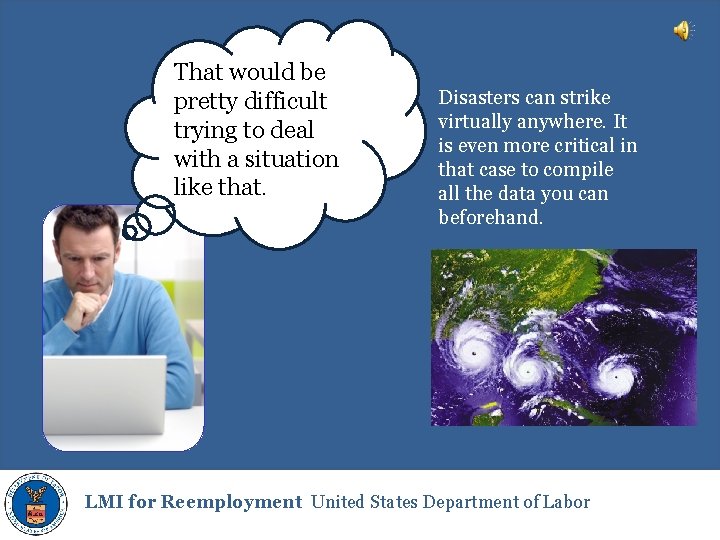
That would be pretty difficult trying to deal with a situation like that. Disasters can strike virtually anywhere. It is even more critical in that case to compile all the data you can beforehand. LMI for Reemployment United States Department of Labor
§ It’s too late to start planning when a flood, tornado, earthquake or hurricane hits. § Having a complete labor profile of your area before disaster strikes is essential to success. § The approach to helping disaster-related dislocated workers is similar but is compounded by other circumstances. § Businesses are destroyed or damaged, records are lost, housing becomes an issue, communications are disrupted, and new businesses move in to help with debris removal and reconstruction. LMI for Reemployment United States Department of Labor
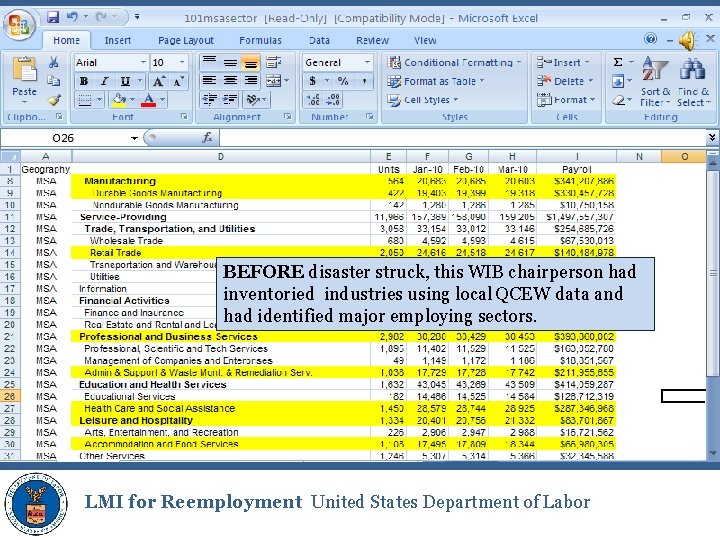
BEFORE disaster struck, this WIB chairperson had inventoried industries using local QCEW data and had identified major employing sectors. LMI for Reemployment United States Department of Labor
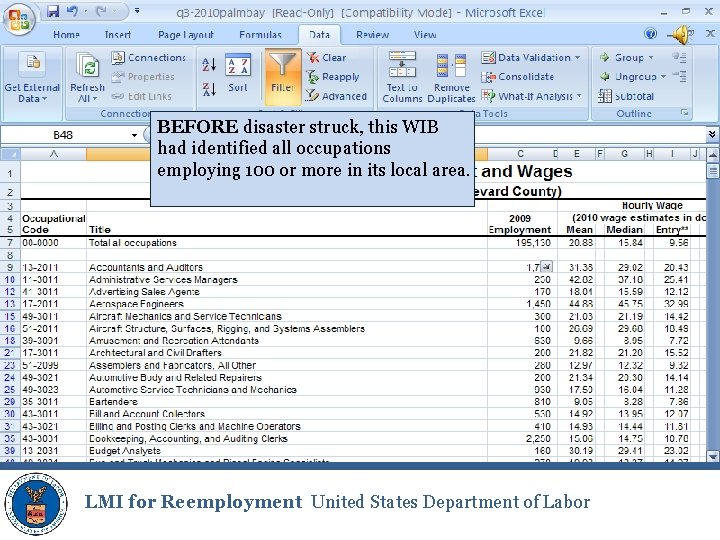
BEFORE disaster struck, this WIB had identified all occupations employing 100 or more in its local area. LMI for Reemployment United States Department of Labor
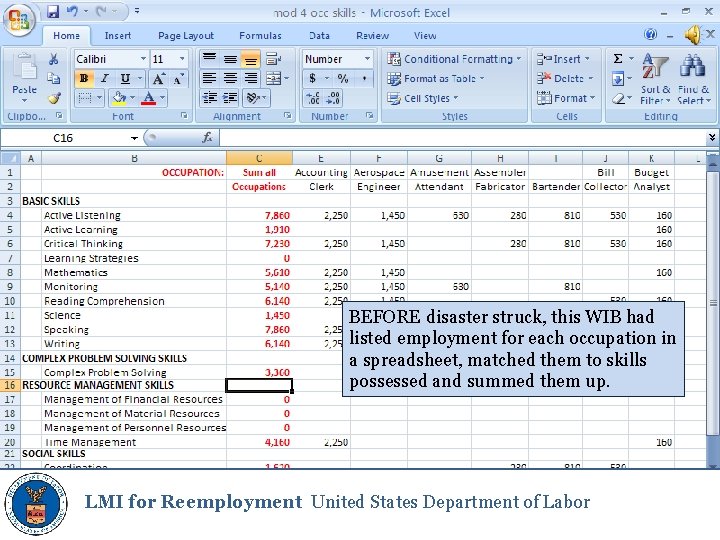
BEFORE disaster struck, this WIB had listed employment for each occupation in a spreadsheet, matched them to skills possessed and summed them up. LMI for Reemployment United States Department of Labor
Implement These Actions § Work with FEMA and local emergency management staff to determine how many businesses are destroyed or damaged, and estimate the number of workers affected. § Coordinate efforts to see that disaster-related unemployment benefits for dislocated workers are begun. § Assist with efforts to utilize volunteers and others who arrive to help with debris removal, cleanup, etc. § Utilize information gathered beforehand to begin job placement efforts for dislocated workers. LMI for Reemployment United States Department of Labor
Other LMI Resources Traditional (LMI) Data § Employment and Wage Statistics § Estimated job openings by industry and occupation § Unemployment Statistics § Mass Layoff Statistics Non-Traditional Data § Job vacancy reports § Trade association reports § Location Quotients Let’s explore some of § Local Employment Dynamics (LED) non-traditional tools • Labor Shed Studies further. • Workforce Indicators LMI for Reemployment United States Department of Labor the
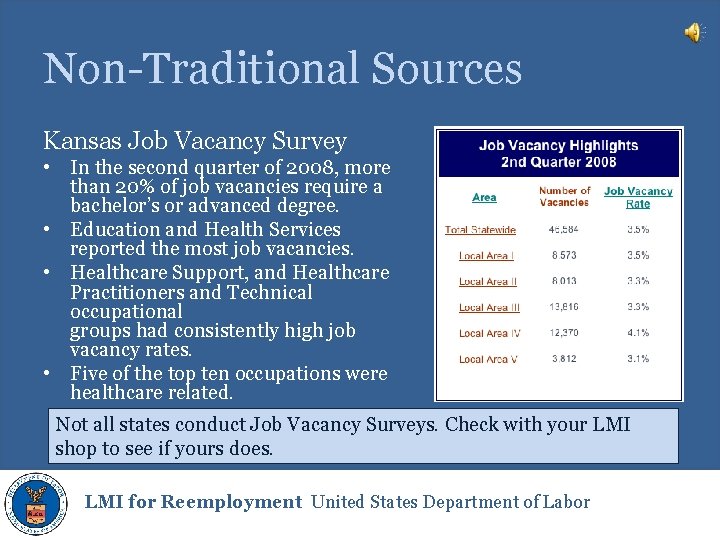
Non-Traditional Sources Kansas Job Vacancy Survey • In the second quarter of 2008, more than 20% of job vacancies require a bachelor’s or advanced degree. • Education and Health Services reported the most job vacancies. • Healthcare Support, and Healthcare Practitioners and Technical occupational groups had consistently high job vacancy rates. • Five of the top ten occupations were healthcare related. Not all states conduct Job Vacancy Surveys. Check with your LMI shop to see if yours does. LMI for Reemployment United States Department of Labor
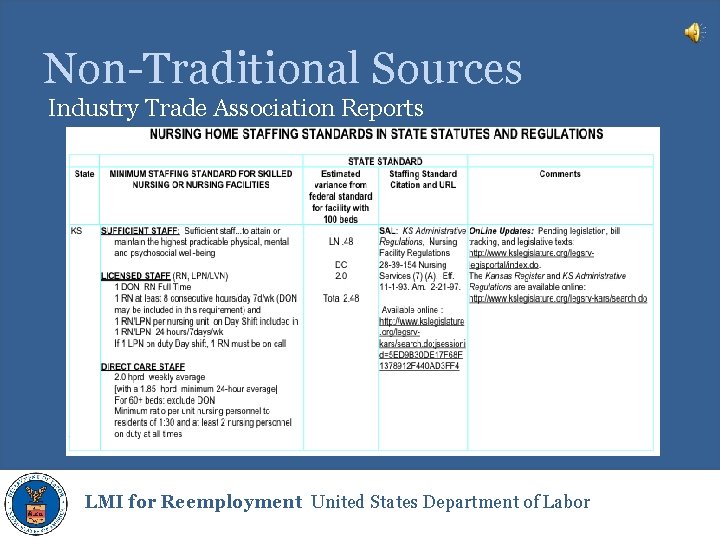
Non-Traditional Sources Industry Trade Association Reports LMI for Reemployment United States Department of Labor
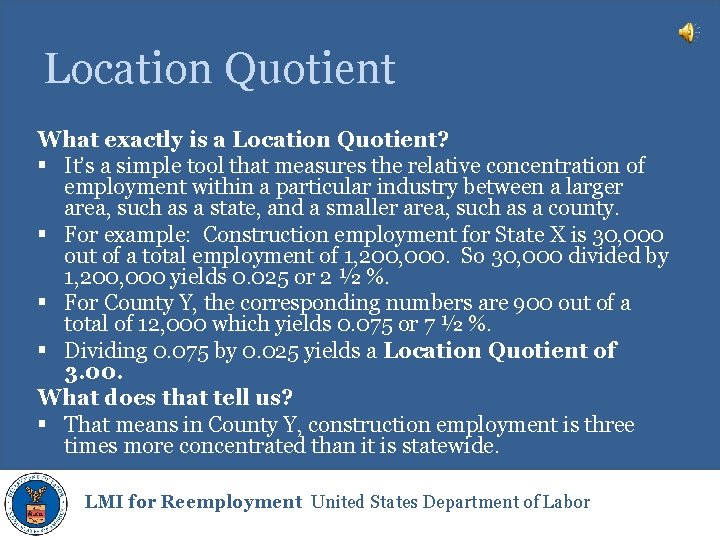
Location Quotient What exactly is a Location Quotient? § It’s a simple tool that measures the relative concentration of employment within a particular industry between a larger area, such as a state, and a smaller area, such as a county. § For example: Construction employment for State X is 30, 000 out of a total employment of 1, 200, 000. So 30, 000 divided by 1, 200, 000 yields 0. 025 or 2 ½ %. § For County Y, the corresponding numbers are 900 out of a total of 12, 000 which yields 0. 075 or 7 ½ %. § Dividing 0. 075 by 0. 025 yields a Location Quotient of 3. 00. What does that tell us? § That means in County Y, construction employment is three times more concentrated than it is statewide. LMI for Reemployment United States Department of Labor
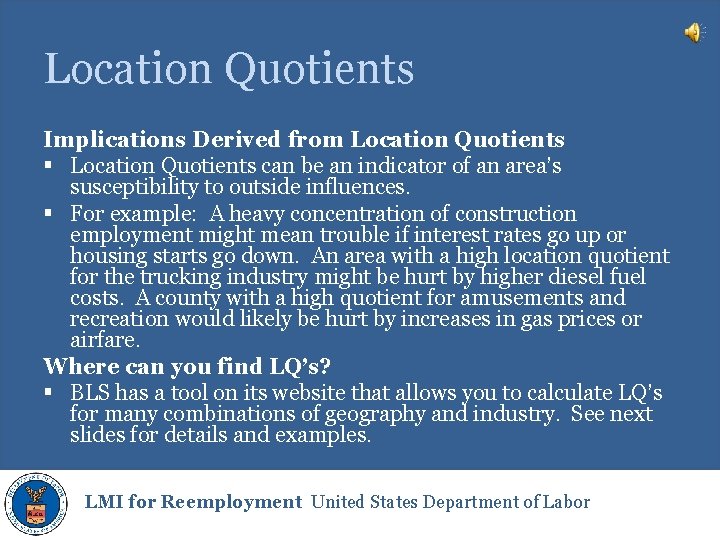
Location Quotients Implications Derived from Location Quotients § Location Quotients can be an indicator of an area’s susceptibility to outside influences. § For example: A heavy concentration of construction employment might mean trouble if interest rates go up or housing starts go down. An area with a high location quotient for the trucking industry might be hurt by higher diesel fuel costs. A county with a high quotient for amusements and recreation would likely be hurt by increases in gas prices or airfare. Where can you find LQ’s? § BLS has a tool on its website that allows you to calculate LQ’s for many combinations of geography and industry. See next slides for details and examples. LMI for Reemployment United States Department of Labor
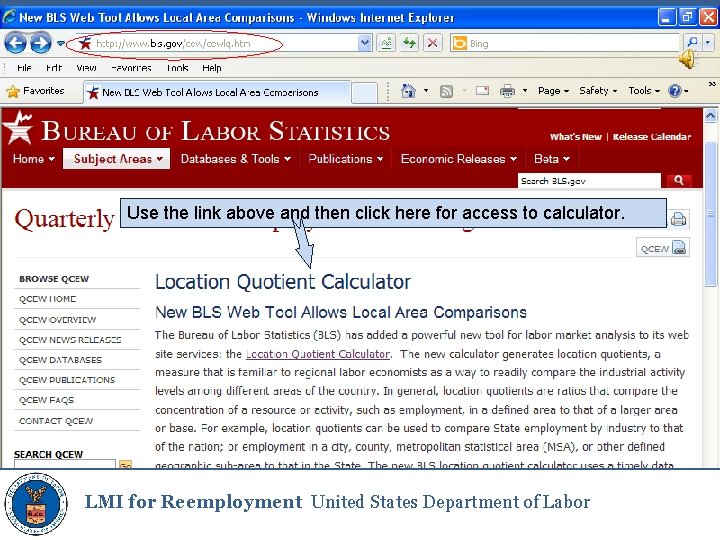
Use the link above and then click here for access to calculator. LMI for Reemployment United States Department of Labor
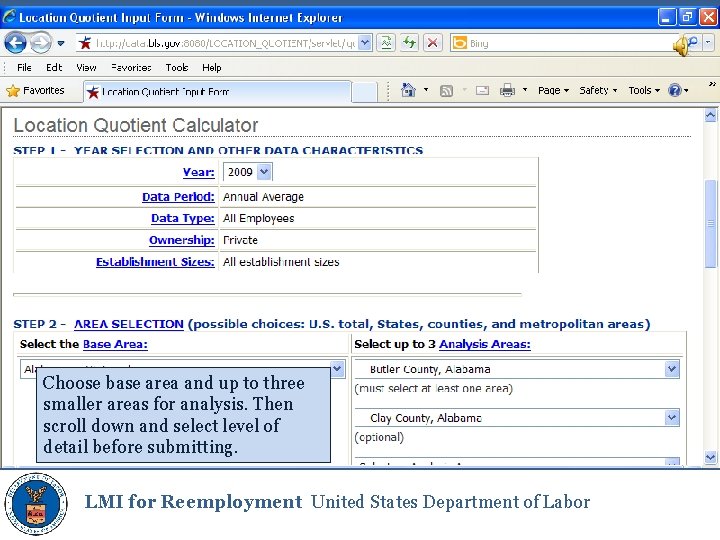
Choose base area and up to three smaller areas for analysis. Then scroll down and select level of detail before submitting. LMI for Reemployment United States Department of Labor
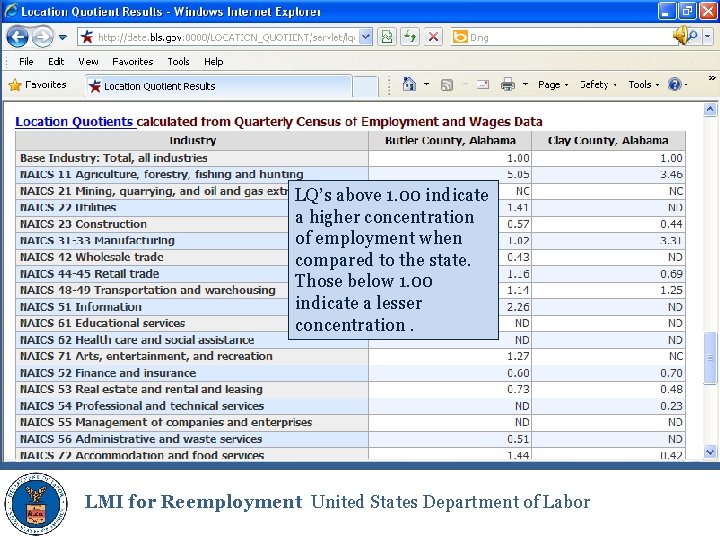
LQ’s above 1. 00 indicate a higher concentration of employment when compared to the state. Those below 1. 00 indicate a lesser concentration. LMI for Reemployment United States Department of Labor
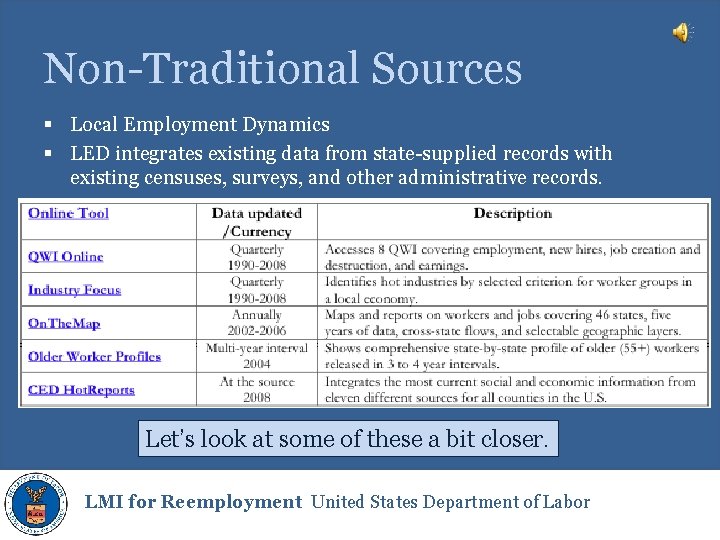
Non-Traditional Sources § Local Employment Dynamics § LED integrates existing data from state-supplied records with existing censuses, surveys, and other administrative records. Let’s look at some of these a bit closer. LMI for Reemployment United States Department of Labor
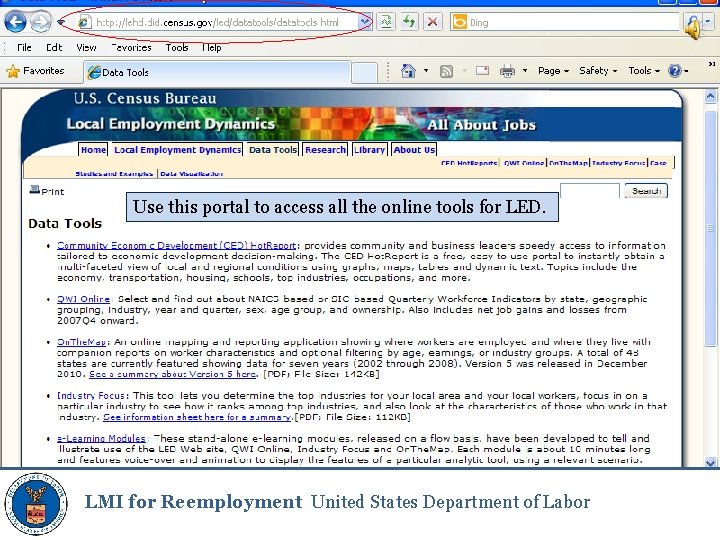
Use this portal to access all the online tools for LED. LMI for Reemployment United States Department of Labor
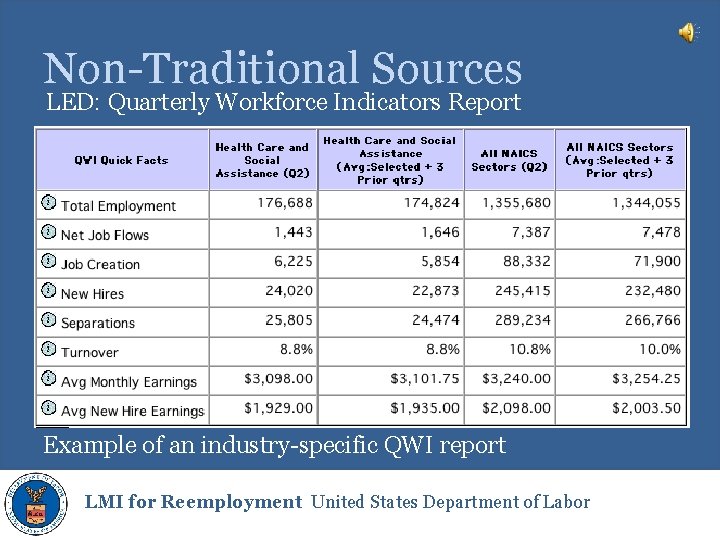
Non-Traditional Sources LED: Quarterly Workforce Indicators Report Example of an industry-specific QWI report LMI for Reemployment United States Department of Labor
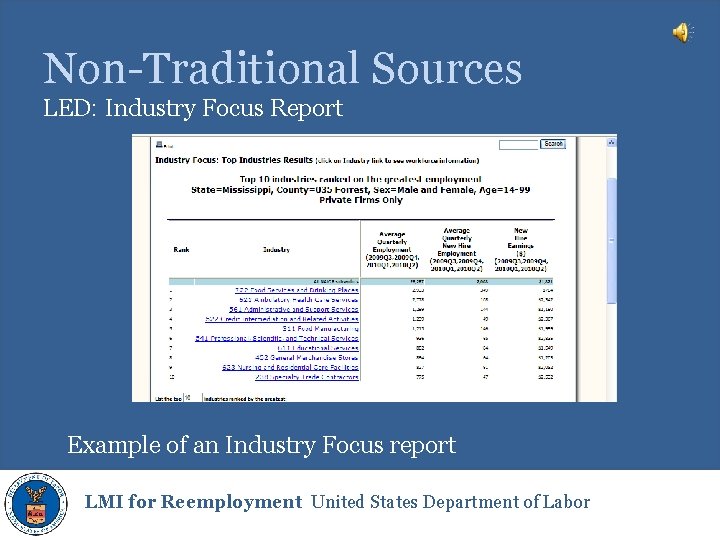
Non-Traditional Sources LED: Industry Focus Report Example of an Industry Focus report LMI for Reemployment United States Department of Labor
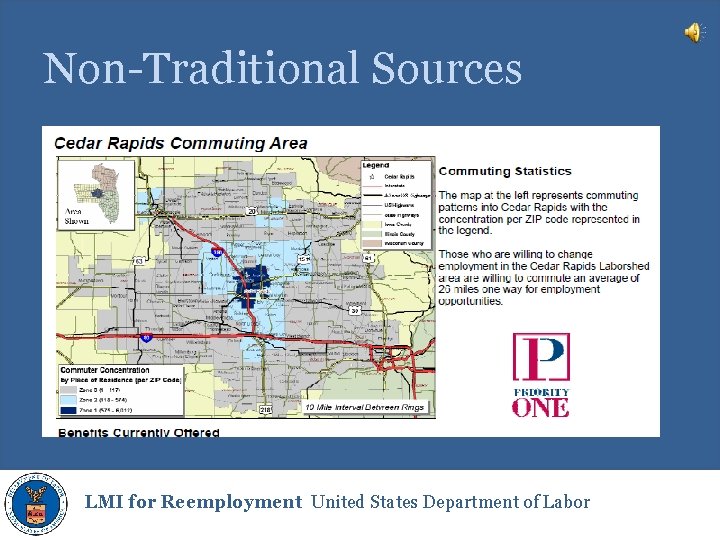
Non-Traditional Sources LMI for Reemployment United States Department of Labor
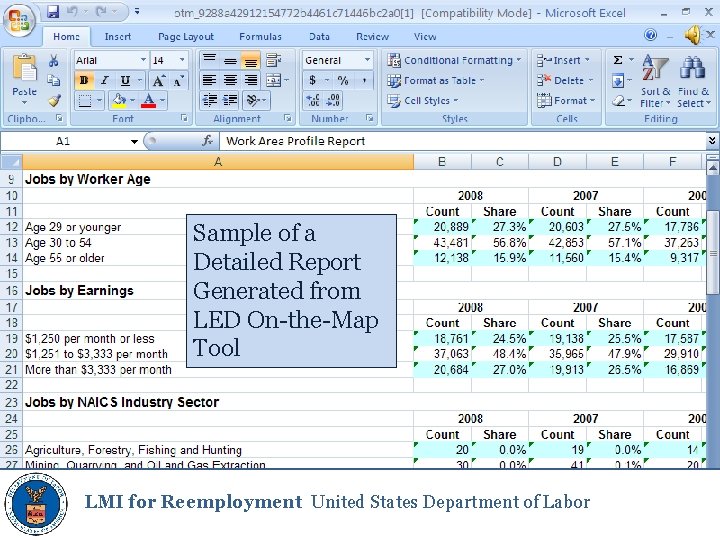
Sample of a Detailed Report Generated from LED On-the-Map Tool LMI for Reemployment United States Department of Labor
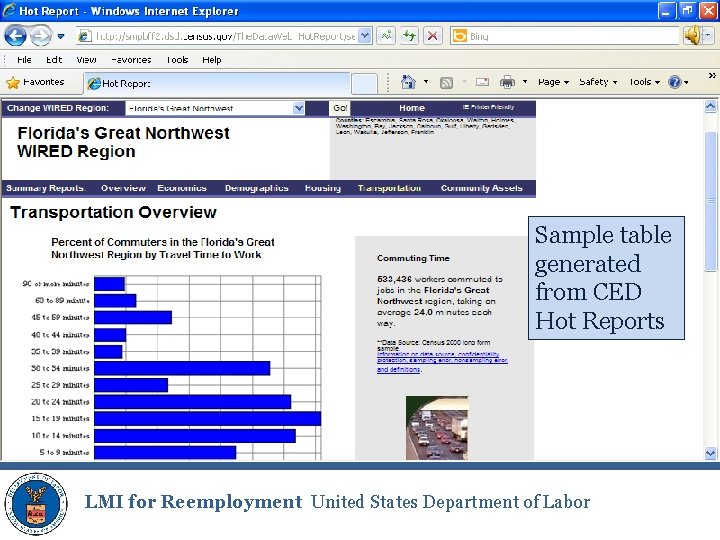
Sample table generated from CED Hot Reports LMI for Reemployment United States Department of Labor
That is absolutely a lot to absorb. So who can help me understand it all? This is where collaboration with your state LMI folks becomes vital. YOUR STATE LMI DIVISION! LMI for Reemployment United States Department of Labor
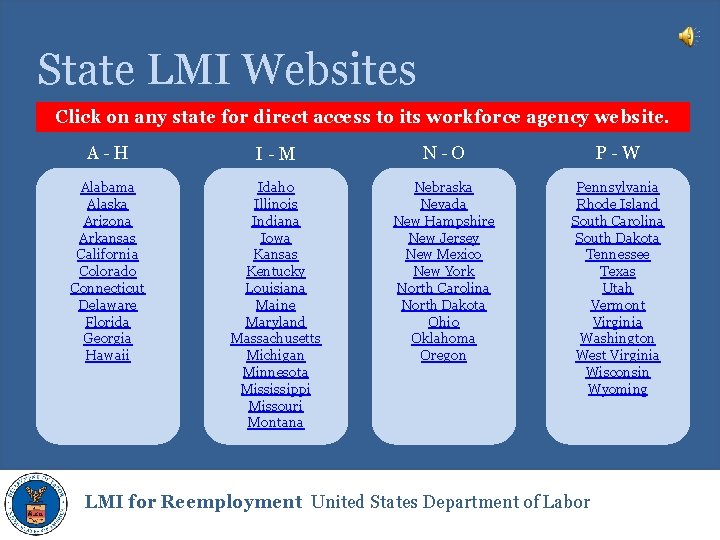
State LMI Websites Click on any state for direct access to its workforce agency website. A-H I-M N-O P-W Alabama Alaska Arizona Arkansas California Colorado Connecticut Delaware Florida Georgia Hawaii Idaho Illinois Indiana Iowa Kansas Kentucky Louisiana Maine Maryland Massachusetts Michigan Minnesota Mississippi Missouri Montana Nebraska Nevada New Hampshire New Jersey New Mexico New York North Carolina North Dakota Ohio Oklahoma Oregon Pennsylvania Rhode Island South Carolina South Dakota Tennessee Texas Utah Vermont Virginia Washington West Virginia Wisconsin Wyoming LMI for Reemployment United States Department of Labor
Collaboration with LMI Shops 1. LMI shops are charged with delivering data to WIB partners. It’s their job. 2. They have the expertise to help you both gather and interpret the information you need to institute a reemployment strategy. 3. They can provide guidance as to which data are relevant in a given situation. 4. They can help by developing surveys or generating special reports to fill in any data you feel might be missing. 5. Generally speaking, they do not charge for any of their services, which certainly benefits the WIB financially. 6. Consider your LMI Division as a help with grant proposals. Check out the next slide. LMI for Reemployment United States Department of Labor
Data and Funding 1. Competitive grants are offered regularly by ETA and others. 2. Generally speaking, such grants require hard data to support the request for funding. 3. LMI shops are an excellent source for the data you need, providing guidance as to what is relevant. 4. Your chances of getting the grant funding for a project are greatly enhanced when all partners are involved. 5. The next few slides show some recent examples of how collaboration with LMI and others can be beneficial. LMI for Reemployment United States Department of Labor
Data and Funding Working in partnership with an LMI for competitive grant funds will make the money more likely to come. Examples of this working include the states of PA, NY, CT, NJ and more. LMI for Reemployment United States Department of Labor
Data and Funding Best Practice: NY-NJ-CT 2008 Grant Seeking Sector Approach § A solid business plan and well-analyzed data are needed to attract investors. § Targeted the Financial Sector § First tri-state NEG grant § NY financial industry employed people who lived in three states -- NY, NJ and CT. § In the past, roughly 25% of the sector’s labor force had been laid off during a similar downturn. § Partnered with LMI for support with solid data in the application for funds § Brought in the federal reserve experts to confirm the models § Outcome: Received $22 million LMI for Reemployment United States Department of Labor
Data and Funding Best Practice: PA Creating Stimulus Grants with Federal Recovery Money § Focused data coupled with collaboration can lead to the creation of an effective solution. § Partnered with LMI § Designed the programs : – Deploying federal recovery dollars – Using strong supporting data § Outcome: • Upskilling Grants – longer skilled training to change occupation areas • Career Pathway Grants – assessments, intervention, certification • On-the-Job Training (OJT) – wage subsidy of 50% LMI for Reemployment United States Department of Labor
Let’s review the key points from this module! LMI for Reemployment United States Department of Labor
Eight Key Points § It is essential to develop a complete labor profile for your area. § LMI has tremendous strategic value when developing reemployment strategies. § You should be able to articulate your LMI data needs. § When dealing with large numbers of dislocated workers, use general traits. LMI for Reemployment United States Department of Labor
Eight Key Points § Tools such as LED or Location Quotients can shed new light on the workforce. § LMI shops are true partners in the process. § Funds from grants are more likely to come when WIBs collaborate with LMI shops. § There is no such thing as too much labor market information! LMI for Reemployment United States Department of Labor
Now That You Have Completed This Module… § Congratulations on adding to your LMI knowledge! If you are interested in learning more about LMI for businesses or assessing skills , check out other modules in the series. LMI for Reemployment United States Department of Labor
Produced by Manhattan Strategy Group on behalf of the Employment and Training Administration of the US Department of Labor LMI for Reemployment United States Department of Labor
- Slides: 81