
LM 117 Regulator Risk Assessment SPICE Why are
- Slides: 13
LM 117 Regulator Risk Assessment - SPICE Why are you here? Ans: To provide feedback and information on how to verify that a design is truly flight worthy. Ans: To provide feedback on you convections about quality. Ans: To review how we validate performance or design quality now. Why am I here? Ans: To gather your feedback Ans: To formulate concepts which will expand our understand of quality Ans: To propose and challenge you with some “new” or “old” ideas. Ans: To determine if there is a clear consensus 1 AGBell
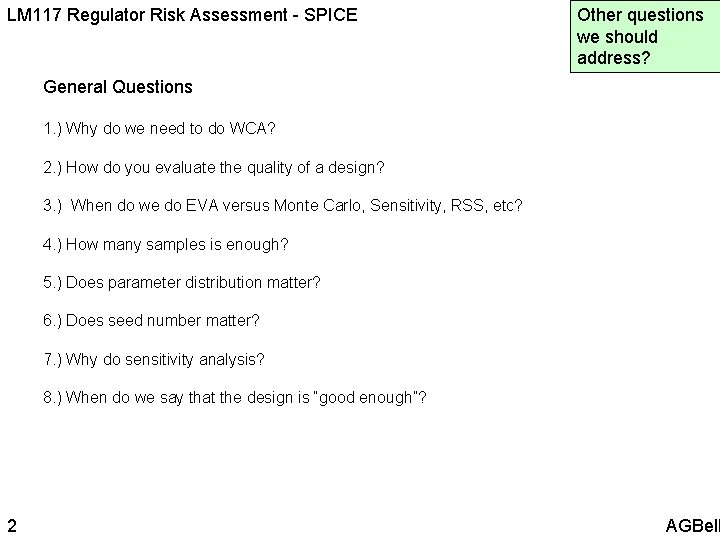
LM 117 Regulator Risk Assessment - SPICE Other questions we should address? General Questions 1. ) Why do we need to do WCA? 2. ) How do you evaluate the quality of a design? 3. ) When do we do EVA versus Monte Carlo, Sensitivity, RSS, etc? 4. ) How many samples is enough? 5. ) Does parameter distribution matter? 6. ) Does seed number matter? 7. ) Why do sensitivity analysis? 8. ) When do we say that the design is “good enough”? 2 AGBell
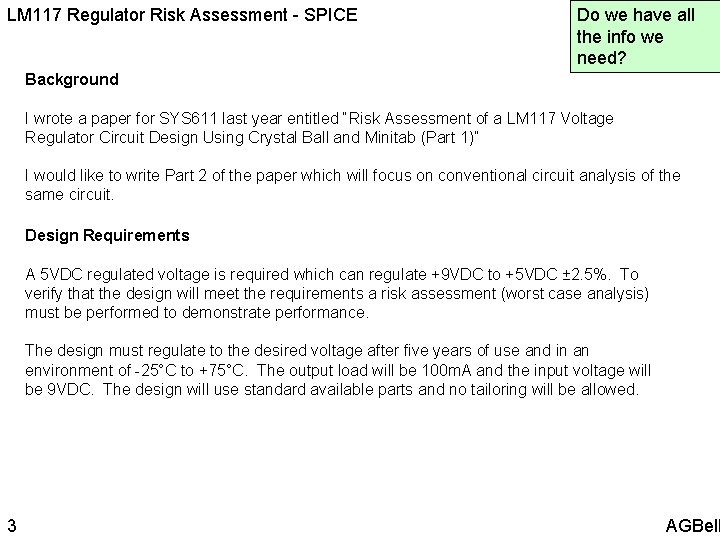
LM 117 Regulator Risk Assessment - SPICE Do we have all the info we need? Background I wrote a paper for SYS 611 last year entitled “Risk Assessment of a LM 117 Voltage Regulator Circuit Design Using Crystal Ball and Minitab (Part 1)” I would like to write Part 2 of the paper which will focus on conventional circuit analysis of the same circuit. Design Requirements A 5 VDC regulated voltage is required which can regulate +9 VDC to +5 VDC ± 2. 5%. To verify that the design will meet the requirements a risk assessment (worst case analysis) must be performed to demonstrate performance. The design must regulate to the desired voltage after five years of use and in an environment of -25°C to +75°C. The output load will be 100 m. A and the input voltage will be 9 VDC. The design will use standard available parts and no tailoring will be allowed. 3 AGBell
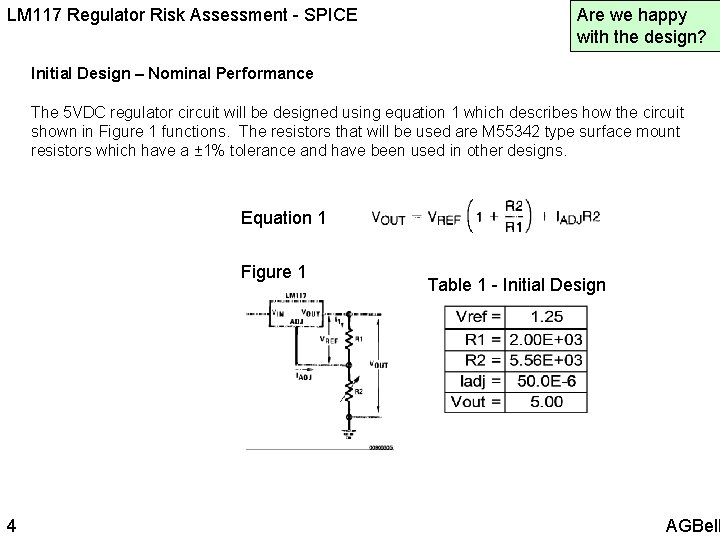
LM 117 Regulator Risk Assessment - SPICE Are we happy with the design? Initial Design – Nominal Performance The 5 VDC regulator circuit will be designed using equation 1 which describes how the circuit shown in Figure 1 functions. The resistors that will be used are M 55342 type surface mount resistors which have a ± 1% tolerance and have been used in other designs. Equation 1 Figure 1 4 Table 1 - Initial Design AGBell
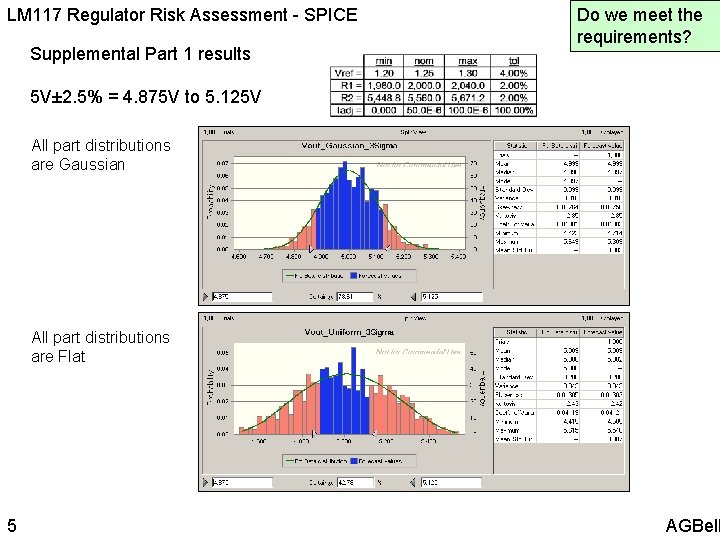
LM 117 Regulator Risk Assessment - SPICE Supplemental Part 1 results Do we meet the requirements? 5 V± 2. 5% = 4. 875 V to 5. 125 V All part distributions are Gaussian All part distributions are Flat 5 AGBell
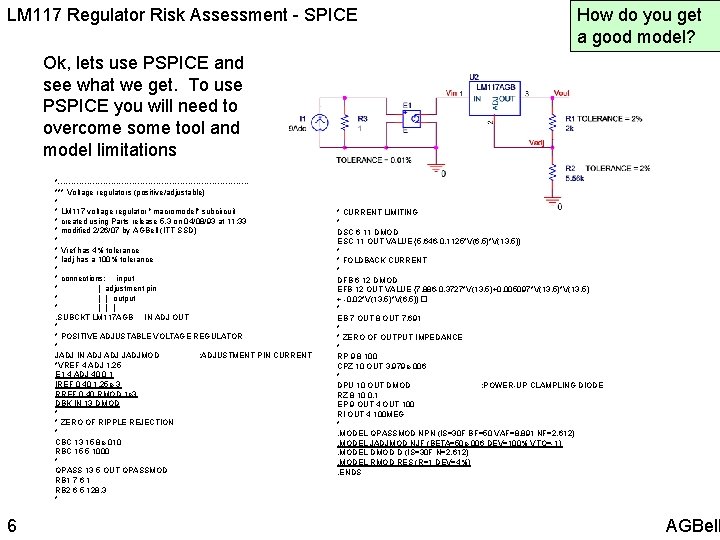
LM 117 Regulator Risk Assessment - SPICE How do you get a good model? Ok, lets use PSPICE and see what we get. To use PSPICE you will need to overcome some tool and model limitations *------------------------------------*** Voltage regulators (positive/adjustable) * * LM 117 voltage regulator "macromodel" subcircuit * created using Parts release 5. 3 on 04/08/93 at 11: 33 * modified 2/26/07 by AGBell (ITT SSD) * * Vref has 4% tolerance * Iadj has a 100% tolerance * * connections: input * | adjustment pin * | | output * | | |. SUBCKT LM 117 AGB IN ADJ OUT * * POSITIVE ADJUSTABLE VOLTAGE REGULATOR * JADJ IN ADJ JADJMOD ; ADJUSTMENT PIN CURRENT *VREF 4 ADJ 1. 25 E 1 4 ADJ 40 0 1 IREF 0 40 1. 25 e-3 RREF 0 40 RMOD 1 e 3 DBK IN 13 DMOD * * ZERO OF RIPPLE REJECTION * CBC 13 15 8 e-010 RBC 15 5 1000 * QPASS 13 5 OUT QPASSMOD RB 1 7 6 1 RB 2 6 5 128. 3 * 6 * CURRENT LIMITING * DSC 6 11 DMOD ESC 11 OUT VALUE {5. 646 -0. 1125*V(6, 5)*V(13, 5)} * * FOLDBACK CURRENT * DFB 6 12 DMOD EFB 12 OUT VALUE {7. 886 -0. 3727*V(13, 5)+0. 005097*V(13, 5) + -0. 02*V(13, 5)*V(6, 5)}� * EB 7 OUT 8 OUT 7. 691 * * ZERO OF OUTPUT IMPEDANCE * RP 9 8 100 CPZ 10 OUT 3. 979 e-006 * DPU 10 OUT DMOD ; POWER-UP CLAMPLING DIODE RZ 8 10 0. 1 EP 9 OUT 4 OUT 100 RI OUT 4 100 MEG *. MODEL QPASSMOD NPN (IS=30 F BF=50 VAF=8. 891 NF=2. 612). MODEL JADJMOD NJF (BETA=50 e-006 DEV=100% VTO=-1). MODEL DMOD D (IS=30 F N=2. 612). MODEL RMOD RES (R=1 DEV=4%). ENDS AGBell
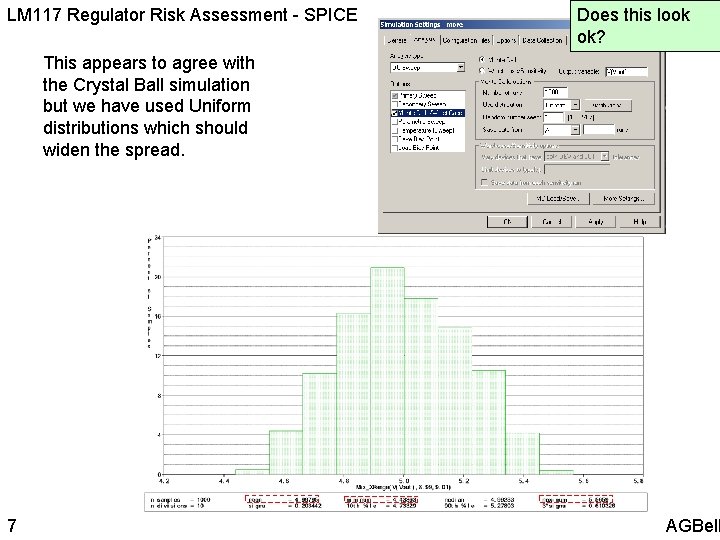
LM 117 Regulator Risk Assessment - SPICE Does this look ok? This appears to agree with the Crystal Ball simulation but we have used Uniform distributions which should widen the spread. 7 AGBell
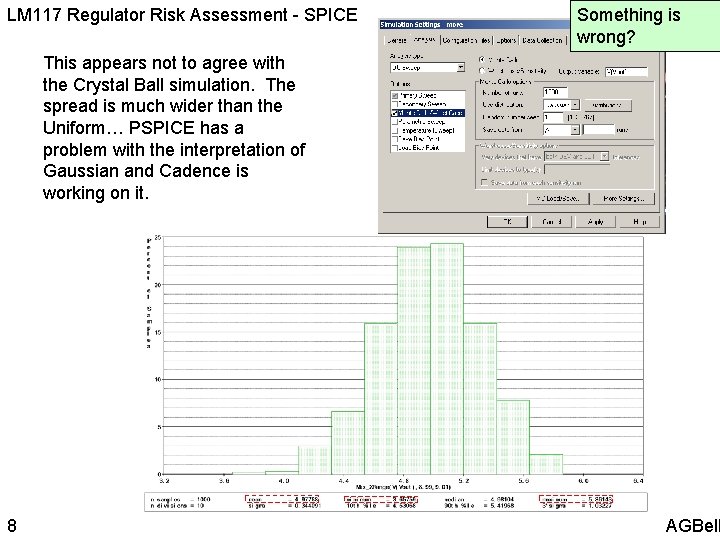
LM 117 Regulator Risk Assessment - SPICE Something is wrong? This appears not to agree with the Crystal Ball simulation. The spread is much wider than the Uniform… PSPICE has a problem with the interpretation of Gaussian and Cadence is working on it. 8 AGBell
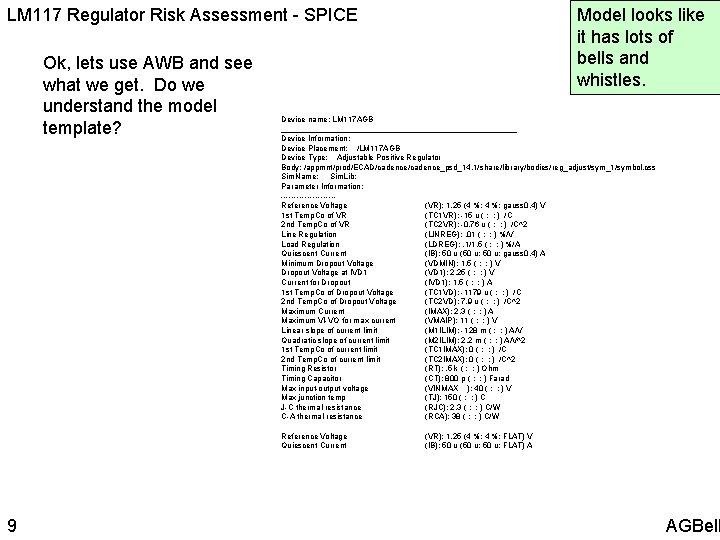
Model looks like it has lots of bells and whistles. LM 117 Regulator Risk Assessment - SPICE Ok, lets use AWB and see what we get. Do we understand the model template? Device name: LM 117 AGB ___________________________ Device Information: Device Placement: /LM 117 AGB Device Type: Adjustable Positive Regulator Body: /appmnt/prod/ECAD/cadence_psd_14. 1/share/library/bodies/reg_adjust/sym_1/symbol. css Sim. Name: Sim. Lib: Parameter Information: ----------Reference Voltage (VR): 1. 25 (4 %; gauss 0. 4) V 1 st Temp. Co of VR (TC 1 VR): -15 u ( ; ; ) /C 2 nd Temp. Co of VR (TC 2 VR): -0. 76 u ( ; ; ) /C^2 Line Regulation (LINREG): . 01 ( ; ; ) %/V Load Regulation (LDREG): . 1/1. 5 ( ; ; ) %/A Quiescent Current (IB): 50 u (50 u; gauss 0. 4) A Minimum Dropout Voltage (VDMIN): 1. 5 ( ; ; ) V Dropout Voltage at IVD 1 (VD 1): 2. 25 ( ; ; ) V Current for Dropout (IVD 1): 1. 5 ( ; ; ) A 1 st Temp. Co of Dropout Voltage (TC 1 VD): -1179 u ( ; ; ) /C 2 nd Temp. Co of Dropout Voltage (TC 2 VD): 7. 9 u ( ; ; ) /C^2 Maximum Current (IMAX): 2. 3 ( ; ; ) A Maximum VI-VO for max current (VMAIP): 11 ( ; ; ) V Linear slope of current limit (M 1 ILIM): -128 m ( ; ; ) A/V Quadratic slope of current limit (M 2 ILIM): 2. 2 m ( ; ; ) A/V^2 1 st Temp. Co of current limit (TC 1 IMAX): 0 ( ; ; ) /C 2 nd Temp. Co of current limit (TC 2 IMAX): 0 ( ; ; ) /C^2 Timing Resistor (RT): . 5 k ( ; ; ) Ohm Timing Capacitor (CT): 800 p ( ; ; ) Farad Max input-output voltage (VINMAX ): 40 ( ; ; ) V Max junction temp (TJ): 150 ( ; ; ) C J-C thermal resistance (RJC): 2. 3 ( ; ; ) C/W C-A thermal resistance (RCA): 38 ( ; ; ) C/W Reference Voltage Quiescent Current 9 (VR): 1. 25 (4 %; FLAT) V (IB): 50 u (50 u; FLAT) A AGBell
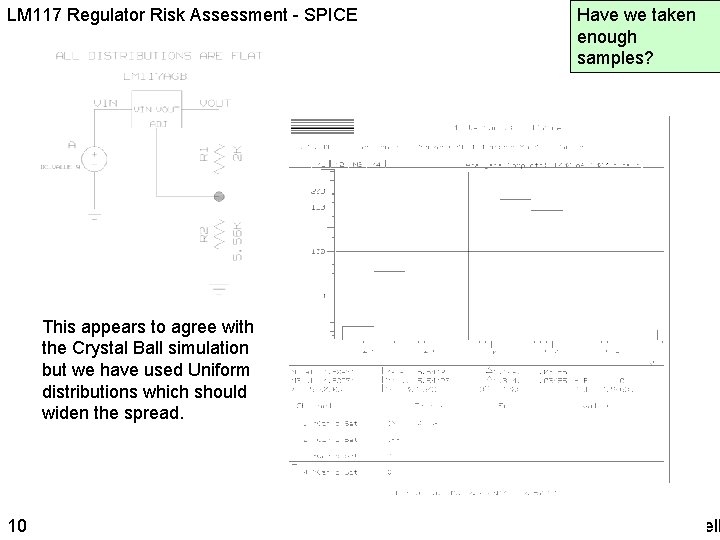
LM 117 Regulator Risk Assessment - SPICE Have we taken enough samples? This appears to agree with the Crystal Ball simulation but we have used Uniform distributions which should widen the spread. 10 AGBell
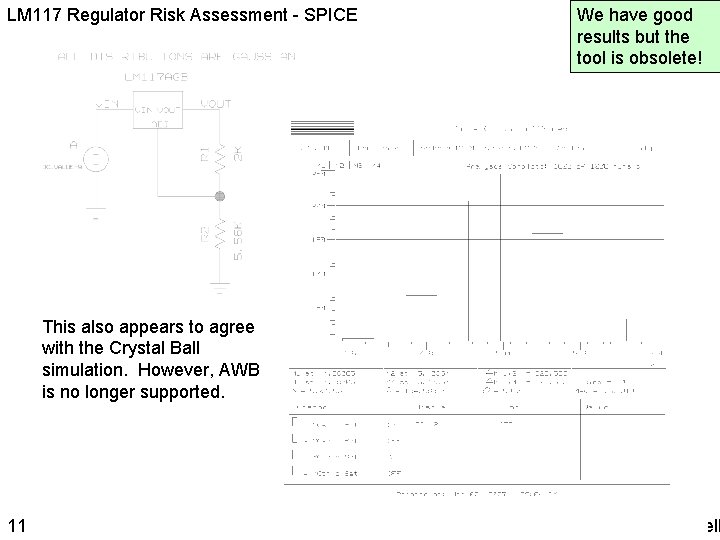
LM 117 Regulator Risk Assessment - SPICE We have good results but the tool is obsolete! This also appears to agree with the Crystal Ball simulation. However, AWB is no longer supported. 11 AGBell
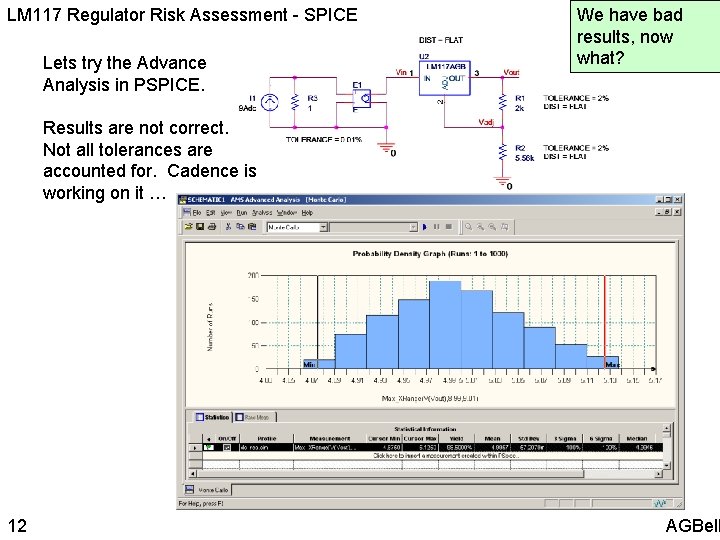
LM 117 Regulator Risk Assessment - SPICE Lets try the Advance Analysis in PSPICE. We have bad results, now what? Results are not correct. Not all tolerances are accounted for. Cadence is working on it … 12 AGBell
LM 117 Regulator Risk Assessment - SPICE We are not done. The tools look like they have issues that need to be solved. We can’t trust the models. We have not answered our “general questions” yet. Not only do models need to be validated but maybe the tools as well. 13 AGBell