
LLRF Phase Reference System The LCLS linac is
- Slides: 11
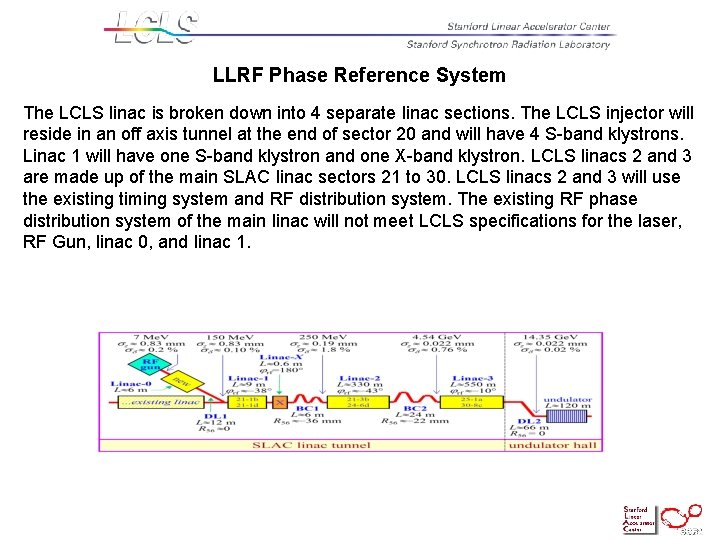
LLRF Phase Reference System The LCLS linac is broken down into 4 separate linac sections. The LCLS injector will reside in an off axis tunnel at the end of sector 20 and will have 4 S-band klystrons. Linac 1 will have one S-band klystron and one X-band klystron. LCLS linacs 2 and 3 are made up of the main SLAC linac sectors 21 to 30. LCLS linacs 2 and 3 will use the existing timing system and RF distribution system. The existing RF phase distribution system of the main linac will not meet LCLS specifications for the laser, RF Gun, linac 0, and linac 1.
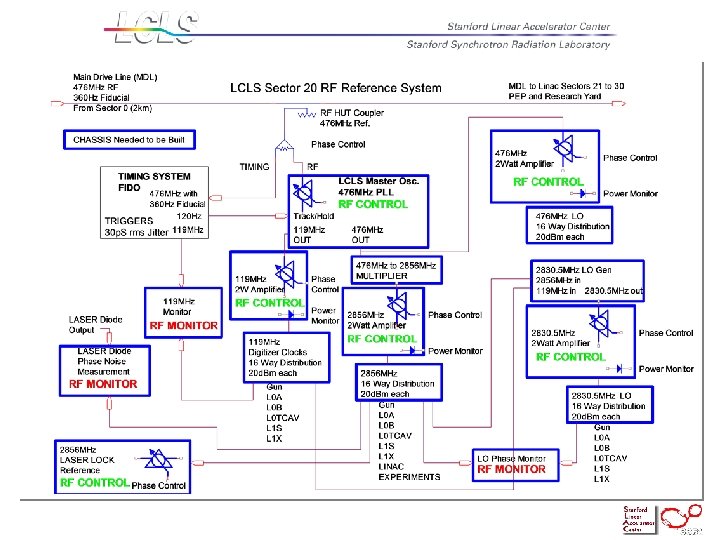
LLRF Phase Reference System A new LCLS Phase Reference System will include locking of a low noise osc. to the Linac RF Main Drive Line (MDL) reference. The LCLS 476 MHz reference will be multiplied up to 2856 MHz and then distributed to the gun laser, RF gun, L 0 -A, L 0 -B, transverse accelerator, L 1 -X and L 1 -S drive and monitoring systems. The electronics for this system will be housed in a temperature controlled room (+/-0. 5 C) that will enclose linac penetration 20 -17. All of the phase critical heliax cables will be run down 20 -17 when leaving the RF Hut. In addition all critical components will be mounted on water cooled plates with the water temperature being held to 0. 3 F. Andrews Heliax cable will be used to distribute the various RF signals.
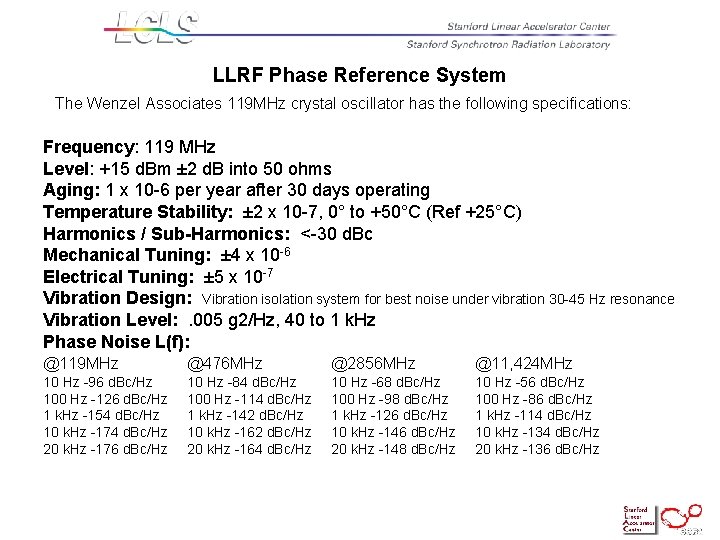
LLRF Phase Reference System The heart of the Phase Reference System is LCLS Master Osc. 476 MHz PLL. This chassis will use a Wenzel 119 MHz crystal osc which will be multiplied up to 476 MHz and then phase locked to the linac MDL. The Master Osc will require a track and hold to be built in and clocked by a linac timing system FIDO chassis at 120 Hz. The LCLS will run at 120 Hz using every 3 rd cycle of the 360 Hz linac timing signal. The oscillator's phase lock loop must track and hold at 120 Hz in order to be phase stable during the 1/3 rd of the time that the LCLS is running. During the other two thirds of the time the PLL will free run since the MDL will be changing in phase by as much as 720°. The phase noise of this system must be stable to within 50 f. S rms during LCLS beam time. A similar system is in use at SPPS. Beam to laser timing measurements show jitter of less than 150 f. S.
LLRF Phase Reference System The Wenzel Associates 119 MHz crystal oscillator has the following specifications: Frequency: 119 MHz Level: +15 d. Bm ± 2 d. B into 50 ohms Aging: 1 x 10 -6 per year after 30 days operating Temperature Stability: ± 2 x 10 -7, 0° to +50°C (Ref +25°C) Harmonics / Sub-Harmonics: <-30 d. Bc Mechanical Tuning: ± 4 x 10 -6 Electrical Tuning: ± 5 x 10 -7 Vibration Design: Vibration isolation system for best noise under vibration 30 -45 Hz resonance Vibration Level: . 005 g 2/Hz, 40 to 1 k. Hz Phase Noise L(f): @119 MHz @476 MHz @2856 MHz @11, 424 MHz 10 Hz -96 d. Bc/Hz 100 Hz -126 d. Bc/Hz 1 k. Hz -154 d. Bc/Hz 10 k. Hz -174 d. Bc/Hz 20 k. Hz -176 d. Bc/Hz 10 Hz -84 d. Bc/Hz 100 Hz -114 d. Bc/Hz 1 k. Hz -142 d. Bc/Hz 10 k. Hz -162 d. Bc/Hz 20 k. Hz -164 d. Bc/Hz 10 Hz -68 d. Bc/Hz 100 Hz -98 d. Bc/Hz 1 k. Hz -126 d. Bc/Hz 10 k. Hz -146 d. Bc/Hz 20 k. Hz -148 d. Bc/Hz 10 Hz -56 d. Bc/Hz 100 Hz -86 d. Bc/Hz 1 k. Hz -114 d. Bc/Hz 10 k. Hz -134 d. Bc/Hz 20 k. Hz -136 d. Bc/Hz
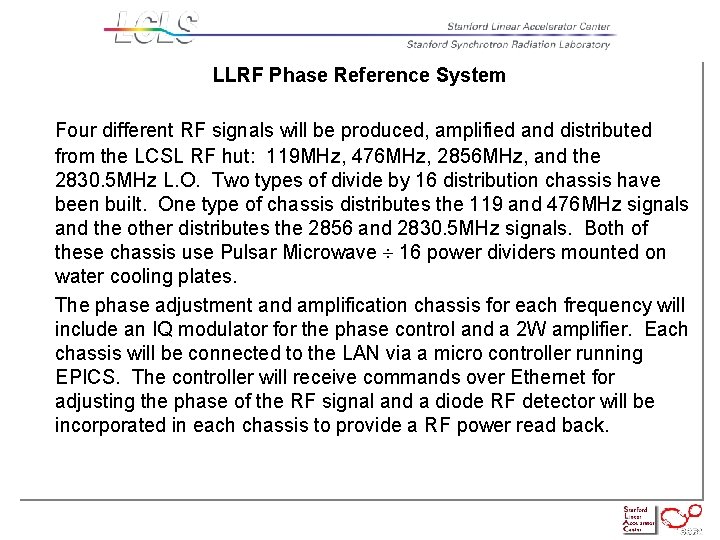
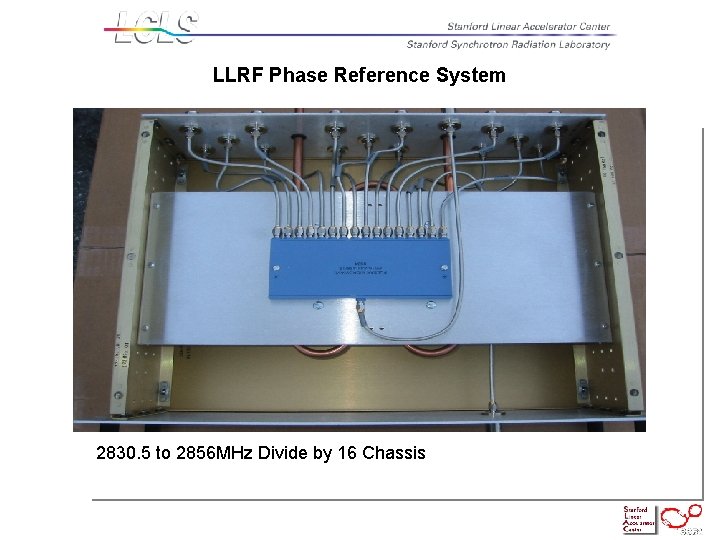
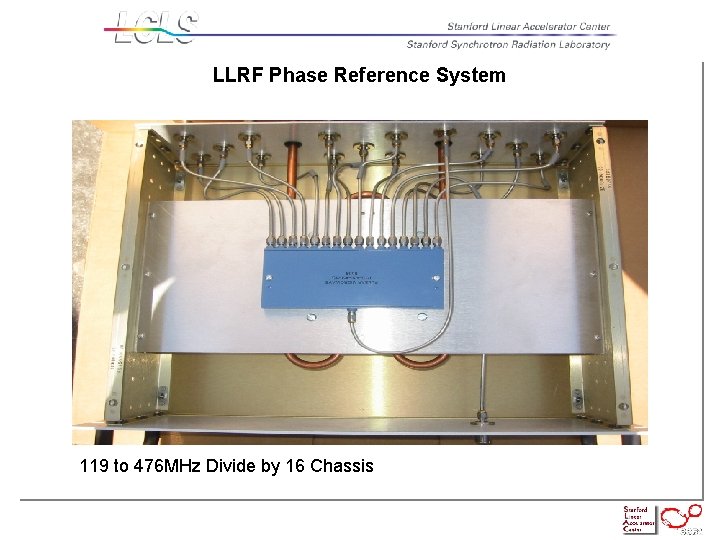
LLRF Phase Reference System Four different RF signals will be produced, amplified and distributed from the LCSL RF hut: 119 MHz, 476 MHz, 2856 MHz, and the 2830. 5 MHz L. O. Two types of divide by 16 distribution chassis have been built. One type of chassis distributes the 119 and 476 MHz signals and the other distributes the 2856 and 2830. 5 MHz signals. Both of these chassis use Pulsar Microwave ¸ 16 power dividers mounted on water cooling plates. The phase adjustment and amplification chassis for each frequency will include an IQ modulator for the phase control and a 2 W amplifier. Each chassis will be connected to the LAN via a micro controller running EPICS. The controller will receive commands over Ethernet for adjusting the phase of the RF signal and a diode RF detector will be incorporated in each chassis to provide a RF power read back.
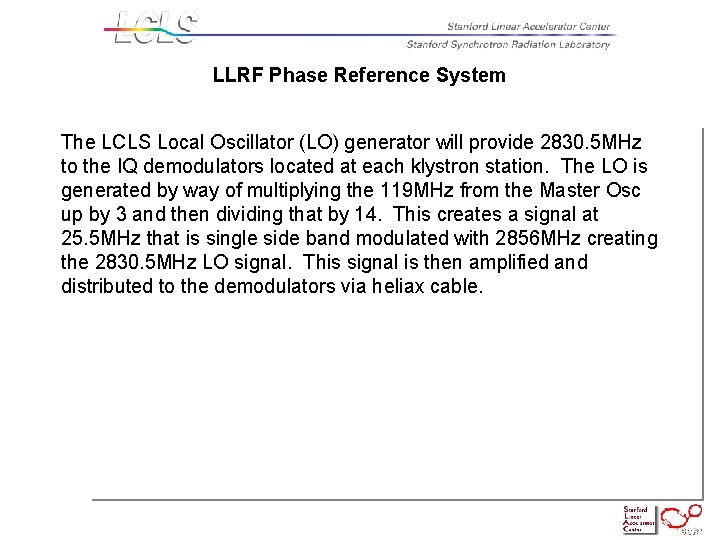
LLRF Phase Reference System The LCLS Local Oscillator (LO) generator will provide 2830. 5 MHz to the IQ demodulators located at each klystron station. The LO is generated by way of multiplying the 119 MHz from the Master Osc up by 3 and then dividing that by 14. This creates a signal at 25. 5 MHz that is single side band modulated with 2856 MHz creating the 2830. 5 MHz LO signal. This signal is then amplified and distributed to the demodulators via heliax cable.
LLRF Phase Reference System 2830. 5 to 2856 MHz Divide by 16 Chassis
LLRF Phase Reference System 119 to 476 MHz Divide by 16 Chassis
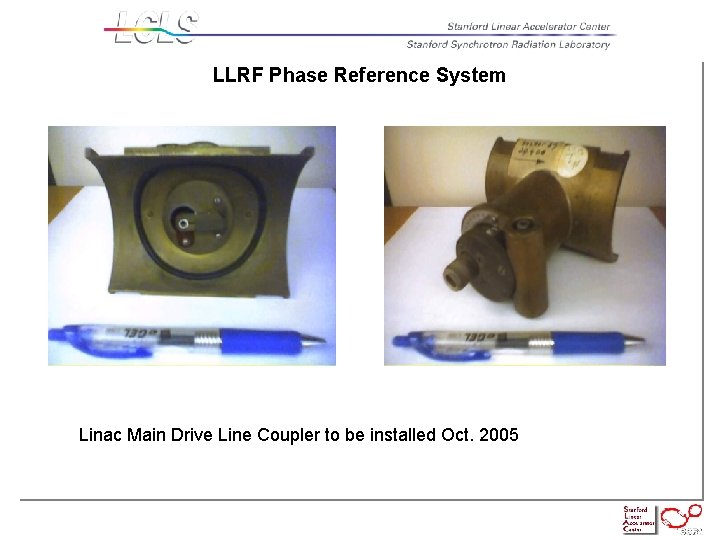
LLRF Phase Reference System Linac Main Drive Line Coupler to be installed Oct. 2005