
Lloyds Register Marine Classification Marine Technology Tim Kent
- Slides: 30
Lloyd’s Register Marine Classification & Marine Technology Tim Kent Technical Director, Marine August 2013
Lloyd’s Register’s Mission Through its constitution, Lloyd’s Register is directed to: • “Secure, for the benefit of the community, high technical standards of design, manufacture, construction, maintenance, operation, and performance, for the purpose of enhancing the safety of life and property at sea, on land, and in the air, and” • “Advance public education within engineering and technological disciplines”
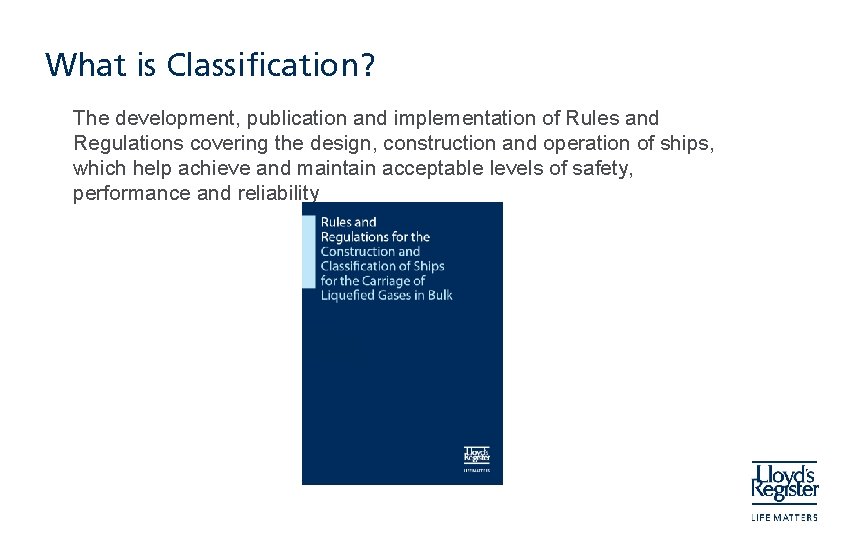
What is Classification? The development, publication and implementation of Rules and Regulations covering the design, construction and operation of ships, which help achieve and maintain acceptable levels of safety, performance and reliability
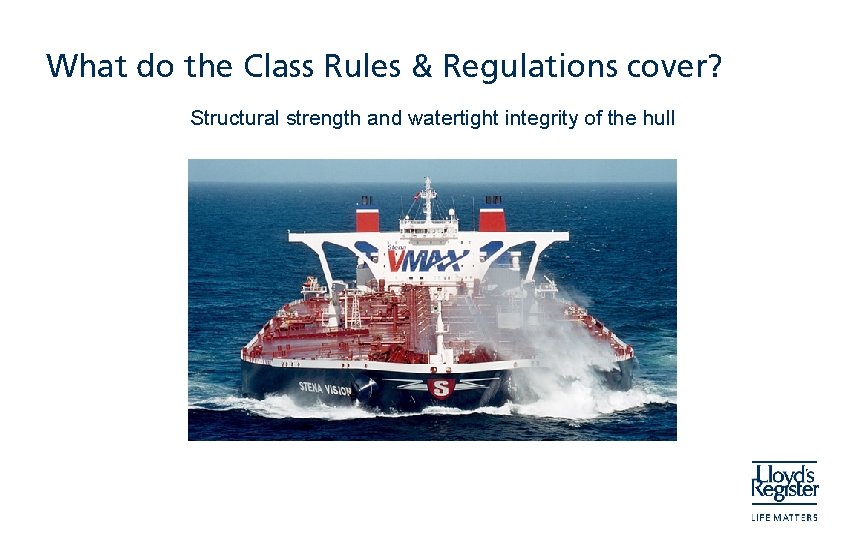
What do the Class Rules & Regulations cover? Structural strength and watertight integrity of the hull
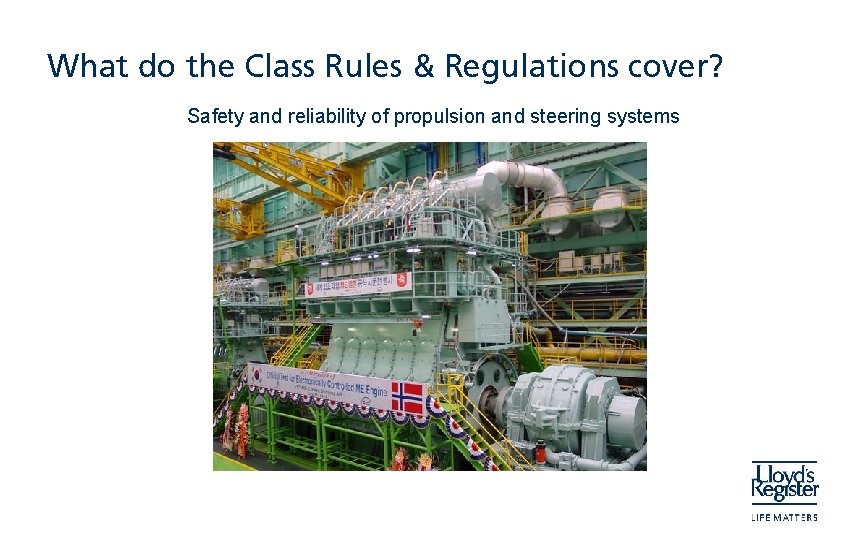
What do the Class Rules & Regulations cover? Safety and reliability of propulsion and steering systems
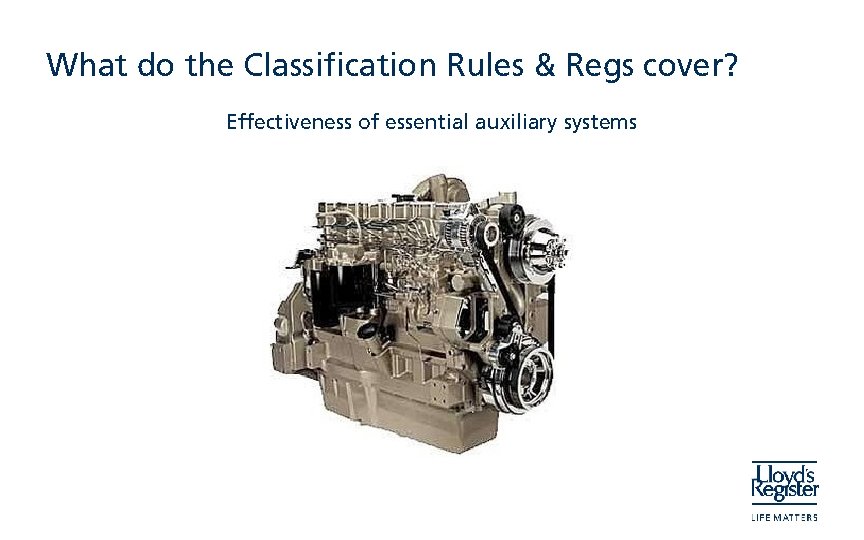
What do the Classification Rules & Regs cover? Effectiveness of essential auxiliary systems
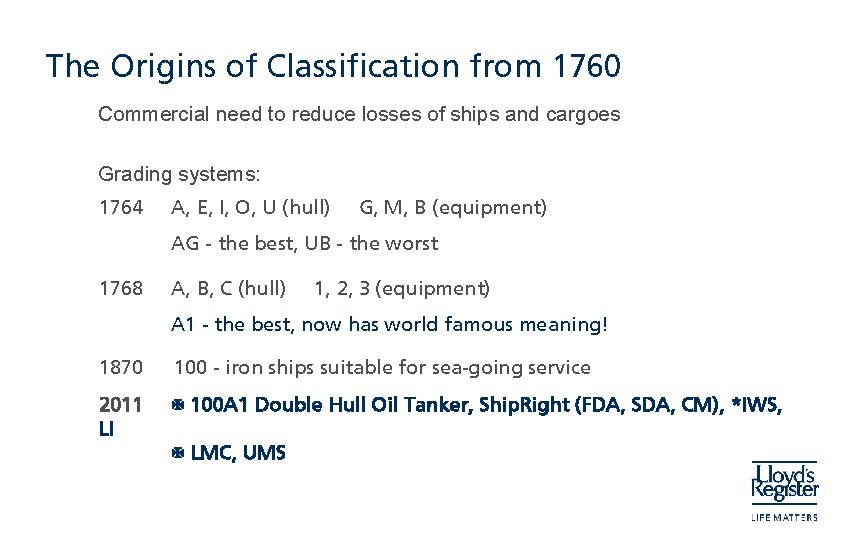
The Origins of Classification from 1760 Commercial need to reduce losses of ships and cargoes Grading systems: 1764 A, E, I, O, U (hull) G, M, B (equipment) AG - the best, UB - the worst 1768 A, B, C (hull) 1, 2, 3 (equipment) A 1 - the best, now has world famous meaning! 1870 100 - iron ships suitable for sea-going service 2011 LI | 100 A 1 Double Hull Oil Tanker, Ship. Right (FDA, SDA, CM), *IWS, | LMC, UMS
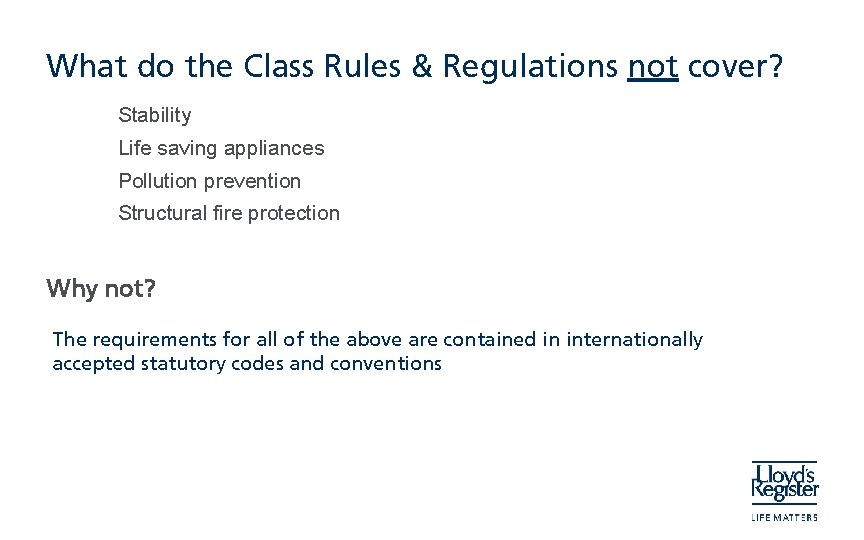
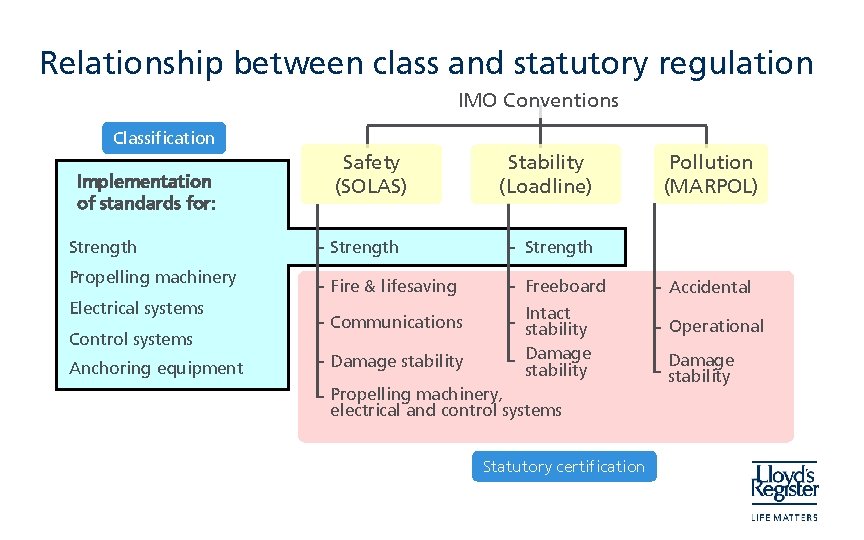
What do the Class Rules & Regulations not cover? Stability Life saving appliances Pollution prevention Structural fire protection Why not? The requirements for all of the above are contained in internationally accepted statutory codes and conventions
Relationship between class and statutory regulation IMO Conventions Classification Implementation of standards for: Strength Propelling machinery Electrical systems Control systems Anchoring equipment Safety (SOLAS) Stability (Loadline) Strength Fire & lifesaving Freeboard Communications Damage stability Intact stability Damage stability Propelling machinery, electrical and control systems Statutory certification Pollution (MARPOL) Accidental Operational Damage stability
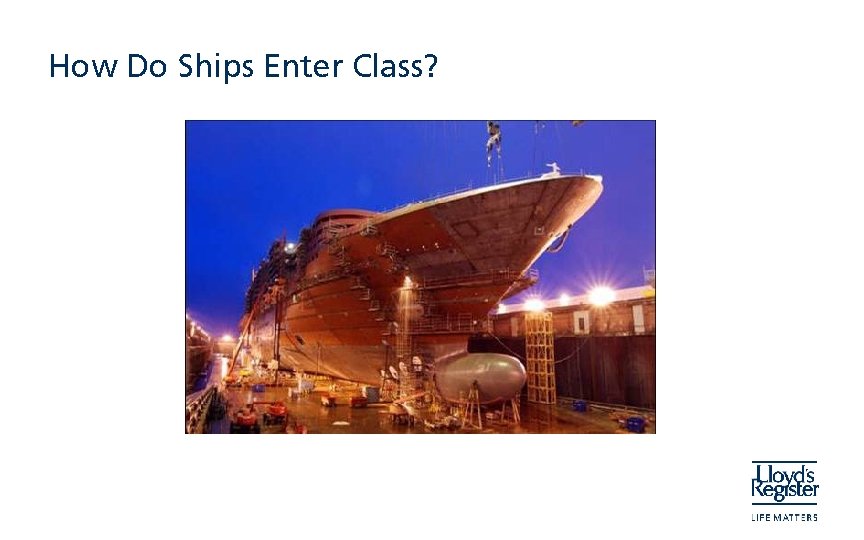
How Do Ships Enter Class?
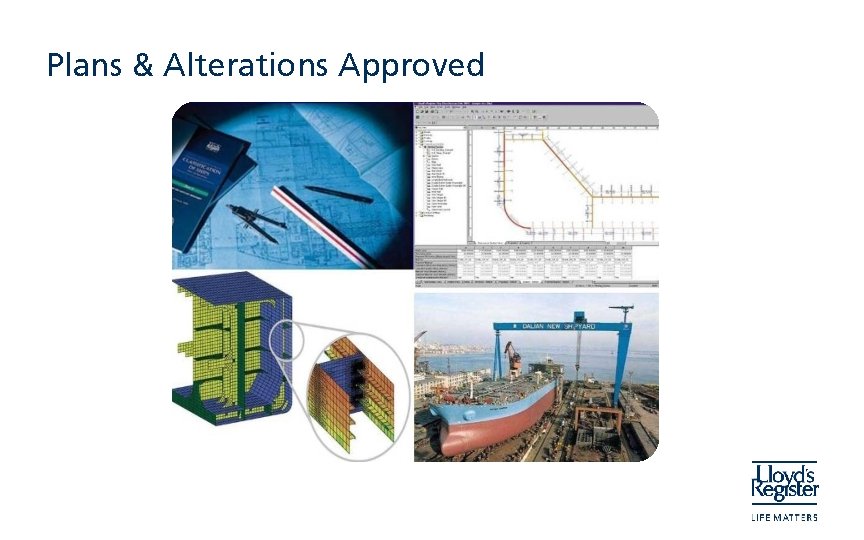
Plans & Alterations Approved
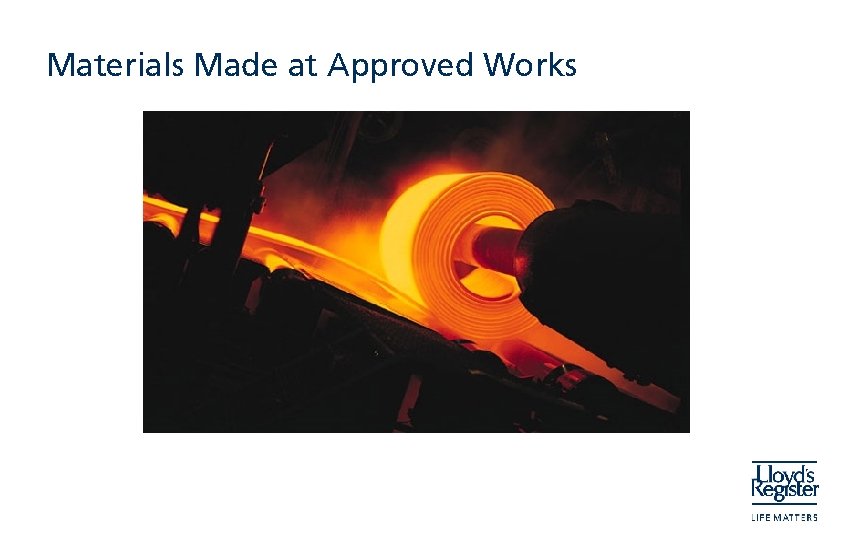
Materials Made at Approved Works
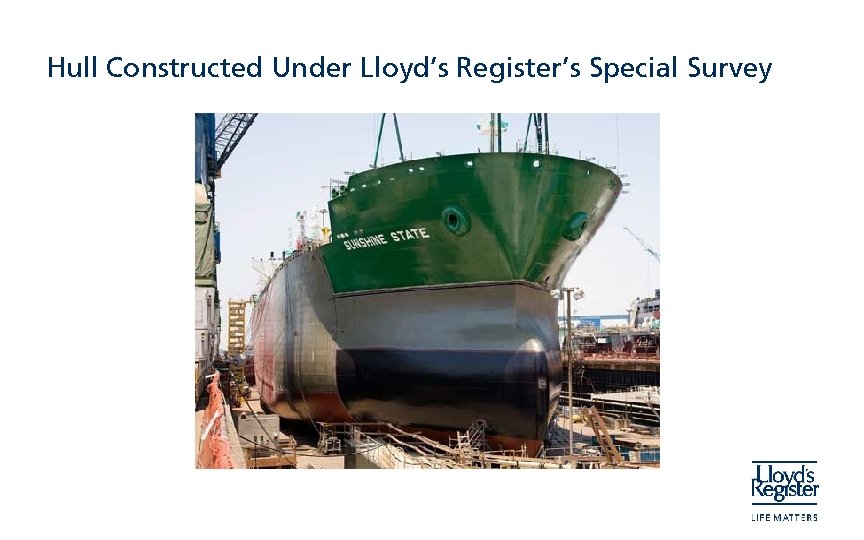
Hull Constructed Under Lloyd’s Register’s Special Survey
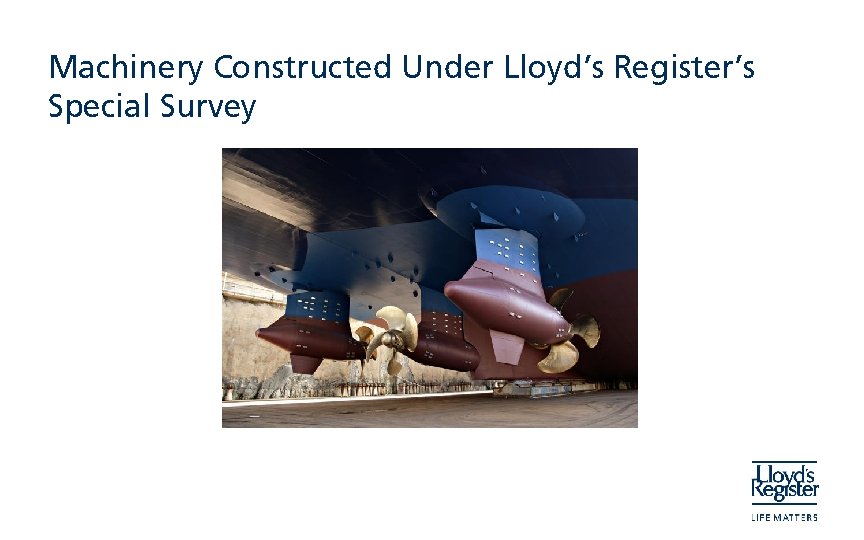
Machinery Constructed Under Lloyd’s Register’s Special Survey
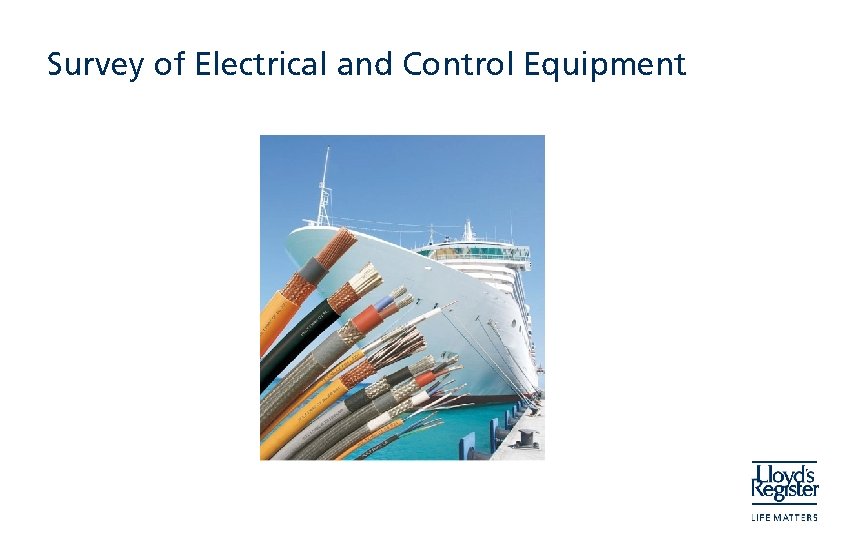
Survey of Electrical and Control Equipment
Conditions for Classification • Satisfactory completion of periodical surveys • Reporting all damages and defects • Valid convention certificates • Correct loading and operation • Availability of approved loading guidance • Operation in suitable environment
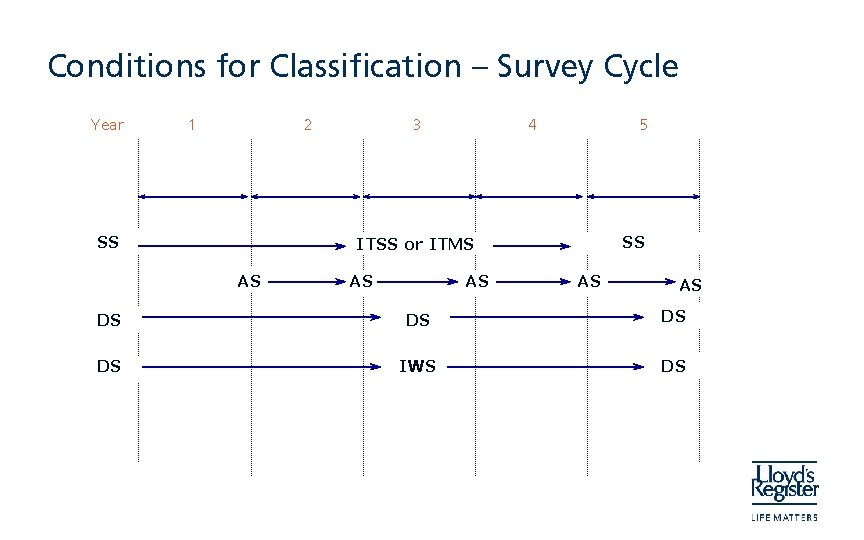
Conditions for Classification – Survey Cycle Year 1 2 SS 3 4 5 SS ITSS or ITMS AS AS AS DS DS IWS DS
Marine Technology – Lloyd’s Register’s Approach
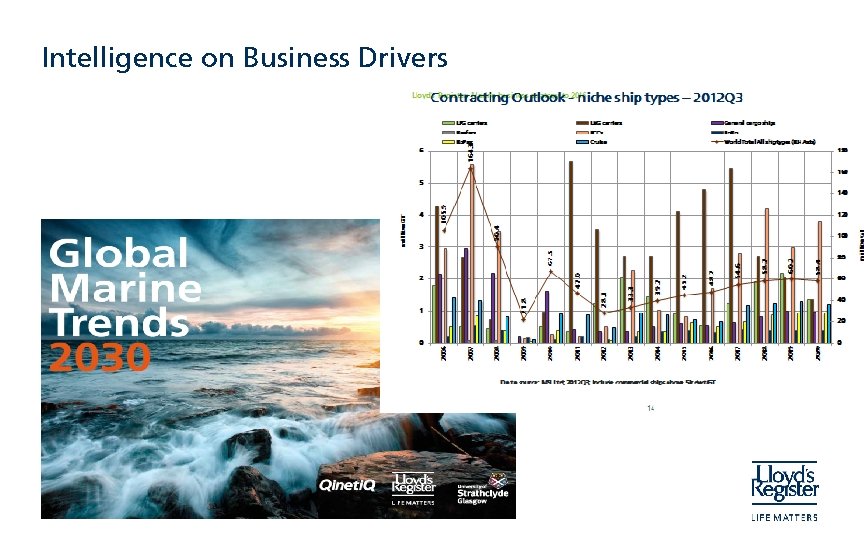
Intelligence on Business Drivers
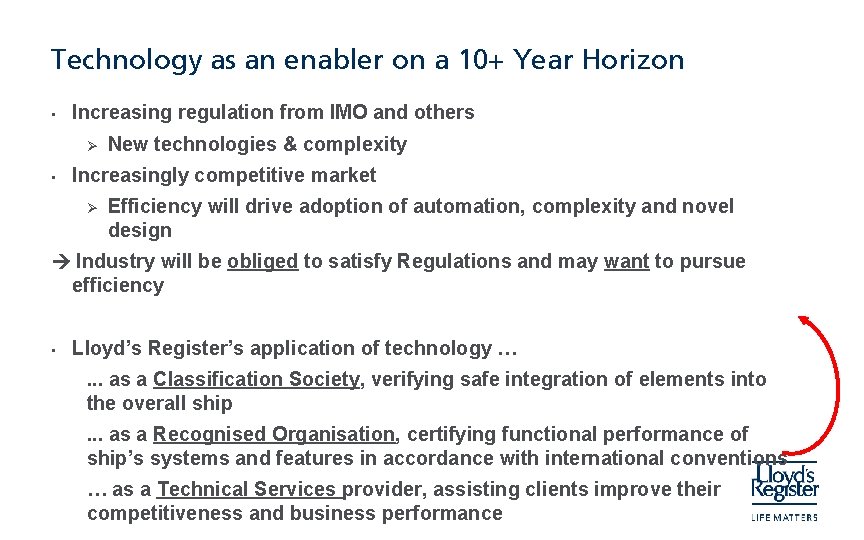
Technology as an enabler on a 10+ Year Horizon • Increasing regulation from IMO and others Ø • New technologies & complexity Increasingly competitive market Ø Efficiency will drive adoption of automation, complexity and novel design Industry will be obliged to satisfy Regulations and may want to pursue efficiency • Lloyd’s Register’s application of technology …. . . as a Classification Society, verifying safe integration of elements into the overall ship. . . as a Recognised Organisation, certifying functional performance of ship’s systems and features in accordance with international conventions … as a Technical Services provider, assisting clients improve their competitiveness and business performance
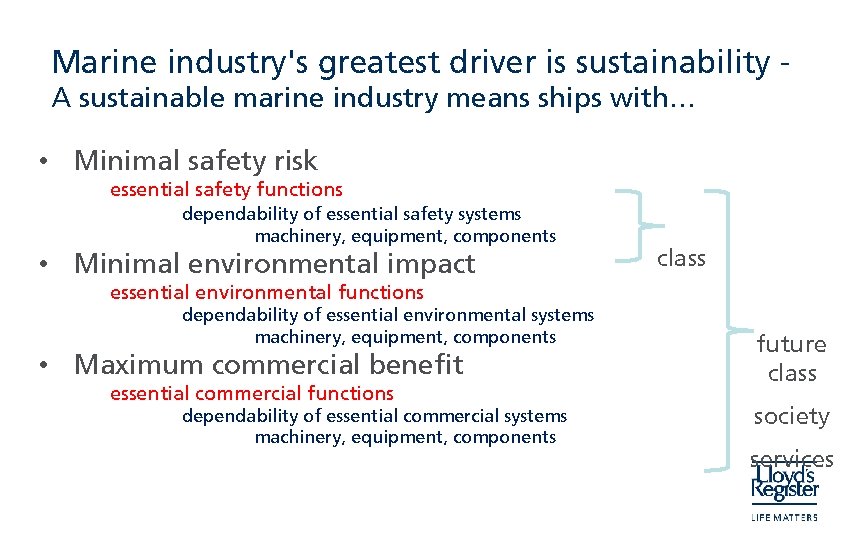
Marine industry's greatest driver is sustainability A sustainable marine industry means ships with… • Minimal safety risk essential safety functions dependability of essential safety systems machinery, equipment, components • Minimal environmental impact class essential environmental functions dependability of essential environmental systems machinery, equipment, components • Maximum commercial benefit essential commercial functions dependability of essential commercial systems machinery, equipment, components future class society services
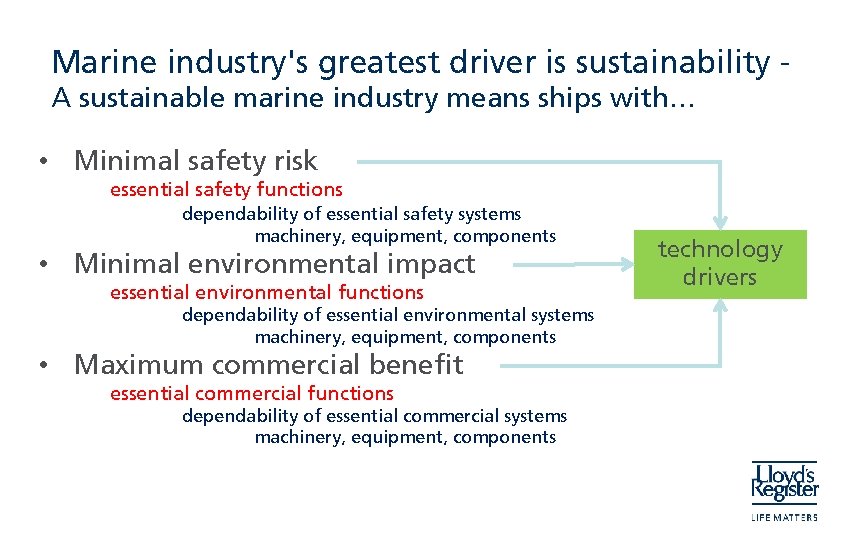
Marine industry's greatest driver is sustainability A sustainable marine industry means ships with… • Minimal safety risk essential safety functions dependability of essential safety systems machinery, equipment, components • Minimal environmental impact essential environmental functions dependability of essential environmental systems machinery, equipment, components • Maximum commercial benefit essential commercial functions dependability of essential commercial systems machinery, equipment, components technology drivers
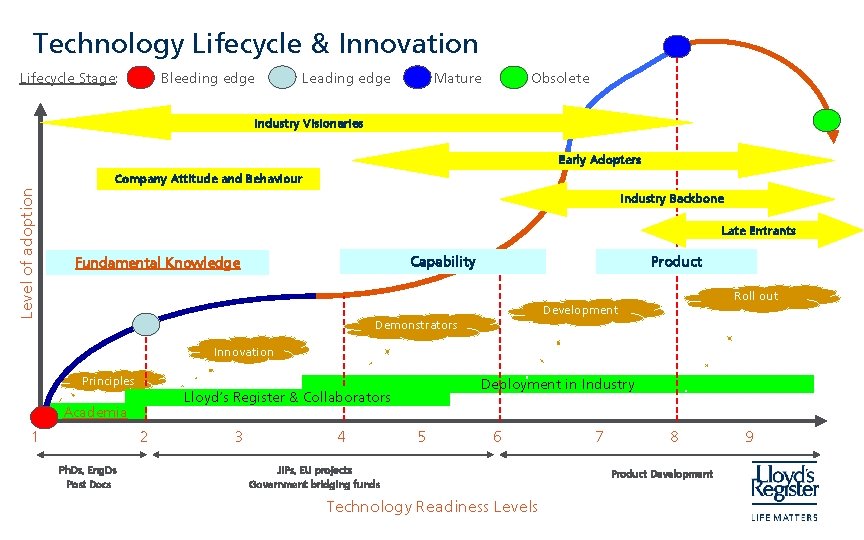
Technology Lifecycle & Innovation Lifecycle Stage: Bleeding edge Leading edge Mature Obsolete Industry Visionaries Early Adopters Level of adoption Company Attitude and Behaviour Industry Backbone Late Entrants Capability Fundamental Knowledge Product Roll out Development Demonstrators Innovation Principles Academia 1 2 Ph. Ds, Eng. Ds Post Docs Deployment in Industry Lloyd’s Register & Collaborators 3 4 5 6 JIPs, EU projects Government bridging funds Technology Readiness Levels 7 8 Product Development 9
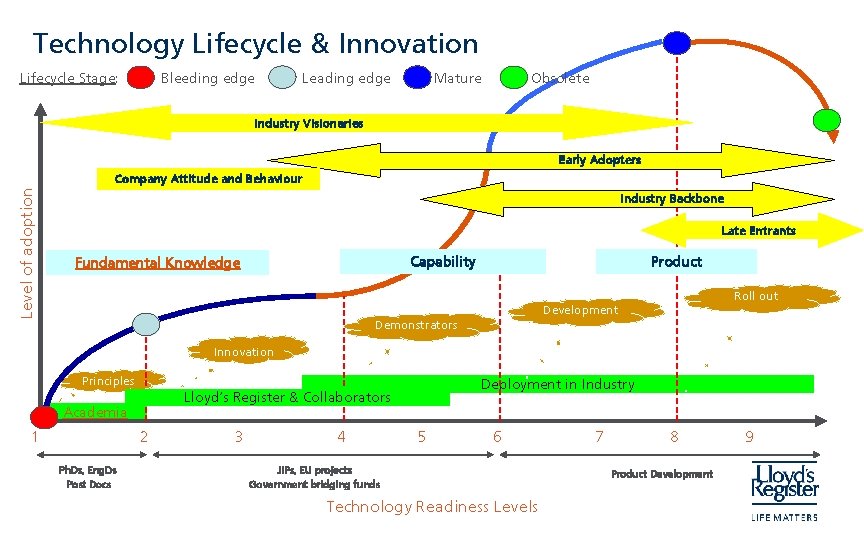
Technology Lifecycle & Innovation Lifecycle Stage: Bleeding edge Leading edge Mature Obsolete Industry Visionaries Early Adopters Level of adoption Company Attitude and Behaviour Industry Backbone Late Entrants Capability Fundamental Knowledge Product Roll out Development Demonstrators Innovation Principles Academia 1 2 Ph. Ds, Eng. Ds Post Docs Deployment in Industry Lloyd’s Register & Collaborators 3 4 5 6 JIPs, EU projects Government bridging funds Technology Readiness Levels 7 8 Product Development 9
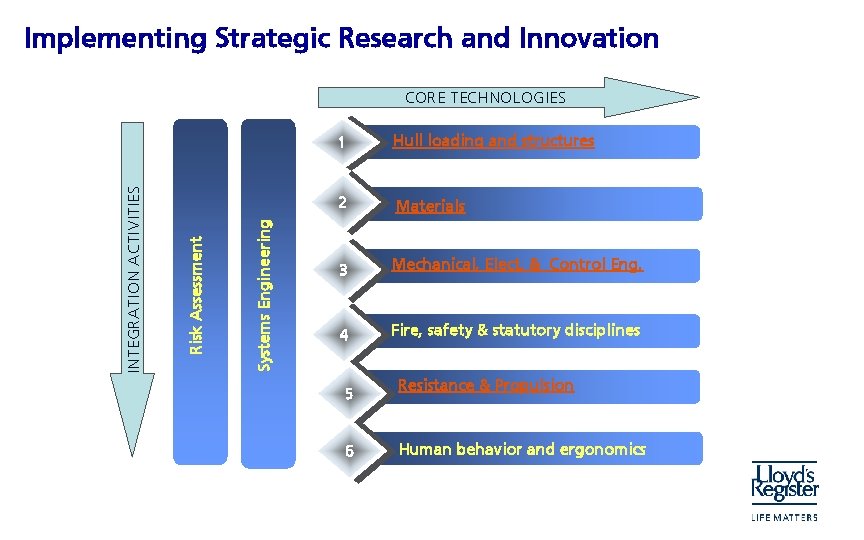
Implementing Strategic Research and Innovation Systems Engineering Risk Assessment INTEGRATION ACTIVITIES CORE TECHNOLOGIES 1 Hull loading and structures 2 Materials 3 Mechanical, Elect, & Control Eng. 4 Fire, safety & statutory disciplines 5 6 Resistance & Propulsion Human behavior and ergonomics
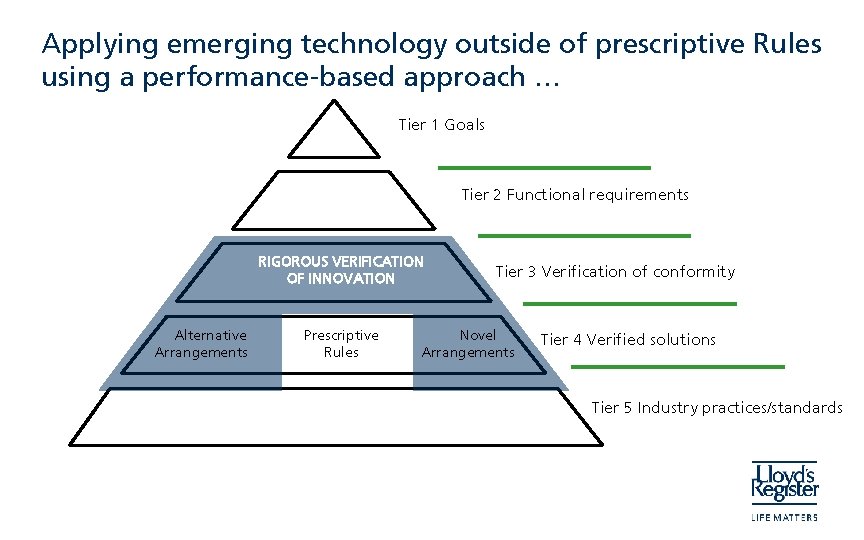
Applying emerging technology outside of prescriptive Rules using a performance-based approach … Tier 1 Goals Tier 2 Functional requirements RIGOROUS VERIFICATION OF INNOVATION Alternative Arrangements Prescriptive Rules Tier 3 Verification of conformity Novel Arrangements Tier 4 Verified solutions Tier 5 Industry practices/standards
righ t? … implemented following a systematic procedure o ge nd t ity … …a lex mp s co t th res add e ba sics To
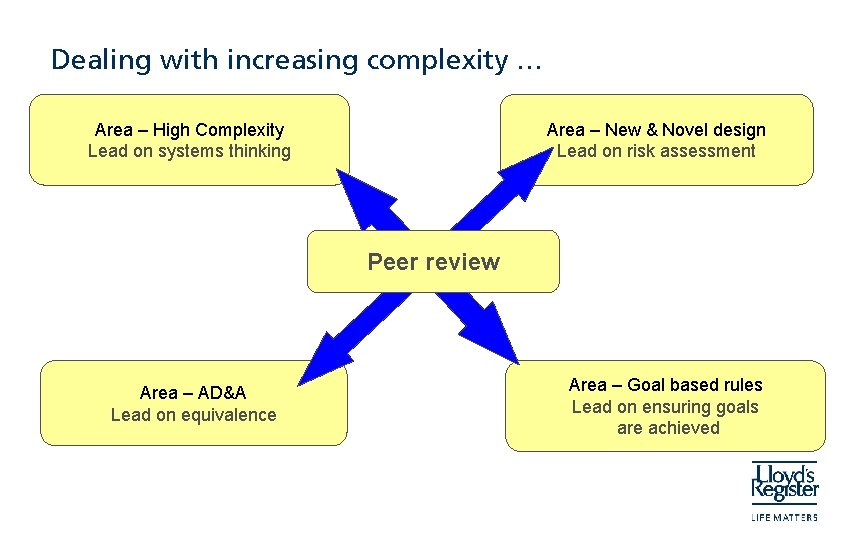
Dealing with increasing complexity … Area – High Complexity Lead on systems thinking Area – New & Novel design Lead on risk assessment Peer review Area – AD&A Lead on equivalence Area – Goal based rules Lead on ensuring goals are achieved
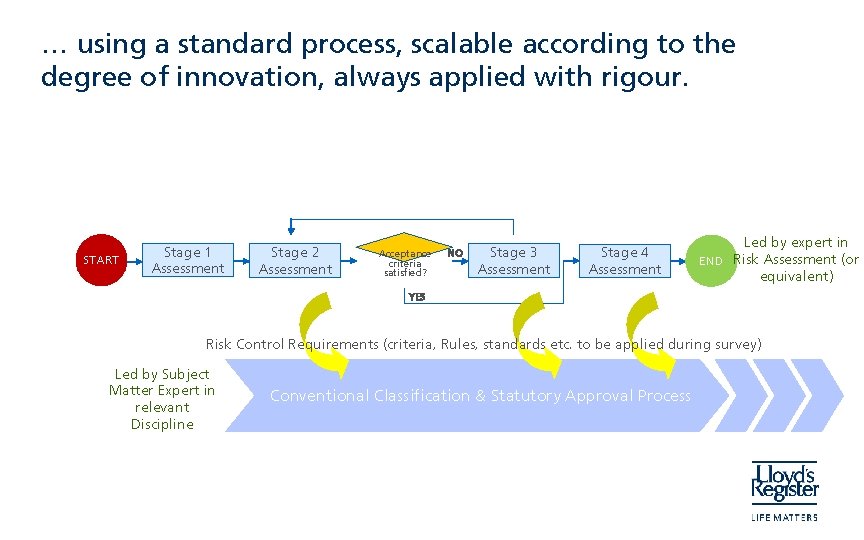
… using a standard process, scalable according to the degree of innovation, always applied with rigour. START Stage 1 Assessment Stage 2 Assessment Acceptance criteria satisfied? NO Stage 3 Assessment Stage 4 Assessment Led by expert in END Risk Assessment (or equivalent) YES Risk Control Requirements (criteria, Rules, standards etc. to be applied during survey) Led by Subject Matter Expert in relevant Discipline Conventional Classification & Statutory Approval Process
Thank you. May 2013