
Lizz Baldyga Nadia Soto Humanistic Theory People are

Lizz Baldyga & Nadia Soto
Humanistic Theory ★ People are basically rational ★ Oriented toward a social world ★ Motivated to seek self-actualization ○ Focus is on the relationship of the individual to society & how you see your place in the world ★ People have self-awareness that leads to search for meaning of life & finding their self-worth ★We have a distinctive view of abnormal behavior
Humanism ❏ A philosophical movement that emphasizes the personal worth of an individual and the importance of human values. ❏ humanistic approach to personality attends to matters of ethics and personal worth ❏ the humanistic approach gives credit to the human ‘spirit’, where other approaches to personality do not.
You are responsible for you. Self-concept: a subjective perception of who we are and what we are like. The concept of self is learned from our interactions with others. Carl Rogers distinguished between two self concepts. There is the self - the person I think I am, and the ideal self - the person I wish I was.
Unconditional Positive Regard ➢ People are inherently worthy of being loved ○ regardless of accomplishments and behaviors ■ how does this relate to ‘i am sam’? ➢ The concept of ‘I may not like you, but I love you’ ➢ Rogers believed we are born with the need for positive regard. We are born with the need to be loved.

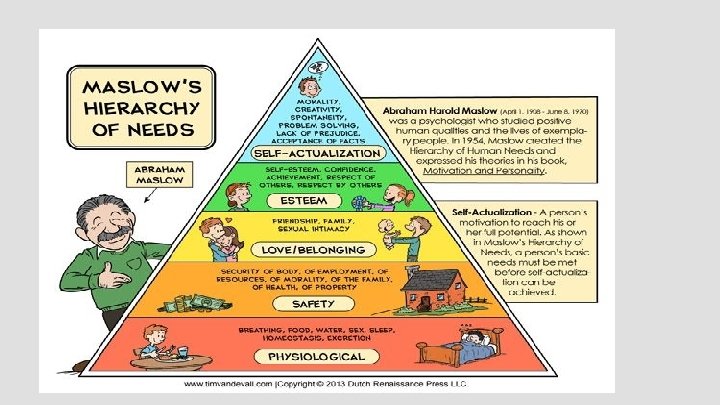
Acceptance ❖ Humans possess an inner drive to grow, improve & use their potential to its fullest extent. ➢ Maslow calls the step in completed growth, selfactualization. ➢ Reaching self-actualization is the highest level of personal development one can reach. Upon reaching this step, one has fully realized his/her potential as a human being. ■ More on this later
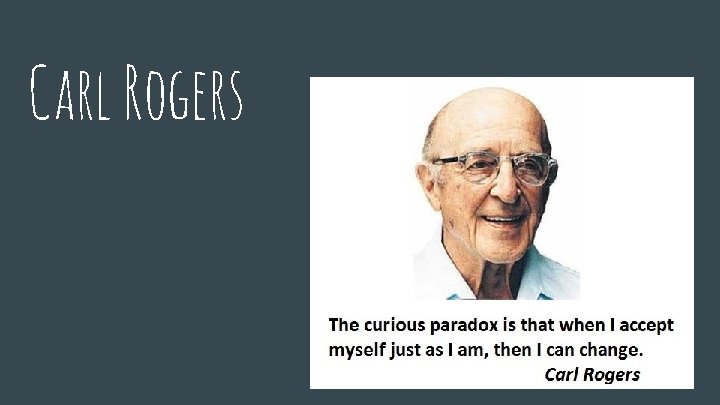
Carl Rogers
Responsibility ★ Each person is responsible for his/her own life & maturity. Humans have an inherent tendency towards growth & maturation, however maturation is not inevitable. ○ People tend to develop in a positive direction & will reach their full potential unless they are prevented from doing so. ★ A psychologically healthy person is one who has a broad selfconcept, and is capable of understanding & accepting many feelings, thoughts & experiences.
Rogerian Therapy A client-oriented psychotherapy developed by Carl Rogers in which therapist tends to be supportive, non-directive, and empathetic & gives unconditional positive regard. A person is a process It is of utmost importance to come to terms with our own nature & accept ourselves. Only then can we begin to change ourselves.
h a r b A M am w o l s a
Deficiency Needs & Need Regression Commonly referred to as the needs that are essential for survival. This includes all levels of Maslow’s hierarchy except for self actualization. Need Regression occurs when a need at a lower level is no longer met & we must move back down the hierarchy to get our needs met.
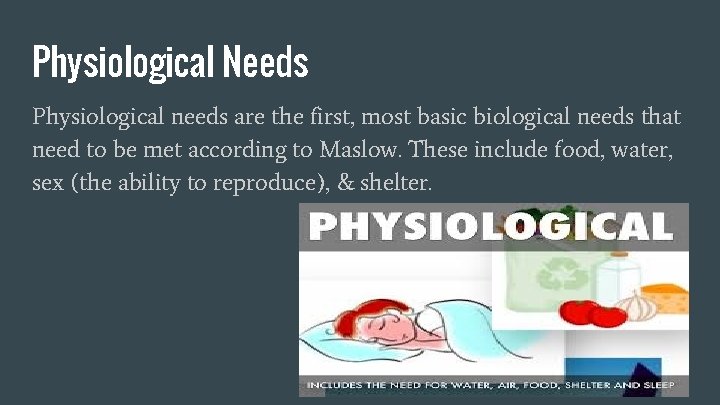
Physiological Needs Physiological needs are the first, most basic biological needs that need to be met according to Maslow. These include food, water, sex (the ability to reproduce), & shelter.
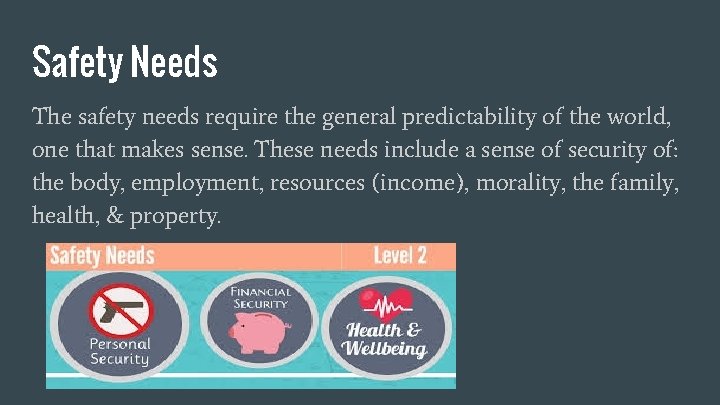
Safety Needs The safety needs require the general predictability of the world, one that makes sense. These needs include a sense of security of: the body, employment, resources (income), morality, the family, health, & property.
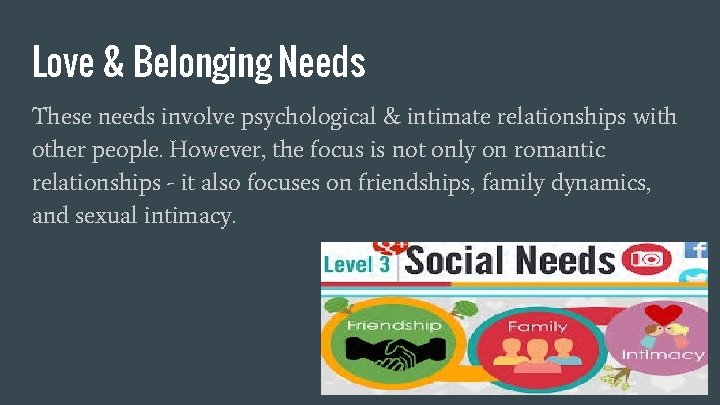
Love & Belonging Needs These needs involve psychological & intimate relationships with other people. However, the focus is not only on romantic relationships - it also focuses on friendships, family dynamics, and sexual intimacy.
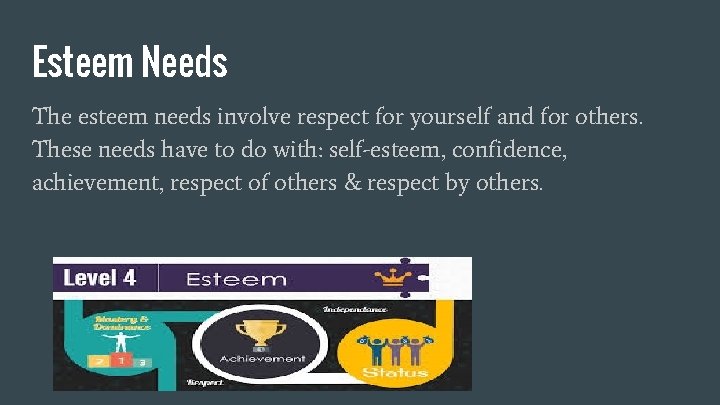
Esteem Needs The esteem needs involve respect for yourself and for others. These needs have to do with: self-esteem, confidence, achievement, respect of others & respect by others.
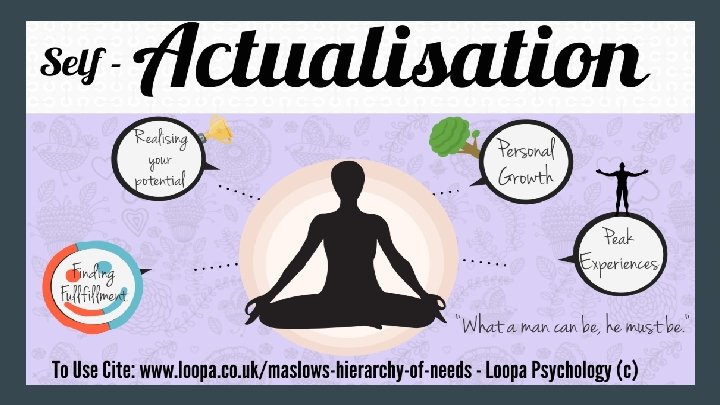
Self-Actualization An instinctive process by which one tends to grow spiritually and realize their potential. Very few people ever reach self-actualization. Some examples of people who have reached it are Albert Einstein Eleanor Roosevelt Thomas Jefferson
Self Actualization Cont. Self actualized people have a realistic knowledge of themselves and accept themselves fully for who they are. These people have a greater sense of: morality, creativity, spontaneity, problem solving skills, lack of prejudice, and a greater acceptance of facts. Unactualized people may occasionally have a peak experience but are more likely to be frightened than enlightened by the experience.
How is self fulfillment measured? Maslow used many assessment tools to measure self fulfillment. He used interviews, observations, self-report questionnaires, projective tests, biographical tests and his personal favorite - the Personal Orientation Inventory (POI). ❖The Personal Orientation Inventory or POI was a self-report questionnaire that asked people to classify themselves on a number of dimensions for the various characteristics of self-actualization or mental health. The POI has been shown to capture only some aspects of a healthy personality. However, this is still the best way to measure self-fulfillment as a new way has not yet been developed.
Peak Experiences ❖ According to Maslow, peak experiences are powerful, meaningful experiences in which people seem to transcend the self, be at one with the world, & feel completely selffulfilled. ➢ For example : when everything seems to just “fall” into place ➢ peak experiences are common among those who have reached selfactualization
Positive Psychology A movement by both Carl Rogers & Abraham Maslow in modern psychology to focus on one's positive attributes rather than on pathology. ➔ How does this concept relate to ‘i am sam’?
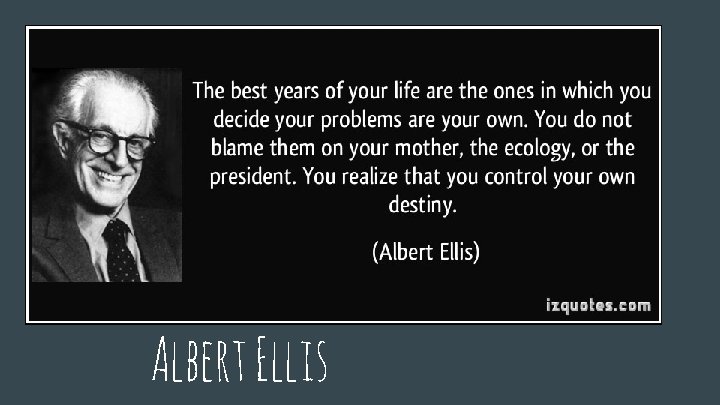
Albert Ellis
The Three Basic Musts According to Ellis all irrational beliefs stem from the source of psychological distress. He believes that there are three common irrational beliefs pertaining to demands about the self, other people, and the world. He calls these beliefs ‘the three basic musts’ & they include these thoughts : 1. I must do well or else I am no good. 2. Other people must treat me fairly & kindly & if they don’t, they are no good and they deserve to be condemned and punished. 3. I must get what I want when I want it. (what other concept does this sound like? ) & I must not get what I don’t want. If I don’t get what I want, I won’t be able to stand it.
The Three Basic Musts Cont. The irrationality in those thoughts can lead to unnecessary suffering and grief. The first belief often leads to feelings of anxiety, depression, shame & guilt. The second belief often leads to awareness of rage, passive-aggression, and acts of violence. The third belief often leads to self-pity and procrastination. Because these beliefs are so demanding they can cause problems. Being less demanding and more flexible in your belief system can lead to healthier emotions and healthier behaviors.

I AM SAM
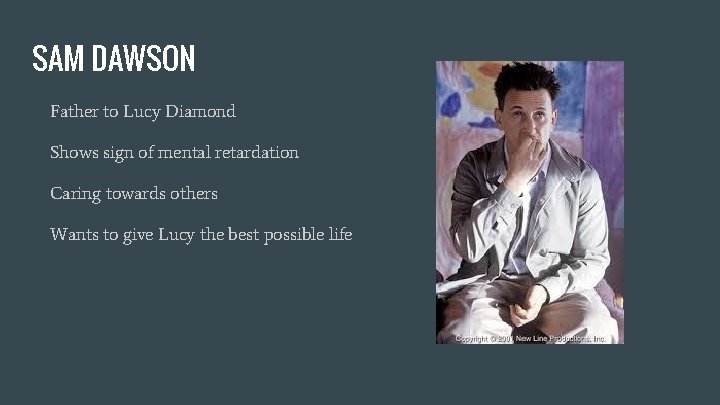
SAM DAWSON Father to Lucy Diamond Shows sign of mental retardation Caring towards others Wants to give Lucy the best possible life
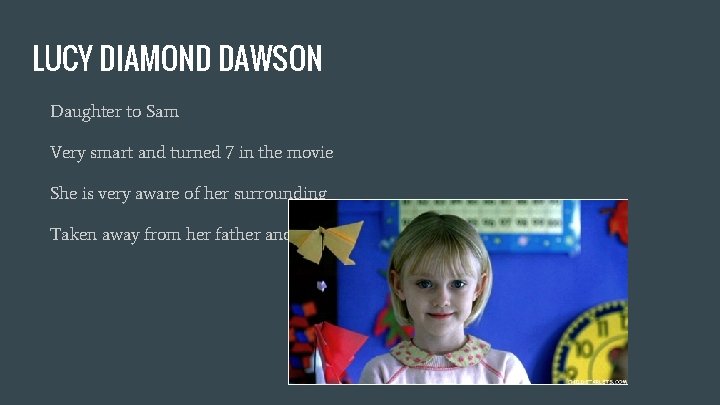
LUCY DIAMOND DAWSON Daughter to Sam Very smart and turned 7 in the movie She is very aware of her surrounding Taken away from her father and placed in foster care
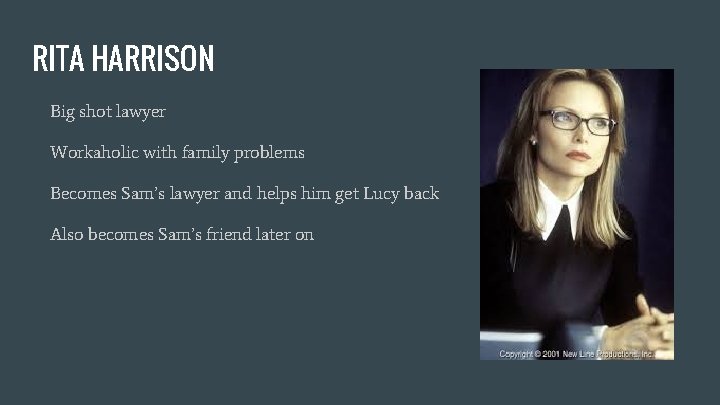
RITA HARRISON Big shot lawyer Workaholic with family problems Becomes Sam’s lawyer and helps him get Lucy back Also becomes Sam’s friend later on
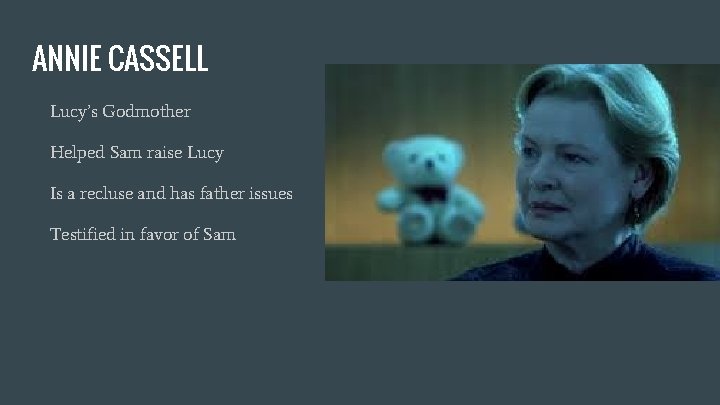
ANNIE CASSELL Lucy’s Godmother Helped Sam raise Lucy Is a recluse and has father issues Testified in favor of Sam

HIS SUPPORT GROUP Brad, Ifty, Joe, and Robert Was literally with Sam every step of the way Brad- Sensible Ifty- knowledgeable Joe- happy/ super nice Robert- paranoid

OTHER GROUPS Margaret Calgrove - Social worker who took Lucy Mr. Turner- was the Prosecutor
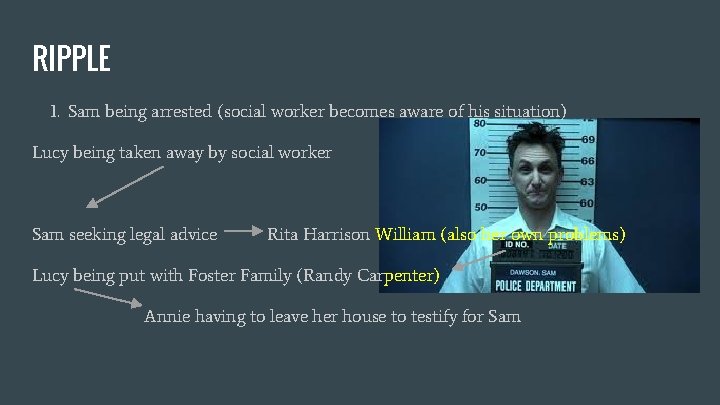
RIPPLE 1. Sam being arrested (social worker becomes aware of his situation) Lucy being taken away by social worker Sam seeking legal advice Rita Harrison William (also her own problems) Lucy being put with Foster Family (Randy Carpenter) Annie having to leave her house to testify for Sam
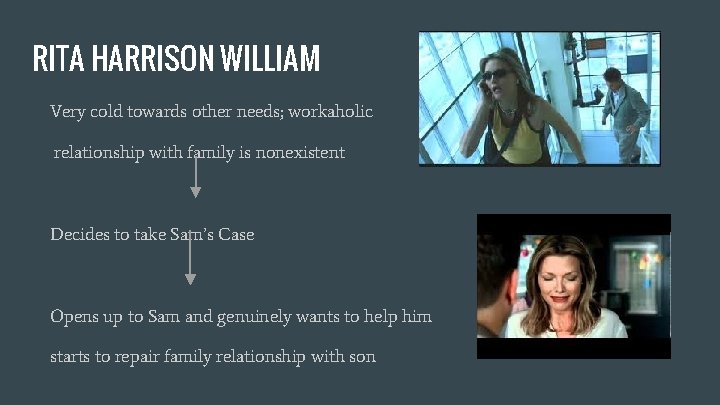
RITA HARRISON WILLIAM Very cold towards other needs; workaholic relationship with family is nonexistent Decides to take Sam’s Case Opens up to Sam and genuinely wants to help him starts to repair family relationship with son
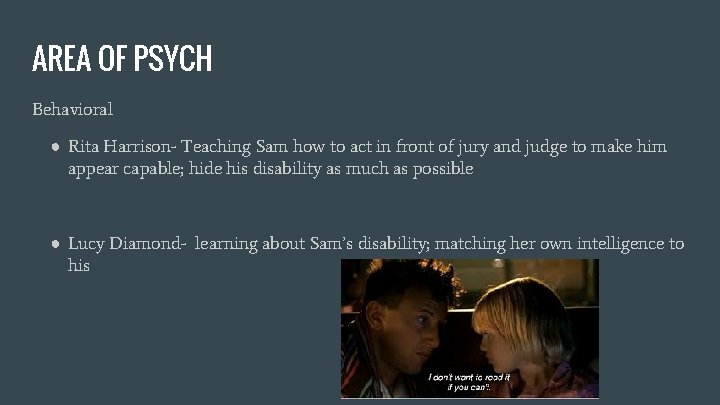
AREA OF PSYCH Behavioral ● Rita Harrison- Teaching Sam how to act in front of jury and judge to make him appear capable; hide his disability as much as possible ● Lucy Diamond- learning about Sam’s disability; matching her own intelligence to his
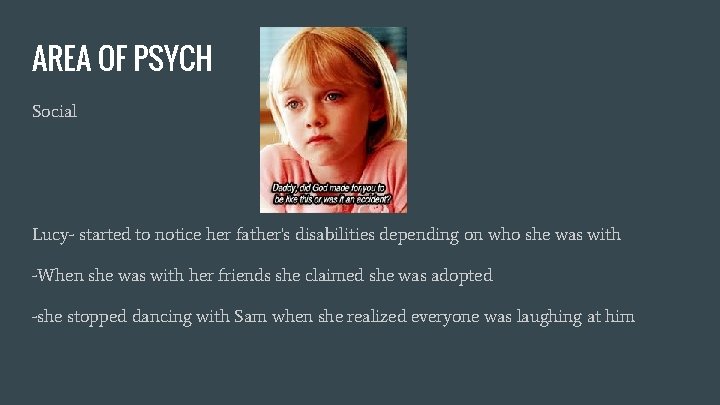
AREA OF PSYCH Social Lucy- started to notice her father's disabilities depending on who she was with -When she was with her friends she claimed she was adopted -she stopped dancing with Sam when she realized everyone was laughing at him

AREA OF PSYCH Psychological Annie- because of her father become a recluse - Later in the film comes out of her house to help Sam and Lucy - is doing well until prosecutor brings up father
HUMANISTIC Rita Harrison- wanting to appear good in front of colleagues and said she was doing a pro bono case, even though she wasn’t Annie Hall- despite her recluse behavior, she was driven by the need to help so she decided to leave her house in order to help Sam
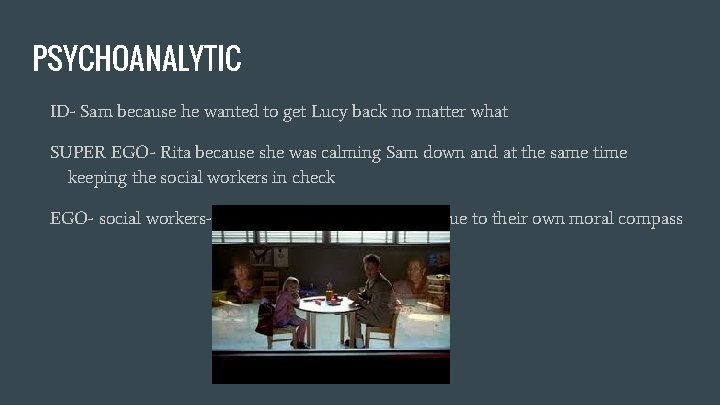
PSYCHOANALYTIC ID- Sam because he wanted to get Lucy back no matter what SUPER EGO- Rita because she was calming Sam down and at the same time keeping the social workers in check EGO- social workers- because they kept Lucy away due to their own moral compass
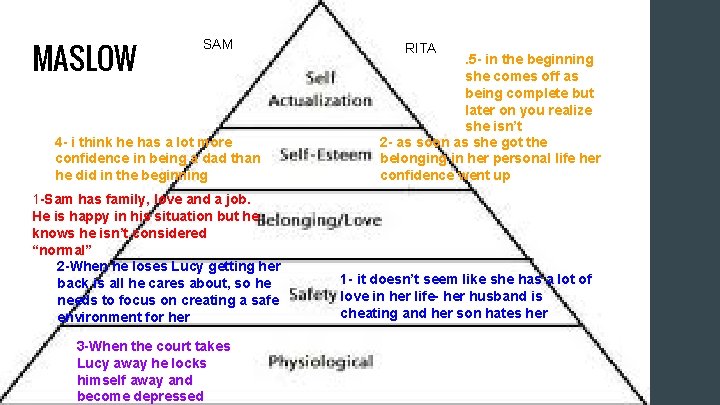
MASLOW SAM 4 - i think he has a lot more confidence in being a dad than he did in the beginning 1 -Sam has family, love and a job. He is happy in his situation but he knows he isn’t considered “normal” 2 -When he loses Lucy getting her back is all he cares about, so he needs to focus on creating a safe environment for her 3 -When the court takes Lucy away he locks himself away and become depressed RITA . 5 - in the beginning she comes off as being complete but later on you realize she isn’t 2 - as soon as she got the belonging in her personal life her confidence went up 1 - it doesn’t seem like she has a lot of love in her life- her husband is cheating and her son hates her
MY PLAN Annie doesn’t seem to get better at the end of the film - use Rogerian Therapy- supportive, non-directive and empathetic, gives unconditional positive regard What would you suggest?

THE END!!
- Slides: 42