
Living Working in Space First Men and Women
- Slides: 18
Living & Working in Space
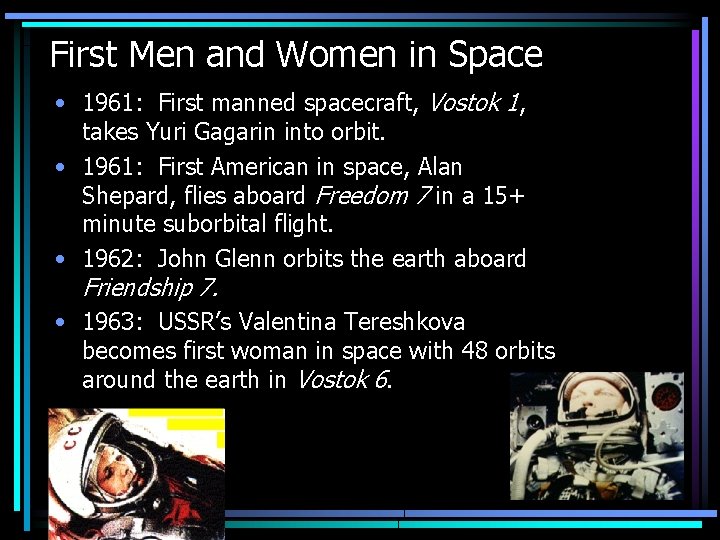
First Men and Women in Space • 1961: First manned spacecraft, Vostok 1, takes Yuri Gagarin into orbit. • 1961: First American in space, Alan Shepard, flies aboard Freedom 7 in a 15+ minute suborbital flight. • 1962: John Glenn orbits the earth aboard Friendship 7. • 1963: USSR’s Valentina Tereshkova becomes first woman in space with 48 orbits around the earth in Vostok 6.
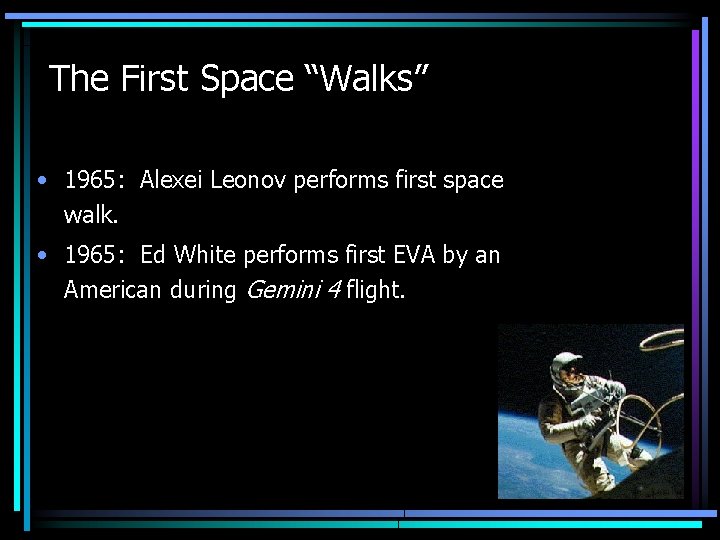
The First Space “Walks” • 1965: Alexei Leonov performs first space walk. • 1965: Ed White performs first EVA by an American during Gemini 4 flight.
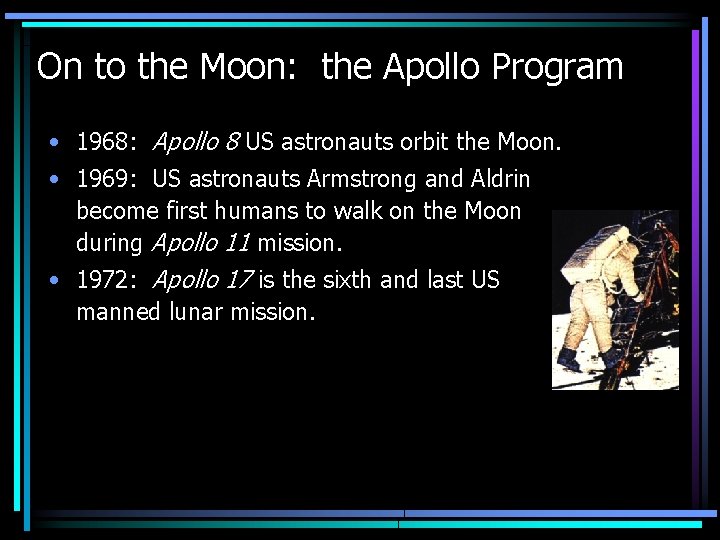
On to the Moon: the Apollo Program • 1968: Apollo 8 US astronauts orbit the Moon. • 1969: US astronauts Armstrong and Aldrin become first humans to walk on the Moon during Apollo 11 mission. • 1972: Apollo 17 is the sixth and last US manned lunar mission.
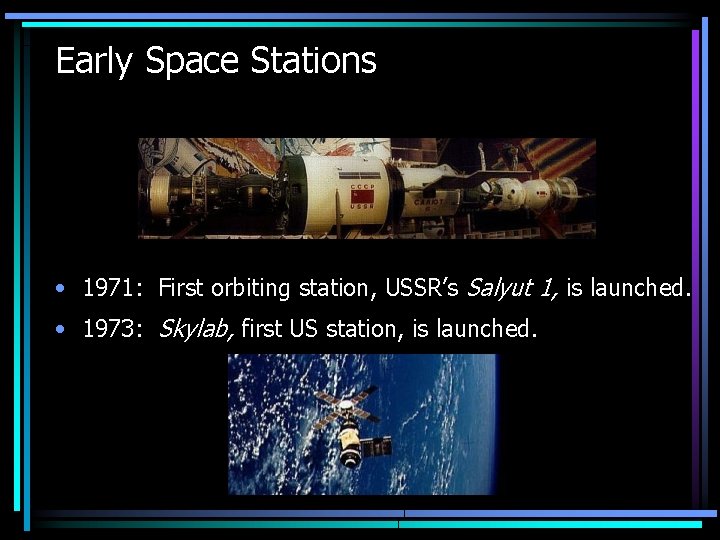
Early Space Stations • 1971: First orbiting station, USSR’s Salyut 1, is launched. • 1973: Skylab, first US station, is launched.
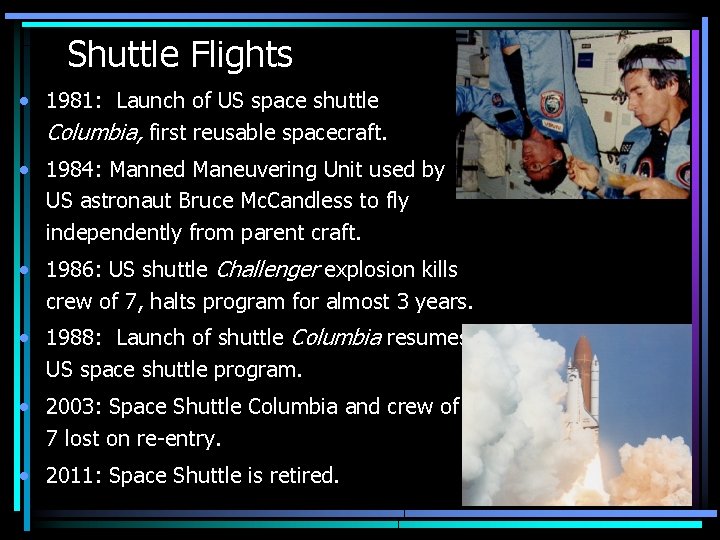
Shuttle Flights • 1981: Launch of US space shuttle Columbia, first reusable spacecraft. • 1984: Manned Maneuvering Unit used by US astronaut Bruce Mc. Candless to fly independently from parent craft. • 1986: US shuttle Challenger explosion kills crew of 7, halts program for almost 3 years. • 1988: Launch of shuttle Columbia resumes US space shuttle program. • 2003: Space Shuttle Columbia and crew of 7 lost on re-entry. • 2011: Space Shuttle is retired.
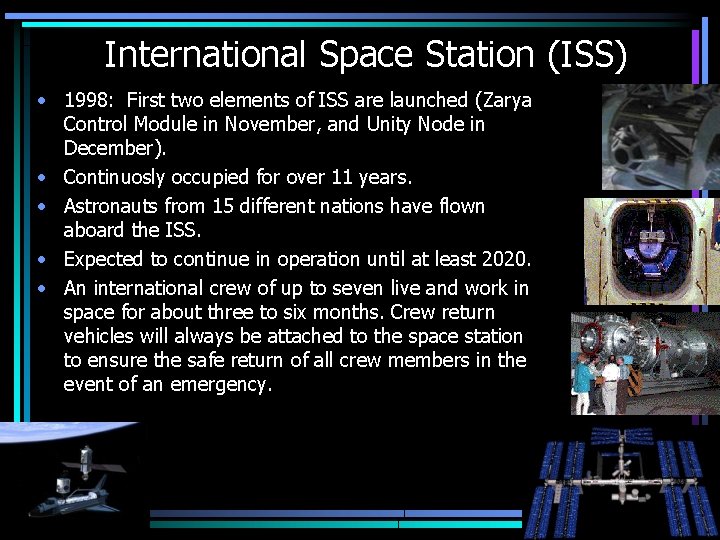
International Space Station (ISS) • 1998: First two elements of ISS are launched (Zarya Control Module in November, and Unity Node in December). • Continuosly occupied for over 11 years. • Astronauts from 15 different nations have flown aboard the ISS. • Expected to continue in operation until at least 2020. • An international crew of up to seven live and work in space for about three to six months. Crew return vehicles will always be attached to the space station to ensure the safe return of all crew members in the event of an emergency.
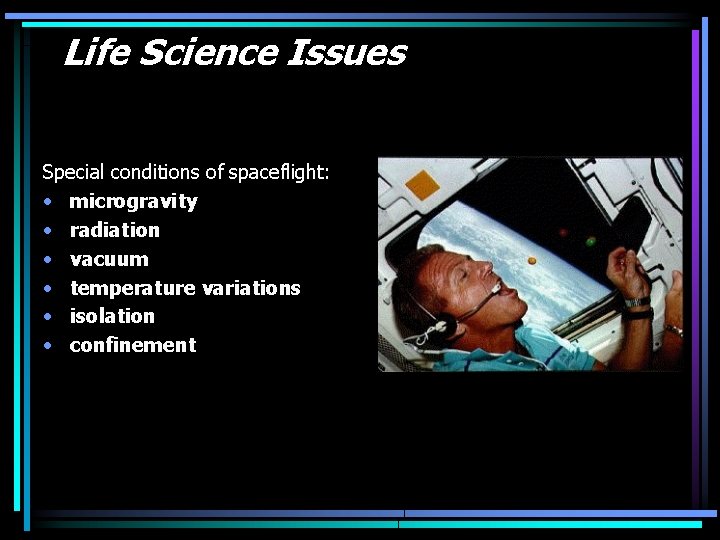
Life Science Issues Special conditions of spaceflight: • microgravity • radiation • vacuum • temperature variations • isolation • confinement
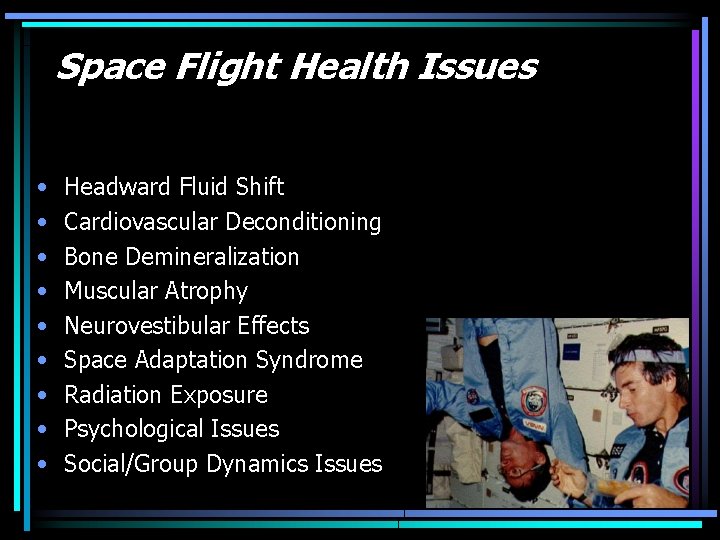
Space Flight Health Issues • • • Headward Fluid Shift Cardiovascular Deconditioning Bone Demineralization Muscular Atrophy Neurovestibular Effects Space Adaptation Syndrome Radiation Exposure Psychological Issues Social/Group Dynamics Issues
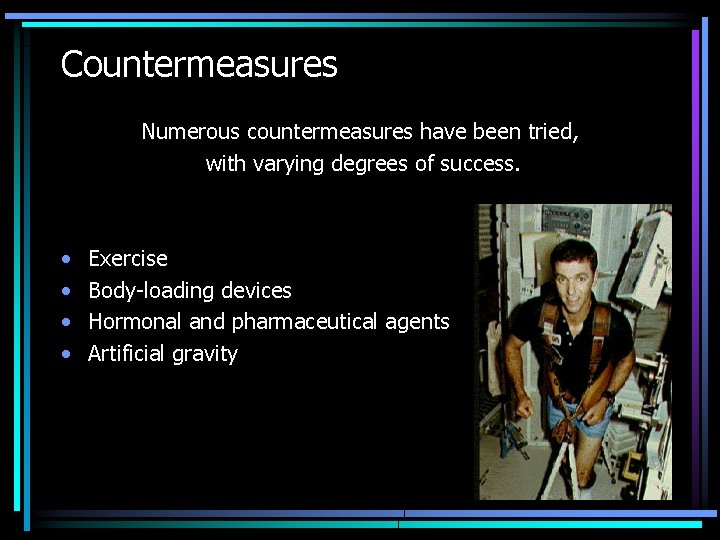
Countermeasures Numerous countermeasures have been tried, with varying degrees of success. • • Exercise Body-loading devices Hormonal and pharmaceutical agents Artificial gravity
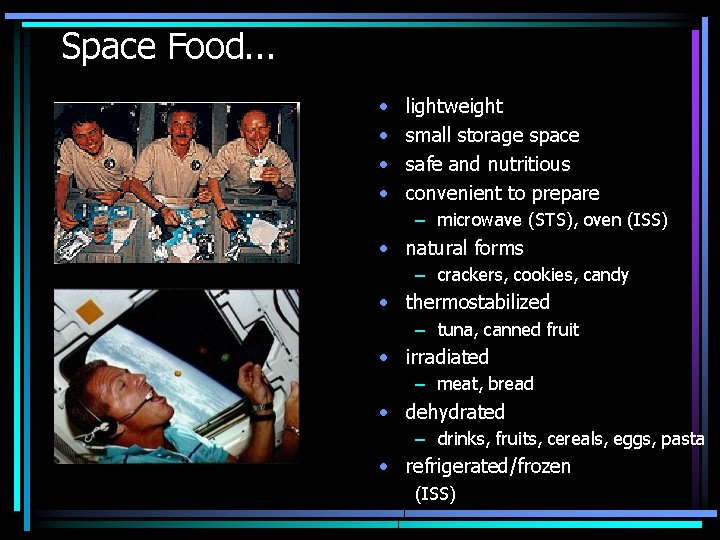
Space Food. . . • • lightweight small storage space safe and nutritious convenient to prepare – microwave (STS), oven (ISS) • natural forms – crackers, cookies, candy • thermostabilized – tuna, canned fruit • irradiated – meat, bread • dehydrated – drinks, fruits, cereals, eggs, pasta • refrigerated/frozen (ISS)
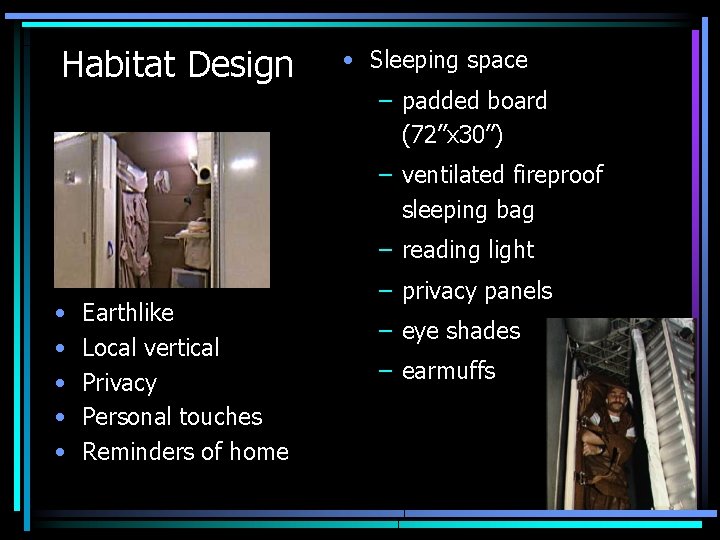
Habitat Design • Sleeping space – padded board (72”x 30”) – ventilated fireproof sleeping bag – reading light • • • Earthlike Local vertical Privacy Personal touches Reminders of home – privacy panels – eye shades – earmuffs
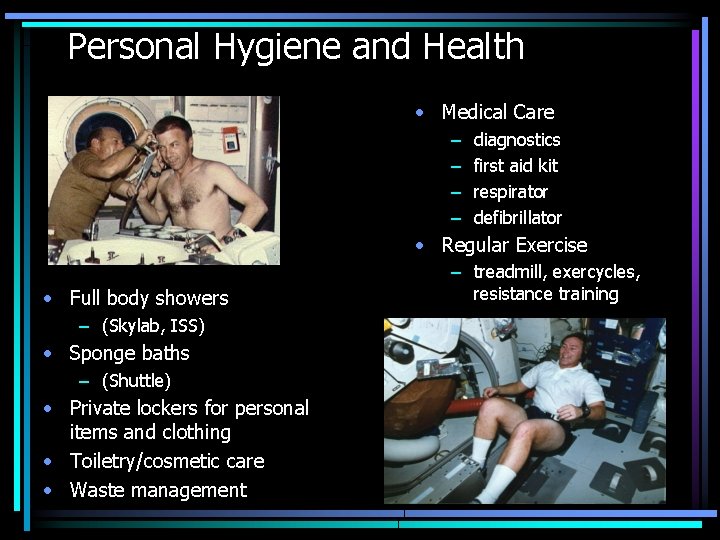
Personal Hygiene and Health • Medical Care – – diagnostics first aid kit respirator defibrillator • Regular Exercise • Full body showers – (Skylab, ISS) • Sponge baths – (Shuttle) • Private lockers for personal items and clothing • Toiletry/cosmetic care • Waste management – treadmill, exercycles, resistance training
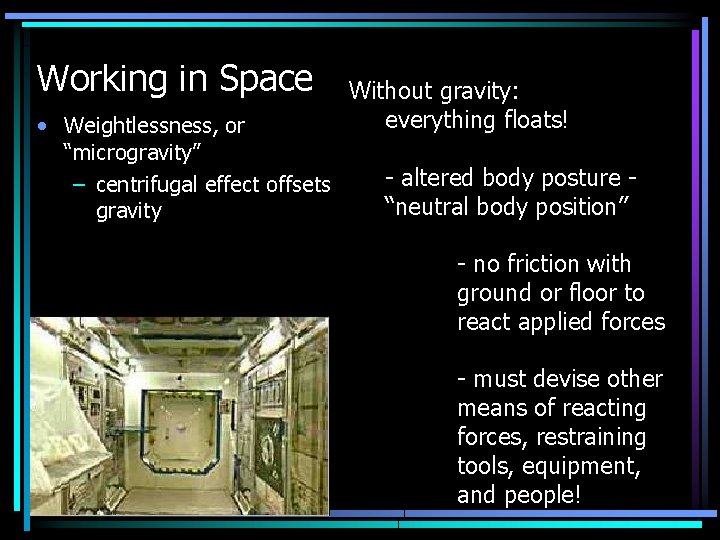
Working in Space • Weightlessness, or “microgravity” – centrifugal effect offsets gravity Without gravity: everything floats! - altered body posture “neutral body position” - no friction with ground or floor to react applied forces - must devise other means of reacting forces, restraining tools, equipment, and people!
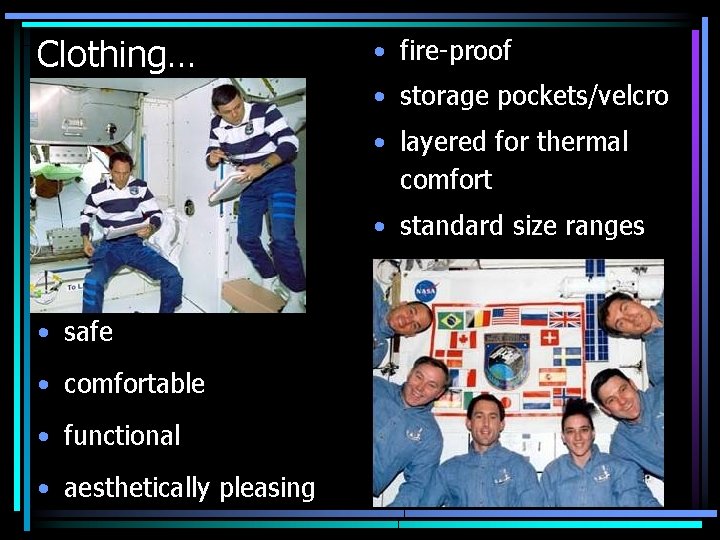
Clothing… • fire-proof • storage pockets/velcro • layered for thermal comfort • standard size ranges • safe • comfortable • functional • aesthetically pleasing
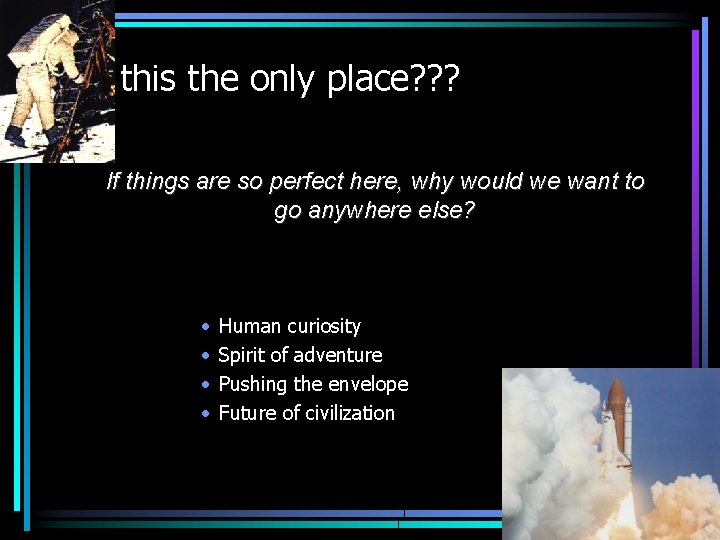
Is this the only place? ? ? If things are so perfect here, why would we want to go anywhere else? • • Human curiosity Spirit of adventure Pushing the envelope Future of civilization
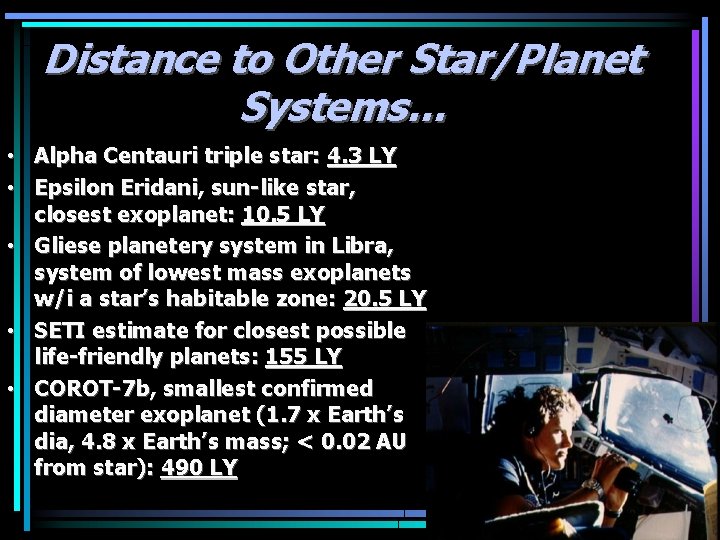
Distance to Other Star/Planet Systems… • • • Alpha Centauri triple star: 4. 3 LY Epsilon Eridani, sun-like star, closest exoplanet: 10. 5 LY Gliese planetery system in Libra, system of lowest mass exoplanets w/i a star’s habitable zone: 20. 5 LY SETI estimate for closest possible life-friendly planets: 155 LY COROT-7 b, smallest confirmed diameter exoplanet (1. 7 x Earth’s dia, 4. 8 x Earth’s mass; < 0. 02 AU from star): 490 LY
SOURCES: • Dr. David Klaus, University of Colorado • Dr. David Robertson, Vanderbilt University • Dr. Oleg Atkov, Russian Institute for Space Biology • Dr. C. R. Canizares, Space Studies Board, NRC • NASA-Johnson Space Center • NASA-Ames Research Center • National Space Biomedical Research Institute • www. esa. int • www. discovery. com • www. nasa. gov • Living in Space – The Astronaut and his Environment, M. R. Sharpe, 1969 • Living Aloft – Human Requirements for Extended Spaceflight, M. Connors, A. Harrison, F. Akins, 1985. • Manned Spaceflight Integration Standards, NASA, 1998.