
living with the lab material balance Engineers design
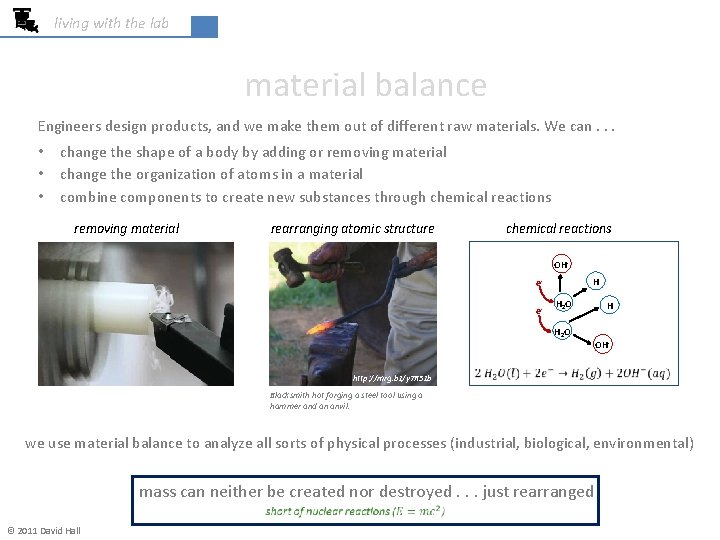
living with the lab material balance Engineers design products, and we make them out of different raw materials. We can. . . • • • change the shape of a body by adding or removing material change the organization of atoms in a material combine components to create new substances through chemical reactions removing material rearranging atomic structure chemical reactions OHH ee- H 2 O H OH- http: //mrg. bz/y 7 R 5 zb Blacksmith hot forging a steel tool using a hammer and an anvil. we use material balance to analyze all sorts of physical processes (industrial, biological, environmental) mass can neither be created nor destroyed. . . just rearranged © 2011 David Hall
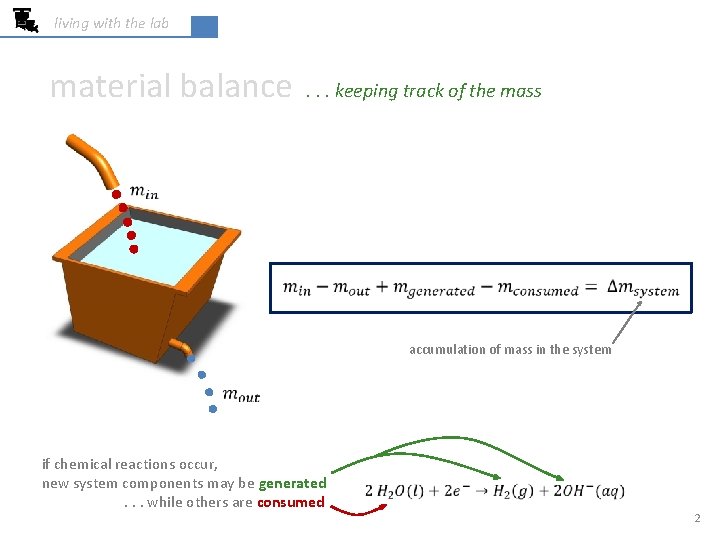
living with the lab material balance . . . keeping track of the mass accumulation of mass in the system if chemical reactions occur, new system components may be generated. . . while others are consumed 2
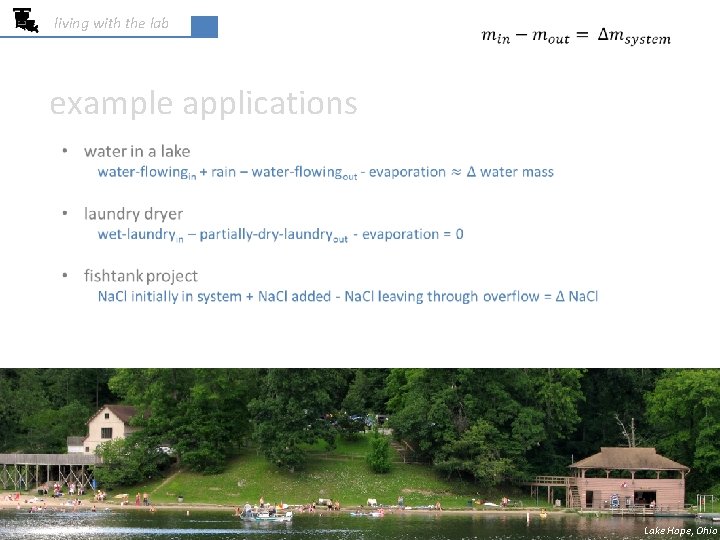
living with the lab example applications 3 Lake Hope, Ohio
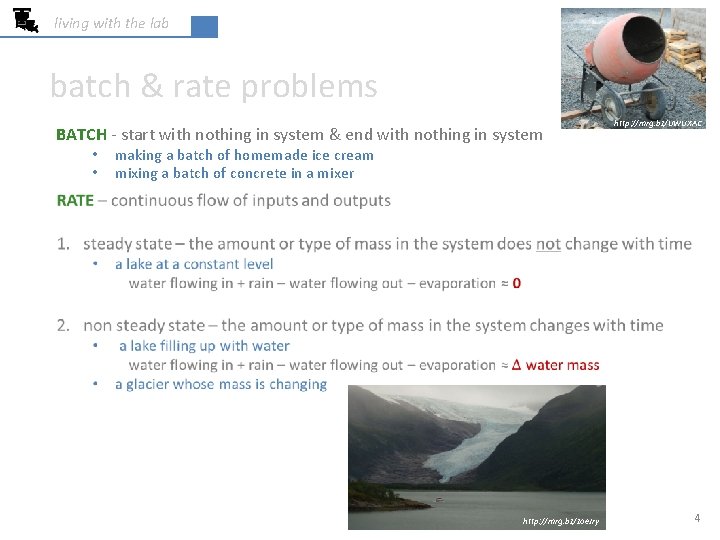
living with the lab batch & rate problems BATCH - start with nothing in system & end with nothing in system • • http: //mrg. bz/UWUXAC making a batch of homemade ice cream mixing a batch of concrete in a mixer http: //mrg. bz/zoe. Jry 4
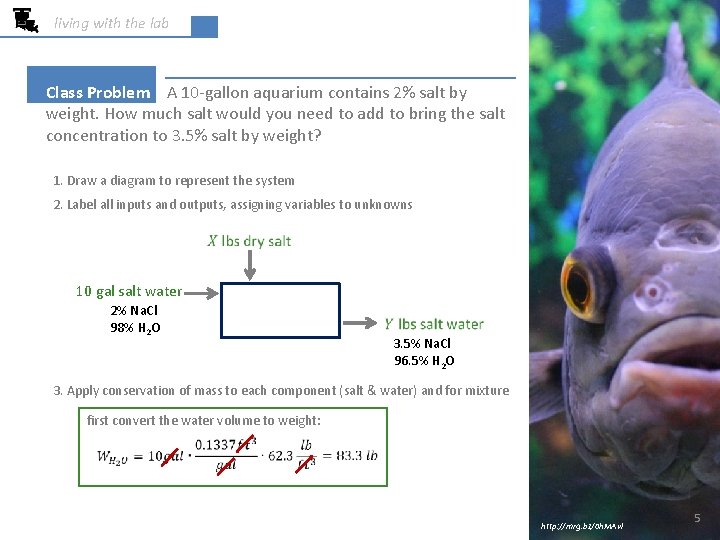
living with the lab Class Problem A 10 -gallon aquarium contains 2% salt by weight. How much salt would you need to add to bring the salt concentration to 3. 5% salt by weight? 1. Draw a diagram to represent the system 2. Label all inputs and outputs, assigning variables to unknowns 10 gal salt water 2% Na. Cl 98% H 2 O 3. 5% Na. Cl 96. 5% H 2 O 3. Apply conservation of mass to each component (salt & water) and for mixture first convert the water volume to weight: http: //mrg. bz/0 h. MAvl 5
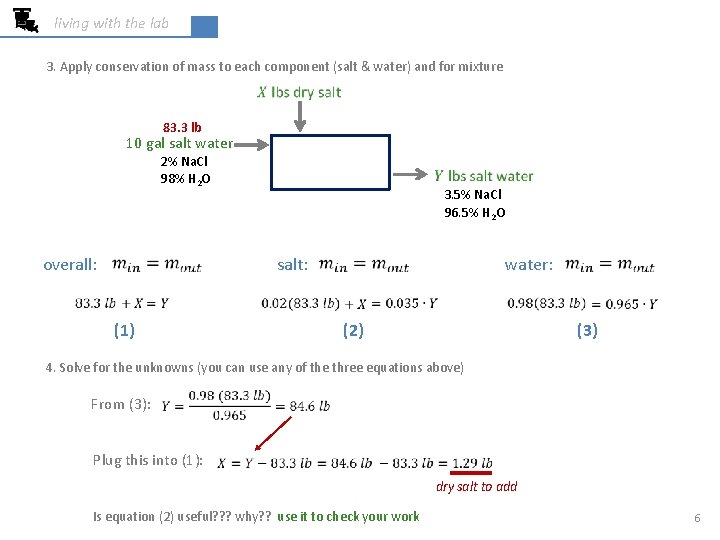
living with the lab 3. Apply conservation of mass to each component (salt & water) and for mixture 83. 3 lb 10 gal salt water 2% Na. Cl 98% H 2 O overall: 3. 5% Na. Cl 96. 5% H 2 O water: salt: (1) (2) (3) 4. Solve for the unknowns (you can use any of the three equations above) From (3): Plug this into (1): dry salt to add Is equation (2) useful? ? ? why? ? use it to check your work 6
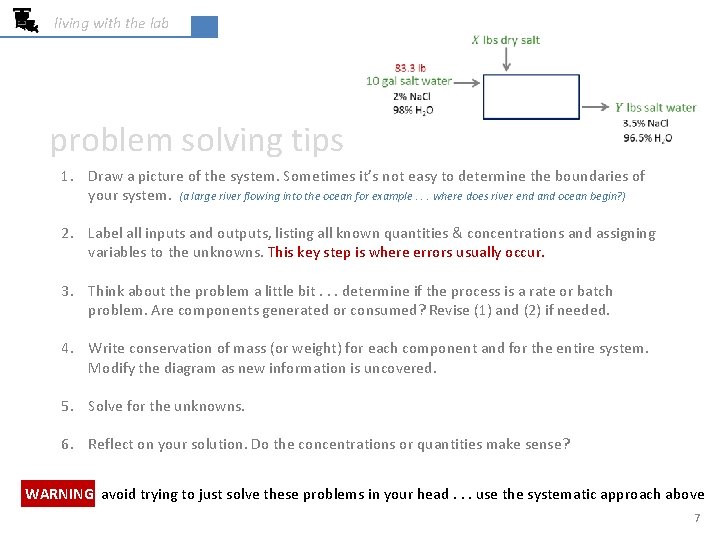
living with the lab problem solving tips 1. Draw a picture of the system. Sometimes it’s not easy to determine the boundaries of your system. (a large river flowing into the ocean for example. . . where does river end and ocean begin? ) 2. Label all inputs and outputs, listing all known quantities & concentrations and assigning variables to the unknowns. This key step is where errors usually occur. 3. Think about the problem a little bit. . . determine if the process is a rate or batch problem. Are components generated or consumed? Revise (1) and (2) if needed. 4. Write conservation of mass (or weight) for each component and for the entire system. Modify the diagram as new information is uncovered. 5. Solve for the unknowns. 6. Reflect on your solution. Do the concentrations or quantities make sense? WARNING avoid trying to just solve these problems in your head. . . use the systematic approach above 7
- Slides: 7