
Living with RussellSilver syndrome falling short Funded by
Living with Russell-Silver syndrome: falling short? Funded by Rf. PB Lisa Ballard Health Psychologist in Training
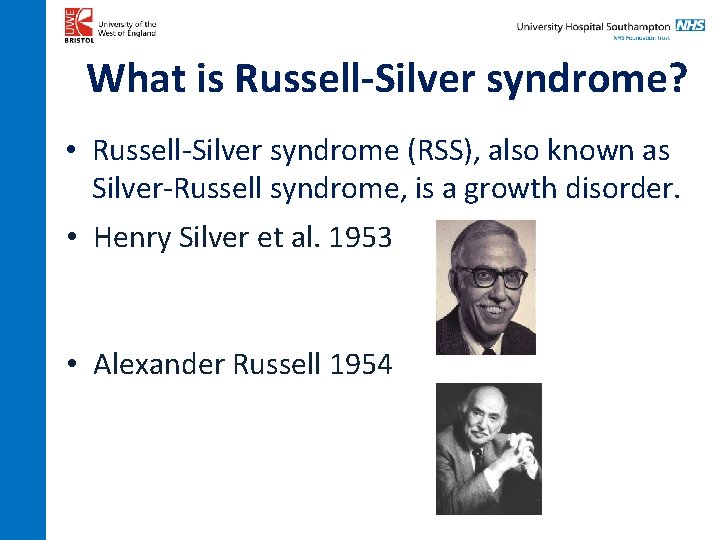
What is Russell-Silver syndrome? • Russell-Silver syndrome (RSS), also known as Silver-Russell syndrome, is a growth disorder. • Henry Silver et al. 1953 • Alexander Russell 1954
What is Russell-Silver syndrome? • Children are born with unexplained low birth weight. Growth is affected during childhood and results in below average height in adulthood (5’ 2” men/4’ 8” women). • Body and face asymmetry. • Children have a distinctive facial appearance. • Treatment is growth hormone therapy (GH). • In some people with RSS a genetic change is found: 40 -50% are found to have a problem on chromosome 11 and in another 5 -10% on chromosome 7, for the other 40% the cause is unknown.
Why research this condition? • We do not know what it means to live with this rare genetic condition. • Exploring the lived experience of adults with RSS will provide valuable information to aid families in making difficult decisions about treatment as well as informing patients living with this syndrome. • Child Growth Foundation support this research – long term health and effects of GH.
Background • Differing from the ‘norm’ could result in unpleasant feelings or emotions 1 • A preference for symmetrical faces may be related to sexual selection and mate choice in males and females 2 and for symmetrical bodies 3 and may be an indicator of health 4 • Children with short stature (SS), compared to peers with normal stature, can often feel less satisfied with their appearance 5 • Skills in resilience and coping are important 1 1. Harcourt and Rumsey, 2012 2. Rhodes, 2006, Thornhill and Gangestad, 1999, Griffey and Little, 2014, Perrett et al. , 1999, Little et al. , 2008 3. Gangestad and Simpson, 2000; Concar, 1995 4. Thornhill and Gangestad, 1999 5. Laub, 2012.
Methodology • • • Qualitative. Method – semi-structured, in depth interviews. 15 participants. 6 were female. 9 were treated with growth hormone (GH). Participant’s ages ranged from 25 -69.
Analysis • Thematic analysis - Essentially a method for identifying and analysing patterns in qualitative data
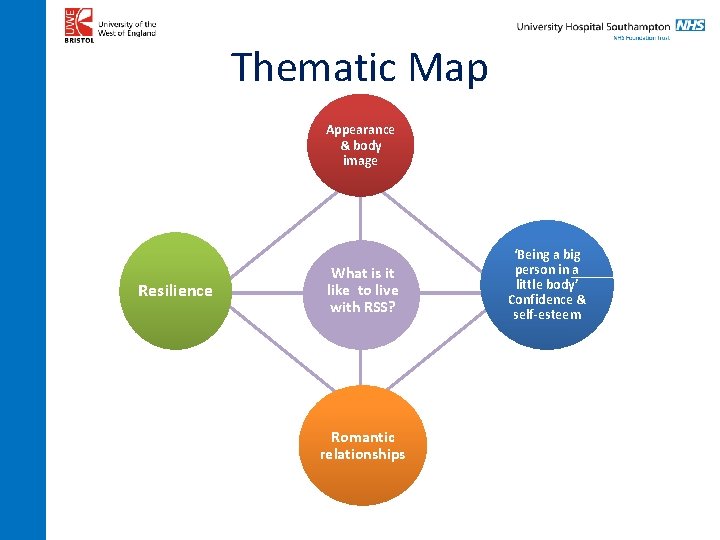
Thematic Map Appearance & body image Resilience What is it like to live with RSS? Romantic relationships ‘Being a big person in a little body’ Confidence & self-esteem
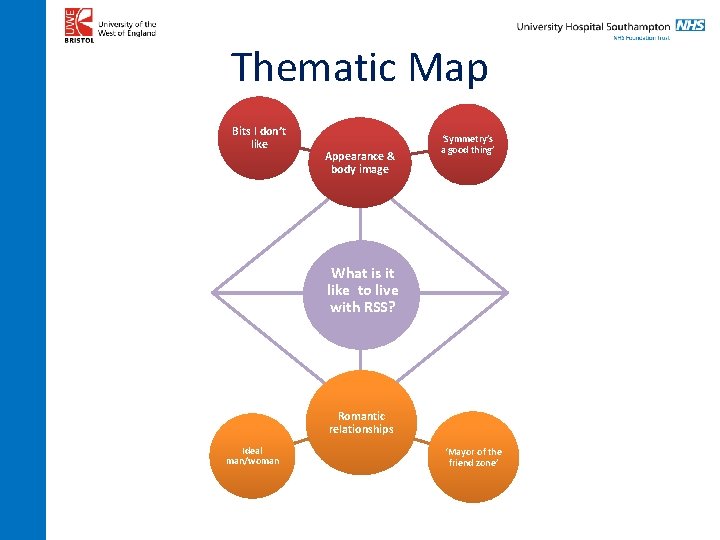
Thematic Map Bits I don’t like Appearance & body image ‘Symmetry’s a good thing’ What is it like to live with RSS? Romantic relationships Ideal man/woman ‘Mayor of the friend zone’
Results ’Symmetry’s a good thing’ Oli (5’ 1”, 39 years old) ‘Symmetry’s a good thing, it always has been. It’s the standard in everything else [. . . ] that’s actually a big problem and people notice and that, in my later teen years really got to me, a lot. ’
Results Bits I don’t like Glenn (5’, 69 years old) • ‘I didn’t like the way I looked. I didn’t actually look at myself in the mirror with the ability to analyse very quickly what I exactly looked like, until I was probably about ten [. . . ] And I didn’t like what I was seeing. And so I could understand why the girls liked me for my personality, but short and ugly, I don’t think so’.
Results ‘Mayor of the friend zone’ Todd (5’ 6”, 34 years old) ‘I think one area where it did really did have an impact was with girls in that kind of teenage phase [. . . ] I think I had pretty low sort of sexual self esteem, all the way through my teenage years and actually probably through most of my 20 s [. . . ] I was very definitely kind of mayor of the friend zone [. . . ] I think I was always maybe slightly resentful that people would judge me very quickly on what I was’
![Results Ideal man Warner (4’ 9”, 37 years old) ‘[B]ecause girls are not going](http://slidetodoc.com/presentation_image_h2/10e2299da26e80e44b3ce5c5ae621060/image-13.jpg "Results Ideal man Warner (4’ 9”, 37 years old) ‘[B]ecause girls are not going")
Results Ideal man Warner (4’ 9”, 37 years old) ‘[B]ecause girls are not going to find me attractive physically. I have to accept that […] because I’m, because of my height, I guess most girls are looking for guys who’re a bit taller. And my lack of muscle. Girls are looking for guys that have sort of got a bit more muscle’.
Conclusions • Main findings - Adolescents, especially males, have appearance related concerns that impact on romantic relationships • - Application of this research Psychological support Health care professionals Child Growth Foundation
![Last word from Luke (4’ 8”, 40 years old) ‘[I]t should be more about](http://slidetodoc.com/presentation_image_h2/10e2299da26e80e44b3ce5c5ae621060/image-15.jpg "Last word from Luke (4’ 8”, 40 years old) ‘[I]t should be more about")
Last word from Luke (4’ 8”, 40 years old) ‘[I]t should be more about being a big person in a little body you know what I mean, and then sort of you know who you are, what you stand for and how to cope with things’.
With thanks to: Dr Elizabeth Jenkinson (Do. S) Professor Angela Fenwick (Second supervisor) Professor Karen Temple Dr Kemi Lokulo-Sodipe Dr Justin Davies Dr Hazel Inskip Dr Deborah Mackay Dr Chris Byrne Dr Emma Wakeling Dr Renuka Dias Mrs Jenny Childs (Child Growth Foundation)
- Slides: 16