
Living with a longterm traumatic spinal cord injury
- Slides: 1
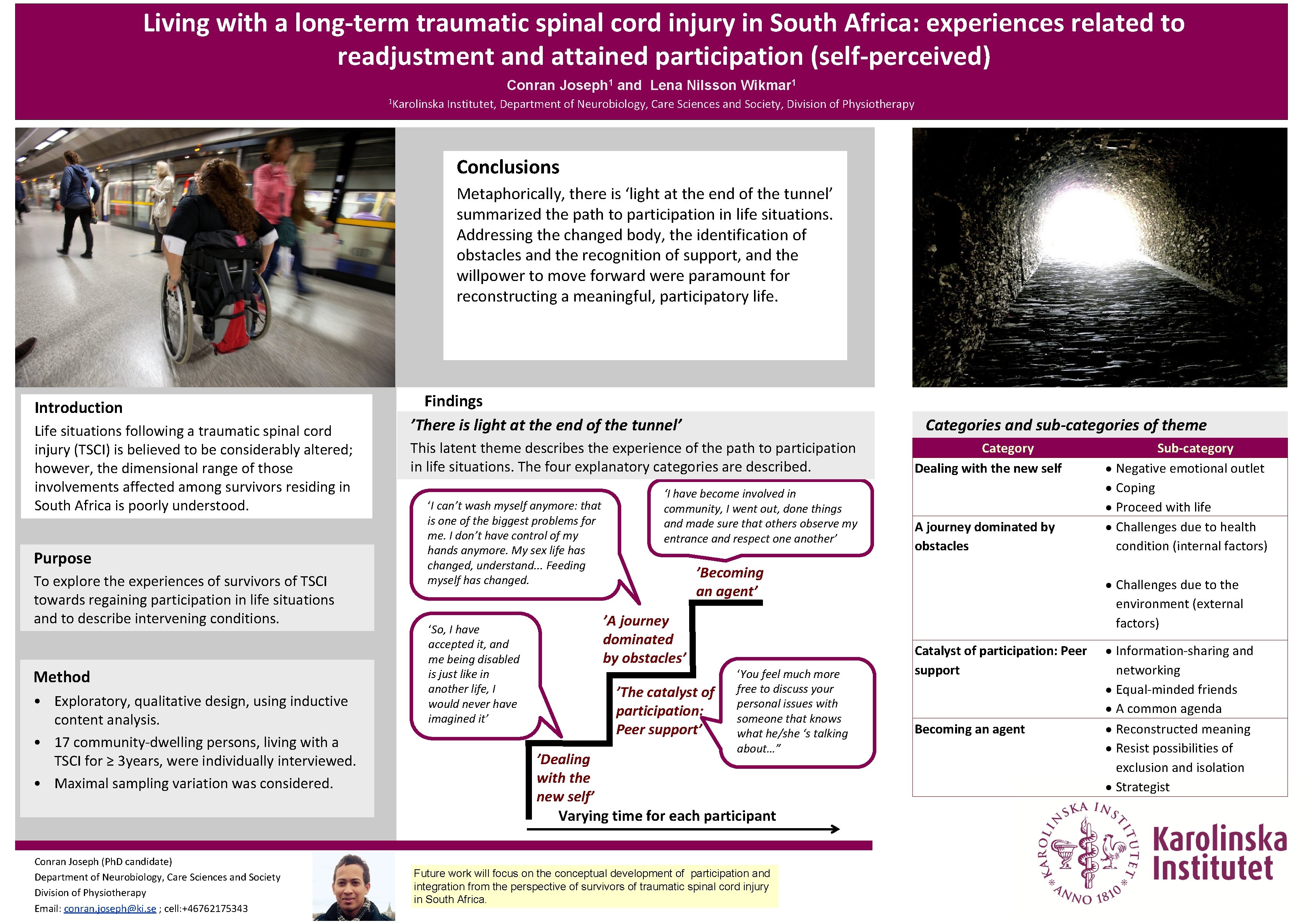
Living with a long-term traumatic spinal cord injury in South Africa: experiences related to readjustment and attained participation (self-perceived) Conran Joseph 1 and Lena Nilsson Wikmar 1 1 Karolinska Institutet, Department of Neurobiology, Care Sciences and Society, Division of Physiotherapy Conclusions Metaphorically, there is ‘light at the end of the tunnel’ summarized the path to participation in life situations. Addressing the changed body, the identification of obstacles and the recognition of support, and the willpower to move forward were paramount for reconstructing a meaningful, participatory life. Introduction Life situations following a traumatic spinal cord injury (TSCI) is believed to be considerably altered; however, the dimensional range of those involvements affected among survivors residing in South Africa is poorly understood. Purpose To explore the experiences of survivors of TSCI towards regaining participation in life situations and to describe intervening conditions. Method • Exploratory, qualitative design, using inductive content analysis. • 17 community-dwelling persons, living with a TSCI for ≥ 3 years, were individually interviewed. • Maximal sampling variation was considered. Conran Joseph (Ph. D candidate) Department of Neurobiology, Care Sciences and Society Division of Physiotherapy Email: conran. joseph@ki. se ; cell: +46762175343 Findings ’There is light at the end of the tunnel’ Categories and sub-categories of theme This latent theme describes the experience of the path to participation in life situations. The four explanatory categories are described. ‘I can’t wash myself anymore: that is one of the biggest problems for me. I don’t have control of my hands anymore. My sex life has changed, understand. . . Feeding myself has changed. ‘So, I have accepted it, and me being disabled is just like in another life, I would never have imagined it’ ‘I have become involved in community, I went out, done things and made sure that others observe my entrance and respect one another’ Category Dealing with the new self A journey dominated by obstacles ’Becoming an agent’ ’A journey dominated by obstacles’ ’The catalyst of participation: Peer support’ ‘You feel much more free to discuss your personal issues with someone that knows what he/she ‘s talking about…” ’Dealing with the new self’ Varying time for each participant Future work will focus on the conceptual development of participation and integration from the perspective of survivors of traumatic spinal cord injury in South Africa. Sub-category Negative emotional outlet Coping Proceed with life Challenges due to health condition (internal factors) Challenges due to the environment (external factors) Catalyst of participation: Peer support Becoming an agent Information-sharing and networking Equal-minded friends A common agenda Reconstructed meaning Resist possibilities of exclusion and isolation Strategist