
Living Wills Health Care Proxies HEALTH CARE PROXY
![Health Insurance Portability and Accountability Act [HIPAA], and Durable Power of Attorney HIPAA: This](https://slidetodoc.com/presentation_image/5f8da862a6b42652773f9dcaca3632a8/image-2.jpg "Health Insurance Portability and Accountability Act [HIPAA], and Durable Power of Attorney HIPAA: This")












- Slides: 19
Living Wills, Health Care Proxies, HEALTH CARE PROXY AND LIVING WILL: You have a right to die and not be kept alive by artificial means as well as to have other medical decisions made for you. You must make this known prior to any such disability. If not, a judge will make the decision for you. Avoid these problems by setting forth your intentions in a “living will”, and designate the person you want to carry out your statement in a “health care proxy”.
Health Insurance Portability and Accountability Act [HIPAA], and Durable Power of Attorney HIPAA: This form is now needed to enable your spouse and adult descendants to access your personal medical information. DURABLE POWER OF ATTORNEY: This is a documents that allows another person to make all financial related decisions. This will help avoid the need for a guardianship and court permission to do certain financial transactions for a loved one. This power is effective when signed but expires upon your death.
Your Last Will & Testament Did you ever wonder what would happen to your property if you died without a will? If you die without a will, your property will be distributed according to the laws of the state in which you reside at the time of death. In Massachusetts, if you are single, your property will pass equally to your mother or father, or the survivor, unless there are children in which case the property will be distributed equally to the children. However, if you are married and die and leave children then your spouse will only get one half of the assets while your children will get the other half. Assets which you own jointly with another person, bank accounts & real estate, will pass to the surviving co-owner. Assets with a beneficiary, IRAs & life insurance, will pass to the named beneficiary. Both of these forms of ownership will avoid probate.
Avoiding Probate The cost of probate can be substantial (3 -5%). In addition, all of your assets that you own in your individual name are listed and valued in a public filing. There is no privacy, and the administration of your estate can be delayed for substantial periods. There is also the possibility of a challenge to your will.
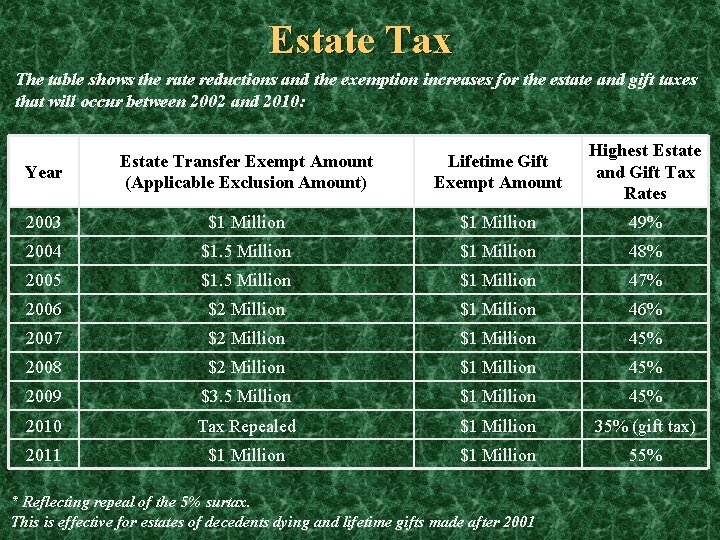
Estate Tax The table shows the rate reductions and the exemption increases for the estate and gift taxes that will occur between 2002 and 2010: Year Estate Transfer Exempt Amount (Applicable Exclusion Amount) Lifetime Gift Exempt Amount Highest Estate and Gift Tax Rates 2003 $1 Million 49% 2004 $1. 5 Million $1 Million 48% 2005 $1. 5 Million $1 Million 47% 2006 $2 Million $1 Million 46% 2007 $2 Million $1 Million 45% 2008 $2 Million $1 Million 45% 2009 $3. 5 Million $1 Million 45% 2010 Tax Repealed $1 Million 35% (gift tax) 2011 $1 Million 55% * Reflecting repeal of the 5% surtax. This is effective for estates of decedents dying and lifetime gifts made after 2001
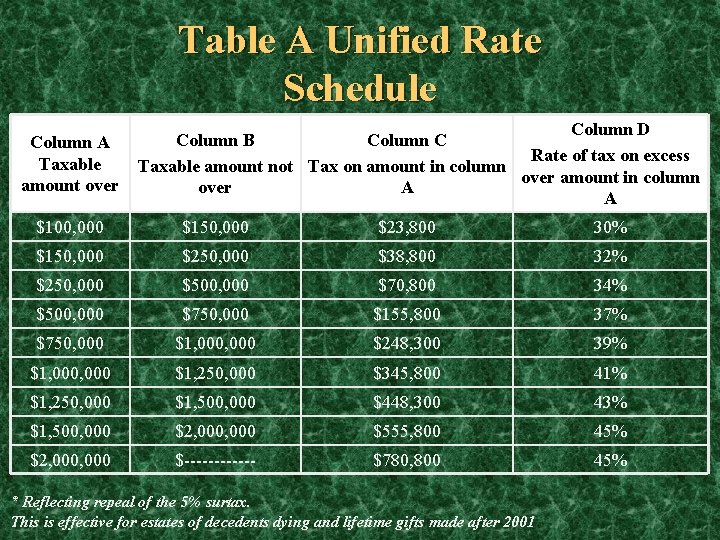
Table A Unified Rate Schedule Column A Taxable amount over Column D Column B Column C Rate of tax on excess Taxable amount not Tax on amount in column over A A $100, 000 $150, 000 $23, 800 30% $150, 000 $250, 000 $38, 800 32% $250, 000 $500, 000 $70, 800 34% $500, 000 $750, 000 $155, 800 37% $750, 000 $1, 000 $248, 300 39% $1, 000 $1, 250, 000 $345, 800 41% $1, 250, 000 $1, 500, 000 $448, 300 43% $1, 500, 000 $2, 000 $555, 800 45% $2, 000 $------ $780, 800 45% * Reflecting repeal of the 5% surtax. This is effective for estates of decedents dying and lifetime gifts made after 2001
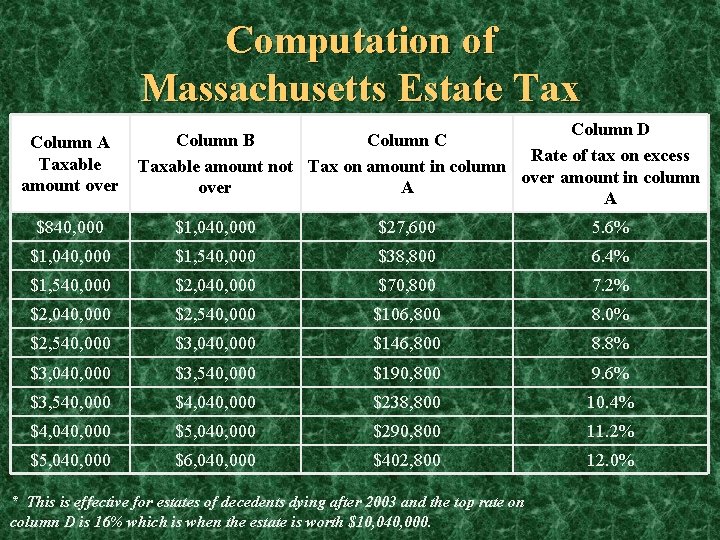
Computation of Massachusetts Estate Tax Column A Taxable amount over Column D Column B Column C Rate of tax on excess Taxable amount not Tax on amount in column over A A $840, 000 $1, 040, 000 $27, 600 5. 6% $1, 040, 000 $1, 540, 000 $38, 800 6. 4% $1, 540, 000 $2, 040, 000 $70, 800 7. 2% $2, 040, 000 $2, 540, 000 $106, 800 8. 0% $2, 540, 000 $3, 040, 000 $146, 800 8. 8% $3, 040, 000 $3, 540, 000 $190, 800 9. 6% $3, 540, 000 $4, 040, 000 $238, 800 10. 4% $4, 040, 000 $5, 040, 000 $290, 800 11. 2% $5, 040, 000 $6, 040, 000 $402, 800 12. 0% * This is effective for estates of decedents dying after 2003 and the top rate on column D is 16% which is when the estate is worth $10, 040, 000.
Why You’d Need a Trust For Federal Estate Tax HUSBAND’S ESTATE $4, 000 WIFE’S ESTATE $4, 000 UNNECESSARY TAXES DUE BALANCE TO HEIRS $1, 019, 200
Estate Tax With No Planning Husband Gross Estate Marital Deduction Exemption Taxable Estate Tax Due $ 4, 000, 000 -0$ -0 - Fed 45% State 10% 55% Net 50% The State death tax is deducted in computing the federal tax. So the net estate tax is 50%
Estate Tax With No Planning Gross Estate Marital Deduction Exemption Taxable Estate Tax Due Husband Wife $ 4, 000, 000 -0$ -0 - $ 4, 000 -0 - $ 2, 000, 000 $ 1, 000 Fed 45% State 10% 55% Net 50% The State death tax is deducted in computing the federal tax. So the net estate tax is 50%
Eliminating Estate Taxes With Planning Husband Gross Estate Marital Deduction Exemptions Taxable Estate Tax Due $ 4, 000, 000 - $ 2, 000 $ -0 - Fed 45% State 10% 55% Net 50% The State death tax is deducted in computing the federal tax. So the net estate tax is 50%
Eliminating Estate Taxes With Planning Husband Gross Estate Marital Deduction Exemptions Taxable Estate Tax Due $ 4, 000, 000 - $ 2, 000 $ -0 - Wife $ 2, 000 -0 - $ 2, 000 $ -0 - Fed 45% State 10% 55% Net 50% The State death tax is deducted in computing the federal tax. So the net estate tax is 50%
Why You’d Need a Trust For Massachusetts Estate Tax HUSBAND’S ESTATE 4, 000 WIFE’S ESTATE $4, 000 UNNECESSARY TAXES DUE BALANCE TO HEIRS $280, 400
Benefits of Having a Trust: Reducing Estate Taxes TOTAL ESTATE $4, 000 HUSBAND’S TRUST $2, 000 WIFE’S TRUST $2, 000 BALANCE TO HEIRS $4, 000 PLAN AND SAVE $1, 019, 200 IN ESTATE TAXES!
Benefits of Having a Trust: Reducing MA Estate Taxes TOTAL ESTATE $4, 000 HUSBAND’S TRUST $2, 000 WIFE’S TRUST $2, 000 BALANCE TO HEIRS $3, 818, 000 PLAN AND SAVE $98, 400 IN MA ESTATE TAXES! BUT STILL OWE $182, 000 VS $280, , 400
Reducing Estate Taxes – Larger Estates : Life Insurance is it Tax Free? 1. Income tax free to the beneficiary 2. Estate taxable as valued on date of death Planning note: Life insurance may cause your estate to be taxable when maybe it would not have been otherwise. Solution Irrevocable Life Insurance Trust: 1. Assets in the trust are creditor protected 2. Assets in the trust are estate tax free 3. The trust is a grantor trust for income tax purposes which means that you are considered the owner for income tax purposes. In other words any income would be taxed at your individual rates.
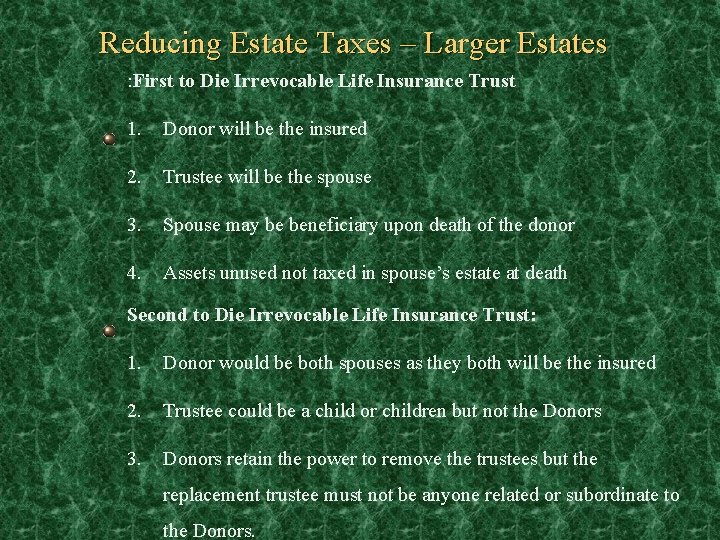
Reducing Estate Taxes – Larger Estates : First to Die Irrevocable Life Insurance Trust 1. Donor will be the insured 2. Trustee will be the spouse 3. Spouse may be beneficiary upon death of the donor 4. Assets unused not taxed in spouse’s estate at death Second to Die Irrevocable Life Insurance Trust: 1. Donor would be both spouses as they both will be the insured 2. Trustee could be a child or children but not the Donors 3. Donors retain the power to remove the trustees but the replacement trustee must not be anyone related or subordinate to the Donors.
Reducing Estate Taxes – Larger Estates Larger estates face an estate tax problem even with proper planning. The federal estate tax rates begin at 45% and go as high as 45%. There is also a special Generation Skipping Tax of 45%. The maximum estate tax rate may be back to 55% in 2011. Your estate may lose as much as 80% to various taxes on the death of the second spouse if income taxes are considered. If you consider gifting property away during your life, you may consider a Qualified Personal Residence Trust (QPRT), a Grantor Retained Annuity Trust (GRAT), a Charitable Remainder Trust (CRT), a self-canceling installment note (SCIN), or even a private life annuity.
Reducing Estate Taxes – Larger Estates Regular and Series Limited Liability Companies: 1. Provide creditor protection against personal assets 2. Maintain control over your assets during life 3. Provide a lack of control discount for estate tax valuation purposes thereby reducing estate tax 4. Provide a lack of marketability discount for estate tax valuation purposes thereby reducing estate tax 5. No adverse income tax consequences year to year 6. Regular LLC is ideal for owning investment accounts 7. Series LLC is ideal for owning rental properties