
Living things Objectives To look at the components
Living things?

Objectives �To look at the components of a living organism and understand how they are organised �To appreciate the role of the microscope in our learning about the body �To review the variety of life
Outcomes �To know what we mean by cells, tissues, organ systems and be able to give examples in both plants and animals �To understand the difference between single and multi-cellular organisms �To provide examples of the diversity of life.
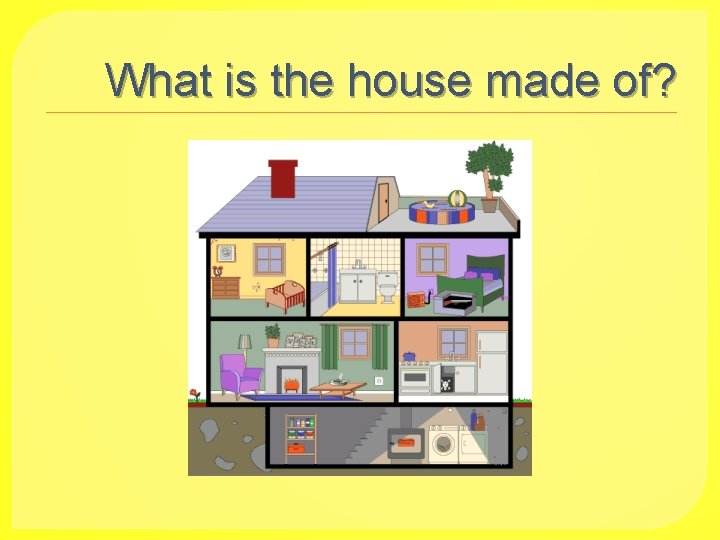
What is the house made of?

What is the body made of?
Draw analogies between the body and the house �Bricks = cells
Not very helpful �The body consists of three parts – the branium, the borax and the abominable cavity. The branium contains the brain, the borax contains the heart and lungs, and the abominable cavity contains the bowls, of which there are five – a, e, i, o and u.
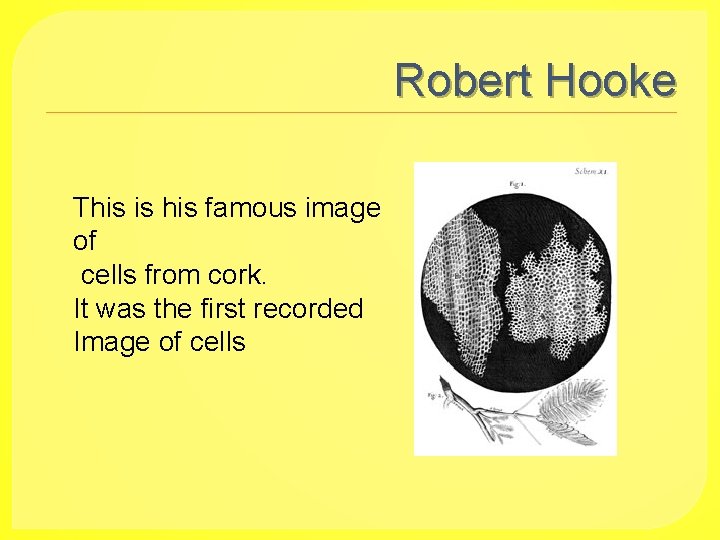
Robert Hooke This is his famous image of cells from cork. It was the first recorded Image of cells
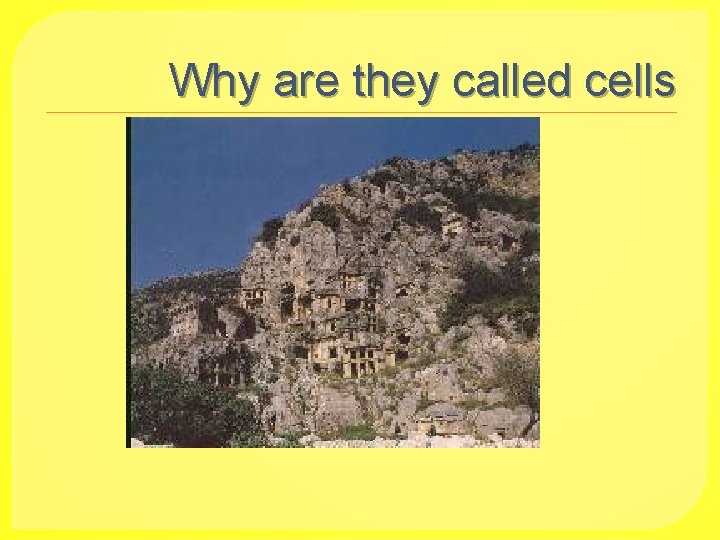
Why are they called cells

Hooke’s Microscope
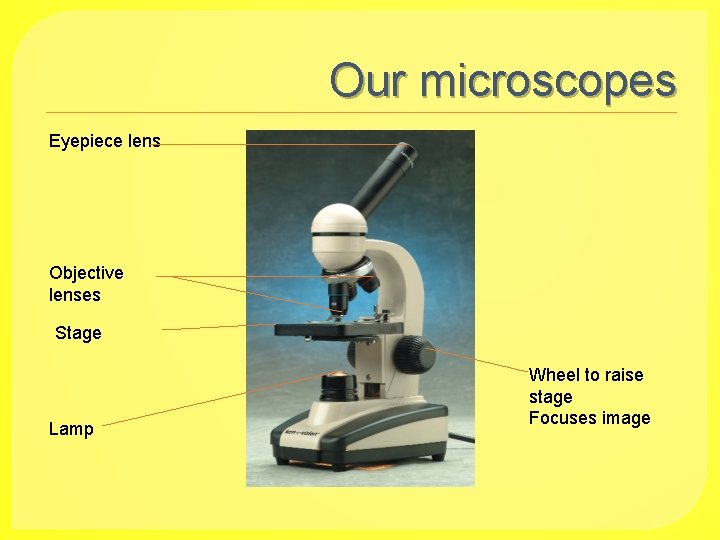
Our microscopes Eyepiece lens Objective lenses Stage Lamp Wheel to raise stage Focuses image
How do we work out magnification? �Eye piece lens x Objective lens
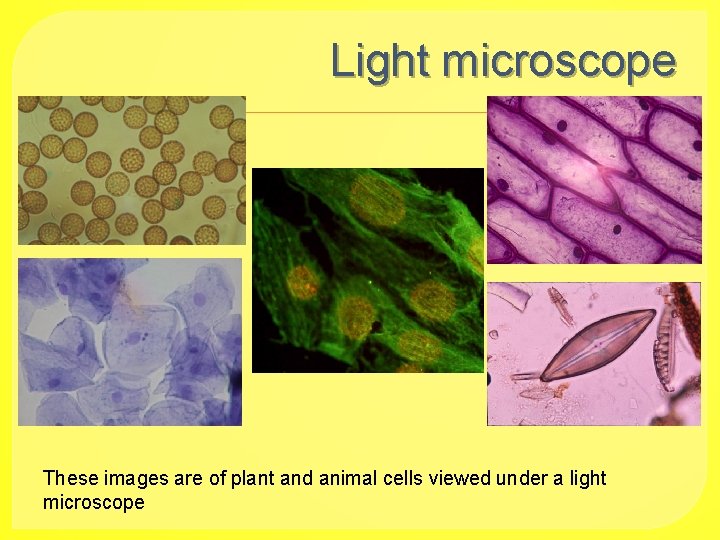
Light microscope These images are of plant and animal cells viewed under a light microscope

Electron microscope These pictures were taken using Electron microscopes How is the on the left misleading?
Microscopy �What are the differences between the two types of microscope image �Light microscopes can magnify to 1000 – 1500 x �Electron 000 x microscopes can magnify to 200

Plenary �Put these in the correct order from smallest to largest. �Give plant and animal examples �Tissue �Organ systems �Cells �Organisms �Organs

The variety of life
5 Kingdoms � Monera � Organisms without nuclei including many diseases. � Protista � Mostly single – celled (some people include algae – I don´t!) May be autotroph or heterotroph. Most reproduce asexually � Cells are long multinuclear hyphae � Fungi with chitin walls which can reproduce asexually with spores and sexually by conjugation. Eat dead and dying things.
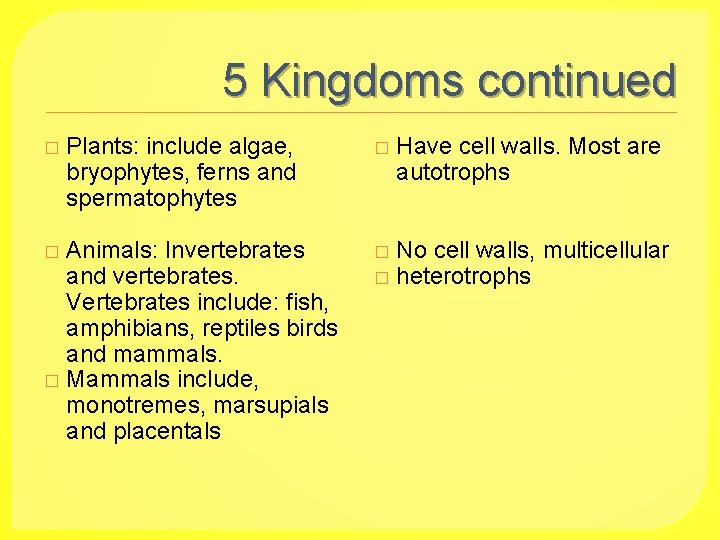
5 Kingdoms continued � Plants: include algae, bryophytes, ferns and spermatophytes Animals: Invertebrates and vertebrates. Vertebrates include: fish, amphibians, reptiles birds and mammals. � Mammals include, monotremes, marsupials and placentals � � Have cell walls. Most are autotrophs � � No cell walls, multicellular heterotrophs
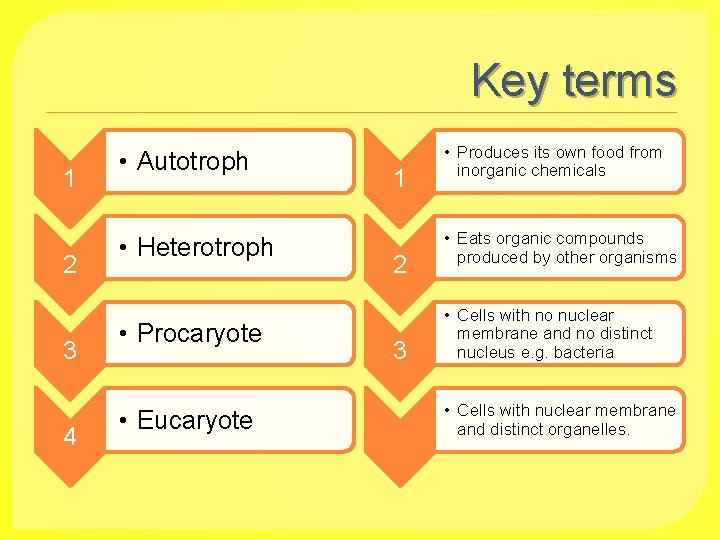
Key terms 1 2 3 4 • Autotroph • Heterotroph • Procaryote • Eucaryote 1 2 3 • Produces its own food from inorganic chemicals • Eats organic compounds produced by other organisms • Cells with no nuclear membrane and no distinct nucleus e. g. bacteria • Cells with nuclear membrane and distinct organelles.
Variety of Life activity � Research your given organism or group of organisms � Find a photo and named example (2 points) � Name features specific to its group (4 points) � Give information about where it is found, what it does etc. (8 points) � Paragraphs and links (3 points) � Written English (3 points) � Upload to portfolio
- Slides: 21