
Living Things and Their Habitats Year One Aim
Living Things and Their Habitats Year One
Aim • I can identify animals in their habitats. • I can use information I have gathered to answer a question. Success Criteria • I can find microhabitats. • I can identify and name the minibeasts I find there. • I can record information about minibeasts in a table. • I can present my results in a pictogram. • I can use my findings to compare 2 microhabitats.
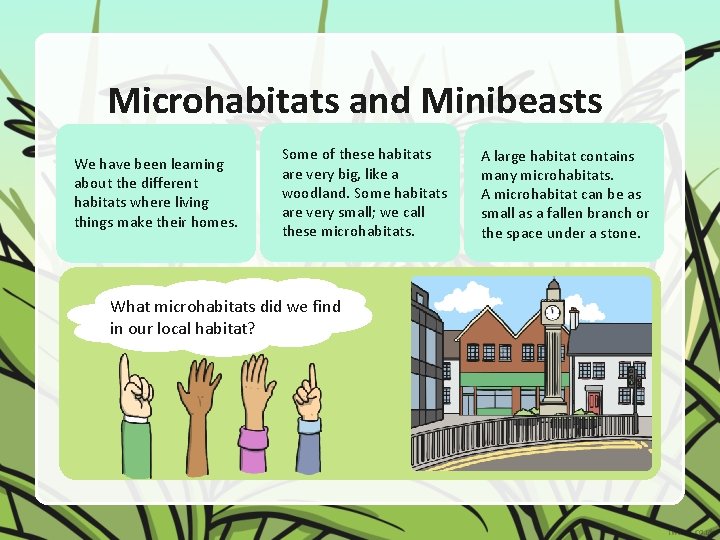
Microhabitats and Minibeasts We have been learning about the different habitats where living things make their homes. Some of these habitats are very big, like a woodland. Some habitats are very small; we call these microhabitats. What microhabitats did we find in our local habitat? A large habitat contains many microhabitats. A microhabitat can be as small as a fallen branch or the space under a stone.
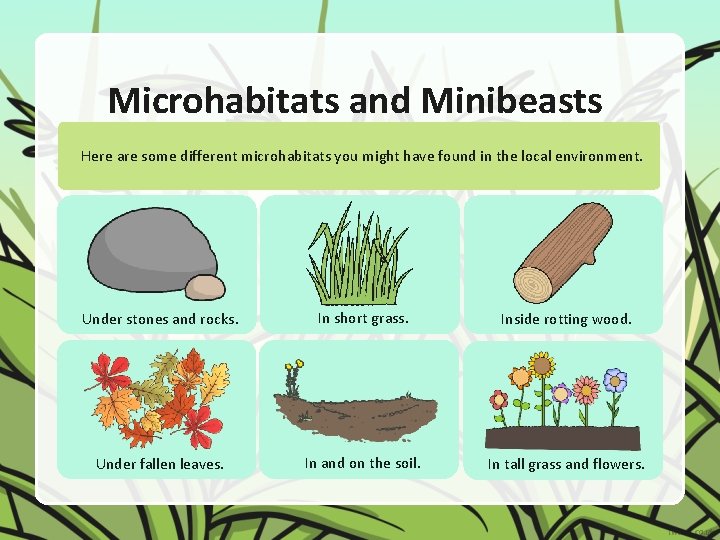
Microhabitats and Minibeasts Here are some different microhabitats you might have found in the local environment. Under stones and rocks. In short grass. Inside rotting wood. Under fallen leaves. In and on the soil. In tall grass and flowers.
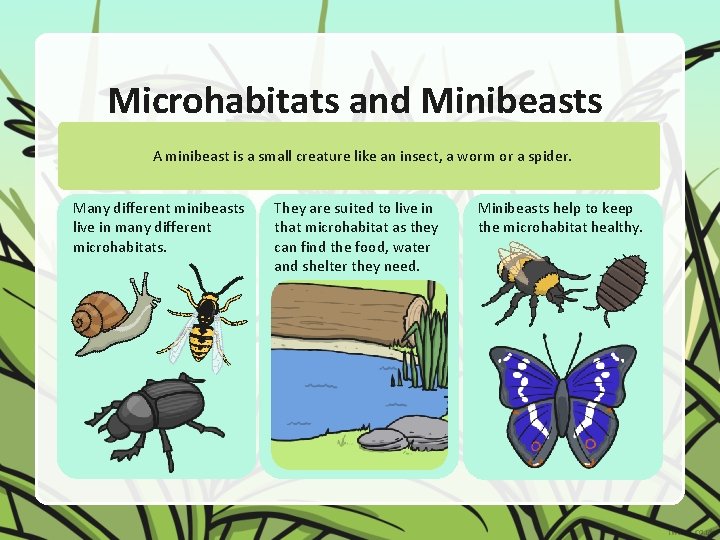
Microhabitats and Minibeasts A minibeast is a small creature like an insect, a worm or a spider. Many different minibeasts live in many different microhabitats. They are suited to live in that microhabitat as they can find the food, water and shelter they need. Minibeasts help to keep the microhabitat healthy.
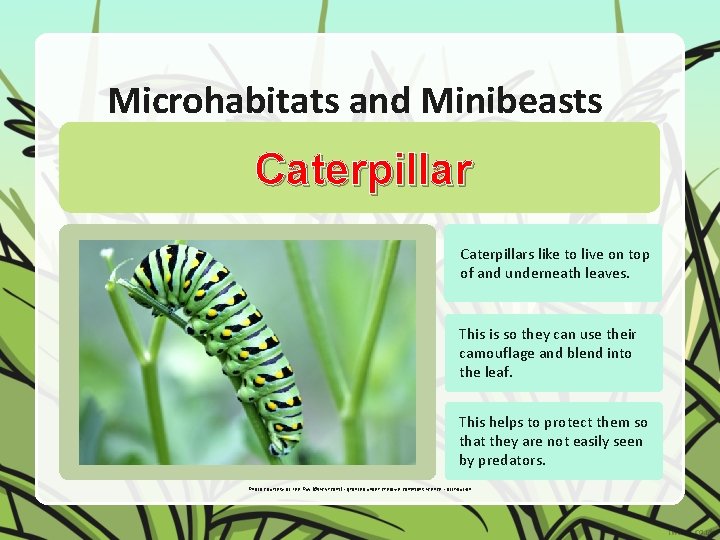
Microhabitats and Minibeasts Caterpillars like to live on top of and underneath leaves. This is so they can use their camouflage and blend into the leaf. This helps to protect them so that they are not easily seen by predators. Photo courtesy of Lee Ruk (@flickr. com) - granted under creative commons licence - attribution
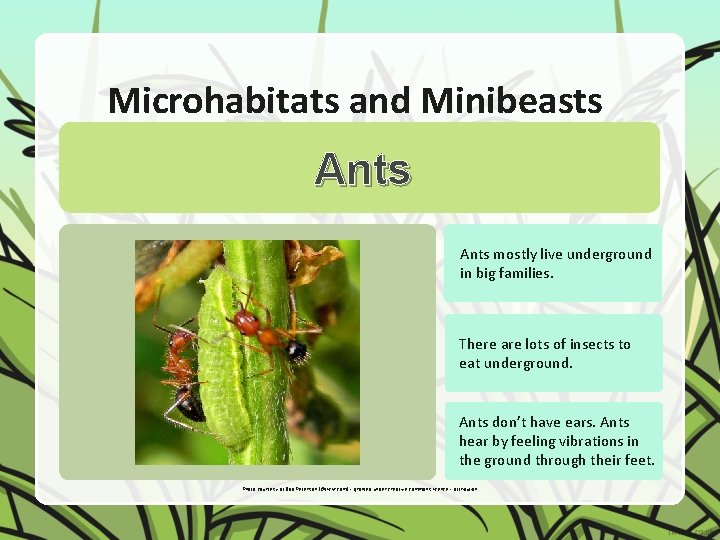
Microhabitats and Minibeasts Ants mostly live underground in big families. There are lots of insects to eat underground. Ants don’t have ears. Ants hear by feeling vibrations in the ground through their feet. Photo courtesy of Bob Peterson (@flickr. com) - granted under creative commons licence - attribution
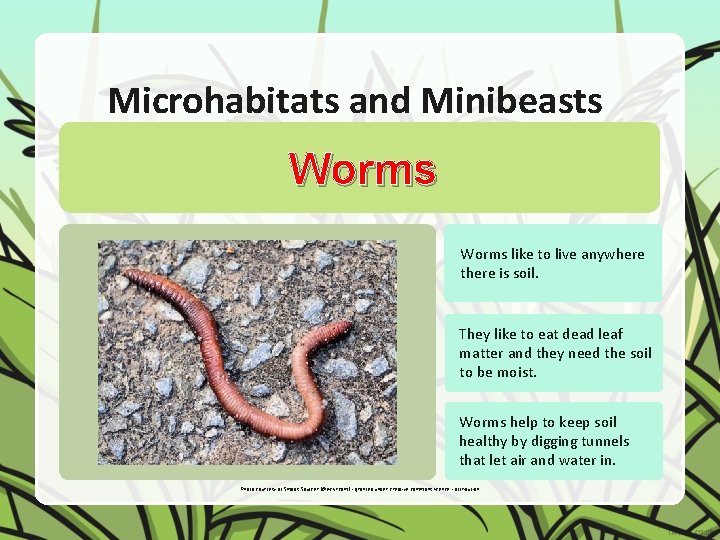
Microhabitats and Minibeasts Worms like to live anywhere there is soil. They like to eat dead leaf matter and they need the soil to be moist. Worms help to keep soil healthy by digging tunnels that let air and water in. Photo courtesy of Smabs Sputzer (@flickr. com) - granted under creative commons licence - attribution
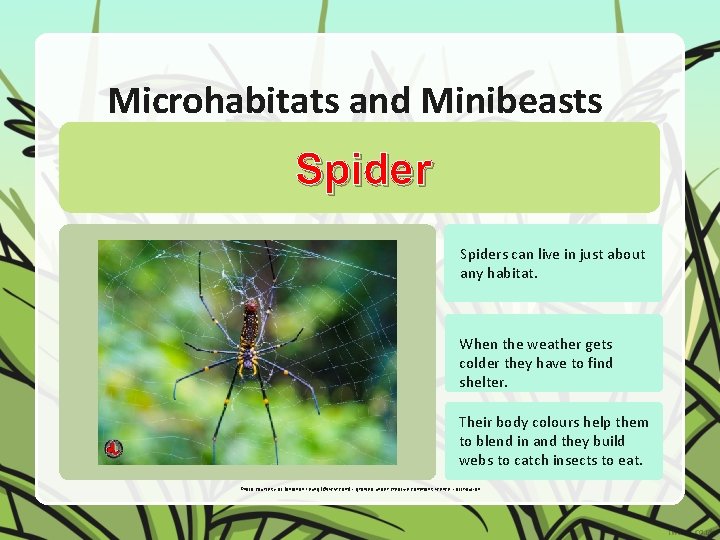
Microhabitats and Minibeasts Spiders can live in just about any habitat. When the weather gets colder they have to find shelter. Their body colours help them to blend in and they build webs to catch insects to eat. Photo courtesy of Jonathan Leung (@flickr. com) - granted under creative commons licence - attribution
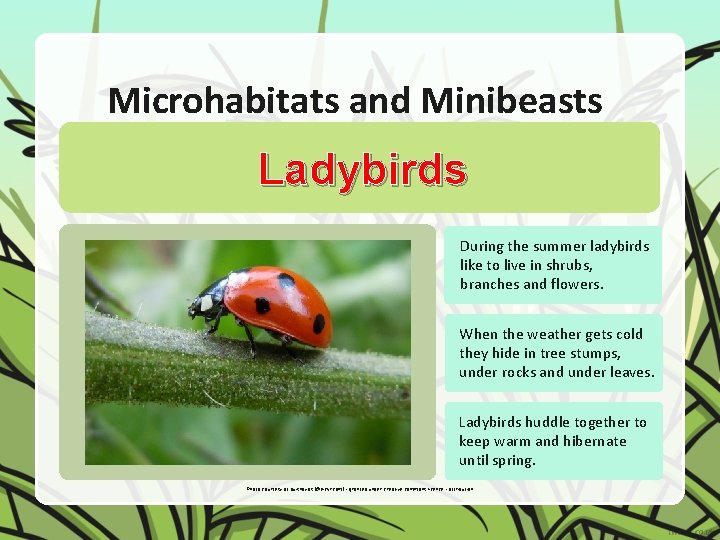
Microhabitats and Minibeasts Ladybirds During the summer ladybirds like to live in shrubs, branches and flowers. When the weather gets cold they hide in tree stumps, under rocks and under leaves. Ladybirds huddle together to keep warm and hibernate until spring. Photo courtesy of quisnovas (@flickr. com) - granted under creative commons licence - attribution
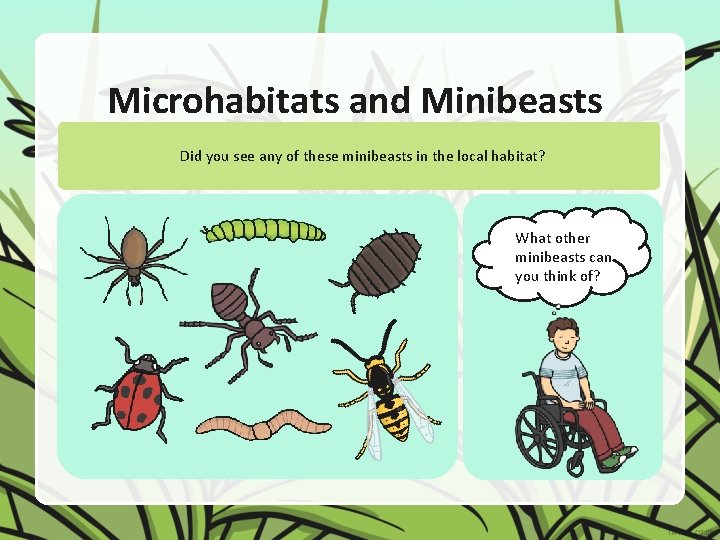
Microhabitats and Minibeasts Did you see any of these minibeasts in the local habitat? What other minibeasts can you think of?
Microhabitats Enquiry How could we answer this question? Do all minibeasts like living in the same microhabitats?
Microhabitats Enquiry We are going to try to answer the question by finding microhabitats in the local environment and counting the different minibeasts we find there. Do all minibeasts like living in the same microhabitats?
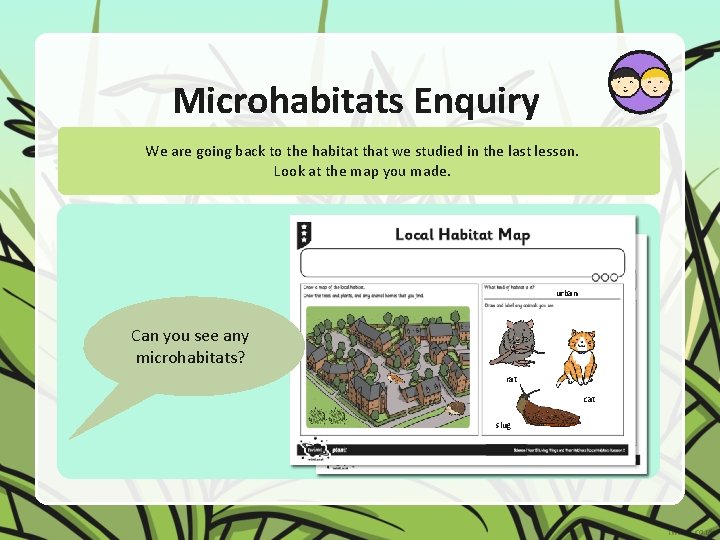
Microhabitats Enquiry We are going back to the habitat that we studied in the last lesson. Look at the map you made. urban Can you see any microhabitats? rat cat slug
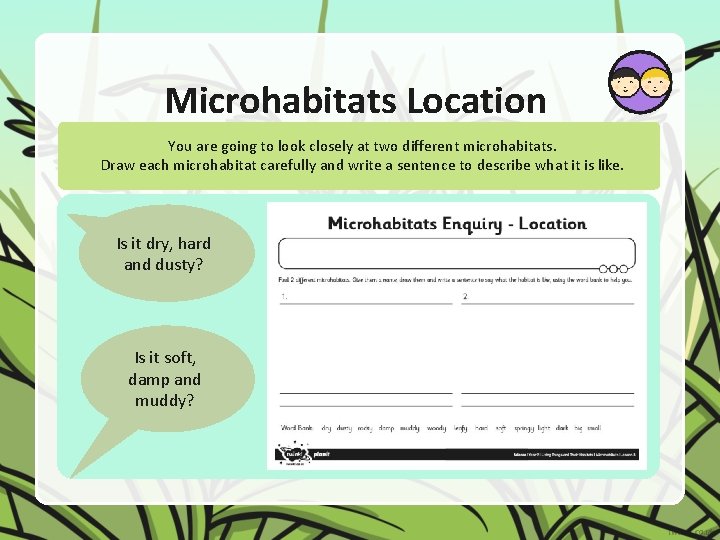
Microhabitats Location You are going to look closely at two different microhabitats. Draw each microhabitat carefully and write a sentence to describe what it is like. Is it dry, hard and dusty? Is it soft, damp and muddy?
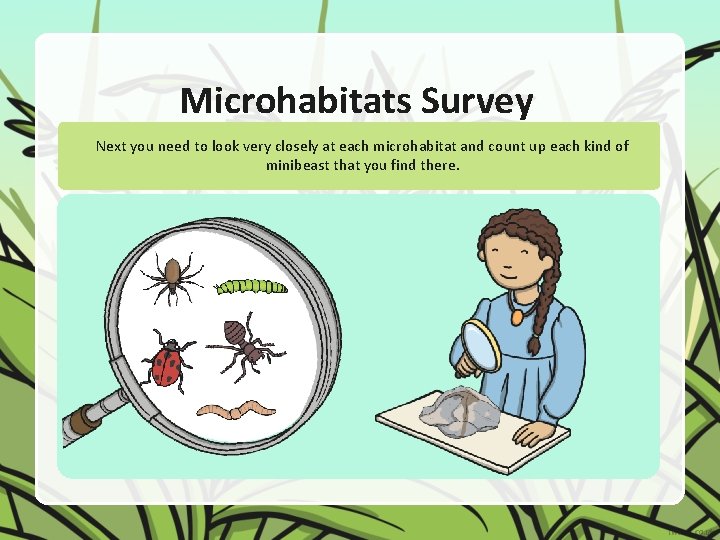
Microhabitats Survey Next you need to look very closely at each microhabitat and count up each kind of minibeast that you find there.
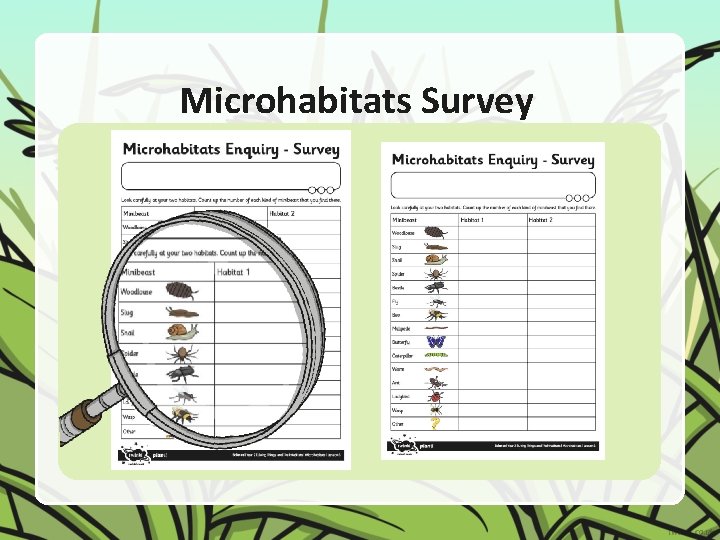
Microhabitats Survey
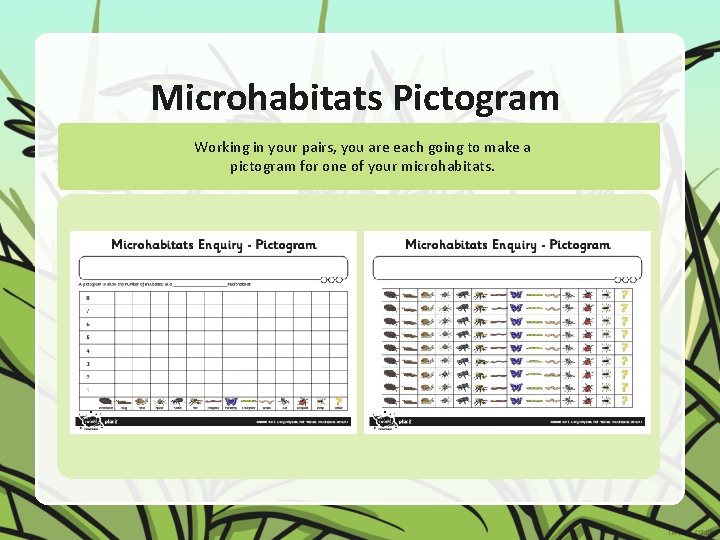
Microhabitats Pictogram Working in your pairs, you are each going to make a pictogram for one of your microhabitats.
Microhabitats Conclusion Work with your partner. Look at your habitat drawings and descriptions. What were your two microhabitats like? Look closely at both pictograms. Did your two habitats have different kinds of minibeasts? Can you suggest why?
Aim • I can identify animals in their habitats. • I can use information I have gathered to answer a question. Success Criteria • I can find microhabitats. • I can identify and name the minibeasts I find there. • I can record information about minibeasts in a table. • I can present my results in a pictogram. • I can use my findings to compare 2 microhabitats.
- Slides: 22