
Living things and their habitats Comparing the gestation
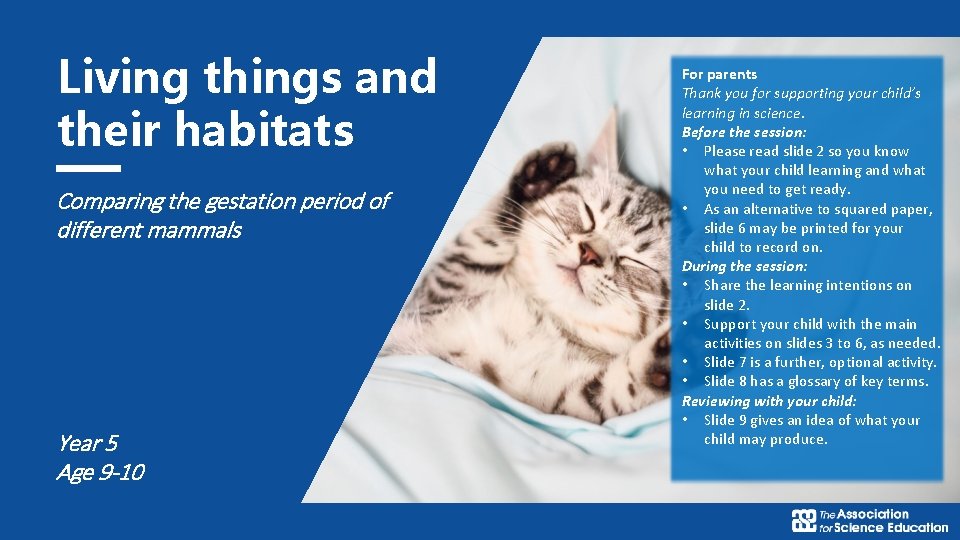
Living things and their habitats Comparing the gestation period of different mammals Year 5 Age 9 -10 For parents Thank you for supporting your child’s learning in science. Before the session: • Please read slide 2 so you know what your child learning and what you need to get ready. • As an alternative to squared paper, slide 6 may be printed for your child to record on. During the session: • Share the learning intentions on slide 2. • Support your child with the main activities on slides 3 to 6, as needed. • Slide 7 is a further, optional activity. • Slide 8 has a glossary of key terms. Reviewing with your child: • Slide 9 gives an idea of what your child may produce.
Logo for section to sit inside roundel Livings things and their habitats Comparing the gestation period of different mammals Key Learning Activities (pages 3 -6): 30 - 45 mins • Most animals reproduce sexually. This involves two parents where the sperm from the male fertilises the female egg. They produce offspring which grow into adults. • Use lined paper, squared paper, a ruler and pencil. • Alternatively, print page 6 as a worksheet. • Humans and most other mammals give birth to live young. • The time between egg fertilisation and giving birth is called the gestation period. Find out more… (page 7) I can… • compare the gestation period for different mammals and look for patterns. 2 • Find out about some mammals with more unusual life cycles.
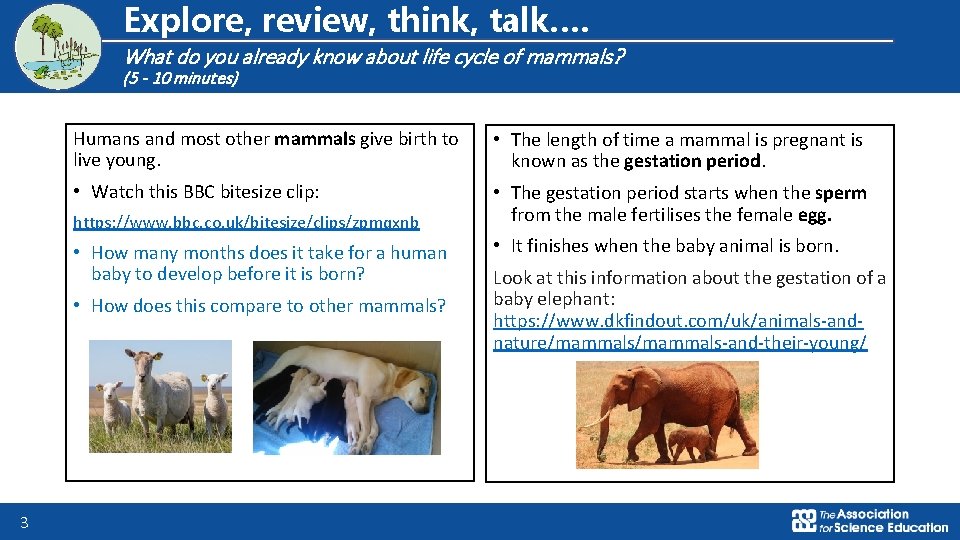
Logo for section to sit inside roundel Explore, review, think, talk…. What do you already know about life cycle of mammals? (5 - 10 minutes) Humans and most other mammals give birth to live young. • The length of time a mammal is pregnant is known as the gestation period. • Watch this BBC bitesize clip: • The gestation period starts when the sperm from the male fertilises the female egg. https: //www. bbc. co. uk/bitesize/clips/zpmqxnb • How many months does it take for a human baby to develop before it is born? • How does this compare to other mammals? 3 • It finishes when the baby animal is born. Look at this information about the gestation of a baby elephant: https: //www. dkfindout. com/uk/animals-andnature/mammals-and-their-young/ 3
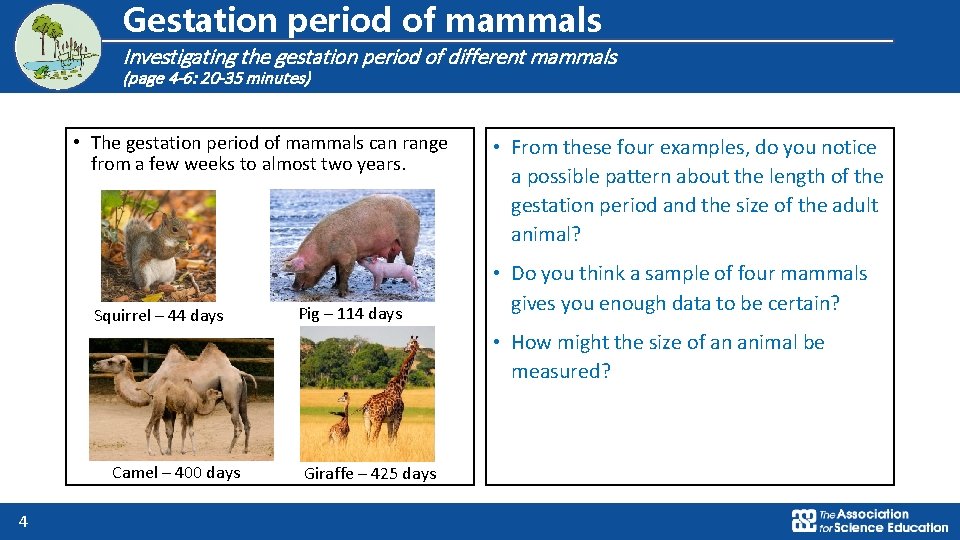
Logo for section to sit inside roundel Gestation period of mammals Investigating the gestation period of different mammals (page 4 -6: 20 -35 minutes) • The gestation period of mammals can range from a few weeks to almost two years. Squirrel – 44 days Pig – 114 days • From these four examples, do you notice a possible pattern about the length of the gestation period and the size of the adult animal? • Do you think a sample of four mammals gives you enough data to be certain? • How might the size of an animal be measured? Camel – 400 days 4 Giraffe – 425 days
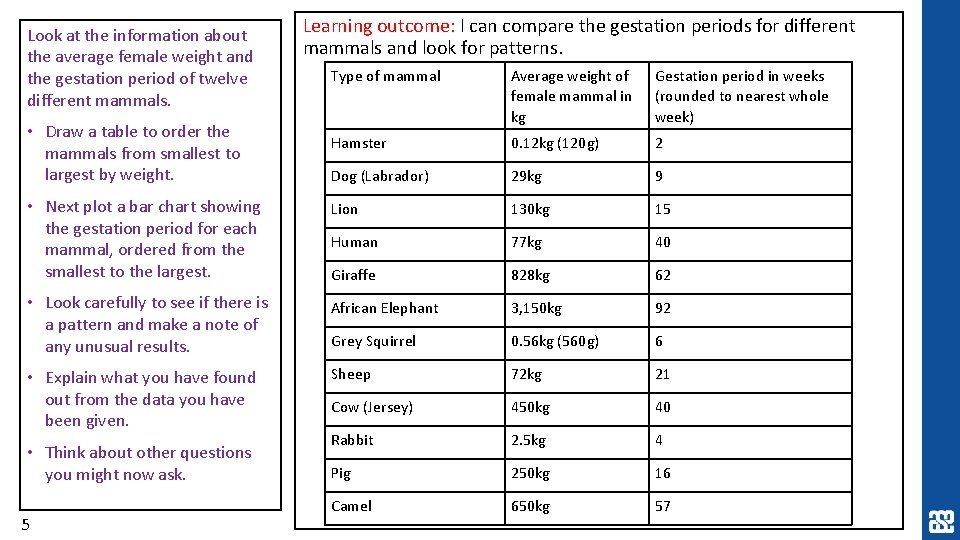
Look at the information about the average female weight and the gestation period of twelve different mammals. Learning outcome: I can compare the gestation periods for different mammals and look for patterns. Type of mammal Average weight of female mammal in kg Gestation period in weeks (rounded to nearest whole week) Hamster 0. 12 kg (120 g) 2 Dog (Labrador) 29 kg 9 • Next plot a bar chart showing the gestation period for each mammal, ordered from the smallest to the largest. Lion 130 kg 15 Human 77 kg 40 Giraffe 828 kg 62 • Look carefully to see if there is a pattern and make a note of any unusual results. African Elephant 3, 150 kg 92 Grey Squirrel 0. 56 kg (560 g) 6 • Explain what you have found out from the data you have been given. Sheep 72 kg 21 Cow (Jersey) 450 kg 40 Rabbit 2. 5 kg 4 Pig 250 kg 16 Camel 650 kg 57 • Draw a table to order the mammals from smallest to largest by weight. • Think about other questions you might now ask. 5
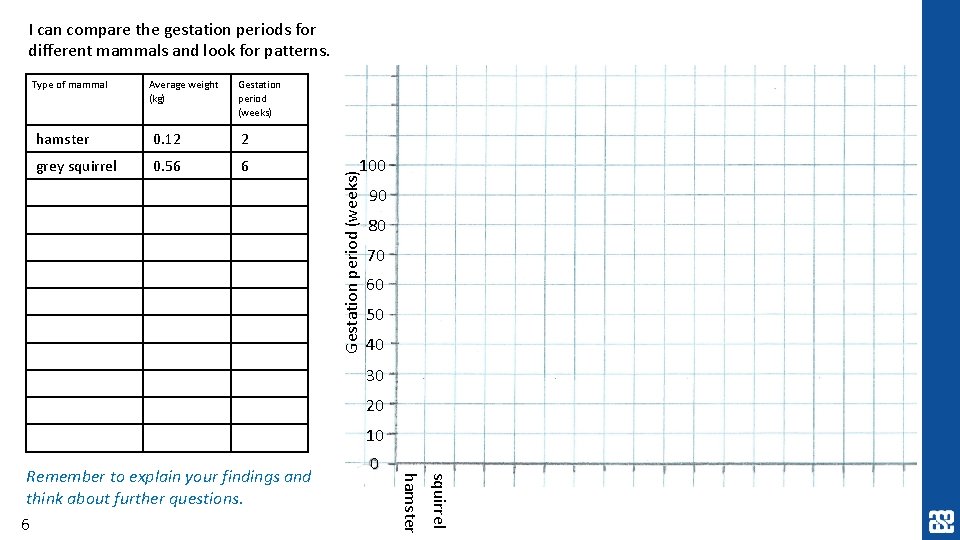
I can compare the gestation periods for different mammals and look for patterns. Average weight (kg) Gestation period (weeks) hamster 0. 12 2 grey squirrel 0. 56 6 100 Gestation period (weeks) Type of mammal 90 80 70 60 50 40 30 20 10 squirrel 0 hamster Remember to explain your findings and think about further questions. 6
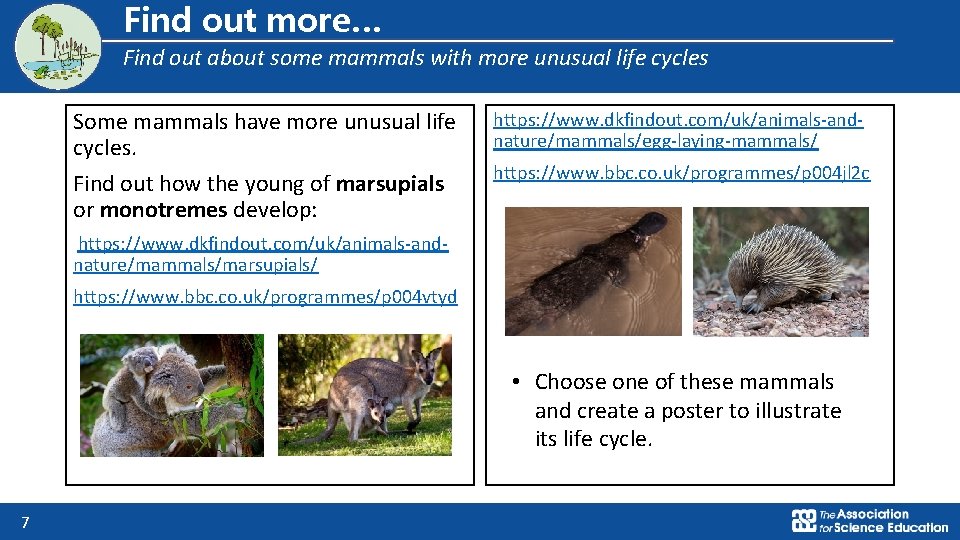
Logo for section to sit inside roundel Find out more… Find out about some mammals with more unusual life cycles Some mammals have more unusual life cycles. Find out how the young of marsupials or monotremes develop: https: //www. dkfindout. com/uk/animals-andnature/mammals/egg-laying-mammals/ https: //www. bbc. co. uk/programmes/p 004 jl 2 c https: //www. dkfindout. com/uk/animals-andnature/mammals/marsupials/ https: //www. bbc. co. uk/programmes/p 004 vtyd • Choose one of these mammals and create a poster to illustrate its life cycle. 7
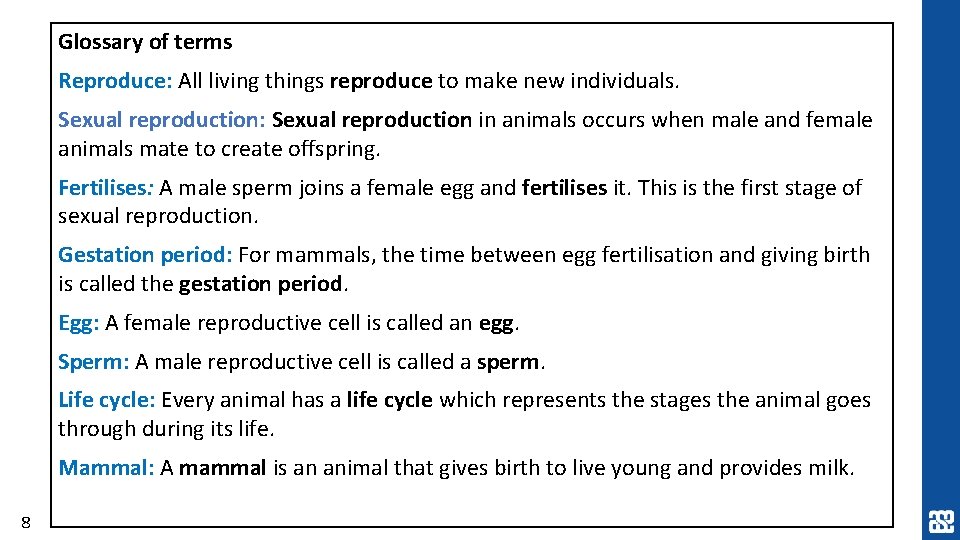
Glossary of terms Reproduce: All living things reproduce to make new individuals. Sexual reproduction: Sexual reproduction in animals occurs when male and female animals mate to create offspring. Fertilises: A male sperm joins a female egg and fertilises it. This is the first stage of sexual reproduction. Gestation period: For mammals, the time between egg fertilisation and giving birth is called the gestation period. Egg: A female reproductive cell is called an egg. Sperm: A male reproductive cell is called a sperm. Life cycle: Every animal has a life cycle which represents the stages the animal goes through during its life. Mammal: A mammal is an animal that gives birth to live young and provides milk. 8
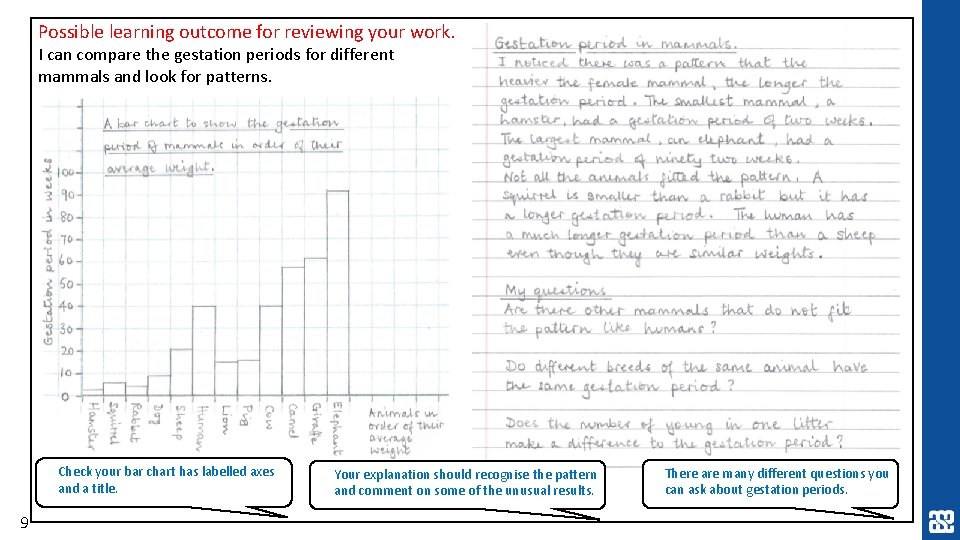
Possible learning outcome for reviewing your work. I can compare the gestation periods for different mammals and look for patterns. Check your bar chart has labelled axes and a title. 9 Your explanation should recognise the pattern and comment on some of the unusual results. There are many different questions you can ask about gestation periods.
- Slides: 9