
Living things and their habitats Classification of living
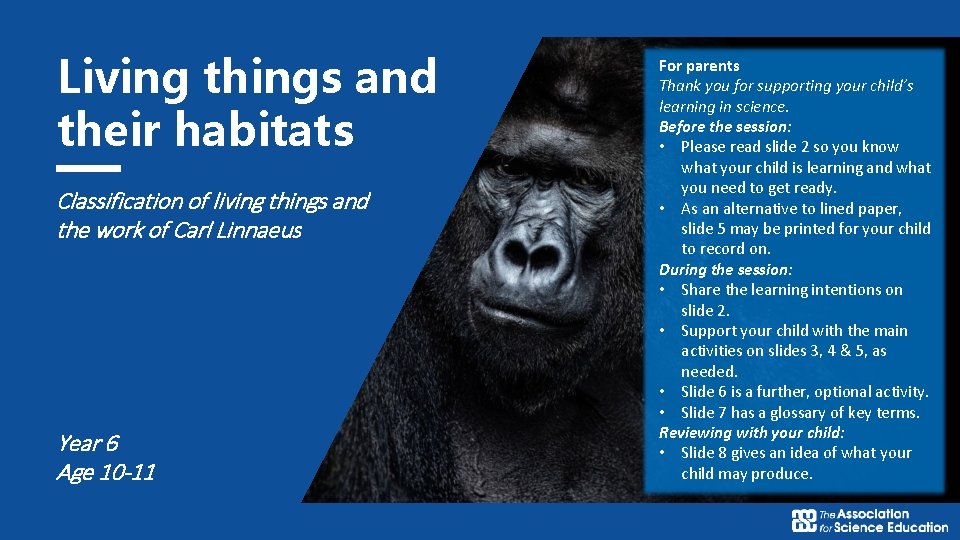
Living things and their habitats Classification of living things and the work of Carl Linnaeus Year 6 Age 10 -11 For parents Thank you for supporting your child’s learning in science. Before the session: • Please read slide 2 so you know what your child is learning and what you need to get ready. • As an alternative to lined paper, slide 5 may be printed for your child to record on. During the session: • Share the learning intentions on slide 2. • Support your child with the main activities on slides 3, 4 & 5, as needed. • Slide 6 is a further, optional activity. • Slide 7 has a glossary of key terms. Reviewing with your child: • Slide 8 gives an idea of what your child may produce.
Logo for section to sit inside roundel Living things and their habitats Classification of living things and the work of Carl Linnaeus Key Learning • Living things can be grouped according to characteristics. • The two main groups are animals and plants. • Other living things include fungi and microorganisms (such as mushrooms, yeast and bacteria). • Carl Linnaeus devised a formal classification system for all living things, which is still used today. Note to Year 6: Work your way through the slides. Activities (pages 2 -5): should take about 30 - 40 mins • Use lined paper, a ruler and a pencil. • Alternatively, you could print page 5 as a worksheet. By the end of the lesson: I can… • Group examples of animals, plants and fungi/ microorganisms. 2 Find out more… (page 6): 20 – 30 mins • Discussion and research.
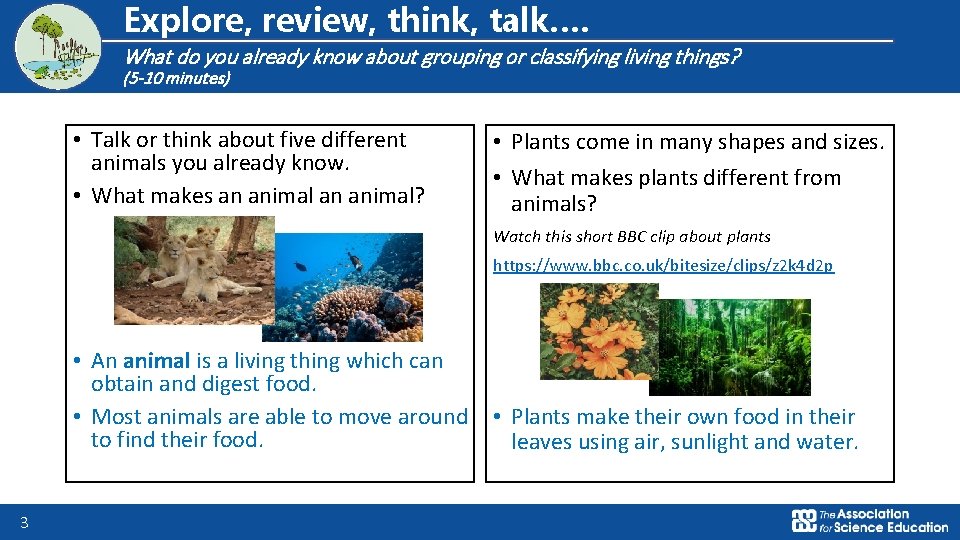
Logo for section to sit inside roundel Explore, review, think, talk…. What do you already know about grouping or classifying living things? (5 -10 minutes) • Talk or think about five different animals you already know. • What makes an animal? • Plants come in many shapes and sizes. • What makes plants different from animals? Watch this short BBC clip about plants https: //www. bbc. co. uk/bitesize/clips/z 2 k 4 d 2 p • An animal is a living thing which can obtain and digest food. • Most animals are able to move around to find their food. 3 • Plants make their own food in their leaves using air, sunlight and water. 3
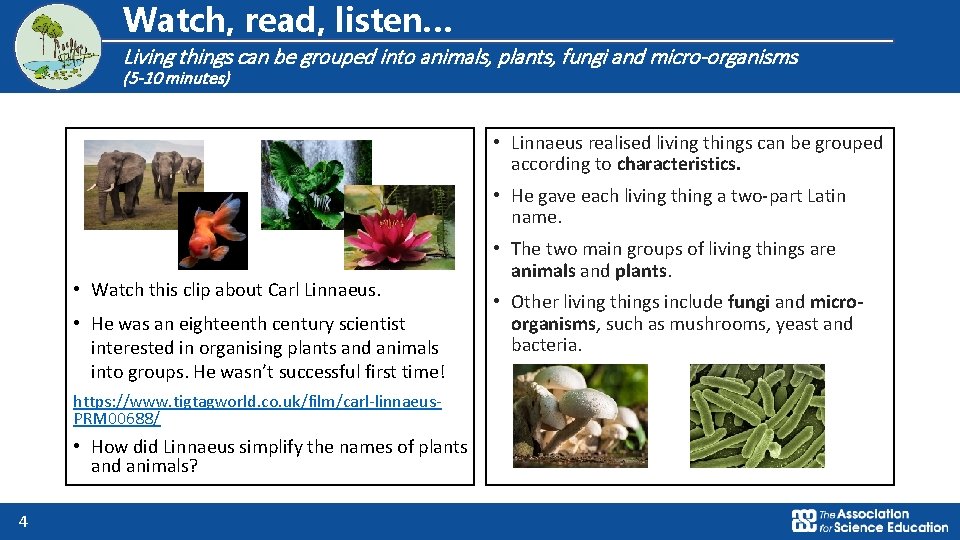
Logo for section to sit inside roundel Watch, read, listen… Living things can be grouped into animals, plants, fungi and micro-organisms (5 -10 minutes) • Linnaeus realised living things can be grouped according to characteristics. • He gave each living thing a two-part Latin name. • Watch this clip about Carl Linnaeus. • He was an eighteenth century scientist interested in organising plants and animals into groups. He wasn’t successful first time! https: //www. tigtagworld. co. uk/film/carl-linnaeus. PRM 00688/ • How did Linnaeus simplify the names of plants and animals? 4 • The two main groups of living things are animals and plants. • Other living things include fungi and microorganisms, such as mushrooms, yeast and bacteria.
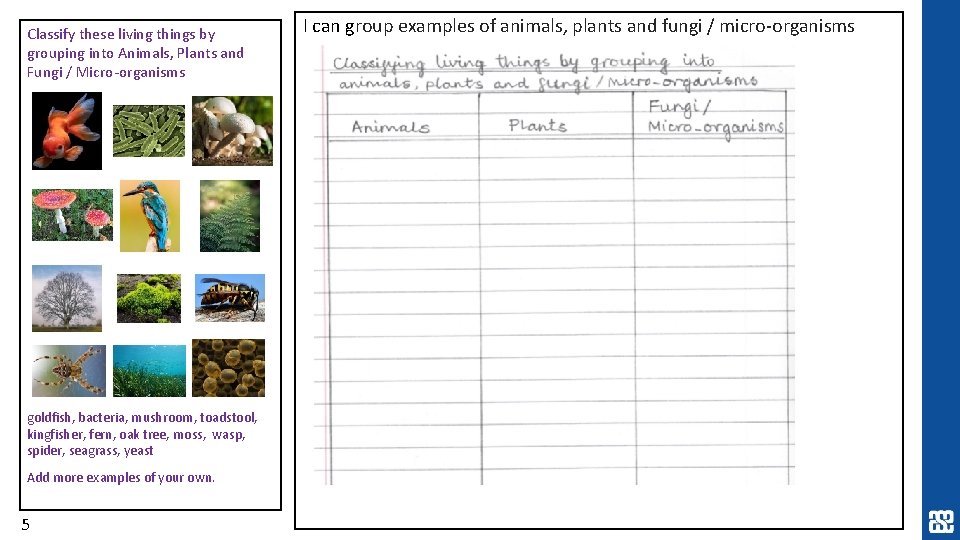
Classify these living things by grouping into Animals, Plants and Fungi / Micro-organisms goldfish, bacteria, mushroom, toadstool, kingfisher, fern, oak tree, moss, wasp, spider, seagrass, yeast Add more examples of your own. 5 I can group examples of animals, plants and fungi / micro-organisms
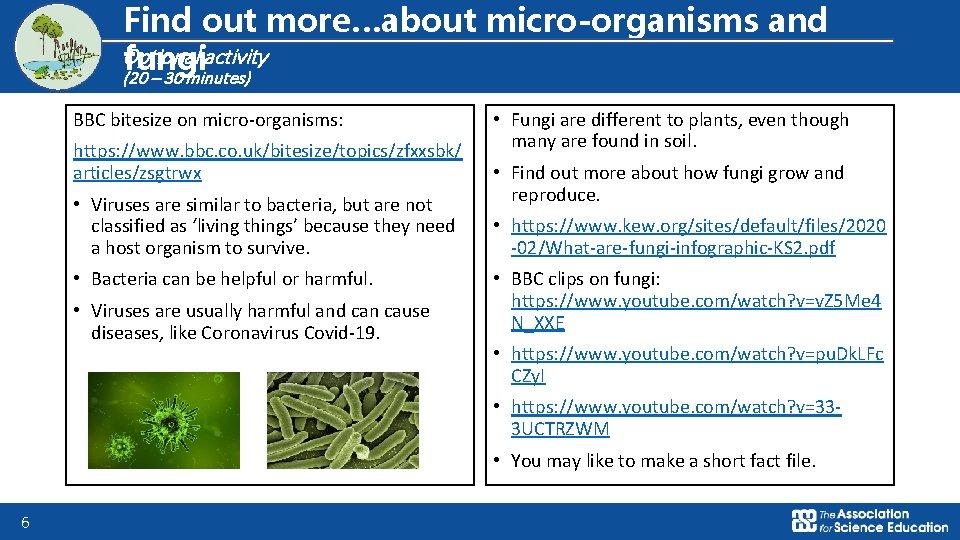
Logo for section to sit inside roundel Find out more…about micro-organisms and Optional activity fungi (20 – 30 minutes) BBC bitesize on micro-organisms: https: //www. bbc. co. uk/bitesize/topics/zfxxsbk/ articles/zsgtrwx • Viruses are similar to bacteria, but are not classified as ‘living things’ because they need a host organism to survive. • Bacteria can be helpful or harmful. • Viruses are usually harmful and can cause diseases, like Coronavirus Covid-19. • Fungi are different to plants, even though many are found in soil. • Find out more about how fungi grow and reproduce. • https: //www. kew. org/sites/default/files/2020 -02/What-are-fungi-infographic-KS 2. pdf • BBC clips on fungi: https: //www. youtube. com/watch? v=v. Z 5 Me 4 N_XXE • https: //www. youtube. com/watch? v=pu. Dk. LFc CZy. I • https: //www. youtube. com/watch? v=333 UCTRZWM • You may like to make a short fact file. 6
7 Glossary of terms Animal: An animal is a living thing which can obtain and digest food. Examples include fish, birds, insects, spiders and humans. Characteristic: Characteristics are features of living things which help scientists classify them. Classification: Classification is the method scientists use to group living things. Fungus: A fungus (plural fungi) is a living thing which breaks down dead matter around it, and uses it as food. Examples include mushrooms and toadstools. Micro-organism: Micro-organisms are small living things, including bacteria and yeast. Plant: A plant is a living thing which can make its own food. Examples include trees, ferns, mosses and flowering plants. Virus: A virus is sometimes called a micro-organism but it is not classified as a ‘living thing’ because it needs a host organism to survive.
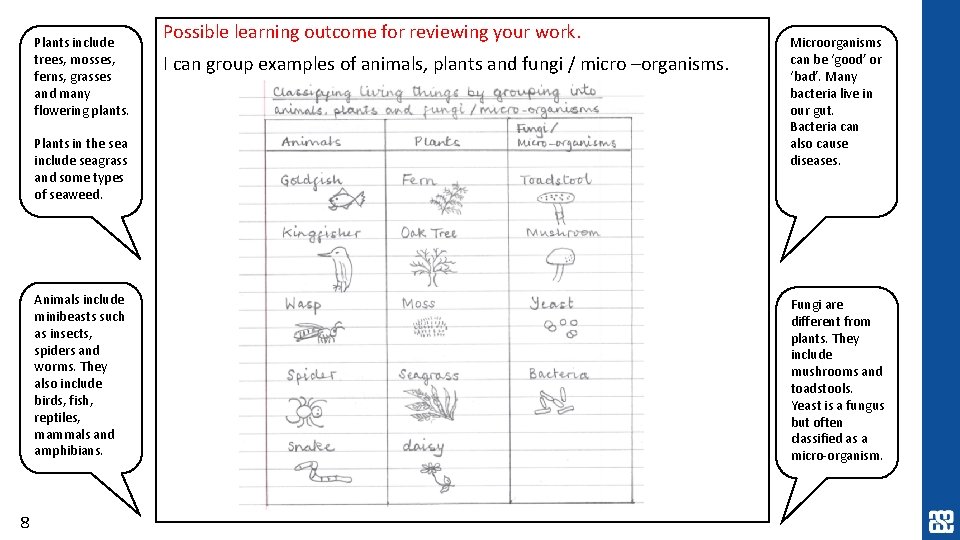
Plants include trees, mosses, ferns, grasses and many flowering plants. Plants in the sea include seagrass and some types of seaweed. Animals include minibeasts such as insects, spiders and worms. They also include birds, fish, reptiles, mammals and amphibians. 8 Possible learning outcome for reviewing your work. I can group examples of animals, plants and fungi / micro –organisms. Microorganisms can be ‘good’ or ‘bad’. Many bacteria live in our gut. Bacteria can also cause diseases. Fungi are different from plants. They include mushrooms and toadstools. Yeast is a fungus but often classified as a micro-organism.
- Slides: 8